Restif de La Bretonne Nicolas EdmeBiblio.com

162 résultats
1784046741Hague 1784. First Edition. Hardcover Full Leather. Near Fine Condition. Binet. 4 volumes in later half morocco over marbled boards. First collected edition of La Paysan and La Paysane Pervertis completely reset and edited - dated 1784 but did not appear until 1787. 16 parts in 4 volumes complete with 120 plates. Quite clean internally a few tiny tears in the outer margin scattered minor foxing. Very slight adhesion in the gutter between title and frontis. 542pp; 536pp; 552pp; 550pp with the two page stock list at the end of volume 4. <br /> <br /> "Rare and almost never found with the full suite of 120 engravings" Bibliographie et iconographie de tous les ouvrages de Restif de la Bretonne 250. Le Paysan Pervertis had been published in 1775 La Paysane in 1784 - this brings the two together for the first time. They are erotic novels with a moral compass - in contrast at least notionally to de Sade's Justine which de la Bretonne opposed with his novel Anti-Justine in 1798 or Juliette. Size: Octavo 8vo. 4-volume set complete. Illustrator: Binet. Quantity Available: 1. Shipped Weight: Under 1 kilo. Category: Literature & Literary; Erotica. Inventory No: 046741. hardcover
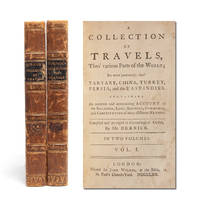
17625478London: John Wilkie 1762. First edition. With title page of volume II erroneously dated MDCCXII as called for by ESTC. Contemporary half calf over marbled boards measuring 168 x 100mm and collating complete: 20 338; 12 324. A square copy with joints professionally renewed; some chipping to spine labels and gentle shelfwear to boards. Faint dampstaining to lower corner of contents in volume I and paper loss to upper corner of pages 203-204 affecting 9 lines each. Volume II overall clean with long archivally reinforced tear to pages 131-132 and paper loss to lower corner of pages 171-172 with no text loss in either case. An exceptionally scarce fantastical travel narrative with erotic content published by notorious Grub Street writer and demi-monde ally Samuel Derrick. ESTC locates only three copies at institutions BL Columbia and UCLA and of the three copies to appear in the modern auction record the most recent was in 1941. The present is the only example on the market. <br /> <br /> In a 1763 review in The Critical Review or Annals of Literature vol. 15 Samuel Derrick's Collection of Travels is derided as a book for "those who read merely for amusement and care not for turning up the huge collection of voyages traveled by Purchas Churchill Astley Harris &c" due to its "total neglect of dates total want of maps a strange perversion of names a general lack of precision or accuracy." These same reviewers make a dismissive nod to how "the adventures of captain John Smith savour strongly of romance" and suggest that the work "does not seem to have been intended so much for serious reading as for pleasing the imagination" but they fail to grasp just how much this is the case. No matter how deeply Samuel Derrick sought to portray himself as a participant in London's intelligentsia he was ultimately a Grub Street hack who "wrote to eat" and not from "any great artistic urge" Rubenhold. Having learned early on that "hacks and whores shared much common ground" Derrick became not only a "gentleman defender" and friend to several of London's demi-monde he also used their escapades as inspiration for his writing and his writing to promote their reputations and services.<br /> <br /> Such is the case with the present work designed for stoking the reader's fantasies and for lining the author and publisher's pockets. Among "the period's richest funds of data erotica and pornography permeated the culture.and the 18th century bookshop" Pettit and Spedding. Works operating under the thin guises of travel law medicine politics history or religion presented readers across genders with graphic depictions not only of cis-gendered and heterosexual encounters but even more often with scenes that cenered queer polyamorous and female pleasure. In the case of Collection of Travels Derrick used preexisting popular travel narratives as the backdrop for his main work: depicting sexual behaviors common within London's sex trade but setting them within exotic locales. Within volume I for example his explorers encounter "the prostitution of the women of Camul and their hospitable reception of strangers" "the common use of women" in Thebet rites of "marriages of the people of Servia" and the "wives and concubines" of Constantinople including how they are valued how virginity is tried and how they are punished. The second volume builds on this including such content as the "courtezans of Persia" the "women lewd" of Turkey and "the usage of their wives" in Algiers. Given his own appreciation for the power of the sex workers in his own life -- notably Lucy Cooper Kitty Fisher and Charlotte Hayes -- he also includes a section on "the authority of the women in this country" of the Congo. <br /> <br /> One of Derrick's few stand-alone multi-volume works to be published and a rarity in the collecting areas of erotic literature and travel fiction. <br /> <br /> ESTC T135777. Not in the Register of Erotic Books. John Wilkie unknown
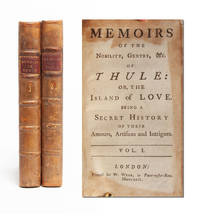
17425133London: Printed for W. Webb 1742. First edition. Bound to style in 19th century sheep with morocco and gilt to spines. Measuring 168 x 96mm and with occasional mispagination but collating complete: xxiv 300; 2 336. Some offsetting to preliminary and terminal leaves and occasional light foxing and marginal chips not affecting text; discreet archival repairs to short tear on pages 115-116 and long tear to 285-286 of volume I preserving all text. Early amateur cloth tape repair to recto of front endpaper to volume II. Pinholes to lower spines of both volumes with minor associated worming to the lower front hinges. A scarce example of early erotic literature centered on London's famous courtesans ESTC lists only 6 copies with institutions. The present copy aside the last example to appear at auction was in 1882. <br /> <br /> Published two years apart the two volumes of Memoirs of the Nobility are different in their approaches to London's elite including the infamous Great Impures who hosted the wealthiest men in their parlours and their beds. Volume I launches its readers into a thinly veiled satire wherein the protagonist Aloisa visits the mythical kingdom of Thule. During her tour on arrival Aloisa discovers a city of extreme decadence whose cast of characters would be familiar to most Londoners indeed the copy housed at the British Museum has contemporary annotations from William Cole denoting some of the avatars' real-life identities. "there was scarce a Thing as a Virgin of twenty Years of Age to be found in all the Island.all was flaming Lust; and from the Court to the Cottage all had their Share in amorous Intrigues." While sexual violence is rampant in Thule Aloisa's host the Chevalier Faire-Franc informs her of numerous girls assaulted and left pregnant by the son of the new Lord Chancellor for example much of the kingdom's activities center on the sex trade. Ambition and wealth drive residents "to get Money which at Night they as lavishly spend" at various houses of pleasure. In these descriptions readers visit the brothels of such real-life bawds as Mother Elizabeth Wisebourn here called Madona who dresses as a nun to recruit girls and uses medicine and magic to "restore" their virginity and continuously demand the highest prices -- a practice she infamously used to market her girls particularly Sally Salisbury and Sally Lodge before they rose to success in their own rights. Nearby Miss Edwards of Kensington possibly Kitty Fisher or Lucy Cooper resides "in open Fornication" yet "defies all Scandal." A string of famous men -- authors dignitaries and gentry -- are also exposed for their engagement with courtesans their elopements and their affairs. <br /> <br /> By volume II these details fade and the stories shift toward a more general erotic fantasy. But both notably participate in celebrating and expressing anxiety about the growing power of London's sex trade. With estimates of London's sex workers ranging widely from 8600-80000 it was undeniable that a vast portion of the population was engaged in sex-for-money whether as a provider or consumer Rogers. The money and public influence of courtesans like Kitty Fisher Lucy Cooper Sally Salisbury Sophia Baddeley Mary Robertson and others highlighted how women who defined traditional marriage economies could carve out their own wealth independence and community. <br /> <br /> ESTC T75813. Lowndes 2681. Not in the Register of Erotic Books. Printed for W. Webb unknown
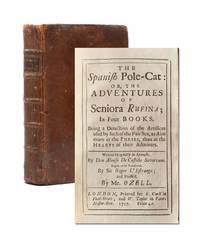
17175378London: Printed for E. Curll in Fleet Street 1717. First thus. Contemporary full calf with gilt label to spine. All edges speckled red. Measuring 155 x 90mm and collating complete including frontis and terminal advertisement: 4 394 2. Shelfwear to extremities and slight bowing to boards. Contemporary annotations to front pastedown and front and rear endpapers with portions of rear endpapers excised; rear pastedown neatly removed. Internally a clean copy with a long closed tear to pages 213-214 professionally repaired with no loss to text and brief examples of pencil marginalia to pages 237-38. A pleasing copy of a scarce erotic book which last appeared at auction over three decades ago and which ESTC lists at only 12 U.S. libraries. <br /> <br /> Drawn from a 17th century Spanish picaresque novel following the intrigues of the female rake Rufina Alonso de Castillo's La Garduna de Sevilla 1642 first appeared in English in 1665 as a romantic adventure translated by John Davies as La Picara or The Triumphs of Female Subtilty. By the time of this translation however Rufina's persona took a more overtly libertine turn as she was declared a "whore" even within the title i.e. "pole-cat". Published by unscrupulous bookseller and printer Edmund Curll the text has clear erotic rather than romantic implications. "A notorious figure among the publishers of the early eighteenth century for his boldness lack of scruple publication of work without authors' consent and taste for erotic and scandalous publications" Curll did not involve himself in the release of texts that aimed to educate men and women into socially dictated marital roles Baines and Rogers. Instead his version of the Rufina story revels in its heroine's sexual appetite and capitalizes on the popularity of the English demi-monde -- courtesans such as Kitty Fisher Lucy Cooper and Charlotte Hayes -- by making her a more exoticized iteration of the fantasy they presented to men and women alike. <br /> <br /> Positioned as it is outside the British Empire Rufina's narrative invites readers to engage at a slight distance with questions not only about her sexual agency or even the agency of courtesans but instead about the agency of women more broadly. As Kathleen Lubey has pointed out erotic works from this period positioned "decadent sexual description" within a much larger prose structure that "posed questions about social justice and elaborated on gender inequity"; indeed "pornographic prose fiction" such as The Spanish Pole-Cat "rethinks which people count as persons to what degree they can claim property in their own bodies and the correspondence of those bodies to social identity" What Pornography Knows. Capable of stimulating the senses of all readers physically and intellectually Rufina the female libertinism and the sex trade she invokes encourage excitement over what can happen when limitations are stripped away from certain portions of the population that don't in reality have the ability to move with such freedom.<br /> <br /> ESTC T89213. Not in the Register of Erotic Books. Printed for E. Curll in Fleet Street unknown
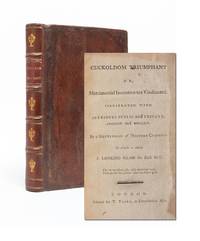
17715080London: Printed by T. Thorn 1771. First edition. Contemporary sheep recornered and rebacked to style with gilt and morocco to spine. Measuring 163 x 95mm. Collating 4 203 1 blank: complete with A Looking Glass beginning at page 146 with continuous register. Nineteenth century bookplate to front pastedown. Offsetting to outer margins of title and of pages 198-203 not affecting text; lower corner of dedication leaf neatly excised with no loss to text; marginal paper flaw to pages 45-46. Overall internally unmarked and clean. One of two equally scarce variants with no priority the other printed by J. Bird. ESTC reports only one surviving copy of each both of these held by the British Library of these only the Bird variant is digitized. Neither these first issues nor the later re-issue titled Cupid Turned Spy appear in the modern auction record. An exceptionally rare work. <br /> <br /> The widespread cultural assertion that men had control over their own fates led to equally widespread anxiety in the seventeenth and eighteenth century. Despite a preponderance of laws and traditions that privileged men and sought to subjugate women and queer peoples sex outside the boundaries of marriage undermined those systems. Few figures encapsulate this truth better than the cuckold. "Cuckolds were seen as being unable to satisfy and control their wives; as literary tropes "they are more often than not the target of derision to both their peers on the stage and the audience the theatre nearly universally to be greeted with laughter as they follow a predictable path of failure in marriage" Corcoran. As much as these figures assisted male audience members in projecting their fears onto allegedly weaker men they signify that complete control over women marriages and lines of inheritance isn't possible. The denial of women's agency does not equate the complete absence of women's agency.<br /> <br /> Women's sexual agency had become highly visible in key sectors of London society by the eighteenth century thanks in part to the rise of a famed generation of courtesans often called the "demi-monde" who dominated not only their own brothels and houses but also theatres opera houses and the court itself. Sex work more generally had become extremely common with studies estimating that anywhere from 8600 to 80000 citizens of the city were engaged in some level of the sex trade Rogers. In this atmosphere depictions of the cuckold shifted in some erotic works. Rather than symbolizing men's sexual failures the cuckold's acceptance of his position acknowledged and at times even celebrated women's sexual autonomy. If being cuckolded was inevitable as a result of women's equal participation in sexual desire then fault might not lie with the cuckold. Indeed being a cuckold may even have benefits when more conservative social judgment is set aside.<br /> <br /> Authored by the pseudonymous "Cornuto" -- a Latin joke naming the author after the cuckold's "horn" -- Cuckoldom Triumphant is dedicated to the gentry noting "the amazing encrease of antlers of late among the nobility whose customs the common people are so fond of copying which gives me the pleasing promise of cuckoldom's becoming universal." Indeed the author notes cuckoldom is inevitable and each must choose his own reaction to the state. To that end "this work is intended to comfort the afflicted and confirm the contented among those who are married as well as prepare the unmarried for the happy state of cuckoldom." In what follows the author provides readers with a sensational erotic story following the awakening of Mrs. Latitat to the pleasures of extramarital sexuality as well as her husband's transformation from jealous resistance to acceptance and contentment within a more peaceful marital state. <br /> <br /> ESTC T62268 T226126 for the J. Bird variant. Register of Erotic Books 1197 for a later issue re-titled Cupid Turned Spy. Printed by T. Thorn unknown
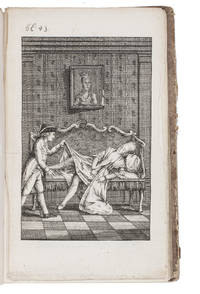
1770ACGGGLIF1Z51The Netherlands 1770. 8vo. Contemporary red half roan sheepskin gold-tooled spine. With an illustration on title-page built up out of cast ornaments and 4 engraved plates. 2 184 pp. Second copy located of the first and only edition of "Confessions of a libertine" an 18th-century Dutch picaresque erotic novel in which the principal narrator Karel tells his fiancée Charlotte about his promiscuous past. The story starts with how his father met his mother Julia in the monastery where he grew up in. Julia was the 17/18-year-old daughter of the abbot who was "taught" all about sexuality by her father at an early age. The abbot passed away soon after Karel's father left for the army and was replaced by a 45-year old Franciscan monk who took turns with both mother and daughter. The situation became unsustainable because of the mother's jealousy of her daughter causing Julia to flee to her lover; Karel was conceived the following night. The life of Karel's parents gives a glimpse of the story that follows often taking place in a religious environment. The novel does not only detail the sexual encounters however but also provides arguments for free morals for instance pointing out that our ancestors just followed their nature without being obstructed by any morals. Novels like this have been neglected for about two hundred years and only in the last decennia interest has been revived.With bookplate and owner's inscription. The plate facing page 43 loosely inserted but otherwise in very good condition. Spine slightly rubbed and colour of the paper sides faded but still firm and otherwise good.l Buijnsters Ned. lit. achtiende eeuw pp. 108-109; Buisman 132 1 copy; Gay & Lemonnyer I col. 374; Leemans Het woord is aan de onderkant p. 225; NCC same copy; STCN same copy; Waller 226 same copy; WorldCat & KVK same copy; not in Ashbee Centuria II pp. 346-354; Kearney The private case ; Muller; Rose Register of erotic books; Scheepers; De Vries. unknown
18003174241800. 38 mounted lithographs including 2 duplicate plates 1 with handcoloring. Oblong 4to. Early 19th century French purple morocco stamped to neo-Gothic panel design in blind and gilt initials "C D" on upper cover a.e.g. Skillfully rebacked preserving original spine. 38 mounted lithographs including 2 duplicate plates 1 with handcoloring. Oblong 4to. A collection of French erotic lithographs in an ornate romantic binding. Includes a series of 17 lithographs "Le départ de la garnison" "L'Antichambre en goguette" "Ah! Le bon bouillon que j'aurai" etc. Provenance: bookplate of Gérard Nordmann lhis sale Christe's Paris 27 April 2006 lot 218 unknown
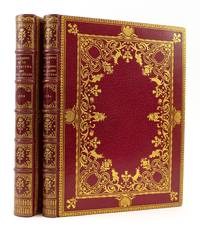
1780ST17950Caprées i.e. Nancy: Chez Sabellus 1780 1784. FIRST EDITIONS FIRST PRINTINGS 11 lines on title page and long "s" in text with these Illustrations. 256 x 190 mm. 10 x 7 1/2". Two volumes. <br/> BEAUTIFUL 19TH CENTURY RED MOROCCO GILT IN THE ROCOCO STYLE BY CUZIN stamp-signed in gilt on front turn-ins covers with a gilt-ruled border featuring rocaille motifs at the sides and a floral spray at each corner elaborate inner frame of strapwork interwoven with scrolling acanthus drawer-handle tools flower garlands and several special tools including satyrs mountain goats insects and large vases of flowers raised bands compartments with gilt lettering or a central floral sprig surrounded by a frame of leaves and flowers turn-ins with intricate gilt lace roll-tooling all edges gilt. WITH A TOTAL OF 102 EROTIC PLATES by Denon each volume with a frontispiece and 50 plates plus an engraved title in volume II. Front pastedowns with ex-libris of Léon Gambetta. Cohen-de Ricci 474-75. ◆Light offsetting from illustrations paper in both volumes perhaps lightly pressed but not washed FIRST VOLUME with the faint stain from a ribbon marker now gone one plate slightly toned and with two very small repairs to margin otherwise IN FINE CONDITION; paper in volume II slightly toned and with occasional small spots and light stains but still excellent. None of this significant because THE GLORIOUS BINDINGS LUSTROUS AND UNWORN.<br/> <br/> Despite their scholarly titles which promise scenes from the private lives of the 12 Caesars and secrets from an ancient Roman cult these are among the most famous erotic books of the 18th century. In the first volume the 12 Roman emperors from Julius Caesar to Domitian are depicted engaged in a panoply of intimate acts beginning with Julius Caesar's liaison with King Nicomedes IV of Bithynia which led his enemies to dub him "Queen of Bithynia." We see what Caesar's heir Augustus was willing to do in order to succeed his great-uncle and his later sexual excesses as emperor including incest. Antony and Cleopatra are relatively demure compared to the orgies of Caligula Nero and Claudius' wife Messalina. The "Secret Cult of Roman Women" examined in the companion work is devoted to the fertility god Priapus and his phallic symbols with guest appearances by assorted satyrs nymphs and Bacchantes. The images are white-on-black to resemble sculptured wall medallions and claim to be based on ancient carvings; however Cohen-de Ricci informs us that while the text is evidence of d'Hancarville's erudition the illustrations are entirely the result of his libertine imagination. Art historian Pierre-François Hugues Baron d'Hancarville 1719-1805 established himself in the world of antiquarians when he helped William Hamilton acquire the impressive Porcinari collection of Etruscan Greek and Roman antiquities that would subsequently be purchased by the British Museum. He then supervised the production of four sumptuous volumes of engravings documenting the collection. He seems to have undertaken the present work for his own amusement. A later issue of the second title facetiously attributed publication to the Imprimerie de Vatican the Church had of course put it on the Index of Prohibited Books. According to Cohen-de Ricci this is the first and most desirable printing identifiable by 11 rather than 10 lines of text on the title page of the first work and by the use of the f-like "long s" in both volumes. The especially splendid bindings by Francisque Cuzin 1836-90 nod to the Rococo bindings of the 18th century and to the risqué subject matter with satyrs cavorting about the elegant frame. Cuzin opened his Paris workshop in 1855 and soon made his name among bibliophiles of that city with his exquisite bindings establishing what was called the "Cuzin style." Devauchelle says that this style was copied by Cuzin's colleagues but was never equalled. Cuzin was not a gilder but employed some of the best in the trade to execute his graceful designs among them Marius Michel père Wampflug Maillard and Cuzin's eventual successor Émile Mercier. Our copy was once in the library of the distinguished French statesman Léon Gambetta 1838-82 one of the founders of the Third Republic who served as president of the Chamber of Deputies. Chez Sabellus unknown