17 résultats
178471111784 À cent lieues de la Bastille 1784. In-8, broché, titre+1 ff épitre+1 ff discours, 131 pp pages, Couverture d'attente de l'époque, . Exemplaire à grandes marges non rognées.une mouillure très claire sur les premières pages. .
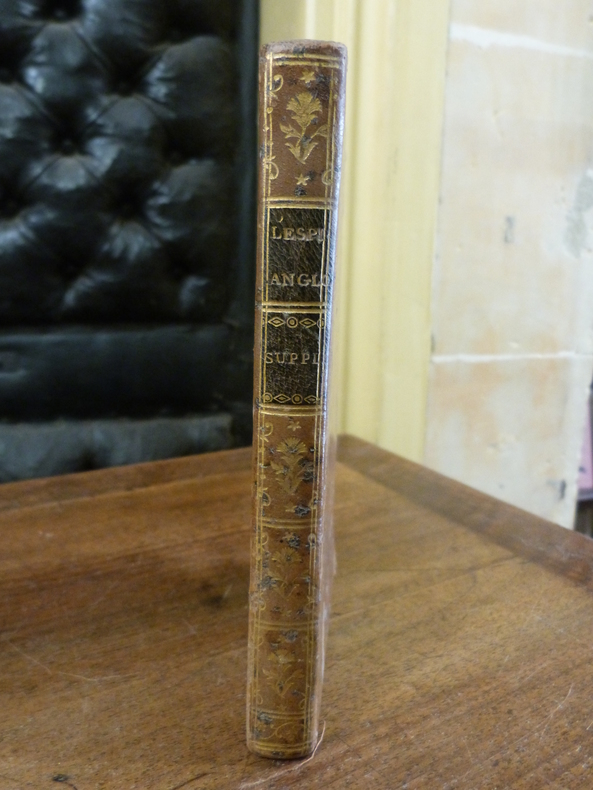
1781DEZ-8384Londres, John Adamson, 1781. In-12, pleine basane époque, dos lisse orné orné de fleurons et de filets dorés, titre doré, toutes tranches marbrées. 222 pp. Edition originale, pamphlet anti-anglais (cf Barbier IV, 586). Frottements sur les plats, petite épidermure au plat inférieur. Intérieur frais.
1726ARC-113963Ratisbone, 1726. Héritiers de Matthias Kerner, 3 volumes in-12, Tome1 : 5 feuillets non chiffrés, xxxvi, 464 pages et 14 feuillets non chiffrés Tome 2 : 3 feuillets non chiffrés, 522 pages et 19 feuillets non chiffré Tome 3 : 2 feuillets non chiffrés, 596 pages et 17 feuillets non chiffrés et Avis au relieur. Veau brun, dos à nerfs orné, pièce de titre et de tomaison en maroquin rouge (reliure postérieure).
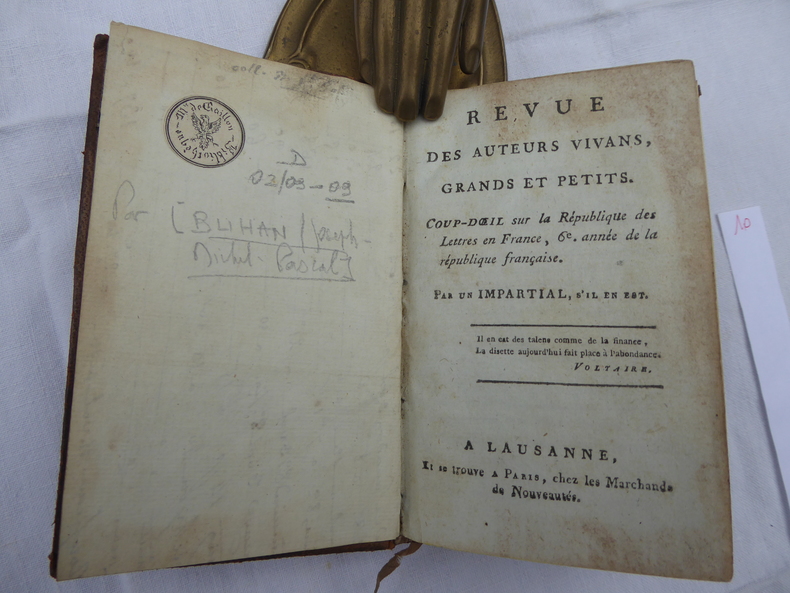
1798DR10Lausanne et Paris, Chez les Marchands de Nouveautés, sans date (1798). In-12, sans faux-titre, (1)f.[titre]-II-86pp., basane flammée ocre, dos lisse à faux-nerfs et fleurons dorés, pièce de titre bordeaux, encadrement doré sur les plats (reliure de l’époque ; manque à un mors, rongement sur le plat supérieur , coins usés ; à l’intérieur , quelques marges brunies au début et en fin d’ouvrage).
17899495(Paris), Imprimerie de Valleyre l'aîné, s.d. (circa 1789) ; in-8, broché ; 6 pp.
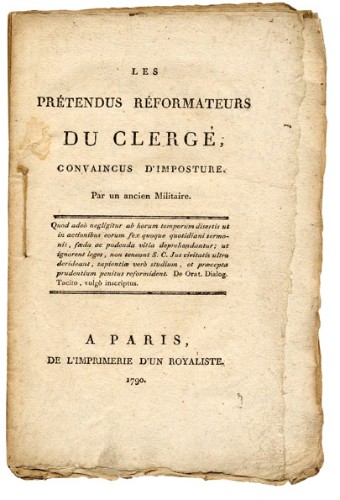
179011282Paris, Imprimerie d'un Royaliste, 1790 ; in-8, broché ; 59 pp.
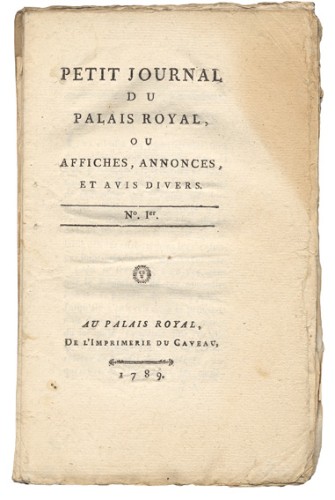
178911113Au Palais Royal, de l'Imprimerie du Caveau, 1789 ; in-8, broché ; N°1, 4, 5, 6 sur les six numéros parus au total (32 ; 19 ; 24 ; 28 pp.).
173385126, 1733-1736, in-4, 8-8 p, Demi-toile chagrinée noire postérieure, titre doré en long, Réunion de deux pamphlets démontrant la posture des autorités médicales et religieuses à propos des miracles et des possessions : le premier, relatif aux convulsionnaires, a été produit l'année de l'interdiction des réunions sur la tombe de François de Pâris ; le second copie une pièce produite en 1662 au sujet des possessions des Ursulines d'Auxonne. 1. La Lettre d'un confesseur [...] (sans nom, ni lieu. Datée du 25 mars 1733) pose la question de la responsabilité des médecins face aux miracles et convulsions opérés au cimetière de Saint-Médard de Paris et de leur rôle à déterminer s'il s'agit de réalités ou supercheries. Le médecin Philippe Hecquet (1661-1737) publia la même année une Réponse à cette lettre, plus connue et moins rare. 2. Le Jugement [...] sur la prétendue possessions des filles d'Auxonne (Suivant la copie imprimée à Châlons-sur-Saône, 1736) rapporte l'opinion des médecins et ecclésiastiques (archevêque de Toulouse et évêques de Rennes, Rodez et Châlons-sur-Saône) sur le cas des possessions démoniaques survenues dans le couvent des Ursulines d'Auxonne près de Dijon entre 1658 à 1663. Ce jugement fut fait à la suite de la visite, en 1661, de l'évêque de Chalon-sur-Saône. À l'instar du couvent de Loudun, trente ans auparavant, le couvent d'Auxonne fut le théâtre de retentissantes possessions diaboliques de 1658 à 1663. Avec force tapages, délires et convulsions, les religieuses se disaient habitées par les démons ; l'épidémie se rependit sur la ville, et des femmes laïques, jugées responsables, furent condamnées au bannissement ou massacrées par la population. En octobre 1660, la soeur de Sainte-Colombe, Barbe Buvée, fut accusée de magie, de sortilège et d'infanticide et, reconnue comme la principale coupable, mise aux fers au couvent, avant d'être innocentée quelques mois plus tard par le parlement de Dijon (Calmeil, De la Folie.., 1845, t. 2, p. 132 : cite cette pièce). Couverture rigide
1789200553Au Grelot, chez Momus, imprimeur des maniaques, 1789, in-8, 70 pp., broché, sans couverture.
17887781788 Londres [Paris ?], sn, 1788. 23 x 14 cm, in-8, 206 pp., broché, couverture muette d'attente, tel que paru.
178815506Paris 1788 -in-8 plaquette brochée petit in-octavo (booklet in-octavo), fausse couverture muette bleu-gris (blue-grey false cover without text), toutes tranches rouges (all red edges), sans illustration (no illustration),sur papier vergé bleuté (blue paper), 1 page d'épître dédicatoire signée (a page of dedicatory epistle signed) Le Jay.Champcenets . Rivarol + 35 pages, 1788 à Paris - rue de l'Echelle,
1786129101786 un volume, reliure demi-velin in-octavo havane à coins (binding half calfskin in-octavo with corners), dos à nerfs (spine with raised bands) décoré or (gilt decoration) avec manque de dorure (lack of gilt) et à froid (blind-stamping decoration), entre-nerfs à fers spéciaux (between the raised bands specials blocking stamps), titre frappé or (gilt title), filets or ( gilt line), coiffe inférieure abîmée ( tail of the spine faded), papier marbré aux plats (cover with marbled paper), charnière fendue (cracked joints) et coins écornés (corners dog-eared), toutes tranches lisses (all smooth edges) peignées (all painting edges) rouges et bleues (all blue and red edges), marque-page en tissu (bookmark in tissue), orné d'un portrait hors-texte (full page engraving) en noir de "l'auteur et son ane" (page 277) par Figaro delinéavit et Gu-tien-gu Sculptsit et orné de culs-de-lampe (illuminated of tailpieces) in-texte en noir, de la page 27 à la page 304, 1786 Pampelune Chez Démocrite, Imprimeur-Librairie de son allégresse Sérénissime Falot Momus, au grelot de lafolie Editeur,
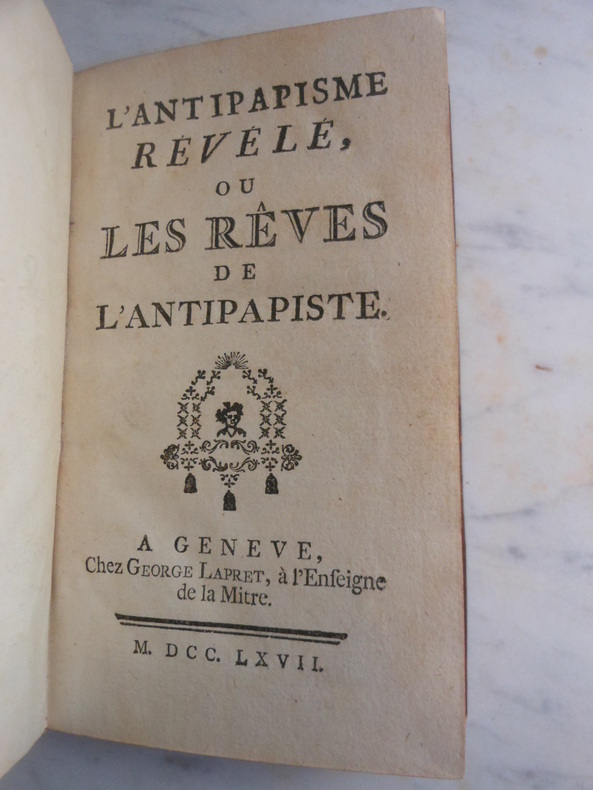
1767427à Genève, chez George Lapret, à l'Enseigne de la Mitre, 1867.
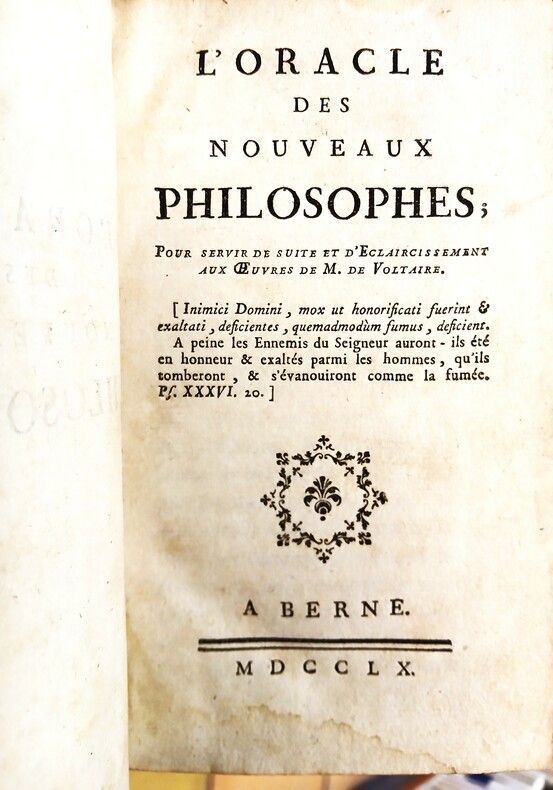
1764001R83Various publishers including . Paris &/or Geneva: -1769. 1764 Fourteen 14 Rare French Literary Pamphlets in two volumes. All 8vo. 205 mm. Leather backed marbled boards very slightly worn. Hardbound. Text in fine condition; some offsetting from the engravings. Contents include: Vol. I - 1. LETTRE AMOUREUSE D'HELOISE A ABAILARD. Translation of: Eloisa to Abelard by Alexander Pope. New Edition corrected by the autor. Chez la veuve Duchesne Paris: 1766. 30 p. large engraving by Eisen; Engraved headpiece by Colardeau. 2. LETTRE DE DON CARLOS A ELISABETH SUIVIE DUN PASSAGE DE L'AMINTE DU TASSE TRADUIT EN VERS & Du Poeme De La Nuit imite de Gesner. Panckoucke Paris & Duchesne Lille: 1768. pp. VIII 29 Gravelot engraved plate. 3. LETTRE DE JULIE FILLE D'AUGUSTE A OVIDE. By Claude Dorat. A Geneve Et se trouve a Paris: Chez Bauche: 1766. 23p. With Engraved head and tail pieces by Eisen and Massard. 4. LETTRE D'OVIDE A JULIE PRECEDEE DUNE LETTRE EN PROSE A M. DIDEROT. By the Marquis de Pezay. Geneva: 1767. 32p. Full page engraved plate and vignettes after Eisen. 5. LETTRE DE SAPHO A PHAON Precedee d'une Epitre a Rosine D'une vie de Sapho & suivie d'une Traduction en Vers des Ouvrages de ce Poete. By Blin de Sainmore. Sebastien Jorry Paris: 1766. 32 p. Engraved plate by Aliamet after Gravelot; Vignettes by Ghendt after Eisen another by Choffard. 6. LETTRE DE CATON D'UTIQUE A CESAR. By Abbe Parmentier. Lambert Paris: 1766. 34 p. Engraved plate after Gravelot. 7. LETTRE D'ALCIBIADE A GLICERE: Bouquetiere d'Athenes suivie d'une Lettre de Venus a Paris et d'une Epitre a la Maitresse que J'Aurai. By Marquis de Pezay. S. Jorry Geneva & Paris: 1764. 36 p. Large engraved plate and vignettes by Eisen. Vol. II - 1. LETTRE DU COMTE DE COMMINGES A SA MERE: Suivie d'une Lettre de Philomele a Progne. By Claude-Joseph Dorat. S. Jorry Paris: 1764. 68 p. Two full page engravings vignettes by Eisen & Massard. 2. L'HEUREUX JOUR EPITRE A MON AMI. By le Parquis de Pezay. Duchene Paris: 1768. pp. 29 1. Engraved title full page engraving & vignettes by Eisen & Massard. Cohen p. 797. 3. LISLE MERVEILLEUSE. Poeme en Trois Chants Traduit du Grec Suivi d'Alphonse ou de l'Alcide Espagnol Conte tres Moral. By C. J. Dorat. Geneva: 1768. 85 p. Engraved plate after Eisen. 4. L'HOPITAL DES FOUS Aesculapius - or The Hospital of Fools by William Walsh. A Play translated by De La Flotte. Jorry Paris: 1765. Large plate head-piece and tail-piece engraved by Delafosse after Eisen. Two lines of French manuscript about Fools. 5. EXTRAIT DE QUELQUES PIECES PRESENTEES A L'ACADEMIE FRANCOISE Pour concourir au Prix de poesie de L'Annee 1766. Regnard Paris: 1766. 27 p. 6. EPITRE AUX MALHEUREUX Piece qui a Eu L'Accessit du Prix de l'Academie Francois 1766. par M G.-H. Gaillard. Paris Regnard: 1766. 10p. 7. EPITRE A UN AMI SUR LA RECHERCHE DU BONHEUR. Cette Piece a concouru au Price de l'Academie Francois 1766. par M.D. Avocat au Parlement Cuissart & Regnard Paris: 1766. 19p. Small circular stain on first 10 pages. This collection is sometimes found with the texts in a different order and with different pagings and signatures and/or with one or more pieces omitted. There are often different printers and publishers where identified. The artists and engravers were among the best of this great era in illustration: Charles-Dominique-Joseph Eisen 1720-1778; Charles-Pierre Colardeau 1732-1776; Hubert Francois Gravelot 1699-1773; Jacques Aliamet 1726-1788; Jean Francois Rousseau; Emmanuel Jean Nepomucene de Ghendt 1738-1815; Joseph de Longueil 1730-1792; Jean Massard 1740-1822; Pierre-Philippe Choffard 1730-1809. A classic of 18th century French book illustration. CHEST 2/1. Hardcover. Very Good. Various publishers, including . Paris &/or Geneva: -1769. hardcover
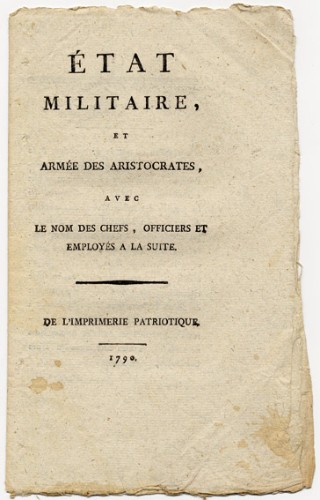
179011114De l'Imprimerie Patriotique, 1790 ; in-8, broché ; 8 pp.
1759ST19900Philadelphia and Germantown: Benjamin. Franklin and David. Hall or Christopher Sower 1759-60. 192 x 130 mm. 7 1/2 x 5". 1 p.l. collection title 47 1 71 4 76-168 iv 5-43 1 55 1 64 16 pp. <br/> Contemporary blind-ruled sheep nicely rebacked to style raised bands. Verso of front flyleaf inscribed in ink in the recipient's hand: "This Book is the Gift of Mr. Anthony Benezett sic to William Anderson October 14th 1760"; front pastedown with ink inscription: "The holy Book To Be Read"; title page with signature of William Anderson dated 1760; front flyleaf and both free endpapers with additional 19th century owner inscriptions. Miller 730; Smith Friends' Books I p. 240. For "Observations": Sabin 4676; Evans 8542. Boards a little dried and scuffed with a couple of small stains text variably toned because of colonial paper quality perhaps a fifth of the text rather browned dampstaining in the upper margin in the middle part of the volume mostly unobtrusive but darker and extending downward on a few leaves. The texts in the kind of problematic condition expected with early American imprints but the binding much better than is normally seen.<br/> <br/> This is a presentation copy of an important published collection of Quaker texts that includes four works printed by Benjamin Franklin as well as an early significant abolitionist tract that delivers a powerful condemnation of the slave trade. The collection title page lists nine tracts in total six of which were issued with separate title pages comprising: "An Extract from the Spirit of Prayer" by W. Law; "A Discourse on Mistakes concerning Religion" by Thomas Hartley; "Christ's Spirit or a Christian's Strength" "The Stumbling Stone" "The Doctrine of Baptism" and "The Trial of Spirits" all by William Dell; "The Liberty of Flesh and Spirit Distinguished" by J. Rutty; and "Observations on Enslaving Importing and Purchasing of Negroes &c." followed by "The Uncertainty of a Death-bed Repentance" both by Anthony Benezet. Miller asserts that "the first fifth sixth and seventh had previously been printed by Benjamin Franklin and David Hall all in Caslon type. The remainder had been printed by Christopher Saur who owned no Caslon letter." The volume title also in Calson type is attributed to the press of Franklin and Hall for the same reason. According to Miller Anthony Benezet put together this collection of Quaker material in the spring of 1760 in an edition of 500 copies with the hope of reaching those living "in ye back Parts of Maryland Virginia & N. Carolina . . . and Connecticut." First printed in 1759 Benezet's forceful denunciation of the slave trade is notable for using eyewitness accounts from people actually involved with the trade recounting the horrific practices and conditions that were realities of the system. Citing various lines of scripture Benezet argues that slavery runs contrary to Christian teachings and Mosaic law and that those who purchase and keep slaves bear as much guilt as the traders themselves. Born in France to Huguenot parents Benezet 1713-84 was a Quaker abolitionist educator and writer who became one of the earliest and most outspoken advocates against slavery in colonial America. He emigrated to Philadelphia by way of Rotterdam and London in 1731 where he founded Pennsylvania's first secondary school for girls and later opened one of the first schools to welcome black students. ANB says that "Although Benezet is recognized as the most prolific antislavery propagandist of the eighteenth century throughout his lifetime he supported and wrote about a wide variety of causes and topics including assistance for Acadian refugees temperance peace fair treatment of Native Americans religion educational reform and poor relief." His wife Joyce Benezet d. 1786 née Marriott was a preacher in the faith herself. According to Waldstreicher Franklin maintained a "lifelong friendship with Quaker politicians merchants and scientists. . . . He admired Quakerism because of its affirmation of simplicity frugality anti-slavery and humanitarianism." Franklin also saw the possibility of profit in printing for the considerable Quaker population of his colony. Hall 1714-72 came to Philadelphia from London in 1744 to work for Franklin and became a partner in the firm in 1748. As a considerable mark of his regard for Hall Franklin drew up a contract whereby his partner would over an 18-year period buy him out. It is a further sign of Franklin's regard for Hall that the printer is buried beside Franklin and his wife. As to contemporaneous provenance we can speculate with some degree of certainty that our William Anderson was the person of that name who was a Quaker preacher from Haverford near Philadelphia. His wife Margaret--like Benezet's wife Joyce--was also a preacher and these two husband-and-wife teams are dealt with in Rebecca Larson's "Daughter of Light: Quaker Women Preaching and Prophesying in the Colonies and Abroad 1700-1775" 1999 Appendix 2. . B[enjamin]. Franklin and D[avid]. Hall or Christopher Sower unknown