7 résultats
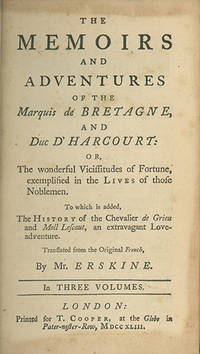
174328470London: Printed for T. Cooper 1743 1743. The second edition but first London of the first English translation of The Memoirs and Adventures of the Marquis de Bretagne and the History of the Chevalier de Grieu and Moll Lescaut preceded only a Dublin edition of 1741 printed "for the translator.". ESTC N10511 locates seven copies Advocates Library BL Columbia Harvard Huntington NYU and Rice; OCLC adds Chicago and Sheffield; COPAC confirms ESTC and OCLC and adds no more; NCBEL II 142. Edges and spines rubbed; some light foxing; a very good sound copy in contemporary state. 3 vols 12mo contemporary calf spines gilt-decorated in five compartments gilt lettering mostly rubbed off. A translation of French writer Abbé Prevost Dexiles' fictional Memoirs sometimes published under the title The Memoirs of a Man of Quality together with a translation of his famous novella The History of the Chevalier de Grieu and Moll Lescaut one of the great love stories in Western literature. Its fame was enhanced by numerous literary stage and orchestral adaptations the most enduring probably being the opera of Giacomo Puccini Manon Lescaut 1893 but Alexandre Dumas Oscar Wilde and Thomas Pynchon also used the story of the love-struck couple. Abbé Prevost Dexiles' 1697-1763 was a popular and influential writer in 18th century England where he lived during in the 1730s and though his extensive travels did not take him to the New World his story of Manon Lescaut reaches its tragic climax in New Orleans and the surrounding wilderness where Manon dies - one of the earliest if not the earliest description of New Orleans and Louisiana in fiction. The Dublin edition of 1741 apparently an identical text is rare; and of the few recorded copies two have been found to be lacking the volume with the story of Manon Lescaut. See ESTC N10512. Little is recorded about the translator William Erskine who warns his readers of the "Fair Sex" that they ought take heed of the story and "guard their Hearts against Love Engagements from which they can expect nothing but Disappointments that will render them miserable and wretched." 19th century vellum bookplate of Chandos Leigh on each front paste-down. <br/><br/> London: Printed for T. Cooper, 1743 unknown books
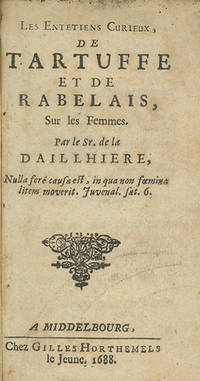
168828487Middelburg: Gilles Horthemels le Jeune 1688 1688. First edition. Brunet II 470; Cioranescu Bibliographie de la Littérature Française 38017; OCLC records 12 copies five in the US and seven in Europe and Britain. Edges of the binding a little rubbed; scattered stains and foxing; paper repairs to the final two leaves mostly marginal but affecting a few letters at the extremities of three lines in the penultimate leaf; very good copy. Small 12mo 19th century brown half morocco signed P. Pralon of Dijon dark brown paper boards blind rules and gilt lettering. Woodcut device on the title-page and two woodcut initials. 12 95 pages. ¶ Three ingenious bold and entertaining imaginary conversations between the fictional character of Moliere's famous play Tartuffe and the deceased François Rabelais written pseudonymously and modeled most closely on the dialogues of Lucian Pietro Aretino and Bernard le Bovier Fontenelle. The subject of the conversations is women men's relationship to women procreation coquetry seduction and caring for them including the roles of eunuchs in classical antiquity. Moliere's character Tartuffe made his first appearance on stage in 1663. Outwardly he was pious but in reality he was mercenary lecherous and deceitful. Both character and play were popular but frowned upon by the church and banned which made pairing him in dialogue with the master of satire free-thinker and great writer Rabelais circa 1485-1553 intriguing. In one part of the second conversation the character of Rabelais teasingly critiques the work of Moliere. And in the preface the pseudonymous Le Sieur de la Daillhiere falsely claims as Tartuffe might have that there is no sin in the text of the dialogues. ¶ This is an early example of a dialogue that uses literary figures as its interlocutors. The dialogue form was popular in France in the 17th century and was used most successfully by Fontenelle 1657-1757 and François Fénelon 1651-1715. In the preface the author states that his reason for anonymity was "that the work doesn't deserve it being a mere trifle in comparison to other works he is about to give to the public of which the present is merely an outline." ¶ From the library of French bibliographer Gabriel Peignot 1767-1849 with the manuscript notation on front blank "Vente Peignot." Catalogue de la Bibliothèque de feu Gabriel Peignot page 227 #1883 this copy. On the front paste-down is the armorial bookplate of Jean-Baptiste Philippe Constant Moens 1833-1908 the Belgian philatelist considered the first dealer in stamps for collectors. <br/><br/> Middelburg: Gilles Horthemels le Jeune, 1688 unknown books
192623434Paris: Les Cahiers de Paris 1926. Each booklet ONE of 1500 NUMBERED COPIES. Première Série. Cahier I-X; Deuxième Série. Cahier I-X. 20 vols. Small 8vo. In the original publisher's pink printed wrappers. Fine in four uniform publisher's quarter leather boxes. Each booklet ONE of 1500 NUMBERED COPIES. Première Série. Cahier I-X; Deuxième Série. Cahier I-X. 20 vols. Small 8vo. Beautifully preserved copies representing two years of this publisher's series edited by Claude Aveline and Joseph Place.<br/><br/>First series:<br/>I. Duhamel George. DELIBERATIONS;<br/>II. Lauzanne Stéphane.LA TABLE QUI PARLE;<br/>III. Nolhac Pierre de. ERASME ET L'ITALIE;<br/>IV. Vaudroyer Jean-Louis. LES PLAISIRS D'HIER;<br/>V. Tillier Claude. DE L'ESPAGNE;<br/>VI. Nerval Gerard de. NOTES D'UN AMATEUR DE MUSIQUE;<br/>VII. Rouff Marcel. LES DEVOIRS DE LAMITIE;<br/>VIII. Klingsor Tristan. ESSAI SUR LE CHAPEAU;<br/>IX. Pourrat Henri. LA FONTAINE AU BOIS DORMANT;<br/>X. Renan Ernest. SUR CORNEILLE RACINE ET BOSSUET;<br/><br/>Second Series:<br/>I. Rivière Jacques. DE LA SINCERITE ENVERS SOI-MEME;<br/>II. Henriot Emile. HISTOIRES MORALES;<br/>III. Gourmont Remy de. LA FIN DE L'ART;<br/>IV. Saint-Prix Pierre de. DEUX ENFANTS;<br/>V. Suarès André. POLYXENE;<br/>VI. Maurois André. PETITE HISTOIRE DE L'ESPECE HUMAINE;<br/>VII. Green Julien. SUITE ANGLAISE.<br/>VIII. Bloch Jean-Richard. FORCES DU MONDE;<br/>IX. Thomas Louis. POUR TRENTE-SEPT FRANCS CINQUANTE;<br/>X. Maurras Charles. L'ANGLAIS QUI A CONNU LA FRANCE. Les Cahiers de Paris unknown books
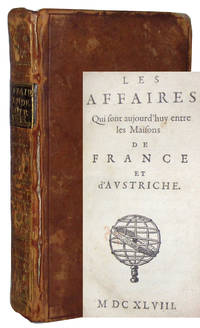
1648FRLIT001Belgium: Louis Elzebier 1648 First edition. Finely bound in mid-18th century brown calf ruled in blind to boards and in gilt to spine with decorative floral tooling and a black leather spine label lettered in gilt board edges tooled in blind red text block edges red marbled endpapers two blue silk markers present. A very good copy with wear to extremities and front hinge cracked but holding otherwise a beautiful copy with a clean interior. A non-fiction discourse on the state of relations between France and Austria this text seeks to highlight the historical events beginning in 1477 that led to the various wars conflicts and periods of peace between what were the two most powerful Christian states in Europe. First Edition. Hard Cover. Very Good. Belgium: Louis Elzebier hardcover books
178414759London 1784. hardcover. very good. 24mo cont. calf. gilt decorated spine with red label. London 1784. Very good .<br/><br/> La Henriade Travestie La Pipe Cassee et Autres Poesies Diverses.<br/><br/> unknown books
265969Philadelphia: Barrie. One of 1000 sets on Japan Vellum printed for Mr. H.R. Parrish. Each volume with plates in two states. 20 vols. 8vo. Half blue morocco spines gilt t.e.g. by Stikeman for Stokes. Spines uniformly toned a few traces of wear at joints else near fine. One of 1000 sets on Japan Vellum printed for Mr. H.R. Parrish. Each volume with plates in two states. 20 vols. 8vo. Attractive selection of late-nineteenth century French literature including:<br/>Madame Bovary by Gustave Flaubert 2 vols.<br/>Bohemian Life by Henri Murger<br/>The Confession of a Child of the Century by Alfred du Musset<br/>His Excellency the Minister by Jules Claretie<br/>Monsieur de Camors by Octave Feiullet<br/>Nouvelles by Alfed du Musset<br/>Raphael by Alphonse de Lamartine<br/>Gerfaut by Charles de Bernard<br/>Miltonia by Theophile Gautier<br/>The Devil's Pool by George Sand<br/>King of Camargue by Jean Aicard<br/><br/>Cardinal Family by Ludovic Halevy;<br/>Germaine Lacerteux by Edmond & Jules de Goncourt<br/>Sapho: Parisian Customs by Alphone Daudet<br/>The Lady of the Camellias by Alexandre Dumas fils<br/>Mademoiselle de Maupin by Theophile Gautier 2 vols.<br/>A Page of Love by Emile Zola 2 vols. Barrie unknown books
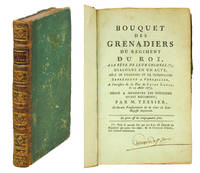
123329Paris: 1775; 1780; 1776. 8vo 3 vols. in 1: 63; 59; x 202 pp. Each with title page; La Pucelle de Paris with the half title and the engraved frontispiece by Claude-Louis Desrais. Green boards richly gilt leather backstrip with red label and five raised bands edges stained red bookplate of Henri Grosseuvre. Boards rubbed and worn at tips pages generally clean with one two early ink doodles and an intriguing undeciphered early signature on the first title page. § Two French plays and a verse drama bound together. The first Bouquet des Grenadiers du Regiment du Roi is one-act play performed at Versailles 25 of August 1775. The second is a play by Dorvigny On fait ce qu'on peut non pas ce qu'on veut proverbe Paris: Ballard & Fils 1780. The third is the first edition of La Pucelle de Paris poeme en douze chants et en vers by Alphonse Dubreuil 1734-1801 bearing the fictitious imprint "A Londres 1774" but published in Paris see ESTC T114889. 1775; 1780; 1776. 8vo hardcover books