Sandford, Chr. / Mark ServerinMareMagnum

5 467 résultats
bound, cloth, 112 pages and Illustrated by Mark Serverin.
19301246189Mailand, U. Hoepli, 1930. Gr.-8vo. 15, (1), 277 S., 1 Bl. Lwdbd d. Zeit.
Tall quarto in pale bluw wraps; 39p.; illus in b/w with photos, charts, diagrams. Uncommon. In Swedish. Typed and signed letter from author laid in. // Med sammanfattning p engelska. Series: SP rapport,; 1988:47. Paper conservation. Photocopy paper conservation.
29541Firenze, Ministero della Pubblica Istruzione/Sansoni, 1954 Paperback, copertina editoriale originale a colori, 21.5x15.8 cm., 522 pp., indice delle tavole, con 5 tavole a colori e 104 in n ero fuori testo.
Paperback, copertina editoriale originale a colori, 21.5x15.8 cm., 522 pp., indice delle tavole, con 5 tavole a colori e 104 in n ero fuori testo. Catalogo Palazzo di Venezia - Roma.
19911318698New York, M. Martino, (1991). Gr.-8vo. 12, 471 S., 1 Bl.; 4 Bl., 494 S., 1 Bl. Mit 1 Titelporträt u. 55 Tafeln. OLwd.
First edition, 2 vols., 491; 586pp., orig. cloth.
19867Antwerpen, Resseler, 1928 papieromslag en titelpagina in zwart en rood en met vignet, 220 x 285mm., 260pp., geillustreerd.
5900, Antwerp, J.-E. Buschmann, 1930.**, Bound, 14x22cm, 88pp, illustrated./
Bound, 14x22cm, 88pp, illustrated./ Translation from the Flemish by Alice Van Riel-Goransson. Nr. 426 of the 450 exemplaires.
5902, Bruxelles, Notre temps, 1937., Relie, toile, sous jaquette d' editeur, jacquette jauni, 22x17,5cm, 209pp, illustre.
Relie, toile, sous jaquette d' editeur, jacquette jauni, 22x17,5cm, 209pp, illustre. 1 x hardcover, 1 x paperback
papieromslag en titelpagina in zwart en rood en met vignet, 220 x 285mm., 260pp., geillustreerd. In goede staat.
Paperback, 183pp. ISBN 9789061001546. Christoffel Plantin, aartsdrukker van Philips II, en zijn opvolgers, de Moretussen. Nieuw.
17466, Bruxelles, Le Musee du Livre, 1924-1925, Broche, couverture carton, 220 x 300mm., 133pp., illustre en couleur.
Broche, couverture carton, 220 x 300mm., 133pp., illustre en couleur. En bon etat.
22510Bruxelles/ Anvers, Musee du Livre/ Buschmann, s.d. Broche, couverture papier illustree a l'impression doree, double frontispice realise en noir et rouge, 220 x 310mm., impression en rouge et noir, vignettes, culs de lampe et illustration abondante ( quelques contre-collees ) en couleur et n/b.
60358Bruxelles/ Anvers, Musee du Livre/ Buschmann, s.d. Broche, couverture papier illustree a l'impression doree, double frontispice realise en noir et rouge, 220 x 310mm., impression en rouge et noir, vignettes, culs de lampe et illustration abondante ( quelques contre-collees ) en couleur et n/b.
Broche, couverture papier illustree a l'impression doree, double frontispice realise en noir et rouge, 220 x 310mm., impression en rouge et noir, vignettes, culs de lampe et illustration abondante ( quelques contre-collees ) en couleur et n/b. Etat satisfaisant.
Broche, couverture papier illustree a l'impression doree, double frontispice realise en noir et rouge, 220 x 310mm., impression en rouge et noir, vignettes, culs de lampe et illustration abondante ( quelques contre-collees ) en couleur et n/b. MET HANDGESCHREVEN BRIEF VAN J. DELEN conservator Plantin.
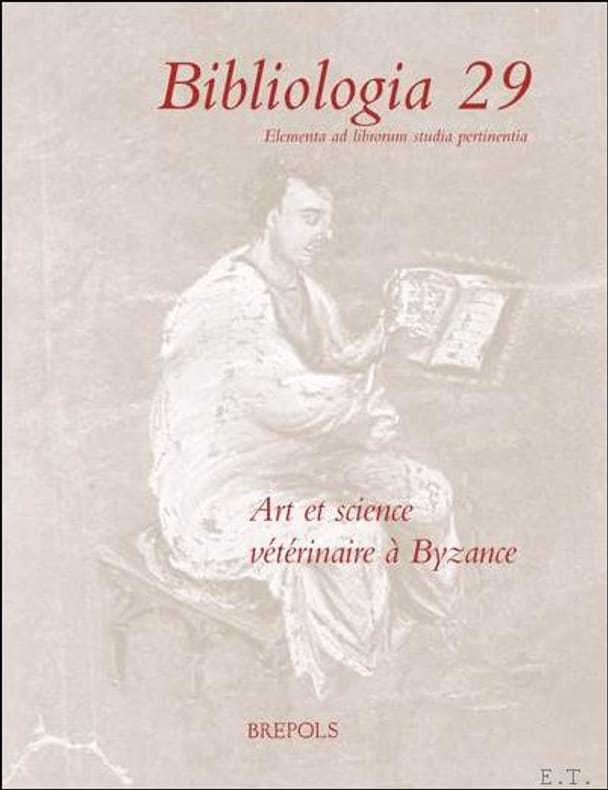
34260Turnhout , Brepols, 2010 Paperback, VI+288 pages ., 26 colour ill., 210 x 270 mm. fine!! ISBN 9782503534466.
Paperback, VI+288 pages ., 26 colour ill., 210 x 270 mm. fine!! ISBN 9782503534466. Cette monographie - la premiere du genre - est une reflexion sur les miniatures hippiatriques grecques, ou se demander pour quel usage et comment le lecteur medieval les ?« lisait ?», conduit necessairement a essayer d'expliciter les rapports complexes qu'entretiennent l'illustration et le texte. Apres une presentation generale de la litterature hippiatrique, l'auteur elucide des questions liees a la composition du Corpus hippiatricorum graecorum. L'interet est principalement porte sur les differentes recensions d'un de ses abreges, l'Epitome, et sur sa place par rapport au Corpus hippiatricorum. Ainsi est-on amene a mieux discerner l'histoire de ce traite et celle des deux seuls manuscrits illustres. Vient ensuite un chapitre consacre a l'etude minutieuse de ces deux temoins, le Leidensus Vossianus graecus Q. 50 et le Parisinus graecus 2244. Paleographie et codicologie s'en melent, qui revisent bien des opinions recues sur l'origine des manuscrits. Un re-examen des miniatures des deux temoins est alors possible. Par-dela analyses stylistique et iconographique, trop souvent attachees a la quete absolue de l'archetype, l'auteur analyse les rapports texte/image pour etablir, en definitive, le modus operandi des imagiers et determiner les fonctions concretes pour lesquelles les figures ont ete pensees et concues. De ce regard synchronique decoule naturellement une etude sur la facon dont le lecteur medieval utilisait les images. Les conclusions pratiques se voient donc confrontees aux theories antiques et medievales sur le role de l'image et celui des mots. Ainsi l'image hippiatrique ne saurait etre seulement une simple illustration du texte : elle appartient a l'oeuvre tout autant. L'ouvrage s'adresse aux antiquisants et aux medievistes, historiens de lart et de la medecine veterinaire antique et moderne ainsi qu'aux philologues et a quiconque s'interesse a l'histoire de l'illustration scientifique et des relations entre l'homme et l'animal. Languages: French.
39889Turnhout, Brepols, 2005 Hardback, XVIII+254 p., 20 b/w ill., 1 b/w line art, 160 x 240 mm. ISBN 9782503516936.
Hardback, XVIII+254 p., 20 b/w ill., 1 b/w line art, 160 x 240 mm. ISBN 9782503516936. Collectively, the contributors to Imagining the Book offer a snapshot of current research in English manuscript study in the pre-modern period on the inter-related topics of patrons and collectors, compilers, editors and readers, and identities beyond the book. This volume responds to the recent development and institutionalization of 'History of the Book' within the wider English Studies discipline. Scholars working in the pre-printing era with the material vestiges of a predominantly manuscript culture are currently establishing their own models of production and reception. Research in this area is now an accepted part of twenty-first century Medieval Studies. Within such a context, it is frequently observed that scribal culture found imaginative ways to deal with the technological watersheds represented by the transition from memory to written record, roll to codex, or script to print. In such an 'eventful' environment, texts and books not infrequently slip through the semi-permeable boundaries laboured over by previous generations of medievalists, boundaries that demarcate orality and literacy; 'literary' and 'historical'; 'religious' and 'secular'; pre- and post-Conquest compositions, or 'Medieval' and 'Renaissance' attitudes and writings. Once texts are regarded as offering indices of community- or self-definition, or models of piety and good behaviour (and the codices holding them statements of prestige and influence), the book historian is left to contemplate the real or imagined importance and status of books and writting within the larger socio-political, often local, milieux in which they were once produced and read. All fourteen essays in this volume question the status of the book in a predominantly manuscript culture. Some focus on the practical politics of book production and local circumstances; others focus on the visual experience of early readers. In this volume, the idea of the pre-modern vernacular book is pursued in terms of its miscellaneity and its association with localised writing projects undertaken by (and occasionally also for) a polyglot and sometimes also socially-aware English readership. Such investigation is valuable since it enables us to recognise the textual networks, the sources and the readership that mark the pre-modern codex as an important medium of social and literary exchange quite distinct from printed books. Languages : English.
39490Turnhout, Brepols, 2011 Paperback, 420 p., 210 x 297 mm. ISBN 9782503534671.