MEUSNIER DE QUERLONBiblio.com
5 résultats
1884105654Paris : Librairie des Bibliophiles Jouaust 1884. 175x115mm. frontispice VIII - lettrines bandeaux culs-de-lampe reliure demi-chagrin. Plats et garde marbrÂŽ. Dos muet. Tranche supÂŽrieure dorÂŽe. Couvertures conservÂŽes. Belle reliure. TrÂs bel exemplaire. 187 Librairie des Bibliophiles, Jouaust unknown
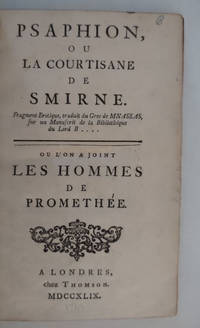
45563"Londres" probably Netherlands: chez Thomson Londres. 1749. Second Edition. Leather / Marbled Boards. Very Good. 8vo; viii1031;231 pages; Later red half morocco over red linen marbled endpapers top edges gilt others sprinkled red. There is rubbing with a tiny area of loss at the top of the spine also minor rubbing at the points of the corners. A drop of ink at the top edges has left a very small stain at the very top margin of seven early leaves pp. vii & viii and 1-10 -- otherwise the text is crisp; a few leaves show very light toning. 'Les hommes de Promethée' has separate divisional title page register and pagination. OCLC number 1204808724 states that "The imprint is false; probably printed in the Netherlands." This is the second edition quickly following an edition issued with a title page dated 1748 -- also 'chez Thomson Londres 1748' -- although the OCLC listing for that edition speculates printing in Paris. Although he had been admitted as a lawyer at the Parlement of Paris in 1723 Meusnier de Querlon had devoted himself to literary pursuits by 1727 when he was employed by the Bibliothèque du Roi until 1735. Meusnier was granted the privilege as editor and publisher of the 'Affiches de province' from 1752-1776 -- and this journal was successful. He also wrote and worked for the 'Gazette de France' and at the 'Journal économique' and the 'Journal étranger.' He edited several classical texts with notes -- including Lucrèce 1748; in-12°; Phèdre 1748 in-12°; Anacréon 1754 in-12; and 'De rerum natura' by Lucretius 1754. As a publisher Meusnier was responsible for the first printed edition of a masterpiece of French literature and thought -- 'Journal de voyage en Italie en 1580 & 1581' by Michel de Montaigne. The manucript of Montaige's account of these travels was found nearly two ceturies later in a trunk which is still on display in the essayist's Tower. Of course the present work might still be possible to describe as per the title page as a "Fragment erotique" but it was certainly not "traduit du grec de Mnaseas" -- but rather an original novel entirely written by Meusnier. The nineteenth century historian and publisher Paul Lacroix Bibliophile Jacob published a new edition of "Psaphion" in 1874 which contains an introduction which extensively quotes Meusnier's explanation of the source of his inspiration and circumstances of his composition of the work. The Louvre has a portrait of a seated man ca. 1769 with his left elbow resting on a closed book and his fingers turning the leaves of an open standing volume -- one of the colorful group known as the Fantasy Figures painted by Jean-Honoré Fragonard 1732-1806. The subject's identity was long thought to be Denis Diderot the Encyclopedist -- but the discovery of a sheet of small ink sketches made by Fragonard representing a number of his "Fantasie" paintings sold at a Paris auction in 2012 changed the traditional attribution. The sheet contains a small figure clearly depicting this portrait. Under his quick sketch representing this picture Fragonard his written the name "Meunier" . Art historians now accept that the Louvre portrait depicts Anne-Gabriel Meusnier de Querlon. Fourteen of the Fragonard pictures which appear to be identified in the ink or graphite sketches on the sheet were exhibited in Washington at the National Gallery of Art under the group title 'Fantasy Figures" -- October 8 – December 3 2017. The sheet of sketches may well have been retained in Fragonard's family until the late nineteenth century. A mount made at an uncertain date for this drawing bore the inscription: ‘No. 12. Esquisses des portraits’ -- other marks on the mount associate the sheet with ownership by Fragonard's family. The slight difference in spelling the subject's surname merely points to Fragonard's propensity for spelling names phonetially. There is another publisher and editor among the 'Fantasy Figures" -- Louis François Prault 1734-1807. Under the sketch representing this portrait Fragonard has simply written "Pro." see 'Burlington Magazine December 2017 Vol. 159 / No. 1377. . chez Thomson, Londres hardcover
1951121534Paris: Editions Eryx 1951. In-4 p. brossura originale pp. 1168 a fogli sciolti magnificamente illustrato da 15 acqueforti originali a colori di Chimot. Tiratura limitata dii 429 esemplari numerati sur Grand Vélin de Rives Blanc a la forme. Il ns. 371 appartiene alla tiratura di 195 esemplari numerati da 235 a 429. Molto ben conservato. Editions Eryx, unknown
1774H19754Paris: Le Jay 1774. First printing. Hardcover. Good. Quarto 11 x 8.75 inches; 280 x 221 mm contemporary calf gilt spine good to very good with light wear to binding outer front joint cracked but boards still firmly attached light rubbing soil and stains to boards contents fresh and clean with lovely copperplate frontispiece of Montaigne engraved by Augustin de Saint-Aubin half title liv 416 pp complete. After the publication of the Essays in 1580 Montaigne stayed six months in Rome. The text of his travel journal was drawn up and annotated by Meusnier de Querlon from the unpublished manuscript discovered by Abbot Prunis in the papers found in Montaigne's residence. Dedicated to Buffon the work was published in three editions during the year 1774 one in quarto format and two in 12mo format. Spine label states Vol. IV; this was undoubtedly bound alongside a quarto edition of Montaigne's essays in three volumes but this was issued on its own and not as part of a set. Desan 111; Brunet III 1843. The quarto edition has never auctioned for less than $1000 in recent years and has sold for as much as 3800 Euros in 2020. Le Jay hardcover
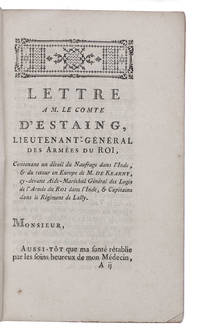
1762A3KBBFCAXE78Paris: the author 1762. 20th-century sponge printed decorated paper wrappers in lavendar green and brown red sprinkled edges. 8vo. With a headpiece built up from Fournier's rococo cast fleurons. Set in Fournier types including decorated titling capitals. Very rare narrative of the loss of the English East Indiaman Fattysalam off the coast of Coromandel on 28 August 1761. It was written by the French counsellor man of letters and employee at the Royal library of King Louis XV Anne-Gabriel Meusnier de Querlon 1702-1780 Comte de Kearny and the book refers to him simply as De Kearny.The Fattysalam had been built at Bombay and had never been employed in the Indian seas. She was intended to carry great part of the stores taken by the English and near 500 troops which it had been thought fit to send to Bengal because after the regiment of Pondicherry they were not wanted on that coast.'' Duncan.Kearny was one out of 12 who had escaped from the ship which had been lost together with most of the crew. By way of the dominion of the Rajah of Arsapour Cuttack Barrasole and Calcutta the company arrived at Goupil Gupil where they spotted several of the East India Company's ships.The book gives no date place of publication or name of the publisher but Barbier indicates that is was published by De Kearny in 1764 the latest date mentioned in the account is 1762. The laid paper is watermarked with a cardinall's arms with "Fin DannonayMfleur-de-lisIohanot 1742" that is Mathieu Johannot in Annonay. The 1742 date was used in French paper for decades and Mathieu Johannot was active in Annonay to 1785. The types and ornaments appear in Pierre Simon Fournier's 1764 type specimen.Only slightly trimmed preserving some deckles. In very good condition with only a small marginal stain at the foot of pp. 35-36. The front wrapper with 2 tears along a fold.l Barbier III col.400 ''publiés par A.-G. Meusnier de Querlon 1764 in -8 48 pp.''; KVK 3 copies; Polak 13070; cf: Andrus and Start publishers Remarkable shipwrecks . Hartford 1813 pp. 94-108; Duncan The Mariner's Chronicle III pp. 180-198; not in Huntress; on the author: Dictionnaire des journalistes 1600-1789 online ed. the author?, unknown