7 résultats
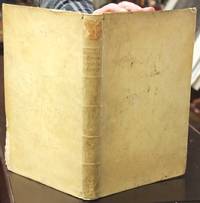
1509045603Paris: de Marnef 1509. Hardcover rebound in leather. Near Fine Condition. Rebound in full red morocco with a black morocco label to the front board new endpapers. No printer listed but the printer's mark of de Marnef on the title page. A few minor stains bright and clean overall. 35 leaves.<br /> <br /> A lovely Parisian edition of Francesco Ottavio's 1447-1490 neo-latin poetry edited by the great editor and printer Josse Badius and the poet critic and friend of Erasmus Andrelini. Just one copy of the 1509 edition in OCLC. First printed with Petit in 1503 in a different edition. Also appeared with the printer's mark of Poncet le Preux in 1509 according to reproductions in the BN in a 35 leaf edition.<br /> Size: Octavo 8vo. Quantity Available: 1. Shipped Weight: Under 1 kilo. Category: Poetry; Antiquarian & Rare. Inventory No: 045603. de Marnef hardcover
15174451Maguntie [Mainz], Joannes Schöffer, 1517. In-4 de 46 pages, titre orné de gravures. Cartonnage de papier marbré noir (19ème). Ex-libris de la bibliothèque du docteur Georges Kloss, dont la vente eu lieu en 1835, réalisée par Sotheby, et qui contenait de très nombreux ouvrages en provenance de la bibliothèque du réformateur Mélanchthon.In-4 of 46 pages, title decorated with engravings. Original cased binding of black marbled paper (19th). Bookplate from the library of doctor Georges Kloss, the sale of which took place in 1835, carried out by Sotheby's, and which contained a large number of works from the library of the reformer Mélanchthon.
1509045603Paris: de Marnef 1509. First Edition. Hardcover rebound in leather. Near Fine Condition. Rebound in full red morocco with a black morocco label to the front board new endpapers. No printer listed but the printer's mark of de Marnef on the title page. A few minor stains bright and clean overall. 35 leaves. A lovely Parisian edition of Francesco Ottavio's 1447-1490 neo-latin poetry edited by the great editor and printer Josse Badius and the poet critic and friend of Erasmus Andrelini. Just one copy in OCLC. Size: Octavo 8vo. Quantity Available: 1. Shipped Weight: Under 1 kilo. Category: Poetry; Antiquarian & Rare. Inventory No: 045603. <br/><br/> de Marnef hardcover books
15546336Venice: Plinio Pietrasanta 1554. First edition. Very Good. Quarto 22 cm; 45 3 pages last leaf blank. Title within woodcut architectural border. Historiated woodcut initials throughout. In half vellum over 17th- or 18th-century woodblock printed paste paper titled in manuscript on spine. Lower board ruptured near corner subsequently rebuilt. Some leaves toned brown. Early ownership inscriptions and later bibliographical notes on front free endpaper and on rear pastedown. References: Adams F-182; Olschki Choix de livres anciens VI 5817 <br /><br />This essay extolling marriage is an early artifact of modern ethnography in that it poses as a survey of marriage customs through history and around the world. In true humanist fashion Fausto mines the ancient historians for most of his material. So we find out that in Lacedaemonia or Atlantis men who refused to marry were forced to run naked through the forum in the dead of winter and that in Assyria husbands were bound by law to obey their wives. The text concludes with a long series of Q&A "quesiti" concerning marriage ceremonies in which we find out why the Boetians crowned brides with asparagus why Persian couples wait until spring to "consummate" any marriage and why it is customary to grease the newlyweds' doorway with pig fat or wolf fat. The book is also notable for its lovely large woodcut initials including a letter T showing a satyr and a man at table together a P with a bare-breasted woman driving a triumphal chariot and an N with a lion-headed man astride a swimming horse. Plinio Pietrasanta hardcover
15546336Venice: Plinio Pietrasanta 1554. First edition. Very Good/This essay extolling marriage is an early artifact of modern ethnography in that it poses as a survey of marriage customs through history and around the world. In true humanist fashion Fausto mines the ancient historians for most of his material. So we find out that in Lacedaemonia or Atlantis men who refused to marry were forced to run naked through the forum in the dead of winter and that in Assyria husbands were bound by law to obey their wives. The text concludes with a long series of Q&A "quesiti" concerning marriage ceremonies in which we find out why the Boetians crowned brides with asparagus why Persian couples wait until spring to "consummate" any marriage and why it is customary to grease the newlyweds' doorway with pig fat or wolf fat. The book is also notable for its lovely large woodcut initials including a letter T showing a satyr and a man at table together a P with a bare-breasted woman driving a triumphal chariot and an N with a lion-headed man astride a swimming horse. . Quarto 22 cm; 45 3 pages last leaf blank. Title within woodcut architectural border. Historiated woodcut initials throughout. In half vellum over 17th- or 18th-century woodblock printed paste paper titled in manuscript on spine. Lower board ruptured near corner subsequently rebuilt. Some leaves toned brown. Early ownership inscriptions and later bibliographical notes on front free endpaper and on rear pastedown. References: Adams F-182; Olschki Choix de livres anciens VI 5817 Plinio Pietrasanta hardcover books
151938015Paris: Vaenundatur a M. Nicolao De Barra 1519. 4to 19.7 cm 7.75". 30 pp. final blank lacking. <br><br>Posthumous but still early edition of Andrelini's collection of epigrams addressing a variety of groups and topics including readers sleep and faith; here in => the first edition edited by Jean Vatel and with his commentary. Andrelini ca. 14621518 was an Italian humanist friend of Erasmus until a dramatic break in 1511 and poet royal to both Charles VIII and Queen Anne of Brittany. Vatel was a similarly intriguing Renaissance man the "data" page of the website of the Bibliothèque Nationale de France designates him "Clerc humaniste professeur de grec traducteur et commentateur éditeur dessinateur de caractères typographiques et imprimeur-libraire." Andrew Pettegree and Malcolm Walsby's bibliography of pre-1601 French books shows that Vatel was greatly interested in Andrelini and edited at least a dozen of his works; his commentary for this text was subsequently reprinted numerous times in the 16th and 17th centuries.<br>Â Â Â Â The text is neatly printed in two different sizes of roman font with one decorative and one historiated initial a Virgin and Child; a sizable printer's device appears on the title-page. Searches of the NUC WorldCat and COPAC reveal only one U.S. institution Yale reporting owning this edition.<br>Â Â Â Â Provenance: From the library of American collector Albert A. Howard small booklabel "AHA" at rear. <br>Â Â Â Â <br>Â Â Â Â Moreau Éditions parisiennes du XVI siècle II 1972; Brunet I 2712; Graesse Trésor de livres rares I 121; not in Adams. On Andrelini see: Contemporaries of Erasmus I; Pettegree & Walsby French Vernacular Books: Books Published in France before 1601 53120. Modern red foliate patterned papercovered boards with gilt orange leather spine label final blank lacking. Short interior tear without loss to title-page perhaps a paper flaw; light waterstaining and/or offsetting from old binding to upper outer corners and a little dust-soiling or creasing the latter perhaps in the press. Light pencilling on one endpaper and one pencilled word on final page. => In fact withal a very pleasing little book. V[a]enundatur a M. Nicolao De Barra hardcover books
1542B5989Rome / Romae: Francesco Priscianese c.1542. Slight browning to some pages; in very good condition . Binding: Contemporary vellum. Spine with five 5 raised bands and ink title on two; trace of old label on spine. All edges speckled red. Notes: The seven books of Advensus gentes Edited by Franciscus Priscianensis and Hieronymus Ferrarius. Dedication to Franois I of France dated a2v “Calen. Septembris 1543.†Colophon R7r dated 1542. The first edition of a defense of the Christian faith and an attack on paganism with ample descriptions of idolatrous rites and beliefs. Printed from an imperfect manuscript found in Paris it required extensive text editing. This is an unusally tall copy clean and beautifully printed. According to Jerome's chronicle Arnobius of Sicca c. 330 early Christian apologist of Berber origin during the reign of Diocletian 284–305 was a distinguished Numidian rhetorician prior to his conversion in Sicca Veneria El Kef Tunisia a major Christian center in Proconsular Africa. Jerome stated that to help the local bishop overcome his doubts as to the earnestness of his Christian belief he wrote c. 303 from evidence in IV:36 an apologetic work in seven books called ‘Adversus Gentes’ entitled ‘Adversus Nationes’ in the only 9th-century manuscript that survived. Size: Folio 305x208mm Provenance: Title and dedication leaves watermarked with an anchor design. References: Graesse I 225 NUC 22.74-75. Ind. Aur. 108.890; Brunet I: 491; BM STC Italian: 56; Adams A1994. Ascarelli: 12. Pages: Pp. 107 leaves. Category: Book Religious Christianity; Book Europe Italy; Book Early Printed 1500; Francesco Priscianese, hardcover