Pereyra, Fausto JosephBiblio.com
10 résultats
1728129611728. unknown
1779005196Rome: Nella Stamperia Del Puccinelli at Governo Vecchio 1779. First edition 1779. Full leather patterned endpapers 220 pages. Lacks the map. Covers worn and spotted with wear to the corners and a chipped spine joints good with covers well attached text block sound with no loosened pages pages free from chips or tears some light scattered foxing inscription on first blank and old price on title page. Free endpapers have been removed. First Edition. Hard Cover. Fair. 12mo - over 6¾" - 7¾" tall. Nella Stamperia Del Puccinelli at Governo Vecchio Hardcover
177929573Rome: Stamperia del Puccinelli al Governo Vecchio 1779. First edition. Large engraved folding map by P. Bombelli. xx 220 pp. Pages ix-xii are signed 5 and 6 but printed with terminal signature O and bound out of order between pp. 214 & 215. 1 vols. 8vo. Contemporary vellum. Fine copy. First edition. Large engraved folding map by P. Bombelli. xx 220 pp. Pages ix-xii are signed 5 and 6 but printed with terminal signature O and bound out of order between pp. 214 & 215. 1 vols. 8vo. Libri di L. V. Fossati Bellani 1681 calls for a subsequently issued Appendix not present here; Italian OPAC listings include copies both with and without the Appendix Stamperia del Puccinelli al Governo Vecchio unknown
1798JC12528New York: Printed by R. Wilson for Samuel Campbell. 1798. Hardcover. Good. Contemporary half calf spine ruled and lettered in gilt; 12mo 167x100mm; pp. xii iv 146. Front board and FFEP detached; library and previous owner bookplates on front paste-down and recto and verso of FFEP; ownership signatures on front flyleaf and top margin of title-page. Text block a bit tanned as usual. An uncommon early edition. <br/><br/> Printed by R. Wilson, for Samuel Campbell... hardcover books
177929573Rome: Stamperia del Puccinelli al Governo Vecchio 1779. First edition. Large engraved folding map by P. Bombelli. xx 220 pp. Pages ix-xii are signed 5 and 6 but printed with terminal signature O and bound out of order between pp. 214 & 215. 1 vols. 8vo. Contemporary vellum. Fine copy. First edition. Large engraved folding map by P. Bombelli. xx 220 pp. Pages ix-xii are signed 5 and 6 but printed with terminal signature O and bound out of order between pp. 214 & 215. 1 vols. 8vo. Libri di L. V. Fossati Bellani 1681 calls for a subsequently issued Appendix not present here; Italian OPAC listings include copies both with and without the Appendix Stamperia del Puccinelli al Governo Vecchio unknown books
1792003484Madrid: en la imprenta de Manuel Gonzalez 1792. First Spanish translation from the French edition of 1786. Full Tree Calf. Very Good at least. 114 pp. frontispiece vi 1-21 plates # 1-44 pp 22-42 plates # 1-21. The "Apéndice" follows after page 21 with a new title page page numbers run continuously but plate numbers reset. 29 cm. Small folio. Later binding in full tree calf with five raised bands decorated in gilt to spine; black Morocco spine label with title in gilt. End papers in heavy marbled stock. Binding and covers in near fine condition with a superficial scuffing and mild wear at the tips. Small tide mark affecting 2-3% area of engraving's upper left quadrant for the first 15 plates growing more faint on each plate until it disappears entirely. Sporadic light foxing throughout two leaves with closed tears PO signature w/ date in fine contemporary hand to blank verso of last plate. In Spanish. A lovely copy. Antiquarian. A seminal work of architectural first principles. The first edition of this book was published in 1593 after which time the engravings for the plates were hidden away; this Spanish translation of 1792 is the first edition which utilized those original engravings after almost 200 years. The spectacular copper engraved frontispiece is present. It features a fine portrait of Vignola in the form of a marble bust which is surrounded by an adoring gang flock of Putti flying around wielding various drafting tools. <br/><br/> en la imprenta de Manuel Gonzalez unknown
1797220638Aberdeen Scotland: William Creech 1797. First Scottish Edition . Hardcover. Good/No Jacket. 4 x 7. Hardcover; 146 pages. 12mo. SCARCE title. Work by a German physician translated into English. Full leather binding. Gilt titles on red leather label on spine. Heavily shelfworn and scratched boards. Leather cracked through front hinge cover still attached via binding. Heavy wear to edges. Bumped corners. Red speckled page ends faded. Bookplate on fep. The endpapers are yellowed. The pages are slightly wavy but are bright and clean. FIRST SCOTTISH EDITION. G/-- <br/> <br/> William Creech hardcover
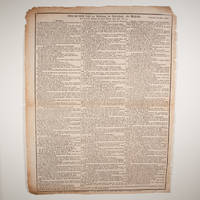
179800341CATTLE PLAGUE BROADSIDE BY DR. FAUST --- 1 broadsheet 463 x 363 mm --- One of at least a dozen broadside editions of the prolific German physician's advice on treating the devastating cattle plague. We find others published at Stuttgart 1797; Bückeburg 1797; Leipzig 1797; Dresden 1799; Bamberg 1801; Leipzig 1813; a 1797 edition without place of production; undated editions at Karlsruhe and Gotha; an 1800 French version Strasbourg and another undated French edition. We suspect the content derives from the author's much more extensive <i>Über die Rindvieh-Pest</i>Stuttgart 1797. His advice was also issued in pamphlet form on which subject our broadside has a terse promotional note at end: "I have also written a book on rinderpest. Read it!" No doubt selling advice from any Dr. Faust required extra effort though he was admittedly quite respected and widely known for his <i>Catechism of Health</i>. At bottom are prices for the broadside both individually and in wholesale quantities of 100 and 600. ¶ There was good reason to produce and post these broadsides widely. "Cattle plague or rinderpest the highly infectious and most lethal of bovine diseases described as the most dreaded above all of animal contagions had repeatedly ravaged Europe since time immemorial" Spinage. Europe was hit especially hard in the 18th and 19th centuries where Germany alone lost an estimated 28 million cattle between 1711 and 1865. Beyond the tragic loss of life livelihoods were destroyed and economies distressed. ¶ Faust here provides a list of symptoms both external and internal; remarks on the fatality of the disease indicating that 25 million German cattle had been killed since 1711 the year of a notorious Italian epidemic; sundry facts and characteristics of the scourge "It's present in every season in all weather and in every country"; details on its transmission; comments on the uselessness of certificates of health and the dangers of the cattle trade; and preventative measures and treatment these accounting for roughly half of the broadside's content with discrete sections on actions to take based on when the disease arrived "If the plague has arrived within 30 or fewer hours there is danger!" plus advice should an infected animal be found in your community "Killing the first sick animal is the best and surest means of putting an end to rinderpest". We expect anyone literate charged with caring for cattle might have kept a broadside like this handy and communities at risk certainly would have benefited from sharing the information publicly. The vast geographic spread of their production betrayed the importance of reaching every corner of the country. Lemgo for example was hardly a great metropolis yet our printer thought it reasonable to offer this broadside in quantities of 600. ¶ We locate no other copies of this Lemgo edition. --- CONDITION: Printed on the recto only of a full sheet of laid paper. Hinged into a hinged matte. ¶ Brittle at the edges with some creases and chips; creased across both dimensions with a pinhole at the intersection and some toning along the horizontal crease. --- REFERENCES: C.A. Spinage <i>Cattle Plague: A History</i>Kluwer Academic 2003 p. 3; Alan L. Olmstead "The First Line of Defense: Inventing the Infrastructure to Combat Animal Diseases" <i>The Journal of Economic History</i>69.2 June 2009 p. 330 "Whatever the total losses a serious problem with rinderpest was that it shocked economies by rapidly wiping out much of the regional cattle stock" Meyerschen Buchhandlung (Heirs of Heinrich Wilhelm Meyer)
180030900MADRID: En la Imprenta de Joseph Doblado 1800. Primera edición.- 8º.- Plena pasta española de época lomera con tejuelo y ruedas doradas.- 115 páginas de texto incluida Portada.- 65 láminas fuera de texto grabadas representando planos el último plegado. Desgarro en una hoja de texto en el mapa plegado sin la más mínima pérdida y debidamente restaurado. Por lo demás muy buen ejemplar. En la portada de la obra consta nueva edición pero en ninguna bibliografía se cita una edición anterior salvo que se refiera a un plano conjunto de Madrid y Paris citado en la ""Cartografía de España en la Biblioteca Nacional Siglo XVI al XIX."" número 1268 que fue grabado por Asensio. El último plano que está plegado y grabado como los otros tiene unas dimensiones de 365 x 505 cms. y en la cartela se lee: ""Plano geométrico de Madrid demostrado con los 64 barrios en que está dividido"". Al pie del mismo: ""Fausto Martínez de la Torre lo delineó y grabó"". Es obra muy rara al estar completa. Alfonso García Escuder en su obra ""Mil libros en la Historia de Madrid número 524"" después de la descripción bibliográfica apostilla: ""Libro difícil de encontrar completo particularmente con el plano grande. De hecho solo hemos encontrado dos últimas ventas en 1994 y 1995 en las cuales se describen con 64 láminas y no 65 como tiene este ejemplar"". Palau 156137 - Aguilar Piñal V- 3576 En la Imprenta de Joseph Doblado hardcover
17936143Seggiano Italy 1793. Manuscript codex 32 x 22.5 cm. in several hands; various paginations in 24 gatherings of unequal lengths including additionally several miscellaneous receipts all indicating a retrospective assemblage headed by a summary report as reflected by the title on the first gathering; bound in vellum and tied with cords. ~ A reference account book for the crop year October 1793-September 1794 two instances of the date 1792 may be errors made for an agricultural estate in the Tuscan municipality Seggiano near Siena south of Florence. It was prepared in advance of a detailed examination or inspection presumably commissioned by the lord of the estate Fausto Ugurgeri originally Ugurgieri della Berardenga of a Siennese family well known in the area from the 9th to the 19th century. The compiler declares himself on the cover as Antonio Ciotti likely the agricultural manager of the estate though he may also have held some public administrative office. Italian fattore cognate with fattoria farmstead appears originally in medieval times to have embraced "accountant" among its meanings but here may approach "director" or "manager" thus encompassing accountant but broader. His title Magnifico does not necessarily indicate membership in the nobility but would seem to confer recognition of public administrative office of some sort. ~ The Ugurgeri/Ugurgieri family traced its lineage to the feudal lords Winigis who founded the first nunnery in the region Fontebona in 867 as well as other religious foundations near Siena thus installing themselves with some degree of permanence as worldly proprietors and heirs according to the traditions of the Italian city states. The name derives more specifically as a contraction of Ugo di Ruggieri a twelfth-century descendant and Sienese consul whose long line held political sway in the centuries thereafter. Their history entwined with that of another line descended from the Winigis the Berarda family who consolidated even greater regional power by the thirteenth century. Hence the formal name Ugurgieri della Berardenga by which Fausto's more immediate ancestors had been known it is not known when the form used here was first adopted. Today there is still a fortress complex called the Palazzo degli Ugurgieri in Siena as well as an entire comune or township - famous for its Chianti wines and vin santos - called Castelnuovo Berardenga. The estate holdings passed from the last of the Ugurgeri Isabella to one Giovanni Battista Vivarelli in the early nineteenth century and subsequently changed hands several times until it was purchased by the Piccolomini family of Siena after World War II. ~ Some sample headings for the accounts: First gathering 6 recto: Canto a Vacche Account for Cows; Cano a Pecore Account for Sheep; recto 9 not counting receipts in folder bound in: Residovi Restati in Mano di me Ant. Ciotti di Tenuta di Seggiano Spettante al Nobile Signore Ugurgieri di 30 Settembre 1794. Residuals Remaining to Hand with me Antonio Ciotti of the Seggiano Estate due the Noble Lord Ugurgeri on 30 September 1794. Second gathering headed: Giornale al Mese d'Ottobre 1793. Journal for the Month October 1793; heading on page 98 13th gathering: Note dell'Olive che si macinevanno dai Particolari all' Oliviera di Casa Pagando di Molenda Cinque Quartucci ogni Pilata a Peso e misure tenese di 356 il Boccale. Notes on Olives that have been Milled Specifically for the Home Oil at a Cost of Five Quartucci a liquid measure by weight and measured at 356 per tankard. A chief purpose of the accounts was to record payments for services in cash goods or land use; such payments were not only noted but also indexed as for example in the 23rd gathering where names that are written on the first recto in a neat scribal hand appear grouped according to place number in the subsequent leaves but recorded there as occasion arose and in some cases in evident haste one Domenico Ferri for instance in group 13 was given cash contanti and a garden plot una partita di suolo. ~ The accounts kept include those for maintenance of livestock pigs goats sheep for maintenance of seed crops per mantenimento di coltivazioni semente and for costs related to transport of animals and goods. Ciotti's personal summary of accounts payable and received - a sizeable business was conducted with both Siena and the village of Baccinello - supplies a good idea of the extent of the Estate's production enumerating quantities of wheat rye farina barley vegetables cheese olive oil walnuts wool and linen. It seems that Ciotti had authority to operate finances with some latitude as even alms for the poor and religious mendicants were noted per elemosina a più poveri e religiosi mendicanti when the local Capuchin Friars Minor came to call though the commitment appears to have been trivial by comparison to the generosity exhibited by Ugurgieri forbears of an earlier millennium. There are many details that await interpretation and analysis but for modern eyes an endearing attribute might be noted namely that in livestock lists the affectionate names of cows are recorded Damigella Little Lady Pastorella Shepherdess Bellarosa Lovely Rose Pomposella Little Miss Grand. CONDITION. hardcover books