2 591 résultats
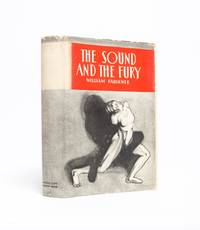
193674579New York:: Random House 1936. First edition. original cloth in dust jacket in a custom clamshell box. Preserved in a custom quarter morocco folding clamshell box. A very fine copy in a very fine dust jacket. Breathtaking. . 8vo. Folding diagram in red and black at rear. Random House, hardcover
192446669Boston:: The Four Seas Company 1924. First edition. original patterned green paper-covered boards with printed paper labels in dust jacket. Preserved in a custom cloth folding box. Very slightly bumped at the top of the spine and upper corner; else a fresh bright copy in a very near fine dust jacket. This very uncommon book is rare in dust jacket. . 12mo. Author's first book. The Four Seas Company, hardcover
195613959JLos Angeles/New York/Oxford Mississippi 1956-1967. This is the approximately 90 page archive file from William Faulkner’s former agents Harold Ober Associates in which they negotiated and sold the motion picture rights to Faulkner’s masterpiece novel “The Sound and the Fury†to Twentieth Century-Fox studios. In 1959 director Martin Ritt produced the acclaimed motion picture starring Yul Brynner Joanne Woodward Stuart Whitman Ethel Waters Jack Warden Albert Dekker. The four contracts signed by Faulkner are described as follows: 1 The Option Agreement Contract to Purchase the Motion Picture Rights to “The Sound and the Fury†10 page contract dated September 1 1956. Signed by William Faulkner and initialed twice by him in the margins. Also signed by Lew Schrieber Executive Manager of Twentieth Century-Fox; 2 The Agreement of Sale Contract to Purchase the Motion Picture Rights 19 page contract dated September 1 1956. Signed by William Faulkner and initialed 15 times by him in the margins as well as on inserted rider clauses. Additionally signed by Lew Schrieber; 3 The Agreement of Sale Contract to Purchase the Motion Picture Rights 12 page contract dated March 22 1957. Signed by William Faulkner; 4 The Exercise of Option Agreement by Twentieth Century-Fox to Purchase the Motion Picture Rights 1 page March 22 1957. Signed by William Faulkner. Additionally signed by Lew Schrieber. The remaining papers are a collection of letters carbon copies of letters to-and-fro among the parties involved interoffice notes and memos and various papers clarifying the relevant issues. There are also additional contracts including four signed by Faulkner’s legendary Random House editor Saxe Cummins acting on Faulkner’s behalf with power of attorney plus one contract signed by Faulkner’s wife Estelle Oldham Faulkner and another signed by his daughter Jill Faulkner Summers. unknown
192459503Boston:: The Four Seas Company 1924. First edition. original patterned green paper-covered boards with printed paper labels in dust jacket. . Front hinge very slightly cracked; else a fine bright copy in a very attractive jacket with a few tiny chips and short tears and some minor wrinkling to the upper portion of the front panel. This very uncommon book is rare in dust jacket. . 12mo. Author's first book. The Four Seas Company, hardcover
195669843Los Angeles / New York / Osford Mississippi 1956-1967. Generally fine. 11 x 8-1/2 inches. In addition to the four contracts there are letters and carbon copies inter-office notes and memos and various papers clarifying issues; plus additional contracts signed by Faulkner's editor Saxe Cummins acting on Faulkner's behalf with power of attorney; one contract signed by Estelle Oldham Faulkner; and one signed by Jill Faulkner Summers. The 1959 acclaimed motion picture was directed by Martin Ritt and starred Yul Brynner Joanne Woodward Stuart Whitman Ethel Waters Jack Warden and Albert Dekker. unknown
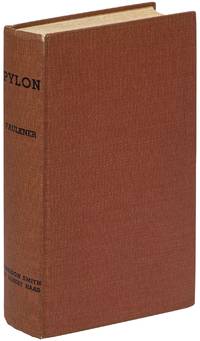
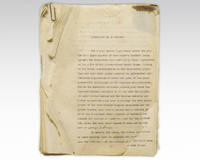
1934140100Oxford Mississippi: N/P c. 1934. Rare original carbon typescript of the novel Pylon with title in ink in the author's hand on the first page a few leaves repaginated in the author's hand 344 pages each of the six chapters held together with a paper clip Oxford Mississippi ca. December 1934. Newly discovered by the family and one of only two known typescripts of Pylon it is the only one left entirely as Faulkner wrote it and is the only one in private hands. William Faulkner's retained unedited carbon typescript of his 1935 aviation novel Pylon. This copy corresponds to the typescript setting copy in the collection of the Alderman Library University of Virginia. The present copy is important in that it shows Faulkner's text in its unedited state. In his introduction to the facsimile of the typesetting copy Noel Polk writes "According to Faulkner's date on the final page of the holograph manuscript at the University of Mississippi he completed the writing on November 26 1934; but he had already sent publisher Harrison Smith the typescript of the first chapter before November 5 the second by November 23 and the third by November 30; the fourth bears the editorial date 12/5 the fifth 12/10 and the sixth and seventh 12/15. As was to the case with Absalom Pylon underwent extensive editorial alteration. As the typescript setting copy … demonstrates editors bowlerized and 'normalized' the deliberate strangeness of the syntax and language and made hundreds of other rather arbitrary changes in the text. Smith who spent a week in Oxford with Faulkner going over the galleys had made many further editorial changes on them. The galleys which were set beginning January 8 record both Faulkner's acquiescence to many of Smith's changes his attempts to restore the original wording and punctuation and numerous attempts to repair damage that Smith had done. Pylon was published on March 25 1935."The incomplete 151-page autograph manuscript of the novel is in the collection of the University of Mississippi. The typescript setting copy at the University of Virginia and the present carbon typescript are the only known complete typescripts of the text. Corrected galley proofs are held by the Humanities Research Center at the University of Texas. Noel Polk based his 1985 corrected text Library of America on the Alderman Library typescript. As Faulkner told students at the University of Virginia in the 1960's he wrote Pylon as a respite from the complications involved in writing Absalom Absalom! The novel was written at great speed at the end of 1934. It has been called Faulkner's most self-consciously "modernistic" work abounding in descriptions of aviators and their machines runways and art deco air terminals. Aside from the frequent references to Shakespeare in the novel Faulkner takes pains to pay tribute to his modernist heroes James Joyce in the second chapter "An Evening in New Valois" and T. S. Eliot throughout the novel but especially in the penultimate chapter "Lovesong of J. A. Prufrock". Pylon is one of Faulkner's few non-Yoknapatawpha novels and is based on the festivities and air shows at New Orleans's newly built Shushan Airport held to coincide with Mardi Gras February 1934. In very good condition with the first leaf darkened and with paper loss at edges some text lost in lower right corner rust stain in upper right corner of chapters 1–4 creasing and spotting to scattered leaves. Laid in: 2 British European Airways luggage claim tags. This carbon typescript newly discovered by the family and one of only two known typescripts of Pylon is the only one left entirely as Faulkner wrote it and is the only one in private hands. A novel at once sympathetic and explosive Faulkner's Pylon is inhabited by characters still strange to the world today - a reckless and indomitable group of barnstormers performing in an unconventional flying circus. Set in a fictionalized version of New Orleans the novel became the basis for the sensational 1957 film 'The Tarnished Angels' starring Rock Hudson Robert Slack and Dorothy Malone. N/P unknown
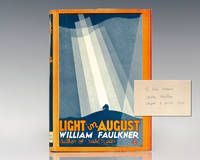
1932135388New York: Harrison Smith & Robert Haas 1932. First edition first issue with first printing statement on copyright page and “Jefferson†for “Mottstown†on page 340 line 1; first-issue binding lettered in blue and orange. Octavo original cloth. Presentation copy inscribed by the author on the front free endpaper "To Eric Dawson William Faulkner Oxford 3 October 1934." Near fine in a near fine dust jacket. Petersen A13a; Howard A13.1a; Massey 103. Housed in a custom half morocco clamshell box made by the Harcourt Bindery. Rare and desirable signed and inscribed with only two examples appearing at auction in the last 90 years. One of William Faulkners most admired and accessible novels Light in August reveals the great American author at the height of his powers. Lena Groves resolute search for the father of her unborn child begets a rich poignant and ultimately hopeful story of perseverance in the face of mortality. It also acquaints us with several of Faulkners most unforgettable characters including the Reverend Gail Hightower plagued by visions of Confederate horsemen and Joe Christmas a ragged itinerant soul obsessed with his mixed-race ancestry. Powerfully entwining these characters stories Light in August brings to life Faulkners imaginary South one of literatures great invented landscapes in all of its unerringly fascinating glory. "No man ever put more of his heart and soul into the written word than did William Faulkner. If you want to know all you can about that heart and soul the fiction where he put it is still right there" Eudora Welty. Harrison Smith & Robert Haas hardcover
1935469253New York: Harrison Smith and Robert Haas 1935. Hardcover. Near Fine/Near Fine. Second printing a month after the first. Touch of foxing to the topedge and hint of wear at the corners near fine in near fine second issue variant dust jacket with new text on front flap and the rear panel and flap unprinted. Faulkner's novel of barnstorming aviation a pursuit which took his brother Dean's life a few months after the book was published. This copy Signed by Faulkner on the title page: "William Faulkner. Sherman Conn. 25 Oct 1945." The ink has smeared a bit but is easily readable. Although not inscribed this was Malcolm Cowley's copy signed by Faulkner at Cowley's home in Sherman Connecticut where he and other important American authors were frequent visitors. <br /> <br /> Cowley was a poet and literary critic and chronicler of the so-called "Lost Generation" of American expatriates in Paris. While probably best known for his book of poetry Blue Juniata his most important work was his editing of the Viking Portable Library where his selections and criticisms fostered the popularization of those American authors whose reputations and fortunes had suffered between the Wars. William Faulkner and F. Scott Fitzgerald both of whom had to some degree disappeared from the landscape of the American literary conversation enjoyed critical resurgences as the result of the Portable editions.<br /> <br /> <br /> Cowley's 1944 Portable Hemingway sold so well that he was able to convince Viking to publish a Portable Faulkner in 1946. William Faulkner was at the time slipping into literary obscurity. By the 1930s he was working as a Hollywood screenwriter and in danger of seeing his works go out of print. Cowley argued for a dramatic revaluation of Faulkner's position in American letters enlisting him as an honorary member of the Lost Generation. <br /> <br /> Robert Penn Warren called The Portable Faulkner the "great watershed" moment for Faulkner's reputation and many scholars view Cowley's essay as having resuscitated Faulkner's career. Faulkner won a Nobel Prize in 1949. He later said "I owe Malcolm Cowley the kind of debt no man could ever repay." A significant association copy. Harrison Smith and Robert Haas hardcover
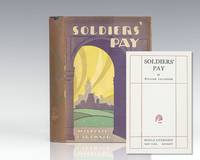
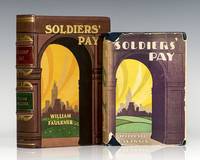
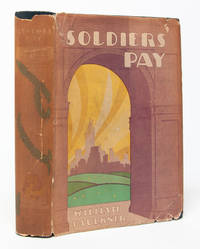
192689328New York: Boni & Liveright 1926. First edition of Faulkner's first book in the rare first state dust jacket with An American Tragedy as the first of five titles listed on the rear jacket panel. Octavo original cloth. Bookplate near fine in an exceptional dust jacket with light toning and wear. From the library of Virginia bibliophile and historian Christopher Clark Geest with his bookplate. Housed in a custom clamshell box. Scarce in this condition. Faulkner’s first novel Soldiers’ Pay 1926 is among the most memorable works to emerge from the First World War. Through the story of a wounded veteran’s homecoming it examines the impact of soldiers’ return from war on the people―particularly the women―who were left behind Boni & Liveright hardcover
1926142531New York: Various Publishers 1926-1962. First editions of each novel by the Nobel Prize-winning author. Octavo 19 volumes bound in full morocco by the Harcourt Bindery gilt titles and tooling to the spine in six compartments within raised gilt bands gilt ruling to the front and rear panels gilt stamped signature to the front panel gilt inner dentelles stamp-signed by the Harcourt Bindery marbled endpapers all edges gilt. In fine condition. An exceptional set rare and desirable. One of the most celebrated writers in American literature William Faulkner became widely know upon his acceptance of the 1949 Nobel Prize in Literature for which he became the only Mississippi-born Nobel winner. Awarded for "his powerful and artistically unique contribution to the modern American novel" Faulkner donated part of his Nobel money "to establish a fund to support and encourage new fiction writers" eventually resulting in the PEN/Faulkner Award for Fiction. Various Publishers unknown
193670639New York:: Random House 1936. First edition. original cloth in dust jacket in a quarter morocco slipcase and chemise. A fine copy in a beautiful dust jacket with the slightest of rubbing to the extremities of the backstrip. There is almost none of the usual darkening and fading to the backstrip. A stunning example. 8vo. Random House, hardcover
192769737New York:: Boni and Liveright 1927. First edition; in the scarce "card-player" variant dust jacket. publisher's cloth in dust jacket; preserved in a custom quarter morocco folding box. Both inner hinges cracked; otherwise a very good copy without the usual effacement of lettering on the spine. Slight unobtrusive abrasion to the upper right corner of the front panel front flap and bottom of the backstrip of the dust jacket; some shallow chipping to the top of the backstrip just touching the "M" in "Mosquitoes." This dust jacket is extremely uncommon. 8vo. Author's second novel. Boni and Liveright, hardcover
195213958JNew York/Los Angeles/ Oxford Mississippi: 8 pages quarto 1952. In 1952 William Faulkner was badly in need of money and wished to promote his protege/lover Joan Williams. He was approached by an old friend television producer James J. Geller to write an original story for television which he proceeded to do in collaboration with Joan Williams. The first piece in the group is a Typed Letter Signed from Geller to Faulkner thanking him for the story and expressing interest in learning more about Joan Williams when Faulkner is to shortly visit Los Angeles. Next is the original contract signed by Faulkner selling the rights to the story. Faulkner arranged all this without consulting his agent Harold Ober to whom he then writes in a letter on July 30th: “…In confidence I am not particularly interested in this sort of thing writing television plays. This one was done in collaboration with a young woman who someday may write something serious and good. My main idea in this was to contrive an opening for her where she could partly support herself while she does tries to do serious writing. I am perfectly willing to allow my name to be used on this TV thing for that reason. As you see I do not commit myself to anything further. Geller is an old Hollywood friend has been kind to me is a reputable man and a reputable agent. The young woman I mentioned finally did a story I think is all right. I sent it to Harper’s magazine. If they decline it will you look at it yourself as possible agent I can promise to stop her from sending you trash or unsalable stuff…I will hold Geller’s check for $500.00 until I hear from you…My eyes are open about this I know my name will be exploited but the piece is honest if thin.†Included is the carbon copy of Ober’s response to Faulkner gently taking him to task for arranging a bad deal. On August 2 1952 Faulkner sheepishly writes to Ober in a second letter: “…Thank you for your letter re; Geller. I feel that I have more or less passed my word about this sum. That is I did not quibble about the price when he offered it and sent him the mss still without demanding any further discussion about price. I cannot seem to learn to ask you to represent me in things of this nature. I had two mysterious telephone calls two different parties one said he was in New York the other said Memphis about my character Gavin Stevens in television. I declined to talk to either insisted that they contact you. If you have not heard they may both be fakes. I didn’t at all like the high-pressure attitude of the Memphis one. They gave names; as usual I do not remember them…on the Geller thing…see what arrangement can be made for more of these short story-lines. I am going to have to raise some money. I am in a condition that is beginning to worry me a little. I have written nothing in a year don’t want to write have to force myself to attend my farm have lost heart somehow. I think I need to get away from here all responsibilities for at least a year maybe for good. But I will begin to need money soon. These short tv things seem to be the simplest; that is a six or page rough story synopsis for $500.00 a job…I think I mentioned a young woman Joan Williams a writing protege of mine to you. I sent a mss of hers to Harper’s about two weeks ago. I don’t remember if I put in return postage. The return address was her Memphis Tenn. the mss title: THE MORNING AND THE EVENING. Will you check with Harper’s in case I did not enclose postage†Also present are two carbons of letters from Ober to Faulkner and Geller discussing the project at length and an original typed letter signed from Geller to Ober clarifying various aspects of purchasing the story. 8 pages, quarto unknown
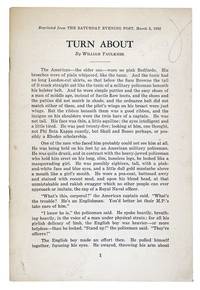
1932035975NY: Saturday Evening Post. 1932. A previously unknown Faulkner "A" item -- an offprint from the March 5 1932 issue of the Saturday Evening Post. In long-accepted Faulkner lore the first and only separate edition of Turn About was the 1939 edition published by W. L. Massiah of Ottawa Canada which has been considered Faulkner's scarcest "A" item with approximately seven known copies. Offered here is a 1932 offprint -- 7 years earlier than the Massiah edition -- with no other known copies. Faulkner's story "Turn About" was first published in The Saturday Evening Post on March 5 1932 with two bibliographically significant markers: the second paragraph includes a description of one character as having "a pink-and-white face and blue eyes and a little dull gold mustache above a mouth like a girl's mouth" and the text is broken up into 10 parts each identified with a Roman numeral from I to X. The earliest book publications of the story -- in O. Henry Memorial Award Prize Stories of 1932 and in Faulkner's collection Doctor Martino and Other Stories published in 1934 -- leave out both the "gold mustache" and the text breaks. The former change seems likely to have been authorial rather than editorial which means that Faulkner changed the text of the story removing the "gold mustache" phrase before the end of 1932 when the O. Henry collection was published. The 1939 Massiah edition includes the phrase which is how it was concluded that it had been printed from the text of the Post story rather than from one of the later book publications. The Massiah publication also retains the 10 text breaks but rather than being identified by Roman numerals the breaks are separated with a filigree design. The 1932 offprint offered here includes the "gold mustache" phrase as well as the 10 text breaks of the original Post publication with Roman numerals delineating the sections -- the only place other than in the original magazine itself where Roman numerals are used in the text. Carl Petersen the renowned Faulkner collector did not have a copy of Massiah's Turn About in his collection when he published his 1975 bibliography. By 1991 when Peter Howard of Serendipity Books published the 643-page catalog of Petersen's Faulkner collection he did have a copy which Serendipity valued at $17500 calling it "by far the rarest of Faulkner's published books." Christie's auction house called the Massiah edition "exceedingly scarce" and noted that "no copies have appeared at auction in at least 50 years" in a 2010 auction listing. As best we have been able to determine this 1932 Saturday Evening Post offprint displaces the 1939 edition of Turn About as Faulkner's scarcest "A" item: it is previously unknown contemporaneous with the initial story publication and possibly at this point one of a kind. 28 stapled pages; one page corner turned; a handful of mostly marginal pencil markings "x's"; near fine in stapled wrappers. Unless otherwise noted our first editions are first printings. First Edition. No Binding. Near Fine. Saturday Evening Post unknown
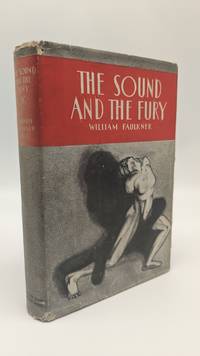
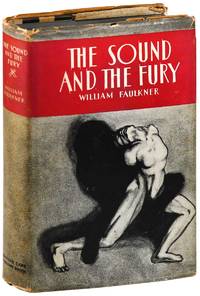
19293014New York: Jonathan Cape and Harrison Smith 1929. Very good/Very good. First state first printing of Faulkner's 1929 masterpiece. Black white and gray paper-covered boards white cloth spine stamped in black with a blue-gray top stain. One of only 1789 copies printed. Jacket has some fading to spine and small chips to top and bottom edges. Boards clean binding tight and top stain well preserved. Interior clean and free of any marks. First state of jacket showing a $3.00 price for "Humanity Uprooted." Copyright page shows "First Published 1929." Petersen A6.2a. Jonathan Cape and Harrison Smith unknown
195746671New York:: Random House 1957. First edition. publisher's cloth in dust jacket. A near fine copy with some very faint browning to the front endsheet in a very good jacket with one internal tape repair. . 8vo. Inscribed by William Faulkner to Sally and Duncan Emerich "sincerely and gratefully and au bon retour." Also signed and dated by Faulkner on the title page as was his custom. Duncan Emerich was U.S. Cultural Affairs Officer in Greece in 1957 during a visit by Faulkner to that country. With the book comes a seven-page dittoed report of that visit by Emerich and 14 8 x 10" glossy photographs of Faulkner with various citizens and students. Random House, hardcover
192669731New York:: Boni & Liveright 1926. First edition. publisher's cloth in dust jacket. A bright fresh near fine copy with the remnants of a tiny bookseller's ticket to the rear pastedown. The dust jacket is tanned on the spine so that the yellow ink in the title lettering author's name and imprint is barely legible. There is some chipping to the top of the front and back panels and the extremities of the spine; and some splits at the folds. The front and rear panels are bright and unfaded. A good to very good example of an uncommon jacket. . 8vo. Author's first novel. Boni & Liveright, hardcover
192681010New York: Boni & Liveright 1926. First edition of Faulkner's first book in the rare first state dust jacket with An American Tragedy as the first of five titles listed on the rear jacket panel. Octavo original cloth. Bookplate near fine in a very good dust jacket with some toning to the spine and some chipping to the extremities. Housed in a custom clamshell box. Rare and desirable. Faulkner’s first novel Soldiers’ Pay 1926 is among the most memorable works to emerge from the First World War. Through the story of a wounded veteran’s homecoming it examines the impact of soldiers’ return from war on the people―particularly the women―who were left behind Boni & Liveright hardcover
195269855New York / Los Angeles / Oxford Mississippi 1952. Some offset shadows from the copy letters to the original Faulkner letters; otherwise fine. 11 x 8-1/2 inches. Faulkner badly in need of funds and wishing to further the career of his protege/lover Joan Wiliams collaborated with her on a story for television at the behest of producer James Geller. Present is a letter from Geller to Faulkner; a contract for the sale signed by Faulkner; a letter from Faulkner to his agent Harold Ober whom he had not consulted in advance describing his relationships with Geller and Williams and acknowledging the his name will be exploited etc.; Ober's chiding response for arranging a bad deal; Faulkner's apologetic response mentioning additional possible deals which he says he referred to Ober and his need for money and other personal matters; a clarifying letter from Geller to Ober; plus two carbon copies of additional letters discussing the project. Superb content. unknown
19297160New York: Jonathan Cape and Harrison Smith 1929. First Edition. First Printing one of 1789 copies per Daniel. Octavo 19.75cm; patterned paper-covered boards and white cloth backstrip with titles stamped in black on spine; dark blue-gray topstain; patterned endpapers; dustjacket; vi4011pp. Spine ends gently nudged hint of sunning to heel and upper board edges with some trivial wear to lower board edges; contents fresh with topstain bold and unfaded; Near Fine. In the second state dustjacket with Maurice Hindus's Humanity Uprooted advertised at $3.50 on rear panel; dustjacket measures half a centimeter taller than the book; modest wear to extremities some tiny tears and shallow losses to spine ends and corners gentle sunning to spine with some scattered foxing and dust-soil and two tape mends at crown on verso; unlike most surviving examples the red panel on the spine remains bright virtually unfaded and without restoration; a Very Good example. Housed in a custom clamshell case.<br /> <br /> Faulkner's fourth novel set in Jefferson Mississippi during the first third of the 20th century charting "the decay of a Southern family of gentle blood and of its members who become drunkards suicides idiots and pathological perverts" Coan p.58. According to Peter Howard's catalog of the Petersen Collection only 300 copies at most of the jacket bear the corrected figure on the rear panel citing this state of the jacket being discovered only in the 1980s. Petersen A6b; Brodsky & Hamblin 130. Jonathan Cape and Harrison Smith unknown
1929338785New York: Jonathan Cape and Harrison Smith 1929. First edition first printing dust-jacket with no price on dust jacket and $3.00 price on rear panel for "Humanity Uprooted. 401 pp. 1 vols. 8vo. Original black and white boards with white cloth spine some fading to head and foot of spine and rubbing along bottom edge; unrestored dust-jacket with usual fading to spine two small chips to top of back panel and one to top of front panel small bit of loss to head of spine spine with visible crease. First edition first printing dust-jacket with no price on dust jacket and $3.00 price on rear panel for "Humanity Uprooted" 401 pp. 1 vols. 8vo. A pioneering work of American modernism Faulkner's fourth novel which employed a stream-of-consciousness technique and multiple narrators; the flap copy says it "suggests Joyce in its technique and the Russians - perhaps Dostoyevsky - in its theme" but in retrospect the work is purest Faulkner with multiple narrators and cascading layers of history telling the story of the fall of a grand Southern family through the generations. Peterson A6b Jonathan Cape and Harrison Smith unknown
19265660New York: Boni & Liveright 1926. First edition. Near Fine/Very Good. A Near Fine copy of the book in Very Good only dust jacket. Book clean and fresh with a small Nashville bookseller's label on the rear paste-down. Dust jacket only Very Good on account of some moderate chipping at the spine ends and corners one inch tear near the crown repaired on the verso with tape. Flap folds starting to crack reinforced on the verso with archival binder's tape. Spine a bit toned. An uncommon book in dust jacket one of just 2500 copies originally printed. Housed in a custom black quarter-leather slipcase with chemise.<br /> <br /> "Soldier's Pay is William Faulkner's first published novel. It begins with a train journey on which two American soldiers Joe Gilligan and Julian Lowe are returning from the First World War. There they meet a scarred lethargic and withdrawn fighter pilot Donald Mahon who was presumed dead by his family. The novel continues to focus on Mahon and his slow deterioration and the various romantic complications that arise upon his return home.Though the novel was a commercial failure at the time of its publication Faulkner's subsequent fame has ensured its long-term success" Standard Books. Over time the themes of psychological damage and ideological disillusionment that were so uncomfortable to readers just emerging from the war came to be praised for their rawness and honesty. Near Fine in Very Good dust jacket. Boni & Liveright unknown
1930140944636New York: Jonathan Cape & Harrison Smith 1930. First Edition. Fine/Near Fine. First edition first printing first issue text with "I" misaligned on page 11. Bound in publisher's original beige cloth stamped in brown. Fine with faint darkening to cloth at gutters light soiling to textblock edge and rear endsheet. In a Near Fine price-clipped dust jacket with slight soiling slight edge wear slight indentation along front spine fold along gutter. A beautiful bright and clean copy in much nicer condition than as normally found. Jonathan Cape & Harrison Smith unknown
192969733New York:: Harcourt Brace And Company 1929. First edition; first printing; one of only 1998 copies. Publisher's black cloth in dust jacket. Good to very good; with wear to the corners and the extremities of the spine. The jacket is chipped particularly at the backstrip and it has been neatly reinforced on the verso in several places with Japanese tissue. Sartoris is very seldom found with an inscription by Faulkner. 8vo. Inscribed on the front free endpaper: "To Frances Eubanks from Bill Faulkner 25 June 1929." Harcourt, Brace And Company, hardcover
19295279New York: Jonathan Cape and Harrison Smith 1929. First edition. Near Fine/Very Good . A Near Fine copy of the book in a Very Good dust jacket. Book with a bright white spine previous owner's bookplate on the front paste-down and just slight toning and wear at extremities. Jacket with the spine well faded as usual and a small repair to the front lower corner replacing a small chip. Additional wear at the crown but no other repairs or restoration. First state jacket with "Humanity Uprooted" correctly priced at $3.00.<br /> <br /> Faulkner's masterpiece - and one of the towering classics of American literature. The Sound and the Fury follows the travails of the Compsons a once prominent family in Jefferson Mississippi. Originally Faulkner began the work as a group of short stories about the Compsons but decided it would be better suited as a novel - and a very experimental one at that. A contemporary review in the Nashville Tennessean described it: "Not an easy book. It cannot be read objectively; the reader if he is to savor the best in this book must surrender himself entirely. The story has much beauty but it is a beauty that hath terror in it the beauty of pathos and tragedy. Never had I adequately known the meaning of pathos until I read the first part of this book." Faulkner's style was too complex for the novel to be an immediate hit but in time it assumed an important place in the canon and was cited as one of the reasons Faulkner was awarded the Nobel Prize in 1949. The novel appears on Modern Library's 100 Best English Novels of the 20th century and Le Monde's list of the 100 Books of the Century. Near Fine in Very Good dust jacket. Jonathan Cape and Harrison Smith unknown