887 résultats
195613959JLos Angeles/New York/Oxford Mississippi 1956-1967. This is the approximately 90 page archive file from William Faulkner’s former agents Harold Ober Associates in which they negotiated and sold the motion picture rights to Faulkner’s masterpiece novel “The Sound and the Fury†to Twentieth Century-Fox studios. In 1959 director Martin Ritt produced the acclaimed motion picture starring Yul Brynner Joanne Woodward Stuart Whitman Ethel Waters Jack Warden Albert Dekker. The four contracts signed by Faulkner are described as follows: 1 The Option Agreement Contract to Purchase the Motion Picture Rights to “The Sound and the Fury†10 page contract dated September 1 1956. Signed by William Faulkner and initialed twice by him in the margins. Also signed by Lew Schrieber Executive Manager of Twentieth Century-Fox; 2 The Agreement of Sale Contract to Purchase the Motion Picture Rights 19 page contract dated September 1 1956. Signed by William Faulkner and initialed 15 times by him in the margins as well as on inserted rider clauses. Additionally signed by Lew Schrieber; 3 The Agreement of Sale Contract to Purchase the Motion Picture Rights 12 page contract dated March 22 1957. Signed by William Faulkner; 4 The Exercise of Option Agreement by Twentieth Century-Fox to Purchase the Motion Picture Rights 1 page March 22 1957. Signed by William Faulkner. Additionally signed by Lew Schrieber. The remaining papers are a collection of letters carbon copies of letters to-and-fro among the parties involved interoffice notes and memos and various papers clarifying the relevant issues. There are also additional contracts including four signed by Faulkner’s legendary Random House editor Saxe Cummins acting on Faulkner’s behalf with power of attorney plus one contract signed by Faulkner’s wife Estelle Oldham Faulkner and another signed by his daughter Jill Faulkner Summers. unknown books
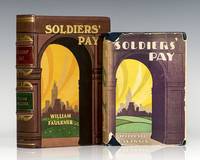
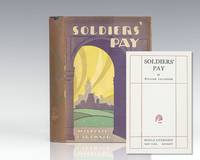
192689328New York: Boni & Liveright 1926. First edition of Faulkner's first book in the rare first state dust jacket with An American Tragedy as the first of five titles listed on the rear jacket panel. Octavo original cloth. Bookplate near fine in an exceptional dust jacket with light toning and wear. From the library of Virginia bibliophile and historian Christopher Clark Geest with his bookplate. Housed in a custom clamshell box. Scarce in this condition. Faulkner's first novel Soldiers' Pay 1926 is among the most memorable works to emerge from the First World War. Through the story of a wounded veteran's homecoming it examines the impact of soldiers' return from war on the people-particularly the women-who were left behind Boni & Liveright hardcover books
193216166JCulver City California: Metro-Goldwyn-Mayer June 3 1932. First Edition First Printing. The only original surviving copy of William Faulkner’s original 16 page mimeographed script printed on rectos only. Bradbound in printed blue studio wrappers with the Metro-Goldwyn-Mayer film studio production label affixed and with Complete File Copy and Vault Copy stamped in blue ink on the front cover. Formerly in the MGM archives it was part of the material disposed of when MGM was sold in 1986. In 1985 Professor Bruce F. Kawin published the book Faulkner’s MGM Screenplays at the University of Tennessee Press which contained facsimiles of the stories and screenplays Faulkner wrote in his first visit to Hollywood writing for MGM in 1932-1933. It is this single surviving script that is reproduced in full facsimile in the book. This unproduced film project was an aviation picture that was designed for MGM’s stars Wallace Beery Robert Montgomery and Marie Dressler to be the leads. In his Flying the Mail introductory essay Kawin points out elements in Faulkner’s script that are related to Faulkner’s novels The Sound and the Fury Absalom Absalom Flags In the Dust A few small chips to edges of wrappers otherwise fine. Enclosed in a custom folding case laid into a clamshell box. Metro-Goldwyn-Mayer unknown books
195213958JNew York/Los Angeles/ Oxford Mississippi: 8 pages quarto 1952. In 1952 William Faulkner was badly in need of money and wished to promote his protege/lover Joan Williams. He was approached by an old friend television producer James J. Geller to write an original story for television which he proceeded to do in collaboration with Joan Williams. The first piece in the group is a Typed Letter Signed from Geller to Faulkner thanking him for the story and expressing interest in learning more about Joan Williams when Faulkner is to shortly visit Los Angeles. Next is the original contract signed by Faulkner selling the rights to the story. Faulkner arranged all this without consulting his agent Harold Ober to whom he then writes in a letter on July 30th: “…In confidence I am not particularly interested in this sort of thing writing television plays. This one was done in collaboration with a young woman who someday may write something serious and good. My main idea in this was to contrive an opening for her where she could partly support herself while she does tries to do serious writing. I am perfectly willing to allow my name to be used on this TV thing for that reason. As you see I do not commit myself to anything further. Geller is an old Hollywood friend has been kind to me is a reputable man and a reputable agent. The young woman I mentioned finally did a story I think is all right. I sent it to Harper’s magazine. If they decline it will you look at it yourself as possible agent I can promise to stop her from sending you trash or unsalable stuff…I will hold Geller’s check for $500.00 until I hear from you…My eyes are open about this I know my name will be exploited but the piece is honest if thin.†Included is the carbon copy of Ober’s response to Faulkner gently taking him to task for arranging a bad deal. On August 2 1952 Faulkner sheepishly writes to Ober in a second letter: “…Thank you for your letter re; Geller. I feel that I have more or less passed my word about this sum. That is I did not quibble about the price when he offered it and sent him the mss still without demanding any further discussion about price. I cannot seem to learn to ask you to represent me in things of this nature. I had two mysterious telephone calls two different parties one said he was in New York the other said Memphis about my character Gavin Stevens in television. I declined to talk to either insisted that they contact you. If you have not heard they may both be fakes. I didn’t at all like the high-pressure attitude of the Memphis one. They gave names; as usual I do not remember them…on the Geller thing…see what arrangement can be made for more of these short story-lines. I am going to have to raise some money. I am in a condition that is beginning to worry me a little. I have written nothing in a year don’t want to write have to force myself to attend my farm have lost heart somehow. I think I need to get away from here all responsibilities for at least a year maybe for good. But I will begin to need money soon. These short tv things seem to be the simplest; that is a six or page rough story synopsis for $500.00 a job…I think I mentioned a young woman Joan Williams a writing protege of mine to you. I sent a mss of hers to Harper’s about two weeks ago. I don’t remember if I put in return postage. The return address was her Memphis Tenn. the mss title: THE MORNING AND THE EVENING. Will you check with Harper’s in case I did not enclose postage†Also present are two carbons of letters from Ober to Faulkner and Geller discussing the project at length and an original typed letter signed from Geller to Ober clarifying various aspects of purchasing the story. 8 pages, quarto unknown books
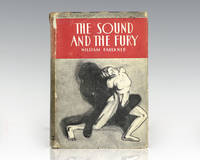
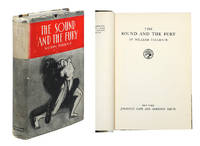
1929D1094New York: Jonathan Cape & Harrison Smith 1929. First Edition. Hardcover. Very Good/Very Good. Original cloth spine still bright white. Front hinge discretely mended. Original dust jacket with its iconic design by Kathe Kollwitz is present and fully intact; some professional restoration to a patch of the rear panel lettering. <br/><br/>The tragic tale of the Compson family certainly counted as a masterpiece of the Southern Gothic tradition and an essential development in the stream-of-consciousness narrative technique. Faulkner's fourth novel refuses any simple synopsis or definition -- and likewise its attempted adaptation to the screen. Though Faulkner enjoyed success writing for Hollywood the attempt by Irving Ravetch and Harriet Frank bore little resemblance to the original tour de force. Jonathan Cape & Harrison Smith hardcover books
192681010New York: Boni & Liveright 1926. First edition of Faulkner's first book in the rare first state dust jacket with An American Tragedy as the first of five titles listed on the rear jacket panel. Octavo original cloth. Bookplate near fine in a very good dust jacket with some toning to the spine and some chipping to the extremities. Housed in a custom clamshell box. Rare and desirable. Faulkner's first novel Soldiers' Pay 1926 is among the most memorable works to emerge from the First World War. Through the story of a wounded veteran's homecoming it examines the impact of soldiers' return from war on the people-particularly the women-who were left behind Boni & Liveright hardcover books
1929140938541New York: Jonathan Cape & Harrison Smith 1929. First Edition. Near Fine/Very Good. First edition first printing. Bound in publisher's black and white Art Deco style boards over white cloth spine lettered in black. Near Fine with toning to pages and top and bottom edges of covers. In a Very Good first issue dust jacket with Humanity Uprooted priced at $3.00 on the rear panel; toning to spine with fading to red print there light edge wear light soiling and erased pencil notation to rear flap corner. A fantastic copy in the scarce first issue dust jacket. Jonathan Cape & Harrison Smith unknown books
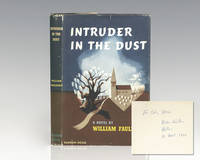
1948114816New York: Random House 1948. First edition of this classic Faulkner novel which explores the lives of a family of characters in the South. Octavo original cloth. Association copy inscribed by the author on the front free endpaper "For Sally Burns William Faulkner 16 April." The recipient Sallie Faulkner Burns was William <span class="match">Faulkner</span>'s first cousin and was a great friend to Maud <span class="match">William</span>'s mother. This was given to her by <span class="match">Faulkner</span> and has remained in the family until now. Near fine in a near fine dust jacket with a touch of rubbing. Jacket design by E. McKnight Kauffer. Housed in a custom half morocco clamshell box. Set in the deep south that provided the backdrop for all of Faulkner's finest fiction Intruder in the Dust is the novel that marks the final phase of its author's outstanding creative period. The chronicle of an elderly black farmer arrested for the murder of a white man and under threat from the lynch mob is a characteristically Faulknerian tale of dark omen its sole ray of hope the character of the young white boy who repays an old favour by proving the innocence of the man who saved him from drowning in an icy creek. Random House hardcover books
193111481JNew York: Jonathan Cape & Harrison Smith 1931. First Edition. Fine copy in a bright attractive dust jacket which has some tiny internal mends to the edges by an expert paper conservationist. Jonathan Cape & Harrison Smith unknown books
1929112328New York: Jonathan Cape and Harrison Smith 1929. First edition of Faulkner's masterpiece. Octavo original cloth black and white patterned paper boards. Near fine in a very good unrestored first-issue dust jacket with the iconic design by Kathe Kollwitz on the front panel and a price of $3.00 for the book Humanity Uprooted on the rear panel with a chip to the spine. Petersen A6.2a. Brucolli & Clark I:121. Housed in a custom half morocco clamshell box. Although The Sound and The Fury is now considered one of top one hundred novels of the 20th century it actually wasn't initially received well upon publication. This was mostly due to the fact that at the time Faulkner wasn't well-known as a novelist although this was his fourth published work. Because he had not had much commercial success with his first few novels it is believed that the publisher limited the initial printing run to 1789 copies. It wasn't until his novel Sanctuary was published in 1931 that he started being really noticed as a writer and more people started giving The Sound and The Fury more serious attention. The title of the book comes from the famous soliloquy of act 5 scene 5 of Shakespeare's Macbeth. Faulkner literally takes Shakespeare's words and writes a "tale told by an idiot". in this case from the point of view of the members of the Compson family who are former Mississippi aristocrats who fall into financial trouble and over a 30 year period many of whom die tragically in one way or another. Or as Shakespeare put it. "the way to dusty death". Faulkner used a stream of consciousness method conceived by other novelists such as James Joyce and Virginia Wolf. Although this narrative style and lack of regard for sentence structure can often alienate new readers it is considered a masterpiece by literary critics and scholars and played a large role in Faulkner's receiving the Nobel Prize in Literature in 1949. Jonathan Cape and Harrison Smith hardcover books
19291086618vo. New York: Jonathan Cape and Harrison Smith 1929. 8vo. iv 401 pp. Original quarter white cloth and black and white patterned paper boards backstrip lettered in black decorative endpapers that match the covers original pictorial dust-jacket fore-edge uncut. Dust-jacket has a few minor chips along the edges a very good copy. § First edition first printing first issue dust-jacket with “Humanity Uprooted†priced at $3.00. The Sound and the Fury was Faulkner’s fourth novel considered by many to be his masterpiece and a turning point in his work. Here he firmly plants himself however unintentionally in the Southern Renaissance and Modernist movements of the 20th century proving himself to be an uncompromising and distinct voice. Faulkner referred to heroine Caddy Compson as “the daughter of his mind†and regarded this work with the deepest of tenderness. This is the quintessential novel by Faulkner and the crown jewel of any collection. Jonathan Cape and Harrison Smith hardcover books
1932WRCLIT63132New York: Harrison Smith & Robert Haas 1932. Large octavo. Rough woven tan cloth lettered in blue and orange. A fine copy in equally fine and unusually bright and fresh pictorial dust jacket with the very slightly chipped and tanned outer glassine wrapper carefully preserved. First edition first printing first binding. The first printing consisted of 8500 copies a relatively small number of which appeared with blue stamping only a characteristic of the bindings of the later impressions. The error "Jefferson" on p.340 has no bibliographic significance as it reoccurs in the reprints. PETERSEN A13a. MASSEY 103. Harrison Smith & Robert Haas hardcover books
193218444ENew York: Smith & Haas 1932. First Edition First Printing. From the library of film director Tod Browning with his signature in pencil to the front pastedown. Very good lightly used copy with a trace of edge wear a faint 1/3†spot to the cloth at the front board and slight edge wear in a very good bright dust jacket with a few tiny nicks and tears with two tears skillfully internally mended by an expert paper conservationist. At this time during the Great Depression Faulkner was attempting to break into Hollywood screenwriting as his income from his novels and stories provided very little. Tod Browning was Lon Chaney Sr.’s most noted director during the silent era specializing in strange and atmospheric crime films and pictures with elements of horror. With the coming of sound Browning directed Bela Lugosi in the original 1931 Dracula and at MGM he directed his 1932 masterpiece Freaks. Smith & Haas hardcover books
1933D1994London: Chatto and Windus 1933. Hardcover. Fine/Very Good. Original blue cloth gilt-stamped lettering on spine. Inscribed by Faulkner on the title-page to Else Faulkner's liaison when he visited Stockholm to collect the Nobel prize. Book is fine in a very nice example of the scarce dustwrapper price-clipped scuffed along the edges. <br/><br/>Faulkner met Else Jonsson 1912-1996 when he visited Stockholm in December 1950 to receive the Nobel Prize. Else was the widow of journalist Thorsten Jonsson 19101950 reporter for "Dagens Nyheter" in New York from 1943 to 1946 who had interviewed Faulkner in 1946 and introduced his works to Swedish readers. At the banquet in 1950 where Faulkner and Else met publisher Tor Bonnier referred to Else as widow of the man responsible for Faulkner being awarded the prize. They had an affair that lasted until the end of 1953. Chatto and Windus hardcover books
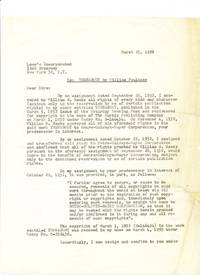
4043Faulkner signed this contract which transferred distribution rights of the film based on Faulkner's story "Turnabout" to the Loew's Corporation. "By an assignment dated September 26 1932 I conveyed to William B. Hawks all rights of every kind. in my story. TURNABOUT published in the March 5 1932 issue of the Saturday Evening Post and registered for copyright. On November 4 1932 William B. Hawks conveyed all. rights. to Metro-Goldwyn-Mayer. your predecessor. In my assignment. it was provided that I. secure. renewals of all copyrights.The copyright of March 1 1932. was renewed in my name on March 4 1959.Accordingly I now assign and confirm to you. the same rights in the work entitled TURNABOUT." Signed in full on the signature line "William Faulkner.". The film referenced in our document is titled "Today We Live" released in 1933 by MGM. According to the Turner Classics Movies web site this film is listed as being distributed by Loew's which was the parent company of MGM from 1924-1959. The story is about an American World War I aviator who befriends a British torpedo boat pilot and comes to see the war from a different perspective. The film considered a romance drama was produced and directed by Howard Hawks and starred Joan Crawford Gary Cooper Robert Young and Franchot Tone. Faulkner provided dialogue for the film. Hawks purchased the option on the story but Irving Thalberg then Vice President of MGM forced Hawks to hire Crawford for the film and forced Faulkner to write a love interest for the men. Crawford was under contract for MGM at the time. <br/><br/>All of this weakened Faulkner's original story and thus the film's plot. In addition the film apparently included inappropriate use of non-period costumes and an unconvincing Crawford. "Today We Live" turned into a failure. According to a movie review in the "New York Times" on April 15 1933 by Mordaunt Hall this "first of William Faulkner's literary efforts to reach the screen. is understood to have been amplified in the studio by the author. is at times vague and cumbersome. It possesses however the spark of sincerity. " Margin tears and stains show on right margins of both pages. unknown books
19361508170Random House 1936. 1st Edition. Hardcover. Fine/Fine. A fine first edition in a fine dust jacket with a signed page from the signed limited edition laid in. Signed by William Faulkner. Small sticker attached on front paste-down. Housed in a custom-made collector's slipcse. Random House hardcover books
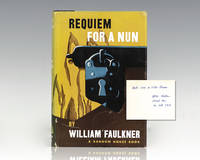
1951112874New York: Random House 1951. First edition of the sequel to Faulkner's Sanctuary. Octavo original cloth. Association copy inscribed by the author on the front free endpaper in the year of publication to his first cousin "With love to Sallie Burns <span class="match">William</span> Faulkner Oxford MS 20 Oct 1951." Sallie Falkner Burns was close with Faulkner and is mentioned in a number of Faulkner biographies as she knew more about his childhood and later years more than anyone living. Near fine in a near fine dust jacket. Jacket design M. McKnight Kauffer. The sequel to Faulkner's early novel Sanctuary Requiem for a Nun follows the previously introduced characters of Temple Drake her friend later husband Gowan Stevens and Gowan's uncle Gavin Stevens. The events in Requiem are set in Faulkner's fictional Yoknapatawpha County and Jackson Mississippi in November 1937 and March 1938 eight years after the events of Sanctuary. In Requiem Temple now married with a child must learn to deal with her violent turbulent past as related in Sanctuary. Random House hardcover books
1940109883New York: Random House 1940-1959. A complete set of the limited signed first edition of Faulkner's acclaimed Snopes Trilogy. Octavo original cloth. Each volume is signed by William Faulkner. Each are in near fine to fine condition. The Hamlet the first book of the series chronicles the advent and rise of the grasping Snopes family in mythical Yoknapatawpha County is a work that Cleanth Brooks called "one of the richest novels in the Faulkner canon." It recounts how the wily cunning Flem Snopes dominates the rural community of Frenchmans Bend- and claims the voluptuous Eula Varner as his bride. The Town the second novel records Flems ruthless struggle to take over the county seat of Jefferson Mississippi. Finally the Mansion tells of Mink Snopes whose archaic sense of honor brings about the downfall of his cousin Flem. "For all his concerns with the South Faulkner was actually seeking out the nature of man" noted Ralph Ellison. "Thus we must turn to him for that continuity of moral purpose which made for the greatness of our classics." Uncommon in this condition. Random House hardcover books
19292005419New York: Jonathan Cape Harrison Smith 1929. First. hardcover. Very good/Very good. A very good first edition so stated on copyright page in a very good restored dust jacket. Restoration to top of dj. 1st issue $3 price for Humanity Uprooted on back panel of dj. Housed in a custom made collector's clamshell case. Jonathan Cape Harrison Smith unknown books
1957125095New York: Random House 1957. First edition first state with the 5/57 at the bottom of the front flap of the dust jacket. Octavo original cloth. Signed by the author on the title page in the year of publication "11 Nov 57 Best wishes William Faulkner." With the publisher's advance review copy slip dated May 1 1957 laid in and a copy of the jacket photograph of Faulkner by Phyllis Cerf laid in. Near fine in a near fine dust jacket with only light rubbing to the crown of the spine bookplate. Jacket design by Push Pin Studios. Rare and desirable signed in the year of publication. The Town follows the fictional Snopes family of Mississippi. It is the second of the "Snopes" trilogy following The Hamlet 1940 and completed by The Mansion 1959. Random House hardcover books
19301508059Jonathan Cape and Harrison Smith 1930. 1st Edition. Hardcover. Fine/Near Fine. A fine first edition first issue in a near fine dust jacket. One of only 750 copies with the first issue dropped I on page 11. Jacket is unrestored. Housed in a custom-made collector's clamshell case. Jonathan Cape and Harrison Smith hardcover books
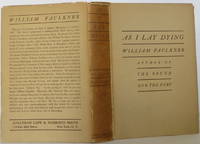
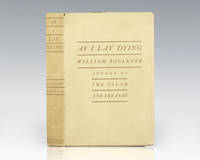
1939115342New York: Jonathan Cape and Harrison Smith 1939. First edition first issue one of 750 copies with dropped "I" on p. 11 and in the first state binding with lettering unbroken of this work which consistently ranks as one of the greatest works of twentieth century literature. Octavo original cloth. Near fine in a near fine dust jacket with light shelfwear. An exceptional example. Faulkner had stated to have written As I Lay Dying in six weeks with no revisions and its stream-of-consciousness style suggests such an immersive spontaneity. "I set out deliberately to write a tour-de-force. Before I ever put pen to paper and set down the first word I knew what the last word would be and almost where the last period would fall" William Faulkner on As I Lay Dying. "No man ever put more of his heart and soul into the written word than did William Faulkner. If you want to know all you can about that heart and soul the fiction where he put it is still right there" Eudora Welty. Listed by Modern Library as one of the 100 greatest novels of the twentieth century. It is the basis for the 2013 film bearing the same name directed and co-written by and starring James Franco. Jonathan Cape and Harrison Smith hardcover books
191713382JOxford Mississippi: University of Mississippi 1917. First Edition. William Faulkner’s historic first appearance in print with his contribution of a drawing. Original flexible leather covers. Contemporary signature of a Faulkner classmate. Near fine copy. All of Faulkner’s Old Miss university yearbooks are rare especially so in this rare first appearance. University of Mississippi hardcover books
195613960JNew York: 3 pages quarto October 8 1956. Original Typed Document Signed – Contract Agreement with MGM Records in which William Faulkner agrees to allow MGM Records to produce a long play recording of him reading from his works. Signed by William Faulkner and initialed 17 times by him in the margins as well as on inserted rider clauses. The finished record “William Faulkner Reads From His Works†was issued in 1957 and contains him reading two excerpts from “Light In August†and two excerpts from “The Sound and the Fury.†3 pages, quarto unknown books
195613975JNew York: 3 pages quarto October 23 1956. Original Typed Letter Signed by William Faulkner and Typed Document Signed by Albert Camus – Typed Letter Signed from William Faulkner and signed as well by Harold Ober authorizing Albert Camus to stage his own production of “Requiem For A Nun†attached to a copy of the contract written in English. Signed by Albert Camus 3 pages October 23 1956. Camus created his own French adaptation and staged it in 1956 entitled “Requiem Pour Une Nonne†and later Camus wrote the preface to the published French translation of Faulkner’s original work. 3 pages, quarto unknown books