13 résultats
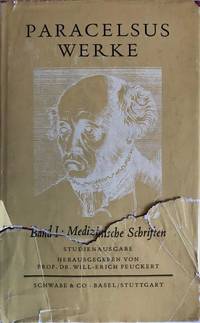
1965MT1055Basel:: Schwabe 1965. 1965. vol. I of II. Small 8vo. XVI 584 pp. Red gilt-stamped cloth. Ownership signature on title of Arthur Teller MD. Very good. Schwabe, 1965. hardcover books
1976BL3133London:: William Heinemann 1976. 1976. Series: Loeb Classical Library No. 471. Volume I of III. 17 cm. lxvii 361 7 pp. Greek & English text. Gilt-stamped green cloth dust-jacket; jacket a bit frayed. Burndy bookplate. Very good. ISBN: 0434994715/ 0674995198 William Heinemann, 1976. hardcover books
197069731Kent:: Kent State University Press. Very Good in Very Good dust jacket. 1970. Hardcover. 0873380428 . Translated from the Greek with notes and introductory essays. First edition. From the personal library of the late sociologist Daniel Bell with his name on the front free endpaper and a few instances of his brief marginalia. Very good in a very good age darkened along the spine dust jacket. . Kent State University Press, hardcover books
1967S10624Chicago:: Argonaut 1967. 1967. First thus. 8vo. 227 pp. Index. Gilt-stamped green cloth. Publisher information tipped-in at title page verso and recto. Includes Theophrastus' De Sensibus in ancient Greek opposite English translation. Ownership signature. Fine. Argonaut, 1967. hardcover books
1923260245Munich: Otto Wilhelm Barth 1923. Volume Seven 7 only of a multi-volume compendium presswork in black-letter with rubricated title- and series-pages. Otto Wilhelm Barth unknown books
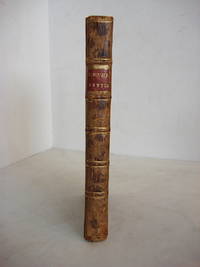
1754684Oxford: R. Clements and J. Fletcher et al. 1754. xii268pp. Note: the final 4 leaves of the preliminaries are misbound at back. Engraved vignette on title. Cont. mottled calf red calf spine label. The first edition of this new translation into Latin with notes and observations in English. R. Clements and J. Fletcher, et al. unknown books
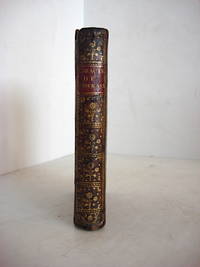
17873210Madrid: Don Miguel Escribano 1787. 8vo. xvi100;304pp. Greek first section pages 60-100 only and Spanish. Cont. mottled calf gilt spine spine extremities a bit chipped. Previous owner's rubber stamp in a few places. Minor marginal worming. Palau 330158 under "Teofrasto". Don Miguel Escribano unknown books
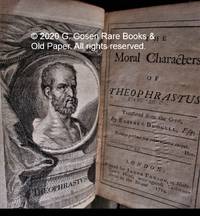
1714370<p>Theophrastus<i>The Moral Characters of Theophrastus. Translated from the Greek By Eustace Budgell Esq; Reddere persone scit convenientia cuique. Hor. </i>London: Printed for Jacob Tonson at Shakespeare's Head over-against Catherine-Street in the Strand 1714. engraved frontispiece by Lud. Du Guernier deli & Sculp; vi; life of Theophrastus xvi; the preface viii; 80; iv 12mo. The introduction begins the text on page 1 chapter 1 begins on page 5; erratum on page 80 advertisements for Jacob Tonson's books 4 pages. Page 79 mis-numbered as "89." Bound in blind-stamped eighteenth century calf re-backed six raised bands. Book plate and embossed stamp of the Sondley Reference Library 1879 – 1919 City of Asheville North Carolina. Ownership signature of Henry Reid above the book plate. With the bookseller's tag of Joseph McDonough Rare Books Albany New York.</p><p>The fraught history of the Sondley Library its holdings its generous benefactor and its eventual piecemeal dispersal is a cautionary tale to any benefactor who might assume economic conditions and local politics will leave his/her bequest unaltered and intact in perpetuity. In the late nineteen-eighties the trustees of the Sondley Library authorized the sale of those books they deemed irrelevant to the Pack Memorial Library's purposes namely North Carolina history. </p>Jacob Tonson the printer is mentioned in Howe's <i>List of London Bookbinders 1648 – 1815. </i>"From his will it appears he was a bookbinder a stationer and a printer as well as a bookseller d. 1735." Lowndes Vol. IV 2663b "Of this translation Addison in the Lover remarked 'it was the best extant of any ancient author in the English Language.' " Printed for Jacob Tonson, at Shakespeare’s Head, over-against Catherine-Street in the Strand, hardcover books
1585D11004Frankfurt am Main: Apud heredes Andreae Wecheli heirs of Andreas Wechel MDLXXXV 1585. Hardcover. Very Good. 4to 210 x 149mm. 16 blank leaves at front and back 4 318 2 pages including final leaf with Wechel printers device. Title also with Wechels woodcut printers device a pegasus soaring over a caduceus pair of cornucopia and shaking hands AW monogram twice. Edited by Friedrich Sylburg. Dedicated to French scholar Joseph Justus Scaliger 1540-1609. Latin dedication notes and index. Greek text 18th-century calf marbled endpapers and red edges rebacked; light edgewear light marginal foxing title lightly browned. Likely remaining for several generations at the library of Balliol College Taylor Institution Oxford number B.181 deaccessioned sometime in the early 20th century two bookplates on front pastedown. Collection of Francis Howard Forbes 1881-1957 professor of Greek language and literature at Amherst College his round pictorial bookplate of Attic-style scribes on front pastedown. This particular copy was cared for by Oxford institutions for a good part of its history then crossed into a New England personal library of a classical scholar sometime in the early 20th century. <br/><br/>This is the self-contained volume from the 1584-1587 collected edition of the works of Aristotle in Greek and the Metaphysica of Theophrastus. Friedrich Sylburg 1536-1596 was a German classical scholar who made important contributions to several popular Greek texts of the later sixteenth century like Estiennes Greek Thesaurus. In 1583 Sylburg resigned from an educational post he held at Lich and moved to Frankfurt to work as leading active editor for the enterprising Wechel publishers. The humanist printers flourished in three distinct cities; Paris Frankfurt and Hanau. Andreas Wechel settled the firm in Frankfurt and distinguished it mainly by publishing neo-Latin literature classical philology and works by Ramus and his followers. The relationship between Sylburg and the Wechel printers was a seamless match; this 1585 edition of Aristotle was praised for its great critical power and finesse. It is widely regarded as the authoritative edition of its kind. Sound example of a sixteenth century published work on Aristotelian principles born from the inventive relationship between scholar and press.Fabricius-Harles III 444; Hoffmann I 275 and 289. Apud heredes Andreae Wecheli (heirs of Andreas Wechel) hardcover books
152817850Strassburg: H. Sybold 1528. Apparently the reprint of an unrecorded 1525 edition. Small 8vo 96 unnumbered leaves printed in Roman types with Greek sidenotes. With 2 nice 9-line historicated initials. Bound in contemporary all-over bindstamped calf rebacked. Some marginal staining a very nice copy. Ritter Bib. Alsace. 2321; Hoffmann III 729; Pritzel Thesaurus Literaturae Botanicae 9187; Strasbourg Imprints p. 248 no. S3.1.2; not in Bird; Adams or the British Library Catalogue. Scarce the OCLC lists just three copies NLM VXG PPC. This is the first edition of Theophrastus to apparently be published specifically as a medical textbook. This contains books vi to ix of the De Historia Plantarum as well as the first three chapters of Pliny's Historia Naturalis. This was translated by Theodore Gaza 1400-1475 that was originally printed in 1483. H. S. Reed notes that Theophrastus was the founder of Botanical science and one of the greatest botanists of all time. The printer Seybold was himself a physician and "probably developed the publication of medical manuals on his own press as an adjunct to his practice . He was instrumental in incorporating the knowledge of the Greek physicians into the standard medical corpus"Chrisman Lay Culture Learned Culture 36 174. The interesting binding is tooled with borders of 2 double ruled frames enclosing strapwork with dots in the small rectangular spaces and large central panels different on the front and back covers of geometrical designs and acrons and a foliate pattern. The title is written on the edges in a contemporary hand. H. Sybold unknown books
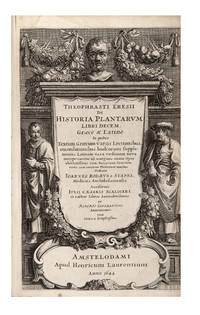
7301Finely engraved title-page a trifle shaved at outer edge & 675 woodcuts in the text. 11 p.l. incl. engr. title 1187 i.e. 1185 87 pp. Folio cont. Dutch vellum over boards upper joint with small split of 7 cm. at foot minor pale dampstaining to first 20 leaves & last third of book panelled in blind central arabesque in blind to each cover ties gone. Amsterdam: H. Laurentius 1644. First edition to be edited by Joannes Bodaeus à Stapel; it "is one of the best and most thoughtfully prepared of all the editions of Theophrastos."-Hunt 240. H.H. Bartlett wrote in his Fifty-five Rare Books Ann Arbor: 1949 of this edition: "It is interesting not only because of the brilliance of the editing but curiously enough to the American botanist as well for involving in the discussion certain species from Virginia other parts of the New World and Asia. The illustrations of these plants have been largely overlooked in botanical history because of their incidental presence in a work which might not be expected to contain anything of the sort. Some were merely borrowed from l'Escluse or de Lobel but others seem to be original in this work." A fine and crisp copy. Bookplate of Piergiorgio Borio M.D. ❧ D.S.B. XIII pp. 328-34. See Garrison-Morton 1783. hardcover books
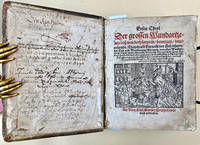
156245126Frankfurt: G. Raben & heirs of W. Hanen 1562. <p>Paracelsus Theophrastus Philippus Aureolus Bombastus von Hohenheim 1493-1541. Erster Ander; Dritter Theil der grossen Wundartzeney . . . von allen Wunden Stich Brendt Thierbissz Beinbrüch . . . 3 vols. in 1 4to. 12 115 1 blank; 12 129 1 colophon; 74ff. Titles in red and black. Large woodcut vignettes on the titles of each volume each illustrating a different medical or surgical procedure; woodcut illustration of surgical instruments on leaf 4 of the Erster Theil; astrological woodcut on f. 64 of the same volume. Frankfurt: G. Raben and the heirs of W. Hanen n.d. 1563. 198 x 150 mm. 16th-century blind-tooled pigskin over wooden boards brass clasps corners worn some age-darkening small wormhole in front cover. Light marginal dampstaining edges frayed some toning title of first part soiled but very good. One or two marginal annotations some notes in different hands on the front and rear pastedowns.</p> <p> Rare Early Illustrated Edition of Paracelsus's Der grossenn Wundartzney first ed. 1536 his first book on surgical technique and the only major book by him published during his lifetime. "Philippus Aureolus Theophrastus Bonbastus von Hohenheim also known as Paracelsus remains one of the most controversial and remarkable personalities of the Renaissance. He has been described as a quack a magician and astrologer and an alchemist as well as a brilliant physician prophet and genius. Sir William Osler called him the ‘Luther of medicine' and Fielding Garrison lauded him as ‘the most original medical thinker of the sixteenth century.' He was perhaps all of these . . . Unlike his contemporaries Paracelsus regarded surgery as no less worthy than medicine writing on both subjects and signing himself Doctor beider Arznei doctor of both medicines. As a surgeon he treated wounds successfully using conservative methods in contrast to the common practice of cauterization with boiling oil. He was the first to agree with the fourteenth-century surgeon Henri de Mondeville that wounds must be kept clean and Garrison described him as ‘almost the only asepsist between Mondeville and Lister'" Grolier Club One Hundred Books Famous in Medicine pp. 61-62.</p> <p> The Grosse Windartzeney provides comprehensive instructions in all areas of surgery and wound management. Treatments are described for wounds caused by arrows bullets burns including those caused by gunpowder and by freezing animal bites including poisoned ones cuts fractures etc. The second book discusses the treatment of open wounds and includes instructions for the preparation of chemical prescriptions for treating venereal diseases sores ulcers fistulae cancerous growths etc. The third book is on syphilis including hereditary syphilis its origin causes symptoms and cures.</p> <p> This edition appears to have been issued at the same time or before Sudhoff's nos. 49-51. The first and second volumes Erster and Ander Theil have the same collations as Sudhoff nos. 49-50 except that the preliminary gatherings are signed with typographical symbols instead of lower-case letters. The first signature of the third volume is the same as Sudhoff 51 with the remainder coming from Sudhoff 29 1553; the publishers Raben and Hanen had taken over the unsold copies from the original publisher Herman Gülfferich and printed new preliminary leaves. Sudhoff Bibliographia Paracelsica 52. </p> . G. Raben & heirs of W. Hanen unknown books
148316243Treviso: Bartholomaeus Confalonerius 2 Feb 1483. First edition in Latin later issued in Greek with the Aldine Aristotle editions of 1497 and 1498. Folio 153 leaves lacks the front blank and 2 leaves of text supplied in clean facsimile. 28.4'x9.2 cm. Bound in later cloth backed boards some marginal waterstaining contemporary Italian marginalia some trimmed close throughout with a full page of contemporary notes on the verso of the final leaf. HC 15491; BMC VI 894; BM-Ital 668; Klebs 958.1; Garrison 1929 12; Castiglioni 1947 181-182; Stillwell T132; Goff T-155; Pritzel 9184;Osler 263; Stillwell The Awakening . 72; Procter 648; Dibner Heralds of Science 18; Norman 266. Rare this had not been to auction since December of 1967 when it sold for $75000 until it sold for $55200 at the Haskell Norman sale 3/18/1998. Stillwell notes that this is the earliest scientific botany. A study of about 5 plants described according to a rather primitive classification which held however until the mid-sixteenth century. Its ninth section on the medicinal properties of plants"the earliest extant herbal except for fragments of a Greek herbal c. 35 B.C."is believed to have been added somewhat after Theophrastus's time. Known as the founder of scientific botany Theophrastus was born in Lesbos and was Aristotle's most highly regarded student and succeeded Aristotle as head of the Lyceum in Athens. He was a prolific writer yet only these two works survive as major works. His De Historia Plantarum described and classifies several hundred plants while the De Causis Plantarum is a work of etiology: exploring a number of topics including generation seeds and the effects of cultivation on wild species. The Historia divides plants into four main divisions: trees shrubs undershrubs and herbs. The translation is by Theodoros Gaza a Greek who became a leading figure in the Italian Renaissance. This translation was commissioned by Pope Nicholas V 1448-1455 a patron of scholars who wished to set up a library that included Greek texts in Latin. Bartholomaeus Confalonerius 2 Feb unknown books