231 résultats
38299Pais, Lemerre en 1876. In-8 en plein maroquin signé Cuzin. Exemplaire n° 46 sur papier Whatman, signé au crayon bleu par l'éditeur. Soixante ballades choisies. 185 pages avec Notes, Appendice, Index des Auteurs, Index des Ballades. Belle reliure janséniste. Bel exemplaire avec quelques rousseurs sur les pages de garde.Tranches dorées.
27560P. Lemerre, 1876. In-8, XXXII-185 pages. Broché. (un petit point brun sur la couverture, sans gravité).
40506New York: H. De Marsan n.y. Broadside. 6¼" X 10". Very good. Numerous edge chips along right side and bit on lower edge only slightly encroaching on decorative border. This crudely printed broadside ballad undated but circa 1861 includes a thick decorative patriotic border featuring red and blue stars and stripes olive-branch clutching American Eagle etc. with publisher's data "H. De Marsan Publisher / 54 Chatham St. / N.Y." at bottom center of border. Sung to the tune of "Marshal Ney" a popular tune celebrating the Napoleonic figure this Civil War tune celebrates the 69th New York Infantry Regiment the "Fighting Irish" or "Fighting Sixty-Ninth." Two stanzas and one chorus are featured the chorus reading: "Right and left -- left and right: / We fought the Rebels with all our might; / Brave CORCORAN did wounded fall / And HAGGERTY died by a Traitor's ball." Irish-born Michael Corcoran 1827-63 led the 69th at the First Battle of Bull Run in July 1861 in which he was taken prisoner and Irish-born Captain James Haggerty the first member of the 69th to die was reportedly killed by a Louisiana Zouave which also included many Irishmen. These "penny ballads" were all the rage during much of the 19th century and were invariably printed on thin delicate stock and sold by street vendors. A quite attractive example of this rare survivor. Inkstamped on verso is "Geo. F. Hambrecht" -- a well-known Civil War collector and noted Lincoln scholar 1871-1943 who founded the Lincoln Fellowship of Wisconsin and served as director of the Wisconsin State Board of Vocational Education. H. De Marsan unknown
380 p. Numerous penciled notations. Sm. 8vo. Worn original publisher's cloth binding. Used as a school book. Athenaeum Press Series. A book of English Ballads. Gummere was of Philadelphia Quaker stock. PA 31
1860214168Glasgow: Printed for the Booksellers" 1860. No. 20 printed at foot of title. Title with woodcut vigentt of "Fair Rosanna". 8 pp. 1 vols. 12mo. Single sheet folded twice; unopened and unbound. A little dusty and wrinkled otherise very good. No. 20 printed at foot of title. Title with woodcut vigentt of "Fair Rosanna". 8 pp. 1 vols. 12mo. <br/><br/> Printed for the Booksellers" unknown
202002061S.l., Flammarion, 1953 ; in-8, 200 pp., br. Très bon état exemplaire dédicacé de l'auteur en pleine page.
200916353Paris, Mercure de France, 1921 ; in-12, 281 pp., broché. 5e editions.
202002060Paris, Flammarion, 1952 ; in-8, 230 pp., br. En bon état exemplaire dédicacé de l'auteur joint une petite lcarte de l'auteur manuscrite et signé (soie 2 signatures).
200702395Paris, Flammarion, 1947 ; in-12, 284 pp., broché. Edition définitive des ballades française et chroniques de france - tome X - avant propos de REMY DE GOURNMONT - EXEMPLAIRE SUR VELIN DES VOSGES - N° 98 /275.
202002099Paris, Flammarion, 1949 ; in-12, 36 pp., br. EN SUPERBE ÉTAT - tome 13 - exemplaire dédicace de Paul Fort en pleine page.
22259Printed by 'William Thomas Argraffydd Caerfyrddin.' No date late Vicvtorian. The title is 'Hanes alarus am 26 o golliers a gollasant eu bywydau yn pwll glo Bedwellty gerllaw Tredegar Dydd Gwener Mehefin 16 1865.' This may be translated as 'The woeful tale of 26 colliers who lost their lives in the Bedwellty coal mine near Tredegar Friday 16 June 1865. 4pp 16mo 15.5 x 9 cm. Paginated 1-4. Bifolium. Printer's slug at foot of last page. Disbound. A frail survival: aged and worn. Beneath the title and covering the rest of the first page is a list of 25 of the deceased their ages and dependents headed 'ENWAU Y PERSONAU.' The first entry in the list is 'Thomas Meredith 50 oed priod ac un plentyn'; and the fourth 'Lewis Lewis 40 gweddw a phump o blant'. The poem in sixteen four-line stanzas covers pp.2-4 and is headed 'HANES ALARUS.' No copy in the National Library of Wales. The only copy of this item located either on OCLC WorldCat or on COPAC is at Swansea University where it is bound with other pamphlets by Carmarthen printers. Printed by 'William Thomas, Argraffydd, Caerfyrddin.' No date [late Vicvtorian]. unknown
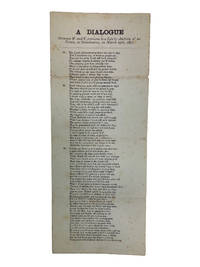
1877003678No Place: No Publisher 1877. Single sided printed ballad approximately 125mm x 315mm in size. Lightly foxed creased from old folds couple of minor nicks to edges at folds but fairly bright. A dialogue between W. and K. about a land sale where W. notes that K. has enough money to buy the land over the local lord. K. states that W. couldn't even afford the deposit and bemoans Radicals assailing his property rights. W. then advises K. that Death is at hand and he would do better to retire and marry a widow rather than a young maid as "It may be that the Lass for lucre's sake To the old Man may in appearance take But youth and beauty 'tis a shame to see Grafted upon an old and sapless tree". Swanbourne is in Buckinghamshire. Broadside Ballads Online: BOD628. First Edition. Unbound. Good. Folio. Broadside. No Publisher paperback
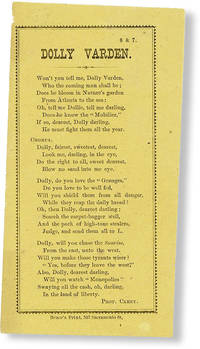
187048786San Francisco: Bruce's Print n.d. ca. 1870s. First Edition. Small broadside 16x8.5cm. printed within typographically decorative border on yellow stock. Miniscule loss at top left-hand margin else Near Fine. Printed at head of title "8 & 7."<br /> <br /> Reconstruction-era three verse ballad broadside addressed to Dolly Varden not /the/ Dolly Varden of Charles Dickens' novel "Barnaby Rudge" though the name was hugely popular as a result of the work and inspired a fashion craze and the name of a trout. The text makes mention of the 1872 Crédit Mobilier fraud; promotes the work of the Patrons of Husbandry "Dolly do you love the 'Granges' / Do you love to be well fed / Will you shield them from all danger / While they reap the daily bread"; and attacks the spread of carpet-bagging in the South "Search the carpet-bagger well / And the pack of high-tone stealers / Judge and send them all to L. Bruce's Print unknown
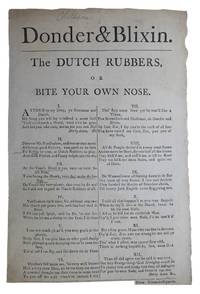
AQ25363London: Printed by W. & T. Bailey s.d. c.1785-1799 Single leaf broadside edges uncut. Shaving to foot with loss of imprint. A remarkably rare survival of 'three-half-pence' broadside verse satire in which a fight breaks out among a group of Dutchmen in a Chelsea tavern. The title of the bawdy ballad is a corruption of the Dutch expression 'donder en bliksem' meaning 'thunder and lightning'. ESTC records a single copy Oxford. ESTC N71592. Dimensions 200 x 290 mm. [Printed by W. & T. Bailey], [s.d., c.1785-1799] unknown
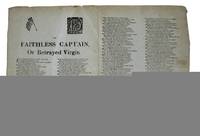
AQ31852London: J. Pitts s.d. c. 1820-44 Single leaf broadside edges uncut. Printed in four columns. With three woodcut vignettes. Old central vertical fold. A trifle creased and marked. A rare survival of a broadside ballad in which the captain of a ship bound for India discovers on board the young servant girl whom he had pledged to wed but then abandoned. He finds that she is carrying his child and though at first angered by her 'betrayal' agrees to marry. However 'fortune to them proves unkind' and a storm descends upon them sweeping the maiden into the sea. When the captain finds her body 'floating on the main' two days later he casts himself overboard to 'share the same fate'. The publishing house of John Pitts 1765-1844 was responsible for a prodigious output of cheap popular printing in the first half of the nineteenth-century. COPAC records copies at just two locations BL and Hull; OCLC adds two further Adelaide and Toronto. . Dimensions 360 x 250 mm. [J. Pitts], [s.d., c. 1820-44] unknown
183029079London: H. Disley 1830. Good overall. That's Where You're Wrong' includes references to emigration to Canada a spirited revolutionary song: "Rise Britons rise and ring your voices thro' the land…"<br /> <br /> This is a broadside ballad were sold for half a penny or penny on the streets in London Manchester and other British cities during the 19th century. Once newspapers became more widespread and cheaper they largely displaced this type of street literature. Printed on cheap tissue paper they included religious warnings political arguments satire comedy bawdy tales crime news fantastic tales love and relationship advice and calls for social reform. In some cases the printer would suggest a familiar tune that would fit the lyrics provided. Most had a woodcut illustration although it may have been unrelated to the subject matter. Many broadside ballads in London were printed in the Seven Dials district. They were sold in large numbers on street corners in squares and at fairs by travelling ballad singers and also pinned on the walls of alehouses where they were sung and read. However because they were meant to be disposable presaging both the consumer culture and mass media relatively few have survived. 7 1/2 by 9 1/2 inches toned edges chipped fold line repaired. H. Disley unknown
29078London. First line: "Have you heard of the rumpus there was I declare All the Popes in the world was in Belgrave Square…"<br /> With The Wonderful Crocodile. "Now list ye landmen all to me To tell you truth I'm bound What happen'd to me by going to sea…"<br /> <br /> According to Burl Ives this tune was based on an old Irish air. John and Alan Lomax collected it in Nova Scotia in 1921 from a man who said it was a song he'd known since he was a boy - "one of thoses that used to be roared out in the back rooms of taverns frequented by seamen forty or so years ago."<br /> <br /> This is a broadside ballad were sold for half a penny or penny on the streets in London Manchester and other British cities during the 19th century. Once newspapers became more widespread and cheaper they largely displaced this type of street literature. Printed on cheap tissue paper they included religious warnings political arguments satire comedy bawdy tales crime news fantastic tales love and relationship advice and calls for social reform. In some cases the printer would suggest a familiar tune that would fit the lyrics provided. Most had a woodcut illustration although it may have been unrelated to the subject matter. Many broadside ballads in London were printed in the Seven Dials district. They were sold in large numbers on street corners in squares and at fairs by travelling ballad singers and also pinned on the walls of alehouses where they were sung and read. However because they were meant to be disposable presaging both the consumer culture and mass media relatively few have survived. 7 1/2 by 10 inches. Edges slt ruffled o/w vgc. unknown
First and only edition, 12mo, [2], 45, [1]pp., with half-title, some minor spotting, orig. marbled paper wrappers, cont. manuscript notation of title and author on upper cover "The Battle of Newland 1790, By Benjn. Clarkson, Alverthorpe Hall". ESTC fails to attribute this to an any particular author, however, the contemporary inscription on the upper cover does give strong evidence to Benjamin Clarkson as being the writer of these poems. Benjamin Clarkson (d. 1820), a Wakefield attorney, resided at Alverthorpe Hall. "Several well known circumstances which happened some years ago in the town and neighbourhood of Wakefield, gave rise to the following Ballad". (Advertisement leaf). Rare; ESTC locating 4 copies (all in the UK).
1827100140Paris, De l’Imprimerie de Crapelet, 1827. In-4, demi-veau vert à coins, dos à nerfs orné d’un décor doré. (quelques rares rousseurs éparses).
202002059Paris, Flammarion, 1950 ; in-8, 270 pp., br. En bon état exemplaire dédicacé en pleine page de l'auteur.
15906Early eighteenth century. Another later version published in the Gentleman's Magazine London May 1744. 2pp. on both sides of a strip of 35.5 x 11.5 cm laid paper with fleur-de-lys watermark. In a secretary hand employing the thorn and long s. In fair condition on aged and worn paper. An untitled forty-line poem divided into five numbered eight-line stanzas. The narrator is an older married woman advising a younger woman not to marry with observations on the frailties of the male sex. The first stanza reads: 'Ere ye. read ys. ye. may suppose. That some new listed Lover. By means of Poetry has chose. His Passion to discover. Know Faire one I am a Matron Grave Which Time & Care has wasted And would thy Youth from sorrow save Which I have in Wedlock tasted.' A variation of the poem was published in the Gentleman's Magazine May 1744 with the title 'The MATRON's Advice to a YOUNG LADY A new BALLAD. Tune Sally.' The grammar of the Gentleman's Magazine version is more modern in tone its first line reading: 'Ere you read this you may suppose' and the variations are most apparent in the third stanza including 'Beset thy dwelling' in the published version for 'Surround thy Threshold' in the manuscript; 'heedless' for 'regardless'; 'Pass all your minutes' for 'Thy Moments pass on'; 'While flames are offer'd at our shrine And Men like Idols sue us' for 'Darts flames & hoards adorn Our shrine And Awful Hymen woo us.' The writer has begun to write another poem on the reverse of the slip: 'Come lesten sic ye tories & jacobites now Your Plot <.> shew'. Not present in the English Broadside Ballad Archive. Early eighteenth century. [Another (later?) version published in the Gentleman's Magazine, London, May 1744.] unknown
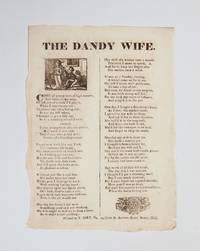
18285421London: T. Birt 1828. First edition. Single sheet measuring 250 x 185mm and printed in two columns to recto. Some edgewear to margins not affecting text; a bit of foxing and toning largely confined to margins. A scarce and delicate survivor OCLC documents only one example at the National Library of Scotland. The present is the only example on the market.<br /> <br /> The Dandy Wife is narrated by a man who aimed "to choose me out a loving wife" at the age of twenty-one but whose experience becomes a warning to "all young men of high renown": "If you want a tidy wife Beware of a boarding school." What unfolds is a satire of how the marriage economy is affected when women have access to knowledge -- intellectual and physical -- and how by meeting a man's superficial expectations a woman can fulfill her own more pressing needs.<br /> <br /> Thinking that a boarding school girl will have the innocence submissiveness and domestic skill he desires the narrator selects a wife from among their ranks. Thinking only of what he can obtain from such a bargain he is unprepared for what an educated woman brings into his house. The Dandy Wife he describes understands the commodity value of her own beauty and material adornment and that these are her key means for acquiring wealth of her own. "She takes one-half of what I earn In drinking gin and tea; Besides such frills and furbelows My Dandy Wife does wear.Her sleeves upon her dandy gown Oh! Lack they're such a size You'd think they were two balloons that in the air would rise." Aside from staying on par with fashion trends her clothing assists her in avoiding domestic tasks she abhors. She refuses to do laundry more than monthly and through ridiculous cooking failures she rapidly establishes that the kitchen is not a showcase for her skillset. Accustomed to a life of learning she is not trained to conduct domestic business. <br /> <br /> By the ballad's end it becomes clear that the Dandy Wife was savvier in managing a marriage than her husband was. For not only does her superior intellect help her carve out a more satisfying role but she also has physical knowledge that predates him: "The day that I was married I thought I'd got a charming maid But I was much deceived.For scarce five months we'd married been When she had a darling son. T. Birt unknown
201706737Mulhouse, Salvator, 1987 ; in-12, 104 pp., br.
201602922Mulhouse, Salvator, 1987 ; in-12, 104 pp., br.
201012943Mulhouse, Salvator, 1987 ; in-12, 104 pp., broché, couverture illustr. Très bon état.