Bonanno, Joseph with Lalli, SergioBiblio.com
226 résultats
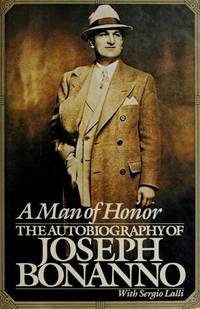
198385978New York: Simon and Schuster 1983. First Printing Stated. Hardcover. Good/Good. 416 pages. Illustrations. Index. Stamp on bottom edge Some edge soiling. Hand written note from the author pasted onto the fep. Note reads To Isaac Marks "only the just man enjoy peace of mind" Wishing you good luck and God Bless you. Sincerely Joseph Bonanno 1/18/1986. Joseph Bonanno provides a unique view of life inside the Mafia describing the organization and its important figures and his vision of this closed society as a confederacy of men of honor. Joseph Charles Bonanno born Giuseppe Carlo Bonanno; January 18 1905 – May 11 2002 sometimes referred to as Joe Bananas was an Italian-American crime boss of the Bonanno crime family which he ran from 1931 to 1968. Bonanno was born in Castellammare del Golfo Sicily. At the age of three Bonanno immigrated to New York City with his family for about 10 years before he moved back to Italy. He later slipped back into the United States in 1924 by stowing away on a fishing boat bound for Florida. After the Castellammarese War Bonanno took control of most of the crime family and at age 26 Bonanno became one of the youngest-ever bosses of a crime family. In 1963 Bonanno made plans with Joseph Magliocco to assassinate several rivals on the Mafia Commission. When Magliocco gave the contract to one of his top hit men Joseph Colombo he revealed the plot to its targets. The Commission forced Magliocco into retirement while Bonanno fled to Canada. In 1964 he briefly returned to New York before disappearing until 1966. The "Banana War" ensued and lasted until 1968 when Bonanno retired to Arizona. Derived from a Kirkus review: "Where judgment of my conduct is concerned I'll take my chances with God."" That's really the bottom line of this no-regrets autobiography of the man who served for close to 40 years as "Father" of a New York-based organized crime family. Bonanno paints himself as "the last survivor of an extinct species and of a bygone way of life." He may well be right. Born into a "leading family" of the Castellammare area of Sicily expelled from an Italian merchant marine academy three years later the young Bonanno landed in America an illegal immigrant and rapidly made his way up through the ranks of the Maranzano "family" amid the chaos of the gangland "Castellammare War" becoming Father of his own family in 1931 at the age of 26. Bonanno always considered himself a man "of the old Tradition" whose family operated on certain firm principles irrespective of what the law said or where a fast buck could be made: e.g. no dealing in narcotics or prostitution no shooting of police or reporters. As the decades passed this conservative style became less in tune with that of other members of the "Commission" the quasi-official ruling body of the Sicilian crime families. Commission members had to be on their toes: quite apart from the slings and arrows of normal political maneuvering one could easily wind up dead. Bonanno's impressions of some of the dramatis personae: Capone--a non-Sicilian and "never representative of our Tradition;" Luciano--"the forerunner of things to come"; Gambino--"a squirrel of a man a servile and cringing individual"; Valachi--"an unreliable interpreter of events." By the Sixties Bonanno felt that the old Tradition "deteriorated. . . and became a byword for gangsterism. . . a grotesque parody of itself" and he began spending more time at the Tucson home to which after several heart attacks he later retired. Bonanno confesses to nothing he calls his recent conviction a case of "speculation based on circumstantial evidence". But there are some fine small snapshots in this personal album: the young Bonanno taking his future father-in-law for a spin in his roadster with his bride-to-be relegated to the rumble seat; the kidnapped Bonanno interrogated for months in a remote farmhouse by his cousin the Buffalo family leader an erstwhile Commission ally; the on-the-lam Bonanno cornered by his own German Shepherd who no longer recognizes him; the devout Bonanno chatting with Billy Graham. Despite some stiff prose here and there: valuable as an insider's political history of the New York mob--and impressive as a personal statement by a man who within the context of his Tradition feels he has earned the book's title. Simon and Schuster hardcover