Aa. vv.MareMagnum

571 résultats
Introduction par Georges Hugnet; 14 ill. in 7 pagine patinate f.t. Edizione stampata in 2020 esemplari.
ill., br. "Perverso e paranoico" raccoglie i testi che Salvador Dali scrisse negli anni trenta, i più decisivi per la definizione della sua poetica surrealista e per la sua maturazione artistica. Ne nasce l'autoritratto della più grande «mente immaginativa del secolo scorso», che illumina di luce nuova le sue opere - ma anche il suo pensiero sul rapporto fra arte e politica, sul sesso e sulla religione, sulla scienza e sulla psicoanalisi -, l'amicizia con Luis Bunuel e Federico Garcia Lorca, il tormentato sodalizio artistico con i surrealisti e la passione per il cinema e la fotografia. L'ossessione, il sogno, l'estasi, il delirio: l'irrazionalismo è il più fertile dei fattori espressivi e creativi grazie al metodo paranoico-critico, vera e propria chiave di volta del percorso di Dali. Nel suo universo artistico ogni rigida distinzione intellettuale, ogni comoda categoria pratica, persino il più ovvio rapporto di causa-effetto sembra implodere e dichiararsi «altro» da sé. L'inorganico trapassa improvvisamente nell'organico, istinto sessuale e istinto alimentare si fondono, mentre Freud e Einstein vengono eletti degni successori di maghi e alchimisti per aver dimostrato - ciascuno a modo suo - che la materia è instabile. Ci vuole un «genio» - un genio che, inutile dirlo, Dali identifica con se stesso - per portare a termine l'aspirazione alchemica prima: mostrare, proprio attraverso una radicale, mistica trasmutazione della materia, come sia possibile perseguire un analogo cambiamento di coscienza: un'«estasi», cioè uno stato nel quale «ogni giudizio cambia in modo sensazionale», e da cui solo può sgorgare l'arte.
199897798Berlin, Volksbühne am Rosa-Luxemburg-Platz, (1998). Beidseitig bedruckter Bogen auf farb. Papier [recto Spielplan für die 3 Spielstätten Bühne, Roter Salon u. Prater im April; verso einleitende Kommentare zu "Perpetuum Mobile" u. 3 anderen Stücken]. 42 x 29,5 cm, mehrfach gefalzt zu 15 x 7 cm.
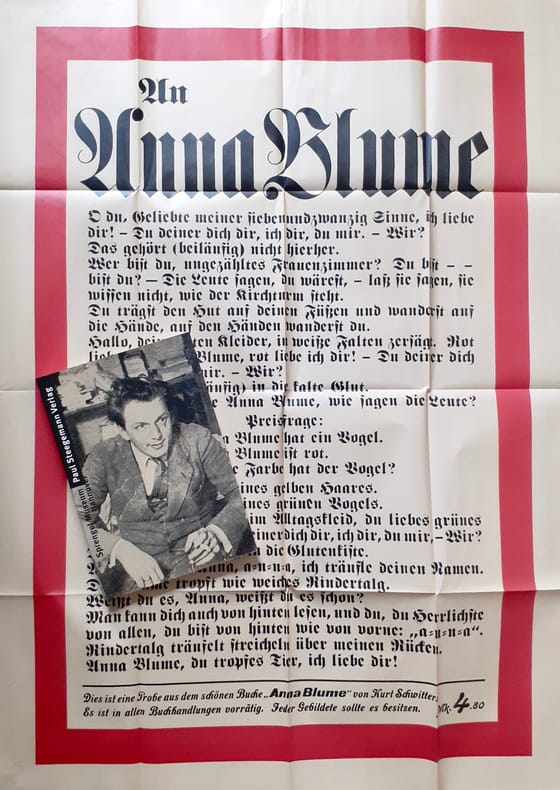
31578Stuttgart : Gerd Hatje / Sprengel Museum Hannover, 1994 - in-8 (16,7x24,2cm) broché sous couverture rempliée, 191pages abondamment illustrées avec une affiche dépliante en deux tons - textes en allemand - bon état -
199419929(Berlin), Edition q, 1994. 384 S. Mit Fotos. OPp. mit SU.
In 4, cm 21 x 30, pp. 576 con moltissime illustrazioni nel testo in b/n e a colori. Brossura editoriale. Ricco e importante catalogo sulle avanguardie culturali, i movimenti letterari e politici tra Francia e Germania: espressionismo, dada, costruttivismo, bauhaus, fotografia, cineama, teatro ecc.
37575Nijmegen, Vantilt, paperback, geillustreerd, 96 pagina's. ISBN 9789075697926.
FIRST EDITION of this poem by Picabia. 8 pp. EDITION LIMITED TO 13 COPIES PRINTED ON FINE WOVE PAPER, OF WHICH THIS IS NUMBER 7. INITIALED BY P.A. BENOIT. Square 24mo. Original wraps. FINE AND BRIGHT, AS NEW. Exceedingly rare.
In 8, cm. 23 x 27, pp. 209 + (3), con 2 illustrazioni fotografiche a piena pagina in bianco e nero a che ritraggono l'artista, numerose illustrazioni in bianco e nero intercalate nel testo e 189 tavole in bianco e nero e a colori che riproducono i suoi dipinti e le opere grafiche. Brossura editoriale illustrata. Ottimo esemplare. Il catalogo e' stato realizzato in occasione dell'omonima mostra tenutasi a Genova presso il Museo d'Arte Contemporanea di Villa Croce dal 30 luglio al 14 settembre 1986. Otto Dix, pittore tedesco, esponente di spicco della "Neue Sachlichkeit" (Nuova oggettivita'), dipinse le sue opere piu' note durante gli anni della fragile Repubblica di Waimar, incentrate su temi forti e rappresentati con crudezza: la guerra e la morte al fronte, i reduci, le deformita', il rapporto tra eros e morte, oltre a numerosi ritratti e autoritratti che realizzera' con costanza per tutta la vita. Al termine della seconda guerra mondiale aderi' al gruppo espressionista della Secessione di Dresda ma ben presto, con Grosz, Schlichter e Heartfield, diede vita al gruppo dadaista tedesco, organizzando nel 1920 a Berlino la Prima fiera internazionale dada.
In 8° quadr., leg. edit. T.Tela con sovr. in acetato con disegno a col. al piatto, pp. 70 circa con 44 tavv. b/n e col. Unito fascicolo con traduz. del testo in francese, inglese e tedesco.
In 8°, cartoncino editoriale ill. , pp. 12 su carta lucida con riproduzioni b/n di alcune delle opere esposte e ritratto dell'autore. Breve testo introduttivo dell'autore, in collaborazione con Erik Satie. Testo del catalogo "Quando gli oggetti sognano" di Tristan Tzara. I testi sono in lingua italiana, inglese e francerse. Buon esemplare.
1989143523Paris, Nrf Gallimard, coll. « Bibliothèque de la Pléiade », n° 358 1989 In-16 17 x 10,5 cm. Reliure éditeur cuir havane, sous jaquette rhodoïd et étui carton blanc illustré, LXXX-1699 pp., notices, notes, notes et variantes, bibliographie, discographie, table des titres. Exemplaire en très bon état.
197797253Lahn-Gießen, Anabas-Verlag, ( 1977). 212 S. Mit Abb.u.Taf. 21 cm. OKart.
28284Paris, Gallimard, 1er août 1931, in-8, brochés, pp. 327 à 330. Réactions et articles sur le dossier dada par L. Aragon, G. Ungaretti, P. Eluard, T. Tzara, etc. Un des exemplaires de luxe numérotés sur vélin pur Lafuma-Navarre, seul grand papier.
28284Paris, Gallimard, 1er août 1931, in-8, brochés, pp. 327 à 330. Réactions et articles sur le dossier dada par L. Aragon, G. Ungaretti, P. Eluard, T. Tzara, etc. Un des exemplaires de luxe numérotés sur vélin pur Lafuma-Navarre, seul grand papier.
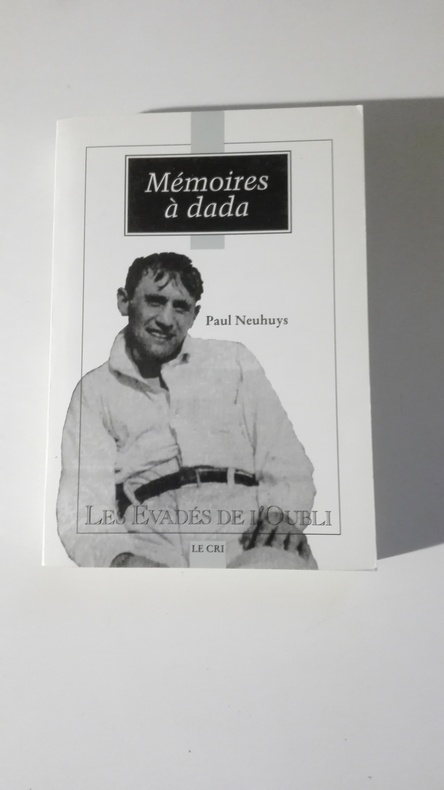
5362Le Cri, 1996. In-8. Broché. Portrait en couverture. 305 pages. Dessins et photos NB in et hors texte. Biographie et index. Etat neuf
1997121307Paris Lachenal & Ritter 1997 1 vol. broché in-8, broché, 238 pp., quelques photos et fac-similés. Nouveau tirage (1997). Très bon état.
1997121307Paris Lachenal & Ritter 1997 1 vol. broché in-8, broché, 238 pp., quelques photos et fac-similés. Nouveau tirage (1997). Très bon état.
New English Paperback. Pbo. 4to. (31 x 24 cm). In English and Turkish. 112 p., b/w and color ills. Murat Akagündüz. VErtigi. [Exhibition catalogue]. Edited by Süreyyya Evren, Ilkay Baliç. Murat Akagündüz's exhibition Vertigo brings together 13 paintings from the "Kaf" series. In this new series the artist depicts some of world's highest mountain peaks as seen on Google Earth. How is the act of painting transformed once we rely upon the mediation of digital data to depict an actual physical landscape? The exhibition thus refers to the ontological consequences of such digital mediation in our relationship to the Earth and its implications in terms of vision and image production. While the series, named after the Kaf Mountain, emphasises a mythological narrative, each painting in the "Kaf" series takes its title from the latitude and longitude values defining the position of the images on Google Earth. Akagündüz offers us views over the peaks of the Alpide Belt, spreading across three continents, and provides us with the coordinates of the Kaf Mountains at the same time. In juxtaposing mathematical exactitude with the perceptually challenging monochromatic use of the colour white, Akagündüz's intention is to explore the minimal conditions of visual representation. The "Kaf" series, in its search for a language using different shades of white, winnows down the minimal conditions of pictorial representation to a bare-bones relationship between light and shade and approaches the threshold of visual perception. In the "Kaf" paintings, the line of the horizon is either invisible or it escapes the eye by merging with the upper corner of the canvas. Adopting a satellite view of the Earth the paintings represent a vertical, groundless perspective. As the horizon is nowhere to be found, our sense of being grounded in space is unsettled and a sense of vertigo sets in. This vertigo effect is also echoed in the spatial construction of the exhibition through a subtle intervention on the walls delineating the first floor of Arter. The "Kaf" paintings bring the process of emergence of image to the eye and to memory, between appearance and disappearance, through reverberations in time. At first sight, these appear to be abstract fragments that are difficult to read in terms of their relationships of scale to the reality they were cut off from. The even distribution of light on the entire surface and its movements through various shades of white, by evading the eye, catch and hold the gaze. The stains, which slip away and alter the moment we think we have caught an image, are contiguous with the void and create a silent space of tension. Vertigo denotes the dizziness and loss of balance felt when a subject or the objects surrounding them appear to be moving in space. As reflected through Murat Akagündüz' "Kaf" series, vertigo is a relational phenomenon, it points both to a spatial disorientation on psychological and physiological levels, and to an uncertainty regarding subject-object relationships as perceived within space. By opening up a space for silent contemplation, the paintings invite the viewer to sense the new possibilities found in this loss of ground and thus produce a new perception of the world.
1280Bordas. 1947. Fort in-8° broché. 310 pages. Edition collective.
194779131947. Paris éditions Bordas 1947 - Broché 12 cm x 19 cm 309 pages - Texte de Tristan Tzara préface de Jean Cassou - Couv. en partie insolée sinon très bon état
11817Sans lieu, sans nom déditeur. [1959] « Ce livre, écrit en 1932 dans le port de Cannes sur le Yacht de Francis Picabia, " lHorizon ", a été imprimé 200 et 20 fois pour lauteur et quelques amis ». Grand in-8° en feuilles sous chemise vert deau imprimée. 66 pages. E.O. 1/220 du seul tirage. Chemise partiellement insolée. Bon exemplaire. Rare.
94148Paris, Jean-Jacques Pauvert, 1974. 13 x 21, 251 pp., broché, très bon état.
Edizione originale. Ottimo esemplare, fresco e pulito, a fogli chiusi. Secondo intervento pubblico di Andrè Breton in reazione alla bizzarra accusa rivolta a Luis Aragon nel gennaio 1932, quando il suo componimento «Front rouge» fu denunciato per sobillazione militare, istigazione all’omicidio e propaganda anarchica. La proposta di Breton a difesa di Aragon, in realtà, si collocava entro un dibattito molto più ampio incentrato sulle qualità politiche “attive” della letteratura, laddove la proposta bretoniana di una “immunità letteraria” sembrò piuttosto sostanziare la linea di un surrealismo apolitico. «On aurait tort de considérer comme anecdotique la querelle entre Breton et Aragon. Ce sont deux conceptions antagonistes de la littérature qui s’affrontent cette année-là. Dans un premier temps, Breton et le groupe surréaliste vont prendre la défense de Louis Aragon dans un tract [«L’Affaire Aragon»]: ils en appellent, dans les grandes lignes, à l’immunité pour le poète. “L’Humanité”, dans un contexte déjà conflictuel avec le surréalisme, va précisément s’opposer à cette immunité. Et toute la question de la responsabilité et de l’engagement se pose déjà. Pour l’organe du PCF, Breton et les surréalistes seraient coupables de ne pas assumer leur vocation révolutionnaire. Dans un second temps, Breton écrit alors “Misère de la poésie”; la référence à Marx est claire et son objectif aussi: réussir à conserver l’intégrité du projet surréaliste, en toute indépendance, tout en restant fidèle au marxisme et au matérialisme historique. Dans les grandes lignes, il condamne, encore à demi-mot, l’orientation esthético-politique de Louis Aragon; corollairement, il définit l’orientation du surréalisme à partir des années 30» (Th. Boixière, «Front rouge», articolo online su «The Conversation, 19 feb. 2018).
ill., br. La presente pubblicazione è dedicata a Joan Miró (1893-1983). In sommario: Tra eclettismo e azzardo sperimentale; Con la bandiera catalana. Miró figurativo e neotradizionalista; A Parigi. Corteggiando la ''tabula rasa''; Sguardi, dardi, bersagli; Miró contro la ''buona pittura''; Autoritratti di gruppo. Come tutte le monografie della collana Dossier d'art, una pubblicazione agile, ricca di belle riproduzioni a colori, completa di un utilissimo quadro cronologico e di una ricca bibliografia.