ANACREON (& SAPPHO) - ANAKREONTOSBiblio.com
6 résultats
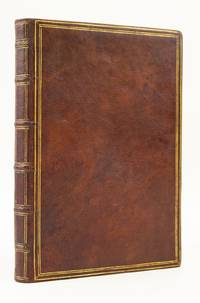
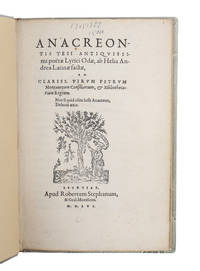
155662303Lutetiae i.e. Paris Robert Stephanum i.e. Robert Estienne & Guillaume Morel 1556. Small 8vo. Lovely newer full marbled paper binding with gilt leather title-label to spine Jens E. Hansen Aarhus. Light brownspotting to a few leaves and somne leaves towards the end with inkspotting at outer blank margin. Early neat handwritten marginal annotations throughout. A lovely copy. 54 pp. <br/><br/><em>Scarce second edition of Elie André’s seminal Latin translation of the Anacreontea – the first complete - which itself is a classic in the history of classical literature. It came to directly influence all later readings of Anacreon. In 1554 Henri Estienne II published the seminal editio princeps of Anacreon which is no less than an outright Renaissance sensation causing the “Anacreaonta†to become the most influential “ancient†Greek poetic text during the Renaissance initiating a poetic revolution in Europe. Simultaneously with this editio princeps Henri Estienne published his own Latin translation of it which constitutes the first translation into Latin. Merely a year later in 1555 Elie André extremely important translation of the Anacreaontea appeared in 1555 printed by Thomas Richard. This translation included additional Odes not in the Estienne edition and was thus the first complete Latin translation of the “Anacreontiaâ€. The following year 1556 Robert Estienne II published his first work namely a second edition of the original Greek Anacreontea that Henri Estienne had published in 1554. Silmultaneously Robert Estienne republished Elie André’s Latin translation which was published separately but which is often found together with the 1556 second edition of the Greek Anacreontea. “The first full translation of CA was again in Latin. It was published by the humanist Elie André 1509-1587 from Bordeaux who was friendly with the Parisian circle around the Pléiade. André’s translation appeared less than a year after Estienne’s edition and comprised the Latin translation only without the Greek text. In a way this can be taken as a signal that the Latin tradition was coming into its own. Accordingly André makes some bolder choices in his translation which already shows in his first lines see Aiijr: Cantare nunc Atridas Nunc expetesso Cadmum: Testudo vero nervis Solum refert Amorem …. In classical Latin the verb expetessere is used only by Plautus and it is extremely rare in postclassical Latin. This brings a somewhat odd ring of comedy to the poem. Here and in a number of other places the translator wishes to strike his readers with an unusual turn of phrase or by some sort of amplification. He does not just imitate ‘Anacreon’ but also competes with him as arguably with Estienne’s translation. André’s willingness to adapt the original text shows also in a certain moralistic tendency not otherwise seen in Latin translations. On the one hand he openly and avowedly changes the text when it comes to unequivocal references to homosexuality: in CA 12 10.8-10 Ï„ µευ καλν νεÏων … φÏπασας Βθυλλον; “Why from my sweet dreams … have you snatched away Bathyllus†for instance he replaces Bathyllus with a puella Cur mane somnianti / Ista loquacitate / Mihi eripis puellam…; in CA 29 17.1-2 ΓÏφε µοι Βθυλλον οτω / τν ταÏον Ï‚ διδσκω “Paint for me thus Bathyllus my lover just as I instruct you†he simply suppresses the word ταÏον “lover†Mihi pinge sic Bathyllum / . Estienne’s translation is: Meos Bathyllum amores / Ut te docebo pinge. Here André proceeds in a way similar to the original Neo-Latin Anacreontics in which homosexual love simply does not occur. On the other hand André makes generous use of a metatextual element which is less conspicuous than his changes but is even more extensive and significant. He includes a considerable number of passages in quotation marks and thus identifies them as sort of sententiae. In CA 4 32 for instance lines 1-6 describe how the poet wishes to lie down on myrtles drink and have Eros as his wine steward. This description of a specific setting is followed by some more general lines about the brevity of life which André includes in quotation marks lines 7- 10: “Cita nanque currit aetas / Rota ceu voluta currus. / Sed et ossibus solutis / Iaceam cinis necesse est†“For hurried life runs along just like a rolling wheel but I shall soon lie a bit of dust from crumbling bonesâ€. The focus of this quotation technique is on lines concerned with the transitory nature of life the uncertainness of tomorrow and the futility of riches. By marking out such lines as sententiae André distinguishes Anacreon the philosopher from Anacreon the drinker and lover and contributes to a larger discourse about the morality of the poet and his poems. While opinions in antiquity were often critical of Anacreon’s morals ‘Anacreon’s’ large flock of modern imitators was united to defend their hero’s virtue. From Estienne’s preface onwards they usually referred to Plato’s Phaedrus 235c where Socrates calls Anacreon “wise†σοφς in matters concerned with Eros. In the 18th century Anacreon the philosopher could even turn into a key-image of enligthened discourses. André’s identification of sententiae in ‘Anacreon’ prepared for this development and could have had a direct influence on it since his translation was widely read until well into the 18th century. The Latin translations of Estienne and André soon became classics in themselves and were the most successful ones in the early modern period.†Tilg: Neo-Latin Anacreontic Poetry. Its Shapes and Its Significance 214. Pp. 177-78. Brunet: I:250; Renouard: I:161. </em> hardcover
155662303Lutetiae (i.e. Paris), Robert Stephanum (i.e. Robert Estienne) & Guillaume Morel, 1556. Small 8vo. Lovely newer full marbled paper binding with gilt leather title-label to spine (Jens E. Hansen, Aarhus). Light brownspotting to a few leaves and somne leaves towards the end with inkspotting at outer blank margin. Early neat handwritten marginal annotations throughout. A lovely copy. 54 pp.
1554CLL-25Paris, [Guillaume Morel pour ?] Henri Estienne, 1554 Petit in-4 de (4) ff., 110 pp., plein chagrin rouge, dentelle dorée en encadrement, dos à nerfs orné de caissons de fleurons dorés, coupes et bordures décorées, tranches dorées (Langlois).
1555ST16215gLutetiae Paris: Apud Henricum Stephanum 1554; Paris: Apud Thomam Richardum 1555. First work: EDITIO PRINCEPS; Second Work: First Complete Latin Translation. 198 x 135 mm. 7 3/4 x 5 1/4". 4 p.l. 110 pp. 1 leaf blank; 24 leaves. Two separately published works in one volume. First work: Translated and edited with notes and commentary by Henri Estienne. Second work: Translated by Helias Andreas Élie André. <br/> Fine retrospective reddish-brown goatskin in the style of the period French fillet frame on covers raised bands spine compartments formed by double gilt rules endpapers raised exposing laced-in boards as an imitation of an antique binding. Estienne device on title page of first work; Richard's device on title of second. First work: Renouard 115:1; Schreiber 139; Dibdin I 258; Adams A-1001; Brunet I 250. Second work: Schweiger I 26; Adams A-1002. ◆Recently and very expertly washed and resized some leaves with very faint browning otherwise bright and fresh as well as entirely clean in a convincing new period-style binding.<br/> <br/> The first book to be published by Henri Estienne the initial work here is the original printing of an important collection of classical lyric poetry described by Dibdin as "a beautiful and rare edition." According to Schreiber this collection of Greek poems written in imitation of the sixth century poet Anacreon "became the most influential 'ancient' Greek poetic text during the Renaissance and Estienne's editio princeps virtually caused a poetic revolution." One of the greatest of the scholar-printers of the 15th and 16th centuries Henri Estienne 1528 or 1531-91 found these poems in two old manuscripts compiled the collection and did the Latin translation. The work became the first project released under Henri's imprint by his father Robert's press; Schreiber believes the presswork was done by Guillaume Morel rather than by Henri himself as it used three sizes of Claude Garamond's lovely and renowned "grecs du roi" type. The second work here includes additional odes not in the Estienne edition and is thus the first complete Latin translation of the "Anacreontia." It is a rare work: OCLC finds just two copies in North America while ABPC and RBH record three copies all bound as here with the 1554 Estienne. Apud Henricum Stephanum, 1554; Paris: Apud Thomam Richardum unknown
155460114Lutetiae (i.e. Paris), (? Guillaume Morel for) Henri Estienne (II), 1554. 4to. Contemporary limp vellum with remains of ties to boards. Remains of contemporary paper labels to spine and traces of autor in ink in contemporary hand, also to spine.A few smaller worm tracts to boards and a bit of spotting, but overall very nice. A large spot to title-page, presumably erased ink, from the removal of an old owner's name. The spot is in the blank margin, close to the printer's device, but not touching it. Apert from that internally very nice with only light occasional damp staining or browning. Old ink note in Greek characters to front free end-paper and a small note (referring also to ""Lyra"") on A(1)r. A very nice copy with large margins. Woodcut printer's device to title-page, woodcut headpiece and opening initial. Magnificently printed in all three sizes of the famous ""grecs du roi""-type. (8), 110 pp.
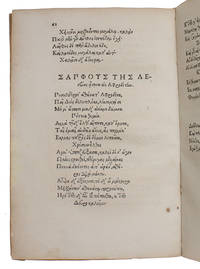
155460114Lutetiae i.e. Paris Guillaume Morel for Henri Estienne II 1554. 4to. Contemporary limp vellum with remains of ties to boards. Remains of contemporary paper labels to spine and traces of autor in ink in contemporary hand also to spine.A few smaller worm tracts to boards and a bit of spotting but overall very nice. A large spot to title-page presumably erased ink from the removal of an old owner's name. The spot is in the blank margin close to the printer's device but not touching it. Apert from that internally very nice with only light occasional damp staining or browning. Old ink note in Greek characters to front free end-paper and a small note referring also to "Lyra" on A1r. A very nice copy with large margins. Woodcut printer's device to title-page woodcut headpiece and opening initial. Magnificently printed in all three sizes of the famous "grecs du roi"-type. 8 110 pp. <br/><br/><em>Rare first edition of the groundbreaking Anacreon-volume by H. Estienne being the milestone publication that not only constitutes the first book by the brilliant Henri Estienne II but also the extremely influential editio princeps of the Anacreontea. Furthermore this groundbreaking publication contains Sappho’s now immortal Aphrodite-hymn being the very first of any of Sappho’s poems to appear in print here for the second time in print as well as the magnificent “Midnight poem†fragment 168B establishing for the first time since antiquity the gathering together of poems by Sappho: “A momentous point in her transmission. Yet it is ironic that the first collection of a fragmentary Greek poet known and admired beyond any other today should have appeared as a mere appendix to a book dedicated to another author entirely without even her name on the title-page.†Cambridge Companion to Sappho p. 251. The impact that Sappho - “mother of all women poets†- would eventually come to have upon modern poetry and society was not yet known to Estienne and his contemporaries for whom she was more or less unknown. Estienne however recognized the value of the poems of hers that he had encountered and with the publication of them in the present volume began a tradition that would eventually cause her to become arguably the most celebrated Greek poet of all time. “Estienne’s edition of Anacreon’s poetry was enthusiastically received by the Pléiade poets which considerably boosted Sappho’s influence on western European literatureâ€. van Dijk: I Have Heard about You p. 37. This beautifully printed slim volume constitutes an outright Renaissance sensation. “The “Anacreaonta†became the most influential “ancient†Greek poetic text during the Renaissance and Estienne’s “editio princeps†virtually caused a poetic revolution not only in France but also in Italy and Germany – where this influence culminated in the 18th century with the Anacreontic Poets “Die Anakreontikerâ€.†Schreiber 139. Henri Estienne II – “in many ways the greatest member of the Estienne dynasty and most certainly its most prolific scholar†Schreiber - had travelled extensively through Italy the Low Countries and England in search of Greek manuscripts. It is from one of these that he had printed possibly by Guillaume Morel his first book this editio princeps of the Anacreaontea which is thus also the first book to bear his imprint. Henri Estienne along with his contemporaries believed the work to contain the ancient Greek lyrics of the poet Anakreon 6th century BC whose poems are not extant except for some short fragments. In fact the poems contained in this volume constitute the Anacreontea which is a collection of Greek lyric poems written in the style and imitation of Anacreon at various dates. “Henri’s publication of these “ancient†Greek lyrics caused an immediate literary sensation in France and was celebrated and immortalized by Ronsard in an oft-quoted passage of his “Odesâ€.†Schreiber. Henri Estienne started out his publishing career with this magnificent publication that catapulted him into fame and he went on to become one of the most influential literary and scholarly figures of the second half of the 16th century in Europe; he dominated Renaissance scholarship with his magnificent publications and has arguably not been superseded by any publisher since. The young Henri Estienne had discovered the present poems in Louvain in a manuscript owned by an Englishman named John Clements who was a friend of Thomas More. Their publication “was a sensation of the first class and the starting-point for a new branch of modern literature†R. Pfeiffer: History of Classical Scholarship†p. 109. “This first edition was greeted with tremendous enthusiasm by the members of the Pléiade who like everyone else believed the poems genuine and each of whom immediately translated or imitated some of the “Anacreonteaâ€.†Schreiber. The poems may not have been “genuine†Anacreon-poems but the influence that the publication of them came to exercise was no less profound than had they been; the mark they have left of modern literature is difficult to compare to anything else. The printing of the original Greek text in all three sizes of the magnificent “grecs du roiâ€-type is followed by the first Latin translation of the poems done by Estienne himself and by Estienne’s own commentary. The text of this editio princeps has been followed by almost every subsequent editor and today the name Anacreon cannot be mentioned without thinking of Estienne. After the Anacreon-poems themselves are two leaves containing first poems by Alkaios and second the two famous poems by Sappho: The Ode to Aphrodite fragment 1 and the Midnight Poem fragment 168B also known as “The Moon Sets†constituting a momentous point in the Sappho-transmission namely the first time since antiquity that anyone had gathered together poems by her. Soon after more Sappho-collections would appear causing her to eventually become the most admired Greek poet. “In a recent article R. Aulotte… shows how Sappho’s influence on the poets dates from the time when Henri Estienne published the odes then known along with his famous edition of Anacreon. His first edition published in 1554 contained the “Ode to Aphrodite†and the fragment “The Moon has Setâ€.†Mary Morrison: Henri Estienne and Sappho in: Bibliothèque d’Humanisme et Renaissance T.24 N.2 1962 p. 388. "From time immemorial women poets have had only one norm one touchstone: Sappho the legendary woman poet who lived on the island of Lesbos in the Aegean sea in the 6th century BC. … The Sappho figure is the peg on which views of female poetic genious and female sexuality have been hung century after century.†Suzanne van Dijk: I Have Heard about You… p. 35 . Dibdin I: 258 “A beautiful and rare editionâ€; Schreiber: 139; Renouard: 115. </em> hardcover