AnacreonBiblio.com
58 résultats
1793139954Parma: Bodoni 1793. contemporary calf gilt borders on covers black and red leather spine labels gilt leather turn-ins marbled pastedowns and endsheets. Bodoni Giambattista. small 8vo. contemporary calf gilt borders on covers black and red leather spine labels gilt leather turn-ins marbled pastedowns and endsheets. viii 100 pages. Printed by Giambattista Bodoni in Parma Brooks 503. Minor shelf wear else a near fine copy. Pages 73-100 contain the "choice of poems mostly not complete which are published under the name of Anacreon". There were 6 copies on parchment. A lovely copy.<BR> <br /> <BR> <br /> Anacreon one of the most celebrated Greek lyric poets was born at Teos in Ionia. He lived in Samos and Athens where his patron was Hipparchus. His poetry is know for it's grace and elegabce and it's celebration of the joys of wine and love. Bodoni unknown
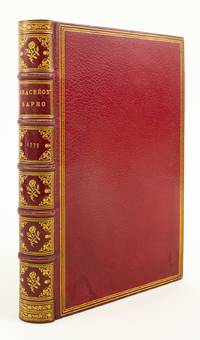
1773ST16314Paris: Chez Le Boucher 1773. First Edition with these Illustrations. 214 x 136 mm. 8 3/4 x 5 1/2". 2 p.l. iv 280 pp. without "Héro et Léandre" as usual.Translated by Julien Jacques Moutonnet de Clairfons. <br/> LOVELY RED MOROCCO GILT BY CHAMBOLLE-DURU stamp-signed on front turn-in covers with French fillet border raised bands spine gilt in compartments with rose sprig at center curling floral cornerpieces gilt titling densely gilt turn-ins marbled endpapers all edges gilt. Engraved frontispiece and 25 charming and delicate engraved illustrations by Jean Massard after Charles Eisen. Cohen-de Ricci 79; Brunet I 254; Graesse I 113. For the binding: Flety 40. ◆Lower half-inch of joints just starting to show wear three minor stains and one short scratch to upper board but a fine and pretty copy the text fresh and smooth with deep impressions of the type with rich impressions of the engravings with ample margins and with a lustrous binding.<br/> <br/> This is a very attractive copy of the first printing of an anthology of French versions of classical poetry described by Cohen-de Ricci as "one of the most elegantly illustrated books of the 18th century." Charles Eisen 1720-78 was Louis XV's court painter as well as drawing master to Madame de Pompadour. Bryan says that "almost all the important books published in France in his time contain his exquisite plates" which "he engraved with a light point and with striking originality." He "took his inspirations direct from nature but added something of the ideal after the manner of Watteau and Boucher." The text contains biographies of and works by four important Greek poets: Anacreon sixth century B.C. Sappho b. ca. 612 B.C. Bion third century B.C. and Moschus second century B.C. The binding here is a perfect example of the kind of handsomely done French classical work produced for an extended period under the name of Chambolle. A rough contemporary of and certainly the equal in technique to binders like Trautz Marius Michel père Lortic and Cuzin the elder Chambolle served his apprenticeship under Hippolyte Duru and later formed a partnership with him as is clear from the stamped signature on our volume. Chambolle's son continued the business when his father retired in 1898 and in her "Modern Bookbindings" Sarah Prideaux says of her contemporary "Chambolle most worthily continues the traditions associated with the name of his father. . . . To him are confided the classics of former times which he clothes in the styles appropriate to them keeping to a simplicity of ornamentation which reveals great taste and feeling for composition.". Chez Le Boucher unknown
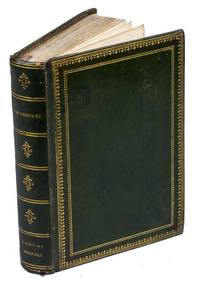
17856702Parma: Ex Regio Typographeio i.e. Giambattista Bodoni 1785. Very Good. Quarto 32 cm; 4. xciv 100 2 pages. Engraved title vignette engraved vignette of the arms of Don José Nicolás de Azara by Domenico Cagnoni. Text in Latin and Greek. Printed in capitals on blue paper. In contemporary dark green-brown speckled calfskin ruled in gilt and bordered with a frond and flower tool all edges gilt. Spine in six compartments titled in gilt and gilt stamped with "Greek pavilion" tool. Greek key turn-ins. Pink marbled endleaves. The whole preserved in recent custom slipcase. Spine fading to brown and beginning to split slightly near head and tail. Few abrasions on boards. Text effectively unblemished. References: Brooks 287 "Magnificamente stampato in caratteri maiuscoli"; Giani Catalogo delle autentiche edizioni bodoniane 3 "Certo questa seconda edizione è più attraente della prima."; De Lama II 35 "bella edizione". <br /><br />Much admired edition in a large quarto format of a text Bodoni had printed in octavo the previous year. Intended in part to show off his new Greek capital letters he printed the entire text on tinted paper in caps and small caps in sharp distinction to any prior edition. Bodoni was actively trying to expand his commercial market and his reputation into Spain during this period hence the dedication to Azara a Spanish noble and sometime resident of Parma. Ex Regio Typographeio [i.e., Giambattista Bodoni] hardcover
1773CLL-858A Paphos et se trouve à Paris, chez Le Boucher, 1773 In-8 de (2) ff., IV, 280 pp., maroquin rouge, triple filet doré en encadrement sur les plats avec fleurons aux angles, dos lisse orné de caissons de fleurons dorés, pièce de titre de maroquin olive, double filet doré sur les coupes, roulette intérieure dorée, tranches dorées (reliure de l'époque).
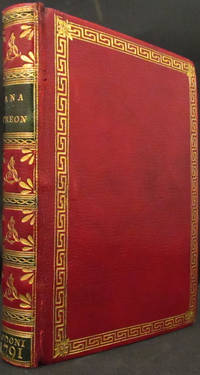
179129736Parma: Giambattista Bodoni 1791. Two parts in one volume. The fine sedicesimo edition of 1791 with provenance of Herzog Albrecht Kasimir August von Sachsen-Teschen. Title with an engraved roundel with Anacreon's portrait by Giuseppe Lucatelli 1751-1828; the following leaf with engraved roundel portrait of the marquis Jose Nicolas de Azara. Text in Greek bound before the text in Latin. 16mo 102x68 mm in very fine contemporary red morocco executed by Georg Friedrich Krauss the leading Viennese binder for Duke Albert von Sachsen-Teschen. The boards framed within gilt Greek-key roll the smooth spine with author's name and imprint in gilt on double green morocco lettering-pieces four further compartments with the gilt initials 'AS' in fine gilt tools and additional gilt tooling these separated by flat bands trimmed in green morocco and gilt tooled green silk endpapers board edges gilt tooled and turn-ins with gilt dentelles a.e.g. blue silk ribbon marker. 4 120; 122 2 pp. A superb and beautiful copy the condition being essentially without flaw. A FINE COPY OF ANACREON BY THE PROMINENT PRINTER AND PUNCHCUTTER GIAMBATTISTA BODONI 1740-1813 OFFERED HERE IN A PRECIOUS MOROCCO BINDING FOR DUKE ALBERT OF SACHSEN-TESCHEN SON OF FRIEDRICH AUGUST 11 OF SAXONY KING OF POLAND. Albert had a well-known taste for the arts his collection of prints and drawings was one of the richest in all of Europe and he was the founder of the eponymous Albertina in Vienna.<br> In 1791 Bodoni printed two different editions of Anacreon one in octavo and the edition offered here in sedicesimo. The smaller Anacreon is one of the finest books ever executed by the great printer. The text is set in the Greek font he designed a few years prior which was based on one of Henri Estienne's 1554 types. His Greek font was highly admired all throughout Europe. The King of France as Bodoni once stated in a letter requested two copies of this beautiful gem of a book.<br> The very fine binding was executed by the leading Viennese binder Georg Friedrich Krauss. Krauss was active between 1791 and 1824 and was one of von Sachsen-Teschen principle binders.<br> Giambattista Bodoni hardcover
1791A6K9AB01U79OParma: in aedibus Palatinis Typis Bodonianis 1791. Contemporary gold-tooled green morocco with the title lettered in gold on the spine gold-tooled board edges and turn-ins shiny pink endpapers with a frame of small silver leaves mounted on the pastedowns. 16mo in 4s 15 x 11 cm. With a small engraved portrait of Anacreon in a roundel on the title-page a small engraved portrait of the dedicatee J. N. de Azara in a roundel on the dedication page. Part of the text is set in Greek type. Beautiful copy of Anacreon's poems printed in Greek and Latin capitals that Bodoni had designed and cut especially for his Anacreon editions. The first of these splendid editions was printed in 1785. Our copy is one of 150 printed. A first 8vo edition was printed by Bodoni in 1784 but the 1785 and 1791 editions are by far the most gorgeous and from a philological viewpoint the best. Brooks no. 421 furthermore mentions a 16mo-edition also printed in 1791. The book aroused the admiration of the famous bibliographer Dibdin who wrote in his classic bibliography Greek and Latin classics p. 265: "The Bodoni edition of 1785 and 1791 is printed in capital letters and more elegant and exquisitely finished productions cannot be conceived".Our copy comes from the library of the Comte D. Boutourlin 1763-1829 a Russian soldier military historian politician and librarian of the Imperial Russian Library. He was one of the most outstanding book collectors of 19th-century Russia and he formed an important library which was unfortunately destroyed during the burning of Moscow in 1812. His second large collection of which a catalogue was published in 1831 in 200 copies was formed during his retirement in Florence. It contained 244 important early manuscripts 964 15th-century books many of which were unrecorded a very complete Bodoni collection and other outstanding items 7929 in all. The book was later owned by the Comte Chandon de Briailles whose bookplate is pasted on first flyleaf: "Au Conte Chandon de Briailles". This is most likely Raoul Chandon de Briailles 1850-1908 historian and wine merchant founder of the Chandon de Briailles mark of champagne part of whose rich library was bequeathed to the Médiathèque at Épernay.With the large armorial bookplate of Comte Chandon D. Boutourlin on the verso of the first free flyleaf and the bookplate of Comte de Briailles on the recto of the second free flyleaf. The binding shows very slight signs of wear internally only very slightly foxed. Otherwise in very good condition.l Brooks 422; De Lama II p. 66; Giani Cat. p. 40 no. 17; Palaia & Moscatelli 141; Quand la simplicité devient art 46; cf. Catalogue de la Bibliothèque de son Exc. M. le Comte D. Boutourlin Florence 1831. in aedibus Palatinis [Typis Bodonianis], unknown
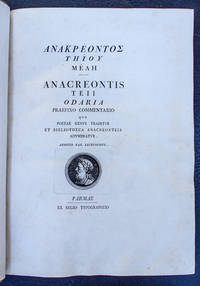
1785ST11935Parmae: Ex Regio Typographeio 1785. ONE OF 50 COPIES ON FINE PAPER of a total of 310 copies. 308 x 216 mm. 12 1/8 x 8 1/2". 2 p.l. xciv 100 pp. 1 leaf. <br/> VERY ATTRACTIVE CONTEMPORARY CRIMSON STRAIGHT-GRAIN MOROCCO spine beautifully gilt in compartments between green stylized pentaglyph and metope strips flanked by double raised bands the plain-ruled compartments densely stippled with gold dots surrounding a small central medallion from which emanate a number of wavy vines bearing flowers and small leaves anular dot cornerpieces elaborately gilt turn-ins blue watered silk endpapers the pastedowns framed with elegant gilt garlands and bead-and-lozenge roll free endleaves with cresting gilt frame leather hinges these expertly renewed at top and bottom all edges gilt. In a modern brown cloth chemise and morocco-backed slipcase. Small author portrait tondo on title page large and elaborate armorial vignette on dedication page engraved by Cagnoni. Text of poems in Greek commentary in Latin both printed entirely in majuscules. Front pastedown with morocco monogram bookplate of Charles C. Kalbfleisch engraved bookplate of Hugh Morriston Davies and book label of Charles Whibley see below. Brooks 287; Dibdin I 265; Schweiger 25; Brunet I 252; Graesse I 111. ◆Spine probably a bit sunned though difficult to tell with so much gilt four tiny wormholes to joints extremities with a hint of rubbing but the binding solid lustrous and attractive; A SPECTACULAR COPY INTERNALLY entirely clean fresh and bright and with enormous margins.<br/> <br/> This is a superb copy of the luxury paper Bodoni printing of the works of the sixth century B.C. lyric poet Anacreon. Imbued with delicacy and grace these works come down to us only in fragments quoted by other authors or in the derived form of imitators and they did not find their way into print until after the middle of the 16th century. Produced by Giambattista Bodoni 1740-1813 the most celebrated European printer of his era this remarkable piece of work is called "magnificent" by Brooks and Dibdin says that a "more elegant and exquisitely finished production . . . cannot be conceived." The appearance of the page printed only with capitals and offered here in a copy with vast margins is simply as stately and powerful as one could ever hope for. Bodoni was not only a great printer but also the most important type designer and punchcutter in Italy during his day. He was responsible for some of the most graceful and immaculate books to be printed during the end of the 18th and beginning of the 19th century and the present item is certainly to be counted among his most beautiful productions. The present copy has a distinguished provenance. Charles C. Kalbfleisch was a discriminating American collector whose library featured a great many beautiful bindings and who was known for choosing only the finest copies available. Parke-Bernet sold much of his collection in January of 1944 in a sale entitled "The Arts of the Book . . . The Splendid Library Formed by the Late Charles C. Kalbfleisch New York." Hugh Morriston Davies 1879-1965 was a pioneering surgeon known as "The Doyen of Thoracic Surgery" who collected fine bindings especially those of the 18th century. Charles Whibley 1859-1930 authored important books and wrote popular periodical columns of literary interest edited a number of works in the substantial and distinguished "Tudor Translations" series was at the center of a British literary circle with links to the Symbolist poets of France and made an enormous contribution to literature by recommending T. S. Eliot to Faber & Faber. Ex Regio Typographeio unknown
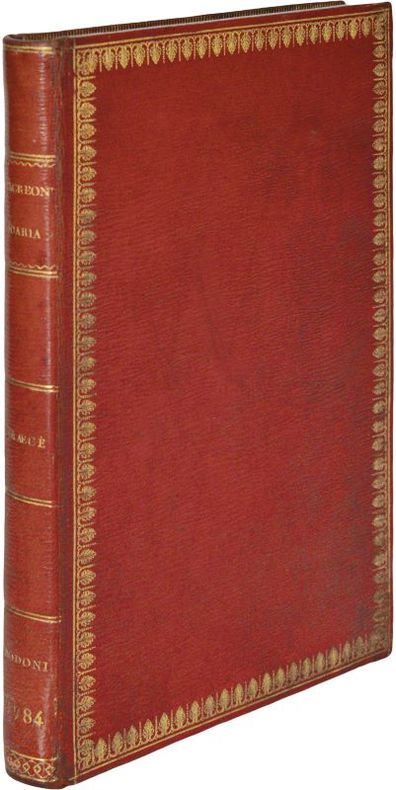
17840041201784 Parmae [Parme], Ex Regio Typographeio [Bodoni], 15 septembre 1784. Petit in-quarto (170 X 246 mm) maroquin rouge à grain long, encadrement de dentelle et filet dorés sur les plats, dos lisse fileté, titre doré avec en queue la date d'impression et la mention «Bodoni», chainette dorée en queue, coupes et coiffes filetées, tranches dorées (Reliure de l'époque); (7) ff. dont titre, LXXXII-103 pages, (1) page d'achevé d'imprimer. Deux ex-libris gravés collés sur le premier contreplat.