"ANACREON (& SAPPHO) - ANAKREONTOS.Livre Rare Book

419 résultats
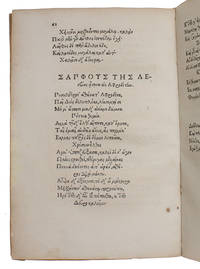
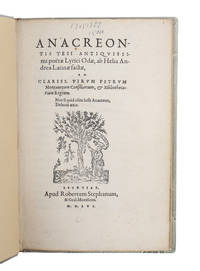
155460114Lutetiae (i.e. Paris), (? Guillaume Morel for) Henri Estienne (II), 1554. 4to. Contemporary limp vellum with remains of ties to boards. Remains of contemporary paper labels to spine and traces of autor in ink in contemporary hand, also to spine.A few smaller worm tracts to boards and a bit of spotting, but overall very nice. A large spot to title-page, presumably erased ink, from the removal of an old owner's name. The spot is in the blank margin, close to the printer's device, but not touching it. Apert from that internally very nice with only light occasional damp staining or browning. Old ink note in Greek characters to front free end-paper and a small note (referring also to ""Lyra"") on A(1)r. A very nice copy with large margins. Woodcut printer's device to title-page, woodcut headpiece and opening initial. Magnificently printed in all three sizes of the famous ""grecs du roi""-type. (8), 110 pp.
155460114Lutetiae i.e. Paris Guillaume Morel for Henri Estienne II 1554. 4to. Contemporary limp vellum with remains of ties to boards. Remains of contemporary paper labels to spine and traces of autor in ink in contemporary hand also to spine.A few smaller worm tracts to boards and a bit of spotting but overall very nice. A large spot to title-page presumably erased ink from the removal of an old owner's name. The spot is in the blank margin close to the printer's device but not touching it. Apert from that internally very nice with only light occasional damp staining or browning. Old ink note in Greek characters to front free end-paper and a small note referring also to "Lyra" on A1r. A very nice copy with large margins. Woodcut printer's device to title-page woodcut headpiece and opening initial. Magnificently printed in all three sizes of the famous "grecs du roi"-type. 8 110 pp. <br/><br/><em>Rare first edition of the groundbreaking Anacreon-volume by H. Estienne being the milestone publication that not only constitutes the first book by the brilliant Henri Estienne II but also the extremely influential editio princeps of the Anacreontea. Furthermore this groundbreaking publication contains Sappho’s now immortal Aphrodite-hymn being the very first of any of Sappho’s poems to appear in print here for the second time in print as well as the magnificent “Midnight poem†fragment 168B establishing for the first time since antiquity the gathering together of poems by Sappho: “A momentous point in her transmission. Yet it is ironic that the first collection of a fragmentary Greek poet known and admired beyond any other today should have appeared as a mere appendix to a book dedicated to another author entirely without even her name on the title-page.†Cambridge Companion to Sappho p. 251. The impact that Sappho - “mother of all women poets†- would eventually come to have upon modern poetry and society was not yet known to Estienne and his contemporaries for whom she was more or less unknown. Estienne however recognized the value of the poems of hers that he had encountered and with the publication of them in the present volume began a tradition that would eventually cause her to become arguably the most celebrated Greek poet of all time. “Estienne’s edition of Anacreon’s poetry was enthusiastically received by the Pléiade poets which considerably boosted Sappho’s influence on western European literatureâ€. van Dijk: I Have Heard about You p. 37. This beautifully printed slim volume constitutes an outright Renaissance sensation. “The “Anacreaonta†became the most influential “ancient†Greek poetic text during the Renaissance and Estienne’s “editio princeps†virtually caused a poetic revolution not only in France but also in Italy and Germany – where this influence culminated in the 18th century with the Anacreontic Poets “Die Anakreontikerâ€.†Schreiber 139. Henri Estienne II – “in many ways the greatest member of the Estienne dynasty and most certainly its most prolific scholar†Schreiber - had travelled extensively through Italy the Low Countries and England in search of Greek manuscripts. It is from one of these that he had printed possibly by Guillaume Morel his first book this editio princeps of the Anacreaontea which is thus also the first book to bear his imprint. Henri Estienne along with his contemporaries believed the work to contain the ancient Greek lyrics of the poet Anakreon 6th century BC whose poems are not extant except for some short fragments. In fact the poems contained in this volume constitute the Anacreontea which is a collection of Greek lyric poems written in the style and imitation of Anacreon at various dates. “Henri’s publication of these “ancient†Greek lyrics caused an immediate literary sensation in France and was celebrated and immortalized by Ronsard in an oft-quoted passage of his “Odesâ€.†Schreiber. Henri Estienne started out his publishing career with this magnificent publication that catapulted him into fame and he went on to become one of the most influential literary and scholarly figures of the second half of the 16th century in Europe; he dominated Renaissance scholarship with his magnificent publications and has arguably not been superseded by any publisher since. The young Henri Estienne had discovered the present poems in Louvain in a manuscript owned by an Englishman named John Clements who was a friend of Thomas More. Their publication “was a sensation of the first class and the starting-point for a new branch of modern literature†R. Pfeiffer: History of Classical Scholarship†p. 109. “This first edition was greeted with tremendous enthusiasm by the members of the Pléiade who like everyone else believed the poems genuine and each of whom immediately translated or imitated some of the “Anacreonteaâ€.†Schreiber. The poems may not have been “genuine†Anacreon-poems but the influence that the publication of them came to exercise was no less profound than had they been; the mark they have left of modern literature is difficult to compare to anything else. The printing of the original Greek text in all three sizes of the magnificent “grecs du roiâ€-type is followed by the first Latin translation of the poems done by Estienne himself and by Estienne’s own commentary. The text of this editio princeps has been followed by almost every subsequent editor and today the name Anacreon cannot be mentioned without thinking of Estienne. After the Anacreon-poems themselves are two leaves containing first poems by Alkaios and second the two famous poems by Sappho: The Ode to Aphrodite fragment 1 and the Midnight Poem fragment 168B also known as “The Moon Sets†constituting a momentous point in the Sappho-transmission namely the first time since antiquity that anyone had gathered together poems by her. Soon after more Sappho-collections would appear causing her to eventually become the most admired Greek poet. “In a recent article R. Aulotte… shows how Sappho’s influence on the poets dates from the time when Henri Estienne published the odes then known along with his famous edition of Anacreon. His first edition published in 1554 contained the “Ode to Aphrodite†and the fragment “The Moon has Setâ€.†Mary Morrison: Henri Estienne and Sappho in: Bibliothèque d’Humanisme et Renaissance T.24 N.2 1962 p. 388. "From time immemorial women poets have had only one norm one touchstone: Sappho the legendary woman poet who lived on the island of Lesbos in the Aegean sea in the 6th century BC. … The Sappho figure is the peg on which views of female poetic genious and female sexuality have been hung century after century.†Suzanne van Dijk: I Have Heard about You… p. 35 . Dibdin I: 258 “A beautiful and rare editionâ€; Schreiber: 139; Renouard: 115. </em> hardcover
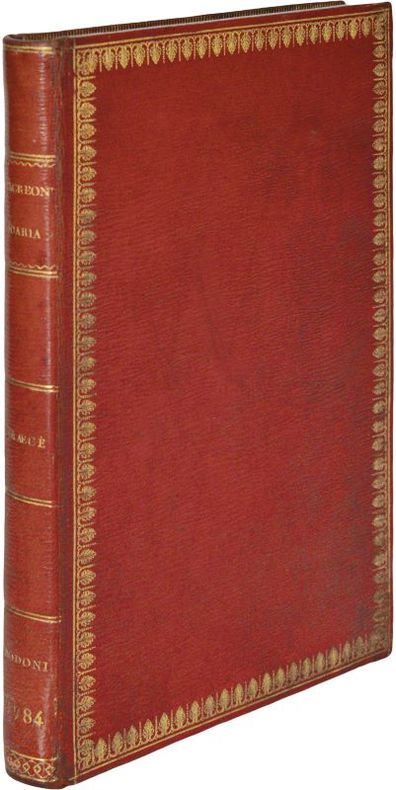
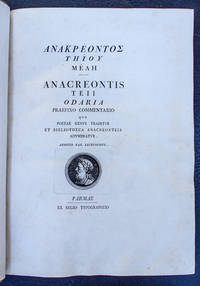
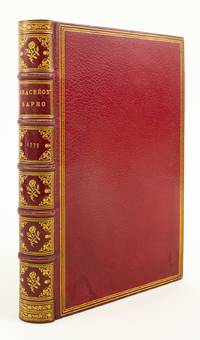
17840041201784 Parmae [Parme], Ex Regio Typographeio [Bodoni], 15 septembre 1784. Petit in-quarto (170 X 246 mm) maroquin rouge à grain long, encadrement de dentelle et filet dorés sur les plats, dos lisse fileté, titre doré avec en queue la date d'impression et la mention «Bodoni», chainette dorée en queue, coupes et coiffes filetées, tranches dorées (Reliure de l'époque); (7) ff. dont titre, LXXXII-103 pages, (1) page d'achevé d'imprimer. Deux ex-libris gravés collés sur le premier contreplat.
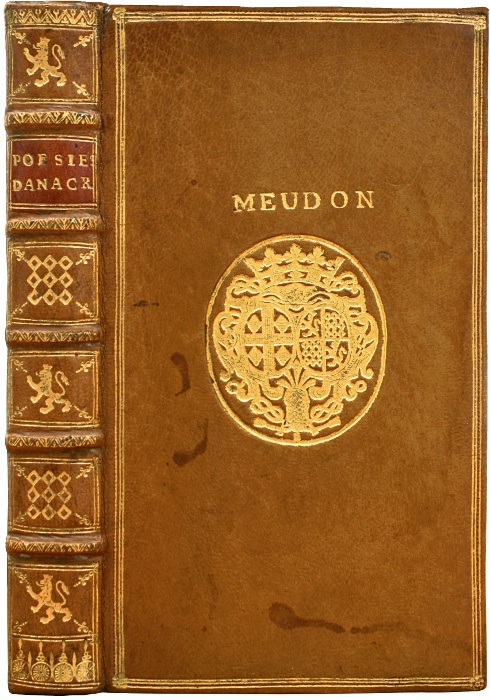
LCS-17412Précieux et superbe exemplaire relié en maroquin citron de l’époque aux armes et pièces d’armes de Jeanne-Baptiste d’Albert de Luynes, comtesse de Verrue (1670-1736). Paris, Pierre Emery, 1684. Avec Privilege du Roy. In-12 de (1) f.bl., (14) ff., 390 pp., (1) f. d‘errata, (1) f.bl. Plein maroquin citron de l’époque, triple filet doré encadrant les plats, armoiries et mention « Meudon » au centre des plats, dos à nerfs orné de pièces d’armes, pièce de titre en maroquin rouge, coupes décorées, roulette intérieure dorée, tranches dorées sur marbrure. Reliure de l’époque. 158 x 90 mm.
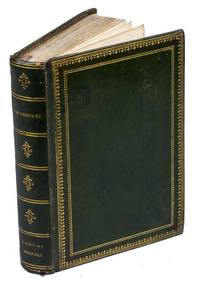
1785ST11935Parmae: Ex Regio Typographeio 1785. ONE OF 50 COPIES ON FINE PAPER of a total of 310 copies. 308 x 216 mm. 12 1/8 x 8 1/2". 2 p.l. xciv 100 pp. 1 leaf. <br/> VERY ATTRACTIVE CONTEMPORARY CRIMSON STRAIGHT-GRAIN MOROCCO spine beautifully gilt in compartments between green stylized pentaglyph and metope strips flanked by double raised bands the plain-ruled compartments densely stippled with gold dots surrounding a small central medallion from which emanate a number of wavy vines bearing flowers and small leaves anular dot cornerpieces elaborately gilt turn-ins blue watered silk endpapers the pastedowns framed with elegant gilt garlands and bead-and-lozenge roll free endleaves with cresting gilt frame leather hinges these expertly renewed at top and bottom all edges gilt. In a modern brown cloth chemise and morocco-backed slipcase. Small author portrait tondo on title page large and elaborate armorial vignette on dedication page engraved by Cagnoni. Text of poems in Greek commentary in Latin both printed entirely in majuscules. Front pastedown with morocco monogram bookplate of Charles C. Kalbfleisch engraved bookplate of Hugh Morriston Davies and book label of Charles Whibley see below. Brooks 287; Dibdin I 265; Schweiger 25; Brunet I 252; Graesse I 111. ◆Spine probably a bit sunned though difficult to tell with so much gilt four tiny wormholes to joints extremities with a hint of rubbing but the binding solid lustrous and attractive; A SPECTACULAR COPY INTERNALLY entirely clean fresh and bright and with enormous margins.<br/> <br/> This is a superb copy of the luxury paper Bodoni printing of the works of the sixth century B.C. lyric poet Anacreon. Imbued with delicacy and grace these works come down to us only in fragments quoted by other authors or in the derived form of imitators and they did not find their way into print until after the middle of the 16th century. Produced by Giambattista Bodoni 1740-1813 the most celebrated European printer of his era this remarkable piece of work is called "magnificent" by Brooks and Dibdin says that a "more elegant and exquisitely finished production . . . cannot be conceived." The appearance of the page printed only with capitals and offered here in a copy with vast margins is simply as stately and powerful as one could ever hope for. Bodoni was not only a great printer but also the most important type designer and punchcutter in Italy during his day. He was responsible for some of the most graceful and immaculate books to be printed during the end of the 18th and beginning of the 19th century and the present item is certainly to be counted among his most beautiful productions. The present copy has a distinguished provenance. Charles C. Kalbfleisch was a discriminating American collector whose library featured a great many beautiful bindings and who was known for choosing only the finest copies available. Parke-Bernet sold much of his collection in January of 1944 in a sale entitled "The Arts of the Book . . . The Splendid Library Formed by the Late Charles C. Kalbfleisch New York." Hugh Morriston Davies 1879-1965 was a pioneering surgeon known as "The Doyen of Thoracic Surgery" who collected fine bindings especially those of the 18th century. Charles Whibley 1859-1930 authored important books and wrote popular periodical columns of literary interest edited a number of works in the substantial and distinguished "Tudor Translations" series was at the center of a British literary circle with links to the Symbolist poets of France and made an enormous contribution to literature by recommending T. S. Eliot to Faber & Faber. Ex Regio Typographeio unknown
12796Paris, Henri Estienne, 1554.
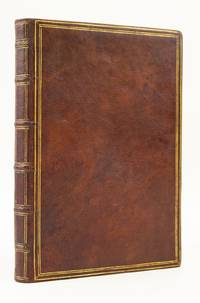
1555ST16215gLutetiae Paris: Apud Henricum Stephanum 1554; Paris: Apud Thomam Richardum 1555. First work: EDITIO PRINCEPS; Second Work: First Complete Latin Translation. 198 x 135 mm. 7 3/4 x 5 1/4". 4 p.l. 110 pp. 1 leaf blank; 24 leaves. Two separately published works in one volume. First work: Translated and edited with notes and commentary by Henri Estienne. Second work: Translated by Helias Andreas Élie André. <br/> Fine retrospective reddish-brown goatskin in the style of the period French fillet frame on covers raised bands spine compartments formed by double gilt rules endpapers raised exposing laced-in boards as an imitation of an antique binding. Estienne device on title page of first work; Richard's device on title of second. First work: Renouard 115:1; Schreiber 139; Dibdin I 258; Adams A-1001; Brunet I 250. Second work: Schweiger I 26; Adams A-1002. ◆Recently and very expertly washed and resized some leaves with very faint browning otherwise bright and fresh as well as entirely clean in a convincing new period-style binding.<br/> <br/> The first book to be published by Henri Estienne the initial work here is the original printing of an important collection of classical lyric poetry described by Dibdin as "a beautiful and rare edition." According to Schreiber this collection of Greek poems written in imitation of the sixth century poet Anacreon "became the most influential 'ancient' Greek poetic text during the Renaissance and Estienne's editio princeps virtually caused a poetic revolution." One of the greatest of the scholar-printers of the 15th and 16th centuries Henri Estienne 1528 or 1531-91 found these poems in two old manuscripts compiled the collection and did the Latin translation. The work became the first project released under Henri's imprint by his father Robert's press; Schreiber believes the presswork was done by Guillaume Morel rather than by Henri himself as it used three sizes of Claude Garamond's lovely and renowned "grecs du roi" type. The second work here includes additional odes not in the Estienne edition and is thus the first complete Latin translation of the "Anacreontia." It is a rare work: OCLC finds just two copies in North America while ABPC and RBH record three copies all bound as here with the 1554 Estienne. Apud Henricum Stephanum, 1554; Paris: Apud Thomam Richardum unknown
1953110019s. l., Cercle Lyonnais du Livre, impr. Fequet et Baudier, Imprimeurs-Typographes, à Paris 1953 In-4 28 x 19 cm. Reliure plein veau vert, signée Creuzevault, dos lisse avec titre en long doré, plats ornés d’un semis régulier de feuilles dorées intercalées de petites pastilles au palladium, tranches dorées, doublures et gardes de chamois vert, couvertures et dos conservés, 80 pp., 50 lithographies originales en noir dont 1 en frontispice et 8 à pleine page de André Derain tirées sur les presses de Mourlot frères. Dernier livre d'illustration originale publié du vivant de l’artiste, au tirage limité à 200 exemplaires sur papier de Rives, dont LXX chiffrés de I à LXX. Celui-ci, N VII. On joint le menu du samedi 30 janvier 1954 illustré d’une lithographie originale supplémentaire. Dos et bords des plats passés.
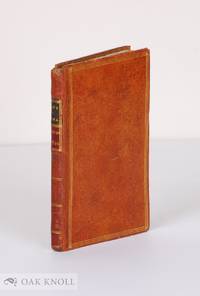
1791A6K9AB01U79OParma: in aedibus Palatinis Typis Bodonianis 1791. Contemporary gold-tooled green morocco with the title lettered in gold on the spine gold-tooled board edges and turn-ins shiny pink endpapers with a frame of small silver leaves mounted on the pastedowns. 16mo in 4s 15 x 11 cm. With a small engraved portrait of Anacreon in a roundel on the title-page a small engraved portrait of the dedicatee J. N. de Azara in a roundel on the dedication page. Part of the text is set in Greek type. Beautiful copy of Anacreon's poems printed in Greek and Latin capitals that Bodoni had designed and cut especially for his Anacreon editions. The first of these splendid editions was printed in 1785. Our copy is one of 150 printed. A first 8vo edition was printed by Bodoni in 1784 but the 1785 and 1791 editions are by far the most gorgeous and from a philological viewpoint the best. Brooks no. 421 furthermore mentions a 16mo-edition also printed in 1791. The book aroused the admiration of the famous bibliographer Dibdin who wrote in his classic bibliography Greek and Latin classics p. 265: "The Bodoni edition of 1785 and 1791 is printed in capital letters and more elegant and exquisitely finished productions cannot be conceived".Our copy comes from the library of the Comte D. Boutourlin 1763-1829 a Russian soldier military historian politician and librarian of the Imperial Russian Library. He was one of the most outstanding book collectors of 19th-century Russia and he formed an important library which was unfortunately destroyed during the burning of Moscow in 1812. His second large collection of which a catalogue was published in 1831 in 200 copies was formed during his retirement in Florence. It contained 244 important early manuscripts 964 15th-century books many of which were unrecorded a very complete Bodoni collection and other outstanding items 7929 in all. The book was later owned by the Comte Chandon de Briailles whose bookplate is pasted on first flyleaf: "Au Conte Chandon de Briailles". This is most likely Raoul Chandon de Briailles 1850-1908 historian and wine merchant founder of the Chandon de Briailles mark of champagne part of whose rich library was bequeathed to the Médiathèque at Épernay.With the large armorial bookplate of Comte Chandon D. Boutourlin on the verso of the first free flyleaf and the bookplate of Comte de Briailles on the recto of the second free flyleaf. The binding shows very slight signs of wear internally only very slightly foxed. Otherwise in very good condition.l Brooks 422; De Lama II p. 66; Giani Cat. p. 40 no. 17; Palaia & Moscatelli 141; Quand la simplicité devient art 46; cf. Catalogue de la Bibliothèque de son Exc. M. le Comte D. Boutourlin Florence 1831. in aedibus Palatinis [Typis Bodonianis], unknown
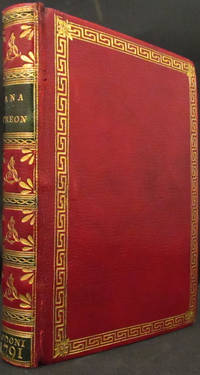
179129736Parma: Giambattista Bodoni 1791. Two parts in one volume. The fine sedicesimo edition of 1791 with provenance of Herzog Albrecht Kasimir August von Sachsen-Teschen. Title with an engraved roundel with Anacreon's portrait by Giuseppe Lucatelli 1751-1828; the following leaf with engraved roundel portrait of the marquis Jose Nicolas de Azara. Text in Greek bound before the text in Latin. 16mo 102x68 mm in very fine contemporary red morocco executed by Georg Friedrich Krauss the leading Viennese binder for Duke Albert von Sachsen-Teschen. The boards framed within gilt Greek-key roll the smooth spine with author's name and imprint in gilt on double green morocco lettering-pieces four further compartments with the gilt initials 'AS' in fine gilt tools and additional gilt tooling these separated by flat bands trimmed in green morocco and gilt tooled green silk endpapers board edges gilt tooled and turn-ins with gilt dentelles a.e.g. blue silk ribbon marker. 4 120; 122 2 pp. A superb and beautiful copy the condition being essentially without flaw. A FINE COPY OF ANACREON BY THE PROMINENT PRINTER AND PUNCHCUTTER GIAMBATTISTA BODONI 1740-1813 OFFERED HERE IN A PRECIOUS MOROCCO BINDING FOR DUKE ALBERT OF SACHSEN-TESCHEN SON OF FRIEDRICH AUGUST 11 OF SAXONY KING OF POLAND. Albert had a well-known taste for the arts his collection of prints and drawings was one of the richest in all of Europe and he was the founder of the eponymous Albertina in Vienna.<br> In 1791 Bodoni printed two different editions of Anacreon one in octavo and the edition offered here in sedicesimo. The smaller Anacreon is one of the finest books ever executed by the great printer. The text is set in the Greek font he designed a few years prior which was based on one of Henri Estienne's 1554 types. His Greek font was highly admired all throughout Europe. The King of France as Bodoni once stated in a letter requested two copies of this beautiful gem of a book.<br> The very fine binding was executed by the leading Viennese binder Georg Friedrich Krauss. Krauss was active between 1791 and 1824 and was one of von Sachsen-Teschen principle binders.<br> Giambattista Bodoni hardcover
195330382Sans lieu Cercle Lyonnais du L 1953 In-8, maroquin lavallire glac orn au centre de chaque plat d'un motif tourbillonnant mosaqu en lger relief en maroquin lavallire non glac, titre de l'ouvrage pouss en longueur l'oeser noir sur un dos sans nerfs; doublures et gardes de papier fantaisie, non rogn, tte lisse et tranches teintes noires, couverture imprime. Etui (Henri Mercher, 1975).50 lithographies originales d'Andr Derain, dont un frontispice et 49 in-texte. Tirage unique limit 200 exemplaires numrots sur vlin de Rives.
1554CLL-25Paris, [Guillaume Morel pour ?] Henri Estienne, 1554 Petit in-4 de (4) ff., 110 pp., plein chagrin rouge, dentelle dorée en encadrement, dos à nerfs orné de caissons de fleurons dorés, coupes et bordures décorées, tranches dorées (Langlois).
19048838Boston Nathan Haskell Dole 1904 Handsomely bound in gilt ruled 3/4 brown Levant Morocco and linen covered boards. Elaborate gilt tooled spine compartments with gilt scored raised bands.Gilt titles. Top Edges Gilded. Tall 8vo. 6.5"x9". The Adelphi Edition. Number 171 of an Edition Limited to 475 copies printed upon French Handmade paper. Illustrated by monochrome frontispieces and elaborate border decorations to each page of text. Sets is comprised by- The Wisdom of Marcus Aurelius. Translated by Jeremy Collier; The Ecolgues of Vergil. Translated by Baron Bowen; Sayings of Epictetus. Translated by T.W. Rolleston; Selections from Gesta Romanorum. Translated by Rev. Charles Small; Odes of Anacreon Anacreontics and Other Selections from the Greek Anthology. Translated by n/a ; The Satires of Horace. Translated by Various Hands; The Story of Odysseus in the Land of the Phæacians Being the Sixth and a Part of the Seventh Book of the Odyssey. Translated by Andrew Lang and Prof. Butcher; Selections from Aristophanes and Lucian. Translated by F.A. Paley; The Olympic and Pythian Odes of Pindar. Translated by Abraham Moore; Selections from the Koran of Mohammed. Translated by George Sale. Various very mild rubbing to covers.Several extremely mild chips to several caps. Small scuffs to several spinesincluding a short vertical streak to Koran spine. Some corners gently bumped. A gleaming crisp and clean Fine set. Nathan Haskell Dole hardcover books
19048838Boston Nathan Haskell Dole 1904 Handsomely bound in gilt ruled 3/4 brown Levant Morocco and linen covered boards. Elaborate gilt tooled spine compartments with gilt scored raised bands.Gilt titles. Top Edges Gilded. Tall 8vo. 6.5"x9". The Adelphi Edition. Number 171 of an Edition Limited to 475 copies printed upon French Handmade paper. Illustrated by monochrome frontispieces and elaborate border decorations to each page of text. Sets is comprised by- The Wisdom of Marcus Aurelius. Translated by Jeremy Collier; The Ecolgues of Vergil. Translated by Baron Bowen; Sayings of Epictetus. Translated by T.W. Rolleston; Selections from Gesta Romanorum. Translated by Rev. Charles Small; Odes of Anacreon Anacreontics and Other Selections from the Greek Anthology. Translated by n/a ; The Satires of Horace. Translated by Various Hands; The Story of Odysseus in the Land of the Phæacians Being the Sixth and a Part of the Seventh Book of the Odyssey. Translated by Andrew Lang and Prof. Butcher; Selections from Aristophanes and Lucian. Translated by F.A. Paley; The Olympic and Pythian Odes of Pindar. Translated by Abraham Moore; Selections from the Koran of Mohammed. Translated by George Sale. Various very mild rubbing to covers.Several extremely mild chips to several caps. Small scuffs to several spinesincluding a short vertical streak to Koran spine. Some corners gently bumped. A gleaming crisp and clean Fine set. Nathan Haskell Dole hardcover
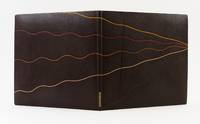
ST17263-25Market Drayton England: Tern Press 1985. No. 9 OF 75 COPIES signed by the artist. 260 x 270 mm. 10 1/4 x 10 1/2". 6 leaves.Translated into English by Thomas Moore. <br/> DYNAMIC DARK BROWN CRUSHED MOROCCO BY ALISON MARTIN five wavy lines of inlaid morocco in yellow orange tan beige and brown emanating from a section near the mid-fore edge of the front cover and radiating out and around the smooth spine three of the lines terminating on the fore edge of the rear cover the other two at the head and tail edges front cover also with a single straight diagonal line of inlaid black calf running from head edge to foot slicing through the color waves paste-paper endleaves made by Martin in an ombré of brown/orange/yellow etched with wavy lines echoing the cover design top edge gilt other edges untrimmed. In a felt-lined black cloth clamshell box black morocco label on spine. With five etchings by Nicolas Parry printed in black and sanguine. Tern Press Check-List 38. As new.<br/> <br/> This appealing fine press edition of an 1800 translation of odes by the sixth century B.C. lyric poet Anacreon comes in a 1995 binding that symbolically embodies the poems and their author. According to Alison Martin's artist's statement "the design represents the five odes as coloured waves against a dark background. These are the ideas and thoughts behind the formation of the Odes the Muses perhaps travelling across the ether destined to come together at an undefined point. . . The poet is represented by the straight black line . . . The man himself has become merely a shadowy figure in the background of his poetic works . . . yet his presence was a vital catalyst to their formation . . . Hence the design is abstract to express things beyond material existence. The colors reflect those used in the paper and printing of the text." Elected a Licentiate of Designer Bookbinders in 1995 Martin earned a degree in English at Leeds University before taking a Diploma in Fine Bookbinding and Conservation at Guildford College. She also worked and trained with renowned binder James Brockman. Tern Press was founded by artist and printer Nicolas Parry and his wife Mary in 1973. In "Matrix 5" Parry said: "Our initial aims were to relate each subject to a relative set of materials to think of the book as an overall work of art rather like an opera with a body stage - props - paper - binding intellect thoughts - words - libretto and feelings music - color - prints to try as in all art to produce a form that lives and breathes. Thus our books are not conceived designed produced through process but are perceived arranged and produced through craft.". Tern Press unknown
155662303Lutetiae (i.e. Paris), Robert Stephanum (i.e. Robert Estienne) & Guillaume Morel, 1556. Small 8vo. Lovely newer full marbled paper binding with gilt leather title-label to spine (Jens E. Hansen, Aarhus). Light brownspotting to a few leaves and somne leaves towards the end with inkspotting at outer blank margin. Early neat handwritten marginal annotations throughout. A lovely copy. 54 pp.
155662303Lutetiae i.e. Paris Robert Stephanum i.e. Robert Estienne & Guillaume Morel 1556. Small 8vo. Lovely newer full marbled paper binding with gilt leather title-label to spine Jens E. Hansen Aarhus. Light brownspotting to a few leaves and somne leaves towards the end with inkspotting at outer blank margin. Early neat handwritten marginal annotations throughout. A lovely copy. 54 pp. <br/><br/><em>Scarce second edition of Elie André’s seminal Latin translation of the Anacreontea – the first complete - which itself is a classic in the history of classical literature. It came to directly influence all later readings of Anacreon. In 1554 Henri Estienne II published the seminal editio princeps of Anacreon which is no less than an outright Renaissance sensation causing the “Anacreaonta†to become the most influential “ancient†Greek poetic text during the Renaissance initiating a poetic revolution in Europe. Simultaneously with this editio princeps Henri Estienne published his own Latin translation of it which constitutes the first translation into Latin. Merely a year later in 1555 Elie André extremely important translation of the Anacreaontea appeared in 1555 printed by Thomas Richard. This translation included additional Odes not in the Estienne edition and was thus the first complete Latin translation of the “Anacreontiaâ€. The following year 1556 Robert Estienne II published his first work namely a second edition of the original Greek Anacreontea that Henri Estienne had published in 1554. Silmultaneously Robert Estienne republished Elie André’s Latin translation which was published separately but which is often found together with the 1556 second edition of the Greek Anacreontea. “The first full translation of CA was again in Latin. It was published by the humanist Elie André 1509-1587 from Bordeaux who was friendly with the Parisian circle around the Pléiade. André’s translation appeared less than a year after Estienne’s edition and comprised the Latin translation only without the Greek text. In a way this can be taken as a signal that the Latin tradition was coming into its own. Accordingly André makes some bolder choices in his translation which already shows in his first lines see Aiijr: Cantare nunc Atridas Nunc expetesso Cadmum: Testudo vero nervis Solum refert Amorem …. In classical Latin the verb expetessere is used only by Plautus and it is extremely rare in postclassical Latin. This brings a somewhat odd ring of comedy to the poem. Here and in a number of other places the translator wishes to strike his readers with an unusual turn of phrase or by some sort of amplification. He does not just imitate ‘Anacreon’ but also competes with him as arguably with Estienne’s translation. André’s willingness to adapt the original text shows also in a certain moralistic tendency not otherwise seen in Latin translations. On the one hand he openly and avowedly changes the text when it comes to unequivocal references to homosexuality: in CA 12 10.8-10 Ï„ µευ καλν νεÏων … φÏπασας Βθυλλον; “Why from my sweet dreams … have you snatched away Bathyllus†for instance he replaces Bathyllus with a puella Cur mane somnianti / Ista loquacitate / Mihi eripis puellam…; in CA 29 17.1-2 ΓÏφε µοι Βθυλλον οτω / τν ταÏον Ï‚ διδσκω “Paint for me thus Bathyllus my lover just as I instruct you†he simply suppresses the word ταÏον “lover†Mihi pinge sic Bathyllum / . Estienne’s translation is: Meos Bathyllum amores / Ut te docebo pinge. Here André proceeds in a way similar to the original Neo-Latin Anacreontics in which homosexual love simply does not occur. On the other hand André makes generous use of a metatextual element which is less conspicuous than his changes but is even more extensive and significant. He includes a considerable number of passages in quotation marks and thus identifies them as sort of sententiae. In CA 4 32 for instance lines 1-6 describe how the poet wishes to lie down on myrtles drink and have Eros as his wine steward. This description of a specific setting is followed by some more general lines about the brevity of life which André includes in quotation marks lines 7- 10: “Cita nanque currit aetas / Rota ceu voluta currus. / Sed et ossibus solutis / Iaceam cinis necesse est†“For hurried life runs along just like a rolling wheel but I shall soon lie a bit of dust from crumbling bonesâ€. The focus of this quotation technique is on lines concerned with the transitory nature of life the uncertainness of tomorrow and the futility of riches. By marking out such lines as sententiae André distinguishes Anacreon the philosopher from Anacreon the drinker and lover and contributes to a larger discourse about the morality of the poet and his poems. While opinions in antiquity were often critical of Anacreon’s morals ‘Anacreon’s’ large flock of modern imitators was united to defend their hero’s virtue. From Estienne’s preface onwards they usually referred to Plato’s Phaedrus 235c where Socrates calls Anacreon “wise†σοφς in matters concerned with Eros. In the 18th century Anacreon the philosopher could even turn into a key-image of enligthened discourses. André’s identification of sententiae in ‘Anacreon’ prepared for this development and could have had a direct influence on it since his translation was widely read until well into the 18th century. The Latin translations of Estienne and André soon became classics in themselves and were the most successful ones in the early modern period.†Tilg: Neo-Latin Anacreontic Poetry. Its Shapes and Its Significance 214. Pp. 177-78. Brunet: I:250; Renouard: I:161. </em> hardcover
1773CLL-858A Paphos et se trouve à Paris, chez Le Boucher, 1773 In-8 de (2) ff., IV, 280 pp., maroquin rouge, triple filet doré en encadrement sur les plats avec fleurons aux angles, dos lisse orné de caissons de fleurons dorés, pièce de titre de maroquin olive, double filet doré sur les coupes, roulette intérieure dorée, tranches dorées (reliure de l'époque).
17856702Parma: Ex Regio Typographeio i.e. Giambattista Bodoni 1785. Very Good. Quarto 32 cm; 4. xciv 100 2 pages. Engraved title vignette engraved vignette of the arms of Don José Nicolás de Azara by Domenico Cagnoni. Text in Latin and Greek. Printed in capitals on blue paper. In contemporary dark green-brown speckled calfskin ruled in gilt and bordered with a frond and flower tool all edges gilt. Spine in six compartments titled in gilt and gilt stamped with "Greek pavilion" tool. Greek key turn-ins. Pink marbled endleaves. The whole preserved in recent custom slipcase. Spine fading to brown and beginning to split slightly near head and tail. Few abrasions on boards. Text effectively unblemished. References: Brooks 287 "Magnificamente stampato in caratteri maiuscoli"; Giani Catalogo delle autentiche edizioni bodoniane 3 "Certo questa seconda edizione è più attraente della prima."; De Lama II 35 "bella edizione". <br /><br />Much admired edition in a large quarto format of a text Bodoni had printed in octavo the previous year. Intended in part to show off his new Greek capital letters he printed the entire text on tinted paper in caps and small caps in sharp distinction to any prior edition. Bodoni was actively trying to expand his commercial market and his reputation into Spain during this period hence the dedication to Azara a Spanish noble and sometime resident of Parma. Ex Regio Typographeio [i.e., Giambattista Bodoni] hardcover
195322242Sans lieu Cercle Lyonnais du L 1953 In-8, demi-maroquin rouge coins, plats de papier mouchet, dos sans nerfs entirement mosaqu de fleurons en maroquin noir encadrs de jeux de filets dors; doublures et gardes de papier mouchet, tte dore, non rogn, couverture imprime (Ch. Septier).50 lithographies originales in texte d'Andr Derain. Tirage unique limit 200 exemplaires numrots sur vlin.
1773ST16314Paris: Chez Le Boucher 1773. First Edition with these Illustrations. 214 x 136 mm. 8 3/4 x 5 1/2". 2 p.l. iv 280 pp. without "Héro et Léandre" as usual.Translated by Julien Jacques Moutonnet de Clairfons. <br/> LOVELY RED MOROCCO GILT BY CHAMBOLLE-DURU stamp-signed on front turn-in covers with French fillet border raised bands spine gilt in compartments with rose sprig at center curling floral cornerpieces gilt titling densely gilt turn-ins marbled endpapers all edges gilt. Engraved frontispiece and 25 charming and delicate engraved illustrations by Jean Massard after Charles Eisen. Cohen-de Ricci 79; Brunet I 254; Graesse I 113. For the binding: Flety 40. ◆Lower half-inch of joints just starting to show wear three minor stains and one short scratch to upper board but a fine and pretty copy the text fresh and smooth with deep impressions of the type with rich impressions of the engravings with ample margins and with a lustrous binding.<br/> <br/> This is a very attractive copy of the first printing of an anthology of French versions of classical poetry described by Cohen-de Ricci as "one of the most elegantly illustrated books of the 18th century." Charles Eisen 1720-78 was Louis XV's court painter as well as drawing master to Madame de Pompadour. Bryan says that "almost all the important books published in France in his time contain his exquisite plates" which "he engraved with a light point and with striking originality." He "took his inspirations direct from nature but added something of the ideal after the manner of Watteau and Boucher." The text contains biographies of and works by four important Greek poets: Anacreon sixth century B.C. Sappho b. ca. 612 B.C. Bion third century B.C. and Moschus second century B.C. The binding here is a perfect example of the kind of handsomely done French classical work produced for an extended period under the name of Chambolle. A rough contemporary of and certainly the equal in technique to binders like Trautz Marius Michel père Lortic and Cuzin the elder Chambolle served his apprenticeship under Hippolyte Duru and later formed a partnership with him as is clear from the stamped signature on our volume. Chambolle's son continued the business when his father retired in 1898 and in her "Modern Bookbindings" Sarah Prideaux says of her contemporary "Chambolle most worthily continues the traditions associated with the name of his father. . . . To him are confided the classics of former times which he clothes in the styles appropriate to them keeping to a simplicity of ornamentation which reveals great taste and feeling for composition.". Chez Le Boucher unknown
396Ouvrage composé de 2 volumes in-4 , avec figures coloriées ou non coloriées, dessinées d'après des statues & des monuments authentiques. Tome premier. Paris, Pierre Rémy, peintre et J. B. G. Musier, libraire, 1785. Grand in-4 (32.5 cm) pagination multiple de (1),16, 8, 12, 5, 6, 16, 15, 12, 8, 4, 16, 9, et 7 p., ill. de 12 bois hors-texte colorés à la main et gravés par Le Coeur d'après Desrais et Defraisne. Reliure plein veau jaspé, dos lisses complètement orné d'étoiles et filets dorés, pièce de titre rouge, dentelle entourant les plats, tranches mouchetées. Reliure d'époque solide. Quelques rousseurs, charnières légèrement fendues, petites égratignures sur les plats, coins et coupes très légèrement frottés. Exemplaire à très grandes marges sur papier vélin. Semble complet, malgré l'indication du titre, l'ouvrage prévu n'a probablement jamais été complété. Aucune mention de l'ouvrage dans Brunet, Colas, Cohen, Quérard, Bibliothèque nationale, British Library, N.U.C. et Graesse. Exemplaire acheté et décrit chez Marc Loliée, libraire à Paris, qui n'avait pas trouvé de références bibliographiques. [ Série de livraisons sur Homère, Anacréon, les Amazones, la femme spartiate, les gladiateurs, etc.]
1793139954Parma: Bodoni 1793. contemporary calf gilt borders on covers black and red leather spine labels gilt leather turn-ins marbled pastedowns and endsheets. Bodoni Giambattista. small 8vo. contemporary calf gilt borders on covers black and red leather spine labels gilt leather turn-ins marbled pastedowns and endsheets. viii 100 pages. Printed by Giambattista Bodoni in Parma Brooks 503. Minor shelf wear else a near fine copy. Pages 73-100 contain the "choice of poems mostly not complete which are published under the name of Anacreon". There were 6 copies on parchment. A lovely copy.<BR> <br /> <BR> <br /> Anacreon one of the most celebrated Greek lyric poets was born at Teos in Ionia. He lived in Samos and Athens where his patron was Hipparchus. His poetry is know for it's grace and elegabce and it's celebration of the joys of wine and love. Bodoni unknown
19533539Lyon Cercle lyonnais du livre 1953 in-4 en feuilles Lyon, Cercle lyonnais du livre, 1953. 28 x 19,5 cm, in-4, 3 ff. bl. - 80 (17) pp. - 3 ff. bl., 50 lithographies originales en noir dont 1 en frontispice et 8 à pleine page, en feuilles sous couverture de fort papier vergé antique crème rempliée et imprimée, chemise et étui.
1773CLL-115Paris, Le Boucher, 1773-1774 In-8 de (2) ff., IV, 280 pp. - XVI, 104 pp., veau porphyre, triple filet doré en encadrement, dos à nerfs orné de caissons de fleurons dorés, pièce de titre de maroquin vert, coupes et bordures décorées, tranches dorées sur marbrure (reliure de l'époque).