(to Emile DURKHEIM) - Lucien LEVY-BRUHLBiblio.com
404 résultats
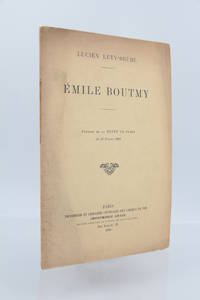
190688848Paris: Imprimerie Chaix 1906. Fine. Imprimerie Chaix Paris 1906 16.2 x 24.5 cm Broché First edition printed in a small number of copies of this offprint from the Revue de Paris dated 15 February 1906. Émile Boutmy was the founder of the École libre des sciences politiques which would later become the Institut d'études politiques de Paris now widely known as Sciences Po. Wrappers slightly toned at the margins inevitable minor edge tears and small losses consistent with the fragile nature of the pamphlet. Inscribed and signed by Lucien Lévy-Bruhl: ""A Emile Durkheim affectueusement L.L.B."" In January 1906 Lucien Lévy-Bruhl professor at the 'École libre des sciences politiques' since 1885 took up his pen to pay a final tribute to the director and founder of this prestigious institution Émile Boutmy. He sent a copy of his work – printed in a small number of copies – to his friend and collaborator Émile Durkheim. This exchange between two major figures of French sociology preceded a pivotal period for this field of study: that same year both were appointed professors at the Sorbonne University enabling sociology to gradually become an academic science Laurent Mucchielli Robert Crawford.  A rare inscription that brings together on the same leaf Lucien Lévy-Bruhl a faithful disciple of Durkheimism and its founder Émile Durkheim. Imprimerie Chaix unknown
189244032Burdigalae Ex Typis Gounouilhou 1892. 8vo. Bound with the scarce original printed wrappers in mathcing recent light greenish-grey boards with title to spine.- A few markings and spotting to wrappers and tiny paper-restorations to corners A part from light pencil-annotations a very fine and clean copy. 74 2 pp. <br/><br/><em>The scarce first edition of Durkheim's earliest published work his subsidiary Latin thesis on Montesquieu which anticipates many of his most important theories and contains important observations that are formative for his later work. As such the present work constitutes his earliest exposition of sociology as a science.Emile Durkheim 1858-1917 the father of sociology is credited with making sociology a science and established sociology as a recognized academic discipline. Together with Karl Marx and Max Weber he is considered the principal architect of modern social science. The present work which serves as the companion to his "The Division of Labour in Society" printed the year after in 1893 analyses Montesquieu's "Spirit of Laws" as a foundational work of modern sociology explains how Montesquieu's distinctions define the conditions and boundaries of sociology and how the work is the first to establish the main principles of political science. One of Durkheim's major contributions lies in his insistence on taking the total society as his theoretical frame of reference which is quite explicitly observed in the present analysis and explanation of Montesquieu. </em> hardcover
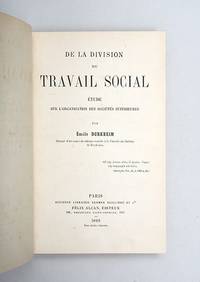
1893160789Paris: Ancienne Librairie Germer Baillière et Cie Félix Alcan Éditeur 1893. One of the founding texts of sociology First edition of the author's first major work and one of the founding texts in the field of sociology his doctoral thesis analyzing the way that societies maintain order and how this changes as they progress from primitive to industrial modes of organisation. The work introduces many ideas and concepts which Durkheim employed throughout his life. Octavo 214 x 135 mm. Contemporary dark green quarter sheep spine lettered in gilt mottled sides marbled endpapers brown speckled edges. Bound without terminal publisher's catalogue. Spine sunned slight rubbing light foxing to initial and final few leaves. A very good copy. Lukes 1893b. unknown
1912140596Paris: Librairie Félix Alcan 1912. Presentation copy inscribed by Durkheim First edition first impression presentation copy inscribed by the author on the half-title "A mon collegue D. Parodi Bien cordialement E. Durkheim". Dominique Parodi 1870-1955 was among Durkheim's collaborators on their journal Année sociologique subsequently the General Inspector of Public Instruction in France from 1919 to 1934 where he presided over the diffusion of Durkheimian ideas in the schools and later editor of the Revue de métaphysique et de morale from 1935 to 1955. This sociological study of religion is one of Durkheim's most influential works. "In his last great work The Elementary Forms of the Religious Life Durkheim gave his most compelling demonstration of the structuralist method tracing relationships between social organization religious beliefs and such fundamental categories of thought as space time and causation. He seemed to have brought about the 'sociologization of everything'" Thompson. Octavo 220 x 137 mm. Folding map printed in red and black. Contemporary black morocco-backed green marbled boards titles in gilt direct to spine green marbled endpapers top edge speckled others untrimmed green silk bookmark. Binding sometime expertly restored extremities rubbed a touch of sunning along head of front board else firm and square a few pencil annotations light marginal toning else internally clean. Loosely inserted is a sheet with two portrait attempts and a few hand-written notes. A very good copy. Lukes 1912a; Ken Thompson "Émile Durkheim" 2002 p. 23. hardcover