44 résultats
184943827Paris, Victor Masson, Imprimerie de Bachelier, 1849-50. No wrappers. In ""Annales de Chimie et de Physique"", 3me Series - Tome XXVI a. XXX., Juin 1849 a. Octobre 1850. (The entire issues offered). Titlepages to vol. 26 a. 30. Pp. 129-256 a. pp. 129-256. Fizeau & Foucault's paper: pp. 138-148 a. pp. 146-159, 2 folded engraved plates. Some scattred brownspots.
185444783Paris, Victor Masson, 1854. No wrappers. Extracted from ""Annales de Chimie et de Physique"", 3me Series - Tome 41. With titlepage to Tome 41. Pp. 120-164 and 1 large folded engraved plate showing the experimental apparatus. Some foxing throughout.
185145070Leipzig, Johann Ambrosius Barth, 1851 Without wrappers as issued in ""Annalen der Physik und Chemie. Hrsg. von J.C. Poggendorff"", 82. Bd., 3. issue (""Heft"" No 3, 1851). Entire issue offered. Pp. 337-464. Foucault's paper: pp. 458-462. With titlepage to volume 82.
183518281Berlin, A. Hirschwald, 1835. Marmorierter Pappband der Zeit, 8°, VIII, 160 S., rotes Rückenschild;- etwas berieben, Rückenschild mit kleiner Fehlstelle, Exlibris, Bibliotheks-Stempel auf Titel.
183518282Berlin, A. Hirschwald, 1835. Einzige Ausgabe. Marmorierter Pappband der Zeit, 8°, XIV, 130 S., rotes Rückenschild;- etwas berieben, Vorspann mit schwachem Wasserrand, Exlibris, Bibliotheks-Stempel auf Titel (gelöscht).
183718289Edinburgh, Adam and Charles Black, 1837. Einzige Ausgabe. Marmorierter Pappband der Zeit, schwarzer Rücken, rotes Rückenschild, 8°, XII, 240 S.;- etwas berieben, Exlibris, Titel mit Stempel des Hamburger Gesundheitsrates, hübsches Exemplar/ marbled hard board, 8vo, xii, 240 pp; -slightly rubbed, exlibris, stamped, nice copy..
181018291Leipzig, A. Bauer, 1810. Zweyte Auflage vermehrt. Marmorierter Pappband der Zeit, schwarzer Rücken u. rotes Rückenschild 8°, XXXII, , 2 Bl, 608 S.;- Ecken u. Kapitale gering bestoßen, Rücken unten mit kleiner Fehlstelle, leicht gebräunt, Exlibris, Titel mit Stempel des Hamburger Gesundheitsrates, sonst sauberes Exemplar.
182718329Leipzig, C. H. F. Hartmann, 1827. Marmorierter Pappband, Rückenschild, 8°, 11 Illustrationen von F. Milde auf 6 lithographierten Tafeln, 1 gefaltete Tabelle, XXII, 647, (1) S.;- stärker beschabt, Bibliotheks-Rückenschild, Tafeln vereinzelt stockfleckig, Titel verso mit Bibliotheks-Stempeln.
184943827Paris Victor Masson Imprimerie de Bachelier 1849-50. No wrappers. In "Annales de Chimie et de Physique" 3me Series - Tome XXVI a. XXX. Juin 1849 a. Octobre 1850. The entire issues offered. Titlepages to vol. 26 a. 30. Pp. 129-256 a. pp. 129-256. Fizeau & Foucault's paper: pp. 138-148 a. pp. 146-159 2 folded engraved plates. Some scattred brownspots. <br/><br/><em>First appearance of thispaper in which the authors demonstrated importent similarities between sound - and lightwaves and that interference takes place between rays of light of different wavelenghts thus giving considerably evidence for the wave theory of light."By analyzing the white light source into simpler constituents by means of a spectroscope Fizeau and Foucault were able to observe fringes produced by interfering light rays with a difference of travel equal to more than 7000 wavelenghts thus showing hat light waves like sound waves remain geometrically constant over a large number of periods. But light waves because of their transverse vibrations are more complex than sound waves. Light can assume different forms of planes of vibration as well as different intensities. Using the same spectroscopic apparatus as in the preceeding experiment Fizeau and Foucault observed the interaction of two rays produced by passing a single polarized ray through a birefringent crystal. In this case instead of obtaining alternating bands of light and dark they obtained bands of light periodcally polarized in different planes of vibration."DSB V p. 19. </em> unknown
185918267Berlin, August Hirschwald, 1859. Marmorierter Pappband der Zeit, schwarzer Rücken, rotes Rückenschild 8°, XXIV, 487 S.; -Kanten berieben, Exlibris, Oberkante mit kleinem schwachen Wasserrand, Titel mit Stempel des Hamburger Gesundheitsrates, gutes Exemplar.
1869133625Paris France: L'Académie des Sciences 1869. unbound edges uncut in later portfolio. Science. 4to. unbound edges uncut in later portfolio. 6 pages. Text in French. Extracted from Comptes rendus des séances de L'Académie des Sciences LXIX December 13 1869. The siderostat is a revolving flat mirror designed to enhance telescopic viewing. Foxing. Unopened. L'Académie des Sciences unknown books
185408799Paris: Victor Masson 1854. Quarter Leather. Very Good. Octavo. Offered is a very good entire Vol. 41 of Annales de Chimie et de Physique in nice quarter brown leather binding and marbled paper covered boards with raised bands spine gilt lettering on black leather spine label. Light rubbing cover edges scattered foxing. Complete with the foldout plate demonstrating Foucault's apparatus diagramatically reproduced in DSB VOl. 5 p. 85. A Comparison of this velocity in air and in water would be clear experimental test between the wave and particle theories of light since the former required light to travel faster in air; the later; in water.Fizeau returned to the rotating mirror to compare light's velocity in rare and dense media but here he was beaten by Foucault who announced on 30 April 1850 that "light travels faster in air than in water" Foucault's first experiment carried out in 1850 and written up in full in his doctorial thesis of 1853; was purely comparative; he announced no numerical values until 1862. DSB Vol. 5 pp. 85-85. <br/><br/> Victor Masson hardcover books
1855287442Paris 1855. unbound. very good. Uncommon A.L.S. "L. Foucault" 8vo. 1 page Paris February 24th 1855 to Monsieur Ami Gilbert Govi in French translated: "Here is my take on the size one has to give the drawing; you could make it even smaller but certainly not any larger. As you know the engraver is more than willing to engrave on your marks so I rely on your extreme kindness. All yours and leaving things in your camp I remain." Two very minor striations at the top left-hand margin otherwise in fine condition.<br/><br/> French physicist who invented the Foucault Pendulum made an early measurement of the speed of light discovered eddy currents and is credited with naming the gyroscope.<br/><br/> unknown books
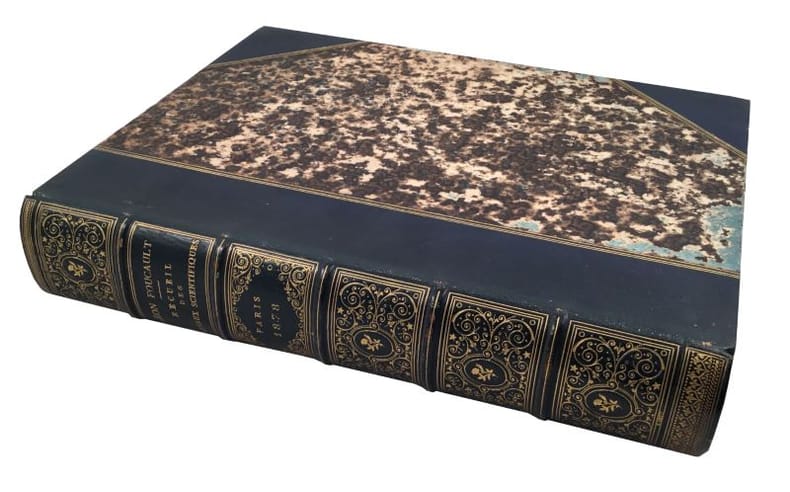
18781033701878 Paris: Gauthier-Villars, 1878, 2 tomes en un volume, in-4 de 269 x 206 mm, demi-chagrin à coins dos à caissons décorés, reliure signée R. Petit.Portrait gravé en frontispice, 19 planches dépliantes et nombreuses gravures dans le texte. Edition originale.Bel exemplaire.(103370)
1883gb720Laval, imprimerie Chailland, libraire-éditeur Broché 1883 RARE. In-8 (17 x 25,3 cm), broché, 292 pages ; reliure cassée, dos fendu, plats désolidarisés, rousseurs à l'intérieur, exemplaire à relier, en l'état. Livraison a domicile (La Poste) ou en Mondial Relay sur simple demande.
1895RO30085753LIBRAIRIE CH. POUSSIELGUE. 1895. In-8. Relié demi-cuir. Etat d'usage, Couv. convenable, Dos abîmé, Intérieur frais. 259 pages. Pièce de titre bordeaux. Titre, fleurons dorés sur le dos cuir marron.. . . . Classification Dewey : 840.08-XIX ème siècle
1895RO40259404Librairie Ch. Poussièlgue, Paris. 1895. In-8. Broché. Etat d'usage, 2ème plat abîmé, Dos abîmé, Intérieur acceptable. 259 pages. Papier muet encollé sur le dos, le consolidant.Etiquette de code sur la couverture. Quelques tampons de bibliothèque. Traces de colle sur la couverture. Petit manque sur le coin inférieur gauche du 2e plat.. . . . Classification Dewey : 922-Religieux
1875vb3203Laval, imprimerie de E. Jamin Relié 1875 In-8 (13,7 x 20,5 cm), reliure cartonnée, 417 pages, envoi de l'auteur ; tampons de bibliothèque de couvent à la première garde et au titre, par ailleurs bel état. Livraison a domicile (La Poste) ou en Mondial Relay sur simple demande.
186211605Publiés et annotés par F. Baudry. Très importants mémoires : Foucault (1643-1721) fut intendant sous Louis XIV durant 32 années; principalement à Caen.(2ff de faux-titre et titre), CLXXVII pp d'introduction et 590 pp. Cartonnage d'éditeur légèrement frotté. Bon Paris Imprimerie Impériale 1862 1 fort volume in-4°
1855287442Paris 1855. unbound. very good. Uncommon A.L.S. "L. Foucault" 8vo. 1 page Paris February 24th 1855 to Monsieur Ami Gilbert Govi in French translated: "Here is my take on the size one has to give the drawing; you could make it even smaller but certainly not any larger. As you know the engraver is more than willing to engrave on your marks so I rely on your extreme kindness. All yours and leaving things in your camp I remain." Two very minor striations at the top left-hand margin otherwise in fine condition.<br/> <br/> French physicist who invented the Foucault Pendulum made an early measurement of the speed of light discovered eddy currents and is credited with naming the gyroscope.<br/> <br/> unknown
185144780Paris Bachelier 1851-52. 4to. Later blank wrapper. Extracted from "Comptes rendus hebdomadaires des séances de l’Académie des sciences" Vol. 32 and vol. 35. Foucault's papers: pp. 135-138 1851 vol. 32 pp. 421-424 1852 vol. 35 pp. 424-427 1852 vol. 35 pp. 469-470 1852 vol. 35 and p. 602 1852 vol. 35. <br/><br/><em>First appearance of the papers in which Foucault presented his discovery of the proof of the rotation of the earth by the large pendulum called FOUCAULT'S PENDULUM. It was presented by Arago at the meeting of the Acadey of Scieces on February 3 1851 the first paper offered. In the third paper offered "Sur les phénoménes d'orientation des corps tournant entraînés par un axe fixe." Foucault presents his invention of the GYROSCOPE a freely spinning flywheel which constitutes a different method of demonstrating the rotation of the Earth; he furthermore correctly predicts the use of the gyroscope as a compass. The word "gyroscope" was coined by Foucault on p. 427 of the third paper taken from the Greek meaning "to look at the rotation".Since Léon Foucault's public demonstration of his pendulum experiment it has played a prominent role in physics physics education and the history of science. The Foucault pendulum is a long pendulum suspended high above the ground and carefully set into planar motion. The phenomenon described by Foucault1 concerns the orientation of the plane of oscillation of the pendulum. "The experiment with the pendulum caused great excitement at the time. Heracleides had first suggested twenty-two centuries before that the earth was rotating and Copernicus had renewed the suggestion three centuries before. Since the time of Galileo two and a half centuries before the world of scholarship had not doubted the matter. Nevertheless all evidence as to that rotation had been indirect and not until Foucault's experiment could the earth's rotation actually be said to have been demonstrated rather that deduced." "Continuing to experiment on the mechanics of the earth's rotation Foucault in 1852 invented the gyroscope which he showed gave a clearer demonstration than the pendulum of the earth's rotation and had the property similar to that of the magnetic needle of maintaining a fixed direction. Foucault's pendulum and gyroscope had more than a popular significance which continues to this day. First they stimulated the development of theoretical mechanics making relative motion and the theories of the pendulum and the gyroscope standard topics for study and investigation. Second prior to Foucault's demonstrations the study of those motions on the earth's surface in which the deflecting force of rotation plays a prominent part especially winds and ocean currents was dominated by unphysical notions of how this force acted. Foucault's demonstrations and the theoretical treatments they inspired showed conclusively that this deflecting force acts in all horizontal directions thus providing the sound physical insight on which Buys Ballot Ferrel Ulrich Vettin and others could build. DSB.PMM: 330 lists the offprint with the title "Sur Divers Signes Sensibles du Mouvement Diurne de la Terre" - Barchas Collection 738 the periodical version but only the first paper - Dibner No. 17 offprint version. </em> unknown
186249458Paris Mallet-Bachelier 1862. 4to. No wrappers. In: "Comptes rendus hebdomadaires des séances de l’Académie des sciences" Vol. 55 No 12 a. 21. Pp. 481--519 a. pp. 781-803. Entire issues offered. With title-page to vol. 55. Foucault's papers: pp. 501-503 a. pp. 792-796. Clean and fine. <br/><br/><em>First printing of Foucault's famous experiments on the velocity of light with the description of his improved equipment the rotating mirror. Foucault's method was later developed by Michelson and Morley in their famous experiment in 1887."Foucault’s first experiment carried out in 1850 and written up in full in his doctoral thesis of 1853 was purely comparative; he announced no numerical values until 1862. Then with an improved apparatus he was able to measure precisely the velocity of light in air. This result significantly smaller than Fizeau’s of 1849 changed the accepted value of solar parallax and vindicated the higher value which Le Verrier had calculated from astronomical data. Foucault’s turning-mirror apparatus was the basis for the later determinations of the velocity of light by A. A. Michelson and Simon Newcomb."DSB.Leon Foucault used a similar method to Fizeau. He shone a light to a rotating mirror then it bounced back to a remote fixed mirror and then back to the first rotating mirror. But because the first mirror was rotating the light from the rotating mirror finally bounced back at an angle slightly different from the angle it initially hit the mirror with. By measuring this angle it was possible to measure the speed of the light. Foucault continually increased the accuracy of this method over the years. His final measurement in 1862 determined that light traveled at 299796 Km/s. Magee "A Source Book in Physics" p. 342 ff. and "Source Book in Astronomy" p. 282 ff. </em> unknown
185145070Leipzig Johann Ambrosius Barth 1851 Without wrappers as issued in "Annalen der Physik und Chemie. Hrsg. von J.C. Poggendorff" 82. Bd. 3. issue "Heft" No 3 1851. Entire issue offered. Pp. 337-464. Foucault's paper: pp. 458-462. With titlepage to volume 82. <br/><br/><em>First German edition of the famous paper in which Foucault presented his discovery of the proof of the rotation of the earth by the large pendulum called FOUCAULT'S PENDULUM. It was presented by Arago at the meeting of the Acadey of Scieces on February 3 1851.Since Léon Foucault’s public demonstration of his pendulum experiment it has played a prominent role in physics physics education and the history of science. The Foucault pendulum is a long pendulum suspended high above the ground and carefully set into planar motion. The phenomenon described by Foucault1 concerns the orientation of the plane of oscillation of the pendulum. "The experiment with the pendulum caused great exitement at the time. Heracleides had first suggested twenty-two centuries before that the earth was rotating and Copernicus had renewed the suggestion three centuries before. Since the time of Galileo two and a half centuries before the world of scholarship had not doubted the matter. Nevertheless all evidence as to that rotation had been indirect and not until Foucault's experiment could the earth's rotation actually be said to have been demonstrated rather that deduced." DSB.Parkinson "Breakthroughs" 1851 E. </em> unknown
1869133625Paris France: L'Académie des Sciences 1869. unbound edges uncut in later portfolio. Science. 4to. unbound edges uncut in later portfolio. 6 pages. Text in French. Extracted from Comptes rendus des séances de L'Académie des Sciences LXIX December 13 1869. The siderostat is a revolving flat mirror designed to enhance telescopic viewing. Foxing. Unopened. L'Académie des Sciences unknown
185408799Paris: Victor Masson 1854. Quarter Leather. Very Good. Octavo. Offered is a very good entire Vol. 41 of Annales de Chimie et de Physique in nice quarter brown leather binding and marbled paper covered boards with raised bands spine gilt lettering on black leather spine label. Light rubbing cover edges scattered foxing. Complete with the foldout plate demonstrating Foucault's apparatus diagramatically reproduced in DSB VOl. 5 p. 85. A Comparison of this velocity in air and in water would be clear experimental test between the wave and particle theories of light since the former required light to travel faster in air; the later; in water.Fizeau returned to the rotating mirror to compare light's velocity in rare and dense media but here he was beaten by Foucault who announced on 30 April 1850 that "light travels faster in air than in water" Foucault's first experiment carried out in 1850 and written up in full in his doctorial thesis of 1853; was purely comparative; he announced no numerical values until 1862. DSB Vol. 5 pp. 85-85. <br/><br/> Victor Masson hardcover