FOUCAULT, Jean Bernard LeonBiblio.com
1 331 résultats
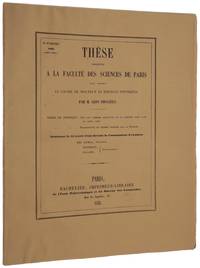
18534843Paris: Bachelier 1853. First edition. <p>First edition rare and an exceptionally fine copy of Foucault's doctoral thesis on the speed of light in which he provides a convincing proof for the wave theory of light. Foucault undertook a series of optical experiments using an apparatus of rotating mirrors to determine the velocity of light. In this thesis Foucault gives a detailed account of his experiment illustrating his apparatus and proves that light travels faster in air than in water a decisive argument in favour of the wave theory of light; it was not until 1862 that he was able to determine a numerical value for the speed of light of about 298000 kilometers per second a figure significantly smaller and more accurate than Fizeau's.</p>. Proving the wave theory of light. <p>First edition rare and an exceptionally fine copy of Foucault's doctoral thesis on the speed of light in which he provides a convincing proof for the wave theory of light. In the 1840s Foucault undertook a series of optical experiments using an apparatus of rotating mirrors to determine the velocity of light. Originally developed by Charles Wheatstone to measure the velocity of electricity the rotating mirror apparatus had been proposed as an instrument for the measurement of light in 1838 by Dominique-François Arago who failed in his own attempts to carry out the experiment. Foucault's initial work was carried out in conjunction with the physicist Armand Hippolyte Louis Fizeau 1819-1896; but a personal dispute broke up their partnership in 1847 and the two collaborators became rivals working separately on the same problem using the same technique. Both reached the same conclusion but while Fizeau was the first to obtain in 1849 a precision measurement of the velocity of light Foucault pre-empted him in announcing on 30 April 1850 that light travels faster in air than in water a decisive argument in favour of the wave theory of light which by the mid-nineteenth century had become generally accepted. In his thesis Foucault gives a detailed account of his experiment illustrating his apparatus; it was not until 1862 that he was able to determine a numerical value for the speed of light of about 298000 kilometers per second a figure significantly smaller and more accurate than Fizeau's. Foucault is today best known for the pendulum experiments demonstrating the rotation of the earth which he performed in 1851. Perhaps he considered these experiments to be unsuitable as a thesis topic as the result the rotation of the earth was well known to everyone whereas the results of his air-and-water experiments though expected by most scientists were new. ABPC/RBH list five copies in the last 40 years: Christie's 2008 $17395; Christie's Paris 2004 €9000; Christie's 2004 $8812; Christie's 1999 $10350; Christie's 1998 $7475.</p> <br /> <p>"The early-to-mid 1800s were a period of intense debate on the particle-versus-wave nature of light. Although the observation of the Arago spot in 1819 may seem to have settled the matter definitively in favor of Fresnel's wave theory of light various concerns continued to appear to be addressed more satisfactorily by Newton's corpuscular theory .</p> <br /> <p>"In 1834 Charles Wheatstone developed a method of using a rapidly rotating mirror to study transient phenomena and applied this method to measure the velocity of electricity in a wire and the duration of an electric spark 'An Account of Some Experiments to Measure the Velocity of Electricity and the Duration of Electric Light' Philosophical Transactions of the Royal Society of London vol. 124 pp. 583-591. He communicated to François Arago the idea that his method could be adapted to a study of the speed of light. Arago expanded upon Wheatstone's concept in an 1838 publication 'Sur un système d'expériences à l'aide duquel la théorie de l'émission et celle des ondes seront soumises à des épreuves décisives' Comptes rendus hebdomadaires des séances de l'Académie des sciences vol. 7 pp. 954-960 emphasizing the possibility that a test of the relative speed of light in air versus water could be used to distinguish between the particle and wave theories of light" Wikipedia.</p> <br /> <p>"A comparison of this velocity in air and in water would be a clear experimental test between the wave and particle theories of light since the former required light to travel faster in air; the latter in water" DSB.</p> <br /> <p>"In 1845 Arago suggested to Fizeau and Foucault that they attempt to measure the speed of light. Sometime in 1849 however it appears that the two had a falling out and they parted ways pursuing separate means of performing this experiment. In 1848-49 Fizeau used not a rotating mirror but a toothed wheel apparatus to perform an absolute measurement of the speed of light in air .</p> <br /> <p>"In 1850 and in 1862 Léon Foucault made improved determinations of the speed of light substituting a rotating mirror for Fizeau's toothed wheel. The apparatus involves light from a slit S reflecting off a rotating mirror R forming an image of the slit on the distant stationary mirror M which is then reflected back to reform an image of the original slit. If mirror R is stationary then the slit image will reform at S regardless of the mirror's tilt. The situation is different however if R is in rapid rotation. As the rotating mirror R will have moved slightly in the time it takes for the light to bounce from R to M and back the light will be deflected away from the original source by a small angle.</p> <br /> <p>"Guided by similar motivations as his former partner Foucault in 1850 was more interested in settling the particle-versus-wave debate than in determining an accurate absolute value for the speed of light. Foucault measured the differential speed of light through air versus water by inserting a tube filled with water between the rotating mirror and the distant mirror. His experimental results announced shortly before Fizeau announced his results on the same topic were viewed as 'driving the last nail in the coffin' of Newton's corpuscle theory of light when it showed that light travels more slowly through water than through air. Newton had explained refraction as a pull of the medium upon the light implying an increased speed of light in the medium. The corpuscular theory of light went into abeyance completely overshadowed by wave theory. This state of affairs lasted until 1905 when Einstein presented heuristic arguments that under various circumstances such as when considering the photoelectric effect light exhibits behaviors indicative of a particle nature.</p> <br /> <p>"In contrast to his 1850 measurement Foucault's 1862 measurement was aimed at obtaining an accurate absolute value for the speed of light since his concern was to deduce an improved value for the astronomical unit. At the time Foucault was working at the Paris Observatory under Urbain le Verrier. It was le Verrier's belief based on extensive celestial mechanics calculations that the consensus value for the speed of light was perhaps 4% too high. Technical limitations prevented Foucault from separating mirrors R and M by more than about 20 meters. Despite this limited path length Foucault was able to measure the displacement of the slit image less than 1 mm with considerable accuracy. In addition unlike the case with Fizeau's experiment which required gauging the rotation rate of an adjustable-speed toothed wheel he could spin the mirror at a constant chronometrically determined speed. Foucault's measurement confirmed le Verrier's estimate. His 1862 figure for the speed of light 298000 km/s was within 0.6% of the modern value" Wikipedia.</p> <br /> <p>Jean Bernard Léon Foucault 1819-68 "worked in a laboratory set up in his home until following the award of the Cross of the Legion of Honor in 1851 for his pendulum experiment and the docteur ès sciences physiques in 1853 for his thesis comparing the velocity of light in air and water he was given a place as physicist at the Paris observatory by Napoleon III. Further honors followed: the Copley Medal of the Royal Society in 1855 officer of the Legion of Honor and member of the Bureau des Longitudes in 1862 and foreign member of the Royal Society 1864 and the academies of Berlin and St. Petersburg. Finally after having failed to be elected in 1857 Foucault was chosen in 1865 following the death of Clapeyron a member of the Académie des Sciences" DSB.</p> <br /> <p>En français dans le texte 270; Norman 820.</p> <br/> <br/> 4to 282 x 230 mm pp. iv 35 1 with one large folding engraved plate. Original printed wrappers unopened. Marginal corrections to text on pages 3 and 5 in the author's hand. Very rare in such fine condition. Bachelier unknown
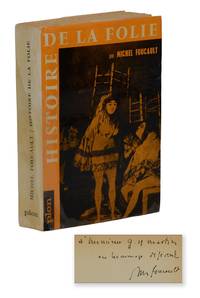
196165314Paris: Plon 1961. Fine. Plon Paris 1961 14 x 20.50 cm broché First edition of which there were no grand papier deluxe copies an advance service de presse copy. Spine slightly bowed with a few tears and lacks to plastic film cover. Slight foxing in the margins of a few pages. Handsome autograph inscription signed by Michel Foucault at the time a young teacher to Jean-Charles Varennes. A very rare advance copy which could be said to have taken the place of the grand papier deluxe copies. Plon unknown
196165314Plon | Paris 1961 | 14 x 20.50 cm | broché
196158093Paris: Plon 1961. Fine. Plon Paris 1961 14 x 20.50 cm broché Madness and Civilization: A History of Insanity in the Age of Reason Plon Paris 1961 5 1/2 x 8 1/16 original wrappers. First edition of which there were no grand papier deluxecopies an advance service de presse copy. A second revised edition appeared in 1972. Spine slightly bowed retaining dj dj with a few tears and lacks to plastic film cover. Handsome autograph inscription signed by Michel Foucault at the time a young teacher on his first important work taken from his doctorate. A very rare advance copy which could be said to have taken the place of the grand papier deluxe copies. Plon unknown
1961140946950Paris: Plon 1961. First Edition. Near Fine/Good. First edition signed by Michel Foucault and inscribed to a former owner on the half-title page rubber stamp from Tribune de Lausanne with inked name at bottom of page. Bound in publisher's cream wraps printed in purple and black. Near Fine with tanning to covers and pages light reading creases to spine. In a Good original orange and black dust jacket with peeling and chipping to surface laminate with major losses to laminate at spine toning and light wear. One of the French philosopher's most important works known as Madness and Civilization to English readers. A historical critique of psychology and the dehumanization of the insane. Plon unknown
196158093Plon | Paris 1961 | 14 x 20.50 cm | broché
185144780(Paris, Bachelier, 1851-52). 4to. Later blank wrapper. Extracted from ""Comptes rendus hebdomadaires des séances de l’Académie des sciences"", Vol. 32 and vol. 35. Foucault's papers: pp. 135-138 (1851, vol. 32), pp. 421-424 (1852, vol. 35), pp. 424-427 (1852, vol. 35), pp. 469-470 (1852, vol. 35) and p. 602 (1852, vol. 35).
185144780Paris Bachelier 1851-52. 4to. Later blank wrapper. Extracted from "Comptes rendus hebdomadaires des séances de l’Académie des sciences" Vol. 32 and vol. 35. Foucault's papers: pp. 135-138 1851 vol. 32 pp. 421-424 1852 vol. 35 pp. 424-427 1852 vol. 35 pp. 469-470 1852 vol. 35 and p. 602 1852 vol. 35. <br/><br/><em>First appearance of the papers in which Foucault presented his discovery of the proof of the rotation of the earth by the large pendulum called FOUCAULT'S PENDULUM. It was presented by Arago at the meeting of the Acadey of Scieces on February 3 1851 the first paper offered. In the third paper offered "Sur les phénoménes d'orientation des corps tournant entraînés par un axe fixe." Foucault presents his invention of the GYROSCOPE a freely spinning flywheel which constitutes a different method of demonstrating the rotation of the Earth; he furthermore correctly predicts the use of the gyroscope as a compass. The word "gyroscope" was coined by Foucault on p. 427 of the third paper taken from the Greek meaning "to look at the rotation".Since Léon Foucault's public demonstration of his pendulum experiment it has played a prominent role in physics physics education and the history of science. The Foucault pendulum is a long pendulum suspended high above the ground and carefully set into planar motion. The phenomenon described by Foucault1 concerns the orientation of the plane of oscillation of the pendulum. "The experiment with the pendulum caused great excitement at the time. Heracleides had first suggested twenty-two centuries before that the earth was rotating and Copernicus had renewed the suggestion three centuries before. Since the time of Galileo two and a half centuries before the world of scholarship had not doubted the matter. Nevertheless all evidence as to that rotation had been indirect and not until Foucault's experiment could the earth's rotation actually be said to have been demonstrated rather that deduced." "Continuing to experiment on the mechanics of the earth's rotation Foucault in 1852 invented the gyroscope which he showed gave a clearer demonstration than the pendulum of the earth's rotation and had the property similar to that of the magnetic needle of maintaining a fixed direction. Foucault's pendulum and gyroscope had more than a popular significance which continues to this day. First they stimulated the development of theoretical mechanics making relative motion and the theories of the pendulum and the gyroscope standard topics for study and investigation. Second prior to Foucault's demonstrations the study of those motions on the earth's surface in which the deflecting force of rotation plays a prominent part especially winds and ocean currents was dominated by unphysical notions of how this force acted. Foucault's demonstrations and the theoretical treatments they inspired showed conclusively that this deflecting force acts in all horizontal directions thus providing the sound physical insight on which Buys Ballot Ferrel Ulrich Vettin and others could build. DSB.PMM: 330 lists the offprint with the title "Sur Divers Signes Sensibles du Mouvement Diurne de la Terre" - Barchas Collection 738 the periodical version but only the first paper - Dibner No. 17 offprint version. </em> unknown
51512Paris.Chalamel.1888.2 vols.in-folio en percaline verte,reliure éditeur, avec caractères noirs et dorés.Texte de 495 p.4 photogravures.101 dessins. de l'Auteur. Atlas de 20 cartes doubles ,1 carte d'assemblage au début, et in fine 1 carte rempliée en couleurs. Grande fraîcheur.Pratiquement sans défaut malgré coiffe supérieure du Texte,,légèrement déchirée.
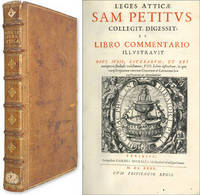
1635516121635. Paris: Sumptibus Coroli Morelli 1635. Paris: Sumptibus Coroli Morelli 1635. An Important Early Study of Ancient Athenian Law Petit Petitus Samuel 1594-1643. Leges Atticae. Sam. Petitus Collegit Digessit et Libro Commentario Illustravit. Opus Iuris Literarum Et Rei Antiquariae Studiosis Utilissimum VIII. Libris Distinctum In Quo Varii Scriptorum Veterum Graecorum et Latinorum Loci Explicantur et Emendantur. Paris: Sumptibus Caroli Morelli 1635. xii 55 1 557 i.e. 567 1 pp. Folio 13-1/2" x 8-3/4". Contemporary calf gilt rules to boards raised bands gilt title and gilt ornaments to spine. A few scuffs to boards some wear to spine ends and corners. Title page with large copperplate vignette printed in red and black woodcut head-pieces tail-pieces and decorated initials. Armorial bookplate of Nicolas-Joseph Foucault to front free endpaper armorial bookplate of the Earls of Macclesfield to front free endpaper. Toning minor worming in a few places with no loss to text internally clean. Small shelf labels to spine ends small embossed Macclesfield stamps to title page and a few leaves. A very handsome copy. $2500. First edition. The author of this study of ancient Athenian law was a distinguished scholar correspondent with leading European men of letters and a friend of Selden Gessendi and Vossius. The work was reissued by K.A. Duker in 1740. This copy comes from the libraries of Nicolas-Joseph Foucault 1643-1721 and the Earls of Macclesfield. Foucault was an influential French civil servant and attorney. A dedicated bibliophile he amassed a vast private library and was an honorary member of the Academie des Inscriptions et Belles-Lettres. The library of the Earls of Macclesfield at Shirburn Castle was one of the finest private libraries in Great Britain. Universal Short-Title Catalogue 6028933. unknown
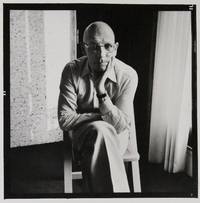
198362310s. l.: Par l'auteur 1983. Fine. Par l'auteur s. l. 1983 22 x 22 cm une feuille FOUCAULT Michel Portrait of Michel Foucault. Original artist's photograph. Large original photographic portrait in black and white by Marc Trivier. Original unsigned silver print like most of Trivier's works. Small tear to upper edge. A handsome original silver print proof by the famous Belgian photographer one of the most secretive contemporary artists who - despite early international success - preferred to limit his output to preserve the coherence of his oeuvre. Marc Trivier doesn't do after-prints of his old portraits and in any case the paper he used for printing is no longer sold. The artist ""prints his images himself on Ilford baryta paper devoting several days of work to each. He pays special attention to rendering the whites contrasted with unusually dense blacks. A Marc Trivier print is like none other. When he does agree to exhibit his images he suspends them in self-made stainless steel frames giving the paper the freedom to live its life"" Xavier-Gilles ""Marc Trivier et la tragédie de la lumière Marc Trivier and the Tragedy of Light"" in Le Monde Libertaire 2011. This ""life of the paper"" participates in the work in the same way as the various changes that the photographs undergo when they're exhibited: ""In the boxes the prints buckle but so what: it's the photographer who's giving rise to this sort of accident"" Claire Guillot ""Les face à face sans échappatoire du photographe Marc Trivier The inescapable encounters of the photographer Marc Trivier Le Monde 2011. Marc Trivier has a particular sensibility for the material aspect of his work. Though photography essentially relies on the multiple this intervention by the artist in the entire process of creation gives these prints an autobiographical air. Whether photographing artists mad people trees or abattoirs Marc Trivier approaches all his subjects with a gaze that is as precise as it is intense. ""In his cosmogony each thing each being whether plant animal or human deserves the same respect. Because all are confronted by the same cast-iron law: solitude"" Luc Desbenoit. The beauty that emanates from his photos comes from this nakedness. There is no retouching and no reframing. One finds throughout his oeuvre the same square format underlined by the squares of the negative that Trivier leaves on his images. This frame traps our gaze in the photographs where the artifice of color is rejected for a cutting black and white. All artificiality gone we are faced not with the arrangement of a subject but a presence exacerbated by the radiant and singular light testimony to a lived moment and not a pose. It is this light tied to the photographic medium that unites Marc Trivier's various series: ""Marc Trivier's photographs write a tragedy of light which does not welcome beings - humans trees or animals - but rather burns them before disappearance"" Xavier-Gilles in Le Monde Libertaire. It is also this tragedy of light freed of all artifice that gives his works the air that makes them so immediate. This ""burning"" of the light throws us back into a real moment to the ""that happened"" of Barthes Camera Lucida 1980: ""Of thirty-five years of photography of various obsessions perhaps this is what is left: a singular way of recording the burning of the light carried through one image after another in a succession of propositions that seem to resemble one another and yet each is just as singular as the fraction of the moment to which it refers"" Marc Trivier. ""Photography says only one thing: 'that happened.' You can only record what has been. If there is a tragedy to it it is in this"" Marc Trivier Warhol Foucault Beckett Dubuffet etc.: the most famous writers and artists posed for Trivier. At the same time the artist was just as interested in the margins of society to what people did not wish to see. He therefore photographed the mentally c Par l'auteur unknown
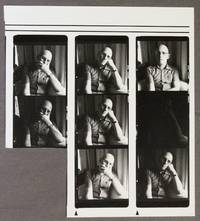
198162331s. l.: Par l'auteur 1981. Fine. Par l'auteur s. l. 1981 21.50 x 24 cm une feuille Set of 8 small-format portraits of Michel Foucault by Marc Trivier. Original unsigned silver print like most of Trivier's works. Precious original silver print by the celebrated Belgian photographer one of the most secretive contemporary artists who despite early international success preferred to limit his production to preserve the coherence of his work. Marc Trivier does not make new prints of his old portraits; the printing paper he used is no longer commercially available. The artist ""makes his own prints on Ilford baryta paper devoting several days of work to each one with particular concentration on rendering the whites in contrast with blacks of rare density. A Marc Trivier print resembles no other. When he agrees to exhibit them he hangs them in stainless steel frames of his own making allowing free rein to the life of the paper."" Xavier-Gilles ""Marc Trivier et la tragédie de la lumière"" in Le Monde Libertaire 2011. This ""life of the paper"" participates in the work just as much as the various alterations that photographs undergo when exposed: ""In boxes the prints buckle but what does it matter: the photographer is fond of this kind of accident."" Claire Guillot ""Les face à face sans échappatoire du photographe Marc Trivier"" Le Monde 2011. Marc Trivier has a particular sensitivity for the material aspect of his productions. While photography is essentially multiple by nature this intervention by the artist in the entire creative process confers an autographic aura to these prints. Photographs of artists madmen trees or slaughterhouses Marc Trivier approaches all these subjects with a gaze as precise as it is intense. ""In his cosmogony each thing each being plant animal or human deserves the same respect. For all are confronted with the same iron law: solitude."" Luc Desbenoit. The beauty that emanates from his photos comes from this nakedness. There are no retouches no reframing. We find in his work the same square format emphasized by the square of the negative that Trivier leaves on his prints. This frame traps our gaze in photographs where the makeup of color is rejected for an incisive black and white. All artificiality having disappeared we do not face the staging of a subject but a presence exacerbated by radiating and singular light witness to an instant of life and not of pose. It is this light linked to the photographic medium that unites Marc Trivier's series: ""Marc Trivier's photographs write a tragedy of light which welcomes beings - men trees or beasts - only by burning them before disappearance."" Xavier-Gilles in Le Monde Libertaire. It is also this light freed from all artifices that gives his works the aura that makes them so present. This ""burning"" of light brings us back to a real instant to Barthes' ""that-has-been"" La Chambre Claire 1980: ""From thirty-five years of photographic practice of obsessions perhaps this is what remains: a singular mode of recording the burning of light declined from one image to another in a succession of propositions that resemble each other and yet each is as singular as the fraction of time to which it refers."" Marc Trivier. ""Photography says only one thing: 'It was.' We only fix what has been. If there is a tragedy it is there."" Marc Trivier Warhol Foucault Beckett Dubuffet . the greatest writers and artists have posed for Trivier. Simultaneously the artist is also interested in the margins of society in what men do not want to see. He then photographs the insane and slaughterhouses that he places alongside celebrities. From the end of the 1980s his work is unanimously recognized and he receives the prestigious Young Photographer Award from The International Center of Photography in 1988 as well as the Prix Photographie Ouverte Charleroi. After the Palais de Tokyo in Paris the Musée de l'Elysée in Lausanne and the Casino in Luxem Par l'auteur unknown
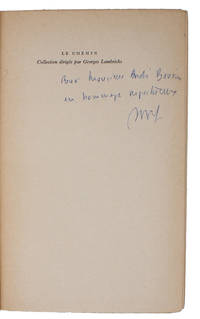
196344017Paris Gallimard 1963. 8vo. Original printed wrappers uncut and unopened. Minor soiling to spine otherwise fine clean and fresh. "S P" punched into bottom of back wrapper and last two leaves. 210 6 pp. <br/><br/><em>First edition presentation-copy "Pour Monsieur André Bourin/ en hommage respecteuse/ MF" of Foucault's highly influential work on the strange and compelling literary genious Raymond Roussel. The work constitutes Foucault's only book-length work of literary criticism and it immediately became highly influential especially among the Surrealists. Raymond Roussel 1877-1933 was a French poet novelist playwright musician and chess enthusiast who exerted a profound influence on 20th century French literature.André Bourin born 1918 is a French literary critic producer and author who has worked for Nouvelles littéraires ORTF TF1 and been the literary critic of La Revue des Deux Mondes Quotidien de Paris and Figaro. </em> unknown
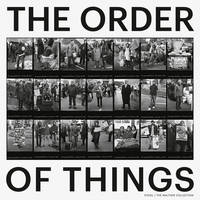
2015114010Steidl. New. 2015. Hardcover. 3869309946 . FREE UPGRADE to Courier/Priority Shipping Upon Request - IN STOCK AND IMMEDIATELY AVAILABLE FOR SHIPMENT - IN STOCK AND IMMEDIATELY AVAILABLE FOR SHIPMENT - Flawless copy brand new pristine never opened - -- with a bonus offer-- . Steidl hardcover
190052530Paris France: Mes. Boudin & Foucault Et Al. As New. 1900. Hardcover. FREE UPGRADE to Courier/Priority Shipping Upon Request IN STOCK AND IMMEDIATELY AVAILABLE FOR SHIPMENT - Text pristine clean & unmarked tight to the spine - Text in French. 265 lots catalogued; 13 plates in black and white or sepia. Among the artists whose works are included in the collection: Antoine Watteau Nicolas Lavreince Fragonard Poussin Lancret and many others. -- with a bonus offer-- . Mes. Boudin & Foucault, Et Al hardcover
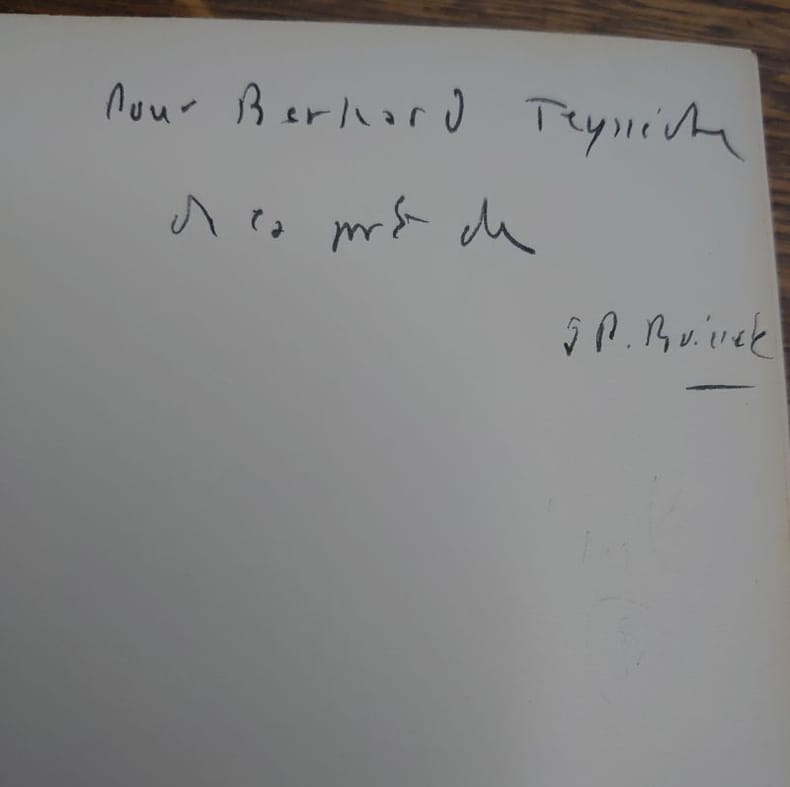
197022301970 Paris, Tchou, 1970. 21 x 14,2 cm, xix-338 pp. Broché, dos légèrment insolé sinon bon exemplaire. Envoi "humoristique" de Michel Foucault : " Pour Bernard Teyssedre de la part de J.P. Brisset ".
584P., Deterville, 1824, 2 fort volumes in 8 reliés en pleine basane, dos ornés de fers et filets dorés, tranches jaspées (reliures de l'époque), (quelques épidermures sur les plats, mouillures pâles dans l'angle supérieur des premiers feuillets au tome 1, défaut de papier d'origine dans la marge extérieure d'un feuillet au tome 1, quelques rousseurs), T.1 : 11pp., 678pp., 7 PLANCHES dépliantes, T.2 : (2), 4pp., 786pp., 12 PLANCHES dépliantes
1995363443London: Routledge 1995. Firs tedition. hardcover. very good/no dustjacket. 8vo. pp.3576 heavy 4 volume set in slipcase additional postage will apply Routledge hardcover
DADAX0394513576Pantheon Books 0000-00-00. 1st American ed. hardcover. New. 0.00x0.00x0.00. Buy with confidence. Excellent Customer Service & Return policy. Pantheon Books hardcover
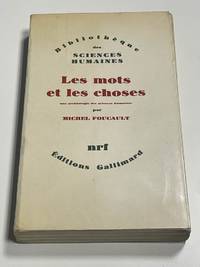
1966367<p><strong>Une archéologie des sciences humaines. 8vo. 225x140 mm 400pp. Original printed French-fold wrappers folding plate of Las Meninas full-page plate of diagrams. First edition first impression of the author's magnum opus the work which made him famous. Foucault examines the origins of the modern human sciences through an "archaeological" approach to the history of thought analyzing how the meaning of knowledge has developed over centuries and shaped Western civilization. A splendid copy now mylar protected & housed in a custom slipcase with chemise & leather label.</strong></p> Gallimard (Une archéologie des sciences humaines) paperback
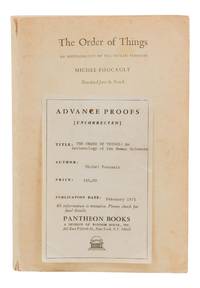
140948765New York: Pantheon Books 1971. Advance Uncorrected Proof. Very Good. Advance uncorrected proof of the first American edition utilizing the uncorrected proof of the British edition published by Tavistock Publications in its entirety but with a slip from Pantheon Books tipped onto the front cover. 387 pp. Bound in publisher's printed wraps. Very Good with lean to binding toning soiling and wear small losses to front joint at ends. A scarce format of this foundational text in postmodernism which argued that every historical era possesses a specific unconscious framework of knowledge or episteme which determines what counts as truth and acceptable discourse. Pantheon Books unknown
1855287442Paris 1855. unbound. very good. Uncommon A.L.S. "L. Foucault" 8vo. 1 page Paris February 24th 1855 to Monsieur Ami Gilbert Govi in French translated: "Here is my take on the size one has to give the drawing; you could make it even smaller but certainly not any larger. As you know the engraver is more than willing to engrave on your marks so I rely on your extreme kindness. All yours and leaving things in your camp I remain." Two very minor striations at the top left-hand margin otherwise in fine condition.<br/><br/> French physicist who invented the Foucault Pendulum made an early measurement of the speed of light discovered eddy currents and is credited with naming the gyroscope.<br/><br/> unknown books
1855287442Paris 1855. unbound. very good. Uncommon A.L.S. "L. Foucault" 8vo. 1 page Paris February 24th 1855 to Monsieur Ami Gilbert Govi in French translated: "Here is my take on the size one has to give the drawing; you could make it even smaller but certainly not any larger. As you know the engraver is more than willing to engrave on your marks so I rely on your extreme kindness. All yours and leaving things in your camp I remain." Two very minor striations at the top left-hand margin otherwise in fine condition.<br/> <br/> French physicist who invented the Foucault Pendulum made an early measurement of the speed of light discovered eddy currents and is credited with naming the gyroscope.<br/> <br/> unknown
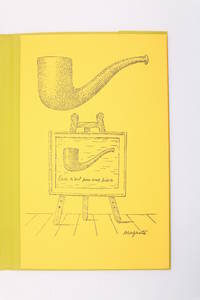
197392010Montpellier: Fata Morgana 1973. Fine. Fata Morgana Montpellier 1973 12.50 x 20 cm en feuilles First edition one of 60 numbered copies on mustard popset paper the deluxe issue. Illustrated with drawings by René Magritte. A very good copy. Our copy is complete with the additional suite of letters and drawings by René Magritte issued with the deluxe copies. Fata Morgana unknown
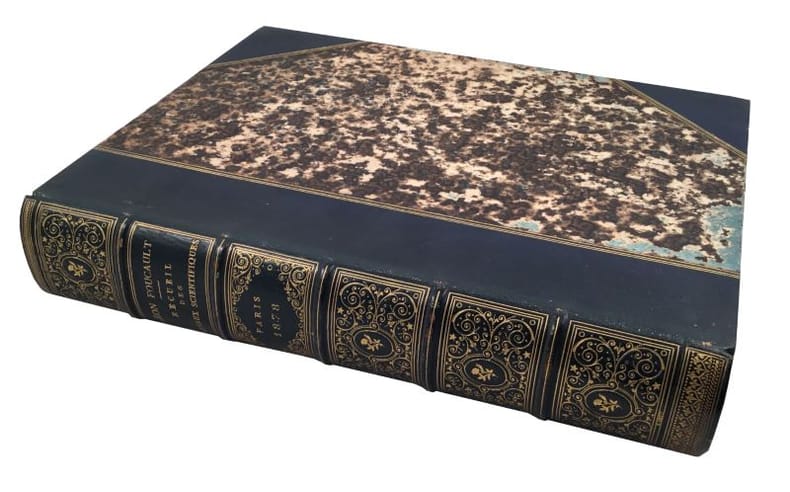
18781033701878 Paris: Gauthier-Villars, 1878, 2 tomes en un volume, in-4 de 269 x 206 mm, demi-chagrin à coins dos à caissons décorés, reliure signée R. Petit.Portrait gravé en frontispice, 19 planches dépliantes et nombreuses gravures dans le texte. Edition originale.Bel exemplaire.(103370)