NADEAU (Maurice) - DUBUFFET (Jean) - (CELINE) - (STYRON) - (MORAVIA) - (DERRIDA) - (ROUDAUT) -Livre Rare Book
1 076 résultats
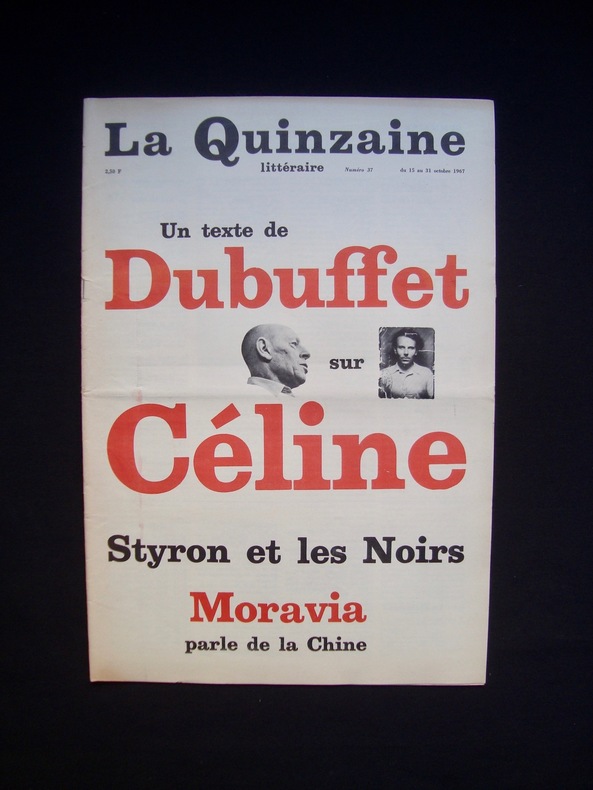
17327Paris : La Quinzaine littéraire, 1967 - journal agrafé au format 26 x 34 cm sous couverture illustrée en couleurs, 32 pages illustrées en noir - bon état -
1996RO20257155LA DECOUVERTE. 1996. In-8. Broché. Bon état, Couv. convenable, Dos satisfaisant, Intérieur frais. 236 PAGES - avec bandeau d'editeur. . . . Classification Dewey : 0-GENERALITES
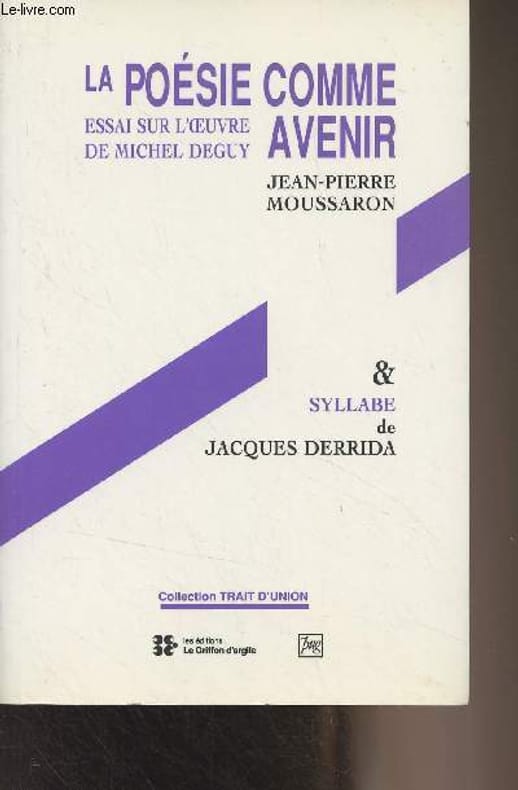
1992R300297957Le Griffon d'argile. 1992. In-12. Broché. Etat d'usage, Couv. convenable, Dos satisfaisant, Intérieur acceptable. XIV + 157 pages. Plats contrepliés en un rabat.. . . . Classification Dewey : 844-Essais
41240955like new. unknown
41240955-nnew. unknown
64308677Stanford University Press pp. 168 . Hardback. New. Stanford University Press hardcover
6368869Polity Press pp. 176 . Hardback. New. Polity Press hardcover
1993PHI51311Calais. Editions de la difference. 1993. 191 S. Kartoniert. Sauberes Exemplar ohne Stempel und Anstreichungen. Mit einigen Abbildungen. Name auf Vorsatz. Einband etwas berieben. Gut erhalten.
20096430680Heidelberg: Universitätsverlag Winter 2009. 261 S., 25cm x 18cm Gebundene Ausgabe
EDITORI RIUNITI 1992, 274 PP. FONDO DI MAGAZZINO: SEGNI DEL TEMPO, QUALCHE LIEVISSIMA ABRASIONE, VOLUME INTONSO. Teorico dell’arte, critico, scienziato sperimentatore e organizzatore delle più avanzate tecniche e scuole del restauro, archeologo, memorialista: il sapere e il fare di Cesare Brandi presentano a chi s’accosta all’opera sua molte e diverse facce così intimamente collegate da non apparire mai dispersive. Al contrario, ogni interesse e speculazione di questo grande scrittore — ché scrittore fu sempre eccelso per lingua, invenzione, sentimento ben oltre lo specifico della critica d’arte — concorrono a formare una personalità e a istituire un’autorità centrata sulla più alta forma d’indagine filosofica, ossia l’estetica. Brandi appare, in questo senso, quasi il restauratore di quel tipo irripetibile di intellettuale che fu proprio del Rinascimento, quando l’unicità delle forme e delle ricerche era risposta dettata dall’esigenza di sfidare il sapere stratificato delle scuole prigioniere del passato. Un umanista d’altri tempi dunque? C’è sicuramente anche questo nella figura di Brandi; ma ciò che oggi più importa è che attraverso il filtro della speculazione teorica e critica passano i più pressanti interrogativi e le decisive questioni attinenti all’essenza dell’arte e alla posizione che essa assume nella socialità di ogni tempo. Il ricco saggio di Massimo Carboni si propone, a pochi anni dalla scomparsa di Brandi e a molte testimonianze oramai attestate, da Croce a Argan, da Luigi Russo a Gianfranco Contini, e alle migliaia di studenti e studiosi italiani e stranieri che al suo dettato si sono formati, di restituire nella sua interezza l’itinerario teorico e critico di questo maestro del XX secolo. Un compendio che traccia un metodo. La prima parte del lavoro di Carboni è dedicata ai concetti generali sottesi all’opera di Brandi; le altre parti ai singoli versanti in cui la sua critica si esplicò, le ultime allo stile personale che ne ha fatto scrittore e artista lui stesso inconfondibile: nelle lettere, nei libri di viaggi, nella passione e nell’ironia delle polemiche con le scuole contemporanee di cui colse acutamente astrattezze, rigidità, partigianerie, nonsensi. Indispensabile, mai prima tentata, perfettamente indagata, la bibliografia che raccoglie in fondo al volume tutto di Brandi e tutto su Brandi circa sessanta pagine fitte di titoli e indicazioni compilate con amorevole scrupolo, uno strumento unico e necessario al pubblico ampio e vario sempre più interessato a una materia dai confini vasti e inesplorati. Massimo Carboni è nato a Livorno nei 1954. Ha pubblicato ’L’Impossibile Critico. Paradosso della critica d’arte’ (edizioni Kappa, Roma, 1985). Collabora alle riviste «aut-aut», «Artforum», «Prometeo» e ai programmi culturali di RAI-Radio Tre. Indice Nota introduttiva Cesare Brandi. Teoria e esperienza dell’arte I. Realtà pura, semiosi, astanza. Dal «Carmine» a «Teoria generale della critica» II. «Gelso» o della lingua poetica III. L’«archè» dell’architettura IV. Il problema del restauro V. Dal Moderno al Contemporaneo VI. Il rilievo stilistico: la scrittura e i libri di viaggio Note Bibliografia completa degli scritti di Cesare Brandi Indice dei nomi
198525366Paris: Les Éditions de Minuit 1985. First edition. 99 xxxvi p. ; photographie Marie-Françoise Plissart ; scénario et montage Benoît Peeters et Marie-Françoise Plissart. Suivi d'une lecture de Jacques Derrida. chiefly ill. ; 31 cm. Illus. boards. Fine. Les Éditions de Minuit unknown
198662299s. l.: Par l'auteur 1986. Fine. Par l'auteur s. l. 1986 22 x 22 cm une feuille Large original black-and-white photographic portrait by Marc Trivier. Original gelatin silver print unsigned as is the case with most of Trivier's works. A rare original silver print by the celebrated Belgian photographer one of the most secretive contemporary artists who despite early international success chose to restrict his output in order to preserve the coherence of his work. Marc Trivier does not produce new prints of his earlier portraits; moreover the printing paper he once used is no longer manufactured. The artist « réalise lui-même ses tirages sur papier baryté Ilford consacrant plusieurs jours de travail à chacun avec une concentration particulière pour rendre les blancs par contraste avec des noirs d'une rare densité. Un tirage de Marc Trivier ne ressemble à aucun autre. Lorsqu'il accepte de les exposer il les suspend dans des cadres en inox de sa fabrication laissant libre cours à la vie du papier. » Xavier-Gilles « Marc Trivier et la tragédie de la lumière » in Le Monde Libertaire 2011. This « life of the paper » is part of the work itself just as the various alterations photographs undergo when exposed: « Dans les boites les tirages gondolent mais qu'importe : le photographe affectionne ce genre d'accident. » Claire Guillot « Les face à face sans échappatoire du photographe Marc Trivier » Le Monde 2011. Trivier shows a singular sensitivity to the material dimension of his art. Although photography is by nature a medium of multiples his direct intervention throughout the creative process confers an almost autographic aura on these prints. Photographs of artists the insane trees or slaughterhousesMarc Trivier approaches each of these subjects with a gaze at once precise and intense. « Dans sa cosmogonie chaque chose chaque être végétal animal ou humain mérite le même respect. Car tous sont confrontés à la même loi d'airain : la solitude. » Luc Desbenoit. The beauty that emanates from his images arises from this nakedness. There is neither retouching nor cropping. His work consistently preserves the square format emphasized by the square of the negative left visible on his prints. This frame ensnares the gaze in images where the cosmetic distractions of colour are rejected in favour of incisive black and white. With all artifice removed we are not confronted with staged subjects but with presences heightened by a singular radiant light witness to a lived moment rather than a posed one. It is this light intrinsic to the photographic medium that unites Triviers series: « Les photographies de Marc Trivier écrivent une tragédie de la lumière celle-ci n'accueillant les êtres - hommes arbres ou bêtes - qu'en les brûlant avant disparition. » Xavier-Gilles in Le Monde Libertaire. It is also this light stripped of all artifice that endows his works with the aura that makes them so compelling. This « burning » of the light recalls the reality of an instant the « ça a été » of Barthes La Chambre Claire 1980: « De trente-cinq ans de pratique photographique d'obsessions c'est peut-être ça qui reste : un mode d'enregistrement singulier de la brûlure de la lumière décliné d'une image à l'autre en une succession de propositions qui se ressemblent et pourtant chacune est aussi singulière que la fraction de temps auquel elle renvoie. » Marc Trivier. « La photographie ne dit qu'une chose : « C'était. » On ne fixe que ce qui a été. S'il y a une tragédie elle est là. » Marc Trivier Warhol Foucault Beckett Dubuffet . the greatest writers and artists sat for Trivier. At the same time the artist turned his lens to the margins of society to what men would rather not see. He photographed the mentally ill and slaughterhouses setting them in counterpoint to celebrities. From the late 1980s his work was widely acclaimed earning him the prestigious Young Photographer Award from the International Ce Par l'auteur unknown
2004x-0415287219Routledge 2004. Paperback. New. 1st edition. 240 pages. 9.00x6.00x0.75 inches. Routledge paperback
2004x-0415287200Routledge 2004. Hardcover. New. 1st edition. 240 pages. 9.25x6.25x1.00 inches. Routledge hardcover
2004Q-0415287219Routledge 2004-10-28. Paperback. New. In shrink wrap. Looks like an interesting title! Routledge paperback
200438630Galilée Couverture souple Paris 2004
2008163703Paderborn, München, Wien & Zürich: Schöningh 2008. 430 Seiten. Gr. 8° (22,5-25 cm). Illustrierte Orig.-Broschur. [Softcover / Paperback].
1991120215Bruxelles Editions Lebeer Hossmann, coll. "Philosophiques" 1991 1 vol. broché in-8, broché, couverture illustrée à rabats, 134 pp., frontispice. Édition originale du recueil des textes prononcés lors de la séance d'hommage à Max Loreau tenue par le Collège international de philosophie le 10 mai 1990. En bonne condition.
1991120215Bruxelles Editions Lebeer Hossmann, coll. "Philosophiques" 1991 1 vol. broché in-8, broché, couverture illustrée à rabats, 134 pp., frontispice. Édition originale du recueil des textes prononcés lors de la séance d'hommage à Max Loreau tenue par le Collège international de philosophie le 10 mai 1990. En bonne condition.
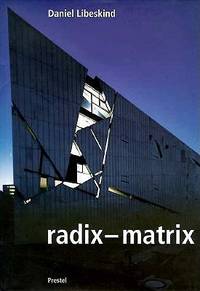
199708536Prestel. Fine in Fine dust jacket. 1997. Hardcover. 379131727X . 167 pages. Numerous illustrations. With essays by Jacques Derrida Alois M. Muller Bernhard Schneider and Mark C. Taylor. Tight clean and crisp with only a faint hint of rubbing to publisher's acetate dustjacket otherwise As New/As New. No remainder mark. Collectible.; 4to - over 9 3/4" - 12" tall. . Prestel hardcover
200542380À l'impossible Couverture souple Montréal 2005 Ed. numérotée
199149093München : scaneg, 1991. Von Fiedler bis Derrida: Zehn Annäherungen 222 S. (23 cm) Broschierte Ausgabe
1992972704Hamburg: Junius. 1992. 165;. 17cm;. Zustand: Sehr Gut, eher ungelesen (Innen); Kleiner Schrifteintrag vor dem Titelblatt; Einband (Außen) hat geringe Gebrauchsspuren; 3.,überarb. und erw. Aufl. Broschiert
1971699851971 Tours, Promesse, 1971, 17 x 23 cm ,136 pp, bon état,
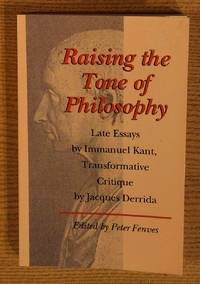
1999180245Baltimore Maryland: The Johns Hopkins University Press 1999. Trade Paperback. Near Fine. A clean unmarked book with a tight binding. Slight wear to cover. 176 pages. Apocalyptic Tone Eternal Peace Voice of Reason John Leavey Late Kant Essays Kantian Critique Critique Pure Reason Deconstruction Peter Fenves End of Philosophy Tonality Language German Idealism Keywords: Apocalyptic Tone Eternal Peace Voice of Reason John Leavey Late Kant Essays Kantian Critique Critique Pure Reason Deconstruction Peter Fenves End of Philosophy Tonality Language German Idealism The Johns Hopkins University Press paperback