(CHAPBOOKS - WOMEN).Biblio.com
20 résultats
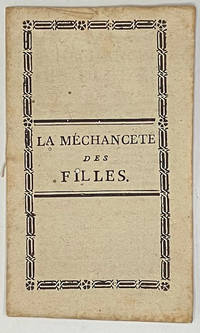
1800103172<p>No place no date but Caen Calopin c. 1800. 12mo. size 85 x 145 cm. Original printed wrappers. 12 pp including wrappers. The front cover shows the title within a decorative border the back cover shows two woodcuts within the same border. small wormhole throughout the work but a lovely clean copy.</p><p>Chapbook on the vices of women inspired by Jean de Marconville "De la BonteÌ et mauvaistieÌ des femmes" Paris 1564. No place no date but the woodcut at the top of the back cover was owned by Pierre-Jean-AimeÌ Chalopin active in Caen between 1777 and 1822. c.f. Hélot La Bibliothèque bleue en Normandie 157; A. Sauvy La Librairie Chalopin B. Hist. mod. et contemp. 11 76.</p> Calopin
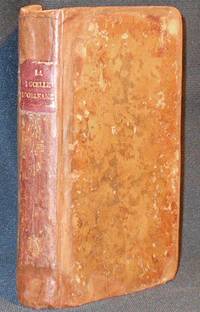
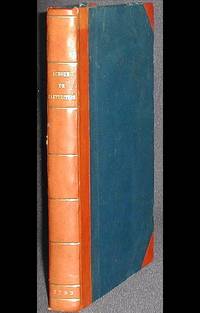
1793006718Paris: De l'Imprimerie Anglais 1793. Hardcover. Good. Nouvelle Edition. 24 264 p.; 16 cm. Contemporary half calf with marbled paper over boards. 19th-century repair of joints with dark brown linen; later repair of front joint with white linen. Small bookplate of the Lynn Public Library on front fixed endpaper; "Rules and Regulations" of the Lynn Free Public Library on front free endpaper. Embossed stamp of the Lynn Free Public Library on the French title page which has on its verso a small label reading "Lynn Library Association No. 224." A very scarce edition 3 copies on WorldCat of this popular advice book by John Gregory 1724-1773 with parallel English and French texts. Much of Gregory's advice to his daughters paints a vivid picture of the lives of girls and women in comfortable circumstances in late 18th-century England; some advice is just as accurate today: "Do not marry a Fool." In Good Condition: loss of most leather over spine; old repairs as described above; boards are rubbed; minor loss from last leaf of text; light foxing and soiling. De l'Imprimerie Anglais hardcover
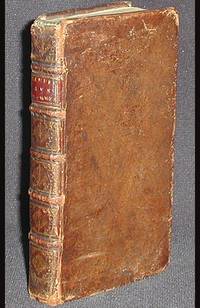
1788005070Amsterdam: Marc-Michel Rey 1788. Hardcover. Very Good. Nouvelle Edition plus complette que toutes les précédentes." 405 3 p.; 18 cm. Contemporary calf; modern spine repair with japanese tissue and gilt-tooled leather spine label. All page edges red. Woodcut tailpieces. Voltaire's satire about the life of Joan of Arc was banned in much of Europe and hence very popular. In Very Good Condition: leather is rubbed; spine repaired with japanese tissue; edges of first and last leaves darkened from glue used on fixed endpapers; some pages lightly browning; otherwise clean and tight. Marc-Michel Rey hardcover
176855807London: Printed for A. Millar and T. Cadell in the Strand 1768. 8vo. 4 252 pp. With 5 of 7 copper-engraved plates. Contemporary speckled calf gilt ruling on covers red & gilt morocco spine label minor scuffing & edgewear minor wear to corners rubbing chipping & wear to spine still good reference copy w/ bright interior. First edition of this work intended to teach women the importance of astronomy and science and which would continue in print until the 19th Century. In the dialogues set up between tutor and pupil the young woman asks whether science is really a suitable activity for a lady and she is reassured that not only does science promote domestic harmony and family values but improves the common sense of mankind. See: See: Henderson & Ferguson Life of James Ferguson pp. 349-350; Suzanne Le-May Sheffield Women and Science: Social Impact and Interaction 2004 pp. 62-63. Printed for A. Millar and T. Cadell, in the Strand, unknown
179261094London: Printed for W. Osborne and Mozley and Co. Gainesborough 1792. 12mo. xii 374 pp. Woodcut-engraved vignette on title. Contemporary calf backed in vellum gilt & red morocco spine label worn scuffing edgewear wear to corners w/o 4 plates still a good sound reference copy. Revised & expanded edition of this popular work first compiled by Anne Fisher 1719-1778 who not only ran “The Printing Press†with her husband Thomas Slack but also operated Fisher’s School for girls in St. Nicholas churchyard Newcastle presumably educating all nine of their daughters as well. This pioneering educator and successful author is perhaps best remembered as the first female Grammarian and her New Grammar which was first published in 1745 would eventually see 40 different editions. Her educational textbooks including this volume as well as the New English Tutor New English Exercise Book and An Accurate New Spelling Dictionary were a significant contribution to education for young women in the 18th- and 19th-Centuries. See: Sarah Collins Barbara Crosbie Adrian Green Matthew Grenby & Helen Williams Symposium on Anne Fisher Literary & Philosophical Society in Newcastle Dec. 10 2019. Printed for W. Osborne, and Mozley and Co., Gainesborough, hardcover
1710002921Rouen France: Jacques Amiot 1710. Hardcover. Good . 2 volumes 2 367 3 p.; 348 p.; 17 cm. Signatures: A6A1x1 B-2H6 A-2F6 12m0. Contemporary full calf with six spine compartments. Leather label in second compartment of vol. 2 with gilt-tooled title: Jean de Bourbon; lacking on vol. 1. Gilt-tooled volume number in third compartments and gilt-tooled decoration in remaining compartments. Gilt-tooled board edges. All page edges speckled red. No date of publication; Privilege du Roy dated May 1710. Title pages in red and black. Remains of armorial bookplate on front fixed endpaper of vol. 2 with motto "Aedes Ca in Usum Carthusia " The author Marie-Catherine le Jumel de Barneville Baroness d'Aulnoy 1651-1705 wrote historical novels of which this is one travel accounts and histories as well as fairy tales for which she originated the term "contes de fées." Her success as an author led to her admission to the Accademia del Ricovvati of Padua one of only nine women to be admitted. In Good Condition: leather is rubbed with minor loss at ends of spines and some loss of gilt; lacking vol. 1 spine label; leather separating over vol. 2 joint but hinge is solid; 4-cm. tear from fore-edge of vol. 1 p. 359-60 without loss; minor insect damage; occasional light foxing; otherwise clean and tight. Scarce. Jacques Amiot hardcover
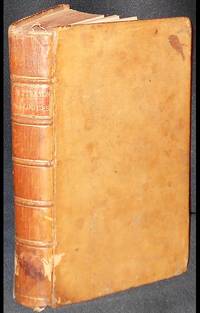
1768004433London: J. Murray successor to Mr. Sandby 1768. Hardcover. Very Good. The Fifth Edition Corrected." 2 xv 1 406 p.; 21 cm. Contemporary full calf with six spine compartments between raised bands. Leather label in second compartment with gilt-tooled title "Lyttelton's Dialogues." Gilt-rolled board edges. All page edges speckled red. Woodcut headpieces and tailpieces. Very small stamp at foot of title page verso reading "Printed in Great Britain." The anonymous author of the majority of these dialogues inspired by Lucian's dialogues is George Lyttelton Baron Lyttelton 1709-1773; the last three dialogues are by Elizabeth Montagu 1720-1800. Among the speakers are "a North-American Savage"; Ulysses; William Penn; Louise de Coligni Princess of Orange; Alexander the Great; Cardinal Wolsey; Lucian; Hercules; and a "modern Bookseller" who complains to Plutarch about being nearly ruined by being unable to sell many copies of Plutarch's Lives and saved by selling fiction -- "secret History in which there is no Secret and no History." In Very Good Condition: minor loss at spine ends; joints are just starting but still solid; scraped along both joints near tail; a few pages are somewhat browned; otherwise clean and tight. J. Murray (successor to Mr. Sandby) hardcover
1708002135Trevoux France: L'Imprimerie de S.A.S. 1708. First Edition. Hardcover. Very Good . Et se vend à Paris. Chez Jacques Etienne Libraire." 94 145 7 p.; 15 cm. Contemporary full calf with six spine compartments between raised bands. Red morocco label in second compartment with gilt-tooled title: "L'Inec aux Hommes." Gilt-tooled decoration in remaining compartments and on board edges. All page edges speckled red. Woodcut head pieces and initial letters. In an old hand on the title page: "par mr hecquet." First edition of Philippe Hecquet's important condemnation of men displacing women as midwives. The second part of the book advises women on feeding infants including breastfeeding. In Very Good Condition: slight loss of leather at head of spine; edges are rubbed; back joint weak at head of spine; hinges are tight; pages are clean and tight. L'Imprimerie de S.A.S. hardcover
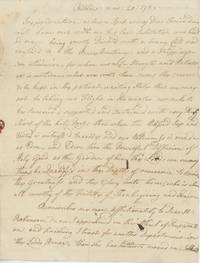
1789List2987Philadelphia Pennsylvania 1789. Single three-page letter measuring 7 ¾ x 9 ¾ inches. Folded with large tears at folds; excellent. A letter from H. Cathrall in Philadelphia to her friend Amey Thurston dated October 20th 1789. The letter discusses her health and the health and lives of their mutual friends. She also describes her experience of hearing ministry at a women’s Quaker meeting:<br /> <br /> “our yearly Solemnity was uncommonly large and much sisterly condescension was comfortingly evidencd; and thro the condescension of Isarels Israel’s King and Shepherd we were made in some sittings reverently to rejoice in that the Lord in wondrous Mercy had not forgotten Sion ‘nor yet in Anger cast off his People’~â€.<br /> <br /> Though Quaker worship meetings did not exclude women Philadelphia did have a women’s monthly meeting as well; Haverford College holds its membership book for 1793 Cathrall does not appear in it but at least one other name mentioned in her letter does.<br /> <br /> Of interest to scholars of Philadelphia’s long Quaker history especially the role of Quaker women. unknown
179148375Paris: Au Bureau des Revolutions de Paris Rue des Marais 1791. 8vo. xvi 460 pp. Engraved frontisp. 4 engraved plates. Contemporary quarter-calf over green marbled boards rebacked occasional light foxing some toning still VG copy signed by the publisher on verso of half-title with details about the engravings. First edition signed of this sensationalistic and titillating commentary on the social and sexual habits of the Queens of France with special emphasis on Marie Antoinette. Louise de Keralio 1757-1821 denounced Queen Marie Antoinette with subtle reference to her sexual debauchery and art of seducing and betraying as well as much more awful crimes. The text was released under the publisher’s name instead of that of Keralio although as early as 1791 Keralio was attacked in Les crimes constitutionnels de France for writing the work. She also reviewed many of the other notorious French Queens noting their turpitudes and condemning their sexual dalliances and crimes. See: Weber Queen of fashion: what Marie Antoinette wore to the Revolution; Hunt Psychoanalysis Feminism and the French Revolution in Main Trends in Cultural History pp. 170-172; Au Bureau des Revolutions de Paris, Rue des Marais, hardcover
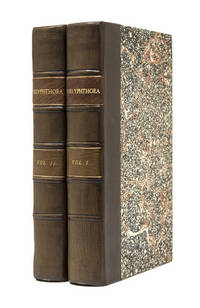
176663921London: Printed for P. Vaillant in the Strand and W. Johnston in Ludgate-Street 1766. Two vols. 12mo. xvi 2 267 1; 2 252 pp. Uniformly bound in full tan polished calf Bickers & Son Leicester Square raised bands gilt fleur-de-lis on spines gilt & green morocco spine labels gilt ruling & inner dentelles a.e.g. very slight small scuff spot back cover vol. II still a NF set from the library of William C. Laurence 1870-1945 and Louise Buermann Laurence 1878-1963 former owners and managers of the famed George B. Lawrence Co. Western Saddlery and supply company for leather and cowboy goods until the 1950’s with their Mount Hood bookplate on front pastedowns of both vols. First edition in English of these “Memoirs†or “Letters†originally published in Liege in 1766 and subsequently quickly translted into English two years after the death of the famed mistress of Louis XV and powerful Jeanne-Antoinette Poisson Marquise de Pompadour. According to Joseph-Marie Querard these Memoirs consisting of a set of fictitious letters were most likely actually written by Crebillon 1707-1777 whose father had been elevated from poverty by Pompadour while detailing the descriptions of “the cabals and intrigues of courtiers; the characters of generals and ministers of state with the causes of their rise and fall; and in general the most remarkable occurrences at the court of France during the last twenty years of the Reign of Louis XV.†Pompadour protected both Voltaire and Montesqieu encouraged Diderot and d’Alembert in their efforts and was a noted political force in not only contributing to the circumstances leading to the Seven Years War but also suppression of the Jesuits in France. Printed for P. Vaillant, in the Strand, and W. Johnston in Ludgate-Street, hardcover
1779002209London: W. Strahan and T. Cadell 1779. First Edition. Hardcover. Very Good. 2 volumes in 1: 8 368 14 p.; 4 344 16 p.; 29 cm. Signatures: A-3C4 -3C4 pi2 B-2Y4 4to. Dark brown cloth spine and corners 20th-century with printed paper spine label; marbled paper 19th-century over boards. Matching marbled endpapers. Errata on terminal page of each volume following index. Occasional notations in a 19th-century hand in the margins sometimes with corrections in the text; an extensive commentary written in the margin of the section on marriage ceremonies among the Romans. In Very Good Condition: boards are moderately rubbed with loss of marbled paper at edges; old archival repair of tear along gutter of final 3 leaves of vol. 1 and first leaf of vol. 2 not touching text and of tear from fore-edge of v. 2 pp. 51-52 without loss of text; upper margin of v. 2 pp. 119-142 darkened; similar at head of gutter on v. 2 pp. 221-243; old stain on v. 2 p. 317 text remains legible; old dampstain along upper edge and fore-edge of v. 2 pp. 337-344; tear from upper edge of last leaf of v. 2 index and following blank leaf with old tape repair no loss of text; otherwise only very occasional soiling in margins and minimal foxing. W. Strahan and T. Cadell hardcover
1783002406London: T. Cadell 1783. Hardcover. Near Fine. 6 x 1 xiv-xvi 255 1 p.; 22 cm. 20th-century binding: half polished calf with gilt-tooled spine title "Osborn on Parturition." Black cloth over boards. Lacking original half title which was supplied probably at the time of the modern binding by a facsimile of a half title bearing an inscription. Title page bears two circular stamps of the Norwich & Norfolk United Medical Book Society and "ANd43" in ink in the upper corner. The Norwich & Norfolk United Medical Book Society was founded prior to 1826 when a catalog of its library was published. The library was dispersed some time after 1955. In the Conclusion p. 241-255 Osborn disagrees vehemently with Alexander Hamilton's remarks on Caesarian operations in his Outlines of the Theory and Practice of Midwifery. Hamilton declared that the mother had only a one in ten chance of dying as the result of a Caesarian operation while Osborn insisted that the odds were precisely the opposite only one in ten of survival. Half title supplied as noted above; otherwise in Near Fine Condition: front endpapers slightly discolored; upper corner of back board slightly rubbed; pages are clean and bright. T. Cadell hardcover
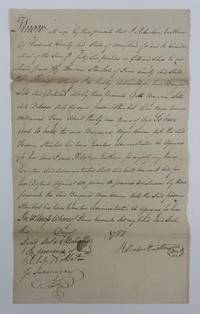
17884111Frederick County Md: March 7 1788. About very good. 1p. folio docketed on verso. Old folds short splits along a couple of fold lines minor toning. An impactful manuscript document from the early national period in Maryland formalizing the sale of a slave woman in Frederick County. The sale was made by Robertson Eastburn whose family emigrated from England to Maryland in the early 18th century. The document reads in part: "In consideration of the sum of forty six pounds in Gold and Silver to me in hand and paid by Frederic Strombol.I do hereby Acknowledge have Bargain'd Sold and Delivered and by these presents doth Bargain Sell and Deliver Unto the said Frederic Strombol One Negro Woman named Torry about thirty years of age To Have and to hold the said Bargained Negro woman unto the said Frederic Strombol."<br /> <br /> Slavery in Maryland lasted over 200 years from its beginnings in 1642 when the first Africans were brought as slaves to St. Mary's City to its end following the Civil War. In 1664 under the governorship of Charles Calvert 3rd Baron Baltimore the Assembly ruled that all enslaved people should be held in slavery for life and that children of enslaved mothers should also be held to the same standard of law. 19th-century American slave sale documents are growing increasingly scarce in the market. March 7 unknown
178155463London: J. Dodsley 1781. The second edition enlarged. 2 vols. 8vo. Recent quarter brown morocco and marbled boards. Inoffensive traces of dampstains else fine. The second edition enlarged. 2 vols. 8vo. Controversial argument in favor of polygamy as compatible with Mosaic law and Christianity and an alternative to the evils of prostitution. J. Dodsley unknown
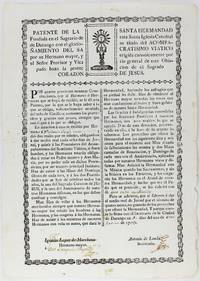
17933334Durango Mx: October 1793. Very good. Broadside 12 x 8.5 inches printed in two columns with a central woodcut headpiece all within a handsome ornamental border. Old folds minor foxing light edge wear eight pinpoint wormholes not affecting readability of text. Completed in ink with ink docketing on verso. Signed and rubricated. A seemingly unrecorded "patente" or indulgence issued by the Holy Cathedral Church of Durango conferring membership into a religious confraternity for a woman named Maria Josefa Cano whose name is entered in ink within the text of the broadside. This indulgence issued by the colonial "Santa Hermandad" defined Cano's duties which included attendance at mass on the last Sunday of each month as well as certain festivities assist sickly brothers and sisters and attend funerals of fellow members "with a candle in hand." It also provided Cano with membership indulgences provided for sixteen pesos for her burial and defined the masses to be performed upon her death. This example includes the name of the former "Hermano mayor" eldest brother crossed out and with the name of the current elder signed and rubricated just below; also includes rubrication below the secretary's name. A wonderful indulgence for a woman in Durango in the last decade of the 18th century. October unknown
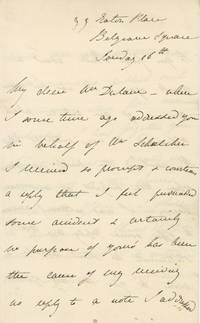
1800List2802London United Kingdom 1800. Single four page letter measuring 4 ½ x 7 inches. Near fine. Frances Anne “Fanny†Kemble 1809–1893 was a British actor writer and later abolitionist. After her initial retirement from acting she married Pierce Mease Butler maternal grandson of American Founding Father Pierce Butler. Butler and Kemble lived in Philadelphia but Butler had been deeded three large plantations—and the people enslaved on them—on Butler Island in Georgia. Kemble finally saw the plantations for herself several years into their marriage and during this time wrote Journal of a Residence on a Georgian Plantation in 1838–1839 which was critical of the conditions of the enslaved people. Butler forbade Kemble to publish the Journal; the two divorced but it was not published until 1863.<br /> <br /> Offered here is a letter from Fanny Kemble to a publisher or newspaper editor about printing her response to a statement in an article about American slavery likely written following her return to London in 1877. Kemble is frustrated about not having received a reply to her initial note to the publisher which was:<br /> <br /> “in consequence of an article which appeared to me extremely likely to the public judgement upon the subject of American slavery – I was extremely anxious to offer some reply to the statement in that article & wrote to you to beg you could tell me whether you would receive & publish such a communication from me . it contained some references to my own private circumstances which I intended for you & no one else.â€<br /> <br /> Of interest to scholars of the abolitionist movement especially women abolitionists. unknown
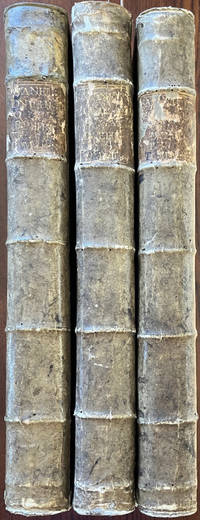
175861510Venice: Typis Antonii Zattae 1758-1762. Three vols. Folio. 11.5 x 15.5 in. xxxii 600; v 1 618; 8 579 1 xl pp. Title of vol. I in red & black woodcut-engraved vignettes historiated initials couple text copper plate engravings in vol. II splendid woodblock-engraved printer’s device tailpiece in Vol. III. Uniformly bound in contemporary vellum raised bands on spines brown morocco & gilt spine labels marbled fore-edges heads of a couple spines expertly repaired minor bumping to corners some soiling to back cover of final vol minor rippling to textblocks still VG set w/former armorial ownership stamps on titles old bookseller notes & pricing on endpapers typescript translation title on red ruled paper laid-in to vol. II. Second edition substantially revised and corrected of this sweeping history of the Hieronymites monastic orders of monks and nuns of the Poor Hermits of Saint Jerome Pisa first established near Pisa in 1377 and would eventually grow to fifty houses of which two still survive in Rome and Viterbo Italy. Sajanelli was a general director of the Hieronymite Poor Hermits of Blessed Saint Jerome Pisa and doctor of theology of Padua who has carefully assembled all of the related documents along with detailed indices and chronologies together with Papal Bulls and monastic orders chronicling the origins and ongoing mission of the this order. Convents with extensive documentation included by Sajanelli include those of the Convent of the Most Holy Trinity founded in 1380 near Montebellum the Convent of Saint Jerome outside of Ariminum and that of Saint Mary of the Annunciation in the town of Saint Anthimum founded originally in 1490. Originating in Spain the monastic order was recognized by Pope Gregory XI in his Papal Bull dated Oct. 18 1373 recognizing the religious order to operate under the Rule of St. Augustine and both monks and nuns adopted the religious order habits of white tunics with brown scapulars similar to the Carmelites. The first nunnery convent began in Toledo Spain led by Maria Garcia near Toledo and perhaps the most revered and well known was Sor Juana Ines de la Cruz of the convent of San Jeronimo y Stanta Paula in Mexico City considered the “Tenth Muse.†See: Perennes Dicionnaire de Bibliographie Catholique Vol. III 1839 p. 933-934; Besse Hieronymites Catholic Encyclopedia 1910. Typis Antonii Zattae, hardcover
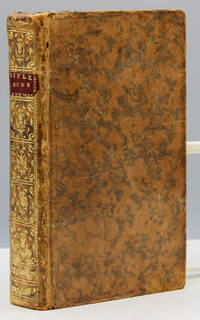
176614914A Amsterdam; & se trouve à Paris: chez Vincent Imprimeur-Libraire rue S. Severin 1766 First edition of a legendary rarity. Barbier and Cioranescu ascribe this work to Madame de Verzure about whom little is known though Quérard tells us she was the wife of a Geneva banker. She apparently wrote no other books. Contemporary mottled calf. Gilt spine with burgundy morocco label blue marbled edges. . Two volumes in one twelvemo. Bottom corners worn leather worn in one spot on back cover. Otherwise a very good copy. In the dedication to Mirabeau the author notes "Une femme qui savise décrire & cqui ose hazarder limpression doit se cacher avec soin & se garder de jamais se laisser appercevoir." Madame Verzure has retired from society in order to better understand herself as woman and as a thinking person. This work which is principally addressed to women contains about sixty chapters of reflections on the world and her position in it. There are chapters on the passions honor celibacy marriage goodness humor law pain ennui paternal love one's duty in the world truth and sincerity notions of the soul self-love etc. The last two chapters "La femme raisonnable" and "La femme du monde" present the central concern of this book: the woman of the world versus the woman of intellect: "L'une veut qu'on la croie parfaite; lautre cherche à le devenir." OCLC lists ten copies six in North America: Harvard Yale Duke Indiana UCLA and Cal State Bakersfield. chez Vincent, Imprimeur-Libraire, rue S. Severin,
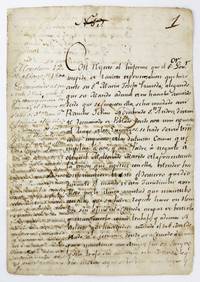
18006287Monclova: May 12 1800. Good plus. 4pp. on a bifolium. Light edge wear and staining. Some moderate offsetting. In a neat legible hand. A very interesting manuscript record of a colonial Mexican marriage dispute in 1800 which includes a request for separation by MarÃa Josefa Pruneda from her husband a report on her “illicit friendship†with another man and an official warning concerning her behavior from the judiciary. The manuscript copies MarÃa Josefa Pruneda’s petition to the governor of Coahuila y Tejas to separate from her husband Miguel Maldonado claiming he neglected her. The document begins “Con respecto al informe que el señor gobernador me pide en remitir en presentacion que hiso ante su señoria Maria Teresa Pruneda alegando que su marido ademas el no haverla assistido desde que se caso con ella se ha mudado aun Rancho Yermo Nombrado Sn. Andres distante de mariado de poblado donde esta mui espuesta al Riergo de los Enemigos.†<br /> <br /> However in the following reportThe intendant of Santa Rosa states that MarÃa Josefa refused to live with her husband due to her father’s influence and because of her “illicit friendship†with a young man named Thomas Zaralsa. The report notes that Miguel Maldonado was a hardworking man while the petitioner enjoyed her husband’s absences. The governor Manuel Antonio Cordero y Bustamante ordered the Justice of the Villa de Monclova to ensure she cohabited with her husband and warned her father to cease influencing her. A final report states that MarÃa Josefa was warned but disobeyed and left the town saying "No cumplio pues se fue sin presentarse a el tiempo de su salida loge. partisipo a Vm. porque en su inteligensia lede el debido cumplimiento segun sed ordena."<br /> <br /> A fascinating delineation of the process for seeking divorce and the difficulties of doing so in late colonial Mexico. May 12 unknown