1 000 résultats
(Milano), Edizioni "Minerva Medica", (1965), in-8, br., pp. 20. Estratto.
179014514ABLeipzig, Schwickert, 1790. 8°. (6), VIII, (2) 764 S.; (4) 835 (3) S.; XII, 468 S. Mit 1 gest. Titelvignette. Halblederbde. d. Zt. mit je 2 mont., goldgepr. Rückentiteln + Wichtig: Für unsere Kunden in der EU erfolgt der Versand alle 14 Tage verzollt ab Deutschland / Postbank-Konto in Deutschland vorhanden + 3 Bde. Neue, umgearb. Aufl. (stark berieben u. bestossen, mit mehreren Wurmlöchern).
179014514ABNeue, umgearb. Aufl. 3 Bde. Leipzig, Schwickert, 1790. 8°. (6), VIII, (2) 764 S.; (4) 835 (3) S.; XII, 468 S. Mit 1 gest. Titelvignette. Halblederbde. d. Zt. mit je 2 mont., goldgepr. Rückentiteln (stark berieben u. bestossen, mit mehreren Wurmlöchern).
1987825690Rostock, 1987. M. mehr. Abb. 95 S. (Beitr. zur Gesch. d. W.-Pieck-Univ. 9).
1983633089(Friedrichsdorf/Taunus), 1983. M. zahlr. Abb. u. graph. Darst. 214 S. OBr. Leichte Gebrauchsspuren. (Wiss. Information 9,3).
Near Fine Turkish, Ottoman (1500-1928) Original pictorial wrappers. Cr. 8vo. (20 x 14 cm). In Ottoman script (Old Turkish with Arabic letters). 109 p. A fine copy. First edition of this very interesting avant-garde novel of the early modern Turkish literature, including a woman character who is a drug addict from the high society, published in the early period of Republican Turkey. The title and scripts on the front cover are written by early modern Turkish calligrapher Hâmid Aytaç (1891-1982). Mecdi Sadreddin Sayman was a Turkish journalist who served for "Ikdam" [i.e. Effort] newspaper, which is one of the most popular newspapers published during the Imperial Ottoman and Modern Turkey. He was the assistance of Ahmet Cevdet Oran (1862-1935) who has established the paper in 1894, and the first issue appeared on 23 September. It initially advocated for Turkism but held a critical attitude towards the Committee of Union and Progress after the Young Turk Revolution had occurred. Yakup Kadri Karaosmanoglu was a journalist with Ikdam during the Turkish War of Independence. Following the establishment of the Republic of Turkey the paper objected to the policies of the Turkish government, including making Ankara the capital city instead of Istanbul as well as the presidency of Mustafa Kemal Atatürk. Partly due to its dissident approach the owner of the paper was changed, and it became an asset of Ali Naci Karacan. The newspaper ran between the years 1894-1928, until the Letter Revolution. Only three copies in OCLC 25346455 (Bogaziçi University Library, Aga Khan Library of London, Princeton University Library).; Özege 2946.
Very Good Turkish, Ottoman (1500-1928) Original illustrated wrappers. Chipped and slight tears on extremities, creasing on papers. Overall a good copy. Folio. (38 x 24 cm). In Ottoman script (Old Turkish with Arabic letters). 8 p., richly illustrated. Extremely rare issue of this early Turkish magazine in Ottoman Turkish, with the photographs of members of the union like Nezihe Muhiddin (1889-1958), and news in the headline on the front cover: "The members of the Women's Union who wants political, legal and political equality for women!", continuing as "Recently, the congress of the women's union came to an end. This congress attracted a lot of attention as it emphasized the need for men and women to be equal. The Women's Union is a strange society made up of men and women. Male members cannot enter the administration. The woman sitting in the middle with her head uncovered is Nezihe Muhittin Hanim. The head, member, and clerk of the society is Nezihe Hanim." This magazine, owned by Zekeriya Sertel and his wife Sabiha Sertel, ran between 1925 and 1929 with 199 issues. This rare issue has the headline of "Women's Union" in the Imperial Ottoman, and then the Turkish Republic. It's one of the rare periodicals which published early Turkish feminist Nezihe Muhiddin's images. Nezihe Muhiddin Tepedelengil (1889-1958) was a Turkish women's rights activist, the pioneer of Turkish feminism, suffragette, journalist, writer, and political leader. In the 20th century Ottoman Empire, Nezihe Muhiddin was a pioneer of the women's movement who fought to ensure the recognition of women's political rights after the declaration of the republican regime. She became one of the leading names of the First Wave Republican feminists. Even before the establishment of the Republican People's Party, Nezihe Muhiddin completed the formation of the Women's People's Party (KHF) in 1923 and became the founder of the first political party in Turkey. She also served as a president of the Women's Union between 1924-1927 and helped the founding process of the journal named "Türk Kadin Yolu" [i.e. Turkish Women's Path].

Very Good Turkish, Ottoman (1500-1928) Original wrappers. Demy 8vo. (21 x 14 cm). In Ottoman script (Old Turkish with Arabic letters). 13 p. Lithographed. First Ottoman edition of this litho book describing the life of Hazrat Fatma in verse and poetically. It includes 74 couplets in 13 pages, written "fâilâtün fâilâtün fâilün" rhythm and translated by the son of the author named Ali b. Haci Esad. Fatimah al-Zahra bint Muhammad (605-632) was born to the Islamic prophet Muhammad and Khadijah. Sunni Muslims hold that Fatimah was the youngest of their daughters, whereas Shia Muslims maintain that Fatimah was the only biological daughter of the couple. Fatimah's husband was Ali, the fourth of the Rashidun Caliphs and the first Shia Imam. Fatimah's children include Hasan and Husayn, the second and third Shia Imams, respectively. Fatimah occupies a similar position in Islam that Mary, mother of Jesus, occupies in Christianity. She is often viewed as an ultimate archetype for Muslim women and an example of compassion, generosity, and enduring suffering. It is through Fatimah that Muhammad's family line has survived to this date. Controversy surrounds Fatimah's death, within six months of Muhammad's demise. Sunni Islam holds that Fatimah died from grief. In Shia Islam, however, Fatimah's (miscarriage and) death are viewed as the direct result of the injuries that she suffered during a raid on her house, ordered by the first caliph, Abu Bakr. Fatimah and her husband, Ali, had refused to acknowledge the authority of Abu Bakr. The couple and their supporters held that Ali was the rightful successor of Muhammad, appointed by him at the Event of Ghadir Khumm. Iranians celebrate Fatimah's birth anniversary on 20 Jumada al-Thani as Mother's Day. Not in OCLC.; Özege 13387.
116452237X.Gpaperback. Good. Access codes and supplements are not guaranteed with used items. May be an ex-library book. paperback
1436723485.Gpaperback. Good. Access codes and supplements are not guaranteed with used items. May be an ex-library book. paperback
1178939812.Gpaperback. Good. Access codes and supplements are not guaranteed with used items. May be an ex-library book. paperback
In 16°, piena tela edit. coeva, tit. in oro al dorso, pp.XVI-423-(10). Terza edizione. In fine formulario terapeutico. Qq. annotazione a matita ai marg. bianchi, conservaz. molto buona
In 8. cm 24x17. Pp. 8. Edizione del 1931 di questa pubblicazione del Dott. Cesare Micheli. Si tratta di un commento sulla relazione del Prof. Turenne al congresso medico del 5-12 ottobre 1930 sul tema "Orientamento chirurgico della ostetricia attuale". Estratto dal n. 5 della Rivista L'Umbria medica. Copertina editoriale in buone condizioni generali con lievi usure ai margini. Legatura in buone condizioni. Pagine in ottime condizioni con rare fioriture. Edition of 1931 of this pamphlet by Dott. Cesare Micheli. It is a commentary on the report of Prof. Turenne in the world congress of 5-12 october 1930 about the theme "Orientamento chirurgico della ostetricia attuale". Extract from n. 5 of the magazine L'Umbria medica. Editorial cover in good general conditions slightly worn in the edges and spine. Binding in good conditions. Pages in very good conditions with occasional foxings.
Opuscolo in brossura spillata con copertina editoriale a stampa. Bossi svolgeva, al tempo della pubblicazione, il ruolo di direttore dell'Istituto Ostetrico Ginecologico dell'Università di Genova (33g).
In-8° (cm. 23), pp. 6 Bross. edit. Timbro Gabotto in cop. BOSSI ginecologo, attivo a Torino con Lombroso, e poi parlamentare del PSI (acceso antitedesco e interventista), direttore dell'Istituto di ostetricia di Novara e di una clinica genovese, istituiì la guardia ostetrica per le partorienti povere a domicilio alle quali, nel 1892, creata a Genova una clinica propria, riservava la metà dei posti disponibili. e si adoperò per elevare professionalmente il livello delle ostetriche; nel 1890 costruì un dilatatore meccanico in qualsiasi periodo della gestazione e per facilitare l'espulsione del neonato, si oppose a pratiche lesive dell'apparato genitale ecc.;(Treccani); nel 1898 operò (senza successo) la moglie di Oscar Wilde; morì assassinato (per gelosia?) dal marito di una paziente (wiki). Importante intervento sostenente la non contagiosità del cancro dell'utero: il Bossi ricorse addirittura a un referendum su scala mondiale, qui ne indicò la profilassi nelle operazioni conservatrici delle lesioni benigne. Rarissimo, censito alla sola Biblioteca Medica Statale - Roma.
In 8. Dim. 26,5x19 cm. Pp. 14. Interessante pubblicazione del 1928 di ostetricia scritta dal Dott. Cesare Micheli. Tratta di una isterectomia addominale in gestante preagonica per distacco prematuro di placenta normalmente inserta. Alla fine sono presenti 3 planches colorate. In ottime condizioni. Brossura editoriale in ottime condizioni generali con lievi usure ai margini e dorso. Interesting pamphlet of 1928 of obstetrics written by the doct. Cesare Micheli. At the end there are three coloured planches. In very good conditions. Editorial cover in very good general conditions slightly worn in the edges and spine.
Interessante pubblicazione del 1928 di ostetricia scritto da Cesare Micheli.<BR>La pubblicazione descrive un caso di resezione del nervo presacrale.<BR>Alcune illustrazioni e foto all'interno. In ottime condizioni. Copertina editoriale in ottime condizioni generali con lievi usure ai margini e dorso. Legatura in ottime condizioni. All'interno le pagine si presentano in ottime condizioni con rare fioriture. In 8. Dim. 26,5x19 cm. Pp. 12. Interesting pamphlet of 1928 of obstetrics written by Cesare Micheli.<BR>The pamphlet describes a case of cutting of presacral nerve<BR>Inside different illustrations and photoes. In very good conditions. Editorial cover in very good general conditions slightly worn in the edges and spine. Binding in very good conditions. Inside pages are in very good conditions with occasional foxings. In 8. Dim. 26,5x19 cm. Pp. 12.
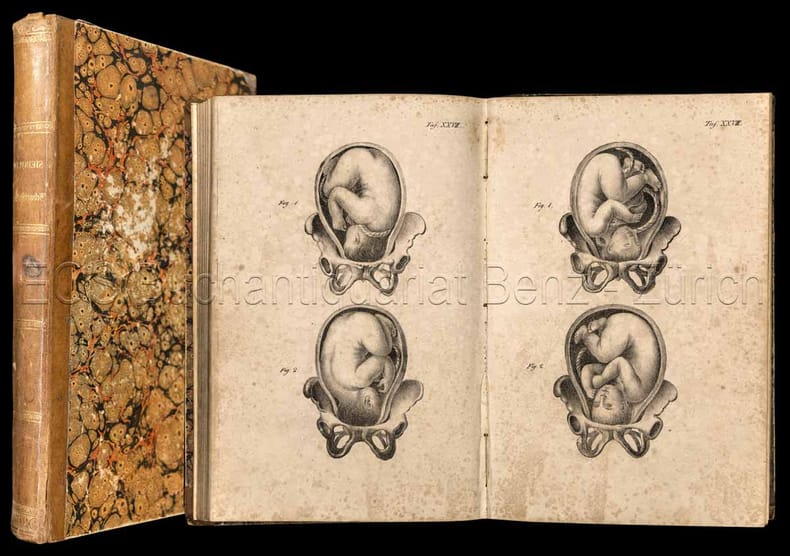
183621451ABReutlingen, Verlag von Jacob Noa Ensslin, 1836. 8°. 4, IV, S. 5?254. Mit 67 lithographierten Tafeln. Halblederband der Zeit. + Wichtig: Für unsere Kunden in der EU erfolgt der Versand alle 14 Tage verzollt ab Deutschland / Postbank-Konto in Deutschland vorhanden +, Abb.
183621451ABReutlingen, Verlag von Jacob Noa Ensslin, 1836. 8°. 4, IV, S. 5–254. Mit 67 lithographierten Tafeln. Halblederband der Zeit.
1968226724Stuttgart, Thieme, 1968. M. 4 Tab. u. 15 Abb. VII, 43 S. St. u. Sign. a. Tit.
178440387DBBerlin, Christian Friedrich Himburg, 1784?1786. 8°. XXII S., 1 Bl., 317 S.; 2 Bl., 344 S. Mit einer wiederholten gestochenen Titelvignette. Späterer Pappband unter Verwendung eines Inkunabelblattes als Bezugpapier. + Wichtig: Für unsere Kunden in der EU erfolgt der Versand alle 14 Tage verzollt ab Deutschland / Postbank-Konto in Deutschland vorhanden +, A|B 2 Bände in 1. [2 Warenabbildungen]
178440387DB2 Bände in 1. Berlin, Christian Friedrich Himburg, 1784–1786. 8°. XXII S., 1 Bl., 317 S.; 2 Bl., 344 S. Mit einer wiederholten gestochenen Titelvignette. Späterer Pappband unter Verwendung eines Inkunabelblattes als Bezugpapier.
180330335DBLeipzig, Heinrich Gräff, 1803. Gr.-folio. (7) Bl., 216 S., (24) Bl. Mit gestochener Titelvignette, 2 Anfangsvignetten, 46 gestochenen Kupfertafeln und 21 Vignetten im Text. Halblederband um 1840 mit rotem, goldgeprägtem Rückenschild und wenig Rückenvergoldung. + Wichtig: Für unsere Kunden in der EU erfolgt der Versand alle 14 Tage verzollt ab Deutschland / Postbank-Konto in Deutschland vorhanden +, A|B 2 Teile in 1 Band. [2 Warenabbildungen]
180330335DB2 Teile in 1 Band. Leipzig, Heinrich Gräff, 1803. Gr.-folio. (7) Bl., 216 S., (24) Bl. Mit gestochener Titelvignette, 2 Anfangsvignetten, 46 gestochenen Kupfertafeln und 21 Vignetten im Text. Halblederband um 1840 mit rotem, goldgeprägtem Rückenschild und wenig Rückenvergoldung.
18221313601Bamberg, Goebhardt, 1822. 2 Bl., 4, 430 S., 1 Bl. m. 2 dopppelseitigen Tabellen. Hldrbd d. Zeit m. goldgeprägtem Rücken, Rückenschild (Einbd etwas beschabt u. fleckig, durchgehend braunfleckig).