249 résultats
1824Q93958Paris, chez Treuttel et Würtz 1824 [iv] + 540pp., première édition française (traduit du latin sur l'Edition d'Amsterdam de 1768 "Deliciae sapientiae de amore conjugalis", et publié par un ami de la vérité), 21cm., brochure muette d'époque (petites manques de papier au dos), quelques rousseurs (texte toujours bien lisible), bon état, fort rare, [Cfr. Caillet no. 10462: "Cette traduction de Moet, le Martiniste, est rare ; il fut intimement lié avec Saint-Martin, le Philosophe inconnu, qui le rechercha pour répandre sa doctrine. Cet ouvrage a pour but d'exalter la sainteté du mariage et de signaler les dangers qu'entrainent l'adultère et le libertinage ; il suit dans toutes leurs phases les profanations de l'amour conjugal et montre leurs funestes conséquences"], Q93958
187819931Paris, Edouard Rouveyre, 1878 ; in 12, demi-chagrin rouge maroquiné à coins, dos à nerfs, titre doré, tête dorée, couverture gris-bleu illustrée par Marrius Perret, imprimée en rouge sanguine et bleu foncé conservée, non rogné (Nicolini à Marseille) ; XVI, 253, [2] entre les pp. 246 et 247, [7] pp. de Catalogue et Achevé d’imprimer. Vignettes in texte imprimée en rouge.
1824Q93957Paris, chez Treuttel et Würtz 1824 [iv] + 540pp., première édition française (traduit du latin sur l'Edition d'Amsterdam de 1768 "Deliciae sapientiae de amore conjugalis", et publié par un ami de la vérité), 21cm., reliure cart. en bon état (plats marbrés, dos en cuir à cinq nerfs, titre doré au dos), tranches et feuilles de garde marbrées, quelques rousseurs (texte toujours bien lisible), bon état, fort rare, [Cfr. Caillet no. 10462: "Cette traduction de Moet, le Martiniste, est rare ; il fut intimement lié avec Saint-Martin, le Philosophe inconnu, qui le rechercha pour répandre sa doctrine. Cet ouvrage a pour but d'exalter la sainteté du mariage et de signaler les dangers qu'entrainent l'adultère et le libertinage ; il suit dans toutes leurs phases les profanations de l'amour conjugal et montre leurs funestes conséquences"], Q93957
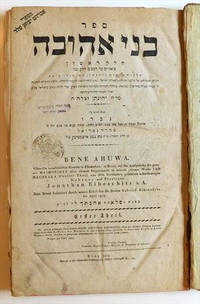
181941334Prag Prague: Gedruckt In D. Schollischen Buchdruckerey 1819. Hardback. 1st edition. 4to period boards 4 82 1 25 leaves aproximately 224 pages. In Hebrew with some German on title page. Vinograd: Prague 1165. StCB: 5867 3; Jewish Museum 179. Contents: helek 1. Hilkhot ishut perek 1-10; helek 2. Hilkhot ishut perek 11-25; helek 3. Hilkhot gerushin. Hilkhot yibum va-halitsah. She'elot u-teshuvot. Maftehot. <br> <br> Novellae to Maimonides of the laws pertaining to women i.e. divorce relationships and marriage by Rabbi Jonathan ben Nathan Nata Eybeschutz 1690/95-1764 the talmudist kabbalist and child prodigy. In his youth after the death of his father he studied in Prossnitz under Rabbi Meir Eisenstadt and Rabbi Eliezer ha-Levi Ettinger his uncle and in Vienna under Rabbi Samson Wertheimer. He married the daughter of Rabbi Isaac Spira the av bet din of Bunzlau. After traveling for some time he settled in Prague in 1715 and in time became head of the yeshivah and a famous preacher. <br> After the death of Rabbi David Oppenheim 1736 he was appointed dayan of Prague. Elected rabbi of Metz in 1741 he subsequently became rabbi of the "Three Communities" Altona Hamburg and Wandsbek in 1750. Both in Metz and in Altona he had many disciples and was considered a great preacher. <br> His position in the Three Communities however was undermined when a dispute broke out concerning his suspected leanings toward Shabbateanism. This controversy accompanied Rabbi Eybeschuetz throughout his life and the quarrel had repercussions in every community from Holland to Poland. His main opponent was Rabbi Jacob Emden also a famous talmudist and a potential rival in the candidature to the rabbinate of the Three Communities.<br> The quarrel developed into a great public dispute which divided the rabbis of the day. While most of the German rabbis opposed Rabbi Eybeschuetz his support came from the rabbis of Poland and Moravia. <br> A fruitless attempt at mediation was made by Rabbi Ezekiel Landau rabbi of Prague. Most of Rabbi Eybeschuetz' own community was loyal to him and confidently accepted his refutation of the charges made by his opponent but dissension reached such a pitch that both sides appealed to the authorities in Hamburg and the government of Denmark for a judicial ruling. The king favored Rabbi Eybeschuetz and ordered new elections which resulted in his reappointment. <br> After his reelection as rabbi of the Three Communities some rabbis of Frankfort Amsterdam and Metz challenged him to appear before them to reply to the suspicions raised against him. Rabbi Eybeschuetz refused and when the matter was brought before the Council of the Four Lands in 1753 the council issued a ruling in his favor. In 1760 the debate was rekindled when some Shabbatean elements were discovered among the students of Rabbi Eybeschuetz' yeshiva. At the same time his youngest son Wolf presented himself as a Shabbatean prophet with the result that the yeshiva was closed. See Bibliography of the Hebrew Book 1470-1960 #000109183; EJ; M. A. Perlmutter R. Yehonatan Eybeschuetz ve-Yahaso la-Shabbeta'ut 1947; Mifal ha-Bibliografyah ha-Ivrit Hoveret le-Dugmah 1964 13-24. <br> <br> SUBJECTS: Marriage Jewish law Divorce Jewish law Husband and wife Jewish law Incest -- Religious aspects -- Judaism. Maimonides Moses 1135-1204. Mishneh Torah -- Commentaries. OCLC: 19167576. <br> Some wear usual light age and damp staining wide margins stamps. Binding starting About Very Good Condition. RAB-66-17-BLRKKQQ-'emn. Prag [Prague]: Gedruckt In D. Schollischen Buchdruckerey unknown
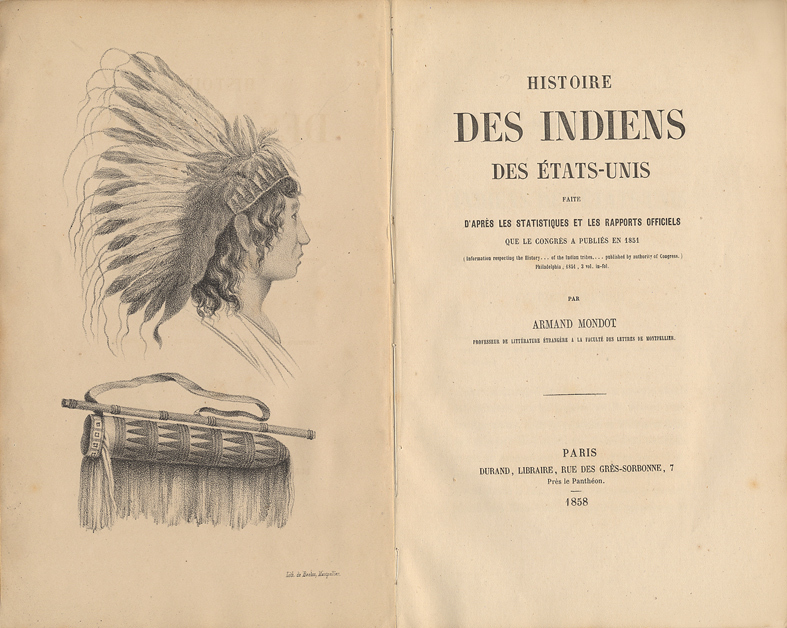
185811257Paris, Durand, 1858 ; in-8, broché ; (4), 352 pp., lithographie en frontispice, couverture imprimée.
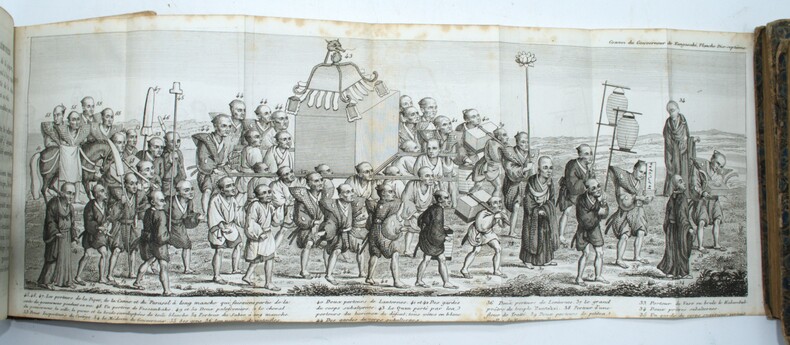
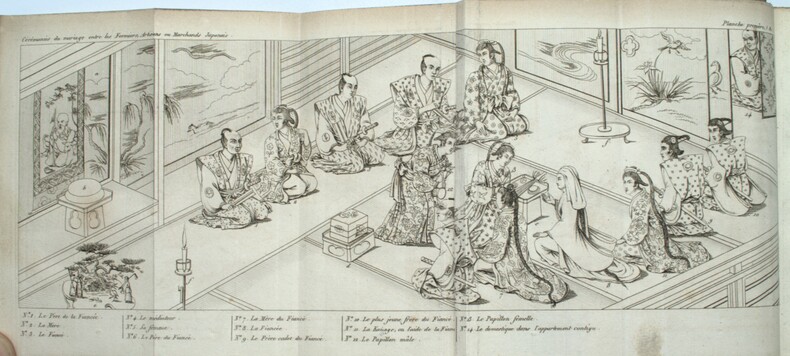
1822PHO-1567Paris, Chez Nepveu,1822, 2 volumes (sur 3) in-16, 2ff.-139pp.,2ff.-206pp., relié demi basane époque , dos lisse avec titre et tomaison , coins usés , frottements, accrocs aux coiffes(T2),petit manque (T3), illustré de 11 gravures , dont certaines dépliantes , représentant des cérémonies de mariages et enterrements ,mœurs et costumes des japonais ,le tome 2 s’occupe des cérémonies funéraires tandis que le tome 3 est consacré aux mémoires et anecdotes des Djogouns, tome 2 et 3 seul, quelques rousseurs.
1898J1148552Gebbie Pubisher 1898. Reprint. Hardcover. Touch of wear to extremities else very good condition./No dust jacket as issued. . Dark red linen over boards with black and gold paper labels on spine. Top page edges gilt. Gold A very nice vintage set in great condition. French literature. Gebbie Pubisher hardcover
1831000178Paris Barba 1831
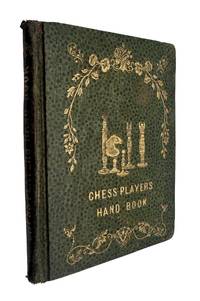
1849358Philadelphia: George S. Appleton 1849. First edition. Decorated publisher's cloth. Very Good. This is the third book on chess published in the United States. It is exceedingly rare in commerce. This is the only copy that has been offered at a recorded auction twice. One other copy in poor condition was sold many years ago on . <br /> <br /> Condition: Very Good<br /> <br /> BOOK INFO<br /> <br /> Published in 1849 by George Appleton in Philadelphia. First edition first printing. In its beautiful publisher speckled two-color green cloth binding with chess pieces devices and floral and wreath patterns tooled in gilt on the front cover and a mirror image of this design tooled in blind on the back cover. Gilt spine lettering and decoration. All page edges gilt. Pocketbook sized: 4.5" x 3 3/8". Collated and complete: viii 9-64 pp. <br /> <br /> Topics include history of chess rules hints openings specific openings like Queen's Gambit and King's Gambit terms and an annotated match game from the 1820s in Edinburgh.<br /> <br /> CONDITION REPORT<br /> <br /> The book is in Very Good antique collectible condition.<br /> <br /> Firmly bound rear hinge just starting to crack. Cloth is colorful and fresh. Gilt is glossy. Spine is sun-darkened. Rubbing to spine tips and bumped corners. Grubby extremities. Toned pages with splotches of foxing or smudging. Owner name inscribed in both ink and in pencil on front pastedown same name different inscriber. A few odd marks text corrections. Page 26 with pencil underlining and marginalia which notes "So there may be as many pawns as queens" when noting the rule how pawns can be promoted on the 8th rank.<br /> <br /> All in all a very nice collectible copy of a rare early American book on chess. George S. Appleton unknown
18952310270175xbvkParis, Société d'Éditions Scientifiques, 1895(!). III, 599 pages; some - few (multiple-)folded - statistical maps, tables and graphs. - Strong half-vellum binding of the period with ochre-and-brown (and a little bit of red) marbled panels and large vellum corners, ornamental and flower-decorated titled spine mentioning the Italian bookinders name 'Roddolo'*; large-8vo.(ca. 24 x 18 x 4 cm; ca. 1,3 kg.).
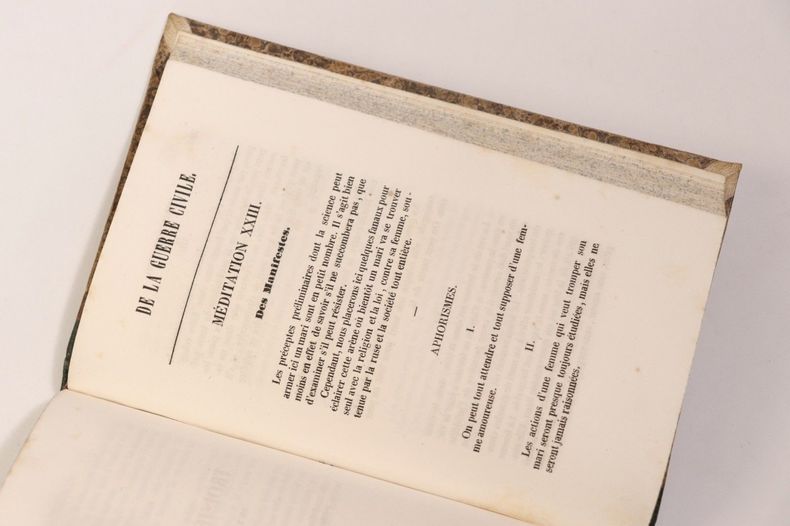
1838AMO-3063aris, Charpentier, Libraire-éditeur, 1838. [Imprimerie d'Ad. Everat et Cie]. 1 volume in-18 (18 x 11,5 cm) de XXII-408-(2) pages. Reliure demi-cuir de Russie vert sombre, dos lisse orné de roulettes dorées, plats de papier marbré, doublures et gardes de papier blanc, coins de parchemin (reliure de l'époque). Reliure en excellent état. Intérieur très frais malgré les rousseurs habituelles (les premiers et derniers feuillets étant plus touchés que les autres). Nouvelle édition. Première édition Charpentier dans ce format. L'édition originale de la Physiologie du mariage de Balzac parait à la fin de décembre 1829 sous la date de 1830, en 2 volumes in-8. Une deuxième édition voit le jour en 1834, également en 2 volumes in-8. On trouve ensuite les quatre éditions Charpentier. La première en 1838, la nôtre, inaugure avec quelques autres premiers titres le lancement de la Bibliothèque Charpentier dans le format in-18 anglais, dit format Charpentier, puis viennent les éditions de 1840, 1843 et 1848. C'est pour contrecarrer la contrefaçon belge que Gervais Charpentier crée sa collection in-18, de typographie compacte et à bon marché. Une contrefaçon belge parait d'ailleurs en 1834 à Bruxelles chez Méline. La publication de la Physiologie du mariage fit scandale, mais le Tout-Paris le considéra comme un événement et le succès pour Balzac fut sans précédent, d’autant plus qu’on voulait savoir qui se cachait sous la signature anonyme du jeune célibataire qui devint aussitôt un auteur à la mode (1830). A la fois essai, méditation, et récit, le texte oscille entre l’étude de mœurs et le traité analytique. C’est d’ailleurs dans ce dernier genre que la cinquième édition de l’ouvrage (Furne) classera l’œuvre en 1846 dans la section Études analytiques de la Comédie humaine. Mais malgré son caractère osé (pour l’époque), sa structure peu conforme au roman balzacien, la Physiologie jette les fondations de la Comédie humaine. Quelques aphorismes Balzaciens sur la femme et le mairage : Une femme honnête est essentiellement mariée. Une femme honnête à moins de quarante ans. Une femme mariée dont les faveurs sont payables n’est pas une femme honnête. Quand un homme a gagné vingt mille livres de rente, sa femme est une femme honnête, quel que soit le genre de commerce auquel il a dû sa fortune. Une femme honnête est celle que l’on craint de compromettre. La femme d’un banquier est toujours une femme honnête ; mais une femme assise dans un comptoir ne peut l’être qu’autant que son mari fait un commerce très-étendu et qu’elle ne loge pas au-dessus de sa boutique. Un volume savoureux où l'humour grinçant et réaliste est présent à chaque ligne. Très bel exemplaire conservé dans son élégante première reliure de l'époque. Cette édition au format in-18 de la Physiologie du mariage de Balzac marque une date importante dans l'histoire de l'édition au XIXe siècle.
18910033# AUTEUR: Edouard Mariage # ÉDITEUR: P. et G. Giard # ANNÉE ÉDITION: 1891 – 1895 # COUVERTURE: In folio en feuillets sous chemise # DÉTAILS: 238 pages 52 planches hors texte. # PHOTOS visibles sur www.latourinfernal.com
1822PHO-1569Paris, Nepveu, 1822. 2 vol. in-16, demi basane, dos lisse avec titre et tomaison (reliure de l'époque),2ff.-viij-271pp., 2ff.-214pp.-1f., illustré de 9 planches dont 8 dépliantes, frottements, papier du plat manquant (T1), 1 coiffe manquante, petit manque au dos, rousseurs éparses, bords des planches brunis.
187816920Paris, Garnier (imprimerie Motteroz), 1878 ; fort in-12, maroquin rouge, dos à nerfs décoré aux petits fers, double encadrement des plats, chacun de 3 filets dorés, fleurons d'angles, filet doré sur les coupes, large roulette intérieure, tranches dorées (fine reliure de l'époque, non signée) ; XLIV, 461 pp. , (1) f. de table.
186421686Paris, Benjamin Duplat, 1864 ; in-8, maroquin bleu-marine, dos à nerfs à décor à froid, titre doré, double filet doré sur les coupes, dentelle dorée d’intérieur, tranches dorées (reliure de l’époque) ; XVO, 578 pp.
182128066Paris Théodore Le Clerc 1821 fort vol. petit in-12 maroquin rouge, dos lisse orné de filets dorés gras et maigres, de fleurons et d'étoiles dorés, filets et palmettes dorés encadrant les plats entièrement recouverts d'un décor aux petits fers, doré et mosaïqué, inscription dorée au centre, tranches dorées [Rel. de l'époque], qqs rouss., petit défaut de papier p. 587
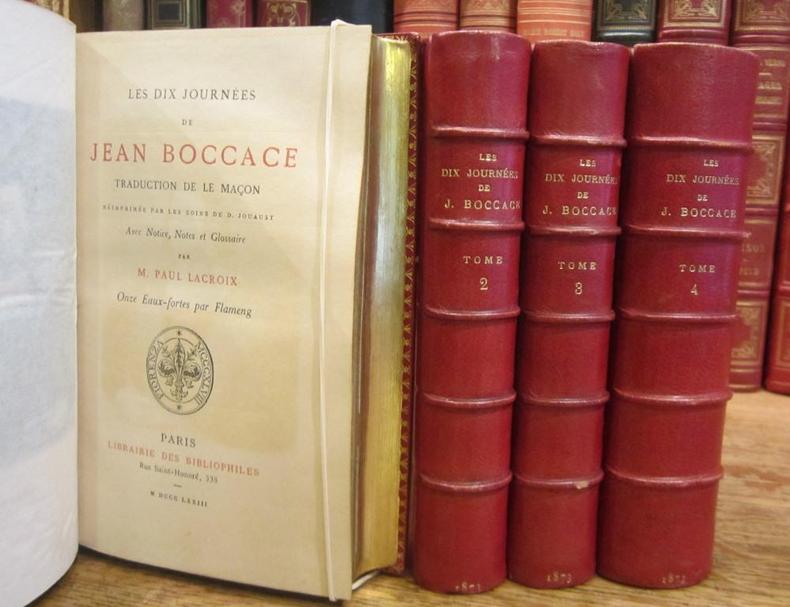
1873002816Paris, Librairie des Bibliophiles, Jouaust, 1873
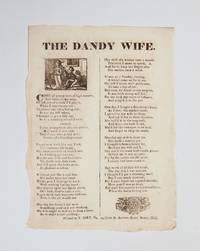
18285421London: T. Birt 1828. First edition. Single sheet measuring 250 x 185mm and printed in two columns to recto. Some edgewear to margins not affecting text; a bit of foxing and toning largely confined to margins. A scarce and delicate survivor OCLC documents only one example at the National Library of Scotland. The present is the only example on the market.<br /> <br /> The Dandy Wife is narrated by a man who aimed "to choose me out a loving wife" at the age of twenty-one but whose experience becomes a warning to "all young men of high renown": "If you want a tidy wife Beware of a boarding school." What unfolds is a satire of how the marriage economy is affected when women have access to knowledge -- intellectual and physical -- and how by meeting a man's superficial expectations a woman can fulfill her own more pressing needs.<br /> <br /> Thinking that a boarding school girl will have the innocence submissiveness and domestic skill he desires the narrator selects a wife from among their ranks. Thinking only of what he can obtain from such a bargain he is unprepared for what an educated woman brings into his house. The Dandy Wife he describes understands the commodity value of her own beauty and material adornment and that these are her key means for acquiring wealth of her own. "She takes one-half of what I earn In drinking gin and tea; Besides such frills and furbelows My Dandy Wife does wear.Her sleeves upon her dandy gown Oh! Lack they're such a size You'd think they were two balloons that in the air would rise." Aside from staying on par with fashion trends her clothing assists her in avoiding domestic tasks she abhors. She refuses to do laundry more than monthly and through ridiculous cooking failures she rapidly establishes that the kitchen is not a showcase for her skillset. Accustomed to a life of learning she is not trained to conduct domestic business. <br /> <br /> By the ballad's end it becomes clear that the Dandy Wife was savvier in managing a marriage than her husband was. For not only does her superior intellect help her carve out a more satisfying role but she also has physical knowledge that predates him: "The day that I was married I thought I'd got a charming maid But I was much deceived.For scarce five months we'd married been When she had a darling son. T. Birt unknown
1822PHO-1568Paris, Nepveu, 1822. 3 volumes in-16 (14.5x90mm), reliés demi-basane époque, XXX-127pp.-139pp-206pp. Illustré de 23 gravures dont 17 dépliantes, accroc au dos tome 3, légers frottements aux plats, 2 planches volantes.
1871002865Paris, Jouaust, Librairie des Bibliophiles, 1871
18434025Berkeley: T.R. Marvin 1843. First edition. Very Good . Original publisher's cloth binding with gilt to front board. Minor loss of cloth to crown of spine. Faint residue of removed library label to spine and front board. Peach endpapers. Light scattered foxing as is typical of the period. Inscribed on the front endpaper by Ward's husband the compiler: "Reverend Mr. Ellingwood with the respects of J.W. Ward." Bookplate on the front pastedown reveals that the recipient Rev. Ellingwood went on to donate the volume to the Theological Seminary of Bangor Maine. A scarce and important example of a published American elegiac volume produced in this case by an eminent family to mourn the loss of an educated woman. Memoirs is unrecorded by OCLC and has never appeared at auction. <br /> <br /> In their marriage James Wilson Ward and Hetta Lord Hayes Ward united two prominent Northeastern families. A senator and Congregationalist minister James descended from the founders of Plymouth and had attended Andover and Amherst. Hetta the daughter of a judge and niece of a Dartmouth president was herself a graduate of Miss Grant's Seminary Academy. The present volume released "exclusively for private circulation among the friends of the deceased" is a testament to Hetta's value not as a daughter who married well or a wife who effectively managed a house but as a companion an intellectual and an individual. In this sense it deconstructs the period's expectations of separate spheres or hierarchy between sexes. With an opening letter by Susan Hayes Hetta's mother as well as a copy of the eulogy conducted by her husband the book reveals vast details about who Hetta was as a person. Both describe her as tender and affectionate; but time and again emphasis is placed on her mind. Though Hetta was skillful with a needle as a child according to her mother "her numberless questions interested and surprised me.She acquired a fondness for poetry.She became as much interested in the in the study of the exact sciences as in the works of imagination making herself acquainted with the higher branches of Mathematics Algebra Geometry etc." James similarly eulogizes his wife. What becomes clear is that he is grieving the loss of a companion and equal. "If we have found a friend of distinguished excellence and for years rejoiced with that friend in mutual interchange and warm affections it is natural when death intervenes and separates us from the dear object of our love to contemplate their virtues.First characteristic which I would notice which she possessed in an eminent degree is an ardent love of truth.She possessed great powers of abstraction.She saw with great clearness the point of an argument and was quick to distinguish between sophistry.She loved to trace the workings of the human mind." Not satisfied simply to have their own testaments to Hetta's extraordinary mind the compilers included to the last half of the book a collection of her own poetry and prose.<br /> <br /> A scarce work in a genre underappreciated in American literature and history. Such coterie publications of intimate mourning were uncommon for the time particularly for a woman.<br /> <br /> National Cyclopedia of American Biography 148. Very Good . T.R. Marvin unknown
188746881Paris Jouaust 1887 In-8, demi-maroquin rouge coins, plats de papier marbr, dos nerfs orn petits fers et filets pousss or; doublures et gardes de papier marbr, tte dore, non rogn, couverture imprime (G. Mercier).21 eaux-fortes originales hors texte de Ad. Lalauze. Tirage limit 215 exemplaires numrots. Un des 15 exemplaires sur papier Whatman, enrichi d'une suite sur japon des gravures en preuves d'artiste avec remarques, chacune signe au crayon par Lalauze. De la bibliothque Suzanne Courtois (ex-libris).
18015554London: J. Wright; Philanthropic Reform 1801. First editions. Two pamphlets bound together in modern quarter calf over marbled boards with morocco label to spine. Measuring 203 x 120mm and both collating complete: 4 136; 27 1 blank. Toning throughout both tracts with closed tears to pages 69-70 and 77-80 with no loss of text; contemporary pencil annotations throughout the first tract documenting one reader's responses to the controversial claims. Numbers 2 and 4 in ink to headers of each title suggest these were part of a larger compilation of legal tracts likely the set of four that were offered for sale in the 1923 Walpole Galleries sale which bear matching marks. Each scarce OCLC reports approximately 20 copies of the first title and ESTC locates 3 copies of the second title; they are the only examples currently in trade. <br /> <br /> Two scarce pamphlets engaging in a longstanding debate about whether how and when divorce should be socially and legally acceptable. These two take up the issue of women's sexual agency and Thoughts on the Propriety specifically espouses the notion that women who have engaged in adultery should not be allowed to divorce an existing spouse in order to marry a man with whom they've been unfaithful. Biblical justifications for this ban are presented throughout; but the hypocrisy woven into the argument makes it clear that its author is manufacturing a problem in order to punish and shame the few women for whom this circumstance even exists. <br /> <br /> Marriages at the time could only be dissolved through divorce in an Act of Parliament; thus divorces were only available to the titled and the wealthy. Additionally at the time of Thoughts on the Propriety's publication in 1800 no woman had ever successfully petitioned Parliament for divorce and been granted one. This landmark would come in 1801 the year of publication for Nuptiae Sacra when Jane Campbell successfully petitioned to divorce Edward Addison on the grounds of abuse. "Of the 314 divorce Acts issued before 1857 all but five were initiated by men. Of the five women who petitioned for divorce Jane Campbell was the first to successfully unbind herself from her husband" History of Parliament. Whether the author of Thoughts anticipated such a ruling or not it is clear that the issue at stake was not so much women gaining divorces as women more openly at the turn of the century engaging in pre and extra marital sexual relationships or even in some cases paid sex work. This was in fact occurring; and it was the subject of numerous satires erotic works and religious diatribes dealing with cuckoldry and whoredom. The desire to shame and control women who expressed sexual subjecthood and the impulse to position them as the sinning parties rather than the men who equally engaged in the behavior with them is telling and predicts how future divorce laws would unfold. J. Wright; Philanthropic Reform unknown
18782111902160201404Hori Seitaro 1878. Soft Cover. Fine. Number of books: 3 Hori Seitaro paperback