5 078 résultats
LCS-14866Superbe peinture chinoise en rouleau horizontal représentant le cortège d’un mariage luxueux. Chine, dynastie Qing, seconde moitié du XIXe siècle. S.l.n.d. [Chine, dynastie Qing, seconde moitié du XIXe siècle].Rouleau horizontal peint sur soie et papier traditionnel chinois. Encre de Chine et lavis coloriés. Baguette d’enroulement en bois sombre ornée d’une bande de soie bleue. L’axe central du rouleau a un diamètre de 2 cm environ. Couverture décorée de soie multicolore. Dimensions du rouleau : environ 3,85 m de longueur x 0,36 m de largeur.
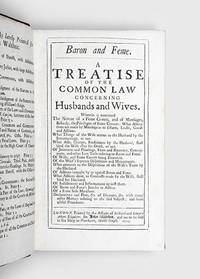
1700176470London: Printed by the Assigns of Richard and Edward Atkyns Esquires for John Walthoe 1700. The first English treatise devoted exclusively to family law First edition in an exceptionally well-preserved binding of this oft-cited work on the legal position of women in 17th- and 18th-century England and a key summary of the social mechanisms underpinning such works as The Taming of the Shrew. "Baron and Feme" refers to the legal fiction that husband and wife shared one legal personhood. The anonymous author of this treatise draws heavily on Sir Edward Coke's edition of Littleton aiming to codify and explain family law "in all the Circumstances of Life from the Solemnization of Marriage to the Divorce" p. vi. "Although written in English at a time when many law books were still published in Latin and law French it was clearly intended for a legally trained reader" Glover p. 75. This copy includes extensive ink annotations in an 18th-century hand suggesting a similar level of legal training. The annotations mainly cite other legal reference works but they also explicate several points of law and invoke others to challenge assertions in the text. The notes on the rear blank verso for instance observe that "the Wife's Portion consisting of Choses in action shall not upon ye husb's death be liable to his debts tho' ye husb: before marriage had made an adequate Jointure on her". Further editions appeared in 1719 and 1738. Octavo 192 x 115 mm pp. xxxii 380 misprinting pp. 178-9 182-3 186-7 and 190-1 as 162-3 166-7 170-1 and 174-5 36. Contemporary calf spine ruled in black and lettered in black manuscript covers with double fillet in black. Housed in custom green morocco book-form case. With 18th-century ink annotations and infrequent underlining to contents and rear blank verso. One corner just worn at tip infrequent brown marks to several pages contents otherwise bright and fresh: a fine copy. ESTC R6177; Wing B899. Susan Glover Engendering Legitimacy: Law Property and Early Eighteenth-century Fiction 2006. unknown
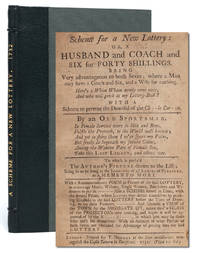
17326120London: Printed for T. Dormer 1732. First edition. Modern quarter morocco over cloth with gilt to spine. Measuring 180 x 111mm and collating complete including frontis folding game board and concluding woodcut: 2 62 2. From the collection of stage magician Ricky Jay with his bookplate to upper pastedown. Top margin trimmed close with consistent loss to running headers and occasional loss to page numbers with no other text effected. Pages somewhat toned with minor marginal chips but otherwise unmarked. A scarce satire playing both on the rising popularity of get-rich-quick schemes and on the economics of the marriage market the present is the only example to appear in the auction record. OCLC locates only twelve institutional copies. The present is the only example currently in trade.<br /> <br /> A Scheme for a New Lottery warns readers against the dangers posed by get-rich-quick schemes targeting large-scale scams like the recently burst South Sea Bubble sometimes called the world's first Ponzi scheme and the pawn-broking swindle of the so-called Charitable Corporation. These scams were appealing to ordinary people at a time when few were "successful in using wealth from trade to found a landed family" Rapp. Mocking both the conmen and the conned A Scheme satirically proposes "Another Lottery which may prove a general benefit to all concern'd; as there is no better Remedy for a Bite from a Mad Dog than the Liver of the Dog that bit." The proposed lottery filled with abstruse rules and convoluted promises ensures that the cycle continues.<br /> <br /> A Scheme also mocks marriage as a scam in which women could either make a wise match in a rich man or lose it all by marrying down. The lottery provides "Fifty Thousand tickets to be deliver'd to Maids or Widows or any that appear to be such" in the hopes of winning a financially stable husband represented by the tickets drawn. Such a match could be a good one: "A Ware-House Keeper with the Salary of a Hundred Pounds" or "the Governour." It could also by virtue of lottery be a loss: "2 Scotchmen both Pedlars 500 Broken Booksellers" and a range of other ruinous bounders are also listed as prizes. For those who desire an advance attempt the folding game bound in the book invites blindfolded women to stick a pin in the board to claim their prize. The present copy was played gently with pin marks revealing a Blacksmith and a Valet de Chambre among those husbands won<br /> <br /> The popularity of A Scheme resulted in a reissue the same year with a canceled title page as The Ladies Lottery and falsely attributed to Swift.<br /> <br /> ESTC N20921. Printed for T. Dormer unknown
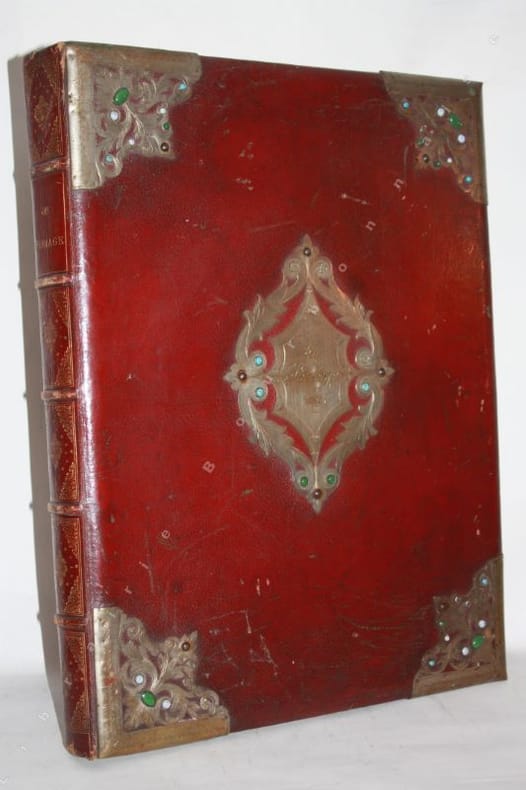
9109Manuscrit sur vélin vers 1881 ; in-folio (53 x 41 cm). 2ff. papier et 1f. vélin blancs-189pp. (f. 173 en double), plein maroquin bordeaux, dos à nerfs orné, plats ornés aux angles de ferrures découpées de palmettes, gravées, et rehaussées de cabochons garnis de perles de verre ou d'émaux. Plaque centrale en métal découpée et gravée au centre du titre : "Un mariage". Coins légèrement choqués, légers frottements sur les plats, manques plusieurs perles colorées. Intérieur très frais.
1783002461Paris, Bastien, 1783
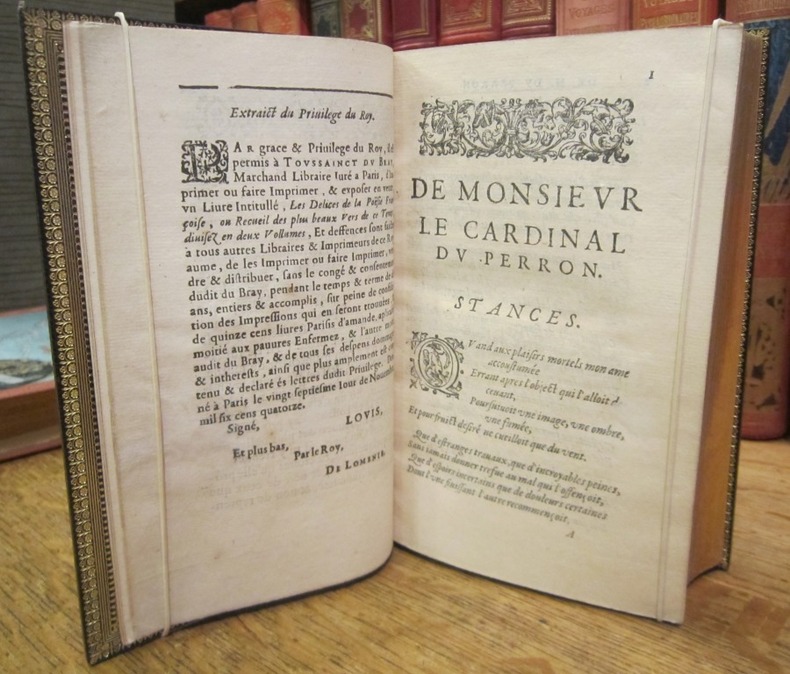
1615002850Paris, Chez Toussainct du Bray, 1615
18782111902160201404Hori Seitaro 1878. Soft Cover. Fine. Number of books: 3 Hori Seitaro paperback
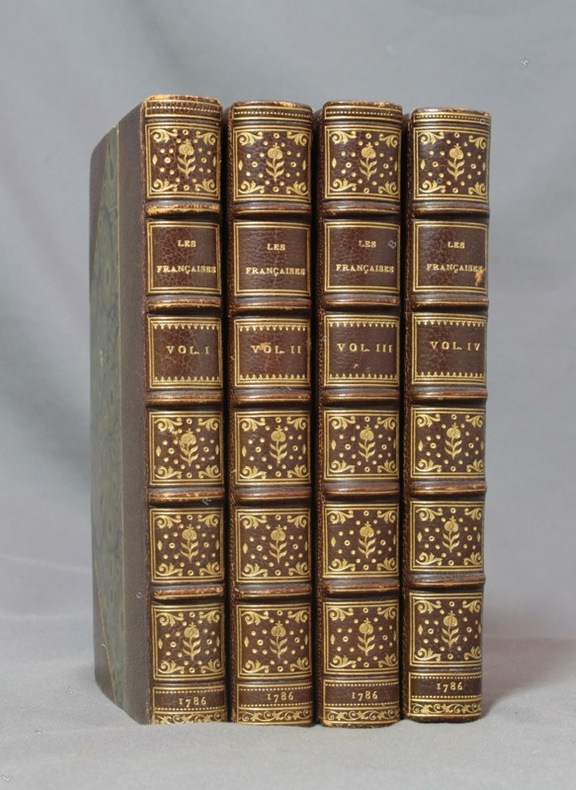
8810A Neuchâtel, et se trouve à Paris, Chés Guillot, libraire de Monsieur, rue Saint-Jacques, vis-à-vis celle des Mathurins, 1786. 4 volumes in-12 de 272; 312; 312; 324-[16] pages, demi-maroquin vert Véronèse (à moins que cela ne soit kaki) à coins, dos à nerfs ornés de filets et fleurons dorés, tranches dorées. Reliures signées Paul Vié.
18015554London: J. Wright; Philanthropic Reform 1801. First editions. Two pamphlets bound together in modern quarter calf over marbled boards with morocco label to spine. Measuring 203 x 120mm and both collating complete: 4 136; 27 1 blank. Toning throughout both tracts with closed tears to pages 69-70 and 77-80 with no loss of text; contemporary pencil annotations throughout the first tract documenting one reader's responses to the controversial claims. Numbers 2 and 4 in ink to headers of each title suggest these were part of a larger compilation of legal tracts likely the set of four that were offered for sale in the 1923 Walpole Galleries sale which bear matching marks. Each scarce OCLC reports approximately 20 copies of the first title and ESTC locates 3 copies of the second title; they are the only examples currently in trade. <br /> <br /> Two scarce pamphlets engaging in a longstanding debate about whether how and when divorce should be socially and legally acceptable. These two take up the issue of women's sexual agency and Thoughts on the Propriety specifically espouses the notion that women who have engaged in adultery should not be allowed to divorce an existing spouse in order to marry a man with whom they've been unfaithful. Biblical justifications for this ban are presented throughout; but the hypocrisy woven into the argument makes it clear that its author is manufacturing a problem in order to punish and shame the few women for whom this circumstance even exists. <br /> <br /> Marriages at the time could only be dissolved through divorce in an Act of Parliament; thus divorces were only available to the titled and the wealthy. Additionally at the time of Thoughts on the Propriety's publication in 1800 no woman had ever successfully petitioned Parliament for divorce and been granted one. This landmark would come in 1801 the year of publication for Nuptiae Sacra when Jane Campbell successfully petitioned to divorce Edward Addison on the grounds of abuse. "Of the 314 divorce Acts issued before 1857 all but five were initiated by men. Of the five women who petitioned for divorce Jane Campbell was the first to successfully unbind herself from her husband" History of Parliament. Whether the author of Thoughts anticipated such a ruling or not it is clear that the issue at stake was not so much women gaining divorces as women more openly at the turn of the century engaging in pre and extra marital sexual relationships or even in some cases paid sex work. This was in fact occurring; and it was the subject of numerous satires erotic works and religious diatribes dealing with cuckoldry and whoredom. The desire to shame and control women who expressed sexual subjecthood and the impulse to position them as the sinning parties rather than the men who equally engaged in the behavior with them is telling and predicts how future divorce laws would unfold. J. Wright; Philanthropic Reform unknown
178911350S.l., s.n., 1789 ; in-8 ; demi-chagrin rouge à petits coins, dos à nerfs, titre doré (reliure moderne) ; 206 pp. y compris le faux-titre et le titre (INED, 578 ; Barbier, I-531).
in-8 , ff. 44, presente ultimo foglio bianco (A-E⁸ F⁴), bella legatura in stile Settecentesco in marocchino verde con triplice filettatura oro ai piatti e ricche dentelles interne, dorso a nervi con fregi oro. Il nome dell'a. si ricava dalla dedica e dall'incipit. Editio princeps. Si tratta della "opera sua più singolare: Angoscia, Doglia e Pena, le tre furie del mondo" (DBIt). Nel 1542 apparvero singolarmente le prime due parti Angoscia e Doglia , ristampate nel 1546, con ritocchi, insieme con una terza, la Pena, e dedicate, con voluta ironia, al fratello Francesco, sposo di fresco. Modello di trattato misogino, l'autore vi riversa, con enfasi, la sua amara esperienza di marito ("subito che averai detto donna, hai detto tutto il male che si può dir in una parola"). L'opera è concepita come commento a due sonetti e una strofa dialogati tra Socrate e Nifo. Il Biondo esercitò la professione medica a Napoli ed è ricordato per aver introdotto l'uso della cura delle ferite e delle contusioni con l'applicazione dell'acqua fredda e per essere stato uno dei precursori piu insigni della terapia chirurgica. Raro, censito in sole 10 Biblioteche Pubbliche italiane. Curiosa l'indicazione in fine: "Vi scrissi ciò per memoria, non per documento da quella Casuppula, dove solitario contemplo la mia fortuna, remigando con tutte le forze al destinato fine". Buon esemplare, con antichi restauri al margine bianco del titolo. Provenienza: al contropiatto anteriore ex libris moderno. . Manca a Gamba. Adams e stc.
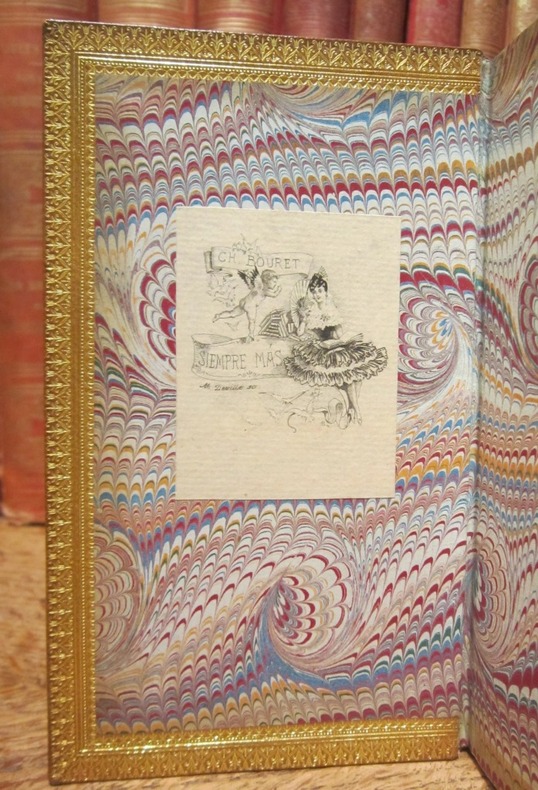
188746881Paris Jouaust 1887 In-8, demi-maroquin rouge coins, plats de papier marbr, dos nerfs orn petits fers et filets pousss or; doublures et gardes de papier marbr, tte dore, non rogn, couverture imprime (G. Mercier).21 eaux-fortes originales hors texte de Ad. Lalauze. Tirage limit 215 exemplaires numrots. Un des 15 exemplaires sur papier Whatman, enrichi d'une suite sur japon des gravures en preuves d'artiste avec remarques, chacune signe au crayon par Lalauze. De la bibliothque Suzanne Courtois (ex-libris).
199067467Art Media Resources Ltd. New. 1990. Hardcover. 9627101168 . FREE UPGRADE to Courier/Priority Shipping Upon Request - IN STOCK AND IMMEDIATELY AVAILABLE FOR SHIPMENT - Flawless copy brand new pristine never opened -- Text in Chinese and English. Description: "This well-illustrated presentation of 200 figure carvings ornaments and utilitarian objects from a distinguished private collection surveys the historical and artistic evolution of Chinese ivory carving from the 12th century B. C. To the early 20th century. Three essays discuss ancient works in ivory and bone summarize major archaeological finds from the Shang to the Yuan dynasty and trace the development of ivory carving in the Ming and Qing dynasties." -- with a bonus offer-- . Art Media Resources, Ltd. hardcover
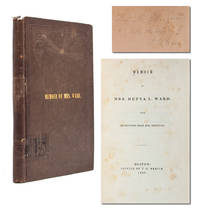
18434025Berkeley: T.R. Marvin 1843. First edition. Very Good . Original publisher's cloth binding with gilt to front board. Minor loss of cloth to crown of spine. Faint residue of removed library label to spine and front board. Peach endpapers. Light scattered foxing as is typical of the period. Inscribed on the front endpaper by Ward's husband the compiler: "Reverend Mr. Ellingwood with the respects of J.W. Ward." Bookplate on the front pastedown reveals that the recipient Rev. Ellingwood went on to donate the volume to the Theological Seminary of Bangor Maine. A scarce and important example of a published American elegiac volume produced in this case by an eminent family to mourn the loss of an educated woman. Memoirs is unrecorded by OCLC and has never appeared at auction. <br /> <br /> In their marriage James Wilson Ward and Hetta Lord Hayes Ward united two prominent Northeastern families. A senator and Congregationalist minister James descended from the founders of Plymouth and had attended Andover and Amherst. Hetta the daughter of a judge and niece of a Dartmouth president was herself a graduate of Miss Grant's Seminary Academy. The present volume released "exclusively for private circulation among the friends of the deceased" is a testament to Hetta's value not as a daughter who married well or a wife who effectively managed a house but as a companion an intellectual and an individual. In this sense it deconstructs the period's expectations of separate spheres or hierarchy between sexes. With an opening letter by Susan Hayes Hetta's mother as well as a copy of the eulogy conducted by her husband the book reveals vast details about who Hetta was as a person. Both describe her as tender and affectionate; but time and again emphasis is placed on her mind. Though Hetta was skillful with a needle as a child according to her mother "her numberless questions interested and surprised me.She acquired a fondness for poetry.She became as much interested in the in the study of the exact sciences as in the works of imagination making herself acquainted with the higher branches of Mathematics Algebra Geometry etc." James similarly eulogizes his wife. What becomes clear is that he is grieving the loss of a companion and equal. "If we have found a friend of distinguished excellence and for years rejoiced with that friend in mutual interchange and warm affections it is natural when death intervenes and separates us from the dear object of our love to contemplate their virtues.First characteristic which I would notice which she possessed in an eminent degree is an ardent love of truth.She possessed great powers of abstraction.She saw with great clearness the point of an argument and was quick to distinguish between sophistry.She loved to trace the workings of the human mind." Not satisfied simply to have their own testaments to Hetta's extraordinary mind the compilers included to the last half of the book a collection of her own poetry and prose.<br /> <br /> A scarce work in a genre underappreciated in American literature and history. Such coterie publications of intimate mourning were uncommon for the time particularly for a woman.<br /> <br /> National Cyclopedia of American Biography 148. Very Good . T.R. Marvin unknown
1871002865Paris, Jouaust, Librairie des Bibliophiles, 1871
1595002235Paris Mamer Patisson, chez Rob. Estienne 1595
46684Genève.Barrillot & Fils.E.O.1750.207 p.et 168 p.avec table alphabétique des Différens Peuples. In-8 relié.Tampon rouge "Bibliothèque de Monsieur le Comte Christian de Guérin de Villiers" avec dessin in fine.Ex-libris aux armes de Jacobus Molinier. BE.Petit manque de cuir en coiffe supérieure.Très légère ouverture en mors inférieur.Un coin émoussé.Veau marbré.Dos orné avec pièce de titre.
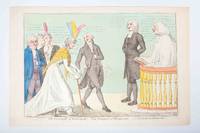
18005629London: S. W. Fores 1800. First edition. Illustrated hand-colored broadside measuring 270 x 400mm and printed to verso only. Faint offsetting to recto and faint traces of mounting to corners. In all a Fine example of this visual satire commenting on the phenomenon of younger men seeking marriage with elderly widows for their own financial gain -- and the cultural anxiety surrounding the marital sexuality of such brides. Unrecorded in ESTC and OCLC we have located two examples of the present work at the British Museum and Yale. <br /> <br /> The present broadside draws together a wide matrix of debates and social anxieties surrounding the economic and sexual status of widows and the financial motivations for marriage among second sons and men of the middle class. Though women were more frequently forced into experiencing marriage as a form of 'honorable prostitution' in which their physical desirability served as their key for accessing wealth and stability under coverture it was increasingly acknowledged that large swaths of young men also suffered under this system. And while widows could escape the system -- shifting from the disempowered femme covert to the more legally independent femme sole on their husbands' deaths -- there was both a social fantasy of reinserting them into the marriage market as a means for regaining control over their money and bodies as well as a social anxiety about their ability to corrupt through the range of knowledge and authority they gained through previous marital experience. Here a young man walks his aging crone down the aisle. Ornately clad and expressing her anticipation for "the comforts of matrimony" she is ridiculed by the ministers at the pulpit who posit that if "matrimony was first ordained.for a remedy against fornication" then "the remedy will be worse than the disease" in this instance. Untroubled the young groom focuses on the land deeds bank notes and jewelry accounts which stuff his pockets -- assets which will legally become his after the ceremony and which serve as his marital comforts. Meanwhile two young women observe from the sidelines one of them planning her future with the groom after his aging bride's eventual demise. "Those jewels will look better on me than on the last owner" she notes as her companion whispers hopefully "you'll let me take a morning ride with you sometimes."<br /> <br /> A visual commentary on the financial and social issues surrounding marriage under coverture which Daniel Defoe would deride as "matrimonial whoredom."<br /> <br /> <br /> British Museum 1935.0522.8.109. Yale Center for British Art B1974.12.328. S. W. Fores unknown
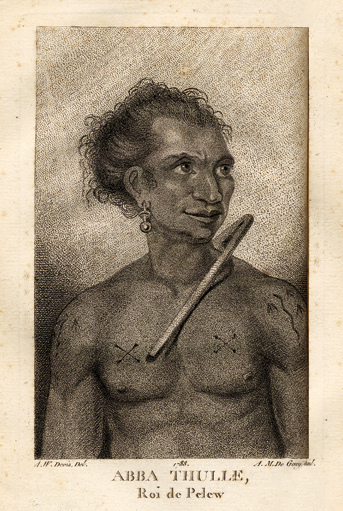
178814520Paris, Le Jay et Maradan, 1788 ; 2 tomes in-8 ; demi-chagrin noisette (reliure moderne) ; (4), 282 pp., portrait du capitaine Henri Wilson en frontispice, gravé par Mme Massard d'après I. Russell, grande carte géographique dépliante, 7 planches gravées dont 6 dépliantes ; (4), 274 pp., (3) ff. Errata et Approbation, 8 planches gravées dont 6 dépliantes, soit 17 planches au total ; vocabulaire de la langue Pelew pp. 251-267 du tome II.
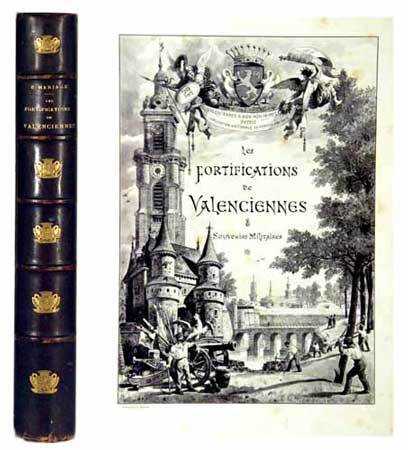
66904aafValenciennes, P. et G. Girard, 1891-1895, in-folio, frontispice montrant une vue de Valenciennes + titre + V + 238 p. + 106 planches + 6 plans dont 2 dépl., qqs traces noires à la fin de l'ouvrage (sur les versos blancs des plans), reliure demi-maroquin, dos à nerfs orné du blason de la ville de Valenciennes répété cinq fois, tête dorée (rel. de l'époque), traces d'usure aux coiffes.
1822PHO-1568Paris, Nepveu, 1822. 3 volumes in-16 (14.5x90mm), reliés demi-basane époque, XXX-127pp.-139pp-206pp. Illustré de 23 gravures dont 17 dépliantes, accroc au dos tome 3, légers frottements aux plats, 2 planches volantes.
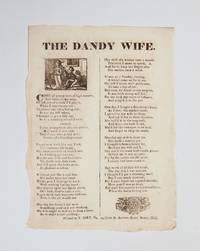
18285421London: T. Birt 1828. First edition. Single sheet measuring 250 x 185mm and printed in two columns to recto. Some edgewear to margins not affecting text; a bit of foxing and toning largely confined to margins. A scarce and delicate survivor OCLC documents only one example at the National Library of Scotland. The present is the only example on the market.<br /> <br /> The Dandy Wife is narrated by a man who aimed "to choose me out a loving wife" at the age of twenty-one but whose experience becomes a warning to "all young men of high renown": "If you want a tidy wife Beware of a boarding school." What unfolds is a satire of how the marriage economy is affected when women have access to knowledge -- intellectual and physical -- and how by meeting a man's superficial expectations a woman can fulfill her own more pressing needs.<br /> <br /> Thinking that a boarding school girl will have the innocence submissiveness and domestic skill he desires the narrator selects a wife from among their ranks. Thinking only of what he can obtain from such a bargain he is unprepared for what an educated woman brings into his house. The Dandy Wife he describes understands the commodity value of her own beauty and material adornment and that these are her key means for acquiring wealth of her own. "She takes one-half of what I earn In drinking gin and tea; Besides such frills and furbelows My Dandy Wife does wear.Her sleeves upon her dandy gown Oh! Lack they're such a size You'd think they were two balloons that in the air would rise." Aside from staying on par with fashion trends her clothing assists her in avoiding domestic tasks she abhors. She refuses to do laundry more than monthly and through ridiculous cooking failures she rapidly establishes that the kitchen is not a showcase for her skillset. Accustomed to a life of learning she is not trained to conduct domestic business. <br /> <br /> By the ballad's end it becomes clear that the Dandy Wife was savvier in managing a marriage than her husband was. For not only does her superior intellect help her carve out a more satisfying role but she also has physical knowledge that predates him: "The day that I was married I thought I'd got a charming maid But I was much deceived.For scarce five months we'd married been When she had a darling son. T. Birt unknown