498 résultats
22128'London: The Book Society 19 Paternoster Row And Bazaar Soho Square.' 1863. No other copy of this royal memento has been traced either on OCLC WorldCat or on COPAC. It is 29 3pp 32mo. Stitched with white thread into shiny white paper covers with title duplicated within border in black on front and back cover carrying an advertisement for a 'New Series of Packets of Books for the young'. The final three pages carry a catalogue of 'Publications of The Book Society 19 Paternoster Row London.' In fair condition lightly aged with faded front cover and dogeared corners. Frontispiece engraving of the royal couple encircled by design topped by the Prince of Wales feathers. A royal souvenir written in the usual mix of eulogy and religiosity with author's initials 'F. G.' at end. 'London: The Book Society, 19, Paternoster Row, And Bazaar, Soho Square.' [1863.] unknown
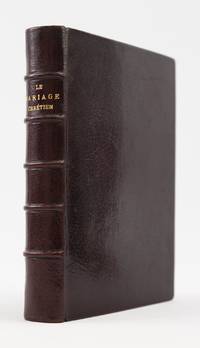
1882ST19567-178Paris: Jules Gervais 1882. Sixth Edition. 160 x 115 mm. 6 1/4 x 4 1/2". 400 pp. <br/> Pleasing deep brown morocco by Fonteney stamp-signed on the verso of the front flyleaf raised bands spine lettered in gilt wide turn-ins gilt tooled patterned endleaves all edges gilt. Engraved frontispiece depicting St. Elizabeth by Friedrich Ludy after Friedrich Overbeck; each page with a decorative figural border. Minor foxing to preliminary leaves very slightly foxed elsewhere otherwise a fine copy the text quite clean bright and fresh and the binding unworn and exceptionally lustrous.<br/> <br/> Decoratively printed and attractively bound this volume on Christian marriage and family life is a delightful example of late 19th century French book production. Its author Félix-Antoine-Philibert Dupanloup 1802-78 was the bishop of Orléans and a proponent of liberal Catholicism in France throughout the 19th century. Alongside teaching and pastoral duties he authored several works on religious matters throughout his career. Initially published in 1869 the present work on "Christian Marriage" went on to become a very popular work remaining in print into the second decade of the 20th century. One wonders if its popularity was as much due to the beauty of the work as its contents: each page is graced with detailed engraved borders laden with scrolling foliage and rich Christian imagery executed with delicacy and panache. This copy is pleasing in its highly polished morocco exterior its lacy inner dentelles and its attractive patterned endleaves. Jules Gervais unknown
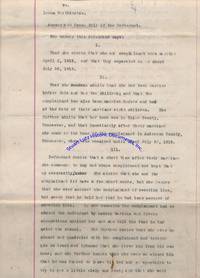
5492DIVORCE. DS. 5pgs. March 17 1920. Anderson County Tennessee. A typed legal document from the divorce of S. R. Worthington and Leona Worthington. It transcribes Leona Worthingtons answers in cross examination. For answer this defendant says: 1. That she admits that she and the complainant were married April 3 1919 and that they separated on or about July 20 1919Defendant denies that a short time after their marriage she commence to nag and abuse complainant and kept that up constantlyOn one occasion the complainant had so abused the defendant by making various and divers accusations against her and she told him that he had acted the rascal. She further denies that she ever so abused and quarreled with the complainant and treated him so cruel and inhuman that she drove him from his own home; and she further denies that she ever so abused him that he was forced to leave his bed and go up-stairs to try to get a little sleep and rest; and that she went up-stairs and insisted that he come back down and that she then quarreled with him the remainder of the nightShe further denies that she has mistreated the complainant and that she has been so cruel and inhuman in her treatment of him as to make it unsafe for him to live and cohabitate with her and she further denies calling him all sorts of vile names and quarrelling with him until she made his home a very bad placeThat after the complainant made the statement about seeing his lawyer and being advised to do everything he could to aggravate and being advised to do everything he could to aggravate her and cause her to leave the complainant seemed to do everything he could to carry out the advise sic of his lawyer and continually quarrelled sic at the defendant accusing her of staying there with him with the sole purpose of getting his property and made her life so miserable and unhappy that she felt that it was impossible for her to longer live with him and she was forced by his cruel and inhuman treatment of her to leave his home and go back to the home of her son in Union County where she is now living. The couple seems to have quarreled about strange things like milking cows in good clothes and spending too much money on undergarments. Leona Worthington asked for a divorce alimony attorneys fees and her old name back. She signed X and her attorney signed twice for her. A notary and two others also signed. The document is extensively annotated in pencil on the versos of several pages as well as corrected on the recto in the hand of Leona Worthingtons lawyer. It is in very good condition with minor wear. The first page is no longer attached to the staples that holds together the other sheets. hardcover
19692111902156002171Ethnological Society of Japan 1969. Soft Cover. Fine. The book is in fine condition. Ethnological Society of Japan paperback
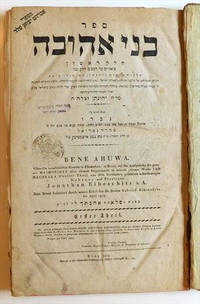
181941334Prag Prague: Gedruckt In D. Schollischen Buchdruckerey 1819. Hardback. 1st edition. 4to period boards 4 82 1 25 leaves aproximately 224 pages. In Hebrew with some German on title page. Vinograd: Prague 1165. StCB: 5867 3; Jewish Museum 179. Contents: helek 1. Hilkhot ishut perek 1-10; helek 2. Hilkhot ishut perek 11-25; helek 3. Hilkhot gerushin. Hilkhot yibum va-halitsah. She'elot u-teshuvot. Maftehot. <br> <br> Novellae to Maimonides of the laws pertaining to women i.e. divorce relationships and marriage by Rabbi Jonathan ben Nathan Nata Eybeschutz 1690/95-1764 the talmudist kabbalist and child prodigy. In his youth after the death of his father he studied in Prossnitz under Rabbi Meir Eisenstadt and Rabbi Eliezer ha-Levi Ettinger his uncle and in Vienna under Rabbi Samson Wertheimer. He married the daughter of Rabbi Isaac Spira the av bet din of Bunzlau. After traveling for some time he settled in Prague in 1715 and in time became head of the yeshivah and a famous preacher. <br> After the death of Rabbi David Oppenheim 1736 he was appointed dayan of Prague. Elected rabbi of Metz in 1741 he subsequently became rabbi of the "Three Communities" Altona Hamburg and Wandsbek in 1750. Both in Metz and in Altona he had many disciples and was considered a great preacher. <br> His position in the Three Communities however was undermined when a dispute broke out concerning his suspected leanings toward Shabbateanism. This controversy accompanied Rabbi Eybeschuetz throughout his life and the quarrel had repercussions in every community from Holland to Poland. His main opponent was Rabbi Jacob Emden also a famous talmudist and a potential rival in the candidature to the rabbinate of the Three Communities.<br> The quarrel developed into a great public dispute which divided the rabbis of the day. While most of the German rabbis opposed Rabbi Eybeschuetz his support came from the rabbis of Poland and Moravia. <br> A fruitless attempt at mediation was made by Rabbi Ezekiel Landau rabbi of Prague. Most of Rabbi Eybeschuetz' own community was loyal to him and confidently accepted his refutation of the charges made by his opponent but dissension reached such a pitch that both sides appealed to the authorities in Hamburg and the government of Denmark for a judicial ruling. The king favored Rabbi Eybeschuetz and ordered new elections which resulted in his reappointment. <br> After his reelection as rabbi of the Three Communities some rabbis of Frankfort Amsterdam and Metz challenged him to appear before them to reply to the suspicions raised against him. Rabbi Eybeschuetz refused and when the matter was brought before the Council of the Four Lands in 1753 the council issued a ruling in his favor. In 1760 the debate was rekindled when some Shabbatean elements were discovered among the students of Rabbi Eybeschuetz' yeshiva. At the same time his youngest son Wolf presented himself as a Shabbatean prophet with the result that the yeshiva was closed. See Bibliography of the Hebrew Book 1470-1960 #000109183; EJ; M. A. Perlmutter R. Yehonatan Eybeschuetz ve-Yahaso la-Shabbeta'ut 1947; Mifal ha-Bibliografyah ha-Ivrit Hoveret le-Dugmah 1964 13-24. <br> <br> SUBJECTS: Marriage Jewish law Divorce Jewish law Husband and wife Jewish law Incest -- Religious aspects -- Judaism. Maimonides Moses 1135-1204. Mishneh Torah -- Commentaries. OCLC: 19167576. <br> Some wear usual light age and damp staining wide margins stamps. Binding starting About Very Good Condition. RAB-66-17-BLRKKQQ-'emn. Prag [Prague]: Gedruckt In D. Schollischen Buchdruckerey unknown
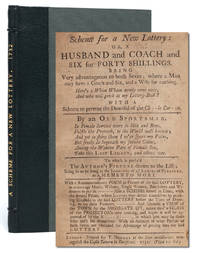
17326120London: Printed for T. Dormer 1732. First edition. Modern quarter morocco over cloth with gilt to spine. Measuring 180 x 111mm and collating complete including frontis folding game board and concluding woodcut: 2 62 2. From the collection of stage magician Ricky Jay with his bookplate to upper pastedown. Top margin trimmed close with consistent loss to running headers and occasional loss to page numbers with no other text effected. Pages somewhat toned with minor marginal chips but otherwise unmarked. A scarce satire playing both on the rising popularity of get-rich-quick schemes and on the economics of the marriage market the present is the only example to appear in the auction record. OCLC locates only twelve institutional copies. The present is the only example currently in trade.<br /> <br /> A Scheme for a New Lottery warns readers against the dangers posed by get-rich-quick schemes targeting large-scale scams like the recently burst South Sea Bubble sometimes called the world's first Ponzi scheme and the pawn-broking swindle of the so-called Charitable Corporation. These scams were appealing to ordinary people at a time when few were "successful in using wealth from trade to found a landed family" Rapp. Mocking both the conmen and the conned A Scheme satirically proposes "Another Lottery which may prove a general benefit to all concern'd; as there is no better Remedy for a Bite from a Mad Dog than the Liver of the Dog that bit." The proposed lottery filled with abstruse rules and convoluted promises ensures that the cycle continues.<br /> <br /> A Scheme also mocks marriage as a scam in which women could either make a wise match in a rich man or lose it all by marrying down. The lottery provides "Fifty Thousand tickets to be deliver'd to Maids or Widows or any that appear to be such" in the hopes of winning a financially stable husband represented by the tickets drawn. Such a match could be a good one: "A Ware-House Keeper with the Salary of a Hundred Pounds" or "the Governour." It could also by virtue of lottery be a loss: "2 Scotchmen both Pedlars 500 Broken Booksellers" and a range of other ruinous bounders are also listed as prizes. For those who desire an advance attempt the folding game bound in the book invites blindfolded women to stick a pin in the board to claim their prize. The present copy was played gently with pin marks revealing a Blacksmith and a Valet de Chambre among those husbands won<br /> <br /> The popularity of A Scheme resulted in a reissue the same year with a canceled title page as The Ladies Lottery and falsely attributed to Swift.<br /> <br /> ESTC N20921. Printed for T. Dormer unknown
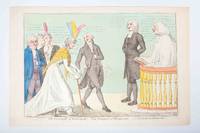
18005629London: S. W. Fores 1800. First edition. Illustrated hand-colored broadside measuring 270 x 400mm and printed to verso only. Faint offsetting to recto and faint traces of mounting to corners. In all a Fine example of this visual satire commenting on the phenomenon of younger men seeking marriage with elderly widows for their own financial gain -- and the cultural anxiety surrounding the marital sexuality of such brides. Unrecorded in ESTC and OCLC we have located two examples of the present work at the British Museum and Yale. <br /> <br /> The present broadside draws together a wide matrix of debates and social anxieties surrounding the economic and sexual status of widows and the financial motivations for marriage among second sons and men of the middle class. Though women were more frequently forced into experiencing marriage as a form of 'honorable prostitution' in which their physical desirability served as their key for accessing wealth and stability under coverture it was increasingly acknowledged that large swaths of young men also suffered under this system. And while widows could escape the system -- shifting from the disempowered femme covert to the more legally independent femme sole on their husbands' deaths -- there was both a social fantasy of reinserting them into the marriage market as a means for regaining control over their money and bodies as well as a social anxiety about their ability to corrupt through the range of knowledge and authority they gained through previous marital experience. Here a young man walks his aging crone down the aisle. Ornately clad and expressing her anticipation for "the comforts of matrimony" she is ridiculed by the ministers at the pulpit who posit that if "matrimony was first ordained.for a remedy against fornication" then "the remedy will be worse than the disease" in this instance. Untroubled the young groom focuses on the land deeds bank notes and jewelry accounts which stuff his pockets -- assets which will legally become his after the ceremony and which serve as his marital comforts. Meanwhile two young women observe from the sidelines one of them planning her future with the groom after his aging bride's eventual demise. "Those jewels will look better on me than on the last owner" she notes as her companion whispers hopefully "you'll let me take a morning ride with you sometimes."<br /> <br /> A visual commentary on the financial and social issues surrounding marriage under coverture which Daniel Defoe would deride as "matrimonial whoredom."<br /> <br /> <br /> British Museum 1935.0522.8.109. Yale Center for British Art B1974.12.328. S. W. Fores unknown
185535931Columbus Ohio: L. P. Rayl & Co 1855. Hardcover. Good. Octavo. 3 64 pages 1 page explanation 63 pages of blank lined pages used for recording births deaths marriages etc. Green cloth hardcover ruled in blind with blind stamped decorations on the covers. Gilt decorations on the cover and gilt title on the spine. Cloth spine is chipped at top and worn at the bottom. Corners are edge worn. Light to moderate foxing to the end papers and text. Occasional brown spots to the blank pages. Blind embossed bookseller stamp on the right front flyleaf from Columbus Ohio. 1857 previous owner inscription in another language written on the right front flyleaf reads - Johann Charls Herpilsheimer den 13 Aprill 1856." A cut section of lined paper with old hand writing in a different language is laid inside the front cover. This copy has no family history written on the blank pages. L. P. Rayl & Co hardcover
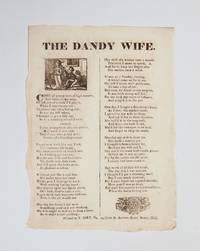
18285421London: T. Birt 1828. First edition. Single sheet measuring 250 x 185mm and printed in two columns to recto. Some edgewear to margins not affecting text; a bit of foxing and toning largely confined to margins. A scarce and delicate survivor OCLC documents only one example at the National Library of Scotland. The present is the only example on the market.<br /> <br /> The Dandy Wife is narrated by a man who aimed "to choose me out a loving wife" at the age of twenty-one but whose experience becomes a warning to "all young men of high renown": "If you want a tidy wife Beware of a boarding school." What unfolds is a satire of how the marriage economy is affected when women have access to knowledge -- intellectual and physical -- and how by meeting a man's superficial expectations a woman can fulfill her own more pressing needs.<br /> <br /> Thinking that a boarding school girl will have the innocence submissiveness and domestic skill he desires the narrator selects a wife from among their ranks. Thinking only of what he can obtain from such a bargain he is unprepared for what an educated woman brings into his house. The Dandy Wife he describes understands the commodity value of her own beauty and material adornment and that these are her key means for acquiring wealth of her own. "She takes one-half of what I earn In drinking gin and tea; Besides such frills and furbelows My Dandy Wife does wear.Her sleeves upon her dandy gown Oh! Lack they're such a size You'd think they were two balloons that in the air would rise." Aside from staying on par with fashion trends her clothing assists her in avoiding domestic tasks she abhors. She refuses to do laundry more than monthly and through ridiculous cooking failures she rapidly establishes that the kitchen is not a showcase for her skillset. Accustomed to a life of learning she is not trained to conduct domestic business. <br /> <br /> By the ballad's end it becomes clear that the Dandy Wife was savvier in managing a marriage than her husband was. For not only does her superior intellect help her carve out a more satisfying role but she also has physical knowledge that predates him: "The day that I was married I thought I'd got a charming maid But I was much deceived.For scarce five months we'd married been When she had a darling son. T. Birt unknown
18015554London: J. Wright; Philanthropic Reform 1801. First editions. Two pamphlets bound together in modern quarter calf over marbled boards with morocco label to spine. Measuring 203 x 120mm and both collating complete: 4 136; 27 1 blank. Toning throughout both tracts with closed tears to pages 69-70 and 77-80 with no loss of text; contemporary pencil annotations throughout the first tract documenting one reader's responses to the controversial claims. Numbers 2 and 4 in ink to headers of each title suggest these were part of a larger compilation of legal tracts likely the set of four that were offered for sale in the 1923 Walpole Galleries sale which bear matching marks. Each scarce OCLC reports approximately 20 copies of the first title and ESTC locates 3 copies of the second title; they are the only examples currently in trade. <br /> <br /> Two scarce pamphlets engaging in a longstanding debate about whether how and when divorce should be socially and legally acceptable. These two take up the issue of women's sexual agency and Thoughts on the Propriety specifically espouses the notion that women who have engaged in adultery should not be allowed to divorce an existing spouse in order to marry a man with whom they've been unfaithful. Biblical justifications for this ban are presented throughout; but the hypocrisy woven into the argument makes it clear that its author is manufacturing a problem in order to punish and shame the few women for whom this circumstance even exists. <br /> <br /> Marriages at the time could only be dissolved through divorce in an Act of Parliament; thus divorces were only available to the titled and the wealthy. Additionally at the time of Thoughts on the Propriety's publication in 1800 no woman had ever successfully petitioned Parliament for divorce and been granted one. This landmark would come in 1801 the year of publication for Nuptiae Sacra when Jane Campbell successfully petitioned to divorce Edward Addison on the grounds of abuse. "Of the 314 divorce Acts issued before 1857 all but five were initiated by men. Of the five women who petitioned for divorce Jane Campbell was the first to successfully unbind herself from her husband" History of Parliament. Whether the author of Thoughts anticipated such a ruling or not it is clear that the issue at stake was not so much women gaining divorces as women more openly at the turn of the century engaging in pre and extra marital sexual relationships or even in some cases paid sex work. This was in fact occurring; and it was the subject of numerous satires erotic works and religious diatribes dealing with cuckoldry and whoredom. The desire to shame and control women who expressed sexual subjecthood and the impulse to position them as the sinning parties rather than the men who equally engaged in the behavior with them is telling and predicts how future divorce laws would unfold. J. Wright; Philanthropic Reform unknown
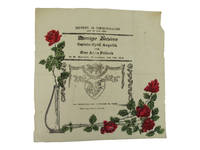
1918003277London: Burgess 1918. Single sided printed tissue approximately 355mm x 360mm in size. Small amount of loss to top right hand corner slightly creased a few light spots of foxing otherwise quite bright and clean. Captain Asquith 1890-1954 was the fourth son of the British Prime Minister H.H. Asquith he later became a barrister and judge. Printed by Burgess at York Place Strand. First Edition. Unbound. Good. Folio. Commemorative Tissue. Burgess Paperback
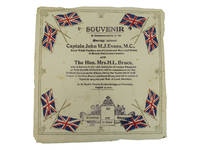
1917003276No Place: No Publisher 1917. Single sided printed tissue approximately 350mm x 360mm in size. Slightly creased and lightly foxed otherwise fairly bright and clean. No publisher but probably printed by Burgess or place but almost certainly London. The marriage between Evans and Bruce formerly Miss Camille Clifford the actress and 'Gibson Girl' who was the widow of the Hon. Henry Lyndhurst Bruce who was killed at Ypres in 1914. First Edition. Unbound. Good. Folio. Commemorative Tissue. No Publisher Paperback
12900The inventory is dated 24 September 1839. The genealogical notes date from the 1860s. SEE IMAGE. The inventory 14pp. is at the front of a 4to notebook with ten pages of genelogical and other notes at the back. In good condition on aged-paper in worn original vellum quarter-binding with blue patterned paper boards and ties. Label on front board: 'Mobilier Picard A Faurel'. The inventory is dated 1839 on a title-page but includes entries from the 1840s. It is divided into the following four sections under calligraphic headings: 'Argenterie' 2pp. 'Meubles Meublant' 5pp. 'Linge' 4pp. and 'Vins Fins' 3pp. Around forty wines are listed with quantity vintage for example 'Chambertins 1832' 'Chablis 1831' 'St. Emilion 1841' 'Chambertin papier 1846' and price. The notes at the rear of the volume apparently made at different times include records of family baptisms and of servants engaged. Signed at end 'Picard Faurel'. The inventory is dated 24 September 1839. The genealogical notes date from the 1860s. SEE IMAGE. hardcover
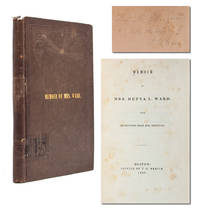
18434025Berkeley: T.R. Marvin 1843. First edition. Very Good . Original publisher's cloth binding with gilt to front board. Minor loss of cloth to crown of spine. Faint residue of removed library label to spine and front board. Peach endpapers. Light scattered foxing as is typical of the period. Inscribed on the front endpaper by Ward's husband the compiler: "Reverend Mr. Ellingwood with the respects of J.W. Ward." Bookplate on the front pastedown reveals that the recipient Rev. Ellingwood went on to donate the volume to the Theological Seminary of Bangor Maine. A scarce and important example of a published American elegiac volume produced in this case by an eminent family to mourn the loss of an educated woman. Memoirs is unrecorded by OCLC and has never appeared at auction. <br /> <br /> In their marriage James Wilson Ward and Hetta Lord Hayes Ward united two prominent Northeastern families. A senator and Congregationalist minister James descended from the founders of Plymouth and had attended Andover and Amherst. Hetta the daughter of a judge and niece of a Dartmouth president was herself a graduate of Miss Grant's Seminary Academy. The present volume released "exclusively for private circulation among the friends of the deceased" is a testament to Hetta's value not as a daughter who married well or a wife who effectively managed a house but as a companion an intellectual and an individual. In this sense it deconstructs the period's expectations of separate spheres or hierarchy between sexes. With an opening letter by Susan Hayes Hetta's mother as well as a copy of the eulogy conducted by her husband the book reveals vast details about who Hetta was as a person. Both describe her as tender and affectionate; but time and again emphasis is placed on her mind. Though Hetta was skillful with a needle as a child according to her mother "her numberless questions interested and surprised me.She acquired a fondness for poetry.She became as much interested in the in the study of the exact sciences as in the works of imagination making herself acquainted with the higher branches of Mathematics Algebra Geometry etc." James similarly eulogizes his wife. What becomes clear is that he is grieving the loss of a companion and equal. "If we have found a friend of distinguished excellence and for years rejoiced with that friend in mutual interchange and warm affections it is natural when death intervenes and separates us from the dear object of our love to contemplate their virtues.First characteristic which I would notice which she possessed in an eminent degree is an ardent love of truth.She possessed great powers of abstraction.She saw with great clearness the point of an argument and was quick to distinguish between sophistry.She loved to trace the workings of the human mind." Not satisfied simply to have their own testaments to Hetta's extraordinary mind the compilers included to the last half of the book a collection of her own poetry and prose.<br /> <br /> A scarce work in a genre underappreciated in American literature and history. Such coterie publications of intimate mourning were uncommon for the time particularly for a woman.<br /> <br /> National Cyclopedia of American Biography 148. Very Good . T.R. Marvin unknown
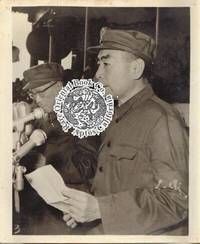
33041901Beijing 1966. Large glossy black & white photograph of Zhou En-lai & Chen Boda sheet: 25.5 x 31 cm. image size 22.5 x 28.8 cm.very good 4 small mended pin holes in the corners else in very good condition.RARE & HISTORIC IMAGE . . . A RARE AND HISTORIC ORIGINAL PHOTOGRAPH DOCUMENTING THE . . . BEGINNING OF THE COMMUNIST PARTY SANCTIONING AND . . . ENCOURAGING THE WENHUA DA GEMING CULTURAL REVOLUTION . . . AND THE OFFICIAL SANCTIONING OF THE HONG WEI BING . . OR "RED GUARDS" . On August 18 1966 MAO Zedong ZHOU En-lai CHEN Boda LIN Biao and other communist party leaders received twelve million young "Red Guards" "Hong Wei Bing" in Beijing's Tiananmen Square. . A high school student girl ran up to the stage and put a "Red Guard" put a red armband bizhang inscribed with the Chinese characters for "Red Guard" on the Chairman Mao and others who stood for six hours speaking to the crowd of admirers and youthful "Red Guards." . This historic rally was captured by the camera. It shows from left to right CHEN Boda and ZHOU En-lai before several microphones as they delivered the keynote speeches to the millions "of HONG WEI BING. . The rally was led by CHEN Boda and LIN Biao who both gave the keynote speeches. . JIANG Qing and other radicals mounted the area where MAO Tsetung ZHOU En-lai CHEN Boda LIN Biao and other CCP leaders were viewing the spectacle and put "Red Guard" arm bands bizhang on many of these leaders. . This photograph shows ZHOU En-lai with his red arm band in place. We have other posters & photographs showing MAO and his red arm band as well please inquire at our website. . 8-18 MASS RALLY: . The "8-18 Rally" as it was known was The first of eight receptions Chairman Mao & other leaders of the CCP gave to "Red Guards" in Tiananmen Square in the fall of 1966. It was this rally that signified the beginning of the "Red Guards" involvement in implementing the aims of the Cultural Revolution. . The second rally held on 31 August 1966 was led by KANG Sheng and LIN Biao who also donned a red arm band. The last rally was held on 26 November 1966. In all Chairman Mao and other leaders greeted eleven to twelve million 'Red Guards' most of whom traveled from afar to attend the rallies. . CONDITION: . This is an original black and white glossy photograph it has the number 3 in the lower left margin negative. The image is sharp crisp and a very large size. The image was previously pinned to a wall and displayed there are 4 old pin holes in the corners and one closed marginal tear to the right side all of which subsequently have been restored with non-acid Japanese Washi paper and rice glue. The image is firm and solid. . ZHOU EN-LAI: 1898 -1976 He was the first Premier of the People's Republic of China serving from October 1949 until his death in January 1976. Zhou served under Mao Zedong and was instrumental in consolidating the control of the Communist Party's rise to power forming foreign policy and developing the Chinese economy. Advocating peaceful coexistence with the West after the stalemated Korean War he participated in the 1954 Geneva Conference and helped orchestrate Richard Nixon's 1972 visit to China. He helped devise policies regarding the bitter disputes with the U.S. Taiwan the Soviet Union after 1960 India and Vietnam. Zhou is best known as the long-time top aide to Mao Zedong specializing in foreign policy. . Zhou En-lai & the "Red Guards": Although Zhou En-lai announced the formal beginning of the Great Proletarian Cultural Revolution on 1 May 1966 at a massive rally to celebrate International Workers Day in Tian'anmen it was not until 16 May that the Politburo established the Cultural Revolution Group comprising Jiang Qing and other radicals. Although there is a general belief that the Palace Museum escaped the depredations of the Cultural Revolution thanks to protection extended by Premier Zhou Enlai this is not entirely true. . CHEN BODA: 1904-1989: He was a member of the Chinese Communist Party CCP a secretary to Chairman Mao and a prominent member of the leadership during the Cultural Revolution chairing the Cultural Revolution Group. . During the Cultural Revolution from 1966 until 1969 Chen Boda played an important role in the Cultural Revolution. In May 1966 he was placed at the head of the newly formed Cultural Revolution Group a body appointed by Mao established to oversee and direct the course of the Cultural Revolution. In time this group would rise to become the most important political body in China surpassing even the Politburo Standing Committee in importance. Chen Boda was also placed as head of the Communist government's propaganda machine. Chen also became a member of the Standing Committee of the Politburo. . As the Cultural Revolution Group began to appear too radical for the liking of Mao & the leadership in Peking its influence began to wane and it was formally dissolved at the CCP's Ninth Congress in the Spring of 1969. . This marked the end of Chen Boda's involvement in the Cultural Revolution. As the leadership became more moderate in its outlook and the initial aims of the Cultural Revolution were sidelined Chen's radicalism caused concern and he was condemned as a 'revisionist secret agent' by the CCP's Tenth Congress in 1973. SEE: CULTURAL REVOLUTION OF 1966-1967-8 The Great Proletarian Cultural Revolution commonly known as the Cultural Revolution was a social-political movement that took place in the People's Republic of China from 1966. Set into motion by Mao Zedong then Chairman of the Communist Party of China its stated goal was to enforce communism in the country by removing capitalist traditional and cultural elements from Chinese society and to impose Maoist orthodoxy within the Party. The revolution marked the return of Mao Zedong to a position of power after the failed Great Leap Forward. The movement paralyzed China politically and significantly affected the country economically and socially. SEE: en-wikipedia-org/wiki/Cultural_Revolution . WHAT & WHO WERE THE "RED GUARDS" "Red Guards" "Hong Wei Bing" were a mass paramilitary social movement of young people students & soldiers in the People's Republic of China PRC who were mobilized by Mao Zedong in 1966 and 1967 during the Cultural Revolution. SEE: or photos are poste to our website. . REFERENCE: . see: thechinatimes.com/online/2011/08/1066-html CULTURAL REVOLUTION: WHAT WAS THE CULTURAL REVOLUTION see: asianhistory.about.com/od/modernchina/f/What-Was-The- Cultural-Revolution.htm . en-wikipedia-org/wiki/Cultural_Revolution CHINESE "RED GUARDS:" en-wikipedia-org/wiki/Red_Guards_China . . unknown
0282557261.Gpaperback. Good. Access codes and supplements are not guaranteed with used items. May be an ex-library book. paperback
036467010X.Ghardcover. Good. Access codes and supplements are not guaranteed with used items. May be an ex-library book. hardcover
0666618291.Gpaperback. Good. Access codes and supplements are not guaranteed with used items. May be an ex-library book. paperback
191622637X.Gpaperback. Good. Access codes and supplements are not guaranteed with used items. May be an ex-library book. paperback
Q-1931846103American Association for Marriage and Family Therapy. Paperback. New. New. In shrink wrap. Looks like an interesting title! American Association for Marriage and Family Therapy paperback
2005Q-193184609XAmerican Association for Marriage and Family Therapy 2005-10-01. Paperback. New. In shrink wrap. Looks like an interesting title! American Association for Marriage and Family Therapy paperback
1491035404.Gpaperback. Good. Access codes and supplements are not guaranteed with used items. May be an ex-library book. paperback
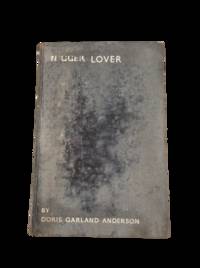
1938228671938. Anderson Doris Garland. Nier Lover 1938 is an interracial marriage memoir documenting the life of a white English woman married to Garland Anderson one of the earliest Black dramatists to achieve a full-length Broadway production. Published for a British audience in the interwar period the work supports research into African American theater history interracial relationships and transatlantic racial attitudes prior to the modern civil rights movement. The narrative records lived experiences of racial discrimination and social exclusion across Britain Europe Canada and the United States situating personal life within the broader structures of Jim Crow segregation and informal racial hierarchies in the Atlantic world.<br /> Anderson Doris Garland. Nier Lover. London: L. N. Fowler & Co. Ltd. 1938. First edition. Octavo. Publisher's dark gray cloth boards lettered in white on spine and upper cover. The text presents a first-person account of marriage to Garland Anderson tracing the couple's movements across multiple countries and documenting encounters with both overt and subtle forms of racial discrimination. Episodes include hotels that accepted them as guests but refused shared accommodations social ostracism within English society and the more rigidly enforced segregation of the United States. The memoir frames these experiences through the lens of Garland Anderson's career as a playwright and lecturer incorporating discussion of his public reception and professional life. The title intentionally provocative contrasts with the narrative's emphasis on mutual respect spiritual alignment and partnership while also reflecting contemporary public hostility toward interracial unions.<br /> 8 preliminary leaves 282 pages with frontispiece and additional portrait plates. Publisher's cloth binding. Octavo format. Cloth heavily mottled and rubbed with fading and soiling to both boards; spine sunned with fraying; text block generally clean and sound; overall good condition. Issued during a period when interracial marriage faced legal and social prohibitions in many regions the memoir provides direct evidence of cross-cultural perceptions of race intimacy and Black public life in the 1930s contributing to the study of race relations gender and African American cultural presence in transatlantic contexts. unknown
19242092902137702092Osaka Mainichi Newspaper appendix 1924. Soft Cover. Fine. The book is in fine condition. Osaka Mainichi Newspaper appendix paperback