3 500 résultats
Paris, Edit. Museo d'Orsay, 2001. Numerosas ilustraciones en color. 113 p. 4º mayor. Rústica editorial ilustrada. Livre en français. Muy buen ejemplar.
València, Galeria L. Adelantado, 1998. Numerosas ilustraciones en color y b/n. 119 p. 4º mayor. Rústica editorial en carpeta. Muy buen ejemplar.
Very Good English Original bdg. HC. Large 4to. (34 x 25 cm). In English, German, French, Italian, Turkish. 1000 p., 1244 color and b/w ills. 50 years from Bedri Baykam's press book, 1963-2013. Edited by Eren Teoman. 1000 copies were printed. First Edition. Signed and inscribed by Baykam. A very heavy and big volume.
Fine English Original bdg. Blue hardcover. Roy. 8vo. (24 x 17 cm). In Turkish. 288 p. Color and b/w ills. [=Turkish painting and sculpture throughout 50 years]. 50 yilin Türk resim ve heykeli.
New English Paperback. Pbo. 4to. (27 x 24 cm). 111 p. In Turkish. Color and b/w ills. 1000 copies were printed. Tekcan's biography: 1940 Born in Trabzon 1963 Graduated from the Painting Department of Ankara Gazi Education Institute. Studied at the Painting Department of Istanbul State Academy of Fine Arts (Miamr Sinan Univeristy) and completed his competense in arts education at the faculty of the same university. 1968-1975 Work as a member of the academic staff at Atatürk Education Faculty 1970-1971 Carried out research in Germany on printmaking education 1975 Joined the staff of Mimar Sinan University Fine Arts Faculty 1985 Professorship. Was appointed to the Chair of the Graphic Art Department the same year 1987 Two-month Original Prints Seminar in Sarajevo Arts Academy 1991 Original Print Seminar at Ankara Bilkent University 1991 Two conferences in Bonn, Germany, named ¿12 Artist in Turkish Graphic Art¿ and ¿ A cross-section of Contemporary Turkish Painting¿ 1994-1995 Dean of the Fine Arts Faculty of Mimar Sinan University as well as the Head of Graphic Arts Department. 1996 Established the Fine Arts Faculty of Yeditepe University which began its educational activities in Büyükada and was the Dean during its first year. 2006 IMOGA-Istanbul Museum of Graphic Arts, Founder and Chairman. 2007 Established the Fine Arts Faculty of I¿¿k University and is the Dean of the Faculty. 2008 Chairman of 1.st International Printmaking Biennial Organization Committee."
New New Turkish Original bdg. Dust wrapper. 4to. (29 x 24 cm). In Turkish. 302 p., color ills. 50. yilinda Akbank resim koleksiyonu. Collection of the Turkish paintings of Akbank.
Köln, Edit. Erzblischöfliches Diozesan, 1976. Kunst und Frommmigkeit im Spatmittelalter und ihr Weiterleben. Algunas láminas ilustradas en b/n. 208p. 8º. Rústica editorial ilustrada algo deslucida. Buen ejemplar. Book in german. Exposición sobre el rosario.
M., Plus Ultra, 1953, 24'5 x 17 cm., cartoné original, 49 págs. - 70 láminas - 2 h.
València, Edit. Gen. Valenciana, 1989. Nombroses il·lustracions en color i negre. 218 p. Foli. Rústica editorial il·lustrada. Lleu resta de doblec inferior. Molt bon exemplar.
New English Paperback. Pbo. 4to. (28 x 23 cm). In Turkish and Italian. [xxv], 125 p. Many folding color plts. [Behçet] Safa. La luce fu su loro leggera.= 1960-1990. Isik vurur üzerlerine hafifçe. 5 Nisan - 5 Mayis 2011 Galeri Tantekin. Translator: Meryem Mine Çilingiroglu. Curated by Jale Durna, Mehmet [Tantekin].
Very Good Turkish Paperback. 4to. (27,5 x 20 cm). In Turkish. 32, [30] p., color and b/w ills., serigraph and mimeograph printing on paper and fabric, 1 folded plate (Ismail Saray's photo). This very interesting and rare book includes the texts on the first 32 pages. Some texts were translated from English and French languages by Sükrü Aysan, Nazli Damlaci, and Faruk Ulay. Articles in the first 32 pages: Kavramsal sanat [i.e. Conceptual art] by Sükrü Aysan.; Felsefenin sonu sanatin baslangici [i.e. The end of philosophy and the beginning of art] by Joseph Kosuth.; Kavramsal sanat üzerine paragraflar [i.e. Paragraphs on Conceptual Art] by Sol Lewitt.; Kavramsal sanat üzerine tümceler [i.e. Sentences on Conceptual Art] by Sol Lewitt.; Not, by Bernar Venet.; Giris notu, by Joseph Kosuth, and Inekleri düzene sokmak için bir yöntem [i.e. A Method For Sorting Cows] by Robert Morris. They're the first and the earliest translations (and for some only) in Turkey on the Conceptual Art. The Definition of Art Group is an original Conceptual Art approach. Conceptual Art was founded to research the structure and nature of art. Conceptual artists question the structure of art through a progression of work that refers to the concept of art. What is being considered is a work or an idea directed towards the analysis of all the facets of and contradictions within the concept of art. Sol LeWitt said, "this type of art is related to all intellectual processes". Impressionism and Cubism gave the first formulas for questioning art. Later, as a result of Duchamp's systematic operations about art's boundaries, function, language, and its being, art again became an intellectual process. Today, the subject of art itself and its place in the universe has reached a stage where its effort is directed towards understanding existence. The stages of this change make twentieth-century art history. Only an art audience informed about the development of art can comprehend contemporary work. To be able to understand today's artistic endeavors, it is necessary to make a conceptual history of art. Pure Conceptual Art by taking this situation to its extreme point, accepts no other audience or observer than the ones actively participating in the making of the work. Thus, art transforms into a state as serious as a science that needs no audience. When using the term, Conceptual Art or its more characteristic name, Analytical Art, in referring to a specific period in the history of Conceptual Art as an approach to art, one is speaking of art that has completely eliminated the production of objects and all plastic art forms. But if one considers the broader understanding of conceptualism, within our twentieth-century art, in addition to the side that verifies by analyzing itself, there is also a logical and philosophical dimension directed towards the comprehension of its structure. In other words, a strongly intellectual art continues its hegemony today. In our time, art without an idea can not be effective. (Source: Official site of Sanat Tanimi Toplulugu). In 1961, philosopher and artist Henry Flynt coined the term "concept art" in an article bearing the same name which was appeared in a proto-Fluxus publication An Anthology of Chance Operations. Flynt's concept art, he maintained, devolved from his notion of "cognitive nihilism," in which paradoxes in logic are shown to evacuate concepts of substance. Drawing on the syntax of logic and mathematics, concept art was meant jointly to supersede mathematics and the formalistic music then current in serious art music circles. Therefore, Flynt maintained, to merit the label concept art, work had to be an object-critique of logic or mathematics via linguistic paradox, a quality which is absent from subs... The use of pure Turkish language in this book is pointed to and this book was printed for an exhibition held between 'March 22 - April 5, 1980'. Printed to only 200 copies and all copies were numbered. This is 49 no. (49/200). Extremely r
Fine Turkish Contemporary blues cloth bdg. Set in four volumes. Roy. 8vo. )24 x 17 cm). In Turkish. 47 issues complete set. Rare complete set of the legendary literary magazine, whose publication life was interrupted periodically due to financial problems of Cemal Süreya, one of the most important names of the poetry movement called "Ikinci Yeni" [i.e. The Second New]. Every issue is a special issue that has a large part of a poet and author. The publication survived between June 1966 and June 1970, and a total of 47 issues were published during this period. Unlike the first period, the magazine became one of the most important literary magazines of those years. Sureya sold the car she brought from Paris for the magazine. Due to financial difficulties and March 12, its broadcast life has come to an end. In 1980 the magazine was reprinted quarterly. During this period, only two issues were published and no more were published due to the September 12 Coup d'Etat. Süreya stated that he named the magazine "Papyrus" in his letter dated 22 December 1959 to one of his friends, Nedret Gürcan, because "the ancient Egyptians wrote their first writings on the leaves of the grass called papyrus growing on the banks of the Nile." (Wikipedia).
New English Paperback. Pbo. 4to. (29 x 24 cm). In English and Turkish. 64 p., color ills. [Painter's Istanbul].= Ressamlarin Istanbul'u. 18 Mart - 11 Nisan 2009. [Exhibition catalogue]. 1000 copies were printed.
Very Good Turkish Paperback. Cr. 8vo. (20 x 15 cm). In Turkish. 35 p., 32 b/w plates. Foxing on the cover. Otherwise a good copy. Nazmi Ziya Güran, (1881-1937), was a Turkish Impressionist painter and art teacher. He was born in Istanbul. He did manage to obtain some private tutoring from Hoca Ali Riza then, following his father's death in 1902, he quietly enrolled at the Academy. He studied with the Italian Orientalist painter, Salvatore Valeri and the sculptor Osgan Efendi, but had some difficulty adapting to the school's conservative teaching methods and came into conflict with Osman Hamdi Bey, the Director. A meeting with the French painter Paul Signac, who visited Istanbul while sailing around the Mediterranean, may have influenced his desired style. The conflicts continued and, in 1907, when he submitted his final exam pictures, he found his graduation delayed by a year. Bedri Rahmi Eyuboglu was a Turkish painter and poet. His first one-man show was in Bucarest at the Hasefer Gallery in 1935. The exhibition was organized by his future wife Ernestine. They were married in Istanbul in 1936. Bedri Rahmi was a very prolific artist; he painted frescoes at the "Lido restaurant" in Istanbul (1943), a large panel at the Ankara Opera House (1946). First and Only Edition. OCLC 909450866.
Acuarela original firmada por esta pintora franco-suiza, fechada a la vuelta el año 1939, 37 x 27,5 cm.
Acuarela original firmada por esta pintora franco-suiza, fechada a la vuelta el año 1939, 31 x 40 cm.
Very Good Turkish Paperback. 4to. (28 x 20 cm). 11 p.; 8 p. b/w plates; 2 color serigraphic plates. Scarce first and only edition of this first study on Turkish postwar and contemporary artist Orhan Peker (1927-1978), including two fine serigraphic prints. The text is written by Adnan Benk (1922-1998), who was Parissienne Turkish translator and author. One of 500 copies. Orhan Peker used all the opportunities of tachism and painting in design, drawing, and color paintings that he dealt mainly with horses, carriages, still live, and birds. There was a craft "Pentur" paint texture in his paintings. Not in OCLC.
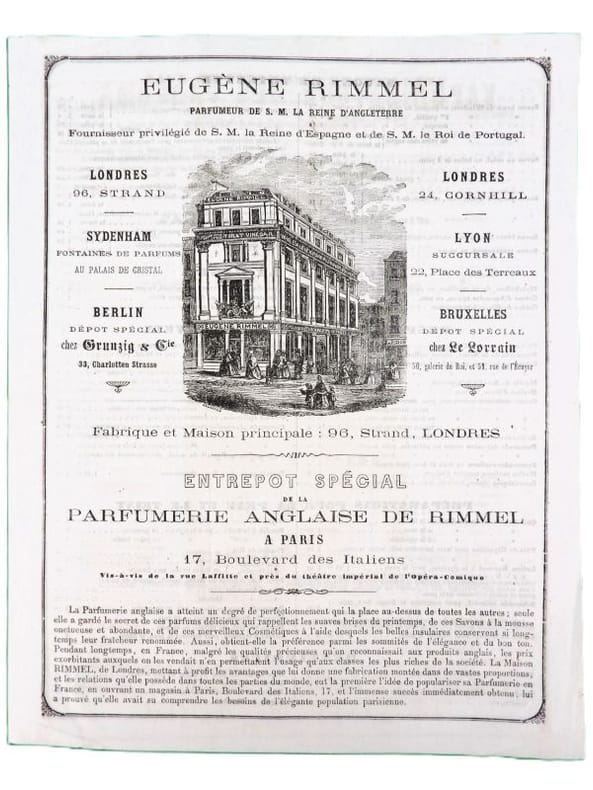
2767Paris, sans nom d'éditeur (Imprimerie A. Wittersheim), sans date (circa 1860-1875). 21,5 x 23,5 cm. 1 double feuillet. Rarissime prospectus commercial et publicitaire du célèbre parfumeur Eugène Rimmel, destiné à promouvoir cette maison d'excellence londonienne auprès de la clientèle française. Ce double feuillet a des allures de cours magistral de marketing appliqué au marché parisien du Second Empire, où un large éventail de techniques formelles (typographie, mise en page, illustration) sert un discours séducteur. En première page, Rimmel affiche d'abord ses prestigieuses références (les têtes couronnées d'Europe, en Angleterre, en Espagne et au Portugal) et la dimension internationale de son activité : il possède en effet deux adresses à Londres même, dont l'une sur le Strand, - l'imposant bâtiment abritant le siège social, la fabrique et le magasin fait d'ailleurs l'objet de la gravure centrale -, et une à Sydenham, ainsi que des dépôts ou succursales à Lyon, Bruxelles et Berlin ; suit un rappel en lettres majuscules, de son implantation géographique dans la capitale (17, boulevard des Italiens), fort opportune puisqu'à proximité de l'Opéra-Comique, que fréquentent assidument les élites ; enfin, un paragraphe d'une dizaine de lignes en petits caractères vante les mérites de la Parfumerie anglaise, à "un degré de perfectionnement qui la place au-dessus de toutes les autres" et pointe le rôle essentiel de la Maison Rimmel dans l'exportation de ce modèle et sa mise à disposition non seulement des plus aisés, mais de catégories sociales moins favorisées, formant toutefois "l'élégante population parisienne". Les deux pages centrales donnent à voir la diversité des productions de Rimmel : outre les parfums et les articles parfumés, sont présentés des produits d'hygiène (savons, dentifrices, préparations pour la peau et le teint), des accessoires de toilette (brosses, peignes, limes, épingles, ...) ainsi que des eaux florales et le fameux "vinaigre de toilette cosmétique et sanitaire", innovation spécifique de l'homme d'affaires. In-fine, la liste des 24 dépôts en province évoque un maillage relativement complet du territoire métropolitain à cette période. La dernière page est entièrement consacrée à la présentation du "vaporisateur des parfums", système breveté par Rimmel dans les années 1850, ancêtre en quelque sorte des diffuseurs de parfums ou désodorisants d'intérieur actuels. Là encore, en appui de l'illustration, se déploie un arsenal argumentaire qui vise à convaincre : appareils disponibles en 4 tailles, grand choix de senteurs florales, caractère "naturel" et sain de cette méthode de purification de l'air, efficacité garantie contre les odeurs culinaires, de tabac ou indésirables, transportabilité et simplicité du matériel (utilisable en voyage, à l'hôpital, au spectacle et dans les lieux de réunions...), rapidité d'action, prix accessibles, caution de savants réputés (chimistes, médecins, etc.), expérimentations jusqu'alors concluantes, si bien que cela "porte à croire que le Vaporisateur Rimmel deviendra d'un usage général aussitôt qu'il sera suffisamment connu".
London, Smith and Son, 1833, 26,5 x 17,5 cm., tela original, retrato + XX págs. + 1 hoja + 326 págs. + 1 hojas y 6 láminas grabadas. (Ejemplar intonso).
London, Smith and Son, 1837, 26'5 x 17'5 cm., tela original, retrato - LXV págs. - 1 h. - 486 págs. - 1 h. - carta facsímil plegada y 6 láminas grabadas. (Ejemplar intonso).
London, Smith and Son, 1835, 26'5 x 17'5 cm., tela original con leve desgarro en la parte superior del lomo, retrato - VII págs. - 1 h. - 573 págs. - 1 h. y 5 láminas grabadas. (Ejemplar intonso).
London, Smith and Son, 1829, 26'5 x 17'5 cm., tela original con desgarro en la parte superior del lomo, retrato - XXX págs. - 2 h. - 412 págs. y 6 láminas grabadas. (Ejemplar intonso. Este tomo I comprende noticias biográficas y obras de Gerard Doe, Peter Van Stingelandt, Francis Van Mieris. William Van Mieris, Adrian Ostade, Isaac Ostade y Philip Wouwermans).