[Latreille (Pierre-André ; 1762-1833)]Livre Rare Book
805 résultats
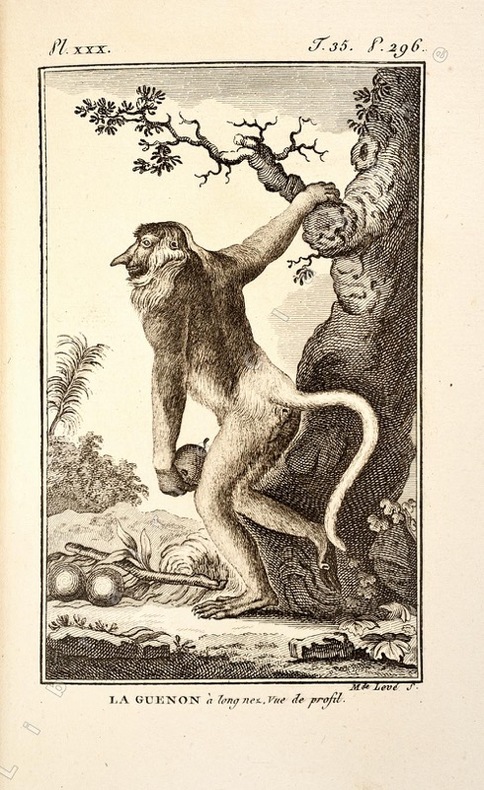
182421251Lyon, 1824 ; in-8, maroquin rouge à long grain, dos lisse à décor de grands losanges de filets pointillés, fleurons, semé de fleurettes, palette en queue, pièces vert-empire, large dentelle d’encadrement des plats, roulettes sur les coupes et d’intérieur, tranches dorées (reliure de l’époque) ; [2] ff. Faux-titre et titre sur papier vert clair, [8] ff. bl, LXXIX planches gravées, protégées par des serpentes, gravées par Voysard, Perée, Berthault, Bigant, Duhamel, Voyez, Jourdan, Miger, Mlle Levé, Cugnet, J. B. Racine, Hubert, Mme Vilain, Delignon, Philipau, d’après Barraband.
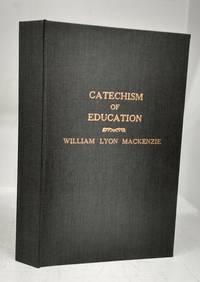
1830146901York Toronto: Colonial Advocate Press 1830. Very good. vi 46 p. 22 cm. Disbound pamphlet. Housed inside grey cloth solander box. Ink inscription at top of title bottom of title page cut off old tape mark at top. <br/><br/>William Lyon Mackenzie 1795 1861 journalist and politician is one Upper Canada's most recognizable historical figures. He represented York County in the Legislative Assembly of Upper Canada and was the first mayor of Toronto. At first aligned only with Reformers he became increasingly more radical eventualy leading the rebels in the Upper Canada Rebellion of 1837. Afterwards he fled to the United States but eventually the parliament of the Province of Canada granted him amnesty. After his return he represented the constituency of Haldimand County in the province's legislature from 1851 to 1858. <br /> <br />He published his first newspaper the Colonial Advocate in 1824 and continued to publish it weekly into the 1830s. Over its twelve years of publication Mackenzie explicitly advocated constitutional change for a responsible government that worked for the people. The Advocate was used as a voice for constitutional reform educating and inspiring citizens to take action against their government. <br /> <br />However besides a newspaper the Colonial Advocate Press published treatises such as this Catechism of Education. Mackenzie believed education should be available to everyone not just the elite so that everyone could benefit. "Political Education consists in a right understanding of the science of Government the business of which is to increase to the utmost the pleasues and diminish to the utmost the pains which men derive from one another ." p. 44. Most of each page consists of Annotations and Illustrations which support the author's views. These points make entertaining reading as they include quotations from sources as diverse as the 1st Annual Report 1829 of the Philadelphia House of Refuge p. 11 Wiliam Penn's letter to his family p. 24 John Locke p. 19 and the Book of Proverbs p. 5. Colonial Advocate Press hardcover
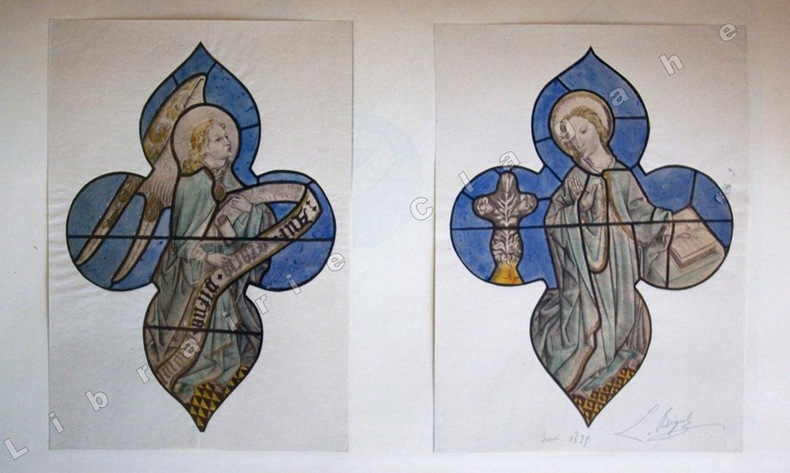
188017189Lyon, imprimerie Mougin-Rusand, 1880 ; in-folio, demi maroquin à coins rouge vif, dos à nerfs, fleurons et titre dorés, triple filet doré sur les plats, tête dorée, tranches juste ébarbées (Magnin) ; (4), VIII, 224 pp. , (1) f. d'imprimeur, et en tout : 29 hors-texte photographique ou au trait, tous en 2 états dont 19 en 3 états, dont celui avant la lettre ; 5H.T. en chomolithographie dont 1 en 2 états plus les 2 vitraux originaux aquarellés et signés L. Bégule 1879 ; suite de 27 figures en double état sur Chine ; ajoutés : 5 figures non utilisées tirées sur Chine, 2 photographies originales de calques de vitraux de la chapelle des Bourbons ; 3 photographies originales de la Nef et de l'horloge et 9 photographies diverses, toutes les photographies ont été tirées peu avant la parution de l'ouvrage.
188157971Tokyo, Nishimura Tomijiro, Fukuda Eizo, Meiji 21 [1881]. 8vo. In the original cloth binding with printed front board (depicting a monkey reading a newspaper). Light wear and soiling to extremities and end papers soiled, otherwise in fine condition. 285 pp. + 3 plates.
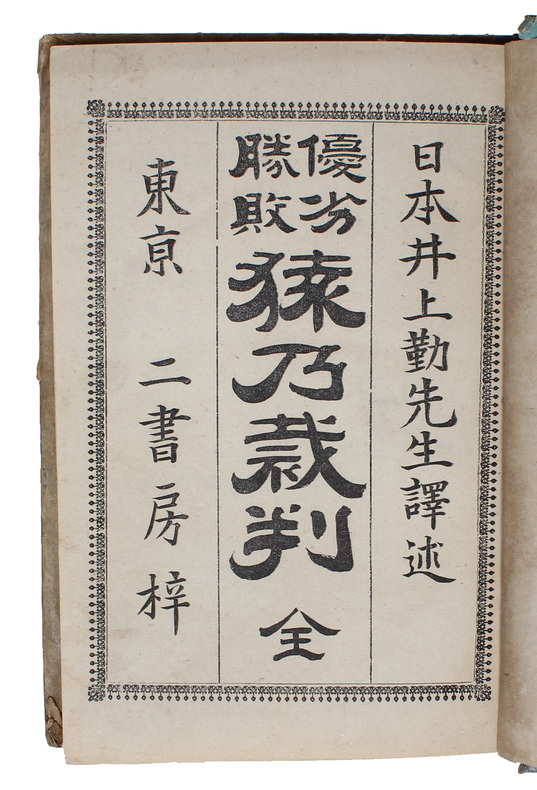
188157971Tokyo Nishimura Tomijiro Fukuda Eizo Meiji 21 1881. 8vo. In the original cloth binding with printed front board depicting a monkey reading a newspaper. Light wear and soiling to extremities and end papers soiled otherwise in fine condition. 285 pp. 3 plates. <br/><br/><em>The rare first Japanese translation of W. P. Lyon's anti-evolutionary text ' Homo versus Darwin'. It constitutes the very first publication in Japanese to reject Darwin's theory. A year after the publication the book was banned for 'corrupting public morals'.The present work is Lyon's reply to the publication of Darwin's The Descent of Man. Here he sees Darwin being charged by Homo of denying him from being a creature made by a God and declaring man to be merely some kind of animal. The author is recorded as being 'Eisa Gurei' Asa Gray but in 1986 a study confirmed the text to be a translation of Lyon's work.'Saru no Saiban' is an important work in the history of the reception of Darwinism in Japan. Darwin's theories had a profound influence on Japan and Japanese culture but in a slightly different way than in the West: Darwinism was marked as social and political principles primarily embraced by social thinkers philosophers and politicians to advocate the superiority of Japanese culture and society and military and not by biologists and zoologists. "It was as if Darwin's famous oceanic journey and the meticulous research into the animal and plant kingdoms that he spent his life undertaking had all been staged as an elaborate excuse for composing a theory whose true object was Victorian society and the fate of the world's modern nations." Golley Darwinism in Japan: The Birth of Ecology. </em> hardcover