Charles W. Domville-FifeLivre Rare Book
3 résultats
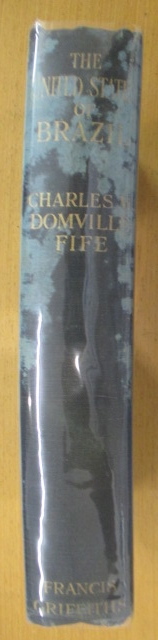
1910GEO131M1910 / 249 pages. Relié. Editions Francis Griffiths.
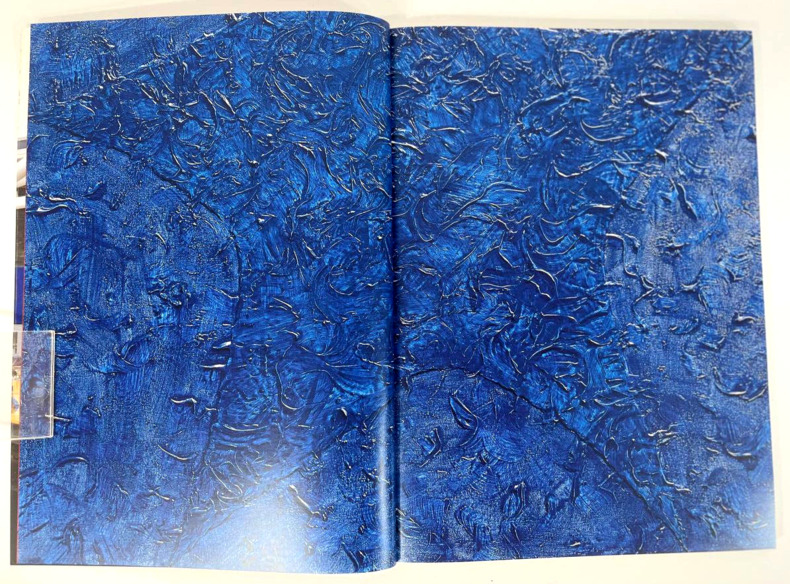
20150408São Paulo, Instituto Tomie Ohtake, 2015. Seule et unique édition. Émis à l'occasion d'une exposition d'avril à juin 2015, ce volume retrace la vie et l'oeuvre de l'artiste Tomie Ohtake, décédée la même année. Bilingue anglais et portugais, textes de Paulo Miyada et al., traduction d'Izabel Burbridge. Grand in-4 de 31 x 22,5 cm pour 104 pp. Broché avec plats à la Bradel. Couvertures colorées à rabats noirs. Imprimé sur papier couché. Toutes les oeuvres de exhibées lors de l'exposition, ainsi que quelques oeuvres exposées dans la résidence brutaliste Tomie Ohtake (nichée à Campo Belo, São Paulo) sont présentées avec légende et textes. Biographie de l'artiste en fin d'ouvrage. Née Tomie Nakakubo à Kyoto (1913), elle est arrivée au Brésil en 1936 pour rendre visite à son frère. Elle rencontra un ingénieur nippo-brésilien, Ushio Ohtake, qu'elle épousa et avec qui elle a eu deux fils. Le premier, Ruy, deviendra l'un des architectes les plus connus du Brésil, et plusieurs de ses maisons brutalistes serviront d'écrins aux oeuvres colorées de Tomie. ************************************ São Paulo, Instituto Tomie Ohtake, 2015. First and only edition. Issued for an exhibition from April to June 2015, this book exposes the life and work of the artist Tomie Ohtake, who died the same year. Bilingual English and Portuguese, texts by Paulo Miyada et al., translation by Izabel Burbridge. Large 4to of 31 x 22.5 cm for 104 pp. Paperback with Bradel covers. Colored covers with black flaps. Printed on coated paper. All the works exhibited during the exhibition, as well as some works exhibited in the brutalist Tomie Ohtake residence (nestled in Campo Belo, São Paulo) are presented with captions and texts. Biography of the artist at the end of the book. Born Tomie Nakakubo in Kyoto (1913), she arrived in Brazil in 1936 to visit her brother. She met a Japanese-Brazilian engineer, Ushio Ohtake, whom she married and with whom she had two sons. The first, Ruy, would become one of Brazil's best-known architects, and several of his brutalist houses would serve as settings for Tomie's colorful works.
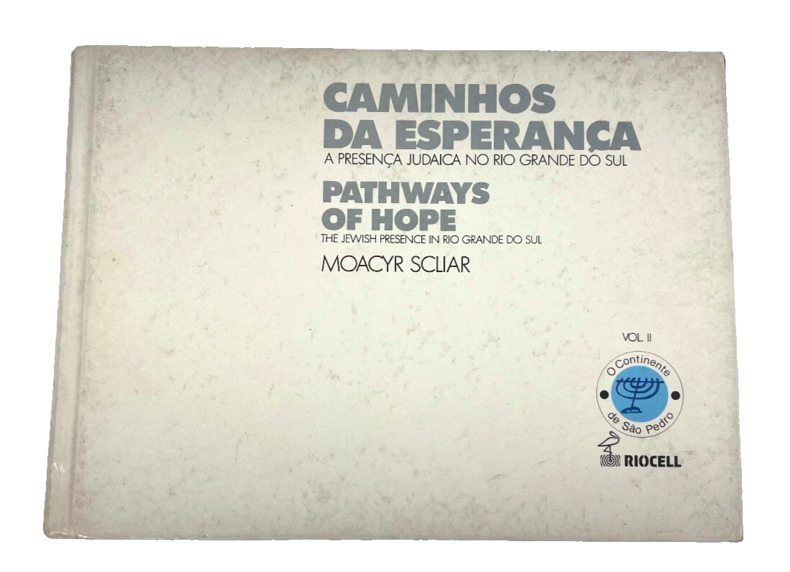
19900485Porto Alegre, Gráfica Editora Pallotti, no date [circa 1990]. First and only edition. Bilingual text, English and Portuguese. SIGNED by author on free endpaper: "Para Jayme Albek, o abraço do MOACYR. Maio, 1991" (For Jayme Albek, with a hug from Moacyr, May 1991) An oblong hardcover book of 297 x 217 mm and 120 pp. Widely illustrated with archive black & white photos, along with a few colored maps and drawings. Co-edited by the Instituto Judaico Marc Chagall, with a foreword of the president of the Institute Evelyn Berg. The book recalls the difficult arrival and settlement of Eastern European Jews, by the beginning and middle of the twentieth century, in the most southern state of Brazil. The author, Moacyr Jaime Scliar (1937-2011), spent most of his life in Porto Alegre. He worked as a physician and university professor while also constantly researching and churning literature: short stories, novels, essays, children's literature and some columns in several Brazilian newspapers. ********************************************** Porto Alegre, Gráfica Editora Pallotti, sem data [circa 1990]. Primeira e única edição. Texto bilíngue inglês e português. ASSINADO pelo autor em folha de guarda livre: "Para Jayme Albek, o abraço do MOACYR. Maio, 1991" Livro oblongo de capa dura, 297 x 217 mm, 120 páginas. Amplamente ilustrado com fotos em preto e branco de arquivo, além de alguns mapas e desenhos coloridos. Coeditado pelo Instituto Judaico Marc Chagall, com prefácio da presidente do Instituto, Evelyn Berg. O livro conta a difícil chegada e fixação de judeus do Leste Europeu, no início e meados do século XX, no estado mais ao sul do Brasil. O autor, Moacyr Jaime Scliar (1937-2011), passou a maior parte de sua vida em Porto Alegre. Trabalhou como médico e professor universitário, além de pesquisar e produzir constantemente literatura: contos, romances, ensaios, literatura infantil e algumas colunas em diversos jornais brasileiros.