2 371 résultats
86574Paris, L'Harmattan, 1995. 13 x 21, 2 volumes, 200 + 187 pages, broché, très bon état.
45380Paris, Actes Sud, 1998. "15 x 21, 317 pp., 38 illustrations en couleurs et en N/B, broché, état moyen(mouillures au bas des dernières pages; 1 pliure au dos)"
1911239LONDON. SAMPSON LOW, MARSTON AND CO. 1911. FORT IN-8 DE XII + 504 PAGES, RELIURE DE L'EDITEUR PLEINE PERCALINE BLEUE, TITRE DORE SUR DOS LISSE ET SUR LE PLAT SUPERIEUR. ILLUSTRE D'UNE CARTE REPLIEE ET DE 52 PLANCHES HORS-TEXTE, DONT 51 DE PHOTOGRAPHIES EN NOIR. (CARTHAGE. TIMGAD. BLIDAH. CHERCHEL. TEBESSA. TUNIS. ALGER. CONSTANTINE. BISKRA....). PETITS DEFAUTS EXTERIEURS SANS GRAVITE, SINON BON EXEMPLAIRE.
11124Paris Editions Maisonneuve & Larose 1990 in 8 (24x16) 1 volume broché, couverture illustrée à rabats, 227 pages [1]. La société et la religion. L'enfance; L'adolescence; La femme; La femme enceinte; La femme meurtrie. Sources et abréviations; Glossaire; Bibliographie. Collection ''Judaïsme en terre d'Islam'', 6. Etat de neuf
193727779Schildhorn / Berlin 1937. 147 S. : mit Abb. ; gr. 8°, Schrift: Fraktur / Altdeutsche Schrift, ohne Schutzumschlag, Eigentümersignatur auf Titelblatt Lw., gebundene Ausgabe, Halbleinen, Exemplar in gutem Erhaltungszustand
208335Aïn-Sefra, 17 octobre 1901 in-4, [7] ff. n. ch., couverts d'une écriture moyenne, soignée et très lisible (environ 30 lignes par page), en feuilles.
2007203933Couverture souple. Broché. 275 pages. Couverture légèrement défraîchie.
Very Good English Paperback. Pbo. 4to. (27 x 21 cm). In French and Arabic. 331, [6] p. Many color and b/w ills. 30 ans au service du Patrimoine. XXVIII Centenaire de Carthage: De la Carthage des Pheniciens a la Carthage de Bourguiba. 18 Octobre 1986 - 18 Octobre 1987 Annee du Patrimoine.
188031S.l., in-8, pagination multiple, sous agrafe.
29122Levallois Paris H. & J. Tourte 1909 in 8 oblong (19,5x27,5) 1 fascicule broché, couverture illustrée, non paginé, 34 pages de photographies de gradés et de groupe des différents bataillons, avec une liste nominative in fine des officiers présent en Algérie le 1er avril 1909 (Etat-Major et des 4 bataillons, quelques rousseurs. Bon exemplaire ( Photographies sur demande / We can send pictures of this book on simple request )
243185Paris, Flammarion, 1962 in-12, un feuillet de prière d'insérer, 220 pp., un f. n. ch., toile grège, dos lisse, pièce de titre cerise, tranches mouchetées, couverture et dos conservés (reliure de l'époque). Des mouillures claires, traces d'humidité à la fin du second texte.
19951134361995 Edition de la Fondation Wafabank / Espace Wafabank, Casablanca - 1995 - In-4, cartonnage toilé vert avec titre en doré sur le premier plat, sous jaquette illustrée de l'éditeur - 51 + 13 pages - Nombreuses illustrations et reproductions photographiques en couleurs hors texte - Textes en français et en arabe
Broch?. 92 pages + publicit?s. Petite mouillure en marge.
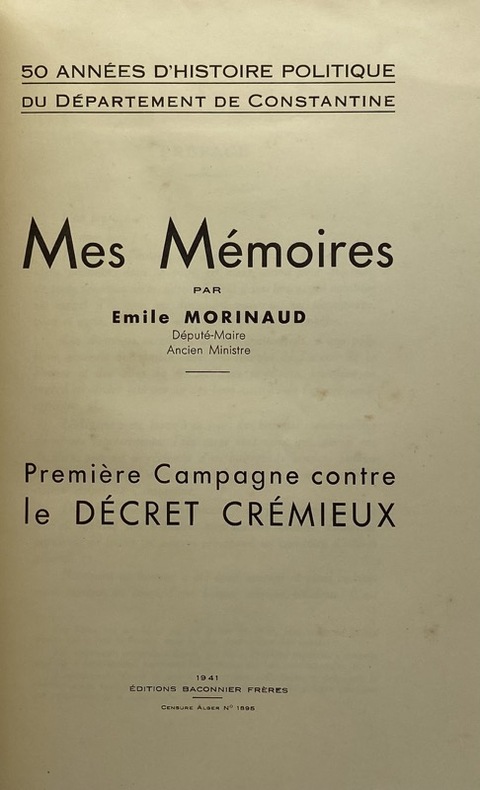
232372Alger, Editions Baconnier Frères, 1941 gr. in-8, 382 pp., portraits in-t. à pleine page, demi-chagrin beige à coins, dos à nerfs, couverture et dos conservés (reliure de l'époque). Dos passé. Bon exemplaire.
234781Tourcoing, Amicale des anciens du 6ème régiment de tirailleurs marocains, 1999 in-4, VI-317 pp., ill. in et h.-t., cartes et plans dépliants, broché.
Very Good Arabic Original autograph document/letter sealed by Ahmad I of Tunisia. 54x42 cm. 1 p. 6 long lines. The letter includes full of poetic praise. It must be sent after successful diplomatic intercourse with Naples. Ferdinand II (Ferdinando Carlo) was King of the Two Sicilies from 1830 until his early death in 1859. It starts with 'Thank God alone', and goes on 'From poor Ahmad Pasha to Lord Almighty Field Marshal Amîr [ruler]. Sealed by the seal of Ahmad Basha Beg including an impressive qasidah in Arabic. Ahmed I (ibn Mustafa), born 2 December 1805 in Tunis died May 1855 at La Goulette, was the tenth Husainid Bey of Tunis, ruling from 1837 until his death. He was responsible for the abolition of slavery in Tunisia in 1846. He succeeded his father Mustafa Bey on 10 October 1837. He had grand ambitions - to expand his army and create a modern navy; to build a new royal residence, a mint and modern institutions of education but neither he nor his brother-in-law the young Mustapha Khaznadar who served as his finance minister, had a clear idea of what such initiatives would cost. As a result, many of his projects became expensive failures which damaged the financial health of the country. Soon after his accession, Ahmad Bey received the traditional Firman from the Sublime Porte which formally invested him with authority to rule from the Ottoman Empire and furnished him with the insignia of office. The Ottoman envoy, Osman Bey, arrived in la Goulette on 15 May 1838 onboard a frigate. The following day, Osman Bey made his official entry into Tunis on horseback, preceded by all the ministers of the beylical cabinet who went before him until he was two leagues from the city. Before he were carried the sword of honor and the caftan to be presented to the Bey. He was escorted by spahis and followed by a large contingent of regular troops an Arab cavalry. Three days after his official entry into the city, the envoy presented himself at the Bardo Palace to formally invest Ahmad Bey with his insignia of office and present gifts. Named as a Divisional General in the Ottoman army in May 1838, he was later promoted by the Sultan to the rank of Marshal on 14 August 1840. This was the first time that a Bey of Tunis had held a rank higher than Divisional General. The purpose of these honors was to emphasize the supremacy of the Ottoman Empire over the Regency of Tunis. Under a treaty with France signed in 1830 by Hussein Bey, a piece of land in Carthage had been ceded to allow the erection of a monument to Louis IX of France who had died there during the Eighth Crusade. On 25 August 1840, the first stone was laid in the cathedral of Carthage. Ahmad Bey also permitted the Christian community of Tunis, consisting mainly of European merchants, to enlarge their small church near the Bab el Bhar. In June and July 1846 the Duke of Montpensier, son of King Louis Philippe of France visited Tunis and Carthage. He was received with great solemnity by Ahmad Bey. According to the Tunisian historian Mohamed Bayram V, Bey's reforms were focused on state structures, the army, and education. He established a modern structure of government and gave his high officials the title of 'minister'. His senior ministers were his Grand Vizier Mustafa Sahib at-Taba'a, Mustapha Khaznadar, Minister of Finance and of the Interior, Mustafa Agha as Minister of War, Mahmoud Khodja as Minister of the Navy and Giuseppe Raffo as Foreign Minister. At certain times Mahmoud Ben Ayed also served as Trade Minister, Kuchuk Muhammad in the honorific post of Minister in charge of the security home of Ahmad Bey's reforms wasted money, such as the large frigate built at La Goulette that could not make it through the channel to the sea. of Tunis and Mohamed Lasram IV as Minister of the Pen. The historian Ibn Abi Dhiaf was the Bey's private secretary. Among Ahmad Bey's successes may be counted as the abolition of slavery in January 1846. To this may be added the formation of the military academy at...
225721Bône [Annaba], 3 juin 1865 2 pièces, in-4 et in-8, en feuilles.
Very Good Turkish, Ottoman (1500-1928) Original wrappers. Cr. 8vo. (20 x 14 cm). In Ottoman script (Old Turkish with Arabic letters). 15 p., b/w portrait of Charles Darwin, (1809-1882) on front cover. Taken from a volume including multiple booklets. Minor wear on spine. Small tear on pages' extremities. Slightly faded on pages. Otherwise a good copy. First and only edition of the first Darwin biography in the Ottoman / Turkish world. "Büyük Adamlar Serisi" [i.e. The "Big Men" series], consisting of about 41 small books, all of which were published in 1927, by a delegation under the presidency of the body and some of which were written by him personally, filled an important gap on 'biography' field in its period. This delegation includes Ali Resat, Tezer Agaoglu, Galip Ata Ataç besides Gövsa. This small book is the first and ever biography of Darwin in Ottoman literature. Gövsa was an Ottoman / Turkish writer and poet who is known for his biography and encyclopedia studies. Extremely rare. Özege 3636.; Not in OCLC.
Very Good Turkish, Ottoman (1500-1928) Contemporary fine dark green cloth bdg. Art-nouveau decorations embossed on boards. Roy. 8vo. (24 x 17 cm). In Ottoman script. 734, [2], [1] p., index. The Scopes trial (1925) fuelled discussion in the United States on the social and political implications of Darwinism. For the defenders of the 1925 Tennessee law - which prohibited the teaching of Darwinism in schools - Darwinism was, amongst other things, responsible for the German militarism which eventually led to the First World War. This view was supported by Ismail Fennî, a late Ottoman intellectual, who authored this book immediately after the trial which aimed to debunk scientific materialism. In it, he claimed that Darwinism blurred the distinction between man and beast and thus destroyed the foundations of morality. However, despite his anti-Darwinist stance, Ismail Fennî argued against laws forbidding the teaching of Darwinism in schools and emphasized that even false theories contributed to the scientific improvement. Indeed, because of his belief in science, he claimed that Muslims should not reject Darwinism if it were supported by future scientific evidence. It is composed of 7+1 chapters to criticize the materialist and positivist philosophical movements and especially the work of the positivist German philosopher Ludwig Bücher 'Kraft und Stoff'. The first part of the book focuses on the evidence presented of the proof of god in the Western and Islamic philosophies. In the second chapter, the issue of immortality of soul and spirit is addressed. In the third chapter, 'the wahdat al-wujud' (vahdet-i vücûd) current is examined. The fourth chapter, examined some famous scholars' thoughts about the matter, materialism, laws of nature, etc. In the fifth chapter, the work of the positivist German philosopher Büchner 'Kraft und Stoff', in the sixth chapter, monism (monism), in the seventh ch. positivism is criticized. In the last ch., there are descriptions and some thoughts on the theory of evolution and the Indian fakirs (fakers). Ismail Fenni Ertugrul was a Turkish mystic, philosopher, writer, musician, lyricist, and composer. He studied traditional madrasah education and learned Arabic and Persian. He was in various state posts. After the retirement, he began to be interested in poetry, music, and philosophy. Before his death, he donated his library including 9050 books to the Library of Beyazit. (Source: An Ottoman response to Darwinism: Ismail Fennî on Islam and evolution, Bilgili). First and Only Edition. Extremely rare. Özege 11879. Alper 195.
233598Paris et Constantine, 1859 - 1872 8 pièces in-4 ou in-8, brochées.
Very Good Greek, Modern (post 1453) Original b/w city map of Byzantine Constantinople printed in 1936, Noemvrios (November). Oblong: 32x46 cm. In Greek (Modern). Folded. Scale: 1:2000. [GREEK MAP of BYZANTINE CONSTANTINOPLE] Byzantion Konstantinoupolis: To petrion kai ta peristh autou. Khartis topographikos - arkhaiologikos ikpointheis kai katartistheis upo Misn. It show Haliç (The Golden Horn) section and shores of Constantinople.
Very Good Arabic Original wrappers. Roy. 8vo. (24 x 17 cm). In Arabic. 50 p., b/w plates. First edition of this rare excerpt book to "Masâlik al-absâr fi mamâlik al- amsâr" by Arab-Mamluk statesman, geographer and historian Shihâb al-Dîn Ah?mad ibn Yahyâ al-'Umarî al-ma'rûf bi-Ibn Fadl Allâh al-Kâtib al-Dimashqî, (1301-1349). "Masâlik al-absâr fi mamâlik al- amsâr" is an account of the Mohammedan kingdoms of the west, excluding Egypt, by Shihâb al-Dîn, who was descended from an old Arab family. The countries described in the book are Abyssinia, Kanem, Nubia, Mali, the Kingdom of the Berber mountains, Ifriqiya, Morocco, and Andalusia. This rare pamphlet includes North Africa (Maghreb) and Andalusia sections of Shihâb al-Dîn's book with a commentary by Al-Wahhâb. Al-Wahhâb was a polygraph and scholar born into a family of dignitaries and high officials of the Tunisian state. OCLC 78694883, 235966687, 863484408.
Very Good Italian Original leaflet printed for Italian students. 20,5 x 14,5 cm. (Open size: 20,5 x 28 cm). In Italian. Two illustrations from Borghi's illustrations. Includes inside 'Orario settimanale delle lezioni' [i.e. Weekly timetable of lessons] and 'Tavola Pitagorica' [i.e. Pythagorean table]. A transparent tape on folded place. Unused. Written nothing on the section of 'Quaderno di...'. [ITALIAN PROPAGANDA / TRIPOLI / PAPER] Print leaflet for students: Guerra Italo-Turca. [i.e. Italian-Turkish War in Tripoli]. Guerra Italo-Turca: Piccola battaglia nell'oasi di Tripoli fra una pattuglia del 84 fanteria ed un'orda di arabi.
Very Good Turkish, Ottoman (1500-1928) Original color map on cloth. Folded. Wrinkled on paper. Stains on cloth. 12 sheets on paper. Oblong atlas folio. (50 x 60 cm). In Ottoman script.[MAP of ALEXANDRETTA] Iskenderun - Tayakadin. It shows villages and settlements in Tayakadin of Iskenderiye. Scale: 1/25.000. Hegira: 1329 = Gregorian: 1913. This is one the serie of the Bonn projection maps which are the first map series in modern techniques in Turkey and the Ottoman Empire. In order to produce these maps covering Turkish territory, Reconnaissance Branch was incorporated into The Mapping Commission. The maps were produced in the datum based on the latitude and longitude of Ayasofya Mosque in equal area Bonn Projection. The field works for the 123 sheets covering the country were conducted by 76 staff. The production was completed in 18 years starting from east west. Field works continued without stopping except in years 1914 and 1920. This map series called also reconnaissance maps contributed a lot to producing 1:25.000 scale maps. Not description on map-maker. A very detailed map. Extremely rare.