Van Gaasbeek, Richard M.MareMagnum

64 résultats
238 pages. Index. Extensively illustrated with black and white photos and diagrams. Charts and tables. A wartime text "especially written for carpenters and other woodworkers who desire to engage in boat or ship building, and as a textbook for schools." - subtitle. Amazingly, a prior owner has neatly handwritten over twenty pages of pertinent notes on and near front and back endpaper! Some additional markings to contents. Binding intact. Somewhat above-average external wear. A sound vintage copy. Book
Full Title: "ELEMENTARY PRINCIPLES OF CARPENTRY. A Treatise on the Pressure and Equilibrium of Timber Framing, the Resistance of Timber, and the Construction of Floors, Centres, Bridges, Roofs; Uniting Iron and Stone with Timber, etc. To Which is Added an Essay on the Nature and Properties of Timber. 4th Edition, Corrected and Considerably Enlarged. With an Appendix Containing Specimens of Various Ancient and Modern Roofs, by Peter Barlow." pp. xxiv, 333 + Fifty-three (53) engraved plates [as called for], some folding. Old age stain. Partially unopened. Small folio. Original full cloth binding, embossed in blind. Thomas Tredgold (1788-1829) was an important English architect and engineer. In 1813 he joined William Atkinson, architect to the ordnance in London, and in 1823 went into private practice as a civil engineer. These 'Elementary Principles of Carpentry' were first published in 1820. He also wrote 'Strength of Cast Iron' (1821), and 'The Steam Engine' (1827). Scarce and significant. **PRICE JUST REDUCED! W150 / DC
First Edition, 4to, xx,250,[2]pp., without half-title, 22 engraved plates (3 double-page), some light spotting to text and plates, orig. cloth, a little faded. The rare first edition of a work that was continually reprinted and updated throughout the 19th and well into the 20th centuries.
Pages well browned. No other marks or inscriptions. No creasing to covers or to spine. A clean tight copy with dull lightly marked boards, sunned spine and slight bumping/rubbing to corners. 272pp.
Pages slightly browned. No other marks or inscriptions. No creasing to covers or to spine. A clean tight copy with dull lightly marked boards, sunned and rubbedspine and slight rubbing to corners. 240 + 140 + 20pp. January to December 1953, January to July 1954, August 1958.
No marks or inscriptions. No creasing to covers or to spine. A very clean very tight copy with unmarked very slightly rubbed faux leather boards and no bumping to corners. 671pp. How to make so many things. Crafts, skills, with timber, electrics, decorating, a rabbit hutch, repairing a lawn mower and so much more. Undated ca 1950s.
19922090502130200525Takenaka Carpentry Tools Museum 1992. Soft Cover. Fine. Number of pages: 192p Size: 30cm Number of books: 1 Takenaka Carpentry Tools Museum paperback
19892083002115708031Takenaka Carpentry Tools Museum 1989. Soft Cover. Fine. Number of pages: 69p Size: 26cm Number of books: 1 Takenaka Carpentry Tools Museum paperback
19942091502135421570Takenaka Carpentry Tools Museum 1994. Soft Cover. Fine. Number of books: 1 Takenaka Carpentry Tools Museum paperback
79 p., illus. Paperback Very good condition
95 p., illus. Paperback Very good condition
96 p., illus. Paperback Very good condition
1993EEzz6956Mchn., Bangert (1993). 4°, 256 S., mit 365, meist farb. Abb., OPp. m. farb. OU.
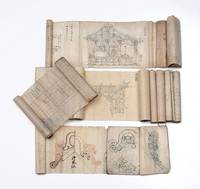
11074Hundreds of drawings & some text. Nine scrolls all roughly 260 x 4500 mm. & one notebook. Japan: late Edo.<br /> <BR> <BR> Japanese shrines and temples require constant maintenance restoration and rebuilding. These nine scrolls and one notebook are concerned with the architectural aesthetics of shrines and temples and the highly specialized construction techniques used to construct them including the complex joinery methods which did not require the use of nails glue or fasteners. As constant reminders in the texts in the scrolls tell us the crafts illustrated here were to be carefully guarded and passed on to future generations in great secrecy. Apprenticeships could last as long as ten years. Some of the master joiners are named.<br /> <BR> <BR> The drawings in the scrolls are exceptionally detailed oftentimes in extreme close-up depictions showing many of the methods of joining the desired proportions accompanied by measurements names of individual parts of the materials used in construction and the problems in building and maintaining a shrine or temple.<br /> <BR> <BR> These nine scrolls contain hundreds of drawings of plans for all aspects of shrines and temples; each is focused on a different topic. These include the many varieties of traditional shrine gates torii 鳥居 oftentimes with measurements references to known gates and their creators and idealized gates with ratios. There are also examples and styles of hafu ç ´é¢¨ decorative bargeboards or gable end boards including kara hafu undulating or cusped gables irimoya hip-and-gable and mukuri hafu curved gables.<br /> <BR> <BR> The concept of kiwari 木割 the proportional system used to determine the dimensions of building components based on their relationship to other components is also discussed in one of the scrolls along with the methods of measuring and cutting wood to achieve a harmonious structure.<br /> <BR> <BR> Many drawings also illustrate the components of taruki 垂木 rafters used to help support a roof in traditional Japanese wooden construction.<br /> <BR> <BR> One scroll illustrates an idealized temple building with succeeding detailed drawings of its components measurements and ratios along with many illustrations of ornaments. Other scrolls are concerned with the ornamental aspects of shrines and temples all illustrated in great detail again with measurements and ratios.<br /> <BR> <BR> One scroll deals with decorative windows screens wooden sliding doors and shelves in many styles.<br /> <BR> <BR> Another scroll discusses and illustrates a NÅh performing stage and ancillary buildings constructed in August 1774 for Matsudaira Chikuzen no kami in Kaga fiefdom.<br /> <BR> <BR> These nine scrolls are accompanied by a manuscript notebook 37 leaves 8vo 247 x 173 mm. which discusses and illustrates gegyo æ‡¸éš decorative wooden boards or pendants traditionally attached under the roof gables found on Shinto shrines Buddhist temples and castles.<br /> <BR> <BR> At the ends of four scrolls it is indicated that they were copied in 1811 and 1819.<br /> <BR> <BR> In fine condition; all preserved in an old wooden box. unknown
19363509New York: W. W. Norton & Company 1936. First edition. Hardcover. Good/good. 8vo 284 pages cloth; dj worn punctured; ex libris Alfred J. Link. <br/><br/>Signed by Sherwood on the title-page. Photograuvres map endpapers. "A man who knows woods from all angles tells the world story of 60 best known woods. History -- origins -- uses -- anecdotes of people connected with wood -- description of manufacturing processes of wood substitutes their use and value. Important book for anyone in any branch of the industry - Kirkus Reviews." Sherwood was from LaPorte Indiana. This is the only print edition of this work. W. W. Norton & Company hardcover
213 pages. Index. Black and white illustrations. "Here is the complete, step-by-step illustrated information to help you make perfect joints every time." - from back cover. Book
History of the Sanders family from 17thC Essex to 20thC Bethnal Green. Illustrated. 230 pages. Index. Illustrated. Dedication from author on half-title page.
A clean, unmarked book with a tight bindin. Full brown cloth boards. 146 pages. Black and white photographs. "The reminiscences recorded in this book are nearly all those of our old carpentry business prior to my grandfather's death in the year 1893."
No marks or inscriptions. A very clean very tight copy with bright unmarked boards and no bumping to corners. Dust jacket not price clipped or marked or torn or creased with very tiny rub to front. 199pp. This book studies the style of furniture rather than minutiae, with changes in construction and design which followed from new techniques. With over 100 photographs and many line-drawings.
698p. + Index. Illustrated with numerous photographs and drawings. 4to. Original full cloth binding. Original dust jacket, worn at extremities. Hardbound. ARCH BOX 2
551p., illus. Hardcover Very good condition good
Fourth edition, revised and corrected by the author, 4to, [20]pp., signatures: [A]-K4, each leaf of letterpress has its own signature and many of the rectos are blank, 83 engraved plates, text and plates age toned, title page creased, fore-edge a little frayed and repaired with archival paper, some light water staining and foxing throughout, recent half calf in a period style, marbled boards, five raised bands, spine decorated in blind and gilt, red morocco title label. Bound in at the back is a folio sheet: A Catalogue of Modern Books on Architecture, &c. Theoretical, practical, and ornamental; which, with the best Ancient Authors, are constantly on sale at I. and J. Taylor's Architectural Library, no. 56, High Holborn, London. [London, s.n., 1788?]. folio, [2]pp., 57 items listed, inner margin repaired with archival paper with the loss of several words, ESTC no. T121354. Archer, 240.4; Harris, 643; ESTC returns a single copy located at the Staatsbibliothek zu Berlin for this fourth revised edition.
First edition, 4to (270 x 215 mm), 5, [11]pp., with the final advert leaf, [20]pp., 83 engraved plates (the contents of which are well represented in the title), some light foxing throughout, some minor worming to upper blank margin of first few leaves, recent calf calf, red morocco label to spine. Archer, 240.1; Harris, 640.
33568Turnhout, Brepols, 2010 Paperback, 376 p., 220 x 280 mm. ISBN 9782503529875.
1995EEzz6962Mchn., Bangert (1995). 4°, 255(1) S., mit zahlr., meist farb. Abb., OPp. m. farb. OU.