[Robert Seaton] [Masonry]Biblio.com
209 résultats
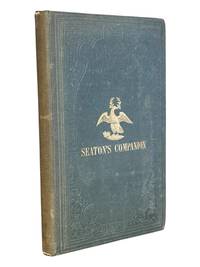
18538821New York: Baker & Godwin 1853. First American edition. 8vo 154pp. Brown blind stamped cloth gilt titling and decoration on front cover spine faded edges worn smudged pages foxed. Ownership of Samuel M. Todd Grandmaster of the state of Louisiana to ffep. Very good. Baker & Godwin unknown
Very Good Turkish Paperback. Demy 8vo. (21 x 15 cm). In Turkish. 191, [1] p., 1 folded huge map (39x75 cm). Tatbikî jeoloji I: Jeolojik harta [sic. harita] alma usulleri. Enver Necdet Egeran was born in Cyprus in 1907. He, High school education in Cyprus, High Mining Engineering in Turkey, the Mineral and Petroleum Geology High Engineering and PhD in the same subject, completed in France. He was sent to France by Mustafa Kemal Atatürk. He served in the bureaucracy for 25 years, led the Mining and Petroleum exploration and made the first oil available in Raman. After retiring from the state, after being the General Manager of an American oil company for 12 years, he managed his own consulting company for 23 years. Rare. Only one copy in OCLC 850735753 (Istanbul Technical University).
Very Good Turkish, Ottoman (1500-1928) Original 1/3 black leather bdg. raised bands to gilded spine 'Usak Askerî Kulübü, the title of the book, and ornamental designs in the compartments. Crescent and star embossing on front board, Imperial Ottoman sign on the backboard. A fine binding. Marbled endpapers in western style. Light wear on spine, fading on boards, ex-owner's inscription on the colophon, and some notes and seal by Usak Askerî Klübü. Sealed by "Ittihat ve Terakki Cemiyeti Usak Kazasi Kulüp Heyeti Idaresi: Uhuvvet - Hürriyet - Musavat" [i.e. Union and Progress Society Usak City Club Directorate: Brotherhood - Freedom - Equality]. Signed and inscribed by Ahmed Saib as 'Usak Askeri Klübü'ne hediye-i acîzânemdir. Vatanimizi kanimiz ile muhafaza ediniz'. Seal is produced in 'July 20, 1908'. Ahmed Saib was born in 1859 in Dagestan. After completing his education in military schools in the Russian Empire, he entered the service of the Ottoman Empire with the rank of captain. He was in the Sultan Abdulhamid II's Hassa Cavalry Regiment and under the aide of Gazi Ahmed Muhtar Pasha, the Extraordinary Commissioner of Egypt. Later, he left his military service and published the newspaper Sancak (1899-1907), which spread the ideas of Ottoman liberals against the tyranny of the sultan since 1899 in Egypt, in the city of Cairo, and included articles on the constitutional struggle and the political structure of the period. Murad V was the 33rd Sultan of the Ottoman Empire who reigned from 30 May to 31 August 1876. The question of Sultan Murad V's enthronement in 1876 was a very strategic move for the Young Turks in its period. Only three copies in OCLC: 427392804.; Özege 19913. First and Only Edition. Extremely rare.
Very Good Turkish, Ottoman (1500-1928) Original manuscript on freemasonry. 28x21 cm. In Ottoman script (Turkish with Arabic letters). 3 p. Chipped on margins, folded. Otherwise a very good manuscript. Written on a paper watermarked "Labor: Extra Strong Bank". It includes "How should a Mason be and act?", it gives some hints on the last Ottoman Freemasonry. The history of Freemasonry in Turkey stretches back to the 18th century under Ottoman imperial rule. The first lodge in Turkey was probably established around 1721 in Istanbul by Levantines. Although Freemasonry in Turkey can be traced into the 18th century, for much of that time it was limited to lodges under the jurisdiction of foreign grand lodges, and there was no independent Turkish Grand Lodge. This changed in 1856 when the first Turkish Grand Lodge was established. Sultan Murad V was a member of the lodge, becoming the first and only Ottoman sultan to join. This first Grand Lodge was banned in 1876 by Murad's successor Sultan Abdulhamit Han. The Grand Lodge came back in 1909 in Istanbul under a new administration. Because the Grand Lodge was used to operate in secret, it was closed again in 1922, only to be opened in the year 1925 again. In 1935 the Grand Lodge has closed again. As a result of the repeated closures, the former Grand Lodge and its members were reluctant to support Kemal Atatürk's reformist policies. (Source: Wikipedia). No information about Dr. Nami.
Very Good Turkish Original b/w folded geological map of Ramandag oil field / area in Mardin and Batman. Oblong folio. (38 x 59 cm). Legends in Turkish; bilingual title in English and Turkish. It shows Raman oil field in Mardin and Batman cities of Southeast Anatolia, and Dicle River (Tigris). on south. Rare.
Very Good Greek, Modern (post 1453) Contemporary fine leather bdg. Demy 8vo. (22 x 15 cm). In Greek. 1118 p., richly illustrated (b/w ills.). Period bindery label of E. Watson in London. Ex-library copy on fourth blank page. Otherwise a very good copy. First and extremely rare translation into Greek of Taxil's 'Myste`res de la Franc-Mac?onnerie'. Mysteries of Freemasonry. Marie Joseph Gabriel Antoine Jogand-Pagès, better known by the pen name Léo Taxil was a French writer and journalist who became known for his strong anti-Catholic and anti-clerical views. He is also known for the Taxil hoax, a spurious expose of Freemasonry and the Roman Catholic Church's opposition to it. Marie Joseph Gabriel Antoine Jogand-Pagès was born in Marseille, and at the age of five, he was placed into a Jesuit seminary. After spending his childhood years in the seminary, he became disillusioned with the Catholic faith and began to see the religious ideology as socially harmful. Taxil first became known for writing anti-Clerical or anti-Catholic books, notably "La Bible amusante" (The Amusing Bible) and "La Vie de Jesus" (The Life of Jesus), in which Taxil satirically pointed out inconsistencies, errors, and false beliefs presented in these religious works. In his other books Les Debauches d'un confesseur (with Karl Milo), Les Pornographes sacrés: la confession et les confesseurs, and Les Maîtresses du Pape, Taxil portrays leaders of the Catholic Church as hedonistic creatures exploring their fetishes in the manner of the Marquis de Sade. In 1879, he was tried at the Seine Assizes for writing a pamphlet A Bas la Calotte ("Down with the Cloth"), which was accused of insulting a religion recognized by the state, but he was acquitted. In 1885, he professed conversion to Catholicism, was solemnly received into the church, and renounced his earlier works. In the 1890s, he wrote a series of pamphlets and books denouncing Freemasonry, charging their lodges with worshiping the devil and alleging that Diana Vaughan had written for him her confessions of the Satanic "Palladist" cult. The book had great sales among Catholics, although Diana Vaughan never appeared in public. In 1892, Taxil also began to publish a paper, La France chrétienne anti-maçonnique (Christian Antimasonic France), with his staunch anti-Masonic publishing friend, Abel Clarin de la Rive. In 1887, he had an audience with Pope Leo XIII, who rebuked the bishop of Charleston for denouncing the anti-Masonic confessions as a fraud and, in 1896, sent his blessing to an anti-Masonic Congress of Trent. Doubts about Vaughan's veracity and even her existence began to grow, and finally, Taxil promised to produce her at a lecture to be delivered by him on 19 April 1897. To the amazement of the audience (which included a number of priests), he announced that Diana was one of a series of hoaxes. He had begun, he said, by persuading the commandant of Marseille that the harbor was infested with sharks, and a ship was sent to destroy them. Next, he invented an underwater city in Lake Geneva, drawing tourists and archaeologists to the spot. He thanked the bishops and Catholic newspapers for facilitating his crowning hoax, namely his conversion, which had exposed the anti-Masonic fanaticism of many Catholics. Diana Vaughan was revealed to be a simple typist in his employ, who laughingly allowed her name to be used by him.The audience received these revelations with indignation and contempt. Afterwards, Taxil left the hall, where policemen escorted him to a neighboring café. He then moved away from Paris. He died in Sceaux in 1907. First Greek Edition. Rare. Only one copy in OCLC: 758917323.
Very Good Arabic Original wrappers. Cr. 8vo. (20 x 14 cm). In Arabic. 63, [1] p., 1 portrait of Atilhan. First edition of this Arabic edition of Turkish "Kendi vesikalarina go?re Masonluk nedir?" [i.e. What is Freemasonry according to their own documents?], written by Atilhan who was a Turkish career officer and antisemitic writer, who was one of the initiators of the 1934 Thrace pogroms. It was published in Iraq, probably Qirkuk (The phone number of the publishing house is written on the cover). During the Turkish War of Independence, Atilhan was appointed as the commander of the Zonguldak-Bartin and Havalisi Fronts. It prevented the spread of the French Army in this region. Upon the victory of the War of Independence, he left the army and went into writing. In his anti-semitic book "Suzy Liberman, Jewish Spy", in 1935 the Turkish Army gave the order to buy 40000 copies and distributed them amongst the officers. The book is banned on September 17, 1936. In 1942, he was arrested by the government of the time on the grounds that the coup was being prepared. He was incarcerated for 11 months before being released by the results of an investigation led by Fevzi Çakmak. During the one-party period of Turkey, Atilhan who was close to the ideas of Turkism contributed writings to two of the most influential magazines of Islamic politics in early Turkey; Sebilürresad and Büyük Dogu. His writings and his political activities affected the growing Islamic movements in Turkey. He was one of the founders of Millî Kalkinma Partisi in 1945 and the Islam Democratic Party in 1951. He was arrested in 1952 along with Necip Fazil Kisakürek in Malatya as responsible for the assassination attempt of Ahmet Emin Yalman. He was detained for 11 months and 15 days. In August 1964 he was invited to the congress of Islamic State in Somalia. He was elected as the Chairman of the executive committee of Congress. This post was his last major mission. Only two copies of this edition can be traced in OCLC: 320298568.
196498858Bielefeld. Privatdruck. 1964. 47, (1) Seiten. Mit Abbildungen. Ill. Originalbroschur (Titelblatt an einer Stelle mit Fleck) 21x15 cm
187427094New York NY: Royal Arch Masons Ancient Chapter No. 1 1874. Royal Arch Mason ephemera including: Addresses of M.E. William Fowler H.P. to the members.on the Evening for Election of Officers.1874 1875 1876; these three addresses are bound in one: 9 12 7 pages. Address of M.E. Samuel Jones H.P. 1881; 11 pages; with separate 4-page list of members. Address of M.E. Benjamin F. Haskin H.P. 1882; 11 pages; list of members as above. 1883 Address also by Haskin; 11 pages. Address of M.E. J. Arthur Levy H.P. 1884 13 pages. 1885 Address also by Levy; 16 pages list of members. 1886 list of members only. Address of M.E. Edward P. Wilder H.P. 1887 15 pages. These addresses act as annual reports with membership details revenues convocation news debts assets fraternal news including obituaries and short eulogies of members. These average approx. 5 3/4" x 9" size with the separate membership directories a little smaller. All are bound in the original paper covers. Some wear & spotting to some; old fold lines; the bright orange paper cover of the Fowler Address as offset to and darkened the title page; in very good condition. . First Edition. Soft Cover. Very Good. Royal Arch Masons Ancient Chapter No. 1 paperback books
