Souad Al-SabahBiblio.com

15 résultats
141525090112I. B. Tauris UK 2014-15. First Edition. Hardcover. Fine/Near Fine. Hardcover. 275206 pages. PUBLISHING DETAILS: I. B. Tauris UK 2014-15. First Edition. CONDITION: The book itself is in fine condition and comes in near fine dust jacket. More specifically: Boards have no wear rubbing or soiling. Edges of dust jacket have superficial wear. . Dust jacket is protected in clear plastic sleeve. Pages are clean and unmarked and in excellent condition. ABOUT THIS BOOK: THE FOUNDATION OF KUWAIT: Amidst political upheaval and the decline of the Ottoman Empire the State of Kuwait emerged as an independent country under British protection in 1899 with Sheikh Mubarak Al Sabah widely accredited as the instrument of its foundation. But the path to power for Mubarak was not a simple or smooth one. THE TRANSFORMATION OF KUWAIT: Sheikh Mubarak was the founder of the modern state of Kuwait. But the man who actually led Kuwait to modernity was his son Abdullah Mubarak Al-Sabah one of the most significant figures of Kuwait from the 1940s to Kuwaiti independence in 1961. Largely responsible for the creation of the Kuwaiti defense forces Abdullah Mubarak Al-Sabah made a point of prioritizing what he saw to be Kuwait's national interests in the face of British American and Iranian pressures during a crucial period of change. He developed carefully crafted cautious relations with foreign oil companies and secured Kuwait's economic standing through his driven and single-minded policies. Quantity Available: 1. Category: Biography & Autobiography; History. Inventory No: 25090112. I. B. Tauris hardcover
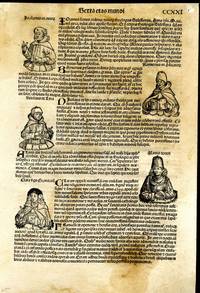
1493048646Nuremberg: Anton Koberger 1493. First Edition. Very Good Condition. A single leaf folio CCXXI a bit stained and browned but attractive with six woodcut portraits and a group portrait of the Council of Vienna. Small paper lifts on upper corners. Size: Octavo 8vo. Quantity Available: 1. Shipped Weight: Under 1 kilo. Category: History; Antiquarian & Rare. Inventory No: 048646. Anton Koberger unknown
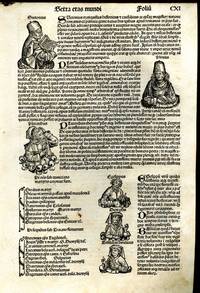
1493048650Nuremberg: Anton Koberger 1493. First Edition. Very Good Condition. A single leaf folio CXI slight browning small paper lifts on upper corners but attractive with eleven woodcuts historians and popes: Suetonius Pliny. Plutarch Hegesippus Basilides Dio Alexander I Sixtus Telephorus Hyginus Pius. Size: Octavo 8vo. Quantity Available: 1. Shipped Weight: Under 1 kilo. Category: History; Antiquarian & Rare. Inventory No: 048650. Anton Koberger unknown
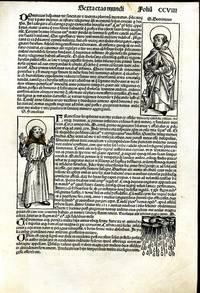
1493048649Nuremberg: Anton Koberger 1493. First Edition. Very Good Condition. A single leaf folio CCVIII slight browning small paper lifts on upper corners but attractive with six woodcuts one with rudimentary handcoloring. St. Dominic St. Francis Popes Gregory Honorius III Celestinus IV. Size: Octavo 8vo. Quantity Available: 1. Shipped Weight: Under 1 kilo. Category: History; Antiquarian & Rare. Inventory No: 048649. Anton Koberger unknown
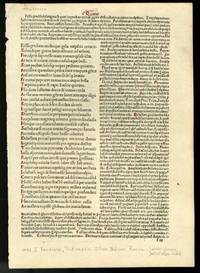
1486046319Strassburg: Printer of the 1483 Jordanus de Quedingburg Georg Husner 1486. Disbound. Very Good Condition. Single leaf from the 1486 edition of the Golden Legend light stains some rubrication tear to one corner small wormtrail touching some letters. Printed in two columns in gothic type. ISTC ij00117000 Goff J117 Size: Octavo 8vo. Quantity Available: 1. Shipped Weight: Under 1 kilo. Category: History; Incunabula. Inventory No: 046319. Printer of the 1483 Jordanus de Quedingburg (Georg Husner) unknown
1486046319Strassburg: Printer of the 1483 Jordanus de Quedingburg Georg Husner 1486. Disbound. Very Good Condition. Single leaf from the 1486 edition of the Golden Legend light stains some rubrication tear to one corner small wormtrail touching some letters. Printed in two columns in gothic type. ISTC ij00117000 Goff J117 Size: Octavo 8vo. Quantity Available: 1. Shipped Weight: Under 1 kilo. Category: History; Incunabula. Inventory No: 046319. Printer of the 1483 Jordanus de Quedingburg (Georg Husner) unknown books
1493044991Venice: Johannes Tacuinus de Tridino 1493. Very Good Condition. Single leaf 11 1/2" x 8 1/4" rubricated with the text surrounded by commentary. Size: Folio. Quantity Available: 1. Shipped Weight: Under 1 kilo. Category: History; Incunabula. Inventory No: 044991. Johannes Tacuinus, de Tridino unknown books
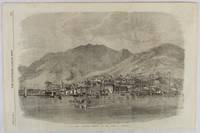
1418177302London.: The Illustrated London News. March 141857. Engraving 34.1 x 24 cm plus caption from "The Illustrated London News" uncoloured as issued edge toning small professionally sealed tear at the foot not affecting the image in very good condition. View of Hong Kong published in "The Illustrated London News" by Richard Principal Leitch twelve years after it had been ceded to British rule. The original newspaper text included on the verso notes: <br>"The town was founded in 1841; and within two years from a tent pitched for the Government residence it became a large assemblage of stores forts wide streets bazaars and markets and several public buildings. <br> <br>From the estate of the late collector and scholar Arthur Hacker with his pencilled catalogue mark on the verso. . The Illustrated London News. unknown
14930005337Nuremberg Germany: Anton Koberger 1493. First edition. Very Good. Woodcuts by the Workshop of Michael Woldgemut & Wilhelm Pleydenwurff. Folio conjoined leaves measuring approximately 455mm by 320mm very minor breaks at fold minor soiling matted but not glazed or framed. <br/><br/>LIBER CHRONICARUM is the most famous travel book of the 15th century and the most exhaustively illustrated book of the incunable era. The complete work contains 1809 woodcuts of which only 29 are double-page town views:: these conjoined leaves is one of those 29 town views specifically "Colonia" i.e. Cologne Germany. The verso of leaf XCI is a half-page view of "Augusta" i.e. Augsburg Germany with descriptive text. Also smaller portraits of historical personages including Cleopatra Alexander the Great Herodias L. Pomponius Leoneus and M. Agrippa. et alios Notes: this is from the Latin edition. The German-language edition DAS BUCH DER CHRONIKEN has different woodblock portraits for Pomponius Leoneus and Agrippa. Also the view of Augsburg is only the left half of the scene which is one of the double-page views. Goff S-307; Hain - Cop 14508x; Klebs 889.1; Oates 1026; Procter 2084; BMC II 437 . Woodcuts by the Workshop of Michael Woldgemut & Wilhelm Pleydenwurff. Anton Koberger unknown
150054897Straßburg, [Georg Husner], 15. Juli 1500. 4°. Mit 2 großen eingemalten Initialen in Rot u. Blau sowie zahlr. dreizeiligen Initialen in Rot. 207 nn. Bll. (ohne das letzte weiße; Got. Typ., 2 Kol., 51 Zeilen), Ldr. d. 18. Jahrhunderts a. 5 Bünden m. blindgepr. Deckelfileten, goldgepr. Rückentitel u. dreiseitig gespränkeltem Rotschnitt.
14755547Basle Switzerland : Michael Wenßler Wenssler 1475 1475. Hardcover. Very Good. Folio - over 12 - 15" tall. 169 Folio leaves ; 31 cm. ; 2° ; bound in quarter suede with three raised bands hand-written titles on spine ; an incunable from the early and important press of Michael Wenssler of Basel Switzerland ; this partial copy without title page or colophon ; Hain 12383 Proctor 7464 British Museum 15th century III 722 IB.37053 Polain 3034 Goff P-83 Walsh 1114 ; single column 36 line Gothic type with conventional 15th century printing ligatures and with rubricized initials throughout; some generally minor edge staining and tears ; a few worm holes in the margins ; a few pages with larger stains ; this copy with no chapter headings or signature marks ; begins at Quintæ Partis Principalis Tractatus de Beatitudinibus with the section on Patience and the temptations of demons and ends the Beatitudes with the discourse on Peace; rubics in the same hand that executed those for the 1474 Quennell edition at the University of Darmstadt ; Michael Wenssler floruit 1472-1497 name variations: Wensler Wensel Vrenssler Wenkler or Wenßler was originally from Strasbourg but became a citizen of Basel in 1473 and was active from 1475 to 1488 when he had to sell his press to pay off his debts. He then leaves Basel for Cluny while his family remained behind in penury and he does not return until 1499 when he retires ; this publication amongst the earliest for Basle is of the celebrated work of William of Auvergne ca. 1180-1271 : the Summa de Virtutibus or The Summation of Virtues the first of the famous two-part tract whose second part published separately treats of the vices. William was born in the former Province of Auvergne about 1180 and by 1223 he was master of theology at the University of Paris and a canon at Notre Dame. He was consecrated Bishop and given the See of Paris in 1228 by Pope Gregory IX and he remained there until his death in 1249. The Summa de Virtutibus et Viitis On the Virtues and Vices a massive work is itself part of a much larger work the Magisterium Divinale et Sapientiale The Teaching on God in the Mode of Wisdom. The style of the work is somewhat rambling moving off into many tangents as it explores related concepts and makes the work appear as an extemporaneous discourse often making a point and then immediately raising objections to that point which William then proceeds to refute. It was reprinted many times and was a monumental Dominican theological work. name variants for William of Auvergne: Guilelmus Peraldus Guillermus Parisiensis Guilielmus Peraldus Guilelmus Peraldus Guillaume Perrault Guilelmus Peraldus Willelmi de Peraldo Wilhelm Peraldus Guilelmus de Petra Alda Guillaume de Peyraud Ardeche G. Lugdunensis G. de Peyrauta G. de Peraudus G. Parisiensis Guil. de Lugduno Guillelmus Peraltus Fr. Guil. a Peira Fr. Guillermo Peraldo Wilhelmus Ep. Lugdun. and Willelmus Arch. Lug. ; extremely rare edition ; VG <br/> <br/> [Basle, Switzerland : Michael Wenßler (Wenssler), 1475] hardcover
1487046404Milan: Antonius Zarotus 1487. Second Edition. Hardcover Full Leather. Very Good Condition. 19th century red morocco gilt hinges and spine rubbed and a little weak but still generally sound and attractive. Added marbled endpapers and a description of the edition and a note on the binding penned on added blank endpapers. The second edition of Tacitus much improved by Puteolanus from the first with the editio princeps of The Life of Agricola. Once thought to have been printed in the 1470s but now usually pegged as 1487. Likely washed though gently except for the first and final leaves Agricola leaves 176-187 with a dampstain in the margin final two leaves darkened. Four small wormtrails in last section leavs 121-end two trails in the textblock but generally very unobtrusive. Top edge gilt and trimmed slightly when rebound leaf numbers penciled lightly and neatly in the inner gutter.<br/><br/>Five 6 line and one 2 line initial colored in early or contemporary color 37 lines set in a fine Roman typeface often compared to Jenson and assumed to be set by him at one point 187 leaves with the blanks at 160 and 176 but lacking the final blank. <br/><br/>Graesse T7 Dibdin Bibl. Spenc. v2 461 Brunet V 633 Goff T7 ISTC it00007000<br/><br/>Provenance: With the label of A.C.C. Brodribb but likely from his father C.W. Brodribb who wrote and published in The American Library Annual a poem describing this volume laid in with a penciled date for the binding of 1855; an inscription on an added endpaper bears the same date. Also laid in is a 1949 letter to A.C.C. Brodribb Esq. from L.A. Sheppard at The British Museum describing the volume which he likely inherited following his father's death in 1945 Size: Folio. Antonius Zarotus hardcover books
1487046404Milan: Antonius Zarotus 1487. Second Edition. Hardcover Full Leather. Very Good Condition. 19th century red morocco gilt hinges and spine rubbed and a little weak but still generally sound and attractive. Added marbled endpapers and a description of the edition and a note on the binding penned on added blank endpapers. The second edition of Tacitus much improved by Puteolanus from the first and the first printed with The Life of Agricola first published by Zarotus in a collection of panegyrics ca. 1482. It was once thought to have been printed in the 1470s but now usually pegged as 1487. Likely washed though gently except for the first and final leaves Agricola leaves 176-187 with a dampstain in the margin final two leaves darkened. Four small wormtrails in last section leavs 121-end two trails in the textblock but generally very unobtrusive. Top edge gilt and trimmed slightly when rebound leaf numbers penciled lightly and neatly in the inner gutter.<br /> <br /> Five 6 line and one 2 line initial colored in early or contemporary color 37 lines set in a fine Roman typeface often compared to Jenson and assumed to be set by him at one point 187 leaves with the blanks at 160 and 176 but lacking the final blank. <br /> <br /> Graesse T7 Dibdin Bibl. Spenc. v2 461 Brunet V 633 Goff T7 ISTC it00007000<br /> <br /> Provenance: With the label of A.C.C. Brodribb but likely from his father C.W. Brodribb who wrote and published in The American Library Annual a poem describing this volume laid in with a penciled date for the binding of 1855; an inscription on an added endpaper bears the same date. Also laid in is a 1949 letter to A.C.C. Brodribb Esq. from L.A. Sheppard at The British Museum describing the volume which he likely inherited following his father's death in 1945 Size: Folio. Quantity Available: 1. Shipped Weight: 2-3 kilos. Category: History; Incunabula. Inventory No: 046404. Antonius Zarotus hardcover
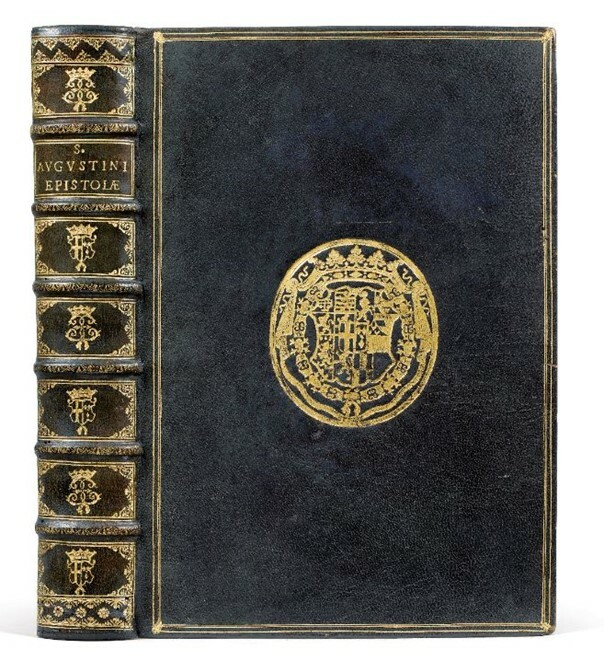
1493YTB-115Les Lettres de Saint Augustin imprimées à Bâle en 1493, reliées pour le prince Eugène de Savoie. (Bâle), Johann Amerbach, 1493. In-folio de 328 ff., complet, 52 lignes + titre courant ; titre remonté ainsi libellé : Liber epistolarum beati Augustini episcopi hipponensis ecclesie ; qq. anciens trous de vers sans conséquence en marge des premiers et derniers feuillets. Maroquin bleu nuit, triple filet doré encadrant les plats, grandes armoiries frappées or au centre, dos à nerfs orné en alternance du chiffre couronné et des armoiries du Prince Eugène de Savoie, coupes décorées, roulette intérieure, tranches dorées sur marbrures. Reliure d’Etienne Boyet vers 1710. 306 x 212 mm. SECONDE EDITION DES LETTRES DE SAINT-AUGUSTIN IMPRIMEE PAR JOHANN AMERBACH A BALE EN 1493. La première édition fut publiée à strasbourg, chez Johann Mentelin en 1471. Goff, A-1268 ; Hain-Copinger, 1969 ; Proctor, 7599 ; BMC, III, 755 ; GKW, 2906 ; Pellechet, 1483 ; Polain (B), 383 ; IGI, 995. De l’énorme correspondance de Saint-Augustin (354-430), il nous reste 206 lettres adressées à 50 correspondants. « Cette correspondance est du plus grand secours pour pénétrer dans les méandres de la vie et de l’esprit de cette haute personnalité ; en outre, elle conforme son influence et ses doctrines. La correspondance purement amicale n’y occupe que peu de place, mais toutes les lettres sont imprégnées de la même ardeur dans la recherche de la vérité et dans l’exhortation à la perfection ; d’autres sont de véritables petits traités. Nulle part ailleurs comme dans ces Lettres, écrit Ebert, n’apparaît l’importance considérable dont jouissait Augustin auprès de ses contemporains. Les évêques et les docteurs le consultent comme un oracle ; il donne des conseils devant l’imminente invasion des vandales. Les théologiens ont classé les lettres en : théologiques, polémiques, exégétiques, ecclésiastiques, morales, philosophiques, historiques et familières. Mais on peut dire que, dans chacune d’entre elles, Augustin réunit tous ces genres littéraires » (T. F. Lesort). Les Lettres de Saint Augustin apportent un éclairage essentiel sur l’œuvre et l’esprit de cette personnalité hors du commun. PRECIEUX EXEMPLAIRE RELIE POUR LE PRINCE EUGENE DE SAVOIE (Paris, 1663 -Vienne, 1736). Ce prince, qui signait Eugenio von Savoie pour rappeler ses trois patries adoptives, avait formé l’un de plus magnifiques cabinets d’objets d’art et de curiosités, de livres rares et de manuscrits précieux. En mourant, le prince Eugène légua sa collection de livres à l’empereur Charles VI. A ce titre, ils firent partie de la Bibliothèque Impériale de Vienne. Plus tard, une sorte de révision eut lieu et, sans respect pour une grande mémoire l’on vendit comme doubles des volumes qui, outre leur mérite propre, offraient l’avantage d’une splendide reliure. Quant aux autres, ils furent dépouillés de leur premier vêtement et recouverts en carton gris. Outre les armoiries et le chiffre du prince Eugène, le volume porte le timbre sec de la Bibliothèque Impériale de Vienne.
1493700DBNürnberg, Anton Koberger, 23. Dezember 1493. Folio (44,5 x 32 cm). (10), 286, (1) Bl. Mit 1980 teils wiederholten Holzschnitten von Michael Wohlgemuth, Wilhelm Pleydenwurff u. a. (einige Holzschnitte koloriert). Späterer Halblederband auf Holzdeckeln mit 2 Metallschliessen (neu aufgebunden mit erneuerten Vorsätzen).