35 résultats
2003LFA-126738687Un ouvrage de 266 pages, format 155 x 240 mm, illustré, broché couverture couleurs, publié en 2003, Editions XO, bon état
37865Editions du Félin. 1993. In-8 pleine toile avec jaquette. Nombreuses ills. en couleurs. 231 p. Bon état.
1979ABE-181431328044 PAGES-EN COUVERTURE "LE VRAI VISAGE D'ALEXANDRE"-LA RENAISSANCE DE SUKHOTHAI-LE TOMBEAU PRESUME DE PHILIPPE II PERE D'ALEXANDRE LE GRAND-JANUSZ KORCZAK LE COMBAT D'UNE VIE POUR LES ENFANTS DESHERITES-HOMMAGE A MARGARET MEAD PAR CLAUDE LEVI STRAUSS
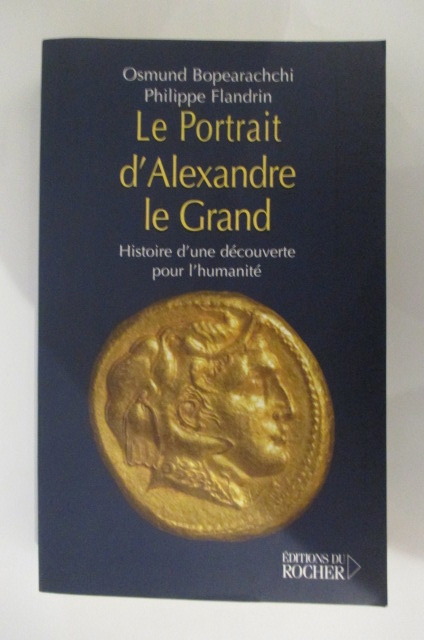
HIS905M2005 / 267 pages. Broché. Editions du Rocher.
31620Paris, E. Plon , Nourrit & Cie, 1884 - in-8, reliure cartonnée pleine percaline vert foncé ; filets, caissons ornés et titre dorés sur dos à nerfs, armes du lycée Ampère de Lyon doré sur 1er plat, XX+443 pages, avec une très grande carte comparative, dépliante in fine, de l'Inde et de ses abords au temps d'Alexandre et à l'époque actuelle - Très bon état malgré qqs rousseurs sur les tranches (très peu in texte)
1980LFA-126730951Un ouvrage de 578 pages, format 155 x 240 mm, illustré de cartes, broché couverture rempliée, publié en 1980, Albin Michel
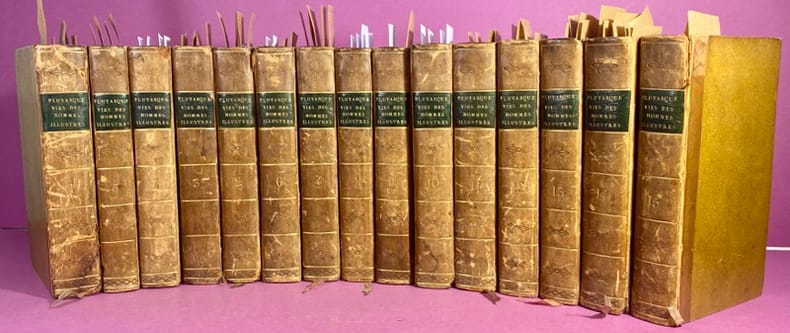
181119011811 Couverture rigide A Paris, chez Louis Duprat-Duverger, 1811. 15 volumes in-16 (14,5 x 9 cm), reliure demi-veau fauve, dos orné de motifs floraux encadrés de filets dorés, pièce de titre en maroquin vert, mors supérieurs fendillés ou partiellement fendus sur quelques volumes et mors supérieur du tome 3 fendu (structure ferme cependant), petit manque de cuir au dos du tome I, quelques frottements aux coiffes et dos. Tome I : feuillet de faux-titre, feuillet de titre, cxiv, 428 pages ; tome II : feuillet de faux-titre, feuillet de titre, 394 pages ; tome III : feuillet de faux-titre, feuillet de titre, 423 pages ; tome IV : feuillet de faux-titre, feuillet de titre, 394 pages ; tome V : feuillet de faux-titre, feuillet de titre, 318 pages ; tome VI : feuillet de faux-titre, feuillet de titre, 441 pages ; tome VII : feuillet de faux-titre, feuillet de titre, 412 pages ; tome VIII : feuillet de titre, 445 pages ; tome IX : feuillet de faux-titre, feuillet de titre, 407 pages ; tome X : feuillet de faux-titre, feuillet de titre, 483 pages : tome XI : feuillet de faux-titre, feuillet de titre, 499 pages ; tome XII : feuillet de faux-titre, feuillet de titre, 406 pages ; tome XIII : feuillet de faux-titre, feuillet de titre, 406 pages ; tome XIV : feuillet de faux-titre, feuillet de titre, xij, 480 pages ; tome XV : feuillet de faux-titre, feuillet de titre, 519 pages. Texte en français, l'ensemble des volumes comprend 63 portraits gravés en taille douce par Delvaux. Présence de rousseurs éparses et papier légèrement passé, comme habituellement pour cette édition, bon état général cependant. Les 15 volumes couvrent l'intégralité des biographies de l'Antiquité. Le principe est de comparer un grand homme grec à un grand homme romain (par exemple, Alexandre le Grand face à Jules César) pour en dégager les vertus, les vices et les leçons de vie. Plutarque était un philosophe, biographe et moraliste grec, citoyen romain et prêtre d'Apollon à Delphes. Graesse (V - 368). Bon exemplaire en assez bon état de cette édition en 15 volumes.
2681Avenione, Apud Laurentium Aubanel, 1814 - in-12, 412 pp. - rel. bas. brune d'ép. (coiffe de tête et pied abîmées, rousseurs, rongeures)
16-3924Lugduni Batavorvm Leiden : Excudit Petrus vander Aa bibliop. 1696. Contemporary calf gilt spine. 11 x 19 cm.36 plates some folding including a map of Alexander the Great's route. Manuscirpt annotatations in an ancient hand with added engraving.Manuscript notation in Getty Research Institute copy attributes the engravings to Adriaan Schoonebeeck.Illustrated with an added engraved title-page frontispiece and plates.Signatures: â¸-1 2²-2² A-3E⸠3F² a-h⸠i²-i2 kâ´.QUINTII CURTII D. REBUS GESTIS ALEXANDRI MAGNI. Commentarris. Lug. Batavorrum. P. Vander Aa. 1696. 36 planches hors texte rel. de l'époque veau moucheté dos ornéExpertise by Roger ROQUES - 06.12.15.30.68 - – 2 rue du Périgord – 31000 TOULOUSE Lugduni Batavorvm [Leiden] : Excudit Petrus vander Aa, bibliop., 1696 unknown
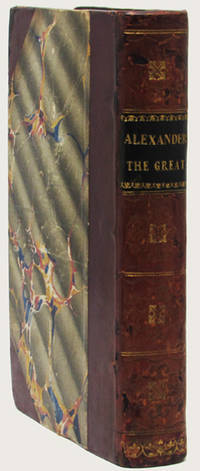
182934651London: John Murray Albemarle Street 1829. First Edition. Illustrated with a large folding map showing the campaigns of Alexander. Small 8vo handsomely bound in contemporary three-quarter calf over marbled paper covered boards the spine ruled in gilt and with a black morocco lettering label gilt. vi 402 pp. A well preserved copy handsome and in good order the binding tight and strong the text-block clean and fresh the map also in fine state. FIRST EDITION OF THIS VERY READABLE HISTORY AND BIOGRAPHY OF ALEXANDER THE GREAT. Alexander III of Macedon Ancient Greek: Aléxandros most commonly known as Alexander the Great was king of the ancient Greek kingdom of Macedon. He succeeded his father Philip II to the throne in 336 BC at the age of 20 and spent most of his reign conducting a lengthy military campaign throughout Asia and Egypt. By the age of 30 he had created one of the largest empires in history stretching from Greece to northwestern India. He was undefeated in battle and is widely considered to be one of history's greatest and most successful military commanders.<br> Born in Pella Macedon Alexander was tutored by philosopher and polymath Aristotle until the age of 16. In 335 BC shortly after assuming the throne of Macedon he launched a campaign in the Balkans and reasserted control over Thrace and parts of Illyria before marching on the city of Thebes which was subsequently destroyed. Alexander then assumed leadership of the League of Corinth created by his father.<br> With this authority over all Greeks he launched a pan-Hellenic invasion of the Persian Achaemenid Empire in 334 BC and with it began a series of campaigns which lasted for ten years. Following his conquest of Asia Minor and a series of decisive battles particularly at Issus and Gaugamela the power of the Achaemenid Empire was broken. He subsequently overthrew Darius III and conquered the Achaemenid Empire in its entirety. After the fall of Persia the Macedonian Empire held a vast swath of territory between the Adriatic Sea and the Indus River. Alexander endeavored to reach the "ends of the world and the Great Outer Sea" and invaded India in 326 BC achieving an important victory over Porus an ancient Indian king of present-day Punjab at the Battle of the Hydaspes. Facing mutiny from troops he was eventually forced to turn back at the Beas River and later died in 323 BC in Babylon Mesopotamia the city which he had planned to make the capital of his empire while on his return to Greece. Alexander's death put an end to his planned invasion of Arabia. John Murray, Albemarle Street hardcover