DOD Outer Space Guided MissilesBiblio.com
Cold War-Era U.S. Military Publications on Guided Missiles Space Strategy and Preflight STEM Instruction Circa Late 1950s
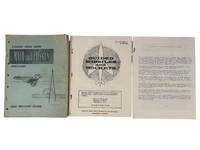
1950223721950. A rare instructional archive from the height of the Cold War arms and space races documenting the teaching strategies technical priorities and ideological frameworks used by the U.S. military to train service members in missile technology physics and emerging space policy. These materials reflect the growing importance of scientific education within the armed forces during the period of intense technological competition between the United States and the Soviet Union following the launch of Sputnik and the acceleration of missile and space programs.<br /> <br /> This archive includes three distinct publications produced by branches of the Department of Defense and the U.S. Air Force: a heavily illustrated USAF Preflight School "Math and Physics" Student Study Guide ca. late 1950s 244 pages; the DOD Fact Sheet 3-F on "Guided Missiles and Rockets" 29 April 1960 59 pages; and a striking early federal statement titled "Introduction to Outer Space" ca. late 1950s 11 pages intended to justify a national space program. Together these works reflect the militarized scientific culture of early Cold War America where soldiers were expected to master STEM fundamentals understand atomic missile classifications and absorb the ideological stakes of U.S. supremacy in space.<br /> <br /> The Preflight School Study Guide opens with a cartoon image of a smiling cadet pointing to a "Table of Contents" listing 20 core lessons including: "Velocity and Acceleration" "Vectors" "Electricity and Magnetism" and "Jet Engine Principles." Designed to bring young recruits up to speed on mathematical and physical foundations this booklet illustrates how the military systematized the transmission of civilian STEM knowledge through instructional cartooning step-by-step reviews and mechanical principles tied directly to aeronautics. The document also reflects broader efforts to professionalize enlisted men into a new technocratic class of Cold War airmen.<br /> <br /> The DOD Fact Sheet 3-F dated 29 April 1960 is a mimeographed technical manual that lists every operational missile and rocket then used by the Army Navy Air Force and Marine Corps. Each entry is meticulously typed and includes missile name type e.g. "surface-to-surface" speed launch weight prime contractor warhead type and guidance system. Key entries include the NIKE AJAX NIKE HERCULES REDSTONE PERSHING and POLARIS missiles. The NIKE AJAX is described as "the nation's first supersonic anti-aircraft guided missile. designed to intercept and destroy bomber aircraft regardless of evasive action." The HERCULES system is called "a major advance. capable of operation in an electronic countermeasures environment." These materials also serve as a record of U.S. procurement partnerships with Bell Labs Western Electric and Douglas Aircraft-illustrating the military-industrial complex in full effect.<br /> <br /> The third item titled "Introduction to Outer Space" is a pedagogical and ideological primer explaining the rationale behind federal investment in space exploration. Structured around four key justifications-scientific curiosity military defense national prestige and technological advancement-it declares: "The first of these factors is the compelling urge of man to explore. Most of the surface of the earth has now been explored and men now turn to the exploration of outer space as their next objective." This philosophical argument for militarized space policy also hints at early satellite surveillance goals: "The launching of satellites. can be done with the aid of new things: 1 it can look down at the earth and map out the terrain. 2 it can look out into space. and 3 it can look at the sun." Notably this text served as the basis for a widely distributed 1958 White House document under the Eisenhower Administration laying ideological groundwork for what would soon become NASA and the National Defense Education Act NDEA of 1958.<br /> <br /> Pages toned with some rusting to staples especially visible on "Introduction to Outer Space." Light wear to edges of math booklet. Overall very good condition. An outstanding and uncommon pedagogical archive documenting how the U.S. military trained its enlisted men to master missile and rocket technologies at the dawn of the space age while also advancing an explicitly ideological case for Cold War space supremacy. unknown
Max Rambod Inc. · États-Unis2 450,00 $US≈ 2 072,94 €