[ROYAL AIR FORCE]Biblio.com
295 résultats
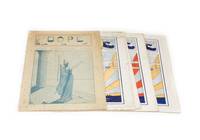
19192358London: printed and published by the Morgan Reeve Company Goldsmith Street 1919. Four issues of the magazine each measuring 250 x 187 mm. all with the original printed colour wrappers. Condition variable. Basically two issues thumbed and well-read one with covers detached; the other two issues are well-preserved. A scarce and desirable relic of the Royal Air Force in the First World War being the light-hearted review magazine of the Spittlegate training depot. These four issues follow the signing of the Armistice on November 11 1918 and the overall purpose of the publication was to foster camaraderie and good relations between men from across the Commonwealth and a good measure of American airmen too. As such the intended audience lists English Scots Welsh Irish Canadians New Zealanders South Africans and Yankees. </p> <p>Undeniably English in tone yet imbued with the risqué and cavalier mood following the end of a grim and depressing war "Dope" comprises sketches caricatures theatrical reviews potted biographies of officers and other identities contributions by the Padre and more. Of special interest are the football results and write-ups including Spittlegate versus 876 Company A.S.C. and Spittlegate versus Cranwell. Unsurprisingly the advertisements are pitched to airmen and include uniforms flying apparel and accoutrements. printed and published by the Morgan Reeve Company, Goldsmith Street unknown
4to., First Edition, with title in red and black; handsomely bound in burgundy full morocco, sides with gilt frame border, back gilt with five raised bands, second and fourth compartments lettered and ruled in gilt, all other compartments tooled and ruled in gilt, gilt top, hand-made endpapers, uncut, a most attractive copy ideal as a gift or for presentation. A lovely copy. O'Brien A173
8vo., First Edition, with plates; handsomely bound in full navy crushed morocco, sides with gilt frame border, back with raised bands, second and fourth compartments lettered and ruled in gilt, all other compartments tooled with propeller motif in gilt, gilt top, hand-made endpapers, ribbon marker, a most attractive copy ideal as a gift or for presentation. Enser, p.57.
12 vols., 8vo., Mixed Editions, with illustrated titles, very numerous illustrations and maps in the text and pictorial endpapers; cloth, gilt backs, a near fine extended set in dustwrapper. Splendid extended set of the most comprehensive survey of the UK's WWII military airfields ever published and an invaluable tool for historians and scholars alike. The ten volumes of the original series, together with the two complementary works, form a milestone in WWII aviation history. The extended set comprises (first impressions unless otherwise stated):Bowyer (M.J.F). Action Stations 1, [third impression, 1980] [East Anglia]; Halpenny (B.B). Action Stations 2, [1981] [Lincolnshire and East Midlands]; Smith (D.J). Action Stations 3, [1981] [Wales and the North West]; Halpenny (B.B). Action Stations 4, [1982] [Yorkshire]; Ashworth (C). Action Stations 5, [fourth impression, 1982] [South-West]; Bowyer (M.J.F). Action Stations 6, [1983] [Cotswolds and Central Midlands]; Smith (D.J). Action Stations 7, [1983] [Scotland, the North-East and Northern Ireland]; Halpenny (B.B). Action Stations 8, [second impression, 1984] [Greater London]; Ashworth (C. Action Stations 9, [second impression, 1985] [Central South and South-East]; Quarrie (B). Action Stations 10, [1987] [Supplement and Index]; Fairbairn (A). Action Stations Overseas, [1991]; Smith (D.J). Britain's Military Airfields 1939-1945, [1989]. EXTENDED SETS IN DUSTWRAPPERS ARE SELDOM AVAILABLE FOR SALE.
8vo., First Edition, with 56 plates on 24; handsomely bound in full navy crushed morocco, sides with gilt frame border, back with raised bands, second and fourth compartments lettered and ruled in gilt, all other compartments tooled in gilt with a propellor motif, gilt top, hand-made endpapers, a most attractive copy ideal as a gift or for presentation. Elegant copy of the first full account, published to mark the battle's twentieth anniversary. Valuable also for its well-chosen and wide-ranging selection of photographs, which include a number from German sources. Enser, p.56.
13 vols., 8vo., First Edition, with illustrated titles, very numerous illustrations and maps in the text and pictorial endpapers; cloth, gilt backs, a very good extended set in the dustwrapper. Bright extra-extended set of the most comprehensive survey of the UK's WWII military airfields ever published and an invaluable tool for historians and scholars alike. The ten volumes of the original series, together with the three complementary works, form a milestone in WWII aviation history. The extended set comprises:Bowyer (M.J.F). Action Stations 1, [1979] [East Anglia]Halpenny (B.B). Action Stations 2, [1981] [Lincolnshire and East Midlands]Smith (D.J). Action Stations 3, [1981] [Wales and the North West]Halpenny (B.B). Action Stations 4, [1982] [Yorkshire]Ashworth (C). Action Stations 5, [1982] [South-West] Bowyer (M.J.F). Action Stations 6, [1983] [Cotswolds and Central Midlands]Smith (D.J). Action Stations 7, [1983] [Scotland, the North-East and Northern Ireland]Halpenny (B.B). Action Stations 8, [1984] [Greater London]Ashworth (C. Action Stations 9, [1985] [Central South and South-East]Quarrie (B). Action Stations 10, [1987] [Supplement and Index]Fairbairn (A). Action Stations Overseas, [1991]Cooksley (P.G). Aviation Enthusiasts' Guide to London & the South-East, [1982]Smith (D.J). Britain's Military Airfields 1939-1945, [1989]EXTENDED SETS OF FIRST EDITIONS ARE SELDOM AVAILABLE FOR SALE.
8vo., Fifth Impression; handsomely bound in full navy crushed morocco, sides with gilt frame borders, back with raised bands, second and fourth compartments lettered and ruled in gilt, all other compartments tooled in gilt with 'propeller' motif, gilt top, hand-made endpapers, a most attractive copy ideal as a gift or for presentation. Published four months after the first edition. Arguably the finest account of the Battle of Britain by a British fighter pilot. Hillary flew Spitfires out of Hornchurch with 603 Squadron and claimed five victories before being badly burned over the North Sea. An early member of the Guinea Pig Club, he was treated by McIndoe and returned to duty, but was killed shortly after in a training accident. The work was many times reprinted, but early issues are scarce. The US title is 'Falling Through Space'. Enser, p.157
1987mon0000141569RAF 1987-01-01. Paperback. Good. in x in x in. NORTHERN EUROPE NOT EUROPEAN MEDITERRANEAN NOT ex-library. Clean copy in good condition. RAF paperback
Single sheet, 8vo., a near fine copy. Signed simply 'Tedder' in the writer's usual manner, the letter is written to Geoffrey Moore, founder of the Buccaneers Cricket Club, and demonstrates the airman's keen and continuing interest in the sport. Tedder was President of Surrey County Cricket Club from 1953 to 1958. The letter regretfully declines Moore's invitation to attend the Buccaneer's annual dinner (held at Lords). Marshal of the RAF Arthur William Tedder, 1st Baron Tedder (1890-1967) was one of Britain's most distinguished air commanders. Educated at Whitgift School and Magdalene College, Cambridge, he transferred from the Dorsetshire Regiment to the Royal Flying Corps in 1916, serving in France from 1915- to 1917 and in Egypt from 1918 to 1919. He was then commissioned in to the (new) Royal Air Force where was appointed Director of Training from 1934 to 1936, after which he became Commander RAF Far Eastern Forces. During WWII he was head of RAF Middle East Command, controlling Allied air operations in the Mediterranean and North Africa, including the evacuation of Crete and the defeat of Rommel; his air power was a vital component of Montgomery's victory at El Alamein. Having been promoted to Air Marshal, Tedder then took part in the early planning for D-Day, and was subsequently appointed Deputy Supreme Commander Allied Forces Europe (the most senior such British position) immediately beneath General Eisenhower, on whose behalf he signed at the German Surrender in 1945. In 1947 he delivered the Lees Knowles lecture, afterwards published as 'Air Power in War'. Following his retirement he served as Chancellor of Cambridge University and Vice-Chairman of the Board of Governors of the BBC. Founded in 1930, The Buccaneers is one of the oldest and most famous 'wandering' clubs in English cricket (a 'wandering' club has no fixed home ground but plays consistently as an 'away' team relying on the hospitality of the 'home' clubs against which it competes). The Club's history has been written twice, by Clifford Bax in 1956 and more recently by Howard Spencer. ORIGINAL DOCUMENTS SIGNED BY TEDDER ARE EXTREMELY SCARCE.
8vo., First Edition; handsomely bound in full navy crushed morocco, sides with gilt frame borders, back with raised bands, second and fourth compartments lettered and ruled in gilt, all other compartments tooled in gilt with 'propeller' motif, gilt top, hand-made endpapers, a most attractive copy ideal as a gift or for presentation. Arguably the finest account of the Battle of Britain by a British fighter pilot. Hillary flew Spitfires out of Hornchurch with 603 Squadron and claimed five victories before being badly burned over the North Sea. An early member of the Guinea Pig Club, he was treated by McIndoe and returned to duty, but was killed shortly after in a training accident. The work was many times reprinted, but early issues are scarce. The US title is 'Falling Through Space'. Enser, p.157
8vo., First Edition, with frontispiece and 24 plates on 12; handsomely bound in full navy crushed morocco, sides with gilt frame border, back with raised bands ruled in gilt, second and fourth compartments lettered in gilt, all other compartments tooled in gilt with a propeller motif, hand-made endpapers, ribbon marker, a most attractive copy ideal as a gift or for presentation. Written by Paul Brickhill (already celebrated as the author of another RAF classic 'The Dam Busters', 1951), 'Reach for the Sky' remains the best account of the legless Battle of Britain hero. It was the basis of Lewis Gilbert's hugely successful feature film (1954) starring Kenneth More in arguably his finest role. One of the legendary figures of the Royal Air Force, Douglas Bader was from the outset an outstanding athlete. As a cadet at Cranwell he gained his 'blues' for cricket, rugby, hockey and boxing. He represented the RAF at both cricket and rugby and would probably have been capped for England but for the accident that changed his life and created a legend. In 1931 a near-fatal air crash left him legless. Knowing that no man with such a handicap had ever walked without a stick he nevertheless found his way back to fitness playing tennis, golf and many others sports. He even flew again, until the authorities determined that a pilot without legs could not fly and discharged him from the service. With the outbreak of War he fought to be readmitted, not merely to a desk job, but back to the cockpit. Finally he was given command of a flight which quickly increased to five squadrons as the RAF realised that he was not only an outstanding pilot but an inspired leader of men and a fighter tactician almost of genius. Even as a POW his spirit was such that his captors were forced at one stage to remove his artificial limbs to prevent the chance of his escaping. Enser, p.375.
5 vols., 8vo., First Edition, with photographs in the text; cloth, gilt backs, a near fine set in unclipped dustwrapper. The set comprises: Vol. I: September 1939 to September 1940 (1996); Vol. 2: September 1940 to December 1941 (1998); Vol. 3: January 1942 to June 1943 (2001); Vol. 4: July 1943 to June 1944 (2002); Vol. 5: June 1944 to May 1945 (2004). Complete sets of the first edition of this standard reference are very scarce.
8vo., Third Impression, with portrait frontispiece and 11 plates on 8; blue cloth, backstrip lettered in black, backstrip faintly sunned else a very good, bright, clean copy in unclipped dustwrapper, the latter mildly rubbed at extremities. SIGNED BY EMBRY ON FRONTISPIECE. Bright copy of one of the earliest and most popular RAF escape stories of WWII, published just a month after the first edition. Shot down near St. Omer, Embry made his return to England via Spain just nine weeks and five days later. He subsequently commanded 2 Group Bomber Command, and although ranked Air Vice Marshal flew several operations under the name 'Wing Commander Smith'. His Mosquitos were renowned for their skill and accuracy in precision daylight bombing, and he would have led personally Operation JERICHO - the raid on Amiens prison in February 1944 (in which his substitute Pickard was killed) - had higher authority not ordered him to stand down. Post-war, Embry served as Commander-in-Chief Fighter Command from 1949 to 1953. SIGNED COPIES ARE EXCEEDINGLY SCARCE. We are told that this copy was signed by Embry for Wing Commander Tom 'Ginger' Neil (Battle of Britain ace and RAF test pilot), but there is no formal evidence to this effect. Enser, p.151 (recording the first edition).
8vo., Sixth Impression, with frontispiece and 24 plates on 12; handsomely bound in burgundy full crushed morocco, sides with gilt frame border, back with raised bands ruled in gilt, second and fourth compartments lettered in gilt, all other compartments tooled in gilt with a propeller motif, hand-made endpapers, a most attractive copy ideal as a gift or for presentation. SIGNED BY BADER ON DEDICATION. Published five months after the first impression. Written by Paul Brickhill (already celebrated as the author of another RAF classic 'The Dam Busters', 1951), 'Reach for the Sky' remains the best account of the legless Battle of Britain hero. It was the basis of Lewis Gilbert's hugely successful feature film (1954) starring Kenneth More in what was arguably his finest role. One of the legendary figures of the Royal Air Force, Douglas Bader was from the outset an outstanding athlete. As a cadet at Cranwell he gained his 'blues' for cricket, rugby, hockey and boxing. He represented the RAF at both cricket and rugby and would probably have been capped for England but for the accident that changed his life and created a legend. In 1931 a near-fatal air crash left him legless. Knowing that no man with such a handicap had ever walked without a stick he nevertheless found his way back to fitness playing tennis, golf and many others sports. He even flew again, until the authorities determined that a pilot without legs could not fly and discharged him from the service. With the outbreak of War he fought to be readmitted, not merely to a desk job, but back to the cockpit. Finally he was given command of a flight which quickly increased to five squadrons as the RAF realised that he was not only an outstanding pilot but an inspired leader of men and a fighter tactician almost of genius. Even as a POW his spirit was such that his captors were forced at one stage to remove his artificial limbs to prevent the chance of his escaping. Enser, p.375 (recording the first edition)
Single sheet, 8vo., a near fine copy. Signed simply 'Tedder' in the writer's usual manner, the letter is written to Geoffrey Moore, founder of the Buccaneers Cricket Club, and demonstrates the airman's keen and continuing interest in the sport. Tedder was President of Surrey County Cricket Club from 1953 to 1958. The letter regretfully declines Moore's invitation to attend the Buccaneer's annual dinner (held at Lords): 'I've already got a date I can't budge!'. Marshal of the RAF Arthur William Tedder, 1st Baron Tedder (1890-1967) was one of Britain's most distinguished air commanders. Educated at Whitgift School and Magdalene College, Cambridge, he transferred from the Dorsetshire Regiment to the Royal Flying Corps in 1916, serving in France from 1915- to 1917 and in Egypt from 1918 to 1919. He was then commissioned in to the (new) Royal Air Force where was appointed Director of Training from 1934 to 1936, after which he became Commander RAF Far Eastern Forces. During WWII he was head of RAF Middle East Command, controlling Allied air operations in the Mediterranean and North Africa, including the evacuation of Crete and the defeat of Rommel; his air power was a vital component of Montgomery's victory at El Alamein. Having been promoted to Air Marshal, Tedder then took part in the early planning for D-Day, and was subsequently appointed Deputy Supreme Commander Allied Forces Europe (the most senior such British position) immediately beneath General Eisenhower, on whose behalf he signed at the German Surrender in 1945. In 1947 he delivered the Lees Knowles lecture, afterwards published as 'Air Power in War'. Following his retirement he served as Chancellor of Cambridge University and Vice-Chairman of the Board of Governors of the BBC. Founded in 1930, The Buccaneers is one of the oldest and most famous 'wandering' clubs in English cricket (a 'wandering' club has no fixed home ground but plays consistently as an 'away' team relying on the hospitality of the 'home' clubs against which it competes). The Club's history has been written twice, by Clifford Bax in 1956 and more recently by Howard Spencer. ORIGINAL DOCUMENTS SIGNED BY TEDDER ARE EXTREMELY SCARCE.
19440001446MONCTON NEW BRUNSWICK CANADA. Good. 1944. On offer is a super original manuscript diary handwritten by James C. Dow trainee of the Royal Air Force written in England and then at 31 P.D. Training Camp Moncton New Brunswick Canada. Along with the diary is a photograph album titled 'The Canadian Adventure. Sept. 1944 to March 1945.' Historians and researchers of the era and the experience of British training in Canada will find the two items complimenting one another in casting interesting light on the day-to-day training routine of a middle-class 19 year old man training as an RAF radio operator during the Second World War. At the start of the diary Dow is in training in Lincolnshire engaged in such activities as learning Morse Code and doing transmitter tuning practice. By August he is training in Lancashire and on 25 August he is drafted to Canada. He usually begins his businesslike entries with a short report of the progress of the war and end with a mention of the weather. In between are usually several sentences of personal information. A typical entry 12 April 1944 reads: 'The Russians have made considerable progress towards the center of the Crimea. Had a pretty easy morning; ostensibly cleaning up defense trenches in the Larch Wood on the far side of the North Drome under Sgt. Fish of the Regiment. Quite restful! Denis passed his morse this morning: so did Mac. Denis & I spent most of the afternoon in the Information Room officially "games". We Taffy Standish Dave Hands & Sid Steed are going on day pass to Lincoln tomorrow. It was quite mild - sunny with some cloud'. On 26 he reaches the Trois Rivieres camp seventy miles from Quebec. The following day he complains: 'We are here for nothing more definite than fatigues to pass time until we start training. Dennis & I are in a party which has to clear up variou rubbish dumps around the camp'. On 24 October he starts his course in Moncton: 'It is going to be very hard work for the 22 weeks it lasts if I stick it out!. We work 8 hours a day so there are usually extra assignments at night.' By the last entry in the diary Dow is 'Flying again this morning - a pleasant trip. As W/Op once again. I got an all-right'. The diary also contains some addresses and a list of 25 books Dow has read. Album: landscape 8vo 24 pp containing 49 captioned black and white photographs ranging in size from 8.5 x 12 cm to 6 x 9 cm together with a postcard of Notre Dame Church Montreal. Internally sound in a worn binding with the photographs in excellent condition. The first eight pictures are of the training camp at Moncton mostly with named individuals. The next eight are of Montreal and these are followed by nineteen pictures under the heading 'Quebec St. Louis de Courville. Week Ends with the Woods' the first two being captioned 'with Bill Scollay & Taffy Standish near the Wood's sic home' and 'Desmond Wood in front with Jimmy from next door'. There follow two pictures headed 'After we left' and eight of an aircraft under the heading 'No 8 Air Observer School Ancienne Lorette Quebec'. The first shows an 'Anson about to take off' and there are also an 'Interior scene during flight' an 'Astrocompass in silhouette' and five views out from over the wing including the 'Shawnigan Falls & the Shawnigan River a frew miles north of Trois Rivieres'. The last four images are of a 'New York Interlude - Christmas 1944'. Diary: 12mo with 91 full pages of neatly-written entries. Text clear and complete. Fair: internally sound and clean on lightly-aged paper in worn original boards. Dow's ownership inscription inside the front board reads 'James C. Dow. R.A.F. 1944.' Overall G.; 12mo - over 6¾" - 7¾" tall; KEYWORDS: WORLD WAR II WWII WW2 RAF ROYAL AIR FORCE RADIO OPERATORS CANADA CANADIANA HANDWRITTEN MANUSCRIPT DOCUMENT LETTER AUTOGRAPH DIARY JOURNAL LOG KEEPSAKE WRITER HAND WRITTEN DOCUMENTS SIGNED LETTERS MANUSCRIPTS HISTORICAL HOLOGRAPH WRITERS DIARIES JOURNALS LOGS AUTOGRAPHS PERSONAL MEMOIR MEMORIAL PERSONAL HISTORY TRAVEL 20TH CENTURY antiquité contrat vélin document manuscrit papier Antike Brief Pergament Dokument Manuskript Papier oggetto d'antiquariato atto velina documento manoscritto carta antigüedad hecho vitela documento manuscrito Papel . hardcover
19430001601NORTH AFRICA EGYPT TUNISIA BRITISH PALESTINE. Fair. 1943. On offer is a simply sensational fascinating original World War II British RAF manuscript diary of an airman named K. James Using a very interesting journal with portrait of an Egyptian pharaoh and North Africa maps as the endpapers. Our writer has inserted a block of papers used as a preface explaining the use of the diary he had charmingly dedicated to his parents. He also does a retrospective portion setting up the narrative. His signature ends the preface letter of explanation and then the actual entries begin dated May 14th 1943 through to winter of 1944 and then a final entry for February 23rd 1945. This airman has seen it all and been everywhere throughout the conflict in the Mediterranean and since the notebook is undated as diary goes his entries are long and very detailed. He begins with the end of the battle for Tunisia carries on with a most intimate personal diary that besides the factual details of the War going on around him and his duties he never fails to provide colourful background of his mates the natives his thoughts his loves his boredom his high and lows. In our experience this is a heads above the rest manuscript of the real life and times of this airman during his time throughout North Africa and Italy. The 6½ x 4½ inch book has a well filled 208 pages of which 5 or 6 are pages with autographs of his close personal narrative. The text block is somewhat loose but all pages appear accounted for. Overall G.; 16mo - over 5¾" - 6¾" tall; KEYWORDS: HISTORY OF NORTH AFRICA CAMPAIGN WORLD WAR II BRITISH RAF ITALY ROYAL AIR FORCE K. JAMES WWII WW2 BRITISH ARMED FORCES BRITISH AIRMAN ROMMEL HANDWRITTEN MANUSCRIPT DOCUMENT LETTER AUTOGRAPH DIARY JOURNAL LOG KEEPSAKE WRITER HAND WRITTEN DOCUMENTS SIGNED LETTERS MANUSCRIPTS HISTORICAL HOLOGRAPH WRITERS DIARIES JOURNALS LOGS AUTOGRAPHS PERSONAL MEMOIR MEMORIAL PERSONAL HISTORYantiquité contrat vélin document manuscrit papier Antike Brief Pergament Dokument Manuskript Papier oggetto d'antiquariato atto velina documento manoscritto carta antigüedad hecho vitela documento manuscrito papel. . unknown
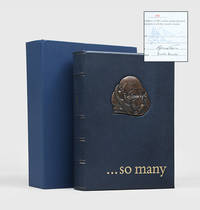
183399London: The Royal Air Force Benevolent Fund 1995. It was the crews of Bomber Command who carried our message of defiance into the very heartland of the enemy First edition number 202 of 401 copies signed by the four members of the creative team on the mounted authentication leaf. This magnificent volume contains 25 silhouettes of Bomber Command personnel from Britain Canada and Australia all signed by the sitter and the artist Michael Pierce. Each portrait is accompanied by a biography photographs of memorabilia and facsimiles of handwritten accounts. The creative team included the aviation historian Bill Gunston editor who compiled the biographies in collaboration with the former RAF pilot John Golley and Air Vice Marshal Frederick "Freddie" Charles Hurrell the director of appeals for the RAF Benevolent Fund. The fund's president HRH The Duke of Kent contributed the preface. So Many and its predecessor So Few raised hundreds of thousands of pounds for the charity and were republished in popular editions by W. H. Smith. Folio. With 25 coloured silhouettes on card leaves tipped-in and tissue-guarded as issued signed by the subject and artist and with artist's embossed stamp; "Supporting Cast" silhouette tipped to p. 265 as issued illustrations and facsimiles some colour in text. Original blue crushed morocco over bevelled boards raised bands to spines within gilt rules title to second compartment in gilt front cover lettered in gilt inset bronze bas relief pilot bust by James Butler RA marbled endpapers edges gilt blue bookmarker. Housed in original blue cloth solander box front cover lettered in gilt moiré silk lining. Lacking original prospectus normally housed in pouch of solander box. A few bumps and marks to box else a fine copy. hardcover
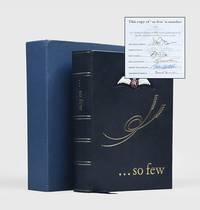
177632London: The Royal Air Force Benevolent Fund 1990. Signed by 25 Battle of Britain RAF fighter pilots First edition number 221 of 401 copies signed by all six members of the creative team on the mounted authentication leaf. This magnificent tribute contains 25 superb silhouette portraits of distinguished RAF pilots from Britain and the Commonwealth all signed by the sitter and the artist Michael Pierce together with his embossed stamp. Each portrait is accompanied by a biography of the subject together with photographs of memorabilia and facsimiles of letters. The prospectus details the meticulous attention to detail during production: 500 sets of sheets were printed with the best 401 chosen and the rest pulped. The editor was the noted historian of aviation Bill Gunston who compiled the biographies in collaboration with the former RAF pilot John Golley. Prince Edward contributed the preface. So Few and its 1995 successor on Bomber Command So Many raised hundreds of thousands of pounds for the RAF Benevolent Fund a success which led to trade issues by W. H. Smith. The first copy of each volume was presented to Queen Elizabeth II. The list of contributors names several charitable organizations and other members of the Royal Family for whom copies would likely have been reserved. Folio. With 25 coloured silhouettes on card leaves tipped-in as issued signed by the subject and artist artist's embossed stamp tissue-guards numerous photographs colour and black-and-white and facsimiles to text. Prospectus inserted in sleeve in inner box lid. Original blue crushed morocco over bevelled boards raised bands to spines within gilt rules titles to second compartments gilt front cover lettered in gilt with inset embroidered RAF brevet and gilt decoration marbled endpapers all edges gilt blue silk bookmarkers. Housed in original moiré silk-lined blue cloth solander box. A few tiny bumps to box else a fine copy. hardcover
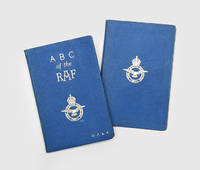
1942192642London: The Amalgamated Press Limited 1942. The copies of Churchill's "accepted star of the Royal Air Force" Air Chief Marshal Sir Charles Portal's specially bound copies of these two introductions to the RAF for which he wrote forewords in his capacity as Chief of the Air Staff. "The opinions entertained of Portal's ability by his wartime colleagues were extraordinarily high. Eisenhower while president told Lord Plowden that he regarded Portal as the greatest British war leader 'greater even than Churchill'" ODNB. Portal was appointed head of the service in October 1940. "The 'accepted star of the Royal Air Force' as Churchill described him he drove himself relentlessly throughout the rest of the war. His leadership was never remotely challenged" ODNB and he was a staunch advocate of the Europe-focused strategy that eventually brought victory. He was promoted to Marshal of the Royal Air Force in January 1944. The Book of the W.A.A.F. is a first edition and the ABC is a new edition expanded from the first of 1941. Both remained in the Portal family until 2026. Two works octavo c. 195 x 130 mm. Frontispieces 1 colour 8 colour plates illustrations in text. Specially bound in contemporary blue pebble-grain cloth gilt badge of RAF on front covers front cover of ABC additionally lettered and with Portal's initials all in gilt blue linen endpapers edges gilt W.A.A.F. with original wrappers bound in. A little rubbing and sunning rear free endpaper of W.A.A.F. affixed to pastedown at bottom right corner by gilding process: well-preserved copies. hardcover