Caves, Richard EBiblio.com

297 résultats
2007SKU0508897Cambridge University Press 2007-07-23. Hardcover. Good. Textbook May Have Highlights Notes and/or Underlining BOOK ONLYNO ACCESS CODE NO CD Ships with Emailed Tracking Cambridge University Press hardcover
2007SKU0508896Cambridge University Press 2007-07-23. Paperback. Good. Textbook May Have Highlights Notes and/or Underlining BOOK ONLYNO ACCESS CODE NO CD Ships with Emailed Tracking Cambridge University Press paperback
052186013X.Ghardcover. Good. Access codes and supplements are not guaranteed with used items. May be an ex-library book. hardcover
2007DADAX052167753XCambridge University Press 2007-07-23. 3. paperback. New. 6.25x0.91x9.25. Buy with confidence. Excellent Customer Service & Return policy. Cambridge University Press paperback
2007DADAX052186013XCambridge University Press 2007-07-23. 3. hardcover. New. 6.00x1.00x9.00. Buy with confidence. Excellent Customer Service & Return policy. Cambridge University Press hardcover
0884102726New. hardcover. New. Satisfaction Guaranteed or your money back. hardcover
0884102726.Ghardcover. Good. Access codes and supplements are not guaranteed with used items. May be an ex-library book. hardcover
2005x-0674018788Harvard Univ Pr 2005. Hardcover. New. new title edition. 376 pages. 8.25x5.75x1.00 inches. Harvard Univ Pr hardcover
3443958-nnew. unknown
3443958like new. unknown
0674018788.Ghardcover. Good. Access codes and supplements are not guaranteed with used items. May be an ex-library book. hardcover
2005SONG0674018788Harvard University Press 2005-09-15. hardcover. Used: Good. 6.02x1.18x8.64. Buy with confidence. Excellent Customer Service & Return policy. Harvard University Press hardcover
2005DADAX0674018788Harvard University Press 2005-09-15. hardcover. New. 6.02x1.18x8.64. Buy with confidence. Excellent Customer Service & Return policy. Harvard University Press hardcover
0674898818.Ghardcover. Good. Access codes and supplements are not guaranteed with used items. May be an ex-library book. hardcover
2001Q-0321089049Addison Wesley 2001-07-30. Hardcover. New. In shrink wrap. Looks like an interesting title! Addison Wesley hardcover
0321226607.Gpaperback. Good. Access codes and supplements are not guaranteed with used items. May be an ex-library book. paperback
0316132268.Gloose_leaf. Good. Access codes and supplements are not guaranteed with used items. May be an ex-library book. unknown
2006Q-0321226607Pearson College Div 2006-07-15. Paperback. New. In shrink wrap. Looks like an interesting title! Pearson College Div paperback
Q-0673398129Longman. hardcover. New. New. In shrink wrap. Looks like an interesting title! Longman hardcover
19770031821977. Hardcover. Good. Publisher: Little Brown and Company 1977 Good HB 470 pp Second Edition. hardcover
201273883Washington DC: National Defense University Press 2012. Revised and Updated First printing thus. Wraps. Very good. 4 64 pages. Notes. The longstanding efforts of the international community writ large to exclude weapons of mass destruction WMD from international competition and conflict could be undermined in 2030. The proliferation of these weapons is likely to be harder to prevent and thus potentially more prevalent. Nuclear weapons are likely to play a more significant role in the international security environment and current constraints on the proliferation and use of chemical and biological weapons could diminish. There will be greater scope for WMD terrorism though it is not possible to predict the frequency or severity of any future employment of WMD. New forms of WMD—beyond chemical biological radiological and nuclear weapons—are unlikely to emerge by 2030 but cyber weapons will probably be capable of inflicting such widespread disruption that the United States may become as reliant on the threat to impose unacceptable costs to deter large-scale cyber attack as it currently is to deter the use of WMD. The definition of weapons of mass destruction will remain uncertain and controversial in 2030 and its value as an analytic category will be increasingly open to question. These conclusions about the future of WMD derive from judgments about relevant technological and geopolitical developments out to 2030. Technological developments will shape what WMD capabilities will be achievable in that timeframe while geopolitical developments will shape motivations to acquire and use WMD. The Center for the Study of Weapons of Mass Destruction is at the forefront of education and research on the impact of weapons of mass destruction WMD on U.S. and global security. The Center was established in 1994 as the Center for Counterproliferation Research at the request of then Assistant Secretary of Defense Ashton Carter as an outgrowth of the Defense Counterproliferation Initiative. Ambassador Robert Joseph who later served as a Special Assistant to the President on the National Security Council staff and as an Under Secretary of State under President George W. Bush served as the Center's first Director. In 2001 Dr. John Reichart succeeded Ambassador Joseph as Director and the Center expanded its research from WMD challenges to the military to encompass a full spectrum of WMD issues affecting a broad set of U.S. government departments and agencies. In 2004 the Center for Counterproliferation Research changed its name to the Center for the Study of Weapons of Mass Destruction to reflect this change in mission. In 2008 pursuant to the Chairman Joint Chiefs of Staff Instruction 1801.01C the Center became the focal point for WMD education in Joint Professional Military Education. In 2015 Mr. Charles Lutes succeeded Dr. Reichart as Director following Dr. Reichart's retirement after more than forty years of government service. Throughout its history the Center has maintained a broad mandate for education research and outreach and has pursued ambitious initiatives in these areas. Its research contributes to the understanding of the security implications of WMD as well as to the challenge of fashioning effective responses. The Center is actively engaged on pressing and emerging WMD issues such as interdiction elimination consequence management deterrence and escalation management. It also examines responses to new and evolving WMD threats including nuclear terrorism bioterrorism and nontraditional agents and assists combatant commands in preparing to deal with the operational impact of chemical and biological weapons. Through its education research and outreach programs the Center seeks to enhance awareness in the next generation of military and civilian leaders of the WMD threat. In addition to the Center's courses on countering WMD and consequence management at National Defense University staff members also lecture on WMD issues widely and across the academic and operational spectrum. The Center is building a cadre of future leaders knowledgeable about WMD through its innovative Program for Emerging Leaders. It also administers a unique Master of Science in WMD Studies program for DoD personnel in conjunction with Missouri State University. The Center further hosts an annual symposium and monthly WMD Spotlight Seminars to address topical WMD issues as well as other conferences workshops and seminars throughout the year. National Defense University Press paperback
6456464464466473544<p>Tight binding crisp and clean. Very well-preserved copy. Published in 1995. Hardback. Written for the U.S. Mid-Amateur Championship held at Caves Valley Golf Club located in Owings Mills Maryland. Lots of color photographs. Includes a description of each hole with accompanying photograph.</p> hardcover
27022658like new. unknown
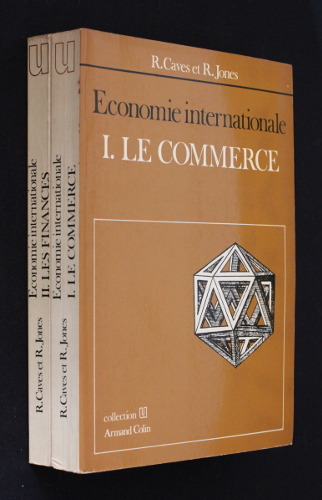
1981ql853Armand Colin Collection U Broché 1981 Deux volumes in-8 (17x23 cm), brochés, couvertures rempliées, 319-223 pages, traduit par Guilène Seigneurin, sous la direction de Patrick Messerlin, avant-propos de P. Messerlin, tome I : 'Le commerce', tome 2 : 'Les finances' ; pliures au dos du tome I, coiffes et coins légèrement frottés, bon état. Livraison a domicile (La Poste) ou en Mondial Relay sur simple demande.
1981RO60055526Armand Colin. 1981. In-8. Broché. Bon état, Couv. convenable, Dos plié, Intérieur frais. 319 + 223 pages. Illustrés de nombreux graphiques en noir et blanc dans le texte. Nombreuses annotations dans le texte (ouvrage de travail). Tranche du tome I légèrement salie.. . . . Classification Dewey : 330-Economie