CHAUVIN, BenoîtLivre Rare Book
55 résultats
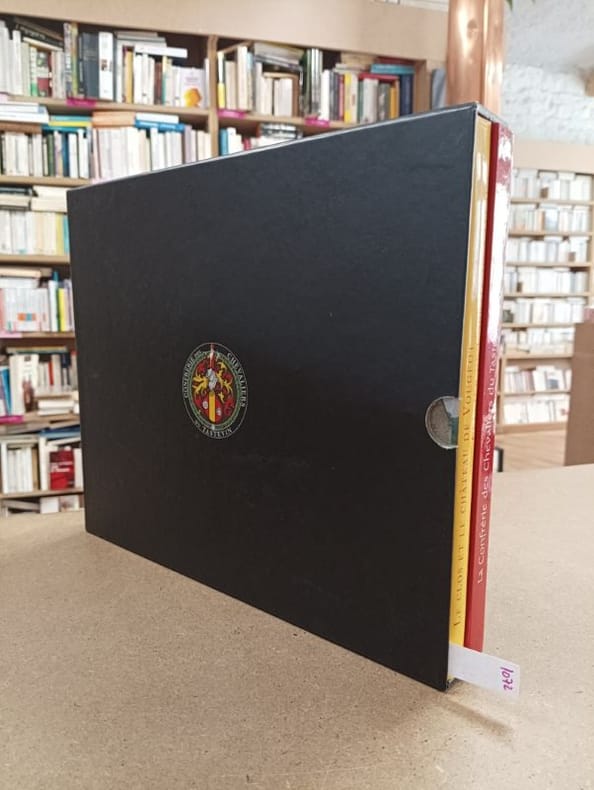
201910722019 - reliure - Editions du Tastevin - Confrérie des Chevaliers du Tastevin - 2008 & 2019 - 2 volumes in-4, format à l'italienne (24,5 x 30,5 cm) cartonnés, dans leur emboîtage - 222 + 203 pages - Très nombreuses photographies - ISBN : 9782951281837 / 9782951281868 - Le premier volume, écrit par Benoit Chauvin, est une reliure toile sous jaquette de l'éditeur - A PROPOS : Coffret réunissant deux ouvrages consacrés au patrimoine historique, architectural et viticole de la Bourgogne. Le premier volume retrace l'histoire du Clos et du château du Vougeot, ancien cellier de l'abbaye de Cîteaux et haut lieu de la viticulture bourguignonne. Le second est dédié à la Confrérie des Chevaliers du Tastevin, à son histoire, à ses traditions et à son action en faveur de la promotion des grands vins de Bourgogne et de la culture viticole régionale
201273883Washington DC: National Defense University Press 2012. Revised and Updated First printing thus. Wraps. Very good. 4 64 pages. Notes. The longstanding efforts of the international community writ large to exclude weapons of mass destruction WMD from international competition and conflict could be undermined in 2030. The proliferation of these weapons is likely to be harder to prevent and thus potentially more prevalent. Nuclear weapons are likely to play a more significant role in the international security environment and current constraints on the proliferation and use of chemical and biological weapons could diminish. There will be greater scope for WMD terrorism though it is not possible to predict the frequency or severity of any future employment of WMD. New forms of WMD—beyond chemical biological radiological and nuclear weapons—are unlikely to emerge by 2030 but cyber weapons will probably be capable of inflicting such widespread disruption that the United States may become as reliant on the threat to impose unacceptable costs to deter large-scale cyber attack as it currently is to deter the use of WMD. The definition of weapons of mass destruction will remain uncertain and controversial in 2030 and its value as an analytic category will be increasingly open to question. These conclusions about the future of WMD derive from judgments about relevant technological and geopolitical developments out to 2030. Technological developments will shape what WMD capabilities will be achievable in that timeframe while geopolitical developments will shape motivations to acquire and use WMD. The Center for the Study of Weapons of Mass Destruction is at the forefront of education and research on the impact of weapons of mass destruction WMD on U.S. and global security. The Center was established in 1994 as the Center for Counterproliferation Research at the request of then Assistant Secretary of Defense Ashton Carter as an outgrowth of the Defense Counterproliferation Initiative. Ambassador Robert Joseph who later served as a Special Assistant to the President on the National Security Council staff and as an Under Secretary of State under President George W. Bush served as the Center's first Director. In 2001 Dr. John Reichart succeeded Ambassador Joseph as Director and the Center expanded its research from WMD challenges to the military to encompass a full spectrum of WMD issues affecting a broad set of U.S. government departments and agencies. In 2004 the Center for Counterproliferation Research changed its name to the Center for the Study of Weapons of Mass Destruction to reflect this change in mission. In 2008 pursuant to the Chairman Joint Chiefs of Staff Instruction 1801.01C the Center became the focal point for WMD education in Joint Professional Military Education. In 2015 Mr. Charles Lutes succeeded Dr. Reichart as Director following Dr. Reichart's retirement after more than forty years of government service. Throughout its history the Center has maintained a broad mandate for education research and outreach and has pursued ambitious initiatives in these areas. Its research contributes to the understanding of the security implications of WMD as well as to the challenge of fashioning effective responses. The Center is actively engaged on pressing and emerging WMD issues such as interdiction elimination consequence management deterrence and escalation management. It also examines responses to new and evolving WMD threats including nuclear terrorism bioterrorism and nontraditional agents and assists combatant commands in preparing to deal with the operational impact of chemical and biological weapons. Through its education research and outreach programs the Center seeks to enhance awareness in the next generation of military and civilian leaders of the WMD threat. In addition to the Center's courses on countering WMD and consequence management at National Defense University staff members also lecture on WMD issues widely and across the academic and operational spectrum. The Center is building a cadre of future leaders knowledgeable about WMD through its innovative Program for Emerging Leaders. It also administers a unique Master of Science in WMD Studies program for DoD personnel in conjunction with Missouri State University. The Center further hosts an annual symposium and monthly WMD Spotlight Seminars to address topical WMD issues as well as other conferences workshops and seminars throughout the year. National Defense University Press paperback
2007AME_9780521677530Cambridge University Press 2007. 3rd. Paperback. New/New. Cambridge University Press paperback
2007SKU0508896Cambridge University Press 2007-07-23. Paperback. Good. Textbook May Have Highlights Notes and/or Underlining BOOK ONLYNO ACCESS CODE NO CD Ships with Emailed Tracking Cambridge University Press paperback
2002DADAX0674008081Harvard University Press 2002-04-30. Revised. paperback. New. 6.14x1.16x9.21. Buy with confidence. Excellent Customer Service & Return policy. Harvard University Press paperback
2008NENE-353-02-09-2022Routledge 2008-11-28. paperback. Good. 7x0x9. clean used paperback copy some highlights/ markings on the pages no stains fast shipping with tracking number. Routledge paperback
2007DADAX052186013XCambridge University Press 2007-07-23. 3. hardcover. New. 6.00x1.00x9.00. Buy with confidence. Excellent Customer Service & Return policy. Cambridge University Press hardcover
2007DADAX052167753XCambridge University Press 2007-07-23. 3. paperback. New. 6.25x0.91x9.25. Buy with confidence. Excellent Customer Service & Return policy. Cambridge University Press paperback
2007DBS-9780521677530Cambridge University Press 2007. 3rd. Paperback. New. Cambridge University Press paperback
2007DBS-9780521677530Cambridge University Press 2007. 3rd. Paperback. New. Cambridge University Press paperback
2002x-0674008081Harvard Univ Pr 2002. Paperback. New. 464 pages. 9.25x6.25x1.25 inches. Harvard Univ Pr paperback
2002Q-0674008081Harvard University Press 2002-04-30. Paperback. New. In shrink wrap. Looks like an interesting title! Harvard University Press paperback
2013DADAX0415862876Routledge 2013-12-16. 1. paperback. New. 7.44x1.34x9.69. Buy with confidence. Excellent Customer Service & Return policy. Routledge paperback
2001Q-0321089049Addison Wesley 2001-07-30. Hardcover. New. In shrink wrap. Looks like an interesting title! Addison Wesley hardcover
2007x-052167753XCambridge Univ Pr 2007. Paperback. New. 3rd edition. 391 pages. 9.00x6.00x1.25 inches. Cambridge Univ Pr paperback
2019x-1138084867Taylor & Francis 2019. Paperback. New. 2nd edition. 188 pages. 9.50x7.00x0.50 inches. Taylor & Francis paperback
2013x-1461377161Springer Verlag 2013. Paperback. New. 558 pages. 9.61x6.69x1.28 inches. Springer Verlag paperback
2007Q-052167753XCambridge University Press 2007-07-23. Paperback. New. In shrink wrap. Looks like an interesting title! Cambridge University Press paperback
2008Q-0415774217Routledge 2008-11-28. Paperback. New. In shrink wrap. Looks like an interesting title! Routledge paperback
20032090202118205081Nihon Keizai Shimbun 2003. Soft Cover. Fine. The book is in fine condition. Nihon Keizai Shimbun paperback
20032092902137503128Nihon Keizai Shimbun 2003. Soft Cover. Fine. Size: A5 size Number of books: 1 book Nihon Keizai Shimbun paperback
2005SONG0674018788Harvard University Press 2005-09-15. hardcover. Used: Good. 6.02x1.18x8.64. Buy with confidence. Excellent Customer Service & Return policy. Harvard University Press hardcover
2003G0954445023I4N00Masterworks International 2003. Paperback. Very Good. May have limited writing in cover pages. Pages are unmarked. ~ ThriftBooks: Read More Spend Less.Dust jacket quality is not guaranteed. Masterworks International paperback
2005DADAX0674018788Harvard University Press 2005-09-15. hardcover. New. 6.02x1.18x8.64. Buy with confidence. Excellent Customer Service & Return policy. Harvard University Press hardcover
2007DBS.Management-9780521677Cambridge 2007. 3rd. Paperback. New. Cambridge paperback