Schofield, Jack: EditorMareMagnum

567 résultats
Features: Dick Laidman - from Bush to Boardroom; E & B flies the R44; Liberator VY241 - Chris Weicht recalls a tragedy in the lonely peaks of the BC Coast Range; Painting Klee Wyck - mural on Helijet's S-76 by Tony Coon; B-36B Bomber #2075 is ditched in B.C. in 1950 - The very first accident with nuclear weapons, as listed in the DOD summaries of accidents involving US nuclear weapons 1950-1980 - *little known B.C. history*; First Flight at 81!. Sound copy. Magazine
186817317BBBonn, Cohen Verlag. 1868. 8° 145 S. Hardcover, Halbleder. Rücken stark beschädigt, teilw. fehlend, Einband stärker berieben, Seiten gebräunt.
19982090502113707012Not Available 1998. Soft Cover. Fine. The book is in fine condition. Not Available paperback
2011255879Haynes Publishing, 2011.
1985255917Museum of Flight Publications, 1985.
198 pages. Index. Glossary. Profusely illustrated with reproductions of black and white photos and twelve in color. "Flying for the first time in December 1947, the XB-47 prototype proved single-handedly that large swept-wing aircraft were feasible. In the process it also paved the way for other military machines like the B-52 Stratofortress and the KC-135 Stratotanker as well as the hugely successful Model 707 and 747 commercial jetliners. Best remembered as a medium bomber with SAC at the height of the Cold War, today few of the 2,042 B-47s survive to recall the days when it formed a key element in the defence of the United States." - back cover. Moderate sunning to spine. Clean and unmarked with light wear. A sound copy. Book
Folio, 143 pages, illustrated. eng
171 pages. Profusely illustrated with black and white reproductions of photos. "Tells the story of the training of Tom Dixon. We see him arrive at the Army Air Base training school and after a rigid and comprehensive course we find him starting off for 'Shangri-la' in a great Liberator assigned to combat duty, proudly wearing the wings of a Bombardier." - dust jacket. Intended for younger readers but interesting to all. Former library copy with usual markings. Lacking title page. Above-average wear to dust jacket now preserved in glossy new archival-grade Brodart. A worthy vintage copy. Book
1946AVI157M1946 / 86 pages. Broché. Editions Albin Michel.
20032828CBMainz, H. Leiwig - Eigenverlag, 2003. 4°, 176 S. mit zahlr. s/w-Abbildungen, illustr. original Kartonage (Paperback), 3., überarbeitete Auflage Einbanddeckel am Kopfschnitt mit einer kleinen Knickspur und zum Fußschnitt ein winziges Löchlein (auch auf Titelseite), am Fußschnitt minimal angestoßen, sonst schönes, sauberes Exemplar (milit-K - A)
1975118614Heyne Verlag um, 1975.
126 pages. Many excellent black and white photos plus substantial text. "The Air Ministry's account of Bomber Command's Offensive Against the Axis September, 1939 - July, 1941." - subtitle. Above-average wear. Binding intact. Unmarked. A sound working copy. Book
Sm. folio, with photographic title-spread and very numerous photographs throughout; laminated photographic boards, blue endpapers, a near fine copy in price-clipped dustwrapper.
Includes recollections/contributions by R.J.P. Warren; John "Swiftly" Swallow; Leslie Temple, ex 101 Sqdn.; Eric Clarke (F/Lt W E. 49 Sqdn. RAF Scampton), Frank Metcalfe, Squadron Leader Alec Cranswick, Ted Cachart; David Clark. Article: The Lost Crew of Lancaster JB659, 97 Squadron Reunited. Unmarked. Somewhat above-average external soiling and wear. Book
8vo., First Edition thus, with frontispiece, and very numerous photographs, illustrations and maps throughout, and endpaper maps; pictorial boards, black cloth back lettered in yellow and white, a fine copy in publisher's blocked board slip-case.
8vo., Second Impression, with photographs in the text and large folding map; pictorial wrappers, a near fine copy.
Roy. 8vo., First Edition, with very numerous photographs and illustrations throughout, black cloth, gilt back, a very good, clean copy in unclipped dustwrapper. Well-illustrated pictorial history of the RAF's most publicised Bomber Group. Enser, p.30.
8vo., First Edition, with 67 photographs, 5 maps (2 double-page) and 4 charts (2 double-page) in the text, gift inscription on front free endpaper; black cloth, gilt back, a near fine copy in unclipped dustwrapper. The definitive biography, and the first to benefit from access to Harris's extensive private papers. The author was formerly Director of RAF Education and subsequently Head of the Air Historical Branch. He was also a co-founder of the RAF Historical Society.
8vo., First Edition, with plates and maps; blue cloth, gilt back, blue endpapers, a very good, bright, clean copy in unclipped dustwrapper. Enser, p.154.
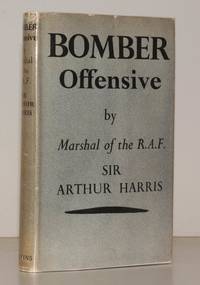
194751027Collins 1947. 8vo. First Edition with endpaper maps; grey cloth gilt back a very good bright clean copy in unclipped lightly browned dustwrapper. VERY SCARCE INDEED IN THIS CONDITION. Marshal of the Royal Air Force Sir Arthur 'Bomber' Harris 1892-1984 was Commander in Chief Bomber Command from 1942 when he replaced Richard Peirse to 1945. Based on his experiences in London during the Blitz Harris developed a belief in intensive incendiary bombing as a means not merely of destroying cities but of undermining civilian morale. His new concept of 'area bombing' was put into practice with the first 'thousand-bomber' raid on Cologne in May 1942. Like most large-scale innovations this was a major gamble but its undoubted success colossal damage inflicted for the loss of forty aircraft paved the way for Britain's bombing strategy for the rest of the war. Eventually this policy which remains controversial to this day brought him into direct conflict with both Portal and Churchill but Harris pursued it doggedly until the surrender. Arguably the greatest RAF commander of WWII Harris was an outstanding and inspiring leader achieving almost iconic status among staff and crews alike. After the war he refused a peerage but accepted a baronetcy in 1953. Enser p.65. Collins, hardcover
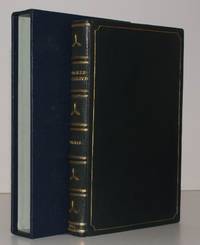
194746354Collins 1947. 8vo. First Edition with endpaper map; elegantly bound in full navy crushed morocco sides with gilt frame border back with raised bands second and fourth compartments ruled and lettered in gilt all other compartments tooled in gilt with propeller motif gilt top hand-made endpapers ribbon marker front panel and front fold-in of dustwrapper mounted on new and separate leaves at front custom-made slip-case a most attractive copy ideal as a gift or for presentation. LOOSELY INSERTED IS A T.L.s FROM THE AUTHOR TYPED AND SIGNED ON FERRY HOUSE STATIONERY AND DATED 1979. THE LETTER IS WRITTEN TO THE BBC WRITER AND PRODUCER W N B RICHARDSON AND RELATES TO A BROADCAST PROGRAMME: 'I have no particular objection to any of the sentiments expressed in it.' COMPLETE WITH THE ORIGINAL ENVELOPE ADDRESSED IN THE AUTHOR'S HAND. Marshal of the Royal Air Force Sir Arthur 'Bomber' Harris 1892-1984 was Commander in Chief Bomber Command from 1942 when he replaced Richard Peirse to 1945. Based on his experiences in London during the Blitz Harris developed a belief in intensive incendiary bombing as a means not merely of destroying cities but of undermining civilian morale. His new concept of 'area bombing' was put into practice with the first 'thousand-bomber' raid on Cologne in May 1942. Like most large-scale innovations this was a major gamble but its undoubted success colossal damage inflicted for the loss of forty aircraft paved the way for Britain's bombing strategy for the rest of the war. Eventually this policy which remains controversial to this day brought him into direct conflict with both Portal and Churchill but Harris pursued it doggedly until the surrender. Arguably the greatest RAF commander of WWII Harris was an outstanding and inspiring leader achieving almost iconic status among staff and crews alike. After the war he refused a peerage but accepted a baronetcy in 1953. VERY SCARCE IN THIS CONDITION. Enser p.65. Collins, hardcover
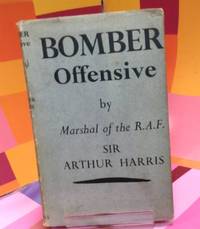
417814Collins. Hardcover. Fair. THERE ARE NO TARIFFS OR CUSTOMS DUTIES ON BOOKS. Marshal of the Royal Air Force Sir Arthur 'Bomber' Harris 1892-1984 was Commander in Chief Bomber Command from 1942 to 1945. Based on his experiences in London during the Blitz Harris developed a belief in intensive incendiary bombing as a means not merely of destroying cities but of undermining civilian morale. His new concept of 'area bombing' was put into practice with the first 'thousand-bomber' raid on Cologne in May 1942.This is a first edition published by Collins in 1947. It has evident signs of wear and tear and shelf life but is otherwise in fair condition for it's age. Collins hardcover
8vo., First Edition, with endpaper maps; grey cloth, gilt back, top lightly dust-soiled else a very good, bright, clean copy in unclipped, moderately age-soiled dustwrapper. Marshal of the Royal Air Force Sir Arthur 'Bomber' Harris (1892-1984) was Commander in Chief Bomber Command from 1942 (when he replaced Richard Peirse) to 1945. Based on his experiences in London during the Blitz, Harris developed a belief in intensive incendiary bombing as a means not merely of destroying cities but of undermining civilian morale. His new concept of 'area bombing' was put into practice with the first 'thousand-bomber' raid on Cologne in May 1942. Like most large-scale innovations this was a major gamble, but its undoubted success (colossal damage inflicted for the loss of forty aircraft) paved the way for Britain's bombing strategy for the rest of the war. Eventually this policy (which remains controversial to this day) brought him into direct conflict with both Portal and Churchill, but Harris pursued it doggedly until the surrender. Arguably the greatest RAF commander of WWII, Harris was an outstanding and inspiring leader, achieving almost iconic status among staff and crews alike. After the war he refused a peerage but accepted a baronetcy in 1953. SCARCE IN THIS CONDITION. Enser, p.65.
8vo., First Edition, with endpaper maps; elegantly bound in full navy crushed morocco, sides with gilt frame border, back with raised bands, second and fourth compartments ruled and lettered in gilt, all other compartments tooled in gilt with propeller motif, gilt top, hand-made endpapers, ribbon marker, custom-made slip-case, a most attractive copy ideal as a gift or for presentation. Marshal of the Royal Air Force Sir Arthur 'Bomber' Harris (1892-1984) was Commander in Chief Bomber Command from 1942 (when he replaced Richard Peirse) to 1945. Based on his experiences in London during the Blitz, Harris developed a belief in intensive incendiary bombing as a means not merely of destroying cities but of undermining civilian morale. His new concept of 'area bombing' was put into practice with the first 'thousand-bomber' raid on Cologne in May 1942. Like most large-scale innovations this was a major gamble, but its undoubted success (colossal damage inflicted for the loss of forty aircraft) paved the way for Britain's bombing strategy for the rest of the war. Eventually this policy (which remains controversial to this day) brought him into direct conflict with both Portal and Churchill, but Harris pursued it doggedly until the surrender. Arguably the greatest RAF commander of WWII, Harris was an outstanding and inspiring leader, achieving almost iconic status among staff and crews alike. After the war he refused a peerage but accepted a baronetcy in 1953. Enser, p.65.
Sm. folio, First Edition, with photographs and maps throughout; black cloth, gilt back, a near fine copy in unclipped dustwrapper. With personal bookplate on front free endpaper.