Committee of the RegimentBiblio.com
421 résultats
2007DADAX0548500622Kessinger Publishing 2007-09-12. paperback. New. 6.00x1.63x9.00. Buy with confidence. Excellent Customer Service & Return policy. Kessinger Publishing paperback
1333644248.Gpaperback. Good. Access codes and supplements are not guaranteed with used items. May be an ex-library book. paperback
1963111111111449Generic 1963-01-01. Hardcover. Very Good. 0x0x0. United States Army Training Center Infantry; Fort Jackson 1963. Hardcover. Book is large additional shipping cost may apply. A Very Good blue binding with gilt lettering and embossed lettering on front board and paper color illustration on front board binding sturdy and intact some handling/rub marks to boards couple of small abrasions top front board edge bit of age toning to pages discoloration to verso front free endpaper slightly upward lifting of front board some scattered foxing top text block edge and top board edges few pages with ink check marks and ink notes previous owner info in ink front pastedown without Dust wrapper. A nice and clean copy. 4toquarto or approx. 11.5 x 13.5 inches unpaginated color and b&w illustrations. We pack securely and ship daily with delivery confirmation on every book. The picture on the listing page is of the actual book for sale. Additional Scans are available for any item please inquire. Generic hardcover
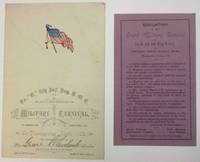
188537814Santa Rosa 1885. Engraved invitation top flap with color illustration of American flag. Bottom half in several elegant type styles and fonts. "Grover Cleveland" in manuscript. Mild wear Very Good.<br /> offered with REGULATIONS OF THE GRAND MILITARY CARNIVAL OF CO. E. 5TH INF. REG. N.G.C. AT ARMORY RINK SANTA ROSA THANKSGIVING EVENING 1885. Small broadside 3-1/2" x 5-3/4" on purple paper listing rules 1-9 with ticket prices Floor Tickets $2; Spectators' Tickets $1. Very Good.<br /> <br /> The elegant Invitation is from the National Guard Corps on Thanksgiving 1885. Whether President Cleveland made the trip from Washington to Santa Rosa is doubtful. Regulations required guests to be "masked and in costume." Moreover "Sharp weapons must be secured to the scabbard. Firearms examined by the committee. unknown
19182092902138200775Imperial Regiment History Publishing Society 1918. Soft Cover. Fine. Number of pages: 154 pages Size: B6 size Number of books: 1 volume Imperial Regiment History Publishing Society paperback
19302092902138200983Kawaryudo Kobayashi Matashichi Branch 1930. Soft Cover. Fine. Number of pages: 240 pages Size: A5 size Number of books: 1 volume Kawaryudo Kobayashi Matashichi Branch paperback
1017434085.Ghardcover. Good. Access codes and supplements are not guaranteed with used items. May be an ex-library book. hardcover
45320Printed for the Author and Sold by J. Robson T. Payne Messrs. Cadell et al. London. 1799. First edition. SCARCE. viii 316pp. The military travels of Croker presented in a series of letters a few years before the Peninsular Wars. The tone is very honest and engaging. In one town the locals decided that it would be fun to throw stones at the troups and only stopped their sport when the use of guns were threatened. Croker writes in detail about the food and wine and is also very observant of the interest the Spanish men pay to the English women that travel with the soldiers. Recently rebound in quarter maroon calf and marbled boards original endpapers and half-title present. Some occ. light foxing one page has a close short tear to margin not affecting text. The pages are remarkably clean and fresh and the volume is very sound. Please contact us for photographs. hardcover
19339101C1933. Tschechoslowakei. 1933-35. ca. 205 x 15 cm. ca. 80 S. Original-Leinen mit goldgeprägtem Deckeltitel. Einband leicht berieben Deckel etwas gebogen. Innen zahlreiche private ganzseitige Einträge und Illustrationen. Altersentsprechend guter Zustand. Das Album zur Dienstzeit eines Soldaten besteht aus deutschsprachigen Einträgen von Kameraden zum Zwecke der Erinnerung an die gemeinsame Dienstzeit und aus Einträgen des Albumeigners selbst. Diese Einträge sind teils tagebuchartig teils sind es eher Verse zur Selbsterbauung. Die Einträge sind datiert und stammen meist aus 1934-1935. Die Soldaten waren scheinbar in ihrem Wehrdienst und wurden geschult die Naivität der Einträge scheint keine Berührung mit irgendeinem Kampfeinsatz zu kennen. Genannt sind Orte wie Nitra Zilina und Malazky welche allesamt in der heutigen Slowakei liegen und damals der Tschechoslowakei in den Jahren zwischen 1918 und 1938 zugehörten. Die Einträge sind alle in deutscher Sprache verfasst oft auch eher etwas holprig. Es scheint sich um das Album eines Deutschböhmers und Sudetendeutschen zu handeln der im Rahmen seiner tschechoslowakischen Soldatenzeit an diese Orte versetzt wurde. In mehreren Einträgen werden auch die Sehnsucht nach der Heimat und das Deutschsein zum Ausdruck gebracht. Ein längerer Eintrag des Albumbesitzers etwa zur Mitte des Albums trägt den Titel "Ein Deutscher Spruch!". Der mehrstrophige Text lautet: "Wenn alles reist wenn alles bricht du Deutsches Herz versage nicht. Versage nicht du Deutsches Land vergiss nicht unsere Bruderhand. / Versage nicht du Deutsches Herz versage nicht in Leid u. Schmerz. Denn einmal kommt die Zeit wo mann uns Deutschen doch befreit. / Halte Deiner Heimat heiligerscholle Deutsch soll sie bleiben komme was wolle komme was wolle Freud oder Leid Deutsch soll sie bleiben in Ewigkeit!" Es sieht so aus als hätte dieser Soldat das Jahr 1938 und den Einmarsch der Wehrmacht am 1.10.1938 kaum erwarten können. Interessante historische Archivalie privater Hand aus der Tschechoslowakei vor 1938! unknown
0259583219.Gpaperback. Good. Access codes and supplements are not guaranteed with used items. May be an ex-library book. paperback
200000221109NICOSIA CYPRUS: CASSOULIDES & SON. BOUND IN HALF BROWN LEATHER WITH YELLOW CLOTH BOARDS AND BRIGHT GILT TITLES TO FRONT BOARD AND SPINE THIS 2000 LIMITED EDITION OF 1000 IS REPRINTED FROM THE 1885 FIRST EDITION PUBLISHED BY J.W. WILLIAMSON IN LIMASSOL CYPRUS. THIS NEW AND ENLARGED EDITION IS EDITED BY PHILIP CHRISTIAN AND CONTAINS THE FOLLOWING ITEMS. EDITOR'S PREFACE BIOGRAPHICAL NOTE OF MAJOR BENJAMIN DONNE RECORD OF DONNE'S MILITARY SERVICE WITH MEDALS AND PROMOTIONS DONNE'S CYPRUS JOUNAL RECORDS OF OTTOMAN CONQUEST OF CYPRUS CYPRUS GUIDE AND DIRECTORY VICTORIAN ADVERTSBIBLIOGRAPHY. ILLUSTRATIONS THROUGHOUT PHOTOS PRINTS AND SKETCHES. CONDITION OF BOOK ALL VG . Very Good. Half Leather. Limited Edition. 2000. CASSOULIDES & SON hardcover
193636076Madrid 1936.- Una enorme hoja de papel couchet en Gran folio Imperial 62 x 104 cm. con el texto bilingüe español-francés profusamente ilustrada por ambas caras con fotografías en negro y que muestran los diversos daños causados a la población civil por los ataques de aviones enemigos sobre el barrio de Tetuán de las Victorias.- Buen estado en general algo debilitada por la parte de las dobleces. GUERRA CIVIL 1936-1939 Y EXILIO Libro en español Sin editorial paperback
193636075Madrid 1936.- 1 hoja en papel couché de Gran Folio Imperial apaisado 325 x 73 cm. con texto trilingüe español-francés-inglés profusamente ilustrada en sus dos caras con fotografías de Museo del Prado en las que se aprecia toda la destrucción que causaron los ataques llevados a cabo sobre Madrid el 16 de Noviembre entre 7 y 8 de la tarde.- Lleva noticia del entonces subdirector del Museo F. S. Sánchez Cantón y artículo del poeta Antonio Machado. Está en buenas condiciones aunque se han restaurado rajitas de las dobleces. GUERRA CIVIL 1936-1939 Y EXILIO Libro en español Sin editorial paperback
19292092902138200818Kyoto Regiment District General School Corps 1929. Soft Cover. Fine. Number of pages: 272 pages Size: A5 size Number of books: 1 volume Kyoto Regiment District General School Corps paperback
1974209020212280162910th Infantry Regiment History Publishing Society 1974. Soft Cover. Fine. Number of pages: 1030P Size: A5 10th Infantry Regiment History Publishing Society paperback
19832091202133401804Eighth Infantry Regiment History Compilation Committee A5 Edition 1983. Soft Cover. Fine. Number of pages: 851p Size: 22cm Eighth Infantry Regiment History Compilation Committee A5 Edition paperback
19302091502135710145Imperial Regiment History Publishing Society 1930. Soft Cover. Fine. The book is in fine condition. Imperial Regiment History Publishing Society paperback
19822091502135704094Shinodayama Cannon Four Association 1982. Soft Cover. Fine. The book is in fine condition. Shinodayama Cannon Four Association paperback
19782091502135415067Not Available 1978. Soft Cover. Fine. Number of books: 1 Not Available paperback
19822091502135501166Railway 15th Regiment Comrades Association 1982. Soft Cover. Fine. Number of pages: 343p Box size: 16x22cm Railway 15th Regiment Comrades Association paperback
17022The account of 'Events in 1855 and 1856' dated by Wrench from Park Lodge Baslow Derbyshire 1902. The duplicated letter dated 12 December 1880. The printed advertisement for talk at the School Baslow and dated 14 January 1881. Wrench was the son of a clergyman and well connected being presented to the Prince of Wales and staying at Chatsworth in his old age. His obituary in the British Medical Journal 27 April 1812 describes how he went out to the Crimea in 1854. 'He had been gazetted Assistant Surgeon to the 34th Regiment in November and joined it on its arrival in the Crimea. He served during the terrible winter of that year and was present at the capture of the quarries the successful assault on the Redan of June 18th and the final capture of Sebastopol on September 8th 1855. He was mentioned in despatches and received the Crimean medal and clasp for Sebastopol and the Turkish medal.' Wrench's own account of his experiences in the Crimea Item One below – entirely unpublished – is a personal one vividly-written and full of detail. It does not appear to be present in the collection of his family papers at Nottingham University Library. ONE: Manuscript consisting of 'Events in 1855' 4pp and '1856 12pp making a total of 16pp. 8vo on twelve leaves attached with a stud. In good condition on aged and dogeared paper. The first page of the 1855 manuscript is headed '12 sic Pages in this Year' but comprises four numbered pages. The beginning of account sets the scene and gives an indication of the level of detail: 'The 1st Janry found me doing duty with the 28th Foot or Slashers in the 3rd. Divt of the army before Sebastopol having landed at Balaclava from the Ship "Queen of the South" on the 20th. Nov. 1854. On the 6th July I was ordered to do duty with the 50th. Foot but as I did not wish to move the weather being very bad and my tent being as comfortable or rather as little uncomfortable as it could be made except to join my own Regt. the 34th. to which I had been gazetted on the 1st. of December 1854. I applied to be sent to it and was ordered to join which I did on 9th of Janry.' The account is made up from diary entries and is none the less vivid and interesting for that: 'On the following morning a wounded Russian named Alexo was brought into our Hospital and we amputated his leg he did really well and was eventually exchanged at Odessa. Poor Jordan's death threw a great damp on the Regiment as he was the first Officer we had had killed. On the 9th. of April being Easter Monday the 2nd. Bombardment took place. It was a fearfully wet windy day so that no one was able to go out to see what damage was done. On the 10th. I was on trenches and the noise was terrific but nothing to what I have since heard. I had a very narrow escape from a round shot which hopped over the parapet close to where I was.' In June 'after 68 hours bombardment an assault was made on the Quarries by ourselves . I did not go down till about 8 with Robinson Scott & Peel and 100 men. We were marching about the Trenches half the night and were finally sent to the middle ravine just below Mamelon. The scene there was most horrible the ground being strewn with dead & wounded. English French & Russians. One poor Russian boy was dragged up by two Zouaves but fainted just opposite to where we were lying. I got a light and found he was shot through the belly and that nothing could be done for him. I gave him some water and he lie sic by me some time but died before morning. I got an amulet off his neck & his cap pouch which I sent home'. The 1856 account begins in dramatic style: 'The first entry in this Diary relates to the explosion which took place within the British Lines during the Siege of Sebastopol. Feb 3rd. I was not many hundred yards from this explosion when it took place & will here relate now Janry 1900 my recollection of it. It took place in Novr. or Decr. 1855. I had just come in from a ride & had given my horse to my Batman when I noticed a vast cloud of smoke shoot up from the Right Siege train an open air arsenal about 500 yds from my house - a tremendous noise of explosion followed & knowing that there would be a rain of missiles from above to fall immediately I jumped under my doorway - hoping the strong lintel would protect me . a shower of fragments fell around me rattling on my iron roof - and wounding many men in the Regiment - 70 men were killed by the explosion some over half a mile off. The artillery horses were passing in front of my door to water & stampeded hurting several men in their rush. Both my horse and my dog bolted. I got the horse back in a few hours - but my dog taken sic a few weeks before out of Sebastopol returned to her old home and was found there weeks afterwards I brought her to England My house that I had just finished building myself did not sustain much damage. .' The account continues packed with incident. At one point he writes: 'I had written the above in 1859 and continue it forty one years after November 4 1900. The events & fights of May 1856 being written so legibly in my brain that I can read much of what we did & said. Alas all the actors except myself are passed away. My notice has been called to the excursion by reading an Illustrated article in a magazine named "Travel" in which Dr. Hy. Lansell has been describing a tour taken last year over the same ground - so little altered from what I saw in 1856 that his description would do for mine'. The diary concludes in fine style. On 2 May 1856 he goes to Yalta where he finds 'the daughters of the English Clerk of the Works of Prince W's Palace were keeping the Hotel a very rough primitive structure low stone built rooms with a long rough wooden verandah overlooking the lovely Bay - We enjoyed an excellent dinner of Turbot & Oyster Sauce & a bottle of excellent local wine like Hock - as we returned we went over the Emperor's Villa Orianda . One day when I remember seeing for the first time a Persian horizontal Water Wheel in a very pretty village embosomed in Walnut Trees where also I bought an embroidered linen neck scarf which I still possess - On another occasion I accompanied Best & Chapman to the Alma & where I picked up the Russian Cannon Ball now on top of the Study Clock - I tried hard to get someone to accompany me to Bagshi Serai & Chuphut Kale but I had to go alone - I wonder now how I dare. For it was in the heart of the Enemies Country. I remember the Priest spit when I went near them in the Church in the Rock and I rode home at night through the Russian Camp on the river Balbec. I certainly felt no fear but that was the Ignorance of youth'. A final note more than half a page long records a meeting at Chatsworth in 1902 with Grand Duke Michael and his wife the Countess Torby. TWO: Duplicated letter by Wrench a hectograph in purple ink intended for circulation among his 'dear children'. 4pp. 12mo. Bifolium. In fair condition on aged and lightly-creased paper. Signed 'E. M. Wrench'. At the beginning is a half-page drawing by Wrench captioned 'Russian Soldier - In the Valley of the Shadow of Death. near Sebastopol - 1855 on Black Sea in the distance'. He describes a lecture he gave at Bakewell the previous Monday on the Siege of Sebastopol beginning 'I began by describing the terrible state of the hospital at Balaclava in November 1854. I had a ward full of wounded from Inkerman with bad cases of fever & cholera - All the windows had been blown out by the great storm of November the 14th. The sick had no beds and often nothing to eat until 3 or 4 oclock in the afternoon. The harbour of Balaclava was crowded with steamers while the coast near was strewn with the wrecks of the 21 ships that had gone down in the storm. .' The letter continues with much valuable detail and a drawing of a 'Section of "sunk" tent with fire place' on the third page. In the final paragraph he reports that 'Lord Edward Cavendish M.P. took the chair at my lecture. The room was quite full and some of the audience had come 8 or 10 miles to hear me.' THREE: Printed handbill advertisement with duplicated illustration another purple hectograph by Wrench on reverse joke featuring two soldiers and a horse and cart. 1p. 12mo. In good condition on lightly-aged paper. The printed advertisement is crisply printed and the date '14th' is added in red ink. It reads: 'A Lecture will be delivered in the School Baslow On Friday January 14th. 1881 At 7.30 p.m. By E. M. Wrench F.R.G.S. entitled Personal recollections of the Siege of Sebastopol. Illustrated by Drawings &c. Admission One Penny. No Change given at the Door.' The account of 'Events in 1855 [and 1856]' dated by Wrench from Park Lodge, Baslow [Derbyshire], 1902. The duplicated letter dat unknown
17021Two duplicate letters one dated from Park Lodge Baslow Derbyshire on 23 December 1907 and 'Christmas 1907'; and the other from the same place 'Aug 1909' and 13 September 1909. Third duplicate and typescript without place or date. Wrench was the son of a clergyman and well educated and well connected being presented to the Prince of Wales and staying at Chatsworth in his old age. His obituary in the British Medical Journal 27 April 1912 describes how after service in the Crimea 'he was transferred to the 4th Lancers went to Madras with that regiment in the following month and served with it during the whole of the Indian Mutiny. For his services in India he received the Indian medal and clasp for Central India. He returned to England in 1860 and married in 1861 his cousin the daughter of Mr. William Kirke of Markham Hall Nottinghamshire'. The four items in the present collection are all in good condition on lightly-aged paper. The three duplicates - all closely and neatly written in a vivid and informative style - are among ones produced by Wrench for circulation within his family there being copies in the collection of Wrench papers in Nottingham University Library. They comprise two letters and a narrative account. The typescript by an unnamed individual is not present at Nottingham. None of the four items is in the Imperial War Museum catalogue. ONE: Duplicate of Autograph Letter by Wrench 'Edwd M Wrench M.V.O - F.R.C.S. late asst Sugeon 12 R Lancers'. Dated at beginning 23 December 1907 and at end 'Christmas 1907 - Park Lodge Baslow Derbyshire'. The letter describes the 'Jubilee commemoration' at the Royal Albert Hall and is headed 'My last Parade'. It begins: 'It was indeed well done The dinner to the surviving Veterans who fought in the Indian Mutiny campaign in 1857 given by the proprietors of the London Daily Telegraph a procession of heart stirring episodes from the Inspection by F.M. Lord Roberts on the steps of the Albert Memorial where I found private Meredith of the 24th who was with me in the trenches at the assault on the Redan Sebastopol June 18 1855 to the surging chorus by the thousands in the Albert Hall of Auld Lang Syne near the end of what Lord Curzon in his thrilling speech said was a "ceremony" rather than a festival a speech that made the tears tremble on my eyelids. They overflowed at the solemn sounding of the "last post" recalling to my memory in the words of the poet O Hara a charge of the 12th Lancers I rode with at the battle of Banda .'. He names others present including 'Col Robertson . he was still the bravest of the brave for though 86 he was in velvet Levee dress silk stockings & pumps without a great coat. He told me he was a teetotaller his picturesque appearance attracted Lord Roberts eye and drew a heavy fire on us not of rifles but of snap shot cameras the result of which has been my portrait in such good company scattered by the hundreds of thousands in The Daily Mirror of Decr 24 . I have looked down the barrel of a loaded musket near enough to see a Sepoys yellow eyes taking aim at the butt end and ridden with cannon balls hopping over my head like balls in a cricket ground I cannot compare my perils during the Sepoy Mutiny to many others of the Kirke family'. 2pp. 8vo. TWO: Duplicate of Autograph Letter by Wrench 'Ed M Wrench'. Dated at beginning 'Park Lodge Baslow Aug 1909' and at end 13 September 1909. 3pp. 8vo. The letter begins: 'Having recently discovered that General W A Franks Major-General William Astell Franks 1838-1929 now living at Northland Road Southampton was present when Uncle Henry Kirke died when fleeing from the Mutineers of his Regt. 12 BNI in 1857 I took the liberty of writing to him he very kindly responded to my enquiries & I feel sure the information he has afforded will be interesting adding much to our scanty knowledge of that terrible time.' There follow extended transcriptions from Franks's letters: '. I saw him the day he died . he was on his horse but rolling about on it . he looked at me with a vacant stare & was deadly pale. I could see he was dying. Shortly after he fell off his horse he was the only one of our party that was buried all the rest being left where they fell .'. Of his own activities Wrench notes: 'I had gone to India almost direct from the Crimea in the year previous 1856. I was assistant Surgeon in the 12th Lancers so was never in the same danger as the Officers of the Native Regiments though I had my share of dangers . and had men blown to pieces by shell not a dozen yards from me . We went not as is said to revenge the Mutiny but to protect the loyal natives of which there were many & restore order yet in one battle we killed 500 rebels and looted two Palaces from one at Kabula we took 40 cart loads of gold & silver; my share of which was £750 . 0 . 0 so I have no personal grievance'. He continues with reference to the Battle of Banda and 'hunting rebels in the jungles'. THREE: Narrative account titled 'Cousin Henry Kirkes story of his escape from Mutineers June 1857'. The account begins: 'In 1857 Uncle Henry was commanding the Head Quarters of the 12th Bengal N.I. at Nowgong now spelt Naogaon Aunt Kirke Henry & St George were with him - He greatly distrusted the Sepoys and when he heard of the mutiny at Barrackpoor in April he immediately sent Aunt & St George off to the Hills just in time for they left Meerut only two days before the fatal 10 May'. A gripping account follows filled with incident: '. At the beginning of June Uncle heard that the left wing of his regiment stationed at Jhansi about sixty miles distant had killed the officers and all the Christian women and children there; Uncle forthwith ordered a parade and addressed the men. He told them of the mutiny of their comrades at Jhansi and added "Now I will let any man that wishes go and join the mutineers but let those who are true come and swear by the Colours". The whole 500 cheered and swore they would be true to him and the Colours. Two days afterwards they broke out into open mutiny shot the Regtl. Sergeant Major and made the officers fly for their lives. . The Europeans ten officers two ladies riding on Uncle's charger and a baby that Henry carried in front with a man riding behind him started for Banda. They asked a Brahmin the way he refused unless they gave him a rupee this Henry did when he ran off demanding another and swore by his gods that if given this he would be faithful but having got it he called to some villagers to come and kill the Faringhees for they had lots of money and so they would be rich for life. Some of the officers wished to shoot the man but Henry dissuaded them but presently the ruffian threw his lathi or club at the ladies horse which reared and they fell off. The man ran forward to kill them when Henry shot him through the back of the head he fell on his face. The villagers turned the dead man over and the two rupees fell out of his mouth when Henry heard them say "It is true they are rich for see they have loaded their guns with rupees". .'. 3pp. 8vo. FOUR: Mimeographed typescript titled '"Not to Revenge but to Protect."' 18pp. 8vo. Containing a transcriptions of Item One pp.16-18 and Item Three pp.4-9 and of passages from Item Two pp.13-15 with a commentary by a knowledgeable but unrelated party. Two duplicate letters, one dated from Park Lodge, Baslow, Derbyshire, on 23 December 1907 (and 'Christmas 1907'); and the other unknown
191441864Randolph VT: Buck Printing Co. 1914. 32 4 pp. Original staples original printed wrappers. Printed on glossy paper with frontispiece photo illustration of General Stephen Thomas tissue guard other full-page photo illustrations. Very Good.<br /> <br /> The heroism of this Vermont Regiment during the Civil War. Buck Printing Co. unknown
12219Without place and date 1960s. The account describes events in April and May 1945. 13pp. foolscap 8vo. Paginated 1 to 13 and signed at the end 'Ernie Wilmott'. On seven leaves stapled into grey covers with the title 'The Last Month' typed on the front cover. In good condition in worn wraps. The account commences: 'There had been gun fire from the west and the south for the last three days. Friday the 13th April 1945 the usual officials did not come to fetch the men but a little later than usual the Gaschwyz sic column was called so we assembled and left for work about 20 of us. There was a lot of activity in the station yard German military vehicles were coming and going and a contingent of unarmed Russian fatigue men were on parade.' A typically vivid passage reads: 'In the morning of the 24th April I heard chaps reporting prisoners passing through and our guards not interfering a lot of Indians were going through without any guards. Chaps with kit got up early because of being cold. I got up after seven and went outside and saw the Indians going through. A column of Russian prisoners appeared with guards and were halted just outside. The German guards were standing about in groups talking to each other and taking no notice of the prisoners some of whom were already making off. A man got up on a cart and addressed us he said he couldn't advise us to go he couldn't advise us to stay the German commandant had said that if we stayed he would do his best to obtain food for us there was a horse dying in the next village and he had the first refusal of it if it expired and we should have it.' The account ends on Wilmott's return: 'At London I bid my comrades of the last 2 years goodbye and got on a train at Paddington. It was a noisy journey ex P.O.W.'s one side of the compartment civilians the other we all talked at once. At Bristol I had to catch a bus home and suddenly realised I had to pay the fare it was more than 3 years since I had paid a fare anywhere.' The covering Autograph Letter Signed by Batt is signed 'Jack' on letterhead of 1 Churstonville Court 1 Overbury Avenue Beckenham Kent. 1p. 4to. Undated and with recipient's name not given. 'The writer Ernie Willmott sic spoke 4 Languages and was learning Russian whilst POW in Germany. As he spoke German he was chosen as Camp Leader of our working Camp at Gaschwitz-Leipzig. Our Common path of experience starts at Campo 53 Page 69 - from there we were together unitl the war ended or shared similar experiences.' In a postscript he adds that Wilmott 'was not in Campo 66 at Capua but in hospital at Caserta'. Also present is a Typed Letter Signed to Batt from 'Charles'. On letterhead of 99 South Eden Park Road Beckenham Kent. 21 June 1974. 1p. 8vo. The 'article on Sidi Nsir' brings back 'many memories' and he is enclosing 'The Story of 46 Division'. Without place and date (1960s?). The account describes events in April and May 1945. paperback
19190011016Coblenz Germany Benton Pa: Occupied Germany Coblenz Benton PA 56th Infantry. Good. 1919. Softcover. On offer is a superb pocket notebook kept by an American soldier in occupied Germany in the months immediately following World War One WW1. The author of this notebook is Ezra Skow. Little is known of Skow's early life. He was born in 1892 and enlisted in the U. S. Army in about September 1918 at the age of 25 or 26. Burial records in Benton PA indicate that he was attached to the 156th Infantry Regiment. However there was no 156th Infantry in the United States Order of Battle in WWI. In his notebook Skow records that he served in the 56th Infantry. This accords with the record of service of the 56th Infantry Regiment. The 56th Infantry Regiment was a regular infantry regiment in the United States Army. Its roots date back to the American Civil War where it served in the North's Army of the Potomac. It originated from personnel of the 17th Infantry Regiment in 1917 and fought in the region of Metz during World War I. In April 1919 a battalion of the 56th entered Metz as an honour guard for the Commanding General of the American Expeditionary Force John J. Pershing. Skow was married before joining the army. His wife Laura lived until 1987 passing away at the age of 93. Skow himself died in 1947 at the age of 57. His entries take the form of letters to his wife. They cover the period Jan 11 1919 through June 25 1919. In his diary Skow records several of the towns and cities in which his unit was stationed including Metz France Mulheim Metternich and other places in and around the city of Coblenz Germany. His entries speak about the day-to-day existence of a private soldier: "This is some place. Gee I wish I was home now. I would tell you a lot. The women are carrying their things on their back when they go to the store" Jan 13; ". I wrote you a letter tonight and send you the worlds clock too as I saw that today over at the city. And I was to see Charley Chaplin in the front line trenches and it was good. I would like to see you now. . I sit here at a Dutch table now writing notes and the Dutch man is reading the paper and his wife is talking out of the front window and you can see they are like but not quite as bad. Your Husband Ezra Skow xxxx" May 2; ". I was over to Coblenz today and wrote you a letter. And it is a fine day. I didn't do very much today. But believe me I would love to be home to loved you again. As I am getting tired of this life and will be able to tell you all about it when I get home . Your most lonely husband this side of the water. Ezra Skow" May 12. On June 4th he writes that he has learned his unit is going to be leaving the Coblenz area and hopefully heading home to the United States. In fact this is exactly what happened. By June 23rd he is in Fort Dix NJ and on the 25th he is out of the army. : ". I am out of the army now. Coming home to you dear." June 25. There are several other pages of note which include among other things the names and addresses of several other men - likely men he met and befriended. For a historian this is an outstanding piece of primary source material. It details the very ordinary day-to-day life of a soldier in WWI capturing his duties and his longing for home. For a regimental historian this fills in details of the history of their regiments. For a genealogist it offers some links to other Americans who served in that regiment. Measuring 5.25 inches by 3.5 inches this notebook contains 72 pages and is 85% complete. The book is in good condition. The binding and pages are intact. His handwriting is cramped but generally legible. ; Manuscripts; 24mo 5" - 6" tall; 72 pages; Keywords: handwritten manuscript document letter autograph writer hand written documents signed letters manuscripts historical holograph writers autographs personal memoir memorial antiquité contrat vélin document manuscrit papier antike brief pergament dokument manuskript papier oggetto d'antiquariato atto velina documento manoscritto carta antigüedad hecho vitela documento manuscrito papel 56th Infantry World War One US Army American soldier Occupied Germany . Occupied Germany, Coblenz, Benton, PA, 56th Infantry paperback