1 248 résultats
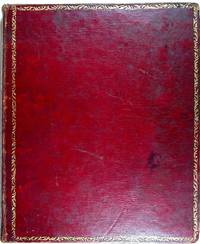
18612786np: np 1861. First edition. Original leather covers. Good. A REMARKABLY EXTENSIVE ARCHIVE OF A UNION SOLIDER INCLUDING DIARIES FROM 1861-1865 SPANNING HIS ENTIRE CIVIL WAR CAREER.<br /> <br /> THE SOLDIER CHARLES E. SMITH PARTICIPATED IN SOME OF THE MOST CRITICAL CAMPAIGNS OF THE WAR INCLUDING THE SEIGE OF VICKSBURG THE FALL OF ATLANTA AND SHERMAN'S MARCH TO THE SEA. Background:<br /> <br /> Charles E. Smith 1836-1905 was born in Berlin Township Ohio. He worked as a farmer and country schoolteacher in Alum Creek Delaware County Ohio. He enlisted in the 32nd Ohio Volunteer Infantry at the age of 25 on September 3 1861 and mustered in September 7 1861. He was promoted to the rank of corporal in Company I of the regiment on January 30 1864. He was slightly wounded on July 29 1864 during the Atlanta Campaign. He mustered out of the service on July 20 1865 at Louisville Kentucky.<br /> <br /> The 32nd Ohio Infantry was organized at Mansfield Ohio on August 20-September 7 1861 and mustered in for three years' service under the command of Colonel Thomas H. Ford. The regiment was involved in several important engagements and operations during the Civil War including the Battle of Greenbrier River the Battle of McDowell the Battle of Harpers Ferry the Battle of Champion Hill the Siege of Vicksburg the Atlanta Campaign the Battle of Jonesborough Sherman's March to the Sea the Carolinas Campaign and the Battle of Bentonville. The 32nd Ohio Infantry mustered out of service at Louisville Kentucky on July 20 1865.<br /> <br /> The Collection:<br /> <br /> The collection consists of 26 dairies dating from 1859 to 1866. Except for four volumes covering a period from 1856 to April 1861 and one covering the period September 18 1865 to December 5 1866 the remaining dairies 21 volumes span his entire Civil War career in the 32nd Ohio Volunteer Infantry covering the period September 3 1861 the date of his enlistment to the date of his mustering out of the service on July 20 1865. The diaries of various sizes average approximately 100 pages with few blank pages.<br /> <br /> His daily entries in his Civil War diaries many of which are detailed consist of descriptions of the weather diet geographical locations his devotion to the Union camp activities military news and description of engagements. He also included several drawings in the diaries some in color. He described his day of enlistment of September 3:<br /> <br /> "Enlisted at Lewis Center between 8 and 9 oclock in Captain Dyre's company of 3 years volunteers. I bid good bye to all my folks and started having resolved to assist in sustaining the Government. But the feelings which came over me when I left home friends and all that seemed dear to me I cannot describe."<br /> <br /> The new enlistees moved to Camp Dennison and Smith records the daily activities in camp as his company prepared for their first movement. From Camp Dennison the 32nd Ohio was ordered to western Virginia present-day West Virginia to assist in driving Confederate forces out of the region. On October 3 1861 the 32nd Ohio participated in the inconclusive Battle of Greenbrier River. Smith records in his diary beginning on September 29 through October 3:<br /> <br /> "In the evening we received orders to march to make an attack on Greenbrier about 12 miles distant. Our company numbered 86 men. Our regiment probably numbered 900 men present and able to perform duty. The 32nd. Went in advance and cleared out the road and took one prisoner. Our regiment stopped at the cross roads within four miles of Greenbrier and stopped. We expected there that the battle commenced. but they Confederate troops did not come and we. crept into the thick laurel bushes to lay till morning. When I awoke it was daylight and other regiments were passing. The artillery was hurrying along as fast as possible each gun was drawn by six horses and about nine oclock the canons began to roar. It was kept up till two oclock on both sides when our communication failed and our men withdrew from the field without losing any guns. The canons roared very loud and the sound rolled over the Mountains and valleys and made everything ring once more. Our loss was including those that were killed on the field and those that died of wounds after the battle about 12 men. We took 13 prisoners." <br /> <br /> Smith describes an engagement with Confederate forces around Beverly Virginia on December 18 1861:<br /> <br /> "The rebels came out and met our forces and a bloody fight ensued. The 32nd fought bravely and drove the enemy back. The 25th were in the advance and were cut up dreadfully. They fell back and the 32nd stood their ground and fought them like tigers. Our men made two or three gallant charges and drove them out of their entrenchments and were forced out themselves. Our boys could not drive them out again and after a desperate and bloody struggle our troops retreated. having lost about one hundred men."<br /> <br /> After spending the winter in Beverly Virginia the 32nd Ohio participated in the Shenandoah Campaign of 1862 where they engaged Stonewall Jackson's Confederate force at the Battle of McDowell Virginia on May 8 and were defeated. On that day Smith recorded the following:<br /> <br /> "We formed into line and gave three cheers to the cavalry and were waiting to welcome the infantry when a dispatch came for us to report immediately at headquarters armed and equipped. We went forthwith and formed into line of battle on an open field. The rebels came down on the hills & tried to pick a spot to plant a gun and our boys threw shell amongst and drove them out. The rebels gathered on a mountain at the right of town about 4000 men. Our boys did not find out what they were at or where they were till late in the afternoon. Two regiments went up the mountain and the ball was opened. The battle lasted till after 8 oclock at night when our boys withdrew bringing the wounded and mostly all the dead from the field. The fight lasted about 4 hours."<br /> <br /> The 32nd Ohio retreated to Franklin Virginia where they joined General John C. Fremont's command. Fremont followed the Confederates into the valley and engaged a Confederate force at Cross Keys Virginia on June 8 1862 but Smith's company did not participate in the action. The 32nd Ohio move on to Winchester Virginia where they performed garrison duty for the remainder of the summer.<br /> <br /> In September 1862 the 32nd Ohio was dispatched to Harper's Ferry. The regiment again faced Stonewall Jackson participating in the Battle of Harper's Ferry September 12-15 1862. In this engagement Jackson captured the town and nearly twelve thousand Union soldiers including the 32nd Ohio subsequently paroling them after confiscating their supplies. In his entry for September 15 Smith describes the last day of the battle:<br /> <br /> "At sunrise the ball opened with a heavy cannonade from both sides. Our men were nearly out of ammunition for artillery and the enemy was mowing down our ranks. The shells and shot came down like hail all around and amongst us and many of our officers and soldiers were mortally wounded. Our artillerists run out of ammunition and there was no other way for us to do than surrender or be slaughtered on the field. At about 8 oclock the stripes and stars were hauled down and the white flag waved as a signal for surrender. The rebel cavalry and officers were soon riding through our camp. They hoisted the bars and stars where an hour before our glorious old star spangled banner floated proudly in the breeze. O how my heart beat and my bosom heaved to see that corrupt flag raised in defiance over us."<br /> <br /> The surrender of the 32nd Ohio resulted in a revolt in the ranks of the enlisted men against the regiment's officers which Smith later discusses in a January 15 1863 entry in his diary stating: "we were obliged to surrender 11500 men to the Rebels General A.P. Hill. It was the opinion of nearly all of our men that Colonel Miles of Baltimore betrayed us into the hands of the Rebels. It was said that he got 15 cents per head for us. Our Col Thomas H. Ford was examined by a committee and dismissed from the service for blame that was unjustly laid against him for the evacuation of the Maryland Heights. Since we were paroled a hard feeling was created between the officers of the regiment." Smith and his regiment eventually rejoined General Ulysses Grant's Army of the Tennessee in Memphis on January 25 1863. The regiment was involved in Grant's Siege of Vicksburg beginning in April 1863.<br /> <br /> A pivotal engagement in Grant's Vicksburg Campaign was the Battle of Champion Hill which occurred on May 16 resulting in a Union victory. Smith's entry for that day records the fighting:<br /> <br /> "A battle had begun on the left the firing seemed to be from large guns and the line seemed to be several miles long. We halted to await orders. Soon they came & we went forward & laid behind a ridge where we could see the fighting. The scene was grand but terrible. The heavy fighting was on the left & center at first. Our brigade charged on a rebel battery and took it & hauled it off. The 32nd did a noble part charging on the hills & ravines and out the battery driving the enemy before them killing a large number."<br /> <br /> The siege of Vicksburg ended on July 4 1863 when the Confederate forces surrendered and the Union troops under Grant including the 32nd Ohio entered the city. Smith recorded the events of July 3 and 4 in his diary. On July 3 he wrote: "This is the 46th day of the Siege. The rebels have sustained at this place and nobly and bravely have they defended it but General Grant has been too much for them." The next day's entry detailed the surrender. "At nine oclock it was announced that Vicksburg was surrendered. What a thrill of joy ran through every heart. The boys all seem lively and jubilant over the success which has crowned our arms. At half past ten oclock the rebels march out of their forts and rifle pits. and form in line outside their works and stuck arms."<br /> <br /> After Vicksburg the 32nd Ohio joined an expedition to Monroe Louisiana and then participated in General James McPherson's expedition to Brownsville Mississippi. In addition to his daily entries Smith also drew a number of pencil and ink sketches that reflected what he described in on a particular day such as sketching images that depicted the sleeping arrangements in the soldiers' tents maps of terrains and a two-page spread showing the capture of a Confederate battery in Mississippi. He also wrote down poems whether written by him or others. For example on January 31 1864 he added a six-stanza poem possibly written by him entitled "Evening Thoughts" to that day's entry. A partial transcription reads: "I'm weary and I'm lonely//As I'm sitting in my tent//And I'll take my leaden pencil//And give you my feelings sent// O would this war be over//And these bloody strivings cease//And our country now distracted//Return with lasting peace."<br /> <br /> In February 3 to March 6 1864 the 32nd Ohio was involved in General William T. Sherman's Meridian Expedition which resulted in the capture of Meridian Mississippi. On March 3 Smith recorded a diary entry that detailed the destruction rendered by the campaign:<br /> <br /> "I cannot fully give the amount of damage done to the Southern Confederacy while on this Expedition but the result foots up about as follows. About 200 miles of railroad running east & west was destroyed. About 60 miles of the Mobile and Ohio railroad was destroyed and about 40 miles of the Central Mississippi road destroyed. There were about 25 Locomotives and a considerable number of cars together with Confederate railroad houses machine shops and foundries manufacturing establishments of arms ammunition. A large amount of cotton was burned."<br /> <br /> On June 10 1864 the 32nd Ohio joined Sherman's Atlanta Campaign. In the campaign the 32nd fought in the Battles of Kennesaw Mountain Atlanta Ezra Church and Jonesborough. The campaign ended on September 2 1864 when Union forces occupied Atlanta. Smith's diary entry for June 27 mentions the engagement at Kennesaw Mountain:<br /> <br /> "We were aroused at early dawn. and then ordered to pile our knapsacks and be ready to move. A battery had been brought up and was shelling the Rebels lively for a while. Our division having formed a line of battle came to a right shoulder shift arms and then we advanced in line through the woods toward the enemy. The skirmishers engaged the enemy who replied by volleys of musketry which whizzed overhead and sounded hideous. The rebels brought several batteries down and opened upon us. Moved up a little higher and laid down again and the rebels opened with shot and shell which came whizzing overhead. Some of them sung like an old spinning wheel under the control of a northern farmer's wife. Our loss in this engagement was considerable. We fell back learning that the rebels were massing their force to right and formed a new line of battle in front of our new breastworks and behind the skirmishers. Skirmishing was kept up lively along the lines and many had hair breadth escapes. We made our demonstration to draw as much rebel force away from the right as possible."<br /> <br /> His diary entry for September 3 1864 reported the good news concerning the fall of Atlanta:<br /> <br /> "Atlanta was evacuated yesterday morning at daylight the rebels having blown up large magazines of ammunition destroyed government stores and eighty carloads of ammunition. The Twentieth Corps under General Slocum marched into and took possession of the city of Atlanta an eleven oclock. We have last caused the rebels to evacuate what they called the 'Gate City' or 'Key' to the southern Confederacy and that without a very general battle. The rebels have made many boasting speeches and declared that they would fight for Atlanta till the last man woman and child was sacrificed before they would give it up. Where is their vain boasting where are their prophesies"<br /> <br /> The capture of Atlanta had a major impact on the presidential election of 1864 and helped President Lincoln's chances for reelection enormously. On election day November 8 the 32nd Ohio voted in the field. Smith's diary entry for the day reads "This being election day the polls were opened and we voted for President. Abe Lincoln carried the day."<br /> <br /> In mid-November 1864 the 32nd Ohio participated in General Sherman's "March to the Sea." The command engaged in no noteworthy battles or skirmishes until reaching Savannah Georgia. On December 10 1864 the regiment was among the lead Northern units that drove the Confederate garrison into the confines of city. Upon the Union Army's capture of Savannah on December 21 1864 the 32nd entered and encamped in the city.<br /> <br /> Within a week of the fall of Richmond the capital city of the Confederacy the news of President Lincoln's assassination and death on April 15 spread slowly to the soldiers in the south including the 32nd Ohio. On Monday April 17 Smith recorded in his diary:<br /> <br /> "An order said to have come from Secretary Stanton to General Howard was announced to the soldiers. That President Lincoln Secretary Seward and son were assassinated and that the President was killed. Whether this be true or not it caused sadness in many hearts and was believed to be reliable."<br /> <br /> The next day's entry was in response to the confirmation that Lincoln was dead:<br /> <br /> "News of the death of our President Abraham Lincoln causes a gloom over our minds. We feel that in losing him we have lost one of the best men our nation ever produced. In losing him we lose a wise and intelligent statesman a great and good counsellor a lover of freedom and humanity and the deliverer of our nation from the curse of slavery."<br /> <br /> In addition to the dairies there are several documents and papers relating to Smith and his family including the following: 1 An autograph manuscript entitled "The Vicksburg Campaign from Millikens Bend Louisiana. From March to July 4th 1863" 81 pages one side only in a bound copy book cover missing 8.5" x 11.5" n.p.; n.d.<br /> <br /> 2 An autograph manuscript entitled "The Siege of Vicksburg Continued" 34 pages one side only in a bound copybook 6.75" x 8.25 n.p.; n.d.<br /> <br /> 3 Autograph manuscript signed entitled "Diary of Events Transpiring between the United States and Spain over Cuban affairs." 117 pages in bound copy book 5.75" x 9" n.p.; circa 1901.<br /> <br /> 4 Autograph manuscript signed entitled "Closing Scenes of the Rebellion. An Original Poem" Six pages one side only in bound copybook 8" x 10" n.p.; May 30 1895. Poem was recited on Decoration Day at Cheshire Ohio on May 30 1895.<br /> <br /> 5 An autograph manuscript entitled "The Great Three Days Battle of Gettysburg Fought July 1 2d & 3d 1863. The Greatest and Most Decisive Conflict of the Great Struggle for American Independence" 28 pages one side only in bound copy book missing front cover 8" x 10" n.p.' n.d.<br /> <br /> 6 Autograph manuscript part 2 of number 4 above 27 pages one side only in bound copy book 8" x 10" n.p.; n.d.<br /> <br /> 7 Autograph manuscript entitled "Original Poem Written for the 49th anniversary of the birth of Mrs. Louisa Rolson Smith" Five pages one side only 8" x 10" n.p.; June 22 1895.<br /> <br /> 8 Autograph manuscript signed entitled "Incidents in the war of the rebellion from 1861 to 1865. Poetical Effusions from the pen of Charles E. Smith late of Co. F. 32d Ohio veteran volunteer Infantry" 68 pages one side only in bound copybook missing front and back cover 8.5" x 11.75" n.p.; n.d.<br /> <br /> 9 Photograph of Charles E. Smith 3.5" x 4.75 oval albumin print mounted on board n.p; circa 1894. <br /> <br /> 10 CDV of George Smith brother of Charles E. Smith 2.5' x 4" T.Beach photographer Delaware Ohio; circa 1860s. <br /> <br /> 11 Medal with badge for 32nd National Encampment GAR Cincinnati 1898.<br /> <br /> 12 Photograph of residence of Charles E. Smith West Berlin Ohio an 9.25" x 7.5 albumen print on a 10.25" x 8.5" mount Acme View Company McAlisterville Pennsylvania; 1894. <br /> <br /> 13 A Confederate envelope "captured on the battle field of Raymond Miss. May 12 1863 by C. E. Smith. <br /> <br /> 14 Discharge of Charles E. Smith from the service one page 6" x 8.5" Columbus Ohio; July 28 1865.<br /> <br /> 15 Two pencil sketches by Smith of "A residence near camp of 20th Ohio sketched by C. E. Smith Dec 3d 1863" on front and "A scene in co. D. 20th O.V.I. Thursday evening Nov 26th 1863. A Thanksgiving oyster supper. Sketch by C. E. Smith Nov 27th 1863." <br /> <br /> 16 A pencil sketch of the "View of The Court House at Vicksburg. Drawn by C.E. Smith Nov 4th 1863."<br /> <br /> 17 Pencil sketch of the Rock House inside the Confederate fortifications at Vicksburg "Sketched by C.E. Smith Nov 2d 1863." On verso is sketch by Smith of the city vault in Vicksburg November 2 1863.<br /> <br /> 18 Photocopy of will of Charles E. Smith Two pages West Berlin Ohio; December 18 1901. <br /> <br /> Condition: The 26 diaries all have leather covers over boards which in most cases are worn but intact. The front cover of volume #9 has separated. Most have flaps. Overall the dairies are in good condition. The other items in the collection are overall good; numbers #1 and #7 manuscripts are brittle and fragile. Foxing and toning to letters along with creasing and light tearing at edges. Wear and staining to the exterior of diaries.<br /> <br /> Note: The text of the collection has been published as "A View From the Ranks: The Civil War Diaries of Corporal Charles Smith" in a very limited printing by the Delaware County Historical Society 1999. A copy of the book is included with the collection. <br /> <br /> A REMARKABLE UNBROKEN RUN OF DIARIES OFFERING A HIGHLY LITERATE FIRST-HAND ACCOUNT OF THE CIVIL WAR EXPERIENCE THROUGH THE EYES OF A UNION SOLDIER. np unknown
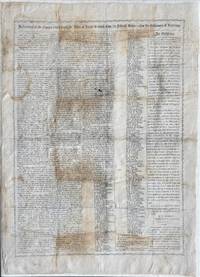
18616200San Antonio: February 2 1861. Good. Broadside on silk 19.5 x 14 inches. Expertly cleaned and restored. Previously folded with some creasing still visible. Moderate staining and a few small holes and separations aided by conservation. Scattered contemporary manuscript notations. An exceptionally rare Texas secession broadside executed on silk satin in San Antonio in 1861. Printed in five columns with an ornamental border the broadside features both the Ordinance of Secession and the Declaration of Causes two of the three principal documents drafted by the Texas Secession Convention along with a list of delegates. According to the colophon "These sheets on Fine Satin may be had at the Herald Office for $1 or on fine Book Paper at 10 cents each." The present broadside belonged to Cyrus Halbert Randolph 1817-1889 who was the Texas State Treasurer at the time of secession. Randolph arrived in Texas in March 1838 and quickly became established as an attorney and politician. A member of the Snively Expedition in 1843 he served in several political roles in Houston County including justice of the peace 1840 chief justice of the county circa 1843 and sheriff 1847. He also represented the county in the Texas Legislature in two terms between November 1851 and November 1857. Randolph was elected state treasurer 1859 and won re-election in 1860. Notably small pencil notations are next to the names of several delegates in the list perhaps associates of Randolph. Other known copies have connections to delegates and it seems likely that the sheets printed "on Fine Satin" were ideal souvenirs for prominent Texas politicians. <br /> <br /> After South Carolina's secession in December 1860 Texas was not far behind in joining them. The Constitutional Convention was organized on February 1 1861 and voted overwhelmingly in favor of secession. The ordinance was ratified by popular vote on February 23rd. The document begins with the Declaration of Causes a fiery assertion of Texas's rights which highlights her unique history as an independent country and leaves no doubt as to the core issue at stake: "Texas abandoned her separate national existence and consented to become one of the Confederated States to promote her welfare insure domestic tranquility and secure more substantially the blessings of peace and liberty to her people. … She was received as a commonwealth holding maintaining and protecting the institution known as negro slavery -- the servitude of the African to the white race within her limits -- a relation that had existed from the first settlement of her wilderness by the white race and which her people intended should exist in all future time. Her institutions and geographical position established the strongest ties between her and other slave-holding States of the confederacy. Those ties have been strengthened by association. But what has been the course of the government of the United States and of the people and authorities of the non-slave-holding States since our connection with them"<br /> <br /> Continuing in scathing language the authors accuse the North of interfering directly as they "encouraged and sustained lawless organizations to steal our slaves;" "invaded Southern soil and murdered reoffending citizens;" "sent seditious pamphlets and papers among us to stir up servile insurrection and bring blood and carnage to our fireside;" "sent hired emissaries among us to burn our towns and distribute arms and poison to our slaves;" and "finally by the combined sectional vote of the seventeen free or non-slave-holding States they have elected as President and Vice President of the whole Confederacy two men whose chief claims to such high positions is their approval of these long continued wrongs and their pledges to continue them to the final consummation of these schemes for the ruin of the slaveholding States."<br /> <br /> What follows is a list of the 168 delegates ending with Philip A. Work distinguishing this copy as a first edition. Noted bibliographer and Texas historian Everett C. Wilkie Jr. made a detailed study of the Texas secession documents in The 1861 Printings of the Ordinance of Secession Dallas 2011 and identifies three separate editions of the broadside essentially differentiated by the list of delegates. The first edition Wilkie 23 was almost certainly printed in February 1861 and ends the delegate list with Philip A. Work. The later editions Wilkie 24 & 25 were printed in early and mid-March respectively with additional delegates added to the list. The present edition is also the only one to include six lines naming the delegates who voted against secession. <br /> <br /> Printed in the right-hand column is the Ordinance of Secession stating the Texas is once again "a separate sovereign state." The preamble encapsulates the grievances of the state "Whereas the action of the Northern States of the Union is violative of the compact between the States and the guarantees of the Constitution and whereas the recent developments in Federal affairs make it evident that the power of the Federal Government is sought to be made a weapon with which to strike down the interests and prosperity of the people of Texas and her sister slave-holding states; instead of permitting it to be as was intended our shield against outrage and aggression; therefore."<br /> <br /> Parrish & Willingham note three institutional copies: University of North Carolina University of Texas and Baylor University. The Baylor copy however is actually a 7-page pamphlet edition Parrish & Willingham 4150. The UNC and Texas are therefore the only other known copies of the first edition. A unique opportunity to acquire one of the most significant broadsides in Texas history in the first edition and on silk.<br /> Crandall 2153. Parrish & Willingham 4151. Wilkie 23. Winkler & Friend 171. February 2 unknown
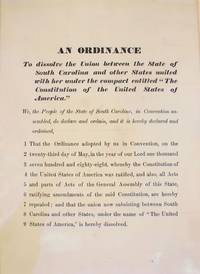
1860369308Charleston S.C.: Evans and Cogswell 1860. Broadside 11-1/2 x 8-1/4 inches. Old folds. Nicely mounted framed and glazed. Broadside 11-1/2 x 8-1/4 inches. One of the earliest Confederate imprints: South Carolina's official act of secession printed for delegates at the secession convention. This first printing of the South Carolina Ordinance of Secession the document which caused the departure of South Carolina from the Union set the nation irrevocably on the path to the Civil War. <br /> <br /> After Lincoln's election South Carolina moved vigorously to follow through its threat to secede from the Union. A secession convention was called and assembled at Charleston on December 20 1860. Their entire business was to debate the issue of secession which they favored overwhelmingly and to settle on the wording of a secession ordinance. Within the day the 169 members of the Convention voted unanimously for the ordinance.<br /> <br /> This is the printing of the ordinance made for the use of the delegates to the Convention. The ordinance was set up in the form of a "reading bill" or "slip bill" familiar to most delegates as the typical form of a legislative bill in working draft with the body of the text in numbered double-spaced lines to facilitate the making of corrections. Following the title given above the text reads:<br /> "We the People of the State of South Carolina in Convention Assembled do declare and ordain and it is hereby declared and ordained That the Ordinance adopted by us in Convention on the twenty-third of May in the Year of Our Lord one thousand seven hundred eighty-eight whereby the Constitution of the United States of America was ratified and also all Acts and parts of Acts of the General Assembly of this State ratifying amendments to the said Constitution are hereby repealed; and that the union now subsisting between South Carolina and other States under the name of 'The United States of America' is hereby dissolved."<br /> <br /> Presumably only several hundred copies of this "slip bill" version of the Secession Ordinance were printed - just enough to distribute to the members of the convention. They were probably printed just before the convention began. Indeed setting and printing it would have taken a few hours at most. After its passage the ordinance would famously be published as a newspaper extra by the Charleston Mercury with the following words in bold below the text of the ordinance: The Union Is Dissolved!<br /> <br /> This is one of four extant examples of the slip bill the others being examples at the Huntington Library Emory University and one in private hands being the example once belonging to Jay Snider sold to him by the William Reese Company in 1997 and resold at the sale of his collection at Christies June 21 2005 lot 165 selling for $66000. Parrish & Willingham 3795; Crandall 1888 Evans and Cogswell unknown
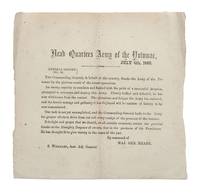
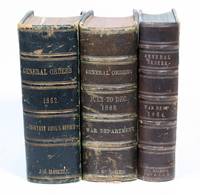
1863353816Gettysburg PA 1863. 1p. Signed in print by Maj. Gen. Meade. 6-3/8 x 6-1/2 inches. Old folds. Housed in a blue morocco backed box. 1p. Signed in print by Maj. Gen. Meade. 6-3/8 x 6-1/2 inches. The General Orders continues: "Our task is not yet accomplished and the Commanding General looks to the Army for greater efforts to drive from our soil every vestige of the presence of the invader. It is right and proper that we should on all suitable occasions return our grateful thanks to the Almighty Disposer of events that in the goodness of his Providence He has thought fit to give victory to the cause of the just."<br /> <br /> Lincoln would take issue with Meade's choice of words arguing that "our soil" applied to the southern states as well. In addition he was disappointed that Meade did not impel a greater effort to pursue Robert E. Lee in retreat. Nevertheless the Union victory at the three-day Battle of Gettysburg would prove a seminal turning point of the war arguably the greatest military victory for the Union. Interestingly Lincoln in his Gettysburg Address would echo Meade's own words from this order over the historic nature of the victory: "The world will little note nor long remember what we say here but it can never forget what they did here."<br /> <br /> Fewer than ten known copies of this battlefield-issued printing of Meade's victory message are recorded in several variant printings. The use of tabletop field printing presses by both the Union and Confederate armies helped make quick field communication possible but minor typographical differences were certain to occur given the circumstances of their composition. In addition a more formal printing of General Orders 68 was issued in Washington and can be found in annual bound volumes of such orders though is frequently misidentified as the present field-printed order. The last example on the market sold at Sotheby's in May 2016.<br /> <br /> WITH: Two-page manuscript official true copy of Meade's General Orders No. 66 assuming command of the Army of the Potomac just prior to the Battle of Gettysburg dated June 28 1863 written and signed by Acting Assistant Adjutant General Paul Nason.<br /> <br /> This example accompanied by a contemporary official manuscript true copy written and signed by A.A.A.G. Paul F. Nason of Meade's General Orders No. 66 in which he assumed command of the Army of the Potomac on the eve of the Battle of Gettysburg: "The country looks to this army to relieve it from the devastation and disgrace of an hostile invasion. Whatever fatigues and sacrifices we may be called upon to undergo let us have in view constantly the magnitude of the interests involved and let each man determine to do his duty leaving to an all-controlling Providence the decision of the contest unknown
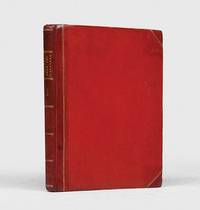
18201541751820-21. Vibrant immediate and honest An outstanding series of 37 vivid candid letters by Major-General Sir George Ridout Bingham 1777-1833 transcribed by him from his original correspondence home and spanning April 1809 to January 1814 including the campaign of Talavera. They constitute a major primary source for campaigning in the Peninsula. In a reflective foreword written at Dean's Leaze in 1820-21 Bingham explains that he found his mother's preserved cache of letters on his return to England and copied them out verbatim omitting only personal matters. He stresses that he made no revisions leaving his early impressions misjudged predictions and evolving opinions intact and notes the gradual growth of his confidence in Wellington. An index closes the volume. A letter of 29 July 1809 from the field near Talavera captures the collection's immediacy: Bingham reports the ferocity of the action the heavy British casualties borne without Spanish support the army's acute want of provisions the deaths and wounds among senior officers his own collapse from exhaustion and the Spaniards' killing of wounded Frenchmen. Such unvarnished observations typify the set. The foreword and letters are printed in Gareth Glover's Wellington's Lieutenant Napoleon's Gaoler 2005. Glover notes that all surviving transcripts - including those at the National Army Museum typescript copies presented to the United Services Institute in 1923 - derive from lost originals. He characterizes the letters as frank immediate and rich in operational detail free from retrospective shaping and attentive to landscape people officers daily routines and the brutal conduct of war. Bingham from a long-established Dorset family rose rapidly: ensign in the 69th 1793 major in the 82nd 1801 and in 1805 lieutenant-colonel of the newly raised 2/53rd. He led the battalion throughout its distinguished Peninsula service Porto to Burgos later commanding a provisional battalion through Vitoria the Pyrenees and the Nivelle. Decorated with the Portuguese Order of the Tower and Sword and made KCB he escorted Napoleon to St Helena and commanded there until 1819 later serving on the Irish staff during a turbulent period. He was widely regarded as a considerate and able officer. Provenance: pencilled ownership of Col. John Delalynde Mansel 1850-1915 Rifle Brigade whose grandfather Lieut.-Col. John Mansel served as Bingham's second-in-command in the Peninsula. Subsequent family marriages united the Mansel Bingham and Pleydell lines. Small quarto 230 x 185 mm. Contemporary red half roan smooth spine divided by seven pairs of gilt fillets gilt lettered "MSS. Letters from the Peninsula" sides and corners trimmed with paired gilt fillets red paper sides. 163 pages running to about 32000 words written in a neat hand. Binding professionally refurbished slight cockling to first few leaves otherwise clean and presenting smartly. Gareth Glover Wellington's Lieutenant Napoleon's Gaoler: The Peninsula Letters & St Helena Diaries of Sir George Ridout Bingham 2005; T. H. McGuffie ed. "The Bingham Manuscripts: 2nd/53rd in the Peninsular War 1809-10 and 1812-13" JSAHR Vol. 26 No 107 Autumn 1948. unknown
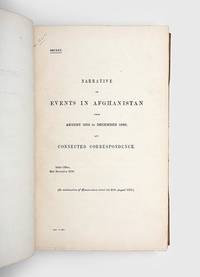
1878166983London & Simla: 1878-82. Confidential India Office archive revealing British decision-making in the final phase of the Second Anglo-Afghan War An exceptional archive of confidential India Office and Government of India papers this collection offers an unusually detailed view of the diplomatic and bureaucratic manoeuvring that accompanied the final stages of the Second Anglo-Afghan War and the negotiation of Britain's withdrawal. Bringing together Foreign Department memoranda from Simla Cabinet papers printed at the Foreign Office and India Office material that seldom survives outside official files it reconstructs policy formation across two administrations and two continents. Running through the papers is the early career of Reginald Baliol Brett later 2nd Viscount Esher who became private secretary to Lord Hartington in 1878. As Hartington and the new Liberal government sought to reverse Lord Lytton's "forward" policy and disengage from Afghanistan the India Office and the Government of India frequently disagreed over strategy intelligence and the limits of influence. The archive captures these tensions vividly and shows Brett learning to operate as an assertive intermediary whose probing questionnaires marginalia and attempts to synthesize rival views already marked him out as a rising - and at times unsettling - force within the department. The documentary foundation of the dossier lies in A. W. Moore's two major surveys of Afghan affairs annotated by Brett and widely regarded as the most authoritative India Office narratives of the conflict. These are complemented by a sequence of extremely restricted Simla-printed papers and a run of Cabinet memoranda from Thomas Harrison's private press together charting the shift from aggressive frontier ambition to the more pragmatic Liberal policy of withdrawal and the recognition of Abdur Rahman as Amir. High-level submissions by Hartington Ripon and Evelyn Baring illuminate the arguments over the retention of Kandahar and Pishin while the "Aide-Mémoire" on negotiations with Abdur Rahman documents the decisive recalibration of British aims. Other materials probe the immediate crises of the war: memoranda assessing Yakub Khan's responsibility for the Kabul Residency attack; correspondence among Griffin Stewart and Lyall on the deteriorating northern situation; and the substantial "Very Confidential" dossier of Russian correspondence between General von Kaufmann and Shere Ali which exposes the diplomatic pressures of the "Great Game". Operational detail appears in the viceroy's secret telegrams of early 1880 field reports from Kandahar and Kabul Wilson's military sketch of the campaign and manuscript troop returns. Among the most revealing personal items is General Charles Gordon's autograph draft of a letter to The Times opposing the retention of Kandahar heavily revised and ultimately suppressed by Brett who feared it would damage Gordon's standing. His decision and later grief at Gordon's death lend an unexpected human dimension to a collection otherwise dominated by official policy and statecraft. Only a handful of the documents can be traced in institutional collections and few survive in private hands. Gathered here in a coherent sequence with close associations they provide a rare high-resolution record of how British officials interpreted the war navigated clashing doctrines and personalities and ultimately engineered their exit from Afghanistan. A full list of the contents is available on request. Folio 339 x 215 mm comprising 37 printed and manuscript items: full listing with titles paginations and outline content given in the note. Contemporary light olive brown diagonal zigzag-grain cloth boards rebacked and cornered in brownish orange morocco in the mid-20th century red morocco label original moderate bluish green endpapers retained matching linen hinges. Esher armorial bookplate. Cloth starting to lift a little from the edges of spine; contents variably browned margins a little fragile in places with a few consequent chips and splits one title page torn across and neatly repaired with archival tape: overall very good. James Lees-Milne The Enigmatic Edwardian: The Life of Reginald 2nd Viscount Esher 1986. hardcover
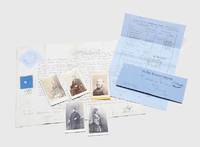
1879169244Onboard ship and in southern Africa: 1879. I should not like to say how many kraals we burnt Such warfare is not very glorious This substantial archive of largely unpublished correspondence - around 21000 words written in the field - offers a vivid and unusually frank primary source for the Zulu War only partially treated in existing historiography. Captain Fitzwilliam Elliot youngest son of the 3rd Earl of Minto and a perceptive officer on special service writes with sharp intelligence admiration for the Zulu and unguarded criticism of British command. Addressed to his mother the well-read and formidable Nina Countess of Minto the letters track his movements from the aftermath of Isandlwana to the campaign's close often with acute reflections on strategy discipline and morale. Elliot sailed shortly after the disasters of early 1879 joining General Crealock's coastal column. He denounces the confused state of operations deplores the "sensational" reporting of the Prince Imperial's death and is consistently scathing of Crealock as "an old woman" and Chelmsford for the "feebleness" of his reports. His march from Durban to Fort Chelmsford and northwards is marked by slow progress foul weather and disorganization. He gives sharp portraits of officers and units praising the veteran 57th and dismissing the 88th as "a real rowdy lot of Irishmen but good to fight friend or foe". He describes kraal raids with discomfort acknowledging the logic of destroying Zulu resources while feeling "rather a scoundrel" at the spectacle of looted food and driven captives. Yet his admiration for the Zulu is striking: "they are always so thoroughly manly never appearing angry nor even humiliated at the loss of homes cattle women every thing indeed which they possess". He reports the VC ceremony for Rorke's Drift doubting the award to Chard and remarks acidly that Colonel Pearson lionized at home after the siege of Eshowe is regarded in the field as "one of the greatest muffs this war has produced". His final letters follow the victory at Ulundi where the "streams are now full of dead Zulus" a scene he describes with evident distress and sanitary alarm. On 12 August he writes from Ulundi to wish his family good sport on the Glorious Twelfth and the next day notes departure "for a dart after Cetewayo better game than grouse". The archive is accompanied by cartes-de-visite of Elliot his parents and John Dunn; Elliot's commission as captain; and his 1867 record of services. 14 autograph letters signed 11 retaining envelopes pale blue paper generally 200 x 125 mm written largely in pencil but also in ink; Record of Services printed on pale blue paper with envelope; commission dated 29 October 1878; 5 carte de visite 2 of the young Elliot in uniform one each of his parents one of John Robert Dunn. Some tears to envelopes otherwise well preserved. John Buchan Lord Minto: A Memoir 1924. unknown
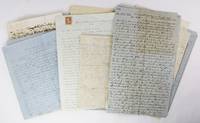
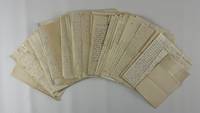
18656242Various locations 1865. About very good. Forty letters approximately 96pp. Many with original envelopes. Light wear and soiling old folds. In a legible hand. Together with twelve additional family letters and two military commissions. A wonderful archive of correspondence written home from the Confederate lines by William Henry Tabb of the 14th Mississippi Infantry. William Henry Tabb 1837-1864 was the son of a minister at the Choctaw Agency in Oktibbeha County Mississippi. In April 1861 he was commissioned as a lieutenant in the Agency Guards which were soon absorbed as a company in the 14th Mississippi Infantry. He was captured at Fort Donelson exchanged reached the rank of captain and was with his regiment when he suffered a fatal wound in the defense of Atlanta on August 5 1864. <br /> <br /> Tabb begins his letters with optimism. On August 1861 after training in Corinth Mississippi the regiment met with a parade in Huntsville en route to eastern Tennessee: "The women men and children were down to see us and a regiment turned out to do us honor. Such cheering from beautiful young ladies all along our way is enough to make men brave." On October 22 1861 he recounts the recent death by disease of his brother Thomas Tabb in Marion Alabama also of the 14th Mississippi calling him "my dearest friend on earth."<br /> <br /> Tabb was captured at Fort Donelson in February of 1862. Two of these letters were written from the Union prison at Johnson's Island near Sandusky Ohio. In May 1862 he writes: "We are not allowed to write what nor as much as we please. I have no friends to work for me see no indications of a general exchange or parole and it is almost impossible to escape from this island. It is amusing to see men one day Confederate officers and the next day cooking or around the wash tub. We have no servants. I am well treated have a plenty not a variety of food and clothing that we need issued to us." By September 24th he was back with his regiment in Mississippi: "The Yankees stole my shoes and I am wearing an old pr of boots. It appears that my conduct at Donelson has been very highly spoken of. Well I.tried to do my duty but I am sure I did nothing extra. Indeed our regt in my opinion fell little short of disgracing itself." He adds a word on the troubled home front situation: "Am sorry to hear that the Negroes have commenced stealing. I would very much like to see all that have behaved themselves and wd thrash those who have been stealing."<br /> <br /> On April 11 1863 he describes the recent Battle of Ponchatoula which other companies in his regiment participated in: "Rollins was sent out with ten of the company on our right wing to try to flank them. As soon as he commenced firing on them we attacked their center and they broke to run. They were zouaves red pants we never could catch them." He lamented the loss of his enslaved servant on June 7th near Yazoo City: "I expected John to come to me. I have become attached to John and don't know how to get along without him. I look for him every day now." Tabb had some great stories about Grant's efforts to take Jackson the Mississippi capital from which Johnston's Confederates performed a stealth evacuation. On the 19th and 20th of July 1863 he wrote: "All of the boys wanted to stay and fight but Grant had 80000 men and we had only 30000. It is true we were behind breastworks but they were not good and the place could be easily flanked. Johnson prepared to evacuate the place from the time we got there. The Yankees knew it. Not a word was spoken not a command given. The Yankees knew nothing of our leaving. Some of our men did not know we had left and were left behind but overtook us. I hear that the Yankees commenced shelling the town the other morning after we left and kept it up til 9 o'clock when some of the citizens hoisted the white flag and surrendered the place. They were vexed to know that we had left them without their knowing anything about it."<br /> <br /> Tabb had been away from the regiment for the start of the Atlanta campaign and on July 9 1864 he wrote: "I reached the command the evening of the 5th and found my company.8 miles from Atlanta. I found the men dirty and many of them with worn out clothes and not very good rations but all in good spirits and glad to see me. The people of Atlanta are leaving rapidly. They think the place will be evacuated. Do not be surprised if you hear it. We will not be whipped if we do leave it." This is Tabb's final letter in the collection. He was shot a month later. The group concludes with nine condolence letters and memorials. An October 1864 memoriam copied in 1894 recounted his death: "At the time he received the fatal shot he was commanding the brigade skirmishers & was just forming the line to proceed to the front. Though terribly mangled & in great pain he was calm & collected." He survived long enough to send farewell thoughts to his family and to regret "that I was not spared to see my country through her troubles." Also included are two of Tabb's military commissions in the Agency Rifles from the State of Mississippi: as Second Lieutenant on 24 April 1861 and as First Lieutenant on 25 December 1861. Both are signed by Governor John J. Pettus. In all a wonderful archive from a Confederate soldier who saw significant action and imprisonment during the war. unknown
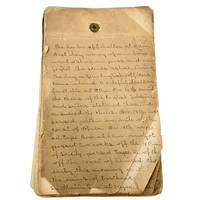
18990012049Donsol Pilar Manila Philippines New York Malta. Poor with no dust jacket. 1899-1901. Other. On offer is an unbelievable handwritten account of 19 months of action on the frontlines of the Philippine Insurrection the Philippine-American War between November 1899 and June 1901. An unknown American soldier writes of his experiences in a level of detail that cannot be overstated. This diary places the reader in the Philippines with shocking realism making this diary exceedingly rare. The 139 pages of this journalled account of events have been removed from a larger document and someone has pinned these loose pages together. This writing begins at the end of a sentence penned on presumably November 17 1899 and concludes half way through a sentence written on June 23 1901. There seem to be very few missing pages from within the journal and it reads very smoothly. The content is outstanding. The diary opens with our soldier diarist sailing from New York to the Philippines via the British Naval base at Gibraltar and the Suez Canal. He describes his experiences sailing sharing about a stop ashore in Malta a Thanksgiving spent at sea a concert enjoyed aboard the gunboat Nashville on the way to Manila and more. He arrives with his regiment in Manila on Dec 22 1899. The troops explore Manila and meet Filipino locals. In early January of 1900 they receive orders to head to southern Luzuon on the Kobbe Expedition which refers to General William Kobbes Expedition to Bicolandia. This expedition was in response to an urgent order from Washington to open up hemp ports of Southern Luzon due to an American hemp shortage. The problem was the port towns were largely controlled by Filipino Insurgents. Our diarist provides absolutely remarkable detail about Americas role in defeating the Insurgents and the tragedy of the Filipino peoples experience. Context indicates that our diarist was possibly a member of the 43rd Volunteer Infantry Regiments USV Company A. An excerpt that provides a sense of how our soldier explains the circumstances in the Philippines follows: Jan 16th we got the order to pack up and get ready to leave Mikata and to proceed to the Southern part of Luzon we were put aboard the transport Hancock which was at anchor in the Bay of Manila All combined we were named the Kobbe Expedition to the Southern Luzon to open up the Hemp ports and protect the natives from the Insurgents down there On the 21st of Jan 1900 our boats dropped anchor in a bay named the bay of Sorsogon in the Province of Albay All over this province there are large gangs of Insurgents holding the towns so at many towns our boys had a hard fight with the Insurgents before they could take the towns and the gun boat had to shell many of the towns. Our Regt. Occupied nine towns. Our detachment of A and D. Co. Were taken to a town named Donsol the gunboat Helena took us ashore from the Hancock On their arrival ashore they were met by a crowd of Philippinos. They had an order from the officers of the Insurgents it read saying that they would not haul down their colors nor surrender for three days. So our Major returned to the gunboat and a short conversation was held with the officers of the gun-boat and it was decided to prepare the gun boat for action and land all of us. If the Insurgents fired one shot at us the gun-boat would shell the town The hills were full of fleeing people. A detail of men were sent out on the hills at once then the Insurgents fired their first shot at us. Our boys had a warm fight for 15 minutes. They found the hills well entrenched and also found one big cannon. Lots of spears Bolas and wooden guns. They returned to town bringing in a few prisoners. A scouting party was seent and they saw a lot of Philippinos fleeing to the mountains. This town had a population of 10000 and three hundred were Insurrectors. The next thing we done was to find ourselves some good houses to live in. Outposts were put out all around the town. A few natives came across our post for a few nights and on the 22th Jan the Insurgents paid our town a visit setting fire to one of the big houses where our men were sleeping. Our men got out of the house without anyone being hurt. We surrounded the town fired a few volleys . Later in January our soldiers regiment goes on the first of many missions all of which he describes in glaring detail. On this mission the troops attempt to leave Donsol for Pilar when they run into trouble as the connecting bridge was destroyed by Insurgents. They make it to Pilar and find the town has been deserted. As they march back to Donsol they find someone has lit the bridge ablaze: Jan 28th We had a very hard time crossing the bridge burning our shoes and legs but we got safely on the Donsol side before the bridge fell with a crash into the river. We marched on we heard several shots from the Mauser and Remington rifles. Next we discovered a big fire and a call to arms and fire call was sounded The fire of the Insurgents got heavier. Our Major gave an order not to fire. He was going out in the front of our lines. He went out with a detail of men and discovered that our town was surrounded and the hills were full of Insurgents. He fired a few volleys then he came into town. The Insurgents answered him by firing a cannon. Then the Insurgents gave a yell and started to advance and we kept quiet and let them get close to our lines. Then we got the order to commence firing and the boys opened up all around the town and we soon put the Insurgents to flight firing a few shots as they ran. Next morning we discovered a few dead Insurgents close to our lines. The Insurgents almost always carry their dead and wounded along with them in their flight Our soldier does an absolutely phenomenal job of describing not only the day-to-day in Donsol where he spends majority of his time but also the various missions in which he participates. His words paint a fulsome picture of the war: 21st Feb at noon our Major asked for a detachment of men to volunteer to go up the river on a scouting expedition. I along with 12 more men went out of our company and 12 out of D. Co. Along with Capt. Hart of D. Co. And our Major left Donsol in a hard paddle boat and one white boat in tow On our way up the river we could see high hills on each side and the river was very narrow. There were many Insurgents outposts in the high trees all the way up and we fired at every one we saw. We went up a distance of 8 miles before we thought of coming home as it was getting late We had traveled one mile on our homeward way when the Insurgents fired on us from the left hand ashore. Our men in the rear boat fired a volley into the two Insurgents and were taking good aim for a second volley when the hills fairly echoed with the yells from the Insurgents. They then opened up on the right hand side which was aimed at the white boat hitting one of our men our company in the head and he was killed instantly. Then we answered their shots from each of our boats and from that time until we got back to Donsol we were under the hot fire of the Insurgents we could see the hills full of Insurgents and we had plenty to shoot at. We made every shot count. The insurgents even fired rocks at us from the high hills . More texture is added when our soldier discusses aspects of the war that dont involve active fire. Some examples follow: March 5th Gen Kobbe of the 8th Army Cor was here on a visit and he said these two companies were a very industrious lot of men and that the building of the stocade and trenches was a very sensible work he also brought us 17 of the Battery G 3rd Artillery men and one Hotch Kiss gun for reinforcements. April 10th the mail boat was here bringing the report of Gen. Pawa likely Jose Ignacio Paua an Insurgent Gen in Command of the Insurgent troops through this province. He surrender to our Colonel in Legaspi Legazpi and was sent to the Military Prison in Manila. April 21st We took a long march across the hills in a round about manner to a town named Sevilla merely an Insurgent camp. The town was deserted on our arrival. Fires were still burning in the houses. Everything was just as they had dropped it in their flight. We passed through the town and discovered many traps laid in the roads for us. One trap was an arrow trap on each side of the path in the bushes and by pulling a strong the arrows would stick into anyone going down the path. None of their traps caught us. Our soldier writes frequently about expeditions for which he volunteers. He describes a mission to Banningaran sic. En route the men captured Captain Hernandiz sic; possibly Adriano Hernández y Dayot and his family before being caught unprepared by the Insurgents who severely injured one of the American sargeants. On their hike back to Donsol they are again attacked by the Insurgents this time caught off guard as they attacked from the rear. And so it goes for many more months. Our author describes the movements of the men with whom he is stationed his commanding officers and the various wins and setbacks of both the Americans and the Insurgents. In May of 1901 our soldier and his regiment begin the process of boarding a ship to return to America. There is of course never a straightforward path and there are many bumps in the road. However our soldier does eventually board a ship and begins again to describe his journey in detail. The diary cuts off abruptly mid-sentence on June 23 1901 as our soldier is describing being at sea with nothing but a sailboat in sight for miles. While we do not know our soldiers identity we do know he was safely heading home at the conclusion of his diary. We know he was a highly motivated volunteer soldier who displayed total buy-in to the mission of the Americans in the Philippines and we know he was a gifted writer penning his experiences with such texture and realism that the reader feels as though they too have been on the front lines of a bloody wet miserable war in the Philippines - fighting for America and for the displaced Philippino people forced to flee from the Insurgents to the mountains. This journal measures 8x5 inches and contains 139 single-sided sheets. The pages were all loose so the author has pinned them together with a single round-headed fastener post. There are no covers to this journal. As a result the first and last few pages show obvious and significant wear and tear including a large corner of the first page being completely ripped off obstructing the text. The handwriting is quite legible. Overall Fair to Poor. ; Manuscripts; 8vo 8" - 9" tall; 139 pages . unknown
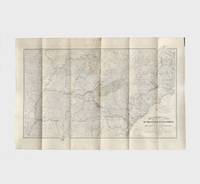
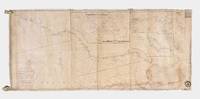
1865377676St. Louis: Printed by Joseph Gedney 1865. Inscribed by Sherman at the lower right "With compliments of W. T. Sherman Lt. Genl. Saint Louis MO September 21 1868. Large map drawn by Capt. William Kossak and John B. Muller under the direction of Maj. W. L. B. Jenney engraved by Evans and Courtenay. 33x51 inches sheet size. Military movements hand colored. Old folds repairs on verso along folds minor staining. Inscribed by Sherman at the lower right "With compliments of W. T. Sherman Lt. Genl. Saint Louis MO September 21 1868" Large map drawn by Capt. William Kossak and John B. Muller under the direction of Maj. W. L. B. Jenney engraved by Evans and Courtenay. 33x51 inches sheet size. Military movements hand colored. An impressively large map covering most of the southern theater of the Civil War extending from Washington D.C. in the northeast to Brunswick GA in the south and westward as far as Natchez Little Rock and St. Louis. The map is filled with remarkable detail including roads towns and villages rivers creeks and railroads. Compiled under the direction of Bvt. Maj. W.L.B. Jenney by order of General Sherman 13 different authorities are credited in its preparation.<br /> <br /> A key to the hand coloring at the bottom reveals the true reason for the map i.e. to chart Sherman's taking of Atlanta and his infamous march to the sea: black lines show the route of the infantry yellow the pursuit of Hood red the 4th Army Corps green the 14th Army Corps and so on; Union fortifications are colored blue and Confederate in red; the routes of Wilson and Stoneman's cavalry corps are also separately delineated.<br /> <br /> There are various versions of this map similarly titled but produced for different publishers and reasons. The most common includes the imprint of Ferd. Mayer Genl. Lith. of New York who printed the map for inclusion in Sherman's Memoirs New York 1875. Another version was produced at a reduced scale for inclusion in the Atlas to Accompany the Official Records of the Union and Confederate Armies with the imprint of Julius Bien plate CXVII. Yet another includes the The American Photo-Lithographic Company of New York imprint at the lower right. The present version however with the St. Louis imprint of Joseph Gedney at the lower left would appear to have been separately published. Given the present version inscribed by Sherman it was perhaps produced on his behalf.<br /> <br /> We have never encountered another of these maps inscribed and signed by Sherman. Stephenson 72; Rumsey 3876 Printed by Joseph Gedney unknown
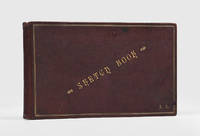
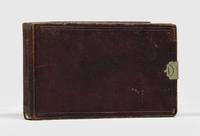
1899182470South Africa: 1899-1902. A unique snapshot of Boer War Cape Town A highly unusual accomplished series of pen-and-ink and watercolour sketches - landscapes and social and military subjects - covering many aspects of life both high and low in Cape Town during the conflict including depictions of indigenous people Malays and Boers. These attractive well-finished sketches in an unusual and flamboyant style seem professional and illustrative rather than "fine art" and captioned in a decorative and very well-formed hand. The artist may well have been a working illustrator: his captions are certainly in the manner used by such periodicals as the Black & White and The Graphic and the style is that employed for lightly "humoresque" reportage. However we have been unable to trace any published versions and of course he may have been simply an observant talented well-placed amateur. The captioning reveals him to be probably British but possibly American - he makes references to the British soldier as "Tommy" and refers to "Australian and Canadian" troops. The album opens with a bird's eye view of Cape Town from Leeuwen Street and is followed by three military subjects. "Poor Tommy passes in his check" shows a British soldier struck in the head by a bullet as fellow infantrymen take cover behind rocks. "Passed in his check" was a slang expression for dying used mainly in America where there was considerable sympathy for the Boer cause and the unsentimental rendering of a Tommy's death may indicate that the artist is indeed American. Similarly the following picture "An intercepted despatch" shows a mounted courier being picked off by a Boer marksman. This is followed by "Cronje's barkers at Green Point - captured at Paardeberg" with a British sentry guarding artillery and a Maxim gun taken at that hard-fought battle 18-27 February 1900. The camp at Green Point Common was established for British troops before being used to house Boer prisoners of war. Of the dozen appealing watercolours five are landscapes the remainder portraits except for "On the Terrace Dix's" which shows a well-to-do trio seated at a table at Dix's Café the place to be seen in fin de siècle Cape Town it's "leading café during the South African War. When the Duke and Duchess of Cornwall and York later King George V and Queen Mary visited Cape Town the Mayor's banquet was held at Dix's" Green. Particularly striking is the very nicely rendered full-length portrait of a young black woman entitled "The girl aint coloured she was born that way". This is much more of a likeness than a "type" and is echoed to some extent in the preceding image "Tommy's substitute for Maria" which shows a British soldier conversing with two well-dressed black women. These may well be "sly girls" a term for women who supplemented their income with occasional sex work. At home and among the higher echelons of the Army there was deep concern about the loose morals of troops in South Africa and "one problem was considered to be their preference for black prostitutes" Kuitenbrouwer p. 203. The artist's rendering of horses is particularly adept as illustrated by "Every man his own horse breaker - Buckjumbers sic from Argentina" a buckjumper is a horse that habitually bucks; many British cavalry mounts were imported from Argentina during the war and an untitled sketch showing a Yeomanry trooper on a prancing mount. Around nine subjects are military including Boer prisoners being escorted under guard at Green Point and soldiers carousing in a mule cart entitled "When the Canadians and Australians went home". Local scenes include several images of refugees from the fighting a nicely rendered portrait of a smartly dressed Indian trader drunks on Bree Street and "doppers" members of the Reformed Churches in South Africa. "Ricksha" is a spirited sketch showing a young Zulu rickshaw-puller fancifully dressed and adorned with horns and wings - an outfit intended to attract custom and often seen in tourist album photographs into the 20th century - pulling a fashionably dressed lady. The artist's eye for costume is also notable even when a little exaggerated for effect giving the images the hallmark of verisimilitude. The album closes on a humorous note with "Our friends the enemy: the mosquito the bug and the nimble flea the African horrors" showing a trio of anthropomorphized insects. Landscape octavo 145 x 245 mm. With 39 original pen-and-ink drawings and 12 watercolours of scenes and people. Contemporary dark brown hard-grain morocco gilt lettered "Sketch Book" on front cover and initialled "A.H." or "F.H." within border of gilt paired fillets gilt milled edge roll gold-veined Double Marble pattern endpapers. Custom brown quarter morocco solander box. Some abrasions to covers a few pale stains to back cover inner hinges cracked but firm expert repairs to edges of first 8 leaves general toning and finger soiling. Overall in very good condition. Lawrence Green Tavern of the Seas 1947; Vincent Kuitenbrouwer War of Words: Dutch Pro-Boer Propaganda and the South African War 1899-1902 2010. unknown
1865353265Vp New York South Carolina Georgia and Virginia 1865. Approx. 260pp. Variously written in pencil or ink on a variety of paper but generally quite legible. A few with original envelopes. With: Haskell's manuscript discharge dated Nov. 18 1864 partly-printed discharge of the same date a cdv of Maj. Gen. Hunter and Haskell's 1865 marriage certificate. 8vo or 4to. Usual folds. Approx. 260pp. Variously written in pencil or ink on a variety of paper but generally quite legible. A few with original envelopes. With: Haskell's manuscript discharge dated Nov. 18 1864 partly-printed discharge of the same date a cdv of Maj. Gen. Hunter and Haskell's 1865 marriage certificate. 8vo or 4to. Haskell 1836-1877 enlisted at Canandaigua Ontario County New York on November 18 1861 and mustered for a three year enlistment in Company F of the 1st New York Engineers. At the start of the war the Army Corps of Engineers was severely underpopulated; Civil Engineer Edward Serrell began recruiting for the specialized service in October 1861 with promises of pay one-third greater than infantry service.<br /> <br /> The first five letters of this archive are written by Haskell from Camp Washington on Staten Island as the regiment was formed trained and awaited orders. The letters describe his daily routine quarters the batteries and harbor and relate news that he has passed as an engineer. Among the most interesting of these letters is one dated January 22 1862 in which he details a visit to Central Park with a lengthy description of the landscape and ongoing construction. <br /> <br /> The 1st New York was deployed to Port Royal Sound and was formed as the 10th Corps Engineers in the Department of the South. Haskell and his company are sent to Hilton Head arriving at the end of February 1862. The next six months are spent on the island working on its wharves and fortifications. He describes his quarters and rations inspection and drills his work on a powder magazine flood gate and surveying for new fortifications. <br /> <br /> He writes at length about the number "contrabands" i.e. the freed or escaped slaves from Confederate plantations coming to Hilton Head. He writes on March 1 1862 soon after arriving: "There are a plenty of contrabands slaves here. They chop and raft logs for the wharves that they are building. The women & children are around among the soldiers selling sweet potatoes oysters and such to them. There are a good many soldiers here on the island and there was a good many that have just left on an expedition and they keep coming." On April 1 1862 he adds: "The government is making preparation to put in a cotton crop here. The negroes are preparing the ground. Contrabands come in every day. Two came in yesterday who said that they had nothing to eat for 4 days." On May 10 1862: "There is a good many contrabands and they keep coming in all the time. When they first arrived they are very ragged both men and women but they are all provided with suitable clothes. The soldiers are down on them because the negroes are used better than they are and have more privilege granted to them by the authorities. And the soldier vents his spite on the negro every chance he can get. Most of the negroes are employed. General Hunter has just commenced getting up a negro regiment of 1500 men to do guard duty through the night and to garrison some of the forts. The officers are to be white men and are to be taken from our regiment. There is quite an effort by some northern society to educate them to work; a job which they have but a slight idea." On October 5 1862 he notes the work General Mitchel among the formerly enslaved: "I went yesterday Sunday to the ordination of the Negro Church Baptist. Our chaplain read the ordination service of the Episcopal church and made a few remarks but General Mitchell done most of the talking . He told them that he was going to have them time by themselves and was going to educate them and make them good citizens. He has a squad of 50 men building houses for them about 3 miles from head quarters called the negro villages."<br /> <br /> In April 1862 he participates in the Battle of Fort Pulaski giving a lengthy account on April 15: "We fell in and marched through the rain to the docks stood in the rain all of an hour and then went on board pretty well soaked. At 9 o'clock the steamboat started. About noon we anchored off Tybee Island in full sight of Fort Pulaski . at seven o'clock the next morning the bombardment of Fort Pulaski commenced. Before the firing commenced Gen. Benham sent a flag of truce and demanded the surrender of the fort in the name of the U.S. " After describing the bombardment he continues: "At sunset the firing ceased on both sides and the two companies of engineers was divided into squads of 8 or 10 men each and sent out to repair the batteries. We worked all night. " He details the work of mounting two 10-inch columbiads "which dismounted themselves the very first shot they made. One of these guns the boys mounted after sunrise and as soon as they discovered from the fort what they was about they directed all of the guns which they could bring to bare upon that particular place. But the boys stuck to their gun and mounted it while the cannon balls was flying over their heads. A feat which they received considerable praise for. " <br /> <br /> In November 1862 Haskell's company is transferred to Fort Pulaski where they work on repairing the damage to the fort remounting the artillery and building a new magazine. He tells news of the war related to his department including a November expedition to destroy railroad bridges between Charleston and Savannah and the death of General Mitchel: "Our Generals called it a partial result and considerable gained by it. But it was such results as I do not believe in for we got tremendously whipped and lost 225 men in killed wounded and missing. But our company succeeded in tearing up some 200 feet of rails on the reach and cutting the telegraph while they were guarded by a few companies of infantry and they all barely escaped being taken prisoner. They found the bridges all guarded by strong batteries. Just as our company and 4 companies of infantry came up to tracks there was a train of open cars going pass loaded with troops. Our men hid behind the fence and when the train came up fired into it and they think they killed a good many. Since then General Mitchel has died and two or three of the other head men . some think that they had yellow fever . others think they was poisoned by eating fish that they bought of the negroes."<br /> <br /> Much of his war commentary during his nine months on Fort Pulaski includes descriptions of the iron clads and monitors. On March 5 1863 for example he writes: "The rebel steamer Nashville was destroyed last Saturday by one of the Monitors The Passaic. She ran by a 13 gun battery and run up the river where she lay and fired two shots into her the first went clear through and the second a shell burst in the magazine and this blew the Nashville to atoms." On June 21 1863 he writes: "The rebel ram Fingal i.e. CSS Atlanta that was built at Savannah and which has kept us in a sweat for nearly a year here and at Hilton Head was captured by one of our monitors last Tuesday without firing a shot." He details the action and movements of the ships before continuing sarcastically: ".The means for building the ram was furnished by the ladies of Savannah and there was two boat loads of them followed the ram down to see her destroy our battery and gun boats but they went back closely followed by one of our gun boats and you must imagine their joy." <br /> <br /> Haskell provides news of the Battle of Fort Wagner on Morris Island including the role of African American troops. He writes on July 15 1863: ". Gen. Gilmour is working his way toward Ft. Sumter and Charleston. There has been some hard fighting on Morris Island." On the 24th he writes: ". our forces had taken eleven batteries on Morris Island and there was two that they had not got possession of yet and that our forces had taken 700 prisoners . yesterday it was reported by some fellows that came from the head that there had been more fighting on Morris Island that the two remaining batteries had been stormed three times and our forces had been repulsed each time with tremendous slaughter. The 55 i.e. 54th Mass. color reg. was one of the storming parties. They were 1200 strong. They lost 700 in killed wounded and missing and the NY 48 was another." Interestingly that same letter includes a commentary on the New York draft riots: "I see by the late NY papers that there is a riot in NY city to resist the draft . I should say that it was to burn buildings murder and to plunder the city. I hope that they will be put down."<br /> <br /> At the end of July 1863 his company is transferred to Morris Island South Carolina to participate in the shelling of Fort Sumter and Charleston where he remains until February 1864. His letters provide great detail of the shelling his work on the artillery and the condition of Fort Sumter. For example: "We are hard at work building batteries and mounting guns . We have just finished a three gun battery on a small island about two miles from our camp. All of the material except the sand had to be boated guns and all. The guns are pointed toward Charleston and the city may feel the effects of them . Two sides of Ft. Sumter are knocked down and the other sides are full of holes and badly shattered & she has not fired a gun in a number of days but we cannot get possession of her until our forces take Fort Wagner . Our regiment is what is called sapping Fort Wagner that is digging trenches in the ground and they are within 100 ft of the fort. We have some killed by grape and canister and by the sharp shooters . The rebels had rifle pits outside of the fort and from these pits they annoyed our boys very much. The 24 Reg. Mass. made a charge on these pits and took 80 prisoners and drove the rest of them into the fort ."<br /> <br /> In January 1864: "You must remember that it takes a tremendous force to throw a hundred lb shell over four miles and it is with the utmost difficulty that we can elevate our guns sufficiently to do it. It requires from 36 deg. to 40 deg. and this elevation allows but little recoil to the gun and the consequence is that we are using up more guns than the damage to the city amounts to. But our Colonel has invented a new wooden gun carriage and day before yesterday one of our men with myself laid the platform and put the carriage . on it and the artillery fellows mounted the gun and tried it. It works first rate and yesterday fired 175 shells into the city and got smoke to rising in a number of places."<br /> <br /> At the end of April 1864 with the shelling of Charleston continuing his regiment is reorganized and he is sent up the James River toward Richmond to join the Army of the Potomac in the Richmond-Petersburg Campaign writing on April 27: "the second battalion which includes our regiment starts for Fortress Monroe tonight . the whole of the 10th army corps are going to operate with the army of the Potomac . The report is that there will be no movement the present season and that all but the most important places will be evacuated and that those will be garrisoned by colored troops."<br /> <br /> Arriving at Bermuda Hundred Virginia in May he writes: "The infantry landed and had a skirmish and took 600 prisoners. Then we built docks to land the cavalry and artillery. The troops advanced some 12 miles our battalion stayed at the landing until most of the stuff was landed which took 24 hours and then we followed on . built fortifications and obstructions then we again advanced and had quite a severe fight and torn up the railroad between Richmond and Petersburg . they said that in one of the battles the 25th SC Reg lost all but three men . We hear that Meade has licked Lee and that he is falling back to Richmond . We are now about 14 miles below Richmond."<br /> <br /> After fortifying the breastworks at Bermuda Hundred his company is moved to Dutch Gap to work on the canal being built to flank the Confederate battery on the river. He writes on August 13 1864: "The river here is very crooked. It runs around five miles and comes within 200 yards of meeting again. The rebels have the most of this five miles filled in with torpedoes and obstruction and a powerful battery to protect them." After describing the topography he continues: "We are digging across here so as to let the monitors go through and thus cut off the rebels battery and their obstructions. But the working party has had a rough time of it today. The rebels have shelled us from their batteries and their iron clads. There has been some killed and quite a number wounded . I think that Gen. Grant will stick to them until he fetches them out of Petersburg and Richmond . There will be some hard fighting in northern Virginia and Maryland ." He adds the following week: "We are at work on the canal. Not exactly at the canal but on the fortifications to protect the canal and are building a corduroy road across a swamp able to get to the canal. We are encamped on the opposite side of the river from the canal and have to cross the river in small boats to our work; the negroes does most of the work on the canal and it does not progress very fast." <br /> <br /> In October he is moved forward to Deep Bottom writing on the 16th: ". Our reg was in the late advance on the north side of the James toward Richmond and have seen some rather rough times . Our company are at work on the advance line. They say about 5 miles from Richmond. I am with four other engineers in charge of building a ten gun fort. We have about 300 men helping us. I have charge of 75 who are cutting away the wood around the fort and carrying timber for it and obstructions to put around it . The rebels are about a mile from this line of works . Wednesday the 12th there was quite a fight here but there was nothing materially accomplished on either side save the killing and wounding of quite a number of men . things indicate a forward movement very soon."<br /> <br /> His letters from Deep Bottom at the end of October and the beginning of November largely concern the presidential and local elections sending his father his ballot to ensure that his vote would be cast. On November 18 1864 with his 3 year term up Haskell is discharged at Varina Virginia and the archive includes both a manuscript discharge and the official partly-printed one he subsequently received. The archive includes one additional letter dated May 19 1865 written from City Point Virginia suggesting he re-upped for another shorter term. He writes: ". For the past ten days we have been busy from 4-1/2 o'clock in the morning until dark at night fitting up boats for transporting troops and horses. The twenty-fifth corps colored are going to Texas to settle the hash with Kerby Smith. One division has already gone and the boats are being fitted up as fast as possible for the rest . I have been to Richmond and Petersburg ." <br /> <br /> A very good Civil War archive of letters by an enlisted man serving as an artificer and engineer on the Georgia and Carolina coast participating in the the Battle of Fort Pulaski and the bombardment and siege of Charleston and Fort Wagner and along the James River in the Richmond-Petersburg campaign. unknown
185521630Washington D. C.: Gpo. Very Good. 1855-1857. First Edition. Hardcover. The first 8 volumes are uniformly bound in contemporary three-quarter red leather. The last four volumes have been rebound to match in red cloth. Volumes 2 6 & 7 have some damp-staining. Moderate foxing. ; 4to 11" - 13" tall . Gpo hardcover
1882H-104A very rare signed edition of privately printed 100 copies of Captain Francis W Dawson's memoir by The News and Courier Book Press. Blue-gray cloth binding decorated with red stamped C.S.A and embellishments. 240 x 150 mm. 9 3/8 x 5 7/8". 180 pp.Author signed: "Mr. W.L. Daggett from F.W. Dawson Jan 1883". The author inscribed this book to William L. Daggett 1824-1889 a printer working for the Charleston's News and Courier with Dawson. Presumably Mr. Daggett was responsible for printing this book making this a presentation copy.This very rare book is a remarkable account of an Englishman traveling to the American South to join the Southern Confederacy. His book includes 18 wartime letters to his friends and family in England.Note: A few pages pp 9-16 inside are loosening from spine not completely detached there is also no loss to text or tear hence we have adequately reduced the price. Overall this book is in great condition and would be a beautiful addition to the library of someone passionate about the American Confederacy. hardcover
1861152570Tientsin: 1861. Peace reigns in Tianjin after the bloody taking of the Taku Forts Highly engaging album the core of which comprises 26 sketches of Tientsin Tianjin in 1861 sketched by Ensign Francis Sadleir Brereton the year following the conclusion of the Second Opium War; with additional views of Singapore and Java. A unique visual record of Qing dynasty Tianjin as seen through the eyes of a young British army officer. Brereton 1838-1911 was commissioned ensign in the Royal North Gloucestershire Militia in November 1855 transferring to the 2nd Battalion 60th Rifles in December of the same year. Even among sharpshooters he was clearly a crack shot serving as inspector of musketry and winning both the Ladies' Purse and Challenge Prize. In 1857 he sailed with his battalion to South Africa. Following service in India during the Rebellion and in China during the Second Opium War he resigned his commission in 1865. He afterwards practised as an architect with his father-in-law Frederick Beeston then independently as an architect and surveyor. In 1889 he was elected to serve on the first London County Council. During the 18th century drawing masters were established at the military training centres at Woolwich Chatham High Wycombe and Addiscombe with the aim of instructing officer cadets in drawing and watercolour. Although there is no record of Brereton having studied in this way his sketchbook comprises an accomplished series of views very much in the tradition of the soldier-artist. In light of his subsequent career his interest in architectural detail is evident in a number of highly worked and painstaking sketches of temples and cityscapes occasionally employing dense hachures and some interesting compositional framing. To the modern eye they have a haunted quality reminiscent of the deserted vistas of Giorgio de Chirico. Views are in the main captioned on verso some at lower right of image all of Tientsin each dated 1861 and initialled unless otherwise noted: View of traditional roundhouses in a landscape "Head Quarters Square 2/60th Royal Rifles" "South West angle Tien Tsin Wall" "Mahomedan Temple" "Bell Temple" "Treaty Joss House" "Pallisir's Grave" Lieut. John R. Palliser 2. Battalion 1st Royal Foot died of fever after taking part in the capture of the Taku Forts "Old Castle near Tien Tsin" View of wall and fort View of fortified tower Three temples "South Forts" double-sheet panorama "Angles of Treaty Joss House" "Treaty Joss House" "Tien Tsin from West Gate" "West Gate from the Wall" "Tien Tsin from East Gate" "Tien Tsin from North Gate" "North Gate Tien Tsin from street" "Tien Tsin from South Gate" "English burial ground & Treaty Joss House from South Gate" "Chinese Graves French Side Tien Tsin" "South Forts Tien Tsin" "South Taku Fort" "2nd North Taku Fort" "Chinamans Houses French Side Tien Tsin" 59th Regiment graveyard "Singapore" seascape "Singapore Nov. 16 1861" double-sheet panorama of the coastline showing junks and ships Java double-sheet panorama with shipping in the foreground View of palm trees in a mountainous landscape Plus another 26 views and sketches 6 double-sheet executed later with appealing panoramas in the west of Scotland Dunoon Tarbert Dumbarton Bowling and elsewhere. The album is accompanied by a typed letter by the popular boys author Lt.-Col. F. S. Brereton 1872-1957 reading in full: "These sketches were made by my father Ensign Frank Sadleir Brereton 2nd Battn. 60th Rifles when on service with his regiment in China 1861. The first action in which he was engaged was I believe an attack on the Taku Forts when he and a small command went over the side and waded ashore" undated personal stationery. Albums such as this are certainly not common on the open market and this is a particularly attractive exemplar. Landscape octavo 105 x 182 mm. Contemporary dark red roan sketchbook by Henry Penny metal clasp stamped with his name label to front pocket gilt patterned endpapers marbled edges; some 60 leaves in all 26 with views of Tientsin and environs plus blanks one of two leaves toward the end excised. Housed in a burgundy cloth flat-back box by the Chelsea Bindery. Loss of leather at foot of spine minor scuffing expected rubbing and signs of handling otherwise remarkably well preserved. hardcover
18622737Paris: Imp. Lemercier rue de Seine 57. Gravée per Erhard Schièble rue Bonaparte 42 1862. Color lithograph map in 16 sections mounted with linen. Bookseller’s vignette on verso A. Corion Succ.r de H. Dorlin Paris. Map somewhat tanned with few stains and light foxing. Linen tanned worn at the two outer foldings of the upper section. Overall in very good condition. Color lithograph map in 16 sections mounted with linen. Bookseller’s vignette on verso A. Corion Succ.r de H. Dorlin Paris. 74 × 96.5 cm. First edition of the most important map in the history of Lebanon the first scientific map of the country.<br /> A highly detailed separately issued large-format lithograph scientific map of Lebanon “based on surveys conducted by French military topographers during their Lebanon-Syria Expedition of 1860–1861. This map defined the notion of ‘Greater Lebanon’ the basis for the creation of modern Lebanon in the wake of the 1919 Paris Peace Conference. Lebanon was at that time part of the Ottoman Empire. The cartographic part of the mission was headed by Captain Charles Gelis who led teams that made advanced systematic trigonometric surveys of the countryside representing the first time that Lebanon had ever been accurately topographically mapped. Map extends into parts of Israel and Syria. Showing cities towns villages Christian monasteries mosques fortified places windmills aqueducts landmarks roads rivers mountains districts which are labeled with their names. Includes Table of population. Relief shown by hachures formlines and spot heights.†David Rumsey Map Collection The statistical table in the bottom right gives the population of the major towns and cities in Lebanon by religion. <br /> Scarce no records on RBH. Imp. Lemercier, rue de Seine 57. (Gravée per Erhard Schièble rue Bonaparte 42) unknown
18622923Washington D.C.: War Department 1862. Calf marbled boards. Very Good. FIRST OBTAINABLE PRINTING OF THE PRELIMINARY EMANCIPATION PROCLAMATION setting a date for the freedom of more than three million enslaved in the United States and reframing the Civil War as a fight against slavery. Issued by the War Department to regimental commanders in the field during the Civil War in the week after the completion of President Lincoln’s official manuscript version. Contained is a set of three volumes of General Orders covering the full year 1862 July-Dec 1863 and the full year 1864. History of the Emancipation Proclamation:<br /> <br /> “The proclamation has been called by responsible persons one of the three great<br /> documents of world history ranking with Magna Carta and the Declaration of<br /> Independence†– Eberstadt<br /> <br /> “From the first days of the Civil War slaves had acted to secure their own liberty. The Emancipation Proclamation confirmed their insistence that the war for the Union must become a war for freedom. It added moral force to the Union cause and strengthened the Union both militarily and politically. As a milestone along the road to slavery’s final destruction the Emancipation Proclamation has assumed a place among the great documents of human freedom†– National Archives<br /> <br /> Following the Seven Days Battle and General McClellan’s retreat from the Peninsula at the end of June 1862 President Lincoln realized that there would be no early end to the war and found himself “as inconsolable as it was possible for a human to be and yet live.†Anxious for news from the army and needing to escape the constant interruptions at the White House he frequently visited the telegraph office in the War Department building to await dispatches. It was during one such visit early in July that he asked the chief of the telegraph staff Major Thomas Thompson Eckert for some paper to “write something special†and began the first draft of the Emancipation Proclamation completing it in a few weeks. Lincoln had long hoped to resolve the slavery issue through a congressional act of emancipation compensating slave owners for their loss of “property†but that approach was roundly rejected by representatives from the border states leaving the President who had decided upon the necessity of emancipation with a presidential proclamation as the only option. The extraordinary document he conceived would announce the liberation on January 1 1863 of all slaves in those states still in rebellion against the Union and promised compensation to slave owners in those states that returned to the fold before that time if they adopted “immediate or gradual abolishment of slavery.†This proclamation would be followed by a final proclamation issued on the 1st of January identifying those states still in rebellion and confirming the liberation of all slaves therein.<br /> <br /> On Tuesday July 22 Lincoln presented his draft to the Cabinet telling them that he had resolved firmly upon the course of action it specified and asking them not for advice but suggestions. The only observation he had not anticipated came from Secretary of State Seward who proposed that it might be best to wait for a military victory before issuing the Proclamation as it could otherwise seem like “the last measure of an exhausted government.†Immediately recognizing the wisdom of the suggestion Lincoln held back. On September 17 after an anxious wait of nearly two months he received the victory he needed at the bloody Battle of Antietam. Completing his final draft Lincoln presented it to his cabinet for refinement on September 22. Following the meeting Seward took the amended draft with him to the State Department where a formal manuscript copy was made then signed by Lincoln and Seward. The formal official “Emancipation Proclamation†was of course issued on January 1 1863 the day it became the law of the land.<br /> <br /> Printing History:<br /> <br /> This printing in the War Department’s official “General Orders†is the fourth printing overall but realistically the first obtainable printing. It is preceded by:<br /> <br /> -The first printing Eberstadt #1 a small three-page circular intended for distribution within the government and to the local press likely printed on September 22. At the time that Charles Eberstadt published his study of the Proclamation 1950 he was able to locate only one copy which he himself owned and as nearly as we have been able to determine no other copies have come to light since then.<br /> <br /> -The second printing Eberstadt #2 may be a phantom printing. Charles Eberstadt was not able to locate a copy but he inferred its existence from the standard State Department practice of printing a folio edition consisting solely of the text of the proclamation followed by another printing consisting of the text of a letter of transmittal from the Secretary of State as well as the text of the proclamation. While there may be a copy of Eberstadt #2 in the National Archives as he speculated it is not recorded in their online catalogue nor have we been able to find a copy in any other online catalogue including OCLC the Library of Congress and the Abraham Lincoln Library.<br /> <br /> -Eberstadt’s third printing is of legendary rarity. It consists of Secretary of State Seward’s one-page letter of transmittal addressed “To the Diplomatic and Consular Officers of the United States in foreign countries†and the text of the proclamation. Eberstadt located a total of only five copies in institutions at the Library of Congress the National Archives Yale the Clements Library and Brown. OCLC does not record any additional copies nor is it recorded in Monaghan. There has been one copy at auction $400000 in 2021 and that was described as the only copy in private hands. <br /> <br /> -The present copy General Orders No. 139 is Eberstadt’s fourth printing of the Preliminary Emancipation Proclamation dated in print on September 24. Eberstadt surmises that this field order printing could have been accomplished as late as September 29 or 30. Although it may have been printed in as many as 15000 copies it is very rare in commerce likely due to the ephemeral nature of the printing and distribution.<br /> <br /> Additional General Orders and Provenance:
<br /> <br /> The three volumes once belonged to John G. Haskell A.Q.M. Chief Quartermaster and contain the General Orders for the year 1862 July-December only for the year 1863 and for the full year 1864. John Gideon Haskell 1832-1907 was a resident of Kansas and joined the Union Army when the war broke out. He enlisted with the 14th Kansas Volunteer Cavalry Regiment and later served as Assistant Quartermaster General of Kansas as quartermaster of the Third Kansas and the Tenth Kansas Volunteers as Captain and Assistant Quartermaster on the staff of General James G. Blunt and as Chief Quartermaster of the Army of the Frontier. After the war Haskell was named official state architect and worked on the state house the capitol the State University and more.<br /> <br /> In addition to the preliminary Emancipation Proclamation the three volumes also contain the Acts of Congress on many other subjects including pay discharge recruitment handling of troops etc.<br /> <br /> Washington D.C.: War Department Adjutant General’s Office 1862-64. Three volumes. Small octavo contemporary three-quarter brown morocco two volumes with cloth boards one with marbled boards. Some rubbing and wear to bindings pencil notations on endpapers with collation and highlighting certain orders and some internal pages. Dampstaining to general title of 1862 volume; internal text and Emancipation Proclamation generally fine. RARE AND IMPORTANT.<br /> <br /> References:<br /> <br /> Charles Eberstadt. “Lincoln’s Emancipation Proclamation.†New York: 1950. War Department unknown
1808367005London: P. Mason at Steel's Navigation Warehouse 1808. Blue-backed sea chart. Insets of the harbor of Rio the Bay of All Saints and the Island of Fernand Noronha. Manuscript annotations by Conner plotting the course of the USS Hornet in the War of 1812. Approx. 31 x 70 inches. Tape repairs on verso some staining. Manuscript note on verso by Philip Syng Physick Conner. Blue-backed sea chart. Insets of the harbor of Rio the Bay of All Saints and the Island of Fernand Noronha. Manuscript annotations by Conner plotting the course of the USS Hornet in the War of 1812. Approx. 31 x 70 inches. Pennsylvania native David Conner joined the navy as a midshipman in 1809 and during the War of 1812 served with distinction aboard the USS Hornet where he rose to the rank of first lieutenant during the war. He participated in action aboard the Hornet against the HMS Peacock in February 1813 and in the March 1815 capture of HMS Penguin and was awarded two medals of valor. In 1817 he was commissioned first lieutenant under Captain Biddle aboard the USS Ontario for its voyage to the Pacific. He would eventually rise to the rank of Commodore commanding the blockade of the Gulf Coast during the Mexican War and responsible for landing Scott's army at Vera Cruz.<br /> <br /> On October 26 1812 the frigate USS Constitution and sloop USS Hornet left Boston to raid British shipping along the coast of South America. The Hornet sailed under the command of famed American naval captain James Lawrence best remembered for his order "Don't give up the ship" in the June 1813 battle between the Shannon and the Chesapeake. After a couple months cruising the waters off the coast of Brazil on February 24 1813 the USS Hornet engaged the HMS Peacock off the mouth of the Demerary River. Exchanging broadsides the Hornet's cannons shot true damaging the British ship. Outmaneuvering the Peacock downwind the Hornet approached from the stern firing and forced the Peacock which had lost her captain and taken heavy casualties to strike. The American ship sent on a boarding party but the Peacock quickly sank. <br /> <br /> This large sea chart oriented with north to the east depicts the coast of Brazil from Sao Luis Maranhao to the Lagoon Merim and is profusely annotated by Conner charting the cruise of the Hornet off the coast between December 1812 and February 1813 i.e. the movements of the ship prior to the engagement with the Peacock. Included in the manuscript additions is evidence of the brief blockade of the English frigate Bonne Citoyenne at Salvador where Lawrence challenged the ship to single ship combat with the Hornet but had to abandon the blockade upon the arrival of a British line of battle ship. "Running up the coast she took on January 6 1813 the schooner Ellen loaded with dry goods . On the fourth of February off Pernambuco she seized the brig Resolution ten guns carrying coffee fustic etc. from Rio to Marnaham and a nice little purse containing 23000 in specie. This the Hornet put intop her opwn pocket and then burnt the brig" Conner. After several more weeks of cruising the Hornet engaged the Peacock.<br /> <br /> On June 18 1914 auctioneer Stan V. Henkels sold the books papers journals and log books from the younger Conner's library which included Lt. David Conner's original logs of the voyage of the USS Ontario now at the Library of Congress MSS84251. The present map was not included in that sale; however it appeared within lot 71 at Parke Bernet on May 25 1971. Conner Philip Syng Physick. "The Hornet's Sting and Wing" in The New England Magazine Vol. XXIII No. 3 Nov. 1900 pp. 268-274 P. Mason at Steel's Navigation Warehouse unknown
18142677Hunthill House Scotland 1814. Written in English in a small and narrow but legible italic hand with occasional corrections or additions in a different hand on wove paper watermarked Budgen & Wilmott / 1812. Four unnumbered pages of French text at front and four at back the latter dated 27 May 1814 in a different hand apparently the author’s on different paper with no visible watermark. Very good; some occasional spotting. Contemporary red straight-grained morocco gilt edges scuffed and scraped joints strained head of spine chipped.<br /> <br /> An unpublished first-hand memoir filled with searing descriptions of the horrors of war by a French army officer veteran of the terrible Peninsular War. The narrator was one of few survivors of the surrender of French forces after the Battle of Bailén in July 1808. The background to this event was Napoleon's attempt to complete the isolation of England from the continent by sending a French army into the Iberian Peninsula to occupy Portugal and Spain thereby preventing British trade with the Continent.  Napoleon later referred to the Peninsular War characterized by appalling cruelty on both sides as the ‘Spanish ulcer’; it was to be one of the primary factors in his downfall. <br /> <br /> General Pierre Dupont de l'Étang was charged with securing French control of the major cities in Spain. Dupont's 20000 men had initial success but as they penetrated deeper into Spain they faced increasing resistance. This memoir by H. de Montvaillant an 18-year-old Protestant officer from Montpellier who was serving in the second Corps d’Observation of the Gironde recounts the route and experiences of Dupont's army to its furthest point of penetration into Spain: Córdoba. There after a particularly bloody and cruel occupation the army was forced to withdraw and was soon overwhelmed. Dupont surrendered his army at Bailén. Originally promised safe passage most of the French were slaughtered immediately after their surrender. <br /> <br /> Montvaillant’s account commences with the French arrival in Bayonne in November 1807. By December 22 the French troops had arrived in the town of Vittoria 50 miles west of Pamplona and by January 9 1808 they had advanced to south of Burgos. Detailed descriptions of the monuments churches libraries art and inhabitants of various localities passed through in their zigzagging progress south through French-occupied Spain enliven this first part of Montvaillant’s narrative: he describes with evident pleasure Burgos Valladolid Guadarrama and the Escorial Madrid and Toledo where the troops spent most of May. He makes the acquaintance of many Spaniards. In Toledo a young woman explains to him the contradictions of Spanish women rendered emotionally susceptible by their extreme religious devotion but whose sometimes shocking to the French frankness contrasts with a strict sexual morality. Later he deplores the time wasted in Toledo while the Spanish insurgents were building up their strength. <br /> <br /> As the French troops proceed southward the local populations exhibit increasing hostility often hidden under excessive politeness. They encounter a Frenchwoman who has fled Bailén saying that she was not safe there because of her nationality but the soldiers assume that she exaggerates. By the end of May the French pass the Sierra Morena and enter Andalusia and the truth becomes evident. It is at this point that the narrative takes on an ominous tone. Montvaillant notes that the population had abandoned the villages taking all foodstuffs. He records that the senior officers had assumed that the army would only be harassed by small bands of “brigands†a far cry from the massive resistance that it encountered: “We learned that the insurgents each day gathered strength and that the Junta of Seville was determined to stop us in our March. The following day we got to the little town Baylen in whose plains two months afterwards our destiny was decided†p. 86. <br /> <br /> The first battle was engaged at Alcoléa just upstream from Córdoba an event Montvaillant describes in a poem in French transcribed. The next day the French arrived at Córdoba where the Spanish enemy had taken refuge. A musketry attack upon their arrival so enraged General Dupont that “he gave up the town to pillage" p. 88. Allowed to run wild the French soldiers sacked the city committing hideous crimes: “Neither tears promises or humble supplications could arrest the thirst for pillage.†p. 89. Discipline was nonexistent drunkenness and looting continued for eight days. The soldiers raped the women and ransacked homes. Montvaillant presents himself as a savior of women and the elderly on several occasions but notes that some of the Spanish whom he and fellow officers placed under protection in Córdoba were later “the first to persecute the unprotected French prisoners and even those who had been their Benefactors†p. 92. While he does not detail the contents of the soldiers’ plunder it is known that the rich churches of Córdoba were heavily looted. Notwithstanding the circumstances he manages to visit and describes in amazement the great mosque-cathedral scarcely changed in a thousand years. <br /> <br /> Nine days after the French entrance into Córdoba Montvaillant and his troops were ordered back to Alcolea to guard a bridge crossing. En route there from Cordóba he discovered and graphically describes the many mutilated corpses of the French sick and wounded who had been left along the line of march while the main body of General Dupont's troops had taken Córdoba. “It is almost incredible how people calling themselves Christians could push inhumanity to such an excess†p. 96.<br /> <br /> The army moved back to Andújar near Bailén and encamped. Montvaillant records that the general staff had by now realized that the French were outnumbered and that the opposition had organized itself. Dupont's army was isolated without hope of reinforcement or re-supply defending a garrison situated on a flat plain in the scorching sun. The narrative becomes one of revenge heat troop dispositions losses tactical mistakes errors of the general staff and increasing difficulties. Dupont's surrender came on July 20 1808 and thus begins the second part of the memoir devoted to the narrator’s experiences as a prisoner of war. <br /> <br /> The officers were segregated from the defeated army before being escorted supposedly to return to France. Most of the army was slaughtered within days. Montvaillant records details of the survivors’ months-long “death march†southwards to the coast. Having finally arrived at Jerez de la Frontera near Cádiz to await embarkation to France they waited in vain. Their captors kept them in Jerez having discovered that the ruling Junta of Seville had abrogated the surrender treaty and that the inhabitants were planning to massacre them on their approach to Cádiz. Montvaillant’s account is henceforth devoted to anecdotes of captivity and of the prisoner’s horrendous treatment at the hands of their escorts and guards. He is unclear as to exact dates but it seems that the French captives were held at Jerez until mid-December and then hastily driven aboard ships to sail for the Balearic Islands. A severe storm intervened and they were blown off course to Africa finally coming to port at Gibraltar; several days later they were blown back to Andalusia at Málaga. After more storms and much sailing having been at sea 25 days for a voyage which normally took a week they finally made the Balearics. <br /> <br /> And here the worst surprise of many bad surprises awaited them: the desert island of Cabrera. Montvaillant counts some 4000 soldiers and 400 officers who were forced to survive as best they could on this scorching hot nearly waterless uninhabited island p. 148. Details of his account square with Denis Smith’s monograph on the subject. During the next four years close to 9400 French prisoners of war were exiled to this island; possibly 40% died of disease or malnutrition. The officers as usual fared much better than their soldiers. Montvaillant was one of 216 officers who were collected from this exile after a month and taken to the capital Palma p. 150; another group was sent to Mahon in Minorca. There imprisoned in better circumstances the group waited although the news from outside was threatening as the Spanish "mobs" were calling for their "sacrifice." The officers between attempting escapes were able to conjure up some distractions. The narrator passed the time translating Spanish poems and plays and spending up to eight hours at a stretch playing chess. They also freely imbibed the good Mallorcan wine danced and partied; making do without women Bacchus presided as he delicately puts it. <br /> <br /> But nearly half these officers were massacred during a riot and assault on the prison by the inhabitants of Palma described by Montvaillant in gory detail pp. 158-162. The survivors were returned to Cabrera in March 1810 as were the officers from Mahon. They found there a diminished population of half-naked walking skeletons. During the next five months spent on Cabrera Montvaillant was nonetheless able to observe a thriving “political economy†on the island where enough food was still provided that the prisoners had the energy for theater productions and dances. Describing the gender-bending that took place as the men playing female roles in the performances instinctively took on conventionally feminine attitudes even to the point of inspiring crushes bickering and jealousy among the audience members Montvaillant comments that the theatrical chronicle of Cabrera would make quite a book â€un bel in folioâ€- p. 170.<br /> <p>In early August Montvaillant and the officers were removed from the island on an English ship — all unhesitatingly leaving their men to rot on the island where they remained for four more years. A diplomatic impasse kept the officers off the coast at Gibraltar for several weeks until they were finally put on ships for Portsmouth and Plymouth. Montvaillaint went on to Salisbury for a short time and then embarked again for Leith en route to his final destination in Scotland where he remained in comfortable exile until the accession of Louis XVIII in 1814. <br /> <br /> The text is written in an occasionally stilted English a translation from the author’s own French account by a family whom he had befriended at Hunthill House near Jedburgh Scotland where he stationed. Eight pages of notes in French by the author are inserted four pages at the beginning the bifolium is inserted using wax seals and four pages at the end. The French preface contains a romanticized account of the author’s Scottish sojourn including a temptress fairy and concludes with the author’s promise to never forget his friends in Scotland. The English text is preceded by the title-leaf and a one-page dedicatory poem introduced by a statement that these “`Recollections’ in an English Garb are presented by the sincerest of Friends to the Author†and dated Hunt Hill 1 January 1814. <br /> <br /> Following the narrative in a letter to his family dated from Jedburgh 27 May 1814 Montvaillant explains the history of the manuscript the remaining pages contain literary notes including translations into French of poems by Robert Burns and Sir Walter Scott. During his years of exile in Jedburgh Montvaillant had become deeply attached to the owners of Hunthill House and to their three daughters. Without them he claims he would not have survived the loneliness of his exile. In homage and gratitude he dedicated his memoir to them. His friends retained the original French version as a keepsake of their friend and an engrossing biographical narrative and presented him with this translation which he brought back to France planning to render it anew into French to share with his family and close friends. He emphasizes that he plans to keep the manuscript unpublished; perhaps the memories were too painful. <br /> <br /> Cf. Denis Smith The Prisoners of Cabrera: Napoleon's Forgotten Soldiers 1809-1814 New York 2001.</p> unknown
1826154580London: Printed by Thomas Davison c.1826. Dividing the spoils of the Maratha Empire A remarkable sammelband of 12 exceptionally rare papers documenting the financial aftermath of the Third Anglo-Maratha War 1817-19 focused on Pune Nagpur and Mahidpur and on the campaigns against Baji Rao II and Bhima Bai Holkar. Only eight of the twelve items are institutionally recorded each by a single copy at the British Library or National Library of Scotland. Together they constitute an unusually full record of the disputes that followed Sir Thomas Hislop's Deccan campaign including the controversies surrounding his conduct at Talnar and the long bitter wrangle over the "Deccan Prize". The papers offer a detailed narrative of operations official correspondence on the suppression or disclosure of reports formal statements of service by the divisions engaged and extensive memorials and claims submitted by Hislop and his officers. Running through them is a sustained argument over entitlement: whether booty seized at Pune Nagpur and Mahidpur belonged to the forces directly engaged under Hislop or must be shared with the more distant but formally "co-operating" Bengal Army under Lord Hastings. Viewed collectively the papers illuminate both the scale of the spoils and the legalism of their distribution. Several documents analyse the enormous sums involved from the c. £200000 formally recognised as prize to the far larger amounts in treasure and arrears appropriated by the Company's government including the celebrated hauls at Nagpur Nashik Belgaum and from arrears due to the Peshwa - figures running into millions of pounds. Others reconstruct the fighting strength movements and actions of the Deccan Army providing granular detail on its pursuit of the Peshwa the capture of his forts and the Reserve Division's decisive role in the operations against Holkar. Hislop's own long memorial to the Treasury closes the group setting out his defence and the claims of his officers in the face of adverse public scrutiny and protracted litigation. These documents are unusually revealing of East India Company warfare at the moment when the Maratha confederacy collapsed. They expose the transactional reality of campaigning - the expectation of plunder the complex distinction between "prize" and "pillage" and the intense competition between presidencies for the proceeds. They also underscore why Indian service remained attractive: opportunities for promotion were rapid conditions often lethal and the prospect of prize money a powerful incentive. Provenance: ownership inscriptions of William Rothery 1775-1864 one dated June 1833 probably the Treasury's legal adviser on slave-trade matters and later a witness before the 1864 Royal Commission on Army Prize. The volume is numbered "Vol. 3" evidently once part of a larger set now dispersed. A full list of the contents is available on request. Quarto 254 x 203 mm. Contemporary dark blue diced calf spine with four low raised bands gilt decorated and lettered direct covers with blind anthemion frame gilt edge roll Spanish on Italian pattern marbled endpapers. Binding professionally refurbished and presenting handsomely a number of papers with light vertical fold internally very good. Richard H. Davis Lives of Indian Images 1999; Rosie Llewellyn-Jones The Great Uprising in India 1857-58: Untold Stories Indian and British 2007; Carolyn Steedman The Radical Soldier's Tale: John Pearman 1819-1908 2016. hardcover
1864373734Houston Texas: Published by E. H. Cushing 1864. First edition. Full page cut of a Texas lone star. viii 184pp. 12mo. Publisher's striped cloth backed lettered paper boards heavily worn front hinge starting. First edition. Full page cut of a Texas lone star. viii 184pp. 12mo. A very rare Texas-printed Confederate juvenile reader intended for Texas children in the midst of the Civil War. The contents are largely historical in nature with sections on Texan history and heroes as well as accounts of Civil War battles in which Texas troops played a role. "Among the large number of original articles here presented we have bestowed special care on those which relate to our State . with the view of inspiring our youth with a love of Texas and an admiration for Texan heroes. The struggles of those who settled the country and fought its battles should be familiarly known to our children . The 'Texas Reader' is a home production. It is a Southern work and is called for not merely from the feelings of State pride but is also demanded by the wants of the country" Preface. Lessons include the history of the first American settlement by Stephen F. Austin the Fall of the Alamo the Texas Santa Fe Expedition Battle of Sabine Pass and many more. <br /> <br /> The publisher's preface notes that "in preparation of this book we are largely indebted to Rev. J. R. Hutchinson D.D. of the Houston Academy and many other gentleman and ladies of our State." A few of the articles include bylines by B. H. Hollinsworth.<br /> <br /> The last example of this work in the auction records not to be confused with another rare work titled New Texas Primary Reader published in 1863 appeared in 1930. Parrish & Willingham 7705 noting 8 copies Published by E. H. Cushing unknown
186412722Various locations in Virginia Maryland and Washington DC 1864. Occasionally soiled foxed and toned. Minor closed tears along old folds. One letter separated along central horizontal fold. Overall very good. An extensive archive of approximately ninety letters consisting of sixty-four letters from Dr. Charles T. Simpers occasionally signed "Sempers" to his wife Elisa along with eighteen of her replies and eleven letters from assorted friends and family. Dr. Charles T. Simpers 1821-1903 enlisted into service from North East Maryland on August 21 1862 as an Assistant Surgeon. He served with General Grant in the Wilderness campaign and was captured at the Second Battle of Winchester on June 13 1863 while tending to the wounded. There is a gap in the present archive from June to December of 1863 while he spent six months in Libby Prison. After his release he was promoted to Surgeon and served as an Executive Officer of the military hospital at Camp Parole before fighting in the Overland Campaign at the Battle of the Wilderness; he was discharged October 26 1864.<br /> <br /> Dr. Simpers' letters average in length from two to four pages and begin a few days after his enlistment. The first is dated August 25 1862 with the bulk of Simpers' letters ending on July 31 1864 though a handful of letters from family continue past that point until July 1865. His letters offer a glimpse into the daily life of a Civil War hospital camp life and military news. While Maryland stayed loyal to the Union there were many Confederate sympathizers within the state. Though staunch Unionists themselves Charles and Elisa write extensively to each other about the sympathetic feeling to the Confederacy amongst other citizens of the state offering a unique glimpse into life within a border state at a time of war.<br /> <br /> A few weeks after enlisting Simpers writes to Elisa about the damage to crops and bridges throughout the countryside created by the retreating Confederates. On September 21 he writes: "the residents of this section of Maryland hailed our arrival with unmistakable evidence of joy as they do the arrival of all the federal troops they do not desire a second visit from such deliverers as Jeff but amongst them they found that instead of being delivered from Lincoln's tyranny they were delivered of their property." He was placed in charge of a hospital after another surgeon was injured in October of 1862; he wrote to Elisa to complain that "I much prefer living in camp and sharing the fortunes of my regiment than to be pent up in a noisome hospital." Despite his preference he excelled during his time at the "Brigade Hospital" in Williamsport. On November 8 he writes that the Sanitation Commission informed him he had the best-regulated brigade hospital they had examined so far and that the patients "ask to come to the hospital they say they know I will attend to them but them other fellers they think don't care wheather sic they get well or not and they try to get under my care" but despite his diligence "Typhoid Fever is the dominant disease in hospital &.there is a sprinkling of everything else from the mumps down we have not had any small pox yet and I trust may not have."<br /> <br /> By the following February Simpers was back with the regiment at Harper's Ferry however the trials of the first six months of service had begun to wear on him. On February 1 he writes to Elisa that "this soldering business tests the material of which men are made. Some improve under it while others become broken down." By March 25 his patience with the enemy had worn thin and he writes a harshly open letter to his wife venting his frustrations: ".If I have betrayed the feelings I entertain for Rebbels.no reasonable minded person would wonder at it if they could come to this part of accursed rebeldom and see as I have the true character of those engaged in the Rebellion.were I in command of the federal armies I would burn every town and house where Rebels are. I would execute or transport or expatriate or consign to close confinement in prisons.all not avowedly loyal I would totally exterminate them both in person and property not only in this country but in the north and any one that enters your house and talks treason or speaks favourably of the Rebbel cause tell them your husband is in the service of the Federal Government endeavoring to aid in sustaining the only Republican Government on earth."<br /> <br /> On May 29 1863 while in Berryville Virginia Simpers witnesses the devastation in the countryside and ruminates on the cost of such widespread loss: "I write you more in detail of the country through which I have passed and the condition of the suffering inhabitants of Old Virginia. Virginia has paid dearly for her error and will require years of patient toil to restore her to her former prosperous condition but what is the loss of property in comparison to the slaughter of her sons.what is the slaughter of her sons in armed rebellion compared to the sacrifices of the lives of patriots upon her soil battling for the preservation of the best Government on the Earth It is dust in the balance - of no value whatever. I feel as if this blessed Government of ours must be preserved at every cost - if need be to the last dollar and the last man." On June 13 General Lee attacked the brigade at Berryville capturing Simpers at the Second Battle of Winchester while he tended to the wounded. He was sentenced to six months in Libby Prison and the archive picks back up in December of 1863 upon his release and promotion to Surgeon. While in prison their infant son Harry passed away in the northeast and Simpers's health took a significant downturn. He was placed at Camp Parole to serve at a military hospital while he recovered.<br /> <br /> Simpers recovered enough to be present for the Wilderness Campaign in the Spring of 1864. He writes to Elisa describing the losses they'd sustained at the Battle of the Wilderness on May 10: "Having an opportunity to send you word by mail of my safety and preservation through the perilous days that have passed recently. I have been.constantly employed with little time for sleep & none for rest. I came on to this place with a large number of wounded & arrived here yesterday and have established hospitals & have the worst cases under shelter. Our dear old flag is pressing on gloriously the enemy feels the valorous arms that now are dealing to them blows heavy and which must subdue them. Maj. J.C. Hill of our Regt is wounded though not seriously a flesh wound of the thigh. Capt Martin & Lieut Myers of the 6th Md are killed & all the officers of our Regt except the Col. One Capt and three Lieuts are wounded our Regimental loss is heavy it opened the fight was in the front for three days during the fighting & then took its turn. After three days fighting our regt surrendered about one hundred and fifty men."<br /> <br /> Just days before the Battle of Cold Harbor Simpers wrote to his wife that they were a handful of miles from Richmond: "I am again with the Hospital of the 3rd Division of the 6th Corps which I enjoined on Tuesday night last. Our position at present is on the south side of the Pamunkey River & near Hanover Court House we are about from 12 to 15 miles from Richmond and expect in a few days to be knocking at its gates for admission." He does not write again until his final letter in the archive on July 15 when the regiment was near Baltimore in order to aid in repulsing General Early from Washington. He writes to Elisa that he intends to resign as soon as possible and was summarily discharged on October 26 1864. After the war he returned home to Cecil County Maryland where he practiced medicine until his death in 1903.<br /> <br /> An example of his wife's responses reads as follows from her letter on "New Year's Night" 1864: "I have been very busy all day preparing eatibles to send tomorrow to you in a box & have just got through at this late hour. Asbery is sick and have no one to assist me but got along very well. The cakes I send you I think will keep and carry better than crullars & hope they will please your taste. The fruit cake I fear is baked too much. Our cow does much better. I send you some butter. Would send more but used part of the churning in your cakes & butter is not to be obtained here often."<br /> <br /> The present collection of Dr. Simpers' war-date letters as well as the smaller collection of his wife's homefront responses provide a detailed picture of Civil War medical and military life over the course of the conflict's first two years with ample opportunities for deeper research. unknown
18251238721825. First Edition. RAWLE William. A View of the Constitution of the United States of America. Philadelphia: H.C. Carey & I. Lea 1825. Octavo period-style three-quarter brown calf and marbled boards red morocco spine label. $8000.First edition of Rawle's groundbreaking study of the Constitutionthe ""first authoritative interpretation"" of the right of state secessiona powerful influence on ""subsequent leaders and supporters of the Confederacy although in fact Rawle opposed secession.Rawle's early and highly influential study of the U.S. Constitution contains a foundational consideration of the rights of states to secede and offers a major consideration of the several powers in the Constitution including freedom of speech and the scope of the Second Amendment. This is the ""first authoritative interpretation in which was admitted the abstract right of state secession. These views exerted a profound influence on Southern political thought"" Howes. Rawle's View of the Constitution with its crucial views on the right of secession ""was used as a textbook for many years at West Point It is therefore generally considered to have influenced subsequent leaders and supporters of the Confederacy although in fact Rawle opposed secession"" Cohen. ""Elected to the Pennsylvania legislature in 1789 Rawle declined Washington's repeated offers to serve as the first Attorney General. He accepted Washington's appointment as U.S. Attorney for Pennsylvania however and held the post from 1792 to 1800."" Rawle also greatly influenced legal interpretations of the 2nd Amendment in this work. ""Writing a century and a half before the Congressional power 'to regulate commerce among the several States' was construed as a power to ban the simple intrastate possession of firearms Rawle stated that even putting the 2nd Amendment aside Congress would have no power to disarm the people"" Kopel Brigham Young University Law Review. A trustee of the University of Pennsylvania and first president of the Historical Society of Pennsylvania Rawle also founded Rawle and Henderson the law firm with the longest continuous practice in the United States. Sabin 68003. Howes R77. Cohen 2893. Shoemaker 22035. Harvard Law Catalogue 426. NYU 401. Warren 541. Faint ownership signature of William Samuel Johnson likely a descendant of the signer of the Declaration of Independence of the same name.Some foxing to text; binding attractive and fine. hardcover
1865333099Vp 1865. Approx. 290 clipped signatures approx. 48 songsheets many illustrated and printed in colors and approx. 10 photographs cdvs removed from their mounts. Each autograph and photograph mounted recto and verso within the album the songsheets generally tipped in. Oblong small folio 7-1/2 x 11 inches. Black leather worn. Approx. 290 clipped signatures approx. 48 songsheets many illustrated and printed in colors and approx. 10 photographs cdvs removed from their mounts. Each autograph and photograph mounted recto and verso within the album the songsheets generally tipped in. Oblong small folio 7-1/2 x 11 inches. Includes signatures by Robert E. Lee E. Kirby Smith Daniel Ruggles Gideon Pillow Raphael Semmes Alexander Stephens M.F. Maury Jubal Early N.B. Forrest John Breckinridge S. Buckner Lew Wallace George Sykes W. T. Sherman P. H. Sheridan Daniel Sickles W. Rosencrans Fitz John Porter O.O. Howard G. B. McClellan H. W. Halleck D. C. Buell and more. The songsheets include many published by the Supervisory Commission for Recruitng Colored Regiments as well as examples by Magnus and Magee. unknown
18729402N.p.: Privately Printed 1872. First edition. 8vo 20x14cm 3 98pp with 50pp consisting of 13 separately printed Pike poems and "In Memoriam Albert Pike" from 1898 bound in at rear. Lengthy presentation inscription from Pike to Capt. Fayette Hewitt and dated in 1872 Washington on separate leaf in front; and opposite a lengthy presentation inscription from Hewitt to a J.H. Johnson in 1896 Frankfort KY memorializing his friendship with Pike and gifting the book. Additionally Pike has briefly inscribed 2 of the poems bound in at rear to Hewitt one dated in 1870. Bound for Hewitt in full gilt-ruled black morocco binding spine and turn-ins tooled in gilt gilt lettering on spine marbled endpapers g.e. Spine ends joints and corners rubbed. Few of the poems at rear with light transmittal folds. <br /> <br /> Tremendous presentation copy of this privately printed collection of mythological poems from the Confederate General and architect of the Southern Scottish Rite Albert Pike 1809-1891. This copy presented to his close friend and subordinate Captain Fayette Hewitt 1831-1909 who served under Pike during the Civil War including the period of Pike's treaty negotiations in Indian Territory. Contemporary accounts from Pike on Hewitt illustrate the foundations of their relationship:<br /> <br /> "He daily deserved praise and won the love and admiration of all who knew him. He became as dear to me as my own sons. Brave courteous amiable unassuming obliging and kind to every one firm in the performance of duty—a nobler gentleman or better soldier never lived."<br /> <br /> <br /> This association is further deepened by the volume itself which Pike inscribed to “Capt. Fayette Hewitt†and which Hewitt preserved for over two decades before presenting it onward in 1896. Expanded with a substantial group of privately circulated poems including one inscribed in 1870 the volume documents a longstanding association between the two men later reinforced by Hewitt’s memorial presentation.  L. Boyden in his Bibliography of the Writings of Albert Pike 1921 records many of these bound-in poems as separately issued printings spanning from 1859 through the early 1870s with titles including "Cruiskeen Lan" "The Light of Days Long Past" "After the Midnight Cometh Morn" "The Fine Arkansas Gentleman" and others.  <br /> <br /> In all this volume represents a singular object at the intersection of the Civil War Southern fraternal culture and the personal legacy of Albert Pike preserved through his wartime friend and subordinate Fayette Hewitt.<br /> <br /> <br /> <br /> <br /> <br /> . Privately Printed unknown