118 727 résultats
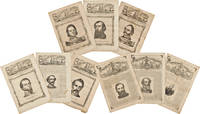
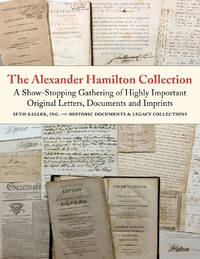
24685<p><b>The Revolutionary War & Founding Collection</b> consists of more than 1000 original historic letters documents imprints and artifacts—including important documents by Washington Hamilton Jefferson Adams Hancock and more. Boasting many objects that had disappeared from the market for many decades and more that have never been sold before this collection is unique and complete in itself.</p> <b>REVOLUTIONARY WAR AND FOUNDING.</b>The collection contains hundreds of documents from leaders soldiers citizens and the press written when the Revolutionary War and Founding were current events. The collection includes powerful letters and documents of Hamilton George Washington Thomas Jefferson John Adams Benjamin Franklin and Aaron Burr among many others. <p><br /></p><p>Alexander Hamilton letters and documents in the collection include:</p><p>- one of his greatest love letters to Elizabeth Schuyler: <i>"You are certainly a little sorceress… and have rendered me as restless and unsatisfied with all about me as if I was the inhabitant of another world"</i>;<br /></p><p>- Hamilton's letter rallying to defeat Jefferson after Washington declined a third term Hamilton changed his tune four years later when he considered Burr a greater danger;<br /></p><p>- a letter written on behalf of General Washington in October 1777;<br /></p><p>- Hamilton to Robert Morris on biases that affect New York taxes;<br /></p><p>- Hamilton and General Charles Lee's former aide-de-camp avoid a new confrontation years after Hamilton served as a second in his friend John Laurens' duel with Lee.</p><p><br /></p>The collection includes:<p>- the Declaration of Independence—official facsimile printed by order of Congress;<br /></p><p>- Benjamin Franklin's electrifying letter on continuing support for the Declaration and his pleasure upon returning home after nine years as minister to France;<br /></p><p><i>- The Federalist Papers</i> first edition from the estate of a Governor of Pennsylvania;<br /></p><p>- letters and documents of leaders and soldiers among them a pay order for Philip Negro.</p><p><br /></p><p>The collection features letters of the first three American Presidents:</p><p>- George Washington's uncharacteristically tongue-in-cheek letter to close friend Dr. James McHenry cryptically confiding his dream of leaving the army;<br /></p><p>- a Washington letter preparing for a possible campaign after his victory at Yorktown;<br /></p><p>- John Adams crowing about the capture of 55 British Ships but warning not to expect peace yet as <i>"The Heads of a King and Ministers is at Stake"</i>;<br /></p><p>- another great Adams letter reacting to the Reynolds scandal asking of Hamilton: "<i>Can talents atone for such turpitude Can wisdom reside with such Gullibility"</i>;<br /></p><p>- Thomas Jefferson refusing to share private correspondence to protect unfiltered thoughts from "<i>obloquy from bigots in religion in politics or in medicine</i>."</p><p><br /></p><p>Also included:</p><p>- Original printings of the Acts passed by Congress implementing Hamilton's Assumption Plan his 1790 Report on the Public Credit the charter for the Bank of the United States and the charter for the Society for Useful Manufactures;<br /></p><p>- His 1784 Phocion pamphlet explaining Federalist positions on peace with Great Britain;<br /></p><p>- Documentation of a Livingston's slam against Hamilton in a near-riot at Federal Hall; and a letter detailing Hamilton's related challenge of Commodore Nicholson to a duel;<br /></p><p>- A rare printing of the "Reynolds Pamphlet" in which he admits to infidelity but vigorously denies financial malfeasance;<br /></p><p>- A lock of Hamilton's hair carefully preserved by his family for generations;<br /></p><p>- the domain name <b>AHamilton.com</b> is included.</p><p><br /></p><p>The Founding is represented in part by more than 40 exceptionally rare original acts of Congress signed by Thomas Jefferson or Edmund Randolph as Secretary of State including the 1791 budget and<i> the Act for raising a farther sum of Money for the Protection of the Frontiers</i> which Hamilton used as a back-door approach to enact his Report on Manufactures tariff proposals.</p><p>An Addendum features a collection of more than 900 original newspapers from 1800 to 1804 that capture the news of the new nation as it unfolds with reports on the Hamilton-Burr duel printed in his own newspaper and Jefferson's First Inaugural and first four State of the Union addresses. Plus French Revolution and Haiti slave uprising reports more Acts of Congress legal cases such as <i>Marbury v. Madison</i> and more politics personalities events and issues.</p> books
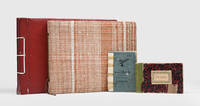
18612786np: np 1861. First edition. Original leather covers. Good. A REMARKABLY EXTENSIVE ARCHIVE OF A UNION SOLIDER INCLUDING DIARIES FROM 1861-1865 SPANNING HIS ENTIRE CIVIL WAR CAREER.<br /> <br /> THE SOLDIER CHARLES E. SMITH PARTICIPATED IN SOME OF THE MOST CRITICAL CAMPAIGNS OF THE WAR INCLUDING THE SEIGE OF VICKSBURG THE FALL OF ATLANTA AND SHERMAN'S MARCH TO THE SEA. Background:<br /> <br /> Charles E. Smith 1836-1905 was born in Berlin Township Ohio. He worked as a farmer and country schoolteacher in Alum Creek Delaware County Ohio. He enlisted in the 32nd Ohio Volunteer Infantry at the age of 25 on September 3 1861 and mustered in September 7 1861. He was promoted to the rank of corporal in Company I of the regiment on January 30 1864. He was slightly wounded on July 29 1864 during the Atlanta Campaign. He mustered out of the service on July 20 1865 at Louisville Kentucky.<br /> <br /> The 32nd Ohio Infantry was organized at Mansfield Ohio on August 20-September 7 1861 and mustered in for three years' service under the command of Colonel Thomas H. Ford. The regiment was involved in several important engagements and operations during the Civil War including the Battle of Greenbrier River the Battle of McDowell the Battle of Harpers Ferry the Battle of Champion Hill the Siege of Vicksburg the Atlanta Campaign the Battle of Jonesborough Sherman's March to the Sea the Carolinas Campaign and the Battle of Bentonville. The 32nd Ohio Infantry mustered out of service at Louisville Kentucky on July 20 1865.<br /> <br /> The Collection:<br /> <br /> The collection consists of 26 dairies dating from 1859 to 1866. Except for four volumes covering a period from 1856 to April 1861 and one covering the period September 18 1865 to December 5 1866 the remaining dairies 21 volumes span his entire Civil War career in the 32nd Ohio Volunteer Infantry covering the period September 3 1861 the date of his enlistment to the date of his mustering out of the service on July 20 1865. The diaries of various sizes average approximately 100 pages with few blank pages.<br /> <br /> His daily entries in his Civil War diaries many of which are detailed consist of descriptions of the weather diet geographical locations his devotion to the Union camp activities military news and description of engagements. He also included several drawings in the diaries some in color. He described his day of enlistment of September 3:<br /> <br /> "Enlisted at Lewis Center between 8 and 9 oclock in Captain Dyre's company of 3 years volunteers. I bid good bye to all my folks and started having resolved to assist in sustaining the Government. But the feelings which came over me when I left home friends and all that seemed dear to me I cannot describe."<br /> <br /> The new enlistees moved to Camp Dennison and Smith records the daily activities in camp as his company prepared for their first movement. From Camp Dennison the 32nd Ohio was ordered to western Virginia present-day West Virginia to assist in driving Confederate forces out of the region. On October 3 1861 the 32nd Ohio participated in the inconclusive Battle of Greenbrier River. Smith records in his diary beginning on September 29 through October 3:<br /> <br /> "In the evening we received orders to march to make an attack on Greenbrier about 12 miles distant. Our company numbered 86 men. Our regiment probably numbered 900 men present and able to perform duty. The 32nd. Went in advance and cleared out the road and took one prisoner. Our regiment stopped at the cross roads within four miles of Greenbrier and stopped. We expected there that the battle commenced. but they Confederate troops did not come and we. crept into the thick laurel bushes to lay till morning. When I awoke it was daylight and other regiments were passing. The artillery was hurrying along as fast as possible each gun was drawn by six horses and about nine oclock the canons began to roar. It was kept up till two oclock on both sides when our communication failed and our men withdrew from the field without losing any guns. The canons roared very loud and the sound rolled over the Mountains and valleys and made everything ring once more. Our loss was including those that were killed on the field and those that died of wounds after the battle about 12 men. We took 13 prisoners." <br /> <br /> Smith describes an engagement with Confederate forces around Beverly Virginia on December 18 1861:<br /> <br /> "The rebels came out and met our forces and a bloody fight ensued. The 32nd fought bravely and drove the enemy back. The 25th were in the advance and were cut up dreadfully. They fell back and the 32nd stood their ground and fought them like tigers. Our men made two or three gallant charges and drove them out of their entrenchments and were forced out themselves. Our boys could not drive them out again and after a desperate and bloody struggle our troops retreated. having lost about one hundred men."<br /> <br /> After spending the winter in Beverly Virginia the 32nd Ohio participated in the Shenandoah Campaign of 1862 where they engaged Stonewall Jackson's Confederate force at the Battle of McDowell Virginia on May 8 and were defeated. On that day Smith recorded the following:<br /> <br /> "We formed into line and gave three cheers to the cavalry and were waiting to welcome the infantry when a dispatch came for us to report immediately at headquarters armed and equipped. We went forthwith and formed into line of battle on an open field. The rebels came down on the hills & tried to pick a spot to plant a gun and our boys threw shell amongst and drove them out. The rebels gathered on a mountain at the right of town about 4000 men. Our boys did not find out what they were at or where they were till late in the afternoon. Two regiments went up the mountain and the ball was opened. The battle lasted till after 8 oclock at night when our boys withdrew bringing the wounded and mostly all the dead from the field. The fight lasted about 4 hours."<br /> <br /> The 32nd Ohio retreated to Franklin Virginia where they joined General John C. Fremont's command. Fremont followed the Confederates into the valley and engaged a Confederate force at Cross Keys Virginia on June 8 1862 but Smith's company did not participate in the action. The 32nd Ohio move on to Winchester Virginia where they performed garrison duty for the remainder of the summer.<br /> <br /> In September 1862 the 32nd Ohio was dispatched to Harper's Ferry. The regiment again faced Stonewall Jackson participating in the Battle of Harper's Ferry September 12-15 1862. In this engagement Jackson captured the town and nearly twelve thousand Union soldiers including the 32nd Ohio subsequently paroling them after confiscating their supplies. In his entry for September 15 Smith describes the last day of the battle:<br /> <br /> "At sunrise the ball opened with a heavy cannonade from both sides. Our men were nearly out of ammunition for artillery and the enemy was mowing down our ranks. The shells and shot came down like hail all around and amongst us and many of our officers and soldiers were mortally wounded. Our artillerists run out of ammunition and there was no other way for us to do than surrender or be slaughtered on the field. At about 8 oclock the stripes and stars were hauled down and the white flag waved as a signal for surrender. The rebel cavalry and officers were soon riding through our camp. They hoisted the bars and stars where an hour before our glorious old star spangled banner floated proudly in the breeze. O how my heart beat and my bosom heaved to see that corrupt flag raised in defiance over us."<br /> <br /> The surrender of the 32nd Ohio resulted in a revolt in the ranks of the enlisted men against the regiment's officers which Smith later discusses in a January 15 1863 entry in his diary stating: "we were obliged to surrender 11500 men to the Rebels General A.P. Hill. It was the opinion of nearly all of our men that Colonel Miles of Baltimore betrayed us into the hands of the Rebels. It was said that he got 15 cents per head for us. Our Col Thomas H. Ford was examined by a committee and dismissed from the service for blame that was unjustly laid against him for the evacuation of the Maryland Heights. Since we were paroled a hard feeling was created between the officers of the regiment." Smith and his regiment eventually rejoined General Ulysses Grant's Army of the Tennessee in Memphis on January 25 1863. The regiment was involved in Grant's Siege of Vicksburg beginning in April 1863.<br /> <br /> A pivotal engagement in Grant's Vicksburg Campaign was the Battle of Champion Hill which occurred on May 16 resulting in a Union victory. Smith's entry for that day records the fighting:<br /> <br /> "A battle had begun on the left the firing seemed to be from large guns and the line seemed to be several miles long. We halted to await orders. Soon they came & we went forward & laid behind a ridge where we could see the fighting. The scene was grand but terrible. The heavy fighting was on the left & center at first. Our brigade charged on a rebel battery and took it & hauled it off. The 32nd did a noble part charging on the hills & ravines and out the battery driving the enemy before them killing a large number."<br /> <br /> The siege of Vicksburg ended on July 4 1863 when the Confederate forces surrendered and the Union troops under Grant including the 32nd Ohio entered the city. Smith recorded the events of July 3 and 4 in his diary. On July 3 he wrote: "This is the 46th day of the Siege. The rebels have sustained at this place and nobly and bravely have they defended it but General Grant has been too much for them." The next day's entry detailed the surrender. "At nine oclock it was announced that Vicksburg was surrendered. What a thrill of joy ran through every heart. The boys all seem lively and jubilant over the success which has crowned our arms. At half past ten oclock the rebels march out of their forts and rifle pits. and form in line outside their works and stuck arms."<br /> <br /> After Vicksburg the 32nd Ohio joined an expedition to Monroe Louisiana and then participated in General James McPherson's expedition to Brownsville Mississippi. In addition to his daily entries Smith also drew a number of pencil and ink sketches that reflected what he described in on a particular day such as sketching images that depicted the sleeping arrangements in the soldiers' tents maps of terrains and a two-page spread showing the capture of a Confederate battery in Mississippi. He also wrote down poems whether written by him or others. For example on January 31 1864 he added a six-stanza poem possibly written by him entitled "Evening Thoughts" to that day's entry. A partial transcription reads: "I'm weary and I'm lonely//As I'm sitting in my tent//And I'll take my leaden pencil//And give you my feelings sent// O would this war be over//And these bloody strivings cease//And our country now distracted//Return with lasting peace."<br /> <br /> In February 3 to March 6 1864 the 32nd Ohio was involved in General William T. Sherman's Meridian Expedition which resulted in the capture of Meridian Mississippi. On March 3 Smith recorded a diary entry that detailed the destruction rendered by the campaign:<br /> <br /> "I cannot fully give the amount of damage done to the Southern Confederacy while on this Expedition but the result foots up about as follows. About 200 miles of railroad running east & west was destroyed. About 60 miles of the Mobile and Ohio railroad was destroyed and about 40 miles of the Central Mississippi road destroyed. There were about 25 Locomotives and a considerable number of cars together with Confederate railroad houses machine shops and foundries manufacturing establishments of arms ammunition. A large amount of cotton was burned."<br /> <br /> On June 10 1864 the 32nd Ohio joined Sherman's Atlanta Campaign. In the campaign the 32nd fought in the Battles of Kennesaw Mountain Atlanta Ezra Church and Jonesborough. The campaign ended on September 2 1864 when Union forces occupied Atlanta. Smith's diary entry for June 27 mentions the engagement at Kennesaw Mountain:<br /> <br /> "We were aroused at early dawn. and then ordered to pile our knapsacks and be ready to move. A battery had been brought up and was shelling the Rebels lively for a while. Our division having formed a line of battle came to a right shoulder shift arms and then we advanced in line through the woods toward the enemy. The skirmishers engaged the enemy who replied by volleys of musketry which whizzed overhead and sounded hideous. The rebels brought several batteries down and opened upon us. Moved up a little higher and laid down again and the rebels opened with shot and shell which came whizzing overhead. Some of them sung like an old spinning wheel under the control of a northern farmer's wife. Our loss in this engagement was considerable. We fell back learning that the rebels were massing their force to right and formed a new line of battle in front of our new breastworks and behind the skirmishers. Skirmishing was kept up lively along the lines and many had hair breadth escapes. We made our demonstration to draw as much rebel force away from the right as possible."<br /> <br /> His diary entry for September 3 1864 reported the good news concerning the fall of Atlanta:<br /> <br /> "Atlanta was evacuated yesterday morning at daylight the rebels having blown up large magazines of ammunition destroyed government stores and eighty carloads of ammunition. The Twentieth Corps under General Slocum marched into and took possession of the city of Atlanta an eleven oclock. We have last caused the rebels to evacuate what they called the 'Gate City' or 'Key' to the southern Confederacy and that without a very general battle. The rebels have made many boasting speeches and declared that they would fight for Atlanta till the last man woman and child was sacrificed before they would give it up. Where is their vain boasting where are their prophesies"<br /> <br /> The capture of Atlanta had a major impact on the presidential election of 1864 and helped President Lincoln's chances for reelection enormously. On election day November 8 the 32nd Ohio voted in the field. Smith's diary entry for the day reads "This being election day the polls were opened and we voted for President. Abe Lincoln carried the day."<br /> <br /> In mid-November 1864 the 32nd Ohio participated in General Sherman's "March to the Sea." The command engaged in no noteworthy battles or skirmishes until reaching Savannah Georgia. On December 10 1864 the regiment was among the lead Northern units that drove the Confederate garrison into the confines of city. Upon the Union Army's capture of Savannah on December 21 1864 the 32nd entered and encamped in the city.<br /> <br /> Within a week of the fall of Richmond the capital city of the Confederacy the news of President Lincoln's assassination and death on April 15 spread slowly to the soldiers in the south including the 32nd Ohio. On Monday April 17 Smith recorded in his diary:<br /> <br /> "An order said to have come from Secretary Stanton to General Howard was announced to the soldiers. That President Lincoln Secretary Seward and son were assassinated and that the President was killed. Whether this be true or not it caused sadness in many hearts and was believed to be reliable."<br /> <br /> The next day's entry was in response to the confirmation that Lincoln was dead:<br /> <br /> "News of the death of our President Abraham Lincoln causes a gloom over our minds. We feel that in losing him we have lost one of the best men our nation ever produced. In losing him we lose a wise and intelligent statesman a great and good counsellor a lover of freedom and humanity and the deliverer of our nation from the curse of slavery."<br /> <br /> In addition to the dairies there are several documents and papers relating to Smith and his family including the following: 1 An autograph manuscript entitled "The Vicksburg Campaign from Millikens Bend Louisiana. From March to July 4th 1863" 81 pages one side only in a bound copy book cover missing 8.5" x 11.5" n.p.; n.d.<br /> <br /> 2 An autograph manuscript entitled "The Siege of Vicksburg Continued" 34 pages one side only in a bound copybook 6.75" x 8.25 n.p.; n.d.<br /> <br /> 3 Autograph manuscript signed entitled "Diary of Events Transpiring between the United States and Spain over Cuban affairs." 117 pages in bound copy book 5.75" x 9" n.p.; circa 1901.<br /> <br /> 4 Autograph manuscript signed entitled "Closing Scenes of the Rebellion. An Original Poem" Six pages one side only in bound copybook 8" x 10" n.p.; May 30 1895. Poem was recited on Decoration Day at Cheshire Ohio on May 30 1895.<br /> <br /> 5 An autograph manuscript entitled "The Great Three Days Battle of Gettysburg Fought July 1 2d & 3d 1863. The Greatest and Most Decisive Conflict of the Great Struggle for American Independence" 28 pages one side only in bound copy book missing front cover 8" x 10" n.p.' n.d.<br /> <br /> 6 Autograph manuscript part 2 of number 4 above 27 pages one side only in bound copy book 8" x 10" n.p.; n.d.<br /> <br /> 7 Autograph manuscript entitled "Original Poem Written for the 49th anniversary of the birth of Mrs. Louisa Rolson Smith" Five pages one side only 8" x 10" n.p.; June 22 1895.<br /> <br /> 8 Autograph manuscript signed entitled "Incidents in the war of the rebellion from 1861 to 1865. Poetical Effusions from the pen of Charles E. Smith late of Co. F. 32d Ohio veteran volunteer Infantry" 68 pages one side only in bound copybook missing front and back cover 8.5" x 11.75" n.p.; n.d.<br /> <br /> 9 Photograph of Charles E. Smith 3.5" x 4.75 oval albumin print mounted on board n.p; circa 1894. <br /> <br /> 10 CDV of George Smith brother of Charles E. Smith 2.5' x 4" T.Beach photographer Delaware Ohio; circa 1860s. <br /> <br /> 11 Medal with badge for 32nd National Encampment GAR Cincinnati 1898.<br /> <br /> 12 Photograph of residence of Charles E. Smith West Berlin Ohio an 9.25" x 7.5 albumen print on a 10.25" x 8.5" mount Acme View Company McAlisterville Pennsylvania; 1894. <br /> <br /> 13 A Confederate envelope "captured on the battle field of Raymond Miss. May 12 1863 by C. E. Smith. <br /> <br /> 14 Discharge of Charles E. Smith from the service one page 6" x 8.5" Columbus Ohio; July 28 1865.<br /> <br /> 15 Two pencil sketches by Smith of "A residence near camp of 20th Ohio sketched by C. E. Smith Dec 3d 1863" on front and "A scene in co. D. 20th O.V.I. Thursday evening Nov 26th 1863. A Thanksgiving oyster supper. Sketch by C. E. Smith Nov 27th 1863." <br /> <br /> 16 A pencil sketch of the "View of The Court House at Vicksburg. Drawn by C.E. Smith Nov 4th 1863."<br /> <br /> 17 Pencil sketch of the Rock House inside the Confederate fortifications at Vicksburg "Sketched by C.E. Smith Nov 2d 1863." On verso is sketch by Smith of the city vault in Vicksburg November 2 1863.<br /> <br /> 18 Photocopy of will of Charles E. Smith Two pages West Berlin Ohio; December 18 1901. <br /> <br /> Condition: The 26 diaries all have leather covers over boards which in most cases are worn but intact. The front cover of volume #9 has separated. Most have flaps. Overall the dairies are in good condition. The other items in the collection are overall good; numbers #1 and #7 manuscripts are brittle and fragile. Foxing and toning to letters along with creasing and light tearing at edges. Wear and staining to the exterior of diaries.<br /> <br /> Note: The text of the collection has been published as "A View From the Ranks: The Civil War Diaries of Corporal Charles Smith" in a very limited printing by the Delaware County Historical Society 1999. A copy of the book is included with the collection. <br /> <br /> A REMARKABLE UNBROKEN RUN OF DIARIES OFFERING A HIGHLY LITERATE FIRST-HAND ACCOUNT OF THE CIVIL WAR EXPERIENCE THROUGH THE EYES OF A UNION SOLDIER. np unknown
1956140943102Various Places: The War Relocation Authority 1956. A substantial archive of over 300 individual documents plus a few duplicates<br /> relating to Japanese internment during WWII<br /> forming a very thorough view of the federal agency that directed their imprisonment The War Relocation Authority. Such a sizeable collection of WRA documents is extremely rare in commerce.<br /> <p>All the major facets of the dark disturbing episode of Japanese internment are represented in this archive: its basic legal and historical outlines the WRA's publicity and propaganda and its reception<br /> in the US the WRA's groundbreaking use of social sciences in service of repressive American policies life and death in the camps and the ending of internment.<br /> <p>The essential history of internment can be said to begin with Franklin D. Roosevelt's Executive Order 9102 establishing the War Relocation Authority included in mimeograph format. Around that time and later an Index-Digest of Opinions by the Office of the Solicitor compiles legal opinions about<br /> internment with commentary by regional attorneys.<br /> <p>Additionally included are many of the WRA's<br /> quarterly and semi-annual reports as well as a<br /> nearly 300-page contemporary history of the<br /> agency by an unknown author untitled and likely written in late 1944.<br /> <p>The publicity campaigns of the agency are reflected in collections of the propaganda leaflets the WRA issued a near-complete run of the abstracts the WRA prepared on press coverage it faced mimeographed speeches presented by WRA head Dillon S. Myer and other agency figures and a file of documents relating to the WRA's investigation by<br /> the House Committee on Un-American Activities<br /> HUAC which would become famous under<br /> Joseph McCarthy in the early 1950s. The WRA's sensitivity to criticism is readily apparent especially in their robust reaction to HUAC's critiques.<br /> <p>One of the most controversial sections of the WRA the Community Analysis Section is heavily represented in this archive by near-complete runs of their Community Analysis and Project Analysis Reports. The Community Analysis Section was largely composed of social scientists primarily anthropologists who studied life in America's WWII concentration camps. Their aim was to aid Franklin D. Roosevelt's administration in running the camps with as little resistance as possible by applying lessons learned in the disciplines of Japan studies<br /> and the human sciences. Although some<br /> Community Analysts voiced objections within<br /> restricted internal communications few brought<br /> these objections before the American public.<br /> Throughout the next six decades anthropologists psychologists and sociologists would become increasingly integral in US military operations and counterinsurgency campaigns leading to controversy with the revelation of their complicity in acts of torture by the American military in Iraq and Afghanistan.<br /> <p>Life and death in the camps is revealed in the previously mentioned reports of the Community Analysis Section as well as in detailed reports of Americans of Japanese ancestry who died in the camps and in military service Cumulative<br /> Casualties by Center documents about Tule<br /> Lake and a death there. The thoroughness of<br /> these reports is undoubtedly of use to future<br /> historians looking into various rebellions within<br /> the camps and the repression which followed<br /> as well as deaths of Nissei in WWII.<br /> A smaller collection of documents outlines the<br /> closing of the camps and attempts to transition<br /> their residents back to normal life.<br /> <p>Most are stapled mimeographed documents; a<br /> few are carbon copy typescriptsas indicated in<br /> their descriptions. Very Good condition overall.<br /> Around ten of the documents are ex-library<br /> copies with their stamps and "discard" written on<br /> them. Occasional holograph notations for<br /> routing in the WRA bureaucracy. Some<br /> documents marked "Confidential" and "Do Not<br /> Publish." Manuscript annotations to some<br /> leaves.<br /> <p>A remarkable collection of documents that<br /> reveal not only what the WRA did but how its<br /> bureaucrats perceived it and themselves. There<br /> is a strange but quintessentially American<br /> mixture of professionalism media savviness<br /> cruelty optimism and racism for historians and<br /> researchers to study here and hopefully for us<br /> all to learn from.<br /> <p>DETAILED DESCRIPTION OF CONTENTS AVAILABLE UPON REQUEST. The War Relocation Authority unknown
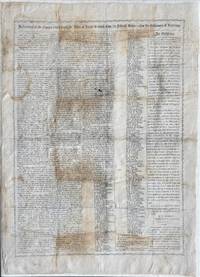
18616200San Antonio: February 2 1861. Good. Broadside on silk 19.5 x 14 inches. Expertly cleaned and restored. Previously folded with some creasing still visible. Moderate staining and a few small holes and separations aided by conservation. Scattered contemporary manuscript notations. An exceptionally rare Texas secession broadside executed on silk satin in San Antonio in 1861. Printed in five columns with an ornamental border the broadside features both the Ordinance of Secession and the Declaration of Causes two of the three principal documents drafted by the Texas Secession Convention along with a list of delegates. According to the colophon "These sheets on Fine Satin may be had at the Herald Office for $1 or on fine Book Paper at 10 cents each." The present broadside belonged to Cyrus Halbert Randolph 1817-1889 who was the Texas State Treasurer at the time of secession. Randolph arrived in Texas in March 1838 and quickly became established as an attorney and politician. A member of the Snively Expedition in 1843 he served in several political roles in Houston County including justice of the peace 1840 chief justice of the county circa 1843 and sheriff 1847. He also represented the county in the Texas Legislature in two terms between November 1851 and November 1857. Randolph was elected state treasurer 1859 and won re-election in 1860. Notably small pencil notations are next to the names of several delegates in the list perhaps associates of Randolph. Other known copies have connections to delegates and it seems likely that the sheets printed "on Fine Satin" were ideal souvenirs for prominent Texas politicians. <br /> <br /> After South Carolina's secession in December 1860 Texas was not far behind in joining them. The Constitutional Convention was organized on February 1 1861 and voted overwhelmingly in favor of secession. The ordinance was ratified by popular vote on February 23rd. The document begins with the Declaration of Causes a fiery assertion of Texas's rights which highlights her unique history as an independent country and leaves no doubt as to the core issue at stake: "Texas abandoned her separate national existence and consented to become one of the Confederated States to promote her welfare insure domestic tranquility and secure more substantially the blessings of peace and liberty to her people. … She was received as a commonwealth holding maintaining and protecting the institution known as negro slavery -- the servitude of the African to the white race within her limits -- a relation that had existed from the first settlement of her wilderness by the white race and which her people intended should exist in all future time. Her institutions and geographical position established the strongest ties between her and other slave-holding States of the confederacy. Those ties have been strengthened by association. But what has been the course of the government of the United States and of the people and authorities of the non-slave-holding States since our connection with them"<br /> <br /> Continuing in scathing language the authors accuse the North of interfering directly as they "encouraged and sustained lawless organizations to steal our slaves;" "invaded Southern soil and murdered reoffending citizens;" "sent seditious pamphlets and papers among us to stir up servile insurrection and bring blood and carnage to our fireside;" "sent hired emissaries among us to burn our towns and distribute arms and poison to our slaves;" and "finally by the combined sectional vote of the seventeen free or non-slave-holding States they have elected as President and Vice President of the whole Confederacy two men whose chief claims to such high positions is their approval of these long continued wrongs and their pledges to continue them to the final consummation of these schemes for the ruin of the slaveholding States."<br /> <br /> What follows is a list of the 168 delegates ending with Philip A. Work distinguishing this copy as a first edition. Noted bibliographer and Texas historian Everett C. Wilkie Jr. made a detailed study of the Texas secession documents in The 1861 Printings of the Ordinance of Secession Dallas 2011 and identifies three separate editions of the broadside essentially differentiated by the list of delegates. The first edition Wilkie 23 was almost certainly printed in February 1861 and ends the delegate list with Philip A. Work. The later editions Wilkie 24 & 25 were printed in early and mid-March respectively with additional delegates added to the list. The present edition is also the only one to include six lines naming the delegates who voted against secession. <br /> <br /> Printed in the right-hand column is the Ordinance of Secession stating the Texas is once again "a separate sovereign state." The preamble encapsulates the grievances of the state "Whereas the action of the Northern States of the Union is violative of the compact between the States and the guarantees of the Constitution and whereas the recent developments in Federal affairs make it evident that the power of the Federal Government is sought to be made a weapon with which to strike down the interests and prosperity of the people of Texas and her sister slave-holding states; instead of permitting it to be as was intended our shield against outrage and aggression; therefore."<br /> <br /> Parrish & Willingham note three institutional copies: University of North Carolina University of Texas and Baylor University. The Baylor copy however is actually a 7-page pamphlet edition Parrish & Willingham 4150. The UNC and Texas are therefore the only other known copies of the first edition. A unique opportunity to acquire one of the most significant broadsides in Texas history in the first edition and on silk.<br /> Crandall 2153. Parrish & Willingham 4151. Wilkie 23. Winkler & Friend 171. February 2 unknown
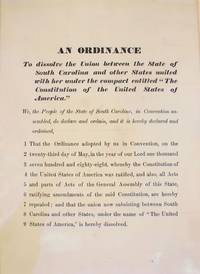
1860369308Charleston S.C.: Evans and Cogswell 1860. Broadside 11-1/2 x 8-1/4 inches. Old folds. Nicely mounted framed and glazed. Broadside 11-1/2 x 8-1/4 inches. One of the earliest Confederate imprints: South Carolina's official act of secession printed for delegates at the secession convention. This first printing of the South Carolina Ordinance of Secession the document which caused the departure of South Carolina from the Union set the nation irrevocably on the path to the Civil War. <br /> <br /> After Lincoln's election South Carolina moved vigorously to follow through its threat to secede from the Union. A secession convention was called and assembled at Charleston on December 20 1860. Their entire business was to debate the issue of secession which they favored overwhelmingly and to settle on the wording of a secession ordinance. Within the day the 169 members of the Convention voted unanimously for the ordinance.<br /> <br /> This is the printing of the ordinance made for the use of the delegates to the Convention. The ordinance was set up in the form of a "reading bill" or "slip bill" familiar to most delegates as the typical form of a legislative bill in working draft with the body of the text in numbered double-spaced lines to facilitate the making of corrections. Following the title given above the text reads:<br /> "We the People of the State of South Carolina in Convention Assembled do declare and ordain and it is hereby declared and ordained That the Ordinance adopted by us in Convention on the twenty-third of May in the Year of Our Lord one thousand seven hundred eighty-eight whereby the Constitution of the United States of America was ratified and also all Acts and parts of Acts of the General Assembly of this State ratifying amendments to the said Constitution are hereby repealed; and that the union now subsisting between South Carolina and other States under the name of 'The United States of America' is hereby dissolved."<br /> <br /> Presumably only several hundred copies of this "slip bill" version of the Secession Ordinance were printed - just enough to distribute to the members of the convention. They were probably printed just before the convention began. Indeed setting and printing it would have taken a few hours at most. After its passage the ordinance would famously be published as a newspaper extra by the Charleston Mercury with the following words in bold below the text of the ordinance: The Union Is Dissolved!<br /> <br /> This is one of four extant examples of the slip bill the others being examples at the Huntington Library Emory University and one in private hands being the example once belonging to Jay Snider sold to him by the William Reese Company in 1997 and resold at the sale of his collection at Christies June 21 2005 lot 165 selling for $66000. Parrish & Willingham 3795; Crandall 1888 Evans and Cogswell unknown
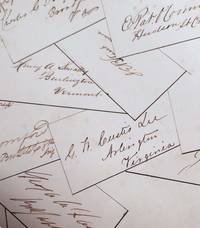
2621n.pl: n.p. n.d. First edition. Very Good. A CLASS DIVIDED: A UNIQUE COLLECTION OF SIGNATURES OF WEST POINT ALUMNI SOON TO BE DIVIDED BY THE CIVIL WAR. <br /> <br /> WITH: FINELY DRAWN INK MAP OF WEST POINT BY ALEXANDER STEWART WEBB AND ELEGANT WATERCOLOR VIEW. <br /> <br /> FROM THE COLLECTION OF JEB STUART. The Signatures:<br /> <br /> The present collection includes two large displays of signatures on sheets featuring numerous small boxes printed onto them filled in by each individual with their name and a location perhaps their current residences. The effect these documents give is the impression of an informal assortment of hand-written calling cards amassed after a social function of West Point alumni. Predominately the sheets are signed by most of the Class of 1854 a fateful group who were soon be divided by the impending Civil War. Beyond this outstanding group other graduating classes are represented as well as certain individuals who were not graduates of the USMA but no less salient figures of wartime America-including Albert J. Myer inventor of wigwag signalling and James Wiley Magoffin lessor for the land upon which Fort Bliss would be built.<br /> <br /> The terminus ad quem for the collection of signatures is most likely 1854 the earliest death of any signee in this case John L. Grattan who died after encountering Sioux troops in the Dakota Territory. Yet a number of signees are from later graduating classes-so either if the signatures were assembled all on one date these individuals were still current students or possibly these sheets represents a longer project of collecting the signatures. <br /> The providences of those who signed these papers alone reflect the many sacrifices made by the servicemen. Michael Ryan Morgan Class of '54 survived the War retired in 1897 and lived to be nearly 80 and Albert J. Myer lived on to propagate his widely-successful wig-wag flag signalling system across the world. William Dorsey Pender and Stephen Hinsdale Weed both Class of '54 perished as so many did at Gettysburg in the early days of July 1863-only three decades of age each. John T. Magruder Class '57 by solemn contrast was killed only one year after his graduation from West Point; the Sacramento Daily Union edition of 17 August 1858 published the notice:<br /> <br /> Information has been received of the sudden death of Lieut. Magruder of Washington City while on his way to Great Salt Lake with the Utah army. His death was caused by another man a quarrel having arose between them which resulted in the shooting of Lieut. Magruder. His parents reside at Washington.<br /> <br /> Yet unlike his peers who would shortly be fractionalised among the Union and Confederate armies Magruder never knew the domestic horror of the Civil War-neither the extent of violence on American soil nor the growing schism between his fellow class-men.<br /> <br /> An enumeration of each of the 53 signees is provided below along with brief biographical details.<br /> <br /> Two West Point Illustrations from Signed JEB Stuart Scrapbook - A Fine Map in Ink by Alexander Stewart Webb and a Watercolour Study:<br /> <br /> In a largely dilapidated scrapbook owned by JEB Stuart signed faintly in pencil "JEB Stuart June 1853" the summer between his Junior and Senior years at West Point two impressive illustrations have been preserved.<br /> The first is a topographic map in ink by Alexander Stewart Webb Class of '55 JEB Stuart's underclassman by one year. Brevetted Brigidier General and Major General on 13 March 1865 Webb was recognised "for gallant and meritorious services in the campaign terminating with the surrender of the insurgent army under Gen. Lee." and his wartime letters are now held at Yale University's Beinecke Library see "Webb Samuel Blatchley" in Appleton p. 403. The present drawing possibly depicting an aerial view of either Trophy Point or Constitution Island is remarkable for the meticulous line shading to capture the region's elevation and natural features.<br /> <br /> The second illustration a miniature watercolour study in sepia offers a scenic view from the Plain at Trophy Point overlooking the water with Constitution off to the right in the background. Signed "Merrill" it is feasibly by Lewis Merrill Class of '55 based on proximity to JEB Stuart's time at West Point but this is uncertain.<br /> Both of these images from JEB Stuart's personal collection capture the natural beauty and early history of USMA West Point.<br /> <br /> ___________<br /> <br /> West Point signature displays c. 1854. 2 pages on 2 folia 13 x 10¾ in; framed: 23 x 20 ¾ in. Small puncture hole toward top left on one sheet not affecting text.<br /> <br /> with<br /> <br /> Webb Alexander Stewart. Topographic map n.d. Ink on paper 13¼ x 9½ in; mounted: 15 x 11¼ in. Signed in ink in bottom right-hand corner "A. S. Webb".<br /> <br /> with<br /> <br /> View from Trophy Point n.d. Watercolour on paper 3 x 2 ½ in; mounted: 15 x 11¼ in. Signed in bottom right-hand corner "MERRILL".<br /> <br /> ___________<br /> <br /> References:<br /> <br /> Appletons' Cyclopædia of American Biography ed. by James Grant Wilson and John Fiske 7 vols. New York: D. Appleton and Company 1898-1900 VI: Sunderland-Zurita 1889<br /> <br /> Heidler David Stephen Jeanne T. Heidler and David J. Coles Encyclopedia of the American Civil War: A Political Social and Military History New York: Norton 2002<br /> <br /> Sacramento Daily Union "Additional Atlantic News" 17 August 1858 p. 4<br /> <br /> <br /> List of Signatures<br /> <br /> No. Name Rank Allegiance USMA Class Notes<br /> <br /> 1 John T. Magruder Bvt 2nd Lt Union '57 d. 28 June 1858 Maryville NE aged 21<br /> <br /> 2 J S Simonson Major <br /> <br /> 3 Henry B. Douglass Colonel Union '52 d. 19 June 1892 Barnet Park NY aged 65<br /> <br /> 4 Albert James Myer Bvt Brigadier General Union - d. 24 August 1880 Buffalo NY aged 51<br /> <br /> 5 John Bordenave Villepique Brigadier General Confederate '54 d. 9 November 1862 Port Hudson LA aged 32<br /> <br /> 6 John L. Grattan Bvt 2nd Lt Union '53 d. 19 August 1854 Ft Laramie Dakota Territory aged 24; engaged by the Sioux<br /> <br /> 7 John Speed Rudd Adj General Confederate <br /> <br /> 8 Washington Lafayette Elliott Bvt Major General Union '44 d. 29 June 1888 San Francisco CA aged 63<br /> <br /> 9 Richard Irving Dodge Colonel Union '48 d. 15 June 1895 Sackett's Harbor NY aged 68<br /> <br /> 10 Richard Kidder Meade 2nd Lt Confederate '57 d. 31 July 1862 Petersburg VA aged 26<br /> <br /> 11 John Henry Edson Lt Colonel Union '53 d. 11 February 1914 Elizabeth NJ aged 84<br /> <br /> 12 Charles Geddings Rogers Lt Colonel Confederate '54 d. 24 February 1888 Nashville TN aged 57<br /> <br /> 13 Charles Nesbit Turnbull Bvt Colonel Union '54 d. 2 December 1874 Boston MA aged 42<br /> <br /> 14 Henry Larcom Abbot Colonel Union '54 d. 1 October 1927 Cambridge MA aged 96<br /> <br /> 15 John Osmond Long Colonel Confederate '54 <br /> <br /> 16 Samuel Kinsey 2nd Lt Union '54 d. 14 July 1855 Washington DC; typhoid<br /> <br /> 17 Robert Granderson Cole Colonel Confederate '50 d. 7 November 1887 Savannah GA aged 49<br /> <br /> 18 Andrew Jackson Smith Colonel Union '38 d. 28 January 1897 St Louis MO aged 82<br /> <br /> 19 Henry Adam Smalley Captain Union '54 d. 13 May 1888 New York NY aged 54<br /> <br /> 20 James E. B. "Jeb" Stuart Major General Confederate '54 d. 12 Mary 1864 Richmond VA aged 31; wounded at Yellow Tavern<br /> <br /> 21 Edgar O'Connor Colonel Union '54 d. 28 August 1862 Groveton VA aged 29<br /> <br /> 22 William Dorsey Pender General Confederate '54 d. 3 July 1863 Gettysburg PA aged 29<br /> <br /> 23 Milton T. Carr Captain Union '54 AWOL 1863<br /> <br /> 24 James Vote Bomford Colonel Union '32 d. 6 January 1892 Elizabeth NJ aged 80<br /> <br /> 25 George Washington Custis Lee Major General Confederate '54 d. 18 February 1913 Alexandria VA aged 81<br /> <br /> 26 John Bailey Mullins Lieutenant Confederate '54 d. 3 October 1891 Norfolk VA aged 62<br /> <br /> 27 William McEntyre Dye Major Union '53 d. 13 November 1899 Muskegon MI aged 68<br /> <br /> 28 Hyatt C. Ranson Lt Colonel Union '51 d. 16 March 1874 Jeffersonville IN aged 51<br /> <br /> 29 George Brinton McClellan Major General Union '46 d. 29 October 1885 Orange Mountain NJ aged 58<br /> <br /> 30 James Wiley Magoffin Jr. - - d. 27 September 1868 San Antonio TX aged c. 68<br /> <br /> Second leaf<br /> <br /> 31 Thomas J. Wright Lieutenant Union '54 d. 12 October 1857 Ft Randall Dakota Territory aged 29<br /> <br /> 32 Samuel T. Shepperd 2nd Lt Union '54 d. 27 June 1855 Ft. Leavenworth KA aged 24<br /> <br /> 33 Stephen D. Lee Lt General Confederate '54 d. 28 May 1908 Vicksburg MS aged 74<br /> <br /> 34 John Trout Greble Bvt Lt Colonel Union '54 d. 10 June 1861 Big Bethel VA aged 27; first West Point graduate claimed by the War<br /> <br /> 35 David Hancock Major Union '54 d. 21 May 1880 Harrisburg PA aged 47<br /> <br /> 36 Alfred Beck Chapman Lieutenant Union '54 d. 16 January 1915 San Gabriel CA aged 85<br /> <br /> 37 John T. Mercer Colonel Confederate '54 d. 19 April 1864 Plymouth NC aged 31<br /> <br /> 38 Thomas J. Treadwell Captain Union '54 d. 2 August 1879 NY Arsenal NY aged 47<br /> <br /> 39 Charles Greene Sawtelle Brigadier General Union '54 d. 4 January 1913 Washington DC aged 78<br /> <br /> 40 John McCleary Bvt Major Union '54 d. 25 February 1868 Charleston SC aged 36<br /> <br /> 41 Edwin Franklin Townsend Brigadier General Union '54 d. 15 August 1909 Washington DC aged 76<br /> <br /> 42 William M. Davant 2nd Lt Union '54 d. 1 October 1855 Rio Grande TX aged 24; drowned<br /> <br /> 43 Henry Whitney Closson Brigadier General Union '54 d. 15 July 1917 Washington DC aged 85<br /> <br /> 44 Loomis L. Langdon Brigadier General Union '54 d. 7 January 1910 New York NY aged 80<br /> <br /> 45 Michael Ryan Morgan Brigadier General Union '54 d. 16 September 1911 St Paul MN aged 78<br /> <br /> 46 Stephen Hinsdale Weed Brigadier General Union '54 d. 2 July 1863 Gettysburg PA aged 30<br /> <br /> 47 George A. Gordon Major Union '54 d. 26 October 1878 Washington DC aged 45<br /> <br /> 48 Judson David Bingham Brigadier General Union '54 d. 17 November 1909 Philadelphia PA aged 79<br /> <br /> 49 Oliver Otis Howard Major General Union '54 d. 26 October 1901 Burlington VA aged 76<br /> <br /> 50 Horace Randal 2nd Lt Confederate '54 d. 27 February 1861 Jenkins' Ferry AR aged 31<br /> <br /> 51 James Deshler Colonel Confederate '54 d. 20 September 1863 Chicamauga GA aged 30<br /> <br /> 52 Zenas Randall Bliss Major General Union '54 d. 2 January 1900 Washington DC aged 65<br /> <br /> 53 Thomas Howard Ruger Major General Union '54 d. 3 June 1907 Stamford CT aged 74. n.p. unknown
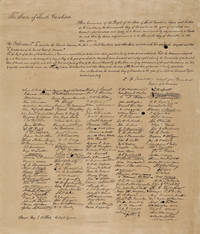
186136810Charleston: Evans & Cogswell 1861. Lithographic broadside 34 x 26 inches. Expert restoration archivally paper-backed. South Carolina calls for secession.<br/> <br/>The very rare lithographic facsimile of the South Carolina Act of Secession which precipitated the beginning of the Civil War and is thus one of the earliest Confederate imprints. One of only 200 copies printed. This large-format contemporary print of the original engrossed and signed manuscript document presents the Act of Secession as it was passed and signed in the South Carolina State House. It so faithfully executed that it also reproduces the ink blots present on the original document. The document features the text of the secession ordinance and the signatures of D.F. Jamison President of the Convention and 169 delegates to the Secession Convention called by Gov. Francis W. Pickens. The historic resolution which revoked South Carolina's ratification of the United States Constitution was largely the work of Robert Barnwell Rhett editor of the Charleston Mercury which printed a well-known secession broadside of its own proclaiming: "The Union Is Dissolved!" The secession resolution was passed unanimously at 1:15 p.m. on Dec. 20 after which Jamison said "The Ordinance of Secession has been signed and ratified and I proclaim the State of South Carolina an Independent Commonwealth." Shortly after passage of the ordinance Evans & Cogswell printers to the convention were asked to prepare a copy for use by the members. The convention reconvened in March 1861 to address issues related to the coming war. According to the report of Paul Quattlebaum Chairman of the Committee on Printing published as an appendix to the March 28 1861 entry in the Journal of the Convention of the People of South Carolina the printing was "in a style creditable to the art; and by a careful comparison with the original the Committee find it to bear a very notable similarity to it." The convention delegates immediately authorized Evans & Cogswell to print 200 lithographic copies of the Ordinance to be distributed at the direction of D.F. Jamison. Evans & Cogswell likely printed the 200 copies including the present copy in the days that followed and probably before the Battle of Fort Sumter on April 12. The copies were then most likely distributed to the convention delegates and other prominent state officials. An exceedingly rare and important Civil War document with only eleven copies known in institutions according to Parrish & Willingham and even fewer in auction records.<br/> <br/>Crandall 1887; Journal of the Convention of the People of South Carolina pp. 204 543. Parrish & Willingham 3794; Sabin 87444. Evans & Cogswell unknown books
1861WRCAM52380Charleston: Evans & Cogswell 1861. Lithographic broadside 33 3/4 x 26 1/2 inches. Mild creasing toning and spotting. Very minor repaired marginal tears small chip in lower left corner. Near fine. Matted and framed. The very rare lithographic facsimile of the South Carolina Act of Secession which precipitated the beginning of the Civil War and is thus one of the earliest Confederate imprints. One of only 200 copies printed this copy was found among the papers of William Dunlap Simpson a prominent South Carolina legislator and governor. Simpson was a lawyer who served two terms in the South Carolina House of Representatives and one in the state Senate. He acted as a lieutenant colonel during the Civil War and was a delegate to the Confederate State House in 1863. After the Civil War Simpson was elected lieutenant governor then governor for a brief time before serving ten years as chief justice of the South Carolina Supreme Court. <br> <br> This large format contemporary engraving of the original engrossed and signed manuscript document presents the Act of Secession as it was passed and signed in the South Carolina State House. It was so faithfully executed that it also reproduces the ink blots present on the original document. The document features the text of the secession ordinance and the signatures of D.F. Jamison president of the Convention and 169 delegates to the Secession Convention called by Gov. Francis W. Pickens. <br> <br> The historic resolution which revoked South Carolina's ratification of the United States Constitution was largely the work of Robert Barnwell Rhett editor of the CHARLESTON MERCURY which printed a well-known secession broadside of its own proclaiming: "The Union Is Dissolved!" The secession resolution was passed unanimously at 1:15 p.m. on December 20 after which Jamison said "The Ordinance of Secession has been signed and ratified and I proclaim the State of South Carolina an Independent Commonwealth." <br> <br> Shortly after passage of the ordinance Evans & Cogswell printers to the convention were asked to prepare a copy for use by the members. The convention reconvened in March 1861 to address issues related to the coming war. According to the report of Paul Quattlebaum Chairman of the Committee on Printing published as an appendix to the March 28 1861 entry in the JOURNAL OF THE CONVENTION OF THE PEOPLE OF SOUTH CAROLINA the printing was "in a style creditable to the art; and by a careful comparison with the original the Committee find it to bear a very notable similarity to it." The convention delegates immediately authorized Evans & Cogswell to print 200 lithographic copies of the Ordinance to be distributed at the direction of D.F. Jamison. Evans & Cogswell likely printed the 200 copies including the present copy in the days that followed and probably before the Battle of Fort Sumter on April 12. The copies were then most likely distributed to the convention delegates and other prominent state officials such as William Dunlap Simpson. <br> <br> An exceedingly rare and important Civil War document once belonging to a South Carolina governor and Civil War officer with only eleven copies known in institutions according to Parrish & Willingham and even fewer in auction records. PARRISH & WILLINGHAM 3794. CRANDALL 1887. SABIN 87444. JOURNAL OF THE CONVENTION OF THE PEOPLE OF SOUTH CAROLINA pp.204 543. Evans & Cogswell unknown books
157128345Nuremberg 1571. Engraving printed on two sheets of laid paper joined. Engraver's monogram at the lower left. Early manuscript caption in English in the lower margin. Plate mark: 11 x 16 inches. Sheet size: 14 5/8 x 18 3/8 inches. Tear extending from the right margin closed with small void in excellent facsimile small worm hole within the image. Very rare German news-sheet map depicting the Turkish fleet invasion of Cyprus in 1570.<br/> <br/>Exceptionally scarce engraved German broadside map depicting the Ottoman fleet sailing to Venetian-controlled Cyprus in 1570. The early English manuscript caption in ink just below image reads: "The representation of the Turkish Navall Army in ye year 1570 going forth to meet the Venetian fleet." Cyprus then under Venetian rule was a strategic point for controlling shipping and trade in the Eastern Mediterranean. The Ottomans ruled by Sultan Selim II had long desired the island. Following a series of warnings and demands the Ottoman fleet commanded by Müezzinzade Ali Pasha and Lala Mustafa Pasha sailed for Cyprus in late June 1570. Depicted here the Turkish fleet was composed of an estimated 350-400 ships and upwards of 100000 men. Following sieges and massacres at Nicosia Kyrenia and Famagusta the island was taken by August 1571. Although the invasion was long-heralded the Venetian fleet failed to prevent the invasion or the subsequent fall of Cyprus to the Turks. However they subsequently raised the support of the "Holy League" of the Catholic maritime states in the Mediterranean and defeated the Ottoman fleet at the Battle of Lepanto in October 1571 off the western coast of Greece. The victory of the Holy League prevented the Ottoman Empire expanding further along the European side of the Mediterranean though did not end their possession of Cyprus. Jenichen who signed the map with his monogram 'BI' was the leading German publisher of news-sheet maps. Jenichen and compatriot Matthias Zündt took particular interest in the conflict and produced views and maps of it that equaled and surpassed those of their Italian counterparts. Given their ephemeral nature all are rare and desirable. We can locate only one other example of this engraving appearing at auction in recent times Sotheby's London 29 April 2014 lot 157 £60000.<br/> <br/>Hollstein XL B 128; G.K. Nagler Die Monogrammisten v. 1 p. 818-819; Andresen II Nr. 276; Drugulin II 364; s.a. Meurer Jenichen S. 50. unknown books
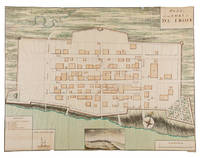
1761WRCAM56427Albany 1761. Manuscript plan in pen and ink with watercolor on four conjoined sheets of paper 21 1/2 x 28 1/2 inches signed at lower right "W.B. Albany Augt. 18th 1761." Old folds minor edge wear light soiling a few unobtrusive minor repairs to verso. Very good. A beautifully-rendered pen ink and watercolor plan of Fort Detroit executed by noted cartographer William Brasier for his commander General Jeffrey Amherst in Albany in 1761. It depicts Fort Detroit just months after it was ceded from New France to Great Britain and very much as it would look for the next four years. This version of Detroit would hold strong against Pontiac and his warriors throughout their barrage in the summer of 1763. <br> <br> William Brasier produced this plan after an original drawn the year before by Lieutenant Diedrich Brehm which was also presented to Amherst some months earlier in February 1761. Brehm had accompanied Robert Rogers from Detroit to New York in late 1760 and early 1761 and arrived at Amherst's command in New York with his plan of Detroit in tow. It is here in Albany where Brasier used Brehm's plan to create the present depiction. <br> <br> Like Brehm's plan Brasier's version presents Fort Detroit as a long roughly rectangular-shaped settlement populated with about seventy mostly-unidentified buildings colored in light red-brown. The names of north and south streets are labeled according to their orientation; this was just the second time the first being on Brehm's map that these streets were identified in print. The fort is shown just off the banks of what is now the Detroit River; a handwritten notation in the water reads "The Streight is about 900 Yards wide here." <br> <br> Brasier includes a "Reference" key at bottom left which identifies six of the buildings and other locations on the plan namely the "King's Powder Magazine" the powder magazine belonging to the inhabitants of the fort the block-houses "The Cavalier" the church and the "Commandant's Garden." This is down from nine locations in a similar key on Brehm's plan. Brasier's plan of Detroit was featured in Brian Leigh Dunnigan's FRONTIER METROPOLIS: PICTURING EARLY DETROIT 1701- 1838 and Dunnigan illuminates the reasoning behind Brasier's elimination of some of these locations: <br> <br> "Brasier's title 'Plan of the Fort at De Troit' does not reveal why it was drawn but the work is not an exact copy of Brehm's original. The differences lie in the west end of the town where all of the buildings shown by Brehm along both sides of the 'Rue neueve St. Germain' have been deleted. These stood within the space gained when Captain Belestre enlarged the stockade during 1758- 59 and it is likely that Brasier's copy relates to the controversy over ownership of those properties. At least twelve grants were made within the town by Captain Belestre during 1758-59 and most were in the area of expansion at the western end of the stockade. Before it had been incorporated into the town however that land was part of the Domain surrounding the fort and was thus the property of the French king. British officers questioned whether Captain Belestre had the authority to grant lots there to individuals. If not the land was rightly the property of King George III." <br> <br> Brasier also followed Brehm by including a "Profil sic of the Stockade" and an elevated depiction of the fort titled "View from the West." The stockade profile is a detailed depiction of the construction of Detroit's main defensive apparatus. The view of the city is considered the "first look at the town of Detroit in other than a ground plan or a map" according to Dunnigan. The perspective of this view was intended to be that of Rogers' troops as they faced the main gate upon arrival at the fort. The tops of many of the buildings including Belestre's own house peek over the tops of the surrounding stockade. The view also makes clear the reality of the uneven ground upon which Fort Detroit was built; the ground swells from left to right to about the middle of the fort then pitches downward again towards the river at right before plunging down to the river banks just outside the stockade walls. <br> <br> William Furness Brasier 1689-1775 was a draftsman in the engineer's office of General Amherst's command post at the time he executed the present plan of Fort Detroit. He was also a prolific and exacting cartographer who produced well-regarded maps of Lake Champlain the upper Hudson River valley and the Mississippi River as well as impressive plans of Fort Ticonderoga Fort Ontario Fort George Mobile and Pensacola and St. Augustine Florida. <br> <br> The whereabouts of this plan were unknown to Dunnigan at the time he published FRONTIER METROPOLIS. The plan remained in the collection of General Jeffrey Amherst and descended through his family until it was bought by Charles Sessler for H. Richard Dietrich at Sotheby's sale of the Earl of Amherst's collection July 4 1967 lot 494. It has been in the Dietrich American Foundation ever since. Brian Leigh Dunnigan FRONTIER METROPOLIS: PICTURING EARLY DETROIT 1701-1838 Detroit: Wayne State University 2001 p.55 figure 4.5. Sotheby's & Co. CATALOGUE OF AMERICANA VOYAGES AND TRAVEL ATLASES AND MAPS London: Sotheby's July 4 1967 pp.102-03. unknown books
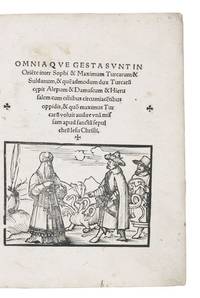
1518G4TESVVUF9FDBasel: Pamphilus Gengenbach 1518. 19th-century pink wrappers. 4to. With woodcut illustration on title-page. Rare 16th-century news pamphlet on the Ottoman-Mamluk War 1516-1517. The booklet relates the events from June 1516 to July 1517 followed by an account of Sultan Selim's visit to Jerusalem. During the Ottoma-Mamluk war the Ottoman Sultan Selim I known as "the Grim" conquered Syria and defeated the Mamluk Sultan in the Battle of Ridaniya. He subsequently captured and sacked Cairo thereby placing the holy cities Mecca and Medina under Ottoman rule which marked the beginning of Ottoman power in Arabia.With two bookplates some browning otherwise in very good condition.l Göllner 115; USTC 679549; VD 16 O 738. Pamphilus Gengenbach, unknown
178063128Head Quarters Bergen County NJ 1780. Folio one page approximately 125 words in part: "I perceive . that you had collected about two hundred Cattle more and that a further number might be obtained . I cannot of right command the services of the militia . let the commanding officers know how distressed the Army has been and is likely to be for provisions and that it will be rendering splendid service to us and distressing the enemy to remove the Cattle from those parts of the Coast which furnish the New York Markets." Very good. Browned one small piece detached one word of text easily repaired. After Washington's victory at Monmouth June 1778 during which battle Forman had served as an advisor to Charles Lee the war settled into stalemate with Washington's army in New Jersey and the British forces content to remain in New York both sides keeping an eye on each other while trying to provide for their soldiers the American forces suffering deprivation similar to that of Valley Forge. Meanwhile on the day this letter was written word reached Washington of the complete rout of Horatio Gates and his troops at Camden South Carolina opening Virginia to British invasion from the South. Bolstered by American victories at Kings Mountain Oct. 1780 and Cowpens Jan. 1781 and the depletion of Cornwallis's army at its victory over Nathaniel Green at Guilford Court House Washington in conjunction with his French allies moved south to envelop Yorktown earning the British surrender in October 1781 effectively ending the war. General David Forman 1745-1797 born and raised in Monmouth County New Jersey was appointed colonel of a New Jersey regiment that reinforced Washington at New York in June 1776. After suppressing a loyalist uprising later that year during which time he earned the nickname "Devil David" he was chosen to lead a regiment in the Continental army and in 1777 was commissioned brigadier general to lead the New Jersey militia commanding that force in the battle of Germantown Oct. 1777. Disagreements with the New Jersey legislature led to his resignation from that command and he spent the rest of the war running listening posts especially along the coast of New Jersey providing Washington with intelligence on the movements of the British fleet and army a service he was providing at the time of this letter. see DAB Tench Tilghman 1744-1786 born and raised in Talbot County Maryland graduated from the precursor to the University of Pennsylvania in 1761 taking up a mercantile business until the outbreak of the revolution. After serving briefly as a captain in the army he joined Washington as a volunteer and served continuously as an aide-de-camp to the general for the balance of the war. "The amount of secretarial work in addition to military duties that he performed for Washington was prodigious" DAB and he was granted a regular commission of lieutenant-colonel in 1781. After the victory at Yorktown Tilghman was chosen by Washington to carry the announcement of the surrender of Cornwallis to the Continental Congress. Provenance: When recently purchased the letter was in an old frame and removal revealed an autograph note inside the backing included here as follows: "This letter was bought by me about 1860 of Miss Brown residing at 92 Columbus Street Albany New York. She was a sister of an old minister of St. Peters Church. This Miss Brown was a client of Orlando Meads and myself and found this letter in a barrel in the garret of the home occupied by her sister at Manalapan New Jersey formerly owned by General David Forman. signed Dexter Reynolds / Albany Sept. 7 1902. Presented to my son Marcus T. Reynolds." A newly discovered Washington letter shedding light on the general's relationship to state militias and his concerns for providing for his troops while disrupting the supply lines of the British. Not in Fitzgerald or the Founders Online from the National Archives which lists 57 other Washington letters to Forman 1777-1782 showing a gap from 24 July 1780 to 17 May 1781 and two others post-war. 9836. <br/><br/> unknown books
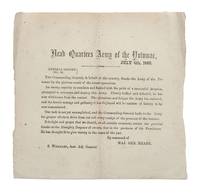
1863353816Gettysburg PA 1863. 1p. Signed in print by Maj. Gen. Meade. 6-3/8 x 6-1/2 inches. Old folds. Housed in a blue morocco backed box. 1p. Signed in print by Maj. Gen. Meade. 6-3/8 x 6-1/2 inches. The General Orders continues: "Our task is not yet accomplished and the Commanding General looks to the Army for greater efforts to drive from our soil every vestige of the presence of the invader. It is right and proper that we should on all suitable occasions return our grateful thanks to the Almighty Disposer of events that in the goodness of his Providence He has thought fit to give victory to the cause of the just."<br /> <br /> Lincoln would take issue with Meade's choice of words arguing that "our soil" applied to the southern states as well. In addition he was disappointed that Meade did not impel a greater effort to pursue Robert E. Lee in retreat. Nevertheless the Union victory at the three-day Battle of Gettysburg would prove a seminal turning point of the war arguably the greatest military victory for the Union. Interestingly Lincoln in his Gettysburg Address would echo Meade's own words from this order over the historic nature of the victory: "The world will little note nor long remember what we say here but it can never forget what they did here."<br /> <br /> Fewer than ten known copies of this battlefield-issued printing of Meade's victory message are recorded in several variant printings. The use of tabletop field printing presses by both the Union and Confederate armies helped make quick field communication possible but minor typographical differences were certain to occur given the circumstances of their composition. In addition a more formal printing of General Orders 68 was issued in Washington and can be found in annual bound volumes of such orders though is frequently misidentified as the present field-printed order. The last example on the market sold at Sotheby's in May 2016.<br /> <br /> WITH: Two-page manuscript official true copy of Meade's General Orders No. 66 assuming command of the Army of the Potomac just prior to the Battle of Gettysburg dated June 28 1863 written and signed by Acting Assistant Adjutant General Paul Nason.<br /> <br /> This example accompanied by a contemporary official manuscript true copy written and signed by A.A.A.G. Paul F. Nason of Meade's General Orders No. 66 in which he assumed command of the Army of the Potomac on the eve of the Battle of Gettysburg: "The country looks to this army to relieve it from the devastation and disgrace of an hostile invasion. Whatever fatigues and sacrifices we may be called upon to undergo let us have in view constantly the magnitude of the interests involved and let each man determine to do his duty leaving to an all-controlling Providence the decision of the contest unknown
157128345Nuremberg 1571. Engraving printed on two sheets of laid paper joined. Engraver's monogram at the lower left. Early manuscript caption in English in the lower margin. Plate mark: 11 x 16 inches. Sheet size: 14 5/8 x 18 3/8 inches. Very rare German news-sheet map depicting the Turkish fleet invasion of Cyprus in 1570.<br/> <br/> Exceptionally scarce engraved German broadside map depicting the Ottoman fleet sailing to Venetian-controlled Cyprus in 1570. The early English manuscript caption in ink just below image reads: "The representation of the Turkish Navall Army in ye year 1570 going forth to meet the Venetian fleet." Cyprus then under Venetian rule was a strategic point for controlling shipping and trade in the Eastern Mediterranean. The Ottomans ruled by Sultan Selim II had long desired the island. Following a series of warnings and demands the Ottoman fleet commanded by Müezzinzade Ali Pasha and Lala Mustafa Pasha sailed for Cyprus in late June 1570. Depicted here the Turkish fleet was composed of an estimated 350-400 ships and upwards of 100000 men. Following sieges and massacres at Nicosia Kyrenia and Famagusta the island was taken by August 1571. Although the invasion was long-heralded the Venetian fleet failed to prevent the invasion or the subsequent fall of Cyprus to the Turks. However they subsequently raised the support of the "Holy League" of the Catholic maritime states in the Mediterranean and defeated the Ottoman fleet at the Battle of Lepanto in October 1571 off the western coast of Greece. The victory of the Holy League prevented the Ottoman Empire expanding further along the European side of the Mediterranean though did not end their possession of Cyprus. Jenichen who signed the map with his monogram 'BI' was the leading German publisher of news-sheet maps. Jenichen and compatriot Matthias Zündt took particular interest in the conflict and produced views and maps of it that equaled and surpassed those of their Italian counterparts. Given their ephemeral nature all are rare and desirable. We can locate only one other example of this engraving appearing at auction in recent times Sotheby's London 29 April 2014 lot 157 £60000.<br/> <br/> Hollstein XL B 128; G.K. Nagler Die Monogrammisten v. 1 p. 818-819; Andresen II Nr. 276; Drugulin II 364; s.a. Meurer Jenichen S. 50. unknown
18201541751820-21. Vibrant immediate and honest An outstanding series of 37 vivid candid letters by Major-General Sir George Ridout Bingham 1777-1833 transcribed by him from his original correspondence home and spanning April 1809 to January 1814 including the campaign of Talavera. They constitute a major primary source for campaigning in the Peninsula. In a reflective foreword written at Dean's Leaze in 1820-21 Bingham explains that he found his mother's preserved cache of letters on his return to England and copied them out verbatim omitting only personal matters. He stresses that he made no revisions leaving his early impressions misjudged predictions and evolving opinions intact and notes the gradual growth of his confidence in Wellington. An index closes the volume. A letter of 29 July 1809 from the field near Talavera captures the collection's immediacy: Bingham reports the ferocity of the action the heavy British casualties borne without Spanish support the army's acute want of provisions the deaths and wounds among senior officers his own collapse from exhaustion and the Spaniards' killing of wounded Frenchmen. Such unvarnished observations typify the set. The foreword and letters are printed in Gareth Glover's Wellington's Lieutenant Napoleon's Gaoler 2005. Glover notes that all surviving transcripts - including those at the National Army Museum typescript copies presented to the United Services Institute in 1923 - derive from lost originals. He characterizes the letters as frank immediate and rich in operational detail free from retrospective shaping and attentive to landscape people officers daily routines and the brutal conduct of war. Bingham from a long-established Dorset family rose rapidly: ensign in the 69th 1793 major in the 82nd 1801 and in 1805 lieutenant-colonel of the newly raised 2/53rd. He led the battalion throughout its distinguished Peninsula service Porto to Burgos later commanding a provisional battalion through Vitoria the Pyrenees and the Nivelle. Decorated with the Portuguese Order of the Tower and Sword and made KCB he escorted Napoleon to St Helena and commanded there until 1819 later serving on the Irish staff during a turbulent period. He was widely regarded as a considerate and able officer. Provenance: pencilled ownership of Col. John Delalynde Mansel 1850-1915 Rifle Brigade whose grandfather Lieut.-Col. John Mansel served as Bingham's second-in-command in the Peninsula. Subsequent family marriages united the Mansel Bingham and Pleydell lines. Small quarto 230 x 185 mm. Contemporary red half roan smooth spine divided by seven pairs of gilt fillets gilt lettered "MSS. Letters from the Peninsula" sides and corners trimmed with paired gilt fillets red paper sides. 163 pages running to about 32000 words written in a neat hand. Binding professionally refurbished slight cockling to first few leaves otherwise clean and presenting smartly. Gareth Glover Wellington's Lieutenant Napoleon's Gaoler: The Peninsula Letters & St Helena Diaries of Sir George Ridout Bingham 2005; T. H. McGuffie ed. "The Bingham Manuscripts: 2nd/53rd in the Peninsular War 1809-10 and 1812-13" JSAHR Vol. 26 No 107 Autumn 1948. unknown
25054401China n.d. ca. 1927-1928. Brown simulated alligator cloth covers 37 x 27.5 cm. black pages spine ribbon-tied ca. 400 b.w. photos corner mounted images very good sharp and clear images NOT fadedsolidnicely done. V E R Y R A R E ! . . SUPERB PHOTO ALBUM OF THE CHINESE CIVIL WAR: . . Beginning of The Communist Party led led by Mao Tse-tung . . V.S. the Kuomintang KMT or Chinese Nationalist Party . Led by Chiang Kai Shek. . The United States Supported the KMT. In this album we see how the KMT soldiers hosted the American Army in China using their trains and military bases throughout China. This unusual album contains 400 original b. w. photographs & and is an historic photographic record of American military deployment showing Dough-boys in China probably from the U.S. Army's 2nd. Battalion 15th. infantry per the flag and insignia found on a group formation photograph. A minority are with written captions by and large taken by the person who made the album also enhanced with a small percent of professional Chinese photos some of which have in-negative captions. There are ca. 3 or so photos missing else completely filling 32 pages or 64 sides one on the inside back cover. The inside of the front cover has five attractive period color luggage type adverts from various hotels: Hotel Lankershim & Coast Line Military & Naval Hotel San Francisco Cal; The Court Hotel Tientsin North China; Grand Hotel des Wagons Litz; Astor House Hotel Ltd. Tientsin. The album begins with photos of a Chinese playing a Pi-pa snake skin banjo then there are three other photos: first two show a Chinese military camouflage train engine from which a Yank soldier in his campaign hat descends and a long train of cars with a large howitzer mounted upon one last shows French troops at parade rest with their rifles and white gloves and crested helmets with anchors naval or marines with others in the background with some officers. The next two pages show Chinese coolies swing a basket from the creek top water a field a mother suckling her baby with her family at the farm a large water tower in the wet slums and a group of Doughboys at attention in formation they wear boots leggings chrome World War I type dress helmets a rifle back pack with bayonet cartridge pouch belts with green wool hip-length jackets. The opposite page shows another view of the Chinese military train a pair of large mounted guns on an armored train car. To the right is a Chinese officer pointing to a large pierced hole in the train with a foreign engineer peering out from the small window. The train sports the Republic of China flag with a Chinese military unit flag painted on the side. Another view shows a group of abandoned Chinese coffins that went to the dogs; a group of soldiers in garrison caps at attention with fixed bayonets as the officers salute someone near the person taking the photo some Chinese officers also present. Next 2 pages show Chinese on a wheel barrow some Japanese women by a pond in Kimono and a group of British troops from their colonial Empire: blacks Indians white trumpeter Chinese and others with musical instruments all wear white cork-type pith helmets. A group of Japanese officers mugging for the camera. Photos of the railhead and large number of Chinese troops with rifles and kit at the railway station some on march carrying their flags others in open box cars with touring cars that are on the move another of camouflaged armored train cars one shows a number of foreign soldiers looking out of a train car window some are with tiny embossed stamp at right corner: "Mei Lee Tien Tsin." The album continues with a mixture of images of civilian Chinese Chinese military their trains moving air planes weapons war refugees in tents military views of barbed wire fortifications trenches machine gunners Russian soldiers Chinese officers Chinese air force funerals rickshaw pullers camel trains captured & wounded prisoners foreign soldiers at their sand-bagged posts. Photos of the great wall magnificent Chinese architectural monuments buildings and pagodas religious icons coffins more coffins mortars & Chinese junks and a plethora of others. The American Consulate General's compound in Tientsin American military band welcoming the newly arrived replacement troops. A large photo group shot of the American officers seated for a memorial photograph with their Battalion flag proudly posted on the wall where they pose source of our citation at the top of the unit name; two buglers are at each outside position the commander is ram-rod straight and taller than all others seated in the front & center; he and only two others on his sides wear full leather knee boots probably indicating the highest ranking officers; others are in boots & leggings. Photos of Doughboys aboard a ship showing the Naval officers with one stunning photo of an American high officer with his Japanese & Chinese counter parts posing for the camera. And a photo of the "Mail Boat Gazun Panama" and a few others of Panama giving credence to the fact that some of these soldiers came from the American East coast via Panama to San Francisco then on to China. Nice photo of semi-nude Panamanian family men women children. Doughboys at target practice photos of Chinese poverty coolies pulling great loads and street vendors. More showing Chinese life style street life horse & bullock carts and yet more caskets left in the open unburied and abandoned train cars full of horses Chinese troops smoke rising from a burning city another with "Tian jin" written in Chinese catholic church more parading of American soldiers within the Tientsin American Consulate parade grounds trooping of the colors. And a nice photo of the "U.S. Army Transport Thomas" Chinese junk &c. A U.S. soldier in a necktie his rifle at fixed bayonet at parade-rest before the Consulate General compound with sand bags inside a photo of a U.S. soldier with his Colt-45 on his hip with canteen looking at some communications connections another photo of two mini U.S. tanks and a very long bridge over the water. Photo of the Tientsin downtown with a Sikh Indian policeman directing traffic. Next page shows a public Chinese street execution: the guilty on his knees with the executioner ready to swing a very large sword and another headless corpse is before him the Tientsin YMCA compound opposite which is likely the inside of the American Consulate offices showing very ancient typewriters and three women staff and one other female Navy person. They all mug for the camera with a good number of U.S. Army or Marine officers behind three desks. Chinese hauling "magnum gold" brand ammunition on hand- trucks a U.S. Army band performing before the Consulate's office. At this point we find a few photos with penned captions: "One of China's Department Stores it shows a bird vendor; Peanut Gambler a mountain of P-nuts; Chinese Shimboo photo of the office and maker of the album and his Chinese officer friend ; "A Chinese Taxi" shows him in a Rickshaw "Me and the boy friend 11/3/28" shows a tiny goat cart carrying a child's coffin with a Chinese man. This penned date gives substantial proof of the date range of the entire album which was placed about the center of the whole work. The next page shows two more penned captions: "Chinese cavalry" and "Note mud house and fence" shows two Chinese officers on horse-back and a very very poor house with very starved animals. The next shows six Chinese undercover men two each holding a Chinese being readied for execution; and a very grizzly photo of a Chinese officer actually executing a Chinese man with his pistol who is seated on a rock: the photo captures the action as the shot blows away the mans brains. Behind the execution scene is a crowd of American soldiers in campaign hats and Chinese military officers who are witness to the event. More views of Chinese street life vendors pullers haulers & horse carts religious icons and a stunning Chinese roofed gate more Chinese troops on the move via train with a very horrible view of a large number of dead Chinese in the muddy filthy waters by a bridge. Homeless Chinese at a "soup kitchen" war refugees hauling their belongings house boat street barbers a group of 7 photos by the ocean. They show American soldiers at leisure looking at Chinese fishermen nets naked fishermen hauling in a net of fish to the beach a burning waterfront village the jetty where several large American transport ships are at anchor and a great assembly of Yankee soldiers on the beach with duffel bags and their gear at the railhead. The last photo shows a great number of various whisky bottles lined up for display. More photos show a coffin maker large coffin basket seller and "chow" sellers on the street. A military formation of 100's of either Scottish or Irish soldiers with fixed bayonets marching down the main street before the "RNC Electricity Dept." below which is a very long line of British soldiers on one side of the street opposite from a good number of American soldiers who are on the side of the street a British Union Jack flies over a castle-like structure this is clearly some kind of grand military parade. More photos of the Great Wall the military parade and army chaplains with an Australia flag flying over another castle tower. Chinese river scene with large numbers of native boats in a canal a beggar's camp with straw -mat tents a canal crossing ferry for people a photo of a U.S. officer stand on top a wooden coffin for a closer look. More poverty-stricken Chinese haulers fortune tellers graves tethered horses log sawyers rice haulers electric trolley with English and Chinese language sign on the roof panorama post card of Shanghai's Bund. The album now shifts to photos of the Peking area. Shows the Ming tombs and the camel-lined road; military train the Americans were transported by that train a large bivouac and tent city where the U. S. military troops camped some Chinese "house boys" proudly holding the American troop's unit flag. More photos of two U.S. soldiers posing near Chinese coffins in a wet ditch. A group of very young Chinese boys posed near the railroad; one is so poor that he has no clothes at all and is in nude. A large group of Nationalist Chinese soldiers marching along a street one classic photo of a single American soldier on guard standing at attention as stands vigil on a barbed-wire barrier his rifle at fixed bayonet. A group of five Chinese young "ladies" who pose for the camera who seemed NOT to be bewildered by the photographer they look like "Sing-song girls" hookers who entertained the U.S. troops. Chinese Buddhist priests in white robes with shaved heads a great gate to Peking Shanghai harbor views shanty huts captured Chinese criminal or traitor guarded by Chinese soldiers train car full of rifles more Chinese soldiers on trains marching in formation on the road. And a good photo of several American officers: one with a whip posing for the camera in garrison hat. Chinese bivouac and American soldiers with bullet and pouches for ammo with rifles at parade rest. More barbed-wire barricades Chinese & British soldiers armored train-mounted gun. More Chinese prisoners traitors being executed heads hoisted on power poles in baskets as a form of public warning and display for other would-be traitors. An American tent bivouac camp at the train yard two more public exec executions by beheading at the moment of loosing one's head an executed dead man lying in the street. Photos of Peking's Forbidden City a Chinese hung to death from a tree a Yank soldier in overalls carries a Chinese bamboo "yoke" with two baskets and smokes a pipe while Chinese look on and laugh. Two photos of lines of Rickshaws waiting for passengers. One comic photo with negative caption: "Find the Chinaman;" it shows two American soldiers sitting among Chinese. Nice shot of the Summer Palace Peking and a U.S. soldier riding in a Rickshaw. The very last photo inside the back cover shows the whole battalion dressed up wearing their chrome helmets standing at attention in formation for a classic and most historic memorial photograph. Their commanding officer is front and center; all have their rifles ammo belts and very polished boots with back packs. They could be standing in the Tientsin American Consulate compound grounds. Followed by a few other photos of Chinese a Chinese soldier et al. This work shows the typical things seen in China during this period of political and military chaos. The feuding war lords and political parties at war; the landing of American military to protect American diplomatic interests. Support & assistance given to the Americans and other foreign military groups by the Nationalist Chinese army. The desperate situation of the tragic Chinese people caught in the grips of upheaval and the summary punishment of traitors in a public display of the swift and ruthless law of China. A riveting and most compelling true record of a U.S. military officer's sojourn to and deployment in China. THE PHOTOGRAPHER AND THE SIZE OF PHOTOGRAPHS: This is not a professional group of photographs but there a very small amount which were obviously purchased by the maker of the album and inserted. The vast majority are his personal photographs these again are obvious to anyone who looks at the album. This is an excellent example of private work of an unknown American Army officer stationed in China during a very chaotic period. He was interested in recording for posterity his experiences and the sights that he saw while on duty. We thank him for giving us privy to this slice of American and Chinese military history. SIZE OF THE PHOTOGRAPHS: The size varies considerably sizes in cm.: the smallest are 8 x 5 most are 14 x 9 3 larger photos 24.5 x 18 and the last 30 x 10. CONDITION OF THE PHOTOGRAPHS: These are original period photos they are all very clear sharp images no fading and in excellent condition. They have been corner mounted. RARITY: Photographic albums of this period in China are NOT commonly found; one made by an American Army officer stationed in China at this time is exceptionally unusual and RARE ! This is a charming primary source with a large number of clean & sharp images taken by an actual participant in this historic period of China. The officer and photographer of these photographs shared for posterity his keen insight and view of these events. We thank him for giving us privy to this slice of American & Chinese military history. . unknown
25054401China n.d. ca. 1927-1928. Brown simulated alligator cloth covers 37 x 27.5 cm. black pages spine ribbon-tied ca. 400 b.w. photos corner mounted images very good sharp and clear images NOT fadedsolidnicely done. V E R Y R A R E ! . . SUPERB PHOTO ALBUM OF THE CHINESE CIVIL WAR: . . Beginning of The Communist Party led led by Mao Tse-tung . . V.S. the Kuomintang KMT or Chinese Nationalist Party . Led by Chiang Kai Shek. . The United States Supported the KMT. In this album we see how the KMT soldiers hosted the American Army in China using their trains and military bases throughout China. This unusual album contains 400 original b. w. photographs & and is an historic photographic record of American military deployment showing Dough-boys in China probably from the U.S. Army's 2nd. Battalion 15th. infantry per the flag and insignia found on a group formation photograph. A minority are with written captions by and large taken by the person who made the album also enhanced with a small percent of professional Chinese photos some of which have in-negative captions. There are ca. 3 or so photos missing else completely filling 32 pages or 64 sides one on the inside back cover. The inside of the front cover has five attractive period color luggage type adverts from various hotels: Hotel Lankershim & Coast Line Military & Naval Hotel San Francisco Cal; The Court Hotel Tientsin North China; Grand Hotel des Wagons Litz; Astor House Hotel Ltd. Tientsin. The album begins with photos of a Chinese playing a Pi-pa snake skin banjo then there are three other photos: first two show a Chinese military camouflage train engine from which a Yank soldier in his campaign hat descends and a long train of cars with a large howitzer mounted upon one last shows French troops at parade rest with their rifles and white gloves and crested helmets with anchors naval or marines with others in the background with some officers. The next two pages show Chinese coolies swing a basket from the creek top water a field a mother suckling her baby with her family at the farm a large water tower in the wet slums and a group of Doughboys at attention in formation they wear boots leggings chrome World War I type dress helmets a rifle back pack with bayonet cartridge pouch belts with green wool hip-length jackets. The opposite page shows another view of the Chinese military train a pair of large mounted guns on an armored train car. To the right is a Chinese officer pointing to a large pierced hole in the train with a foreign engineer peering out from the small window. The train sports the Republic of China flag with a Chinese military unit flag painted on the side. Another view shows a group of abandoned Chinese coffins that went to the dogs; a group of soldiers in garrison caps at attention with fixed bayonets as the officers salute someone near the person taking the photo some Chinese officers also present. Next 2 pages show Chinese on a wheel barrow some Japanese women by a pond in Kimono and a group of British troops from their colonial Empire: blacks Indians white trumpeter Chinese and others with musical instruments all wear white cork-type pith helmets. A group of Japanese officers mugging for the camera. Photos of the railhead and large number of Chinese troops with rifles and kit at the railway station some on march carrying their flags others in open box cars with touring cars that are on the move another of camouflaged armored train cars one shows a number of foreign soldiers looking out of a train car window some are with tiny embossed stamp at right corner: "Mei Lee Tien Tsin." The album continues with a mixture of images of civilian Chinese Chinese military their trains moving air planes weapons war refugees in tents military views of barbed wire fortifications trenches machine gunners Russian soldiers Chinese officers Chinese air force funerals rickshaw pullers camel trains captured & wounded prisoners foreign soldiers at their sand-bagged posts. Photos of the great wall magnificent Chinese architectural monuments buildings and pagodas religious icons coffins more coffins mortars & Chinese junks and a plethora of others. The American Consulate General's compound in Tientsin American military band welcoming the newly arrived replacement troops. A large photo group shot of the American officers seated for a memorial photograph with their Battalion flag proudly posted on the wall where they pose source of our citation at the top of the unit name; two buglers are at each outside position the commander is ram-rod straight and taller than all others seated in the front & center; he and only two others on his sides wear full leather knee boots probably indicating the highest ranking officers; others are in boots & leggings. Photos of Doughboys aboard a ship showing the Naval officers with one stunning photo of an American high officer with his Japanese & Chinese counter parts posing for the camera. And a photo of the "Mail Boat Gazun Panama" and a few others of Panama giving credence to the fact that some of these soldiers came from the American East coast via Panama to San Francisco then on to China. Nice photo of semi-nude Panamanian family men women children. Doughboys at target practice photos of Chinese poverty coolies pulling great loads and street vendors. More showing Chinese life style street life horse & bullock carts and yet more caskets left in the open unburied and abandoned train cars full of horses Chinese troops smoke rising from a burning city another with "Tian jin" written in Chinese catholic church more parading of American soldiers within the Tientsin American Consulate parade grounds trooping of the colors. And a nice photo of the "U.S. Army Transport Thomas" Chinese junk &c. A U.S. soldier in a necktie his rifle at fixed bayonet at parade-rest before the Consulate General compound with sand bags inside a photo of a U.S. soldier with his Colt-45 on his hip with canteen looking at some communications connections another photo of two mini U.S. tanks and a very long bridge over the water. Photo of the Tientsin downtown with a Sikh Indian policeman directing traffic. Next page shows a public Chinese street execution: the guilty on his knees with the executioner ready to swing a very large sword and another headless corpse is before him the Tientsin YMCA compound opposite which is likely the inside of the American Consulate offices showing very ancient typewriters and three women staff and one other female Navy person. They all mug for the camera with a good number of U.S. Army or Marine officers behind three desks. Chinese hauling "magnum gold" brand ammunition on hand- trucks a U.S. Army band performing before the Consulate's office. At this point we find a few photos with penned captions: "One of China's Department Stores it shows a bird vendor; Peanut Gambler a mountain of P-nuts; Chinese Shimboo photo of the office and maker of the album and his Chinese officer friend ; "A Chinese Taxi" shows him in a Rickshaw "Me and the boy friend 11/3/28" shows a tiny goat cart carrying a child's coffin with a Chinese man. This penned date gives substantial proof of the date range of the entire album which was placed about the center of the whole work. The next page shows two more penned captions: "Chinese cavalry" and "Note mud house and fence" shows two Chinese officers on horse-back and a very very poor house with very starved animals. The next shows six Chinese undercover men two each holding a Chinese being readied for execution; and a very grizzly photo of a Chinese officer actually executing a Chinese man with his pistol who is seated on a rock: the photo captures the action as the shot blows away the mans brains. Behind the execution scene is a crowd of American soldiers in campaign hats and Chinese military officers who are witness to the event. More views of Chinese street life vendors pullers haulers & horse carts religious icons and a stunning Chinese roofed gate more Chinese troops on the move via train with a very horrible view of a large number of dead Chinese in the muddy filthy waters by a bridge. Homeless Chinese at a "soup kitchen" war refugees hauling their belongings house boat street barbers a group of 7 photos by the ocean. They show American soldiers at leisure looking at Chinese fishermen nets naked fishermen hauling in a net of fish to the beach a burning waterfront village the jetty where several large American transport ships are at anchor and a great assembly of Yankee soldiers on the beach with duffel bags and their gear at the railhead. The last photo shows a great number of various whisky bottles lined up for display. More photos show a coffin maker large coffin basket seller and "chow" sellers on the street. A military formation of 100's of either Scottish or Irish soldiers with fixed bayonets marching down the main street before the "RNC Electricity Dept." below which is a very long line of British soldiers on one side of the street opposite from a good number of American soldiers who are on the side of the street a British Union Jack flies over a castle-like structure this is clearly some kind of grand military parade. More photos of the Great Wall the military parade and army chaplains with an Australia flag flying over another castle tower. Chinese river scene with large numbers of native boats in a canal a beggar's camp with straw -mat tents a canal crossing ferry for people a photo of a U.S. officer stand on top a wooden coffin for a closer look. More poverty-stricken Chinese haulers fortune tellers graves tethered horses log sawyers rice haulers electric trolley with English and Chinese language sign on the roof panorama post card of Shanghai's Bund. The album now shifts to photos of the Peking area. Shows the Ming tombs and the camel-lined road; military train the Americans were transported by that train a large bivouac and tent city where the U. S. military troops camped some Chinese "house boys" proudly holding the American troop's unit flag. More photos of two U.S. soldiers posing near Chinese coffins in a wet ditch. A group of very young Chinese boys posed near the railroad; one is so poor that he has no clothes at all and is in nude. A large group of Nationalist Chinese soldiers marching along a street one classic photo of a single American soldier on guard standing at attention as stands vigil on a barbed-wire barrier his rifle at fixed bayonet. A group of five Chinese young "ladies" who pose for the camera who seemed NOT to be bewildered by the photographer they look like "Sing-song girls" hookers who entertained the U.S. troops. Chinese Buddhist priests in white robes with shaved heads a great gate to Peking Shanghai harbor views shanty huts captured Chinese criminal or traitor guarded by Chinese soldiers train car full of rifles more Chinese soldiers on trains marching in formation on the road. And a good photo of several American officers: one with a whip posing for the camera in garrison hat. Chinese bivouac and American soldiers with bullet and pouches for ammo with rifles at parade rest. More barbed-wire barricades Chinese & British soldiers armored train-mounted gun. More Chinese prisoners traitors being executed heads hoisted on power poles in baskets as a form of public warning and display for other would-be traitors. An American tent bivouac camp at the train yard two more public exec executions by beheading at the moment of loosing one's head an executed dead man lying in the street. Photos of Peking's Forbidden City a Chinese hung to death from a tree a Yank soldier in overalls carries a Chinese bamboo "yoke" with two baskets and smokes a pipe while Chinese look on and laugh. Two photos of lines of Rickshaws waiting for passengers. One comic photo with negative caption: "Find the Chinaman;" it shows two American soldiers sitting among Chinese. Nice shot of the Summer Palace Peking and a U.S. soldier riding in a Rickshaw. The very last photo inside the back cover shows the whole battalion dressed up wearing their chrome helmets standing at attention in formation for a classic and most historic memorial photograph. Their commanding officer is front and center; all have their rifles ammo belts and very polished boots with back packs. They could be standing in the Tientsin American Consulate compound grounds. Followed by a few other photos of Chinese a Chinese soldier et al. This work shows the typical things seen in China during this period of political and military chaos. The feuding war lords and political parties at war; the landing of American military to protect American diplomatic interests. Support & assistance given to the Americans and other foreign military groups by the Nationalist Chinese army. The desperate situation of the tragic Chinese people caught in the grips of upheaval and the summary punishment of traitors in a public display of the swift and ruthless law of China. A riveting and most compelling true record of a U.S. military officer's sojourn to and deployment in China. THE PHOTOGRAPHER AND THE SIZE OF PHOTOGRAPHS: This is not a professional group of photographs but there a very small amount which were obviously purchased by the maker of the album and inserted. The vast majority are his personal photographs these again are obvious to anyone who looks at the album. This is an excellent example of private work of an unknown American Army officer stationed in China during a very chaotic period. He was interested in recording for posterity his experiences and the sights that he saw while on duty. We thank him for giving us privy to this slice of American and Chinese military history. SIZE OF THE PHOTOGRAPHS: The size varies considerably sizes in cm.: the smallest are 8 x 5 most are 14 x 9 3 larger photos 24.5 x 18 and the last 30 x 10. CONDITION OF THE PHOTOGRAPHS: These are original period photos they are all very clear sharp images no fading and in excellent condition. They have been corner mounted. RARITY: Photographic albums of this period in China are NOT commonly found; one made by an American Army officer stationed in China at this time is exceptionally unusual and RARE ! This is a charming primary source with a large number of clean & sharp images taken by an actual participant in this historic period of China. The officer and photographer of these photographs shared for posterity his keen insight and view of these events. We thank him for giving us privy to this slice of American & Chinese military history. . hardcover books
1878166983London & Simla: 1878-82. Confidential India Office archive revealing British decision-making in the final phase of the Second Anglo-Afghan War An exceptional archive of confidential India Office and Government of India papers this collection offers an unusually detailed view of the diplomatic and bureaucratic manoeuvring that accompanied the final stages of the Second Anglo-Afghan War and the negotiation of Britain's withdrawal. Bringing together Foreign Department memoranda from Simla Cabinet papers printed at the Foreign Office and India Office material that seldom survives outside official files it reconstructs policy formation across two administrations and two continents. Running through the papers is the early career of Reginald Baliol Brett later 2nd Viscount Esher who became private secretary to Lord Hartington in 1878. As Hartington and the new Liberal government sought to reverse Lord Lytton's "forward" policy and disengage from Afghanistan the India Office and the Government of India frequently disagreed over strategy intelligence and the limits of influence. The archive captures these tensions vividly and shows Brett learning to operate as an assertive intermediary whose probing questionnaires marginalia and attempts to synthesize rival views already marked him out as a rising - and at times unsettling - force within the department. The documentary foundation of the dossier lies in A. W. Moore's two major surveys of Afghan affairs annotated by Brett and widely regarded as the most authoritative India Office narratives of the conflict. These are complemented by a sequence of extremely restricted Simla-printed papers and a run of Cabinet memoranda from Thomas Harrison's private press together charting the shift from aggressive frontier ambition to the more pragmatic Liberal policy of withdrawal and the recognition of Abdur Rahman as Amir. High-level submissions by Hartington Ripon and Evelyn Baring illuminate the arguments over the retention of Kandahar and Pishin while the "Aide-Mémoire" on negotiations with Abdur Rahman documents the decisive recalibration of British aims. Other materials probe the immediate crises of the war: memoranda assessing Yakub Khan's responsibility for the Kabul Residency attack; correspondence among Griffin Stewart and Lyall on the deteriorating northern situation; and the substantial "Very Confidential" dossier of Russian correspondence between General von Kaufmann and Shere Ali which exposes the diplomatic pressures of the "Great Game". Operational detail appears in the viceroy's secret telegrams of early 1880 field reports from Kandahar and Kabul Wilson's military sketch of the campaign and manuscript troop returns. Among the most revealing personal items is General Charles Gordon's autograph draft of a letter to The Times opposing the retention of Kandahar heavily revised and ultimately suppressed by Brett who feared it would damage Gordon's standing. His decision and later grief at Gordon's death lend an unexpected human dimension to a collection otherwise dominated by official policy and statecraft. Only a handful of the documents can be traced in institutional collections and few survive in private hands. Gathered here in a coherent sequence with close associations they provide a rare high-resolution record of how British officials interpreted the war navigated clashing doctrines and personalities and ultimately engineered their exit from Afghanistan. A full list of the contents is available on request. Folio 339 x 215 mm comprising 37 printed and manuscript items: full listing with titles paginations and outline content given in the note. Contemporary light olive brown diagonal zigzag-grain cloth boards rebacked and cornered in brownish orange morocco in the mid-20th century red morocco label original moderate bluish green endpapers retained matching linen hinges. Esher armorial bookplate. Cloth starting to lift a little from the edges of spine; contents variably browned margins a little fragile in places with a few consequent chips and splits one title page torn across and neatly repaired with archival tape: overall very good. James Lees-Milne The Enigmatic Edwardian: The Life of Reginald 2nd Viscount Esher 1986. hardcover
1526000453<p>Rare German Anti-Ottoman Propaganda Pamphlet on the Defense of Christendom<br />Germany 1526.</p><p>12mo. One title leaf and 17 ff. 36 pp. Text in early New High German Frühneuhochdeutsch. Nineteenth-century marbled boards. Very Good. Ex-library with two small marginal stamps.</p><p>Extremely rare sixteenth-century political and military propaganda tract directed against the Ottoman Empire printed at the height of Ottoman expansion into Central Europe following the Battle of Mohács 1526. No printer or place stated.</p><p>According to Carl Göllner Turcica: Die europäischen Türkendrucke des XVI. Jahrhunderts only one copy is recorded dated 1526 VD 16 no. 1881 underscoring the exceptional rarity of this work.</p><p>The pamphlet addresses the urgent question of how the Holy Roman Empire Deutsches Reich should organize its defense against the Ottomans. While it discusses military preparedness and strategic resistance to the Turks the core focus of the text lies in the economic and social burden of war specifically:</p><p>How the costs of military defense should be financed<br />The responsibility of the Christian Church and the Vatican<br />Contributions expected from the German territorial states<br />The allocation of financial obligations among different social classes within German society<br />The work reflects contemporary anxieties surrounding the Ottoman threat and provides valuable insight into early modern fiscal-military thought confessional politics and the rhetoric of defending Christendom against Islam. It is an important source for the study of Reformation-era political discourse anti-Ottoman propaganda and the social history of warfare in sixteenth-century Europe.</p><p>A remarkably scarce survival of early German political printing concerning the Ottoman question.</p> hardcover
1778161245New York: Printed by James Rivington 1778. Britain seeks peace with revolutionary America First editions of these six tracts recording efforts at British-American reconciliation during the Revolutionary War. This copy has an excellent provenance: although not marked as such it comes from the family collection of William Eden 1744-1814 a key figure in the negotiations and the author of the latter two works. In 1778 Lord North appointed Eden a member of the Board of Trade and Frederick Howard 5th Earl of Carlisle 1748-1825 to a commission charged with reconciling Britain and America after the British defeat at Saratoga. Although the commissioners were authorized to grant every American demand short of independence the mission was not a success. Mostly this was because the Americans had already formed an alliance with France but Carlisle did not help matters by issuing a manifesto which criticized the French and insisted that Britain would fight to the bitter end. This attracted the attention of the Marquis de Lafayette who challenged Carlisle to a duel which was rejected on diplomatic grounds. The Collection of Papers published in New York by the king's printer includes Carlisle's manifesto along with various other letters and proclamations exchanged between the commissioners and Congress. The second third and fourth tracts comprise Congress's four-page response to the Carlisle manifesto a petition and an address to the commissioners from the loyalist merchants of New York City. These papers are often found with the Collection but are not always present and are listed as separate works in ESTC. In Eden's two tracts he defends his record with the commission and demonstrates his continued engagement with British and Irish politics. He had begun to push for Carlisle's promotion and in 1779 he secured for him the presidency of the Board of Trade. In 1780 Carlisle became Lord Lieutenant of Ireland taking Eden with him as his chief secretary. The other tracts comprise: b SECOND CONTINENTAL CONGRESS. The following Paper is reprinted in New-York by Authority with the Remarks subjoined to it. By the Congress of the United States of America. Manifesto. New York: Printed for James Rivington 1778. 4 pp. Not in Howes or Sabin; ESTC W23804; Evans 16133. c The Petition of the Merchants and Traders of the City of New York. New York: Printed for James Rivington 1778. 4 pp. Not in Evans Howes or Sabin; ESTC W18925. d The Address of the Inhabitants of the City of New-York and its Dependencies and others his Majesty's faithful and loyal subjects late Inhabitants of the revolted Colonies. New York: Printed for James Rivington 1778. 3 1 pp. Not in Evans Howes or Sabin; ESTC W19159. e EDEN William. Four Letters to the Earl of Carlisle. On certain perversions of political reasoning. On the Present Circumstances of the War between Great Britain and the combined Powers of France and Spain. On the Public Debts. On the Representations of Ireland respecting a Free-Trade. London: Printed for B. White and T. Cadell 1779. 2 163 1 pp. Bound without half-title. Not in Evans; Adams 79-6a; ESTC T40097; Howes E43; Sabin 21827. A second edition was published later in the same year. f EDEN William. A Fifth Letter to the Earl of Carlisle. On Population; on certain Revenue Laws and Regulations connected with the Interests of Commerce; and on Public Oeconomy. London: Printed for B. White and T. Cadell 1780. 2 71 1 pp. Bound without half-title. Not in Eden or Howes; Adams 80-7a; ESTC T35522; Sabin 21828. Six works bound in a single vol. octavo 208 x 123 mm. Complete with four-leaf appendix and errata leaf. Woodcut ornament to title page woodcut head- and tailpieces. Contemporary sprinkled calf smooth spine panelled and with elaborate decoration in gilt and with red and green morocco labels edges yellow. Housed in a tan cloth flat-back box by the Chelsea Bindery. Light bumping and rubbing front joint cracked but holding firm slight loss to lower spine end minor browning and foxing to endpapers and contents a couple of small ink splashes to contents: a very good copy. ESTC W20046; Evans 15825; Howes C585; Sabin 14380. hardcover
52697Album of 143 silver gelatin photographs largely 33 x 26.5 cm or the reverse printed on a warm and cold tone photographic stock dry mounted on album leaves 40.6 x 38 cm recto only with printed captions. Full blue morocco covers lined in blue silk gathered with screw posts and bearing the silver insignia of the Army Services Forces and imprinted "Franklin D. Roosevelt." Very good. Laid-in is a TLs from Lieutenant General Brehon Somervell on the letterhead of the War Department Army Service Forces Office of the Commanding General dated 21 October 1944: Dear Mr. President: I felt that you would be sure to be interested in this pictorial story of the Army's activities at the New York Port of Embarkation. At no other point are so many of the Army's activities concentrated. The pictures I believe will tell you the story without any further words from me." The photographs depict the full logistical operations of the New York port including machinery munitions troops and transport and range from broad views of the port to portraits of the troops. The photographic style is largely of the modernist mode with strong diagonals aerial views at off-kilter angles and close-ups of machinery and large equipment. <br/><br/>Although the photographers are not identified there is a very strong resemblance to the work of Margaret Bourke-White who did make an official portrait of General Somervell and was enlisted by the General to photograph the logistics of the North African and Italian theater in 1943; "My assignment to Italy was an unusual one. A request for my services came from the Pentagon.the Army Service Forces under General Brehon Somervell. I was pleased to learn that it was my ability to photograph engineering subjects that impelled General Somervell to ask for me. As before with the Air Force my work was for both Life and the Pentagon. This was an assignment of great scope that would give me a look at the war from many aspects." Bourke-White Margaret. PORTRAIT OF MYSELF. NY 1963. p.235. Further when LIFE Magazine published Bourke-White's photo essay January 10 1944 the introduction states: "The pictures on these pages taken by LIFE photographer Margaret Bourke-White in the United States and North Africa show the tremendous size of the job done by the ASF and the variety of items it supplies."<br/><br/>Many of these images have been digitized and are made available online from a disbound copy in the Robert P. Patterson Collection at the Library of Congress. Robert Porter Patterson Sr. 1891 - 1952 was the United States Under Secretary of War under President Franklin Roosevelt and the United State Secretary of War under President Truman from September 27 1945 to July 18 1947. One could presume that other copies of this album were distributed to others in the cabinet of President Roosevelt. <br/><br/> unknown books
000041<p><strong>Paper on cloth 114 × 89 cm.</strong><br /><em>The British Expedition in the Arabian Hejaz during the First World War – Arab Revolt Medina–Mecca.</em><br />Reprint of the first provisional issue with large corrections. Published by the Survey of Egypt for the Arab Bureau under authority of the War Office November 1916.</p><p>This map is a collection of sketches compiled by Egyptian pilgrimage officers and members of the Sharif's forces. An attempt was made to verify the information using local native sources but without success. The coastline is derived from Admiralty charts. The Jedda–Taif area is taken from G.S.G.S. sources.</p><p>Some light staining but generally in good condition.</p>
1936142062Spain & northern Europe: 1936-41. Auf-zum! so ging es tagtäglich" "Off we go! That's how it went every day" An exceptional and unusually complete archive documenting the career of Leutnant Konrad Ellermann a decorated airman who served with the Condor Legion in Spain and later in flying-boat operations on the Eismeer Front. Centred on two meticulously compiled photograph albums and augmented by scarce supporting documents it offers a rare coherent visual record of theatres where comprehensive personal archives seldom survive. The first album charts his Condor Legion service beginning with 43 tourist views of Spain and 25 informal images of squadron life followed by sequences showing Heinkel 59 flying boats in preparation and in flight with aerial views of enemy positions and bomb damage. Ellermann dedicates a page to comrades killed in March 1938 almost certainly the crew of the HE 59 downed near Cambrils and records their funerals and repatriation. Additional images include Condor Legion fighters He 51 He 112 Bf 109 long-range raids from Portbou to Oropesa and bombed railway lines. A section headed "Einiges von den Taten!" depicts two merchant vessels sunk by his unit - the British SS Jean Weems and the Danish SS Edith - alongside further action shots. The album closes with off-duty scenes and high-quality aerial photographs of Pollença Tangier and Portbou. The second album covers northern service. It opens with trials of the Dornier Do 26 flying boat in late 1938 with fine airborne views images of the second prototype and photographs of Dornier staff at work. Other aircraft represented include the Blohm & Voss Ha 139 the Latécoère 521 and the Dornier Do 18. Around 20 aerial views of Norway follow including encounters with He 111s and Ellermann's aircraft moored in Rombaken fjord culminating in a medal ceremony featuring Oberleutnant Karl Otto Max Barth. A final section documents his posting with Flussklärungsfliegerstaffel 1/125 in Finland with portraits of his Heinkel HD 114 scenes in Helsinki and Turku maintenance shots and a concluding portrait of Ellermann. Born in Geisingen in 1915 Ellermann began as a funkmeister before becoming an observer in 1938. He received the Iron Cross First and Second Class the Narvikschild the Frontflugspange für Kampfflieger in gold and silver the Luftwaffe Honour Cup and the Deutsches Kreuz in Gold. His service included AS-88 in Spain 1937-38 Sonderstaffel Tr. O 1939-41 Küstenflieger-Staffel 1/406 in Norway 1942-43 and Seeaufklärungsgruppe 131 1943-45. His surviving logbook records 484 flights between October 1937 and March 1944 378 of them operational including 62 Condor Legion sorties on ships and towns such as Barcelona Sagunto and Alicante. Later missions encompassed reconnaissance and anti-submarine patrols over the North Sea and Norwegian coast one section countersigned by Captain Martin Harlinghausen later the Luftwaffe's leading ship-killer of the Second World War. 4 items. Album 1: 245 x 320 mm original pale red and white rough-weave cloth punch holes at spine golden brown fastening cord bookseller's ticket of Otto Memmert Kiel; 222 original photographs on 24 black card leaves mainly deckle-edged snapshot images most 60 x 90 mm some larger up to 110 x 170 mm manuscript "title page" in coloured chalks with crossed Spanish and Nazi flags. Album 2: 250 x 330 mm original dark red faux leather punch holes to spine white coated-wire fastening tape bookseller's ticket of Bohrer & Co Kiel; 171 original photographs 50 x 60 mm to 240 x 180 mm on 24 tan card leaves glassine guards; manuscript "title page" with illustration of Nazi eagle above legend; 2 divisional pages first with watercolour drawing of unit insignia ram's skull above title; second with watercolour drawing of unit insignia penguin wearing clogs and flying over sea above title. Soldbuch: 28 pp 145 x 100 mm original blue card printed wrappers Ellerman's photograph mounted on inside front cover punch holes with metal eyelets to front cover. Log book: 100 x 155 mm pp. 114. Original marbled sides green cloth spine paper label on front cover. Album 1 in very good condition; Album 2 with a little wear to binding shallow indentations to covers leaf loose; Soldbuch: general signs of handling paper sometime taped around spine; Log book with some loss of marbled paper from front cover a little finger soiling. A well-preserved group. Sebastian Cox & Peter Gray eds Air Power History: Turning Points from Kitty Hawk to Kosovo 2002. hardcover
1864WRCAM54026Richmond: Ayres & Wade 1864. Forty-four issues of 110 most 8pp. each. Folio. Old fold lines and light wear. Separations along gutter vertical folds. Some light tanning and soiling scattered foxing and wear. Some issues lightly dampstained. Many issues trimmed at gutter margin creating loose sheets. Still very good overall. THE SOUTHERN ILLUSTRATED NEWS was the Civil War South's answer to northern publications such as HARPER'S WEEKLY. A pictorial paper it printed portraits and biographies of important military leaders political cartoons mocking President Lincoln and other northern figures as well as literary tidbits. The paper ran from Sept. 13 1862 to Feb. 4 1865 and was published weekly. Through 1863 issues were eight pages in length but into 1864 issues were more often four pages or sometimes skipped entirely and only published every other week. <br> <br> The quality of the publication and its illustration were rather crude by comparison with the North's offerings. The publishers advertised several times for expert engravers but never seem to have found any to take up the job. Nevertheless each issue contains cartoons and portraits of famous generals and officers along with literary works a few advertisements theatre and literature critiques and the news of the day though often several days behind. The back page of each issue advertises literary works now available or recently off the press maps of the war and different plays and shows coming up. One cartoon shows a downcast President Lincoln as Julius Caesar with a black Brutus; another shows the pleasant conditions for Union soldiers at Belle Isle Confederate Prison as opposed to the isolation and unhappiness of Confederate soldiers imprisoned in Ohio. Still a further illustration shows a dead man sprawled across a coffin captioned: "The Fate of a Deserter." The NEWS not surprisingly published with a pro-southern bias even to the point of declaring the Battle of Gettysburg to be a great Confederate victory. <br> <br> Publication only became more difficult as the months passed. Legend has it that in 1864 several issues were printed with shoe polish rather than proper printing ink due to shortages not borne out by an examination of existing copies. Paper was also in short supply resulting in shortened or skipped issues. By 1865 with the Union Army occupying major southern cities and marching further into the heart of the Confederacy the paper's circulation plummeted and distribution outside of Richmond became next to impossible. Richmond fell to the Union on April 2 1865 which is when the periodical effectively ceased. <br> <br> This excellent run consists of issues spanning from Sept. 20 1862 No. 1:6 through March 5 1864 No. 3:9. The NEWS published forty-two issues in its first volume Sept. 13 1862 to June 27 1863 twenty-five in its second volume June 27 1863 to Dec. 26 1863 and thirty-eight issues in its third Jan. 2 1864 to Dec. 24 1864. There is some confusion about how many issues appeared in 1865. Some sources record the paper running until September 1865 though that is almost certainly wrong; others say the end of March. The Library of Congress website devoted to historical newspapers "Chronicling America" indicates an end date of Sept. 3 1865 but gives the final issue as Volume 4 issue 5 which was published on Feb. 4 1865. Emory University holds a 4:5 dated Feb. 4 1865 the latest we can find listed anywhere and thus probably the actual end of the publication. Assuming this is correct the present run contains forty-four of one hundred ten issues. <br> <br> Issues are rare and representative runs even more so. A wonderful resource for Civil War history. Ayres & Wade unknown books
1945172534Various dates primarily 1945-47. The end of the war in south-east Asia A collection reflecting Fuller's important role in South East Asia Command including proof copy number 142 of Mountbatten of Burma's post-war official report inscribed by Mountbatten to Fuller as well as a short snorter signed by General Raymond Wheeler and other members of the US delegation to the Japanese surrender of Singapore. Also present is Fuller's copy of a photographic portfolio documenting the ceremony. A member of West Point's class of 1909 Fuller 1886-1966 gained command of the 41st Infantry Division in 1941 and was promoted to the temporary rank of major-general in December. In late 1944 he succeeded Wedemeyer as deputy chief of staff at SEAC under Mountbatten holding the position during the crucial closing period of the war in Asia. The proof copy of Mountbatten's report is inscribed on the inner front cover "To Horace Fuller Deputy Chief of Staff SEAC in gratitude and appreciation of his loyal support and friendship from Mountbatten of Burma." An accompanying letter from Mountbatten to the general addresses the recent publication of a book mentioning differences between Mountbatten and Stilwell. "I discussed this matter with General of the Army Eisenhower when he was in London in 1946 and he agreed that I should not now omit reference in my Report to any controversial matter published. The two Governments may well not wish the whole of this Report to be published. I would therefore impress upon you that this is a personal copy to enable you to make any last minute comments if you find any factual inaccuracy." On 10 September 1945 Fuller travelled to Singapore as a member of General Wheeler's official party for the signing of the instrument of surrender. The souvenir portfolio of US Army photographs lettered with Fuller's name on the front cover chronicles events between 9 and 13 September. The images show the arrival of Wheeler's group at Kallang Airfield - in a group portrait in front of their C-54 transport plane Fuller stands next to Wheeler - and Wheeler's inspection tour of Changi prison and other sites. Photographs also show the surrender ceremony and a dinner given in Wheeler's honour at Raffles Hotel during which Fuller sat between Brigadier-General Thomas S. Timberman SEAC and Margaret "Peggy" Wheeler a civilian employee of OSS and the general's daughter. Accompanying the portfolio is another souvenir: a banknote signed on 12 September 1945 by members of Wheeler's party perhaps at the Raffles dinner. Among the signatories are Wheeler himself Brigadier-General William H. Tunner Air Transport Command Margaret Wheeler Major-General Thomas J. Hanley United States Air Force and Lieutenant-Colonel Walter H. Skielvig Fuller's executive officer. The note is also signed on the reverse by members of the C-54's flight crew. Alongside these core items is a gelatin silver portrait of General Douglas MacArthur inscribed "To Horace Fuller. With the affectionate regards of his old comrade-in-arms. Douglas MacArthur" and recalling Fuller's command of the 41st Infantry as well as a charcoal portrait of Fuller by McClelland Barclay 1891-1943 executed after Fuller's promotion to major-general. A full listing of the other items in this archive such as ribbon racks photographs and badges is available on request. Together 6 core items: quarto report original buff wrappers front cover lettered in black inscribed by Mountbatten of Burma to Fuller; single-sheet typed letter signed 250 x 200 mm from Mountbatten to Fuller; Japanese Invasion Money 100-dollar banknote 170 x 85 mm inscribed "Singapore Surrender 12 September 1945" at head and signed by Fuller and 16 other individuals on one side and further 6 individuals on other and known as a "short snorter"; Fuller's souvenir portfolio of US Army Signal Corps photographs from surrender of Singapore original wooden boards with photostat reproduction of Instrument of Surrender 36 large gelatin silver photographs 210 x 270 mm 4 leaves duplicated typescript captions; gelatin silver portrait 247 x 197 mm of General Douglas MacArthur inscribed by MacArthur to Fuller; charcoal portrait of Fuller contemporary frame and glaze 260 x 220 mm. Together with material concerning Fuller's military career full inventory available on request. Wrappers of report repaired Mountbatten letter with small loss top-left not affecting text boards of portfolio somewhat worn and caption leaves browned MacArthur portrait with some silver mirroring charcoal portrait with wear to frame other material showing signs of handling: generally a very good collection. hardcover