{Civil War.ABAA
645 résultats
1864101456Pamphlet 8vo removed illustrated 86 pp. Probably lacking self wrappers dbd removed some notes on title last leaf folded in the lower corner; normal aging and browning; otherwise a good copy. This pamphlet is a U.S. Sanitary Commission report that includes four pretty dramatic illustrations taken from photographs of Union soldiers in a very emaciated condition. The photographs were taken shortly after the prisoners returned from Belle Isle. The commission appears to be headed by Valentine Mott former head of the medical department at the University of New York who was to find out if the sufferings of the POWs were a deliberate action of the Rebel Government or were the result of matters a beyond their control. Another edition of this work was published in Philadelphia in the same year. A map of the Andersonville prison is also included. books
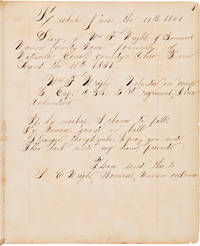
1861WRCAM56124Various places in Iowa and Missouri as described below 1861. 1022pp. approximately 16000 words. Contemporary half sheep and marbled boards. Boards detached but present worn and rubbed. Bookseller stamp on front free endpaper. Pages loosening but all present pages 33-34 with old repairs to a vertical tear running the length of the page. Occasional spots of soiling throughout but overall the text is quite clean and very easily read. Overall very good. An engaging account of the early days of the Civil War in Missouri by William F. Wright a Union volunteer from Somerset Iowa. Missouri was a highly-contested border state with both Union and Confederate supporters. It sent soldiers and arms to both sides was represented with a star on both flags maintained dual governments and featured a vicious intrastate war within the larger national war. William Wright's journal of his service in the first year of the war ably communicates the dangerous and unprecedented nature of guerilla warfare in the western theatre of the Civil War. <br> <br> Wright 1837-1905 enlisted in the 3rd Iowa Infantry Regiment in May 1861 responding to President Lincoln's first call for troops. Much of the diary centers on the months from July to September 1861 as his unit traveled back and forth across Missouri facing a guerrilla enemy with no clear battle lines. Unlike the large armies and massive battles further east Wright's regiment was frequently on the move by rail and foot often splitting off into companies squads and scouting parties prone to ambush by raiding parties with small detachments occasionally getting picked off by snipers. In addition to Confederate soldiers Wright's regiment also faced bands of pro-Confederate irregulars known as "bushwhackers." The war in Missouri was continuous from 1861 to 1865 with conflicts throughout the state. There were over 1200 distinct engagements in the state during the war; only Virginia and Tennessee exceeded this total. <br> <br> Wright is generally stoic throughout though he does admit to occasional homesickness and is justifiably distressed over a case of ague that comes on in August. When not drilling or recounting recent attacks Wright frequently mentions attending church prayer meetings and Bible study though he does not seem overly picky as to where. He attends a Catholic mass and a Presbyterian service on the same day and on another attends Episcopal Methodist and Presbyterian services on the same day. <br> <br> The diary begins on May 27 1861 as Wright puts his affairs in order and travels to Indianola where he "was sworn into the state service for three years" after which he proceeds with other recruits to Keokuk Iowa a major staging area for Union forces. His unit is officially sworn into "United States service" on June 8 receive their rifles on the 23rd and then assemble in camp on the 26th. The next day they receive word that they are heading to Missouri in the morning: "we received orders to cook enough provisions for three meals the drum would beat at 3 in the morning at which time we were to pull up stakes." They march to the docks board several steamships and head south on the Mississippi to Hannibal Missouri. Upon disembarking Wright comes across two men taken prisoner by the home guard "and I had for the first time the privilege of seeing a secession prisoner." <br> <br> The next day July 1 they board trains and head west: "I was surprised to see so many fine residences also quite a number of slaves were to be seen at work in the fields who cheered lustily as we passed.We passed several encampments of soldiers on the way who were all in good spirits. We hauled up at Utica in Livingston Co. slept in the cars." After a couple of weeks of false alarms of pending attack mysterious shots at night low rations and rumors of murdered soldiers the company was on edge. On July 18 Wright and nine other men were detailed to guard the railroad station in Utica after reports "that the enemy was going to burn it." During their watch "a spy came in with the information that from 500 to 800 men on Spring Hill were making preparations for an attack at the bridge and station simultaneously." No attack materialized however: "Daylight came and no enemy we were disappointed as we were well prepared for them and would have been pleased to have seen from 50 to 100 make their appearance." <br> <br> Tensions continued in a similar vein for the next few weeks as they shifted back east to Kirksville. Wright reports of all-night guard duty multiple nights in a row and frequently going without meals due to inadequate rations. On August 19 they received warning of a pending enemy attack which ends up as a small skirmish: "Six of our scouts were surrounded by 25 of the enemy. They killed Corporal Dix. The others made their escape after killing 3 or 4 of the enemy." Not long after they start heading south and while passing through Shelbina Missouri three of their men were shot one died by an enemy squad hidden in the brush. Circling back to Shelbina to rest they find the town partially destroyed by Rebel forces. Wright's unit then finished the task which he describes neutrally: ".the boys were allowed to go where they pleased and they took and destroyed ev'y thing in town. When ever a chicken was heard to crow a dozen men were ready to start for the place. Chickens and pigs were killed women's dresses taken children's playthings &c &c." Passing through Macon Missouri Wright and his comrades "dropped into a Brewery. There were quite a number of the boys there. Some of them were trading their shoes some shirts and others drawers for beer. I do not know whether they were their own clothes or whether they had stolen them. Saw three fights today." <br> <br> Heading west just outside of Kansas City they notice enemy scout activity. After more than two months of skirmishing and sniping the regiment saw its first pitched battle. On September 17 "3 p.m. we started from Liberty about 600 strong in the direction of the river. The enemies scouts were retreating as we went forward. The enemy killed 4 and wounded one of our men. About 4 o'clock we were fired into by the enemy which was the first that we knew of their position. We were within about 100 yds of their lines when we were fired on.We fought about an hour and 20 minutes when we were ordered to fall back as they had three men to our one and were flanking us. Four of the artillery men were kiled & four wounded which did not leave enough to man the gun and she was only fired three times when we had to haul her back by hand.we had 17 killed about 60 wounded and a number missing.it is reported that there were over 100 enemy killed and wounded." This was the Action at Blue Mills Landing also known as the Battle of Liberty. The next day Wright wrote "I have been helping to make coffins for our killed 12 bodies which will be buried in the evening.The most shocking scene that I have ever witnessed is one of the dead men whose face has been skined said to have been done by his brother-in-law." <br> <br> Wright had reported on his unit's tendency to loot earlier in the diary and now makes an interesting clarification: "When in the free State of Kansas the boys behaved very well. But since we have again come into Mo. they have began their old tricks. Last night there were quite a number of chickens stolen and a calf taken out of a man's dooryard." Perhaps in fairness to the Iowa troops they regularly went without rations or were given only flour and because they were often in hostile territory they rarely had permission to hunt or fish for their meals. <br> <br> Until this point Wright does not mention any direct encounters with African Americans but on October 18 as they depart Kansas City he notes they ".took three slaves with us who had run away from Lexington." Upon reaching Quincy Illinois "Will Newton and I went down town and got lodging for the three darkys who came from Kansas City. We left them with the supt. of the Colored Peoples Church." <br> <br> For the remainder of this diary Wright was stationed at the Benton Barracks in St. Louis; some of these entries are slightly out of order chronologically as though Wright inadvertently skipped pages. On December 1 he writes "In the evening one of Co. K was killed by accident. One of his comrades cocked his gun not knowing that it was loaded and shot the top of his head off. It was the most horrible sight that I have yet seen." Not much else happens until the end of the month when they get word that they'll be heading back out soon and start prepping their equipment. Leading up to Christmas he notes many of the men planning a big Christmas dinner: "For my part do not feel like celebrating the day. Think it will not pay here will pass it by as other days for this time." <br> <br> Wright's final entry on Christmas Day is also introspective. Having reflected on his past seven months in the army the things he has seen and how frequently he has been spared he concludes: "I do not like a sol. life. Would be far from following it from choice but believe that it is my duty as we are engaged in a just and noble cause trying to sustain one of the best governments ever formed. Co. G is not drunk to night but slightly inebriated." <br> <br> At the end of the diary Wright has transcribed a letter from a rebel which gives a sense of some the psychological warfare practiced during the conflict. Dated at Fillmore Missouri July 18 1861 it reads in part: "I hope when this letter comes to hand you may have time to read it. And I think that I shal be nearby. And then as soon as it is red I shal be near enough to nock your life out of you. I hope the time may come when the flag of the fifteen glorious states may fly over the free and independent.Instead of one thousand of us there is about 8000 of us and we are coming there as soon as we can get there." <br> <br> Wright reached the rank of sergeant in 1863 and survived to muster out in 1864. After the war he married raised a family and farmed in Kansas and Nebraska. <br> <br> A detailed and informative diary of the brutal and chaotic early months of the Civil War in Missouri. hardcover books
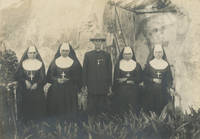
1900List518Most Cuba or Jacksonville 1900. Silver gelatin or albumen photographs various sizes ranging from 3 x 3 to 6 x 8 most captioned to verso. With handwritten manuscript four leaves discussing various diseases. The Spanish-American War was the first war in which nurses formed their own dedicated units as well as the first war in which they were accepted within military hospitals. While no nurses died in battle 153 died during the war from disease. Nurses were responsible for both treating soldiers as well as maintaining sanitary conditions within the camps. Conditions were often poor leading some to work until they were too sick to continue. <br /><br /> The current collection of photographs documents the experiences of a Mrs. Waters who was originally from Groton Massachusetts. The collection begins with a couple early photographs including a portrait as a young woman and a cyanotype of one of Waters' leprosy patients at Johns Hopkins Hospital in Baltimore. The next section shows Waters' training in Jacksonville Florida with either the Fourth or Seventh Army Corps at what was called Camp Cuba Libre both Corps trained there in 1898. The photographs of Jacksonville show life around the military camp and environs with some notable photographs of African-American inhabitants of the region. Three photographs quite notably show the Congregation of American Sisters a small group of American Indian nuns led by Reverend Francis Craft. The photographs taken in Cuba are notable for their portrayal of local life. Several photographs of military installations are taken around the "trocha" or line established by General Valeriana Weyler from Mariel to Majana. Another notable photograph is a cabinet card of a large group of nurses taken by the Havana photographer R. Testar. <br /><br /> The group overall shows very early photographic records of military nurses in training as well as a scarce photographic record from a woman in a combat situation. The photographs are generally well preserved in very good to excellent condition with some light fading. Accompanying the photographs is a four page manuscript essay presumably by Waters discussing leprosy as well as the booklet Spanish Phrase Book for American Soldiers and Sailors published by the National Relief Commission of Philadelphia. <br /><br /> Offered in partnership with Daniel / Oliver Gallery. books
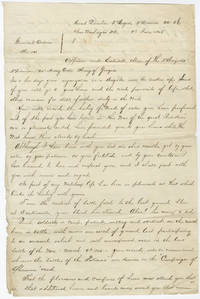
186523320<p>Brigadier General William Cogswell offers a dramatic farewell message to the troops under his command in the Army of Georgia. A Salem Massachusetts lawyer Cogswell turned his law office into a recruiting station after learning the 6th Massachusetts had been attacked in Baltimore. He was first in last out in his Civil War service: In 24 hours he raised the first full company of the war Company C 2nd Massachusetts Volunteers and his brigade fought in the final battle of the war in Bentonville North Carolina. Despite his relative obscurity Cogswell's eloquence rivals the great farewell messages in military history.</p> <b>WILLIAM COGSWELL. CIVIL WAR.</b>Manuscript Document Signed. General Orders No. 14. Farewell to the Army of Georgia Near Washington D.C. June 9 1865. 1 p. 7¾ x 12 in.<p><b>Complete Transcript</b></p><p><i> Head Quarters 3rd Brigade 3d Div. 20th Army Corps </i></p><p><i> Near Washington D.C. 9th June 1865</i></p><p><i>General Orders</i></p><p><i>No. 14</i></p><p><i>Officers and Enlisted Men of the 3rd Brigade 3rd Division 20th Army Corps Army of Georgia.</i></p><p><i>In a few days your organization will be broken up. Some of you will go to your homes and the civil pursuit of life while others remain for still further duty in the West. </i></p><p><i>Your noble record the history of the deeds of valor you have performed and of the part you have taken in this "War of the great Rebellion" now so gloriously ended have preceded you to your homes while the West knows them already by heart. </i></p><p><i>Although I have been with you but six short months yet by your valor by your patience by your fortitude and by your courtesies I have learned to love and respect you and I shall part with you with sorrow and regret. </i></p><p><i>No part of my military life has been so pleasant as that which links its history with yours. </i></p><p><i>From the earliest of battle fields to the last grand blow at Bentonville N.C. your blood has stained Alas! too many a sod. </i></p><p><i>Quick soldierly in camp patient willing and obedient on the march brave in battle with never an inch of ground lost participating to an unusual extent and with unsurpassed valor in the last battle of the War – March 19 1865 – your record will be remembered wherever the "battles of the Potomac" are known or the "Campaign of Sherman" read. </i></p><p><i>That the pleasures and comforts of home may attend you that go that additional honor and laurels may await you that remain that an Almighty and good God may forever lead you in ways of pleasantness and paths of peace that industry and virtue may crown you with their rewards that all that good brave men deserve may be yours that those who remain may shortly be sent to home and friends and that the blessings of a kind heaven may always be with you wherever you go is the last best wish of your Brigade Commander.</i></p><p><i> Wm Cogswell</i></p><p><i> Bvt. Brig Gen Commanding</i></p><p><b>Historical Background</b></p><p><b>William Cogswell</b> 1838-1895 was the son of the founder of the Massachusetts Republican party. He left Dartmouth College and spent two years on a square-rigger sailing around the world. When he returned he attended Harvard Law School and became a lawyer in Salem Massachusetts. When word reached Salem that the 6th Massachusetts had been attacked in Baltimore on April 19 1861 Cogswell turned his law office into a recruiting station and raised Company C of the 2nd Massachusetts Volunteer Infantry in 24 hours. He went on to become its commander.</p><p>Though the regiment suffered heavy losses Cogswell's company distinguished themselves well at the Battle of Antietam. Cogswell was promoted from company to regimental commander. During the Battle of Chancellorsville Cogswell was seriously wounded which resulted in his missing the Battle of Gettysburg where the 2nd Massachusetts lost another commander resulting in Cogswell's promotion to colonel. Cogswell was brevetted brigadier general on December 15 1864 and took command of the 3rd brigade 3rd division of the 20th Corps a part of the Army of Georgia that participated in Sherman's Savannah Campaign better known as the March to the Sea.</p><p><b>Condition</b></p><p>Very good. Lower half of left margin somewhat tattered affecting only one word go edge wear at upper right half some toning. Superb for display.</p> books
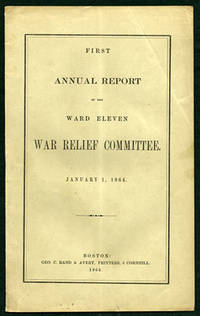
186427535Boston: Geo. C. Rand & Avery Printers 1864. First edition. Stitched paper wrappers. A very good or better copy folded. 14 pp. 8vo. A report on the progress of supporting the families of those serving in the Civil War living in Ward Eleven in Boston Massachusetts now the South End. Scarce. OCLC shows a single copy at the Mass. Hist. Soc. Geo. C. Rand & Avery, Printers unknown books
1884WRCLIT59632Boston: Oliver Ditson & Co. 1884. 96pp. Large octavo. Gilt cloth. Likely one of a number of printings with music reprinted from a variety of sources. A few pencil notes crack at toe of front inner hinge else very good. Includes works by Root Work Foster and many others. Oliver Ditson & Co. hardcover books
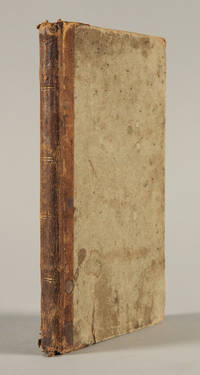
1812WRCAM53507Baltimore: Published by J. and T. Vance 1812. 117pp. Original calf-backed paper boards. Hinges cracked spine ends chipped some wear and soiling to boards. Later ownership inscription and pencil annotations on front endpapers and titlepage. Moderate tanning and foxing. Good. A scarce collection of patriotic songs published for the War of 1812. Titles include: "Union and Liberty" "Old Commodore" "American Star" "An Ode to the Volunteers of 1812" "John Bull Get the Grapes" "Ode for the Fourth of July 1812" among many others. In 1863 this volume was owned by George Eitemiller of McConnellsburg Pennsylvania who was then attending telegraph school in nearby Chambersburg. Four months after the Confederates swept through his region and were defeated at Gettysburg and just five days after Lincoln's Gettysburg Address young Eitemiller was overcome by patriotism and inscribed the volume four times in pencil writing on the titlepage: "Hurrah for Liberty & Union." Shaw & Shoemaker locate only seven copies; OCLC adds three more. SABIN 21615. SHAW & SHOEMAKER 25311. Published by J. and T. Vance hardcover books
1812WRCAM53959London 1812. 219pp. Dbd. Title-leaf detached else a clean very good copy. A rare War of 1812 pamphlet written by British Secretary to the Admiralty and Member of Parliament John Wilson Croker. Here Croker argues the British side of the story in the impending conflict and urges the United States to see France as the real enemy. Anderson Galleries called this work "extremely rare" in their 1918 catalog for the H.R. Lawrence Collection. SABIN 37671. GOLDSMITH-KRESS 20412. unknown books
1813WRCAM41998Sackets Harbor N.Y. 1813. 1p. manuscript letter signed docketed on verso. Folio. Old fold lines. Some separation at folds; one tear closed with archival tape. Lightly soiled. Good. An eyewitness account of the second battle of Sackets Harbor on the shores of Lake Ontario from the commander of the American forces there Gen. Jacob Brown to his friend Joshua Hatheway quartermaster general and formerly the commander of the defenses at Sackets Harbor. The town situated near the entrance to the St. Lawrence River at the far eastern end of Lake Ontario and opposite the Canadian town of Kingston was a vital defensive point for the Americans challenging British control of the St. Lawrence and the lake and preventing a British thrust into New York State. If either side could control both sides of the entrance to the St. Lawrence they could control the Upper Great Lakes. Taking advantage of the American action against York which drew troops away to the western end of the Lake the British decided to strike. On May 28 1813 the British Great Lakes squadron under the command of James Yeo appeared off Sackets Harbor carrying troops under the command of the governor-general Lieut. Gen. George Prevost. Having been forewarned by several men who escaped the Battle of Henderson Bay the previous day the Americans had some time to reinforce their defenses before the British could attack. The British landed on the 28th but launched their main attack the next morning. They easily routed the American militia but the regulars under Brown were able to fight off repeated attacks on their fortifications. Prevost fearing the arrival of more American troops ordered a retreat which nearly became a rout. Brown was the hero of the day and was later rewarded with a commission as brigadier general. He must have immediately written this letter describing the action. This appears to be written in a secretarial hand and signed by Brown himself. The letter states: "Dr. Sir I received an order some days since from Genl Dearborn to take comm. at this Post. Comd. Chauncey is up the lake. We were this morning attacked as day dawned by Sir George Prevost in person who made good his landing with at least a thousand picked men. Sir James Yeo commanded the fleet after loosing some distinguished officers and of course some gallant men. Our loss is very severe as to the quality of those who have fallen. The enemy left many of their wounded on the Field - but I have no doubt carried off many more. We shall probably be again attacked as Sir George must feel very sore. All I can say is whatever may be the result we will not be disgraced." A superb battlefield letter reporting on one of the most significant military actions of the War of 1812. unknown books
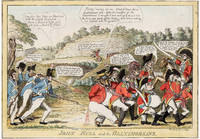
181425448<p>"<i>Mercy! mercy on me. What fellows those Baltimoreans are. After the example of the Alexandrians I thought I had nothing to do but enter the Town and carry off the Booty. And here is nothing but Defeat and Disgrace!!</i>"</p><p>A masterpiece of design and composition.</p> <b>WAR OF 1812. WILLIAM CHARLES.</b>Print. <i>John Bull and the Baltimoreans</i>. Satirical engraved aquatint cartoon. Philadelphia Pennsylvania October 1814. 1 p. 12½ x 9 in.<p><br /></p><p>Per Wikipedia's extensive entry on these prints "Charles despite being a native Scot had no compunction in displaying Scots accents out of the mouths of the enemy in the dialogue here perhaps for humorous reasons as well as accuracy." Italicized text is a transcript from our print.</p><p><b>Transcript</b></p><p>American soldier prodding John Bull: "<i>Oh! hoh! -- Johnny you thought you had Alexandrians to deal with did you -- But we'll teach you to know what a flogging is!!!</i>"</p><p>John Bull: "<i>Mercy! mercy on me -- What fellows those Baltimoreans are -- After the example of the Alexandrians I thought I had nothing to do but enter the Town and carry off the Booty -- And here is nothing but Defeat and Disgrace!!!</i>"</p><p>Mounted officer possibly Admiral Cockburn urging the British on: "<i>What's the Matter! you Cowardly rascals! Back back and execute the orders of your Government --We must attack every point that's assailable!</i>"</p><p>a Highlander replies: "<i>In gude troth Admiral I think ye are as mad as our government Dinna ye ken the General's kilt -- ye must only attack sie places as Hampton Havre de Grace & Alexandria.</i>"</p><p>an American sniper in the background firing at General Robert Ross: "<i>Now for this Chap on Horseback with the plaid Bonnet on -- There – there's a Rifle pill for you -- Thats a quietus.</i>"</p><p>Ross: "<i>Deil sic tak that Republican rascal wi his Rifle gun for he's blawn my brains out.</i>"</p><p><b>Historical Background</b></p><p>Having burned the Capitol and captured Alexandria without a fight the British sailed up the Chesapeake. On September 12 their army and navy attempted a combined assault on Baltimore. Thanks in part to a storm likely a hurricane that hit the fleet right after the burning of Washington and in part due to the foray into Alexandria the Americans had just enough time to strengthen critical American defenses and organize resistance. The bombardment of Fort McHenry in Baltimore harbor failed and General Ross was killed by an American sniper. The British retreat provided America with a major morale boost after the destruction of Washington.</p> books
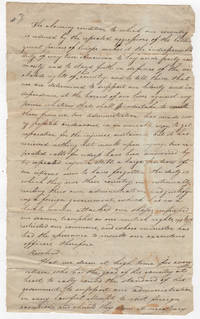
181044417NY 1810. Very good folded few edge tears one obscuring a small portion of text light soiling & ink bleed contents legible. 2 pp. 7.5 x 13 inches. Unsigned and unpublished manuscript draft of a series of resolves supporting the Madison administration's policy towards Britain and ending with support for the nomination of Daniel Tompkins for Governor of New York and John Broome for Lt. Governor for the election of 1810. "The alarming condition to which our country is reduced by the repeated aggressions of the belligerent powers of Europe makes it the indispensable duty of every true American to lay aside party animosity and to stand forth in defiance of the violated rights of his country. and to tell them that we are determined to support our liberty and independence at the hazard of our lives against my power whatever. therefore Resolved: That we deem it high time for every citizen who has the good of his country at heart to rally around the standard of his government to support our administration in every lawful attempt to resist foreign aggressions and should they deem it necessary to have recourse to arms we will cheerfully sacrifice our lives in defiance of our liberty Resolved: That we approve the conduct of the President in dismissing Frances James Jackson otherwise Copenhagen Jackson for insulting our government in charging it with a falsehood Resolved: That we highly approve of the just rebuke of Thomas Sammons in defense of Jackson's conduct Resolved: That we concur in the nomination of Daniel Tompkins for Governor and John Broome for Lt. Governor as fit persons for those offices & whose capacity has been tried to our satisfaction & that we will support them to the utmost of our power. A wonderful document elucidating the issues and emotions driving the country apart and leading to the War of 1812. unknown books
183544071London 1835. Good. Separated at folds edge worn and torn a few chips one affecting a few words at the end of about a dozen lines of text light soiling. 6 pp. with integral address. Folio. 10.5 x 16.5 inches. Manuscript with numerous corrections and additions concerning the failure of the British military in the War of 1812. In late 1835 then Colonel William Francis Patrick Napier 1785-1860 member of the British Army and a military historian gave speech at Bath which the Sunday Times reported claiming he had criticized the British soldiers in the War of 1812 as failing because they "stood as patriots and freemen on less firm and less elevated ground than the Americans themselves" which John Mitchell notes at the very beginning of this article published in the January 1836 issue of "United Service Journal and Naval and Military Service Magazine" pp. 84-92. Defending the soldiers Mitchell goes on to launch an attack on Napier's speech and the British command and their tactics. "The failure of the British troops at New Orleans was as complete as possible; but patriotism or want of patriotism had nothing to do with the business. The military policy of England guided by men ignorant alike of the strength and the weakness of armies swayed besides by the influence of philanthropic and economical patriots whose evil counsel fell like a death-bearing pestilence on the ranks of the army-shone out in all its poor and paltry littleness: in the constant striving to save farthings millions of treasure were wasted and thousands of gallant lives were remorselessly sacrificed. The valour everywhere exhibited by the troops the zeal ability high spirit and devotedness displayed by so many matchless officers the number of gallant blows struck and noble feats of arms performed- were not it must be allowed sufficient to counterbalance the folly ignorance and presumption that marked the official management of that most miserable war. But I repeat the fault was not with the troops" The failure is not just at New Orleans. "The British failed at Sacket's Harbour Platsburgh and New Orleans; to which for argument sake we will add Baltimore. At Sacket's Harbour and Platsburgh the British forces retired from phantom hosts and imaginary foes. At Baltimore something of the same kind happened." After a detailed analysis of the military's failures he ends his unrelenting attack: "But the soldiers of a great nation must know that they are equal to any contest. An American war like every war in which brave men are to be encountered has its difficulties; and it is only by looking those difficulties fairly in the face that they can be overcome. Had we listened to the liberal and patriotic despondency which so long represented us incapable of contending against the French we should at this moment have been crouching beneath the lash of Napoleon or his successor on the throne of the Grand Empire." Needless to say many jumped to the defense of Napier who wrote in his letter to the editor that the Sunday Times report of his speech was pure fiction and that he never criticized the troops; in fact he states he never mentioned the war at all. John Mitchell 1785-1859 was an army officer and writer who served in the West Indies in the Peninsular War and on diplomatic missions for Wellington. He wrote much on the defects of the British army tactics and a number of volumes including "The Fall of Napoleon" and "Biographies of Eminent Soldiers." Postmarked London December 22 1835. Addressed to Major Thomas Henry Shadwell Clerke who was editor of "The United Service Journal and Naval and Military Service Magazine." unknown books
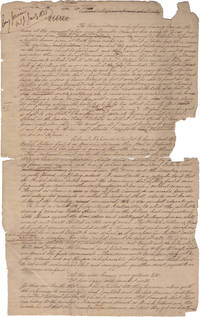
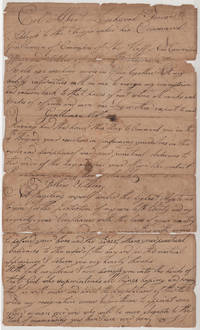
1816443051816. Torn and separated along the folds affecting a few lines of text scattered soiling and ink smudging contents otherwise legible. 1 sheet. 7.5 x 12.5 inches. Signed by Barnabas Allen who recorded this farewell address of Colonel Albert Lockwood of the 4th Regiment from Connecticut. The address was some time after the conclusion of the War of 1812 as Barnabas Allen served in that war. "Gentlemen of Commission of the Staff non commission officers and soldiers of the 4th Regiment. My old age my long service in office together with any bodily infirmities call me to resign my commission and return back to that places of rest where all ranks and grades of officers and men one day or other expect to meet. Gentlemen Officers- Having had the honor this day to command you in the 4th brigade your escertions in informing yourselves in the rules and discipline of war your punctual obedience to the order of the day and for your officer-like conduct I return you my hearty thanks Fellow Soldiers- Not forgetting myself under the highest obligations to you for the protection of own life liberty and my property. Your compliance with the laws of your country cut hereequipping yourselves with arms to defend your lives and the lives of others. Your punctual obediences to the order of the day and for the martial appearance I return to you my hearty thanks. With full confidence I now dismiss into the hands of that God who superintends all things hoping and praying that he will order and direct the Legislature of this state when my resignation comes before them to appoint some officer or man over you who will be more adequate to the task of commanding you than I have ever been. I have my hand my heart and my aid with you. Farewell gentle officers and Soldiers of the 4th regiment." Most likely Albert Lockwood b. 10 Apr. 1757 d. 16 Feb. 1846 married to Grace Godfrey of Weston Ct. see Revolutionary War Records of Fairfield Connecticut Volume 3. Lockwood served in the American Revolution and the War of 1812. unknown books
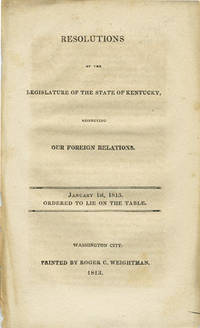
181337583Washington D.C.: Printed by Roger C. Weightman 1813. First edition. Disbound. Disbound edge worn faint marginal soiling still good. 4 pp. 8vo. Approved December 22 1812 this short list of resolutions unequivocally supports the war against Great Britain expressing that the Kentucky is "prepared to contribute whatever her strength shall be required for the vigorous and effectual prosecution of this war." Signed in print: Joseph H. Hawkins speaker of the House of Representatives. R. Hickman speaker of the Senate; approved Isaac Shelby. Quite uncommon. American Imprints 30370. Printed by Roger C. Weightman unknown books
1808100573<p>Pamphlet 8vo paperbound 16 pp. Partially disbound but still in tact. Normal aging and browning with some chips and folds at the extremities. Also slight fold at the center and early owner’s signature on title page. About very good. Very interesting pamphlet prepared during the Madison administration that takes a look at the challenges facing a new country. For the most part the report addresses the belligerent acts of England and France prior to the War of 1812. The report also challenges the legality of the British blockade and the taking of our ships on the high seas. Importantly it points out that France is no better than the English in this respect and that it would be hard to justify war against one without the same treatment of the other. However the authors were also very realistic about going to war with both England and France who were "two of the most powerful nations in the world". The report recommends that we not submit to French and English legal rationalizations for their actions and that we not allow their ships into our ports. Wisely it also suggests we improve our defenses. The OCLC seems to locate only a couple of copies. OCLC. </p> A. & G., Printers, books
187634022Erie Pa.: Ashby and Vincent 1876. First Edition. 96pp. illus.Port. of Lawrence. Original 16mo grey printed wrapperssmall nick at lower spine Not in Howes. This is an account of Perry's Victory. It was prepared with consultations with his father who was a Sailing Master. He served on the Upper Lakes during the War of 1812. It is also a comparison with the accounts by MacKenzie Cooper and Lossing. He compiled his work based on these accounts. Very scarce No copies on the internet. Ashby and Vincent unknown books
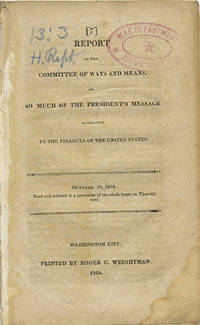
181437506Washington City: Printed by Roger C. Weightman 1814. First edition. Removed. About very good leaves detached with inked notation and War Department Library stamp on title dampstain to one corner throughout not affecting text. 8 pp. 8vo. U.S. 13th Cong. 3d sess. 1814-1815. House. Doc. 7. Discussed problems with financing and banking during the War of 1812 recommendation of tax increases with table of amounts raised. Sabin 69816. American Imprints 33437. Printed by Roger C. Weightman unknown books
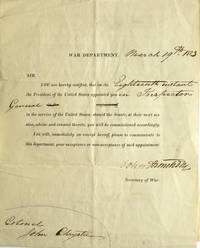
18133044271813. 1 p. partially printed document accomplished in manuscript with 1 p. manuscript draft reply on second bifolium leaf. 4to 9-3/4 x 7-3/4 inches. Old folds. 1 p. partially printed document accomplished in manuscript with 1 p. manuscript draft reply on second bifolium leaf. 4to 9-3/4 x 7-3/4 inches. Armstrong 1758-1843 a delagate to the Continental Congress a U.S. Senator from New York and briefly Secreatry of War under James Madison 1813-4 during the War of 1812. He was forced to resign as Secretary of War in September 1813 after failing to defend Washington from the British.<br/>Here he appoints Colonel John Chrystie an Inspector General of the US Army. Chrystie declined the post and a draft of his reply - dated Niagra April 30th 1813 - is penned on the attached bifolium leaf: "In reply I have to state that being now in command of a battalion of the 13th Infy. I prefer my present situation." Chrystie 1788-1813 after whom Chrystie Street in Manhattan is named was lieutenant colonel in the 13th U.S. Infantry. He would die of natural causes just three months after his reply to Armstrong. unknown books
181536137Portland Maine: Argus Office 1815. Letterpress broadside approximately 15 1/2 x 10 inches. Wide margins with deckle edges. Rare Maine broadside announcing the signing of the Treaty of Ghent which ended the War of 1812.<br/> <br/>This broadside announcement begins with a statement by the publishers of the Argus newspaper office in Portland: "At eleven o'clock last evening an express arrived in this town in Thirteen Hours from Boston with the following letter and Handbill to Capt. William Webb &c. containing the joyful tidings of Peace. By the favor of an esteemed friend we are enabled thus early to lay them before the Public." This is followed by a letter from Thomas Motley in Boston forwarding the hand bill from the Boston Centinel quoting New York publisher Jonathan Goodhue's 11 February announcement of the arrival of H.M.S. Favorite in New York with American commissioner Carroll aboard with a signed treaty in hand. Maine sat on the front lines of the War of 1812 making this news of the Treaty of great significance. By the fall of 1814 the British had invaded and occupied eastern Maine and formally brought all of the District east of the Penobscot River back into the British Empire. Much to the ire of Maine's citizens Massachusetts did nothing to defend its eastern District which in turn led directly to Maine's seeking separation and statehood following the war. Although the Treaty of Ghent ended the War of 1812 in December 1814 Moose Island remained under British control since the issue of ownership of the islands in Passamaquoddy Bay was in dispute until settled in June 1818. A rare Maine broadside: OCLC locates only the Indiana University copy; American Imprints locating only the Massachusetts Historical Society copy.<br/> <br/>Shaw & Shoemaker 36115; Williamson 9913. Argus Office unknown books
181211299np 1812. 16pp caption title as issued. Disbound some loosening moderately worn. Good to Good. Federalists from New England led by George Sullivan assert they "could not consider the war into which the U.S. have in secret been precipitated as necessary or required by any moral duty or any political expediency." They document the muzzling of debate on the question of the Declaration of War the war's disastrous effect on commerce the unreasonable bias of the Madison Administration toward France; and they mourn the loss of American security. Quite scarce. Not in AI Sabin which records an 1812 response to this Address Eberstadt Decker or evidently NUC. unknown books
181212948np Boston 1812. Caption title as issued 8pp. Untrimmed and uncut lightly foxed and worn. Very Good. A meeting at Concord Mass. on July 15 1812 protesting "the momentous and calamitous state of our country" and denouncing the national government for having "unnecessarily declared an offensive war." Congress has "trifled away our dearest privileges and annihilated our fondest hopes." President Madison has sought to shore up his "sinking" popularity by a war policy; he and his allies seeking to stigmatize their opponents as "tories" and traitors have "an ambitious design to continue the power in the hands of our present rulers." FIRST EDITION. AI 26074 2. Not in Sabin Eberstadt Decker. unknown books
181235416Windsor: Thomas M. Pomroy 1812. 31 1 blank pp. Stitched untrimmed. Uniformly toned Very Good.<br/><br/> This is an important illustration of New England opposition to the War and precursor to the Hartford Convention-- this is an early symptom of the Secession Virus that would continue to afflict the country until after the Civil War. It is signed by 34 Congressmen and was reprinted all over the country. <br/>Howes A77. AI 24555 6. Thomas M. Pomroy unknown books
1812WRCAM45158New York: C.S. Van Winkle 1812. 32pp. Stapled. Wear and soiling. Fair. A protest of the War of 1812 signed by thirty-four members of Congress. One of several printings others appearing the same year in Alexandria Hartford New Haven New York Baltimore etc. HOWES A77. SHAW & SHOEMAKER 24548. C.S. Van Winkle unknown books
1812WRCAM45157Boston: John Eliot 1812. 32pp. Stitched as issued. Wear and a large closed tear to titlepage without loss; library ink stamp on titlepage. Some light soiling and foxing. Fair. A protest of the War of 1812 signed by thirty-four members of Congress. One of several printings others appearing the same year in Alexandria Hartford New Haven New York Baltimore etc. HOWES A77. SHAW & SHOEMAKER 24538. John Eliot unknown books
1812WRCAM45160Northampton: William Butler 1812. 29pp. Modern paper wrappers. Light toning. Very good. A protest of the War of 1812 signed by thirty-four members of Congress. One of several printings others appearing the same year in Alexandria Hartford New Haven New York Baltimore etc. HOWES A77. SHAW & SHOEMAKER 24549. William Butler unknown books