84 résultats
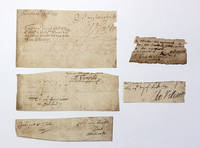
1650031291UK 1650. First Edition . Paper. Very Good. 48mo - over 3" - 4" tall. A group of 5 Ink Signatures of Royalist soldiers who fought in the 1st Civil War. They include 2nd Viscount Molyneux of Maryborough George Monck 1st Duke of Albemarle Sir William Compton General William Legg; Edward Villiers and Guilford Slingsby. Dated between 1640/1680. All removed from various paper documents and comprising signatures of: Richard 2nd Viscount Molyneux of Maryborough c. 1617-1654 'R. Molyneux' signed at the foot of a small piece with text in another hand being a list of supplies and countersigned by Corporal Griffith Standen; George Monck 1st Duke of Albemarle 1608-1670 'Albemarle' on an irregularly trimmed piece dated 4 February 1660; Sir William Compton 1625-1663 'W. Compton' written at the foot of a possible autograph sentiment sent to General William Legg; Edward Villiers 1620-1689 'Edw. Villiers' on a small piece dated 29 April 1680; Guilford Slingsby 1610-1643 'Gylf. Slyngsby' on an irregularly cut piece with autograph sentiment 'your loving friend' Richard Molyneux 2nd Viscount Molyneux of Maryborough about 1617-1654 was a Royalist officer in the English Civil War. Molyneux was present at the siege of Manchester in September 1642 and on 20 April 1643 was defeated by Captain Ashton at Whalley. After the surprise capture of Wakefield on 21 May 1643 the Earl of Derby being then with Queen Henrietta Maria at York Molyneux was ordered to conduct the Lancashire forces thither. He was defeated on 20 August 1644 by Major-general Sir John Meldrum at the battle of Ormskirk and narrowly escaped capture by hiding in a field of corn. He was at Oxford on 24 June 1646 when the city surrendered to the Parliament. George Monck 1st Duke of Albemarle 1608 -1670 was an English military officer and politician who fought on both sides during the Wars of the Three Kingdoms. A prominent military figure under the Commonwealth his support was crucial to the 1660 Stuart Restoration of Charles II. Sir William Compton 1625 - 1663 was an English royalist army officer. He earned the name of the "godly cavalier" in 1648 from Oliver Cromwell for his conduct at the siege of Colchester. William Legge 1608 - 1670 was an English army officer and politician who was a close associate of Prince Rupert of the Rhine. On the outbreak of the First English Civil War Legge joined the king's army and was taken prisoner in a skirmish at Southam Warwickshire on 23 August 1642. Committed by the House of Commons to the Gatehouse Prison he escaped about 4 October 1642 and rejoined King Charles at Oxford. Henceforth he closely attached himself to Prince Rupert and was wounded and again taken prisoner while under his command at the siege of Lichfield in April 1643. At the Battle of Chalgrove Field on 18 June 1643 he was temporarily taken prisoner on the field. After the first Battle of Newbury 20 September 1643 the king presented him with an ornate hanger and wanted to knight him. On 19 May 1644 Prince Rupert appointed him temporary Governor of Chester. Guilford Slingsby 1610-1643 was a member of the Yorkshire gentry who was confidential secretary to Thomas Wentworth 1st Earl of Strafford and present during the trial which ended in his execution in April 1641. Slingsby sat in the Parliament of Ireland as Member of Parliament for Carysfort from 1634 to 1635 and during Strafford's period as Lord Deputy of Ireland was appointed to several administrative posts. When the First English Civil War began in August 1642 he raised a regiment for the Royalist army in Northern England; he was badly wounded in a skirmish near Guisborough on 16 January 1643 and died three days later. Some occasional spotting age toning and paper sizes 11 x 18.5 cm and smaller. Ref19239 <br/> <br/> unknown
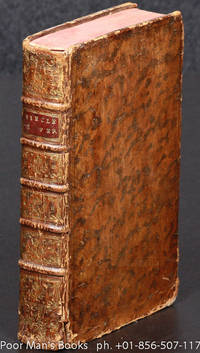
165832480Brussels: Chez Francois Vivien. Very Good with no dust jacket. 1658. Third Edition. Hardcover. History French; 17th Century; 12mo 7" - 7½" tall; 542 pages; Wing P361. Nicely bound in full sheep leather with ornate gilded spine. Short history of this century of iron. Containing the miseries and calamities of recent times with their causes and pretexts till the coronation of Ferdinand IV King of the Romans made in late summer one thousand six hundred fifty three. The author wrote his book to expose the horror of war. . Chez Francois Vivien hardcover
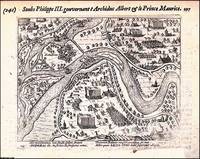
1649190141Erschienen bei J. Janssonius, 1649. 38 x 49 cm, Papiermaß: 46,3 x 55,6 cm.
1618106380<p>Entire issue small folio 8 1/2" x 11 1/2" removed disbound 473-480 pp. slight offsetting A few small holes affecting a some letters holes look like a slight tear in right column some aging and browning; otherwise about very good. At the Battle of Camden in South Carolina the Americans suffered a major defeat at the hands of the British. The British General Cornwallis defeated the American General Gates on August 16 1780 causing the American to lose 2000 men in the process. Despite its publication in a London newspaper this is an American account of the Battle of Camden which includes a letter from General Gates. history american-revolution/battle-of-camden website.</p>
1618106380<p>Entire issue small folio 8 1/2" x 11 1/2" removed disbound 473-480 pp. slight offsetting A few small holes affecting a few letters some aging and browning; otherwise about very good. At the Battle of Camden in South Carolina the Americans suffered a major defeat at the hands of the British. The British General Cornwallis defeated the American General Gates on August 16 1780 causing the American to lose 2000 men in the process. Despite its publication in a London newspaper this is an American account of the Battle of Camden which includes a letter from General Gates. history american-revolution/battle-of-camden website. </p> books
16511006702 volumes 4to however one volume is slightly larger than the other modern calf and boards printed in black leter and Roman types 2 1369-1417 & 2 1677-1689 pp. Last leaf in both volumes moderately worn and some repairs to one of those leafs pages in both volumes creased in the middle library plate on both front pastedowns early owners inscrpition on back of last leaf in one volume normal aging and browning; otherwise very good. This is a scarce item that was probably removed from a larger work however the sjubect is the same. Basically these acts focus on the seizure of lands during the English Civil War following the execution of Charles I in 1649 and just before the installation of Oliver Cromwell as Lord Protector in 1653. The text is primarily lists of nobility who remained loyal to the crown and whose lands were forfeited to the commonwealth for "treasons against the parliament and the people of England." John Field, hardcover
16511006702 volumes 4to however one volume is slightly larger than the other modern calf and boards printed in black leter and Roman types 2 1369-1417 & 2 1677-1689 pp. Last leaf in both volumes moderately worn and some repairs to one of those leafs pages in both volumes creased in the middle library plate on both front pastedowns early owners inscrpition on back of last leaf in one volume normal aging and browning; otherwise very good. This is a scarce item that was probably removed from a larger work however the sjubect is the same. Basically these acts focus on the seizure of lands during the English Civil War following the execution of Charles I in 1649 and just before the installation of Oliver Cromwell as Lord Protector in 1653. The text is primarily lists of nobility who remained loyal to the crown and whose lands were forfeited to the commonwealth for "treasons against the parliament and the people of England." John Field, hardcover books
165380881653 demi-rel. bas. mod. in-4, 26pp. (1 f.blanc), s.l., s.n., 1653,
165580661655 in-4, 8ff. (le dernier blanc), demi-rel. moderne. s.l., s.n. 1655,
16946281London: Josiah Bromley 1694. First Edition. Loose Broadside Framed Under Glass. Good. Original one-sheet broadside roughly trimmed 8-1/8 by 12-4/8 inches. Printed on rag paper with old creases now mellowed and two archival tissue repairs on left margin. Mounted on mat board with mat board overlay. Overlay with edge-wear. Framed under glass. First Lord of the Admiralty Edward Russell 1653 -1727 was a key figure in the Nine Years War notably establishing his reputation at the Battles of Barfleur and La Hougue. <p>Following a decisive 1693 victory over the French navy near Cape Barfleur the House of Commons determined that Russell had not done enough in dispatching French ships; he was removed from duty. After disasters that befell the British Navy in summer 1693 Russell was reinstated. In early May 1694 he was appointed First Lord of the Admiralty and sailed for the Mediterranean to thwart French depredations against the Spanish coast near Barcelona and Palamos. The engagement documented here likely occurred enroute to the Mediterranean.</p> <p>With the idiosyncratic spelling and usage common to the era. e.g. "we were buzzed about the ears .". A charming patriotic broadside from reign of William and Mary. Rare. No institutional copies located.</p> . Josiah Bromley unknown
1664GITh109Amstelodami Typis Danielis Elzevirii sumptibus Societatis 1664. Petit in-12 (12cm sur 6cm) 3-456pp 28 feuillets non chiffrés imprimés sur 2 colonnes (index). Pleine basane havane, dos à nerfs, reliure de l'époque. Orné d'un beau-titre-frontispice et 3 jolies cartes dépliantes (Empire Roain, Espagne, Gaule). Reliure frottée, coiffes arasées avec manque de cuir en tête et en queue, coins émoussés, mors fendus avec manque de cuir (1cm et 2cm en tête, 2cm en queue), papier légèrement jauni. Exemplaire en mauvais état mais bien complet du titre-frontispice et des cartes.
163364300Breslau, Georg Baumann für Johann Eyring Erben, (1633). 4°. Mit breiter figürl. Holzschn.-Titelbordüre. 12 nn. Bll., Geheftet (ausgebunden; ohne Einband).
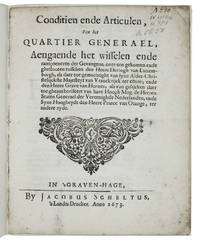
1673ABC_46181The Hague 1673. 4to. Jacobus Scheltus Modern wrappers. With a woodcut vignette on the title-page. 8 pp. First edition of a highly interesting agreement regarding the treatment and exchange of prisoners of war taken captive whether by the French or by the Dutch army during the French-Dutch war of 1672-1673 the rampjaar or year of disaster. The agreement was concluded on 26 May 1673 and signed on the French side by the notorious François of Montmorency 1628-1695 Duke of Luxembourg the French Governor of Utrecht and instigator of the massacres of Bodegraven and Woerden who later that year made his famous retreat from Utrecht to Maastricht. In 1675 he was made Marechal of France. On the the side of the States General and Stadtholder William III the agreement was signed by Willem Adriaan II of Horne 1633-1694 a high-ranking officer in the army of the States General.The prisoners could be exchanged according to their military ranks or could be ransomed. Pp. 3-5 lists the monetary value for each rank. A new version was promulgated in 1675 and was reprinted several times probably into the early 18th century.Slightly dust-soiled with a horizontal fold in the middle but overall in good condition.l Knuttel 10717; STCN 851322913; Tiele 6638. unknown
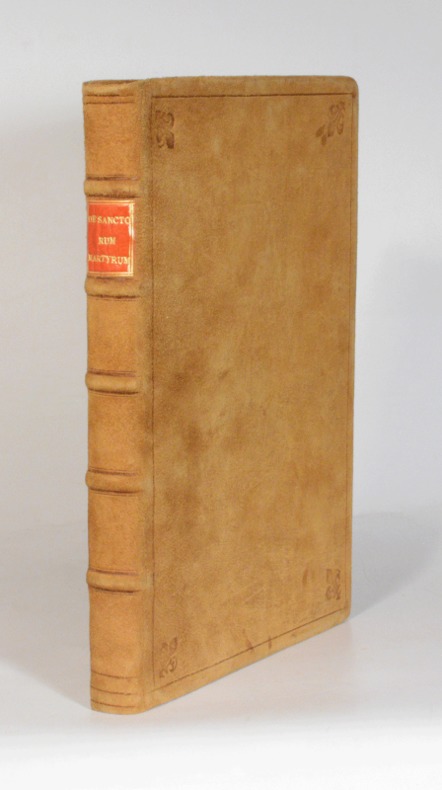
16590049501659 Parisiis [Paris], Fridericum Leonard [Frédéric Léonard], 1659-60. In-quarto (187 X 254 mm) cuir suédé fauve, plats ornés d'un encadrement à froid avec fleur de lys dans les angles, dos cinq nerfs sertis de filets à froid, pièce de titre maroquin rouge vif, tranches mouchetées en rouge (reliure postérieure) ; (1) f. blanc, (5) ff., 322 pages, (5) pages d'index. Cachet héraldique ancien à l'encre bleue en marge du feuillet de titre. MANQUENT QUATRE FEUILLETS : pages 153/154, 155/156, 169/170 et 229/230, mouillures claires angulaires et en marge de plusieurs feuillets.
1635B96346Bruxelles, chez la Vefue d'Hubert Anthoine Velpius 1635 [12] pp., avec blason gravé sur la page de titre, 19cm., brochure muette, bon état, [Ordonnance 1635-06-24], B96346
167244860No Place, No Printer, Gedruckt in 't Wonder-Jaer 1672. 4to. No wrappers. 12 pp.
167244860No Place No Printer Gedruckt in 't Wonder-Jaer 1672. 4to. No wrappers. 12 pp. <br/><br/><em>The pamphlet contains a discussion between three persons an Englishman a French and a Dutch relating to the Third Anglo-Dutch War 1672-74. </em> unknown
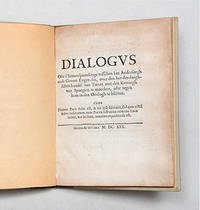
1630139110Amsterdam: publisher not named 1630. First edition of this West Frisian rhymed dialogue against the ongoing peace negotiations between the United Provinces and Spain to conclude the Dutch War of Independence 1568-1648. The United Provinces had gained significant ground in the preceding few years with the Dutch West India Company occupying Bahia the capital of Brazil in 1624 and that year taking Pernambuco the centre of Brazilian sugar production. The author of the rhymed dialogue deemed the tide to be in the favour of the United Provinces and opposed any truce while in a strong position. They moreover support the continuation of the war to enhance the Dutch economic interest especially with regard to trade with the West Indies. Despite the weakening of Spain negotiations proceeded slowly and peace was not declared until 1648. Worldcat locates six copies in the Netherlands one in Germany one in the UK British Library and two in the US Michigan Minnesota. Small quarto 189 x 143 mm. Twentieth-century green quarter cloth printed labels to spine and front cover grey card sides. A little rubbed contents a little browned. A very good copy. Brown European Americana 630/54; Knuttel 4020. Not in Landwehr or Sabin. hardcover
163680801636 demi-rel. mod. in-4, 40pp., 1 tableau généal. dépl., s.l., s.n. 1636,
1616373417Michel Colin Amsterdam Undated c.1616. Unframed Print. Very Good Condition. The page measures 17 x 22 cms printed to both sides. There is loss of blank margin and an old lower margin repair. A rather rare survivor of a very uncommon publication. Category: PRINTS : Antiquarian Interest; Antiquarian & Rare; PRINTS : Historic Interest; Special Features. This item may require more postage than the rates shown for delivery outside the UK. If extra postage is required we will contact you before processing your order and you will be given the details and option to decline the extra cost. Michel Colin unknown
166080671660 in-4, titre, 48pp., demi-rel. mod. (s.l., s.n. ca.1660),
165880741658 in-4, 10pp. (1f. blanc), demi-bas. mod. Hambourg (s.n.) 1658,
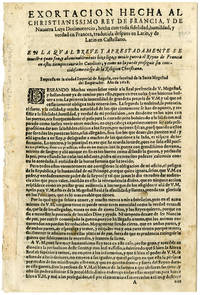
1626WRCAM39190Impressa en la ciudad Imperial de Augusta i.e. Trier: con facultad de la Sacra Magestad del Emperador 1626. 16pp. Small folio. Dbd. Contemporary manuscript docketing on p.16 and contemporary ink underscoring on p.7. Some loss repaired in silk from chipping at gutter and from worming in several leaves the latter affecting some text but not exceeding 1 x 1 inch in area. Closed tears in final leaf repaired with very early paper on verso. Light staining and foxing. Overall very good. The original Spanish translation of an important invective against Louis XIII during the first phase of France's involvement in the Thirty Years' War. At the time of this publication in 1626 France had actively begun to support the Protestant side in the conflict concerned with the political threat of the Hapsburg states that surrounded it on three sides in Spain and Spanish-controlled Flanders to the south and north and the Holy Roman Empire in Germany to the East. In 1624 Cardinal Richelieu was appointed to the Royal Council of Louis XIII and immediately began to institute a vigorous anti-Hapsburg policy. The following year France joined England in subsidizing the efforts of Christian IV of Denmark to defend Lower Saxony against the Holy Roman Empire beginning an involvement in the war that would eventually lead to its own military participation against its fellow Catholic powers. <br> <br> The present document is a long and detailed warning to Louis XIII against pursuing a course of actions that would pit France against the rest of the Catholic world. According to the document itself the text was first composed in French and subsequently translated into Latin and thence into Castilian Spanish. It immediately occasioned a number of responses and refutations and its anonymous authorship soon became the subject of a 200-year-long debate. In his exhaustive and authoritative bibliography on the Jesuits BIBLIOTHÈQUE DE LA COMPAGNIE DE JÉSUS Augustin de Backer seems to have put the question of authorship to rest attributing it to the German Jesuit Jacob Keller. Keller 1568-1631 was a German scholar and controversialist widely regarded as a genius and best known for a counter- Calvinist tract on Tyrannicide and a celebrated defense of the Papacy in a debate with Lutheran theologian Jacob Heilbrunner. Backer lists both the French and Latin versions of the EXHORTATION. and refers to a German translation but he omits any mention of the present Spanish version. He also describes the document as having been printed in Italy which may result from confusion regarding the city name of Augusta. While Augusta Syracuse was under anti- French Spanish control in 1626 and may thus be a candidate for the printing location all other signs and context point to Trier "Augusta Treverorum" in Latin including the publisher's imprint which calls Augusta an "imperial city" and declares permission for publication from the Holy Roman Emperor. <br> <br> An extremely interesting and rare document anticipating the violent wars between France and the rest of Catholic Europe of the following decade and offering a view of the French-Hapsburg rivalry from the Austro- German Hapsburg perspective and translated for the Spanish Hapsburg audience. One copy is held at the Casa de la Cultura Ecuatoriana BenjamÃÂn Carrión in Quito; OCLC lists one additional copy at the New York Public Library. Backer BIBLIOTHÈQUE DE LA COMPAGNIE DE JÉSUS NOUVELLE ÉDITION PAR CARLOS SOMMERVOGEL Louvain 1960 Vol. IV Cols. 992-3. "Jacob Keller" THE CATHOLIC ENCYCLOPEDIA http://www.newadvent.org/cathen/08613c.htm. con facultad de la Sacra Magestad del Emperador unknown books
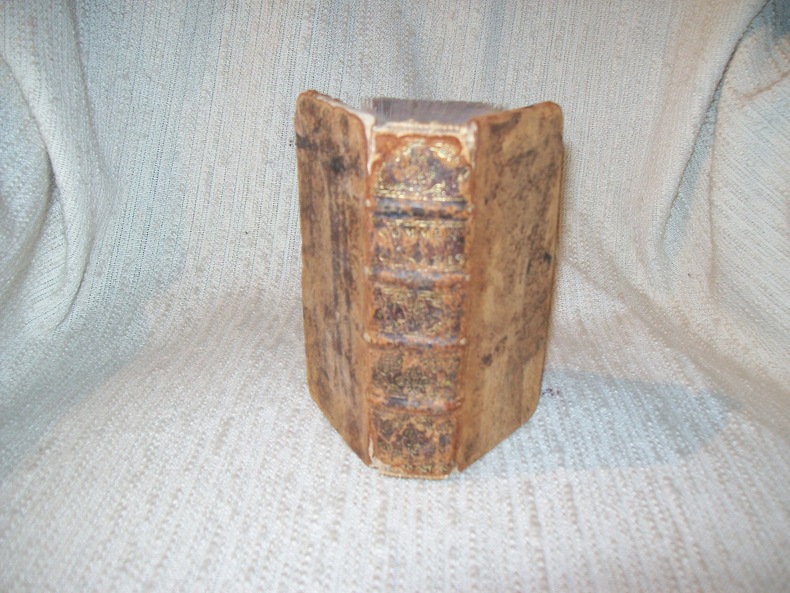
1632112630libert 1632 vélin parchemin Parisiis, Apud Ioannem Libert, 1632, 1 volume in-18 de 110x70x50 mm environ, Première partie : 22 ff. (titre, epistola, prefatio, index capitum), 1 carte dépliante, 324 pages, 18 ff. (index), - Deuxième Partie : 18 ff. (titre, epistola, index capitum, approbation, privilège), 525 pages, 34 ff. (index). Reliure plein parchemin crème de l'époque, titre manuscrit au dos. Couture des cahiers lâche, petite déchirure sur la première garde blanche, deux coins émoussés, volume légèrement voilé, page de titre recoupée (manque 1 cm sur la marge externe), tranche un peu grise avec petites taches d'encre, petite galerie marginale p. 415 à 460, mouillure claire dans la marge sur l'ensemble du volume, sinon bon état. Texte en latin.
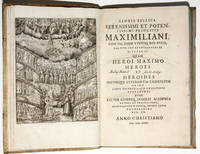
16235340Ingolstadii: Ex officina typographica G. Haenlini 1623. Hardcover. Near Fine. 4to 27 x 17.5 cm. 17 ff. 388 pp. recte 386 7 ff. with misnumbered pages at pp. 203-06 243-46 and 260-71 1 full-page engraving 20 x 15.5 the platemark. Bound in contemporary blind-stamped pigskin raised bands boards beveled somewhat scuffed clasps missing. Blue edges small hole repaired on half title and engraving ownership inscription of Andechs Abbey on title page minor browning in some quires. An excellent and unsophisticated copy. First edition of a rare volume of prose and verse glorifying the military exploits of the Prince-Elector Kurfürst of Bavaria Maximilian I 1572-1651 by members of the University of Ingolstadt as compiled by the Jesuit philosopher-theologian Georg Stengel 1584-1651. The Gloria Bellica is an important witness to the intertwining of princely power university politics and religious sectarianism at the onset of the Thirty Years War 1618-48. Published in the year of Maximilian's elevation to Prince-Elector 1623 the book seems to have been an attempt by faculty at Ingolstadt to secure his favor. The increasingly Jesuitical university would be frequently imperiled during the flux of the war and quickly identified Maximilian himself educated by Jesuits as an important military protector. Maximilian's central role in the German Catholic League had been essential in checking the power of the Protestant Union. The volume is especially notable for its full-page prefatory engraving executed by the Augsburg artist Daniel Manasser a highly detailed and elaborate allegory charting Maximilian's martial rise and the praise conferred on him from various secular and sacred sources. Merchants clerics Liberal Arts herself and a throng of lesser citizens crowd together to salute Maximilian as he rides upward on the back of Pegasus toward the Olympian gods reclining in the empyrean; the demigod Hercules mediates between heaven and earth while battling Nessus and the Lernaean Hydra. Flanking Maximilian's ascent are 8 groups from whom he receives "Gloria": his enemies his commanders and soldiers muses and scientists hometown Bavaria the Catholic League the Holy Roman Emperor Ferdinand I the pope and church and indeed Mary Christ and the saints. The text of the Gloria Bellica is arranged as a fuller version of this scheme with 20 chapters each detailing a source Maximilian's glory. OCLC identifies U.S. copies at Harvard Trinity CT Georgetown and Chicago. VD 17 23:231047E; De Backer/S. and VII 1550 32; Lentner 3774; Pfister I 4297; Mario Praz Studies in Seventeenth-Century Imagery Rome: Edizioni di Storia e Letteratura 1975 pp. 503-04. <br/> <br/> Ex officina typographica G. Haenlini hardcover