645 résultats
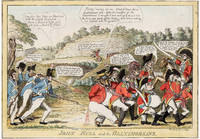
181425448<p>"<i>Mercy! mercy on me. What fellows those Baltimoreans are. After the example of the Alexandrians I thought I had nothing to do but enter the Town and carry off the Booty. And here is nothing but Defeat and Disgrace!!</i>"</p><p>A masterpiece of design and composition.</p> <b>WAR OF 1812. WILLIAM CHARLES.</b>Print. <i>John Bull and the Baltimoreans</i>. Satirical engraved aquatint cartoon. Philadelphia Pennsylvania October 1814. 1 p. 12½ x 9 in.<p><br /></p><p>Per Wikipedia's extensive entry on these prints "Charles despite being a native Scot had no compunction in displaying Scots accents out of the mouths of the enemy in the dialogue here perhaps for humorous reasons as well as accuracy." Italicized text is a transcript from our print.</p><p><b>Transcript</b></p><p>American soldier prodding John Bull: "<i>Oh! hoh! -- Johnny you thought you had Alexandrians to deal with did you -- But we'll teach you to know what a flogging is!!!</i>"</p><p>John Bull: "<i>Mercy! mercy on me -- What fellows those Baltimoreans are -- After the example of the Alexandrians I thought I had nothing to do but enter the Town and carry off the Booty -- And here is nothing but Defeat and Disgrace!!!</i>"</p><p>Mounted officer possibly Admiral Cockburn urging the British on: "<i>What's the Matter! you Cowardly rascals! Back back and execute the orders of your Government --We must attack every point that's assailable!</i>"</p><p>a Highlander replies: "<i>In gude troth Admiral I think ye are as mad as our government Dinna ye ken the General's kilt -- ye must only attack sie places as Hampton Havre de Grace & Alexandria.</i>"</p><p>an American sniper in the background firing at General Robert Ross: "<i>Now for this Chap on Horseback with the plaid Bonnet on -- There – there's a Rifle pill for you -- Thats a quietus.</i>"</p><p>Ross: "<i>Deil sic tak that Republican rascal wi his Rifle gun for he's blawn my brains out.</i>"</p><p><b>Historical Background</b></p><p>Having burned the Capitol and captured Alexandria without a fight the British sailed up the Chesapeake. On September 12 their army and navy attempted a combined assault on Baltimore. Thanks in part to a storm likely a hurricane that hit the fleet right after the burning of Washington and in part due to the foray into Alexandria the Americans had just enough time to strengthen critical American defenses and organize resistance. The bombardment of Fort McHenry in Baltimore harbor failed and General Ross was killed by an American sniper. The British retreat provided America with a major morale boost after the destruction of Washington.</p> books
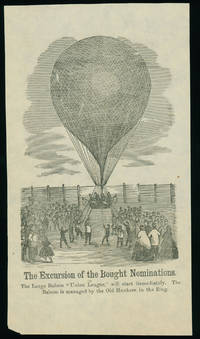
186421986.04<p><b>CIVIL WAR.</b>Broadside <i>"The Excursion of the Bought Nominations The Large Balloon 'Union League' Will Start Immediately. The Balloon is managed by the Old Hunkers in the Ring."</i> 1864. 4 ¾ x 8 ½ in. </p><b>Historical Background</b><p>The Union League Club formed in New York in 1863 to support Union troops and cultivate civil devotion. Made up of prominent citizens in New York Philadelphia Brooklyn New Haven and Chicago the clubs raised money to provide for the U.S. Sanitary Commission and establish a group of political elites to sustain Union military efforts. The league favored a strong central government tariff protections and internal improvements.</p><p>The "Old Hunkers" were the conservative branch of the New York state Democratic party in the mid-nineteenth century. They favored the status quo whether in business or on the contentious issue of slavery. The more progressive "Barnburner" faction stood in opposition to the old Hunkers and were against slavery strong state powers expanding the public debt and government subsidizing businesses.</p><p>Though the Old Hunkers shared many similarities in terms of business philosophy with the Union League—especially that of strong central government power and infrastructure improvements—the disconnect between the two groups' stance on slavery makes this cartoon perplexing. Are the Old Hunkers carefully managing the political situation the balloon through the New York political machine note the capital "R" of Ring as in the infamous Tweed Ring Or are they setting the progressive Union Leaguers adrift</p> books
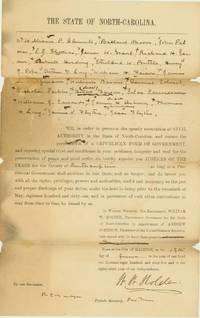
1865218141865. No binding. Fine. Archive of materials relating to the administering of loyalty oaths in North Carolina after the Civil War during presidential Reconstruction. 1865-1866. 21814.01. William H. Bagley Autograph Letter Signed as private secretary of Governor William Holden to William Barrow John Odom and others. Raleigh N.C. July 10 1865 1 p. quarto on State of North Carolina Executive Department lettersheet.Excerpt""Your Memorial . has been received at this office and the Governor directs me to say in reply that the matter therein referred to will be attended to at the earliest possible moment. This however cannot be done until the Enrolling Boards shall have accomplished their work in the different counties in administering the oath of amnesty to the people - separating the loyal from the disloyal. In the meantime the preservations of the Public peace will devolve upon the Justices of the Peace in the several counties who have the right on all occasions to control the Local Police and posses the power to increase the same to such a number as they may deem necessary to meet any emergency which may arise in which they may think is likely to arise .""21814.02 W.W. Holden Printed Letter Signed in Type as Provisional Governor to Col. David A. Barnes with matching cover addressed ""To the Clerk of the County Court of Northampton County Jackson N.C."" Entitled ""Directions for Qualifying Magistrates and Organizing the County Courts."" Raleigh N.C. July 8 1865 1 p. quarto on State of North Carolina Executive Department lettersheet.Excerpt"".If necessary you will call on the officers of the Local Police to notify the Justices to meet at the Courthouse on a day to be appointed by you. And said officers are hereby commanded to aid you in notifying the Justices to attend. When the Justices shall have assembled you will administer to them first the oath of amnesty; secondly the oath to be found in the Revised Code chapter 76 page 434 to maintain the Constitution of the State not inconsistent with the Constitution of the United States; thirdly the oath of office to be found in Revised Code chapter 76 page 441. No Justice or other officer who is included in any of the fourteen excluded classes of the President's amnesty proclamation will be permitted to take the oaths prescribed or enter on the performance of duty until a pardon shall have been received by him from the President. And the oath of amnesty is not to be administered to any one who is not disposed to take it willingly and cheerfully. If any Justice named in the commission hesitates to take the oath it will be your duty to withhold it from him . The Clerk will make a full and complete record on his books of the proceedings of the Justices a copy of which you will at once transmit to this office.""21814.03 W.W. Holden Printed Letter Signed in Type as Provisional Governor. September 15 1865 1 p. quarto on State of North Carolina Executive Department lettersheet.Excerpt""You are hereby directed to retain the Amnesty Oath books until further orders as they will be kept open to allow the people to take said oath up to the time of voting for Governor members of Congress & c.""21814.04 Manuscript Document Oath. Northampton County N.C. August 15 1865. 1 p.21814.05 Printed Document Oath of Allegiance 1865 unissued. 1 p.21814.06 W.W. Holden Partly Printed Document Signed appointing twenty-two men 2 of whom are identified as dead as Justices of the Peace. Raleigh N.C. June 19 1865. 1 p.Excerpt""WE in order to promote the speedy restoration of CIVIL AUTHORITY in the State of North-Carolina and ensure the perpetuation of a REPUBLICAN FORM OF GOVERNMENT and reposing special trust and confidence in your prudence integrity and zeal for the preservation of peace and good order do hereby appoint you JUSTICES OF THE PEACE for the County of Northampton as long as a Provisional Governor shall conti. See website for full description books
186519217Caernarfon Wales: H. Humphreys. @ 1865. 2 12 2 advt pp. Bound in modern wrappers. Very Good. The head of the title reads 'Rhif 78. Llyfrau Ceiniog Humphreys Caernarfon.' <br/>OCLC 13367468 1- Lincoln Pres. Lib. as of January 2020. Not in Eberstadt Decker Nevins Sabin Dornbusch Nicholson. H. Humphreys. [@ unknown books
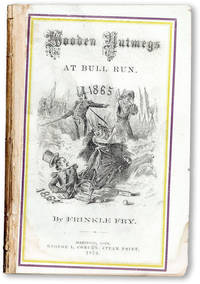
187246642Hartford: George L. Coburn 1872. First Edition. Octavo 20.5cm; publisher's glazed green pictorial wrappers printed within purple and chartreuse double rule disbound from larger volume; viii9-86pp.; text illus. throughout. Rather worn upper wrapper separated and tipped to title page lacking rear cover disbound from larger volume and first signature very nearly separated shallow dampstain along bottom edge of upper cover and first few leaves. Though a Good only copy still retains the uncommon upper wrapper. Satirical description of the role of the 1st Connecticut Infantry Regimen during the Battle of Bull Run and the destruction of Stone Bridge by the Confederates. However "In his attempts to be witty Tyler too often strays far form the truth" NEVINS I p. 171. SABIN 26096. George L. Coburn unknown books
1861D11147Westhampton likely Massachusetts 1861-1864. Ephemera. Fine. Group of 13 manuscript letters black ink in tidy cursive addressed to "Hattie" who is perhaps in Springfield. Most are signed "Mother" one the last and only letter in pencil is signed "Sister Anna" and all are dated 22 April 1861 - "Sabbath Eve" May 1864 and located in Westhampton. A few are somewhat faint but still legible -- otherwise condition is fine. <br/><br/>An interesting group of letters quintessential for their reports on the health of seemingly everyone in town and for their concern with the American Civil War. "I am taking a great interest in war matters feel curious to read the daily paper think the North will come off conquered and I hope without shedding Oceans of blood" she remarks in the earliest letter in the group. Some remarks from later letters include: "We heard that Bolton and Alvin Clark were sick at Annapolis and that Henry Smith is a prisoner at Richmond. Mother England blusters about terribly doesn't she Hope she isn't going to declare war against us."; "Our people have had no letters since the battle are expecting some daily. Edward Coyt of Huntington was one of the wounded. After the battle of Roanoke he wrote to his folks he'd seen enough of war."; "Our men A. P. Bridgman Davis Burt Bartholt Bissell Edward Delany Charles Land Henry Sulliver a fellow living at Capt Custs and an Irishman. So you see we send seven married men."; "Frank Hule was killed in the battle at Murfeesboro Dec 31st by the first fire of the Rebs"; plus a few more comments and names. Mother seems to know everyone in town and some recurring surnames include King Montague Bissell Wright Chapman Davenport Parsons Land or Laud Burt Edwards Jewett Clark Hooker Hubbard Lyman. unknown books
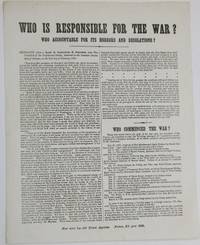
186433660New York 1864. Broadside 9-1/8" x 11-1/2". Printed in two columns light indications at blank top margin of prior matting on blank verso. Near Fine.<br/><br/> The AAS entry for this broadside states that the words at its foot "For sale by all news agents. Price $1 per 100" are identical to the language of several 1864 Republican campaign broadsides published by the National Union Executive Committee Astor House New York. "Presumably this edition was also published by the Republican Party's national committee."<br/> The broadside begins with "EXTRACTS from a Speech by ALEXANDER H. STEPHENS now Vice-President of the Confederate States delivered in the Secession Convention of Georgia on the 31st day of January 1861: 'This step the secession of Georgia once taken can never be recalled; and all the baleful and withering consequences that must follow as you will see will rest on the Convention for all coming time. To attempt to overthrow such a Government as this. is the height of madness folly and wickedness to which I can neither lend my sanction nor my vote'." In his 1868 book 'A Constitutional View of the Late War Between the States' Stephens declared the Speech to be a "fabrication."<br/> There follows an answer to the question 'WHO COMMENCED THE WAR' "Those who would throw the guilt of the war upon the shoulders of Mr. Lincoln are requested to read the following catalogue of 'remarkable events' published in a Southern Almanac all of which occurred during the Presidency of Mr. Buchanan." The "Catalogue" is a list of aggressions committed by the Southern States. "All these were warlike and treasonable acts."<br/>De Renne 1316. Not in Sabin Bartlett Nevins Eberstadt LCP Monaghan. OCLC shows a number of institutional locations. unknown books
1864100734Small broadside 11 1/2x 9 printed on one side. A little darkened with a few spots and some light dampstaining; else very good. This broadside is a response to the Democratic Party platform which suggests the war is all but lost and advises meeting with the Confederate government to talk peace terms. The National Union Ticket supporting Abraham Lincoln quotes at length from speeches of Jefferson Davis revealing the difficult circumstances facing the Confederacy concluding ".Vote For Lincoln! This is the most effecfive way of EndingThe War And Restoring The Union." National Union Executive Committee unknown books
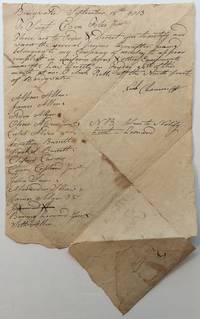
1813267258Bridgewater 1813. unbound. 1 page 9.75 x 7.5 inches not including the flap Bridgewater September 15 1813. Written by a Captain Noah Chasman to Sergeant Ezra Fobes directing him to notify various soldiers who were evidently AWOL to comply with the war-time quota of mandatory soldier attendance in the state militia in large part: "These are to order and direct you to notify and warn the several persons hereafter.to appear compleat sic in uniform horses and other equipments as the law directs on Fryday sic 24th of this month at one o clock P.M. at the North part of Bridgewater." With a listing of the AWOL soldiers at the conclusion. Evenly toned with the usual folds associated with a field order directive; weakness and staining at the folds. Very good- condition.<br/><br/> unknown books
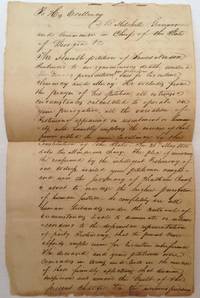
1816217967Georgia 1816. unbound. 4 Pages 13.25 x 8.25 inches Georgia January 23 1816. This exceptional-content letter is a petition for clemency sent to the Governor of Georgia on behalf of a soldier who had been sentenced to death for murdering his senior office. In part: "the deceased and the petitioner were comrades in the army and both got drunk.He is a boy just verging to manhood.who has given five years service in the honorable cause of defending our country. The deeds of this patriot could atone for the errors of youth. The sentence of.death for murder affords ample room for Executive interference.both were drunk in the morning and were strolling without the garrison - without a solitary witness to attest his innocence. He has a record of good conduct." The petitioner James Nixon was illiterate and signed his signature with an "X" after his name. This petition also contains the signatures of thirteen soldiers and officers of the U.S. Artillery as well as the Officers of the Court. Repairs at folds and uniformly toned; otherwise very good condition.<br/><br/> unknown books
1846WRCAM4388Washington 1846. 52pp. Dbd. Very good. The committee outlines reasons for the U.S. declaration of war against Mexico in May 1846. unknown books
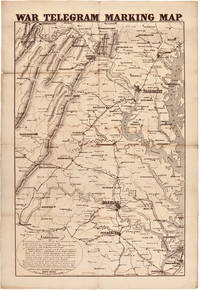
1862WRCAM52854Boston: L. Prang & Co. 1862. Large lithographic poster 38 x 26 inches. Backed with later paper. Old fold lines some minor soiling and wear. Minor loss at a few folds. Nearly very good. A handsome and large-scale map of Virginia from Norfolk to Lynchburg and north to Baltimore and Harper's Ferry. The explanatory cartouche indicates "The extraordinary large scale on which this map is drawn has been adapted to make it just what we designed it to be namely 1st. The most distinct map ever published of the whole Virginia Territory; 2nd. A Marking Map that is a map to mark the change of positions of the Union Forces in red pencil and the Rebel Forces in blue on the receipt of every telegram from the seat of war; for this latter purpose we want plenty of space and a distinctness combined with enough detail not to crowd but to enable us to follow the march of the army as advised by the telegrams. The pencils which we also furnish should be used with a light hand to enable obliterating the marks with the aid of a little soft bread if found necessary. These peculiarities combined with extreme cheapness will make this Map a welcome companion to every person interested in the pending struggle of our nation." L. Prang & Co. unknown books
1884WRCLIT59632Boston: Oliver Ditson & Co. 1884. 96pp. Large octavo. Gilt cloth. Likely one of a number of printings with music reprinted from a variety of sources. A few pencil notes crack at toe of front inner hinge else very good. Includes works by Root Work Foster and many others. Oliver Ditson & Co. hardcover books
1897288977Washington. : Government Printing Office. 1897. . Hardcover publisher’s black cloth gilt spine titles. Spine title faded on vol II owner’s ink name to pastedowns and first pages of text edges lightly foxed otherwise a very good tight set. . 8vo. Heavy set requires extra postage. Government Printing Office. hardcover books
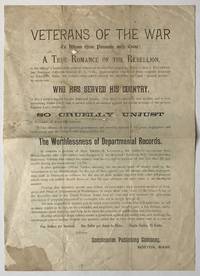
1886858Boston: Combination Publishing Company 1886. About good. Broadsheet 11.75 x 8.5 inches. Old folds a few slight losses not affecting text. Lightly soiling and moderate wear. Ephemeral broadsheet advertising a new book "A True Romance of the Rebellion" by Cyrus S. Haldeman a veteran of the Civil War. "The story is unusually well written and is very interesting within itself; but it carries with it an earnest appeal for a wise revision of the present Pension Laws which are so cruelly unjust to thousands of deserving veterans." In addition to its narrative it contains "official tables showing the enormous sums of money paid by the Government to our Bondholders.and the meagre amounts in proportion paid in Pensions to soldiers for the use of their bodies together with other information which every old soldier should have so that he may advocate his own cause in an intelligent manner." Includes information for pricing and orders. The verso contains an excerpt with a large woodcut illustration of a skeleton in the weeds captioned "Reported Missing." While we locate several copies of the book itself in OCLC we find no record of this advertising broadsheet. Ephemeral and an interesting piece of publishing history. Combination Publishing Company unknown books
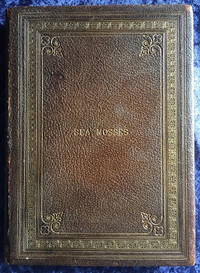
186424170<p><i>"call us not weeds we are flowers of the Sea."</i></p> <b>CIVIL WAR. ANNA BIGELOW.</b>Autograph Manuscript Signed unique calligraphy book with illustrations pressed sea weeds and hand lettered four lines of verse titled 'Sea Weeds.' New York N.Y 1864. 7½ x 10½ on 60-plus pages with 31 moss examples interleaved.<p>Album donated to benefit Union soldiers presented at the New York Metropolitan Fair held on March 28 1864 to raise funds to aid sick and wounded Union soldiers. The Metropolitan Fair was organized to benefit the Sanitary Commission a private relief agency authorized by federal legislation in 1861. The Commission raised an estimated $25 million in revenue more than $386 million today and enlisted thousands of volunteers. A New York Times article on Jan. 1 1864 provided a preview: "Every branch of agriculture trade industry and art will be invited to contribute its choicest and costliest products for exhibition and sale. Musical and dramatic artists will be invited to aid the common cause with their talent and genius. All the material resources of the great City of New-York and of the region directly tributary to it are to be invoked."</p><p>The great success of an earlier Chicago fair inspired many women in the North to become involved. The Metropolitan Fair included everything from "Architectural Ornaments" to "Wines & Liquors" to "Wholesale Millinery Goods." Commemorative and ceremonial objects were often specially designed for the Sanitary fairs. Anna Bigelow's album of sea mosses may have been displayed in the "Arrangements and Decoration" section.</p><p>When Northerners attended fairs donated money or goods or volunteered their time they were aiding the soldiers on the front lines. Autographs of leading Americans were often sold; Lincoln even donated an autograph manuscript of the Gettysburg Address to the New York Fair where it sold for $1000. For Chicago's Great Northwestern Fair Lincoln donated his original signed draft of the Emancipation Proclamation with an accompanying letter stating his "desire to retain the paper but if it shall contribute to the relief or comfort of the soldiers that will be better."</p><p>The elaborately hand lettered and decorated title page of this album bears a small signature "Ellsworth" and "819 Broadway." Henry W. Ellsworth is listed in New York's Manual of the Board of Education as a penmanship instructor at School No. 47 on Twelfth Street between Broadway and University Place p. 295. There is also an inscription "Drawn by E. W. Gandy 1864" at the top of the front free endpaper.</p><p><b>Condition</b></p><p>All edges gilt. Elaborately gilt stamped brown morocco gift binding with white silk linings with gilt title "Sea Mosses" at front board and "Album" at spine. A bit chipped top of spine. Internally a bit marked at the silk linings. The plates in very good condition with the each sea moss plate a delicate floral arrangement. Front cover detached. Some soiling and foxing.</p> hardcover books
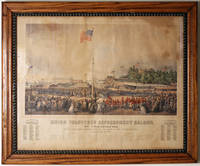
186122953<p>Showing Union troops arriving in Philadelphia from New Jersey via ferry and marching in formation towards the Union Volunteer Refreshment Saloon cheered on by Philadelphians. Text at the bottom lists members of the committee and men willing to accept donations for the saloon. This image became a choice souvenir for soldiers passing through Philadelphia.</p> <b>CIVIL WAR.</b>Print. <i>Union Volunteers Refreshment Saloon of Philadelphia</i>. James Queen delineator and lithographer. Philadelphia: Thomas Sinclair 1861. In period frame 35 x 29 in. <p><b>Historical Background</b></p><p>The Union Volunteer Refreshment Saloon was organized in South Philadelphia in 1861 by grocer Barzilla S. Brown. He began informally distributing food to Union troops traveling through Philadelphia an important rail and steamer hub. The relief effort became official on May 27 1861. The saloon provided soldiers with food drink stamps and paper and offered traveling troops a place to rest. This initial effort differed in some ways from the later Sanitary Fairs that contributed to the care of sick and wounded soldiers. At this point the civilian members were catering to the needs of healthy new recruits.</p><p>In September the Refreshment Saloon added a hospital to aid sick and wounded troops. The saloon supported itself through donations of food clothing cash and later through admission cost to view the Confederate navy vessel <i>Ram</i> which was captured in 1863. After providing social and medical services for four years the saloon closed in late 1865.</p><p><b>James Fuller Queen</b> 1820-1886 apprenticed to learn lithographic draftsmanship. He drew a large variety of lithographs for large printing houses of Wagner & McGuigan Thomas Sinclair and P. S. Duval. He drew views of buildings cities scenic attractions newsworthy events portraits sheet music covers diplomas illustrations for magazines and other images. He also became an outstanding chromolithographer. His view of the "Union Volunteer Refreshment Saloon" is one of Queen's most complex works and perhaps the one for which he is best known. He later drew the United States Sanitary Commission Fair in Philadelphia.</p><p><b>Thomas S. Sinclair</b> c. 1805-1881 was born in the Orkney Islands of Scotland and studied lithography in Edinburgh and other cities. He started his own printing firm in Philadelphia in 1838. He was among the first in Philadelphia to experiment with color lithography. From 1854 to 1859 his brother joined him in the firm of Thomas Sinclair & Co. Later his son worked with him in Thomas Sinclair & Son. He published three different hand-colored lithographs by Queen of Brown's Refreshment Saloon and its friendly rival William M. Cooper's Cooper Shop Volunteer Refreshment Saloon in 1861.</p> Thomas Sinclair books
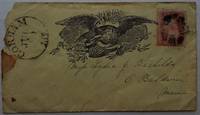
1864245108Gorham Maine 1864. unbound. Union patriotic cover with a large imprint of an angry Heraldic Eagle with stars & stripes shield holding arrows in one talon and an olive branch in the other draped with a banner marked "E. Pluribus Unum." Postmarked: "Gorham Maine July 13" with a cancelled 3c Washington A-25 stamp pink variety. No year circa 1864 3 x 5.5 inches. Small quarter-inch stain on the irregularly cut left margin not affecting postmark. Good condition.<br/><br/> unknown books
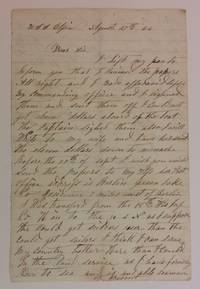
18642833371864. unbound. fine. Union Navy A.L.S. 8vo. 2 pages August 27th 1864 Aboard the USS Elfin. Just three months before she would be destroyed by bombardment while in service on the Tennessee & Cumberland Rivers. Letter from a sailor who is trying to get his Land Grant application to Wisconsin but he can't raise the $11.00 application fee on his ship. In part: "I received the papers alright and I signed an affidavit before my Commanding Officer - and I signed them and sent them off but could not get $11.00 aboard of the boat. The Captain signed them also. Write to my wife and have her send the eleven dollars down to Menasha before the 20th of September. I was transferred from the 18th Wisconsin Infantry Co. into the United States Navy as I suppose they could get Soldiers easier than they could get Sailors. I think I can serve my country better here than I could in the land service as I have formerly been to sea and I am an able seaman at present." Fine condition.<br/><br/> unknown books
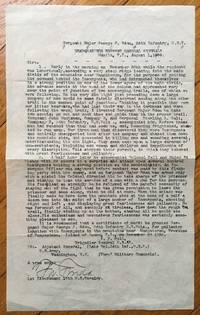
1900208Manila 1900. Very good. Typed letter signed 1p. Typed on thin paper. Folded. A true copy of a typed letter by Gen. J.F. Bell that recommends Sgt. Maj. George J. Oden of the 36th Volunteer Infantry for a Certificate of Merit for gallantry during an engagement with Insurgents native Filipinos who rebelled against American rule after Spain ceded the islands to the United States in the mountains near Mangaterem on November 28 1899 during the Spanish-American War. According to the text of the letter "When the attack was finally made he tore down the mountain side at the head of a half dozen men into the midst of a large number of Insurgents shooting right and left and displaying great fearlessness and gallantry. He was foremost of all and seemingly tireless flew down the rough trail finally winding up at the bottom chasing all he could see alone. His enthusiasm and unconscious fearlessness was something pleasant to see." Certified as a true copy of the letter by a Buffalo Soldier a First Lieutenant in the 10th U.S. Cavalry. unknown books
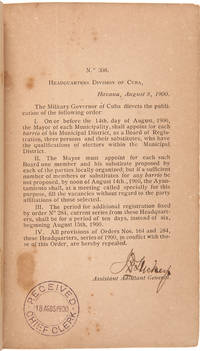
1900WRCAM51843Havana 1900. Approximately 520; 600pp. including several folding charts. Over 200 separate imprints. Original half leather and brown cloth boards spine gilt. Corners and edges worn spine rubbed boards scuffed. Initial leaves of first volume torn away but present. Several other leaves chipped and torn throughout. With many official signatures and docketing stamps. Good. Two volumes of orders promulgated in 1889 and 1900 by the American military government of Cuba after the cessation of hostilities in the Spanish-American War. Under the terms of the Teller Amendment to the Congressional Joint Resolution for war with Spain in 1898 the United States denied the intention of using the conflict as a pretext for the annexation of Cuba and promised to leave the island following the termination of the war. The American military therefore oversaw the creation of the new independent Cuban government before departing in 1902. The documents contained in this collection consist of over two hundred orders in both English and Spanish from the Headquarters Division of Cuba that helped to shape the emerging civilian government. They include instructions for the running of elections the organization of the courts and school system the appointments for various government offices provisions for tax regulations and many other critical issues facing Cuba at its independence. The directives cover two periods from January to July in 1899 and from July to September in 1901. Many of the orders are signed in manuscript by the assistants to the military governor for the island Gen. Leonard Wood including assistant adjutant generals J.B. Hickey and L.W.V. Kennon and Brig. Gen. Chief of Staff Adna R. Chaffee. An interesting documentation of the first American occupation of Cuba. hardcover books
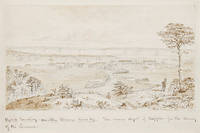
1863WRCAM56150Aquia Landing Va 1863. One pen and ink drawing 7 x 10 1/2 inches sight and one pencil sketch 6 3/4 x 9 3/4 inches sight each in recent matching frames 11 1/2 x 15 inches; plus 2pp. letter on folded folio sheet. Slight soiling and smudging to sketches. Short tape repairs to two closed tears at top margin of letter minor separation at fold text not affected. Very good overall. Two drawings by an unnamed artist submitted as potential accompaniments for articles in HARPER'S WEEKLY which was well-known for the copious Civil War illustrations that supplemented its text. Such illustrations were usually either drawn by reporters or artists sent into the theater by HARPER'S or less often by soldiers in the field. These two works were done by a Union Army Division Post Master and are accompanied by a letter from his commanding officer submitting them for publication. <br> <br> The first work done in pen and ink on paper is entitled "Aquia Landing on the Potomac River Va. The main depot of Supplies for the Army of the Potomac" and depicts a river scene with steamers and sailing vessels along with a pier in the middle distance with a supply train approaching in the foreground which is observed by two soldiers. In the foreground are delicately drawn trees and shrubs; in the background one can see more ships and the other side of the river possibly Simms Point. In early March 1862 the Confederates abandoned Aquia Landing a strategically important post on the Potomac River and Union forces quickly seized the point. The Union Army used the wharves and storage building at Aquia Landing until June 7 1863 when the army headed north for the Battle of Gettysburg and again used the facilities in 1864 during the Overland Campaign. <br> <br> The second work is a pencil sketch titled "Army Bakery in charge of Capt. James Gillette Commissary of Subsistence to Genl. Geary's Division." One medium-sized and two small cabins are at the left side of the image with barrels and a large cauldron nearby; presumably this is where the bakers prepared bread and other items for baking. On the right side of the image is a large wooden lean-to sheltering at least nine ovens. Two bakers are carrying trays of bread and one stands near an open oven with a large peel. To the right of the lean-to is a tent partially open and filled with loaves of bread with three more bakers loading in loaves. In the background are bare trees suggesting this scene is set in winter. <br> <br> The accompanying letter on "Office of the Commissary of Subsistence" letterhead is from Capt. James Gillette to John Bonner then editor of HARPER'S WEEKLY. Gillette writes that he encloses three sketches of which two are included here: "These sketches were made under my own supervision by our division post master are as accurate in detail as any I have seen." Gillette then describes additional material he has enclosed and notes "Some time since a few sketches of scenes in Richmond furnished by my experience found place in your weekly eliciting from you the request that I should occasionally forward to your address such representations of military scenes as might be of interest. Hence these enclosures which in truthfulness cannot be excelled." <br> <br> James Gillette 1838-81 enlisted as a private and rose quickly through the ranks. By this time he was Captain and Assistant Commissary of Subsistence for the 2nd Division XII Corps under Gen. John W. Geary. For his meritorious service he was breveted lieutenant colonel U.S. Volunteers and for gallantry at the battle of Chancellorsville he was breveted major in the regular Army. John Bonner 1829-99 was one of the best known newspaper writers in America at this time. He started as a writer at the NEW YORK HERALD and then moved on to be an editor at HARPER'S. After the Civil War he made a small fortune on Wall Street and then lost it in a most dramatic fashion. He drifted west working for the LEADVILLE CHRONICLE and LEADVILLE NEWS in Colorado and the SAN FRANCISCO CHRONICLE and SAN FRANCISCO CALL among other Bay Area newspapers. <br> <br> An attractive pair of original Civil War drawings from a Union soldier in Virginia in the middle year of the war accompanied by the letter from the Army Commissary officer submitting them for publication to HARPER'S WEEKLY. unknown books
1862101900Three leaves two 8 x10 sheets and one 5x10 text on all sides and comes with typed transcripts. Normal aging and browning and a few tears at folds. The letters were written by George Roden who was born in 1841 from Newark New Jersey who was the son of English immigrants and served in the 2nd New Jersey Infantry regiment. He was a corporal at the time these letters were written. The letters talk about the desolation of the Virginia countryside. "Not a fence or a decent house is to be seen for miles… the black remains of Camp fires with the filth of the many camps of both armies are seen on most every farm. I tell you Va. is suffering for her folly." The letters are from Alexandria and Stafford Court House Virginia. See guide to Roden family papers at the William L. Clements Library. books
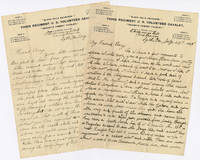
1898WRCAM46791Chickamauga Park Ga 1898. 5pp. Quarto written on "Black Hills Squadron" stationery. Old fold lines. Minor wear. Very good plus. A pair of letters written by Leighton H. Baxter to a friend back home. In his first letter he states that he is "not an enlisted soldier but has a regulation suit.a horse to ride and am fixed up very nicely. He works for the commander of the squadron Major Leigh H. French presumably as a teenage civilian clerk. His duties include "a good deal of writing to do telegrams to send take notes of cases tried in the regiment and a great many other minor duties." He sleeps in the same tent as the Major and takes his meals with the officers. He is well fed but is very glad not to be a private as they "fare badly." It is however "a regular circus to see the boys ride and shoot they beat Buffalo Bill all to pieces." Baxter reports that there are some 40000 to 50000 troops at Camp Thomas with more due to arrive. Some have already departed for "Porto Rico" and he expects his squadron to be going there at any time. In his second letter he notes that the men in his regiment are all "crack shots and fine riders" and all from around Deadwood and the Black Hills. He has been drilling with the men and has learned to handle a sword fairly well. He also mentions practicing "rough riding.such as leaping from a horse while he is running then back again picking up a hat while at full speed etc." <br> <br> The Third U.S. Volunteer Cavalry was mustered into service in May 1898 and commanded by Melvin Grigsby attorney general for the state of South Dakota. The unit was known both as the "Black Hills Squadron" and as "Grigsby's Cowboy Cavalry." Its commander Maj. Leigh H. French was trained as a medical doctor and surgeon and had a practice in Washington D.C. when the war broke out. One of his captains Seth Bullock was the first sheriff of Deadwood. The squadron never saw active duty outside the continental United States spending most of its brief career at Camp Thomas in Georgia. In the crowded camp in the heat of a southern summer typhus measles and other illnesses were rampant and Grigsby's Cavalry lost twenty-seven men to disease. unknown books
189733203Washington D.C.: National Tribune 1897. 320pp. Lacks wrappers text brittle. Fair to Good. National Tribune unknown books