87 résultats
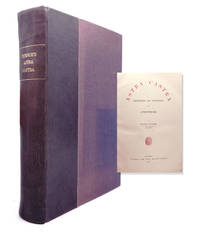
189029191Chicago 1890. Oblong folio. 10 3/4 x 13 inches. 152 albumen photographs most 7 x 9 inches mounted recto and verso of each leaf within the album. Images captioned in manuscript on the mount below the image many signed in white ink or in the negative by Taylor. Expertly bound to style in half dark purple morocco over period cloth covered boards spine lettered in gilt marbled endpapers<br/> <br/>A remarkable album of early Chicago photography by John W. Taylor: a significant photographic record of Chicago in the late 19th century.<br/> <br/>A major photographic record of the city of Chicago and its architecture in the late 19th century almost entirely the work of the significant photographer John W. Taylor with his imprint in the negative. Taylor was a bookseller and stationer before advertising himself as a commercial photographer in the late 1880s. He concentrated his work on Chicago-area architecture and city infrastructure. Today he is recognized as a pioneering photographer of architecture working in Chicago at the very beginning of the skyscraper era. This superb photograph album presents a fairly comprehensive view of Chicago's architecture and life during one of the city's most interesting and vibrant periods from the highest of the skyscrapers to the interiors of pig pens in the stockyards with numerous residences parks lush interiors the 1893 World's Fair and more in-between. Taylor's importance as one of the earliest significant architectural photographers is addressed in Peter Bacon Hales' Silver Cities: Photographing American Urbanization 1839-1939: "Photographers of the older generation managed to retain their identities even as they adjusted to their more prosaic role as visual adjuncts to the architects who designed the buildings they photographed. J.W. Taylor of Chicago for example made an extensive survey of the "modern" buildings of Chicago and its environs many of which traveled throughout the globe as architects and engineers converged on the city in the later 1800s and beyond to see the miracle of the Chicago style of building. Taylor's pictures went as far as Melbourne Australia in the collection of Australian architect E.G. Kilburn who made his pilgrimage to the architects' mecca in 1889. Kilburn stared sketched and took notes; then he brought back photographs by Taylor of everything from the Pullman company town to the Palmer House." Chicago has been an especially important architectural center since the period represented in this collection. After the Great Chicago Fire of 1871 destroyed most of the buildings in the downtown area a special class of architects and engineers flocked to the city resulting in an architectural boom unequaled in the history of 19th century urban development. Hallowed names such as Louis Sullivan Dankmar Adler John M. Van Osdel Daniel Burnham William W. Boyington William LeBaron Jenney John Wellborn Root William Holabird Martin Roche Edward Baumann Harris W. Huel Solon Spencer Beman and Clinton J. Warren stamped their unique architectural character on the Chicago landscape. Each of these architects is amply represented in the photographs contained herein. There is even one photograph of the magnificent lobby of the Rookery Building considered the grandest lobby in Chicago at the time. This view is especially interesting to architectural historians because this interior was remodeled a short time later in 1905 by Adler & Sullivan's former head draftsman Frank Lloyd Wright. The late 19th century was also a transitional time in building construction when architects were beginning to leave behind cast iron frames and experiment with steel-frame construction and large areas of plate glass especially in the "Commercial Style" made famous by Sullivan and others in the Chicago School. As a result some of the earliest modern skyscrapers are found in Chicago. A general summary of the photographs in the album is as follows: forty-two buildings including the Masonic Temple the tallest skyscraper in the world at the time the Woman's Temple the Rookery Building the Chamber of Commerce the Monadnock Building the Northern Hotel the Home Insurance Building the Tacoma Building the Caxton Building the Pullman Building the Oakland Hotel the Grand Pacific Hotel Palmer House the Auditorium Building Marshall Field's the Lester Building the Hotel Metropole Libby Prison the New Regiment Armory depots and churches; seven downtown street scenes; seventeen residential streets including Lake Shore Dr. and Michigan Ave. and residences of prominent citizens including Potter Palmer and Lambert Tree; twenty parks pavilions and recreation scenes; three of Grant Monument and its unveiling; ten Lincoln Park scenes some with animals; three of Garfield Park; ten featuring World's Fair building construction; nine views of the October 1892 World's Fair dedication showing ceremonies and a large parade; two scenes of boating; twelve views of stockyards and meat processing six exterior and interior views of an auditorium; eight interiors including Palmer House and a bank; and three scenes of horse racing at Washington Park. Taylor's photographs reside in the collections of the Art Institute of Chicago fifty-six images and the Chicago History Museum 150 images. The subject matter of those collections and the present work overlap significantly testament to the prodigious nature of Taylor's output. For example this collection has a significant number of images related to the World's Columbian Exposition a.k.a. the Chicago World's Fair of 1893; the Chicago History Museum collection contains no images from this monumental event in Chicago's history. A truly remarkable record of Chicago architecture by a significant photographer. unknown books
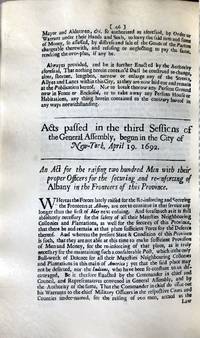
18943187New York: Theodore Low de Vinne for The Grolier Club 1894. Printed on vellum. Folio 285 x 185 mm. 6 leaves clxiii 1; 4 84 4 4 6 11 pp. 1 leaf. 2 blank leaves at front and 4 at back. Title with Grolier Club device three engraved vignettes by Max Rosenthal in the first part Fowler's introduction unsigned lithograph on a separate leaf at the end of the introduction included in the pagination showing William Bradford's tombstone woodcut or linocut ornamental initials final leaf with De Vinne press device. Bound in black morocco t.e.g. others untrimmed by Denis Gouey blind-stamped signature on lower pastedown. Provenance: personal copy of the printer Theodor Low De Vinne bookplate; Bernard Breslauer inserted collation notes on The Ritz London stationery and carbon copy of a letter sent by him to Decherd Turner July 19 1997 plus a clipping from the bookseller's catalogue from which he purchased the book; sale Christie's New York part 3 27-28 June 2005 lot 1134. A fine association copy: the exemplaire de tête printed on vellum retained by the printer for his private collection from a total edition of 315 copies of which 312 copies on hand-made paper and three copies on vellum of a facsimile of the founding laws of the colony of New York. The first part consists of a long historical introduction by Robert Ludlow Fowler. The Facsimile was made from the Lenox Library copy as explained in a two-page note from the Publication Committee pp. 172-173. The book was published by the Grolier Club on the occasion of its tenth anniversary and the other two vellum copies were auctioned off at the tenth annual members' meeting on 21 February 1894. A copy of the Grolier Club invitation to that meeting as well as the 4-page illustrated prospectus for the book both of which were printed by de Vinne are loosely inserted along with the aforementioned documents from Bernard Breslauer. Mr. Breslauer collected books on vellum and in the inserted 1997 letter to Decherd Turner he announced his acquisition of this his fifth Americanum on vellum.Theodore Low de Vinne was one of the nine founding members of the Grolier Club and he printed most of its publications until his death. "His encyclopedic understanding of the craft his advancement of its technology and design his appreciation of its history his business leadership and his many writings earned him among his contemporaries the designation `Dean of American Printers'" APHA website The De Vinne Centennial Feb. 16. 2014. (Theodore Low de Vinne for) The Grolier Club hardcover books
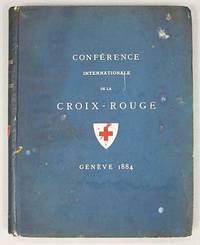
188541347Genève: Au Siège Comité International de la Croix-Rouge 1885. 1st edition. PRESENTATION copy INSCRIBED from Barton "To my friend / Dr. Joseph Gardner / with sentiments of esteem and cordial regard. / Which words cannot express. / Clara Barton. / Washington D. C March 15 1889." Further a 2 line quote by Barton underneath "As the best of all fortune has come squiggly underline in the past / My heart only prays that the present may last." concluded with her "C. B.". Original publisher's blue cloth binding with silver stamped lettering to spine & front board accompanied by an impressed silver & red Red Cross logo. Housed in a custom chemise & 1/4 leather slipcase with marbled paper boards. Volume shows wear & evidence of dampstaining. Rear hinge paper starting at bottom. An About VG copy. Chemise & slipcase - Fine. xix 1 blank 444 pp. Text in French. 4to. <br/><br/>Scarce Red-Cross volume of which OCLC records 5 institutional holdings none in the US inscribed to Dr Joseph Gardner a prominent Indiana citizen and early friend/benefactor of Clara Barton as well as patron of the recently-formed American Red Cross founded in 1881 and of which Barton was president when this volume was inscribed. <br /> <br />Barton had a long-standing friendship with the Gardners with her one-time sectetary Enola Lee becoming the 3rd Mrs. Joseph Gardner. <br /> <br />In 1893 Dr. Gardner donated a large plot of his land in Indiana to the American Red Cross which Barton envisioned becoming a central-states headquarters/warehouse for the organization. All was to come to naught however as the plot was never developed & ulitmately sold to settle back taxes et al. Such was to later cause Barton problems however as she was accused of financial malfeasance which ultimately contributed to her 1904 retirement from the Red Cross. Cf. Cavinder MORE AMAZING TALES OF INDIANA pp. 79 - 80. <br /> <br />Early inscribed Barton material is somewhat uncommon in the trade. We are pleased to be able to offer this volume documenting the friendship between these two civic-oriented individuals. Au Siège Comité International de la Croix-Rouge hardcover books
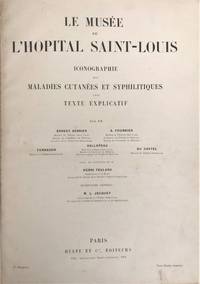
1895M13445Paris:: Rueff et Cie 1895-97. 1895. Folio. 2 iv 346 pp. 50 chromolithographic plates 23 engravings 18 photogravures. Contemporary half crimson gilt-stamped morocco marbled boards raised bands. Very good. RARE. First edition. A MASTERPIECE OF PHOTO-CHROMOLITHOGRAPHY. "The authors of this book were senior doctors at the Hôpital Saint-Louis. Besnier presided over the 4th International Congress of Dermatologists held in Paris in 1900. The museum had been founded by Devergie in 1865. During his 25 year long career Devergie commissioned water colour paintings of the major skin diseases for use in his lectures. It was not long before these were supplemented by photographs and moulages. Between 1867 and 1894 the Italian moulage artist M. Baretta 1834-1925 produced 1800 such models. He devised the internal colouring technique. This is a technique whereby the colours are applied in between the layers of wax. The effect is one of transparency and greater similarity to the colour of human skin Zanca and Tagliavini. The various separate lesions have been portrayed exceptionally well. Less attention was paid to facial expressions. The museum now has a collection of 4667 moulages at its disposal Dahm. The finest among them were reproduced in this book. The printing technique used was photochromy." – Franz Ehring Skin Diseases: 5 Centuries of Scientific Illustration. pp. 176-177. "Ernest Besnier was born in Honfleur in 1831. He studied in Paris and was a celebrated pupil of Hardy and Bazin. Having been graduated in 1857 he turned his attention exclusively to dermatology and by 1872 had become a chief at l'Hôpital Saint Louis." "Besnier was active in all phases of dermatology. Although essentially French in his diathetic thinking he was responsible for translating Kaposi's text into French with masterful annotations by himself. His monograph on psoriasis his work on atopic dermatitis. and his work on eczema entitle him to his place as the leading French dermatologist of his time." - Shelley & Crissey Classics in Clinical Dermatology p. 246. "Ernest Besnier was the unquestioned master of French dermatology towards the end of the 19th century. When he took over the leadership of the Parisian dermatology clinic in 1873 French dermatology had lost its premier position and fallen behind the Vienna school not only in regards to research and teaching but also in terms of space and equipment. Besnier reformed French dermatology incorporating many advances from Vienna such as establishing laboratories for bacteriology mycology and histopathology and encouraging basic research. As he retired just before the turn of the century French dermatology had closed the gap." "Ernest Henri Besnier was born on 21 April 1831 in Honfleur a small village in the Normandy. Since his father was a customs official the family moved frequently including stays in Marseille and Orleans. Besnier studied medicine in Paris and advanced to Interne des Hôpitaux in 1853. His teachers included Ernest Bazin Philippe Boyer and Henri-Louis Royer whose niece Besnier married a few years later. In 1857 his doctoral thesis on the diagnosis and therapy of ileus was accepted. He continued to address mainly internal medicine themes. Named Medecin des Hôpitaux in 1863 he published between 1864 and 1872 studies ranging from cholera to diseases of the spleen to rheumatic diseases to gall stones becoming one of the best known internists in France. As signs of recognition he was elected Vice-President of the Societe anatomique in 1861 and Secretary-General of the Societe Medicale des hôpitaux in 1864. He served as a military physician in the Franco-Prussian War of 1870/1871 and was awarded the highest military honor being named a Chevalier de la Legion d'Honneur." "When Bazin retired as head of dermatology clinic at Hôpital Saint-Louis at the end of 1872 Besnier was the highest ranking faculty member and entitled to the position. Although no one dreamed he would desert internal medicine for dermatology he accepted the challenge. With little experience but great energy he started his new job on 1 January 1873. Within a few months he had read the entire dermatologic literature concentrating on the works of Bazin and Erasmus Wilson; he profited greatly from the immense clinical experience of his colleague Charles Lailler who tactfully assumed the role of the old experienced tutor. Besnier also benefited from working together with Adrien Doyon the founder and editor of the Annales de Dermatologie et de Syphiligraphie; Doyen made him aware of the great advances in dermatology in Germany and Austria. With Besnier' encouragement Doyen translated into French Moriz Kaposi's textbook from 1880 Pathologie und Therapie der Hautkrankheiten. Besnier employed his by now encyclopedic knowledge of the dermatologic literature to provide commentaries which enhanced Doyen's translation. The French edition appeared just one year later 1881 and dominated the training of dermatologists in France for the next two decades and helped to reduce the differences between the French and German-speaking schools of dermatology. In 1881 Besnier also became editor of the Annales de Dermatologie et de Syphiligraphie and was named a member of the medical academy." "Kaposi's Clinic in Vienna was the model of a modern dermatology clinic for Besnier. In 1882 he asked Doyen for a detailed report over the Viennese clinic which was published in the Annales de Dermatologie et de Syphiligraphie and including information not only about the teaching program and costs of inpatient care but also covered such details as patient clothing the size of hospital rooms and how instruction signs were posted on the walls. When compared to Vienna the conditions in Hôpital Saint-Louis were primitive. Besnier described his outpatient clinic as a sleazy ramshackle hut completely unworthy of a great capital city. He demanded the construction of new inpatient wards and emphasized the importance of a histopathology laboratory. He also established the first laboratory for bacteriology and mycology at Hôpital Saint-Louis. Besnier demanded a change from purely descriptive dermatology turned against the nosologic speculations of his predecessor Bazin which he felt had lost validity through the groundbreaking work of Pasteur and demanded the incorporation of knowledge from bacteriology and histopathology into dermatology. In addition he tried to get dermatology incorporated into general medical education so that medical students could not graduate without some exposure to dermatology – that had not been the case previously." "Besnier's daily activities were highly regimented. He arrived every morning at 8:45; once a week he made inpatient rounds while the other days were devoted to specialty clinics. After each patient contact Besnier washed his hands and cleaned under his fingernails. He was always carefully dressed and reserved. his students including Louis Brocq Raymond Sabouraud Lucien Jacquet 1860-1914 George Thibierge Felix Balzer 1849-1929 and Emile Leredde 1866-1926 consider him the ideal academic teacher. He stimulated them to produce many papers. His lectures were clear and contained a great deal of clinical and histopathological information embedded in a broad theoretical background. They attracted a wide range of listeners ranging from pharmacists and medical students to guest physicians from abroad. in 1888 Besnier started weekly meetings on Thursday for all physicians working at Hôpital Saint-Louis during which all the interesting cases of the week were discussed. Out of this meeting evolved in 1889 the Societe francaise de Dermatologie et de Syphiligraphie with Besnier as a founding father. He served initially as Vice-President and then became President in 1892." "Besnier published very little. In 1879 he described the diagnostic possibilities made available by histologic examination and coined the term biopsy. In 1889 he described the diagnostic possibilities made available by histologic examination and coined the term biopsy. In 1889 he described lupus pernio which was recognized a few years later as a manifestation of sarcoidosis and in 1892 he provided the first precise description of atopicdermatitis. In order to properly describe this illness Besnier stated that one had to break away from the tyranny of Willan's and consider not only the primary lesions but all the findings. He stated that the central symptom is pruritus intensive pruritus waxing and waning often worse in the evening with seasonal remissions and exacerbations. The lesion morphology in contrast had little meaning; instead he pointed out that one absolute fundamental characteristic was that none of the lesions associated with or triggered by the illness were specific. Besnier did not use the terms lichen or eczema employing instead lichenification and eczematization to emphasize that the skin changes were not specific but instead banal lesions which resulted from itching and scratching. The disease often started in early childhood and took a variable but chronic course. Sometimes the disease left the skin and presented then primarily as emphysema bronchitis asthma hay fever or less often gastrointestinal problems. Since he felt a congenital tendency towards pruritus existed which then could appear in varying degrees of severity Besnier designated the disease as Prurigo diathesique." – Loser Plewig and Burgdorf Pantheon of Dermatology pp. 89-93. Franz Ehring Skin Diseases: 5 Centuries of Scientific Illustration. pp. 176-177; Loser Plewig and Burgdorf Pantheon of Dermatology pp. 89-93; Shelley & Crissey Classics in Clinical Dermatology p. 246. Rueff et Cie, 1895-97. hardcover books
188261972Cleveland Ohio 1882. Four pages approximately 350 words in part: "Advance sheets of Mr. Blaine's address reached her yesterday morning. Thronging emotions and memories made my heart stand still. It was the anniversary of the last day the Gen'l passed in our Mentor Ohio home . hopes ambitions aspirations pure & high and almost assured all swept away -- nothing left but tears." Garfield took office in March 1881 was shot in July and died a lingering death in September. Mrs. Garfield thanks Mr. Blaine for his wonderful words and his tribute to her husband's life and character. A beautiful poignant letter. Still very good. Folded for mailing some browning at folds. 9782. <br/><br/> unknown books
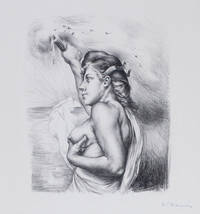
189527882n.d. ca. 1895. First Edition. Limited to an unspecified number of which this is no. 16. Original etching; sheet size approx. 60.75x45cm.; image area 28x22.5cm. Signed with limitation number in blue pencil by the artist. A Fine copy mounted in archival mat. Symbolist image by the French anarchist painter and engraver Charles Maurin. According to a previous dealer this image was produced for the anarchist newspaper Les Temps Nouveaux edited by Jean Grave. Image depicts the personification of freedom "la Marianne" shown here in profile and partially in deshabille her left hand clutching her breast while her right hand holds up a torch. unknown books
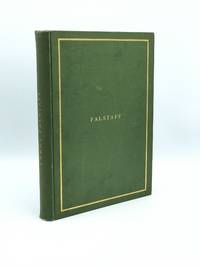
1893402877Milan Rome etc.: G. Ricordi & Co 1893. 4to 267 x 203 mm; 10½ x 8 inches. 471 pages. Full-page portrait of Verdi. Original gilt-lettered and -ruled green cloth. A fine copy with only slightest of wear at the ends of the spine. FIRST EDITION IN ENGLISH. Published the same year as the first edition in Italian. Falstaff is the last of Verdi's operas composed as he neared his eightieth year. The composer wanted to write a comedy and collaborated with Boito for three years from mid-1889. Of his 27 operas this is only his second comedy the first was his second opera Un giorno di regno. The work premiered at La Scala in Milan on 9 February 1893; it was published in its original Italian and in translations later that year. . <br/><br/> G. Ricordi & Co hardcover books
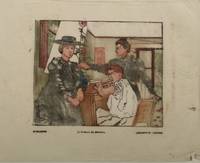
1890184Lithograph. c. 1890. As published for L'Estampe et L'Affiche. Printed on very thin tissue. Image: 5 x 7. Margins: 9 x 11¼. L'Estampe et L'Affiche. books
1865319096London: Chapman and Hall 1865. First Edition. Illustrated with 39 full page plates of portraits of famous Aeronauts and their Ascents including Icararus as the Frontispiece and 51 vignettes in the text. xxiii 530 pp. 1 vols. Folio. Bound in modern quarter green morocco and cloth. About fine. First Edition. Illustrated with 39 full page plates of portraits of famous Aeronauts and their Ascents including Icararus as the Frontispiece and 51 vignettes in the text. xxiii 530 pp. 1 vols. Folio. The fullest pictorial account of ballooning containing good reproductions of many rare prints a bibliography and a chronological list of ascents from 1783-1848 and incidently giving an account of meteorological observations during ascents." Brockett 12110; Gamble 373; Liebman-Wahl 676; L'Art Ancien Catalogue Flight #250; Tissandier p. 61; Zeilinger Bibliotheca Chemico-Mathematica 20759 Chapman and Hall unknown books
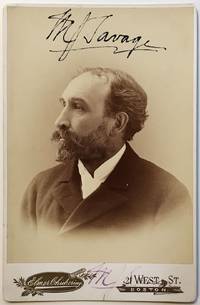
1895274282Boston 1895. unbound. Gorgeous mounted albumin photograph 6.5 x 4.25 inches taken at the studio of Elmer Chickering 21 West Street Boston Massachusetts a shoulder-up profile image of Savage dressed in a heavy coat boldly signed on the image in black ink "M.J. Savage" below the image on the mount in purple ink "M.J. Savage" and again on the back "M.J. Savage - May 24th '95." An exceptional item that is in fine condition. Note: Elmer Chickering 1857 - 1915 was a photographer who specialized in celebrity portraits in the late 19th and early 20th centuries.<br/><br/> American Unitarian Minister who was an early advocate of Darwinian Evolutionistic Optimism and Social Reform and supported the Theory of Evolution through his numerous sermons and church teachings.<br/><br/> unknown books
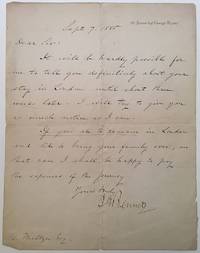
1885272611Paris 1885. unbound. 1 page 10.5 x 8 inches Paris September 7 1885 in English to journalist Henry Meltzer who was in the United States waiting to be called to London for the purpose of establishing a British edition of the New York Herald in part: ".It will hardly be possible for me to tell you definitely about your stay in London until about three weeks later. If you are to remain in London and would like to bring your family over in that case I shall be happy to pay the expenses of the journey." Evenly toned with four small tape repairs on the folds on the back. Very good- condition.<br/><br/> Son of the founder of the New York Herald. He is best remembered for sponsoring Henry Morton Stanley's trip to Africa to find David Livingston financing the whole endeavor for exclusive dispatches from the Congo. As a sportsman Bennett is credited with organizing the first tennis match in the United States. As a businessman he partnered with Jay Gould and co-founded the Commercial Cable Company.<br/><br/> unknown books
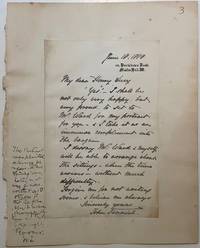
18882818991888. unbound. very good. 1 page 9.5 x 7.5 inches London June 18 1888 confirming his appointment at Wm. Wards studio in part: "Yes! - I shall be not only very happy but very proud to sit to Mr. Ward for my portrait for you & take it as an immense compliment into the bargain. Mr. Ward & myself will be able to arrange about the sittings - when the time arrives - without much difficulty. Forgive me for not writing sooner." This letter was addressed to Sir Henry Lucy a patron of the arts who mounted the letter in a scrap book and added a postscript in the left margin: "The portrait was painted and hung for years in our dining room." Gently faded at the edges with light spotting in the margins; still in very good condition overall.<br/><br/> English illustrator and political cartoonist who was prominent in the second half of the 19th century. He was the illustrator for "Alice in Wonderland" and is best remembered as the principle political cartoonist for "Punch" magazine for over 50 years.<br/><br/> unknown books
186441942Boston: F. A. Searle Printer 118 Washington Street 1864. Some age toning light crease here & there with the occasional spot or two. Horizontal fold-line. Still a VG example of this fragile item. One broadside sheet printed recto only. 18-1/8" x 6-1/4" <br/><br/>Margaret Julia Mitchell popularly known as Maggie Mitchell was an American actress born in New York. She made her first regular appearance as Julia in The Soldier's Daughter at the Chambers Street Theatre in 1851. The parts in which she was best liked were Jane Eyre Mignon Little Barefoot and Fanchon the Cricket. Wiki In January 1861 At at De Bar’s St. Charles Theatre in New Orleans Mitchell first appeared in Fanchon the Cricket a new secondhand adaptation by August Waldauer from George Sand’s story “La Petite Fadette.” Her characterization of the sprite of a heroine which included a graceful and entrancing shadow dance was an immediate sensation. Her Southern tour was cut short by the Civil War and Mitchell took Fanchon to Boston and New York where it was equally successful. Fanchon remained her mainstay for 30 years. Audiences never tired of it—her admirers included the likes of Abraham Lincoln and Ralph Waldo Emerson—and even in her 50s Mitchell retained the winsome elfin appeal that made her so successful. She also early obtained the rights to Fanchon which enabled her to amass a considerable estate. EB. We find one institutional holding of this playbill at the MHS. A rare survivor of this play's northern run. F. A. Searle, Printer, 118 Washington Street unknown books
189113733.1San Francisco: E. L. G. Steele 208 California Street 1891. 1st edition BAL 1109; Baird & Greenwood 252; Wright III 525. Original publisher's brown cloth with gilt stamped lettering to spine & front board variant with leaf 19-8 excised. Modest wear & soiling. Glit a bit dull. Unobtrusive bit of bubbling to rear board. Withal Very Good. 300 2 blank pp. 8vo. 7-3/8" x 4-13/16" <br/><br/> E. L. G. Steele, 208 California Street hardcover books
1864WRCLIT81569Paris: Cadart & Luquet 1864. Original etching plate 16 x 22 cm with full margins 33.5 x 44.5 cm. Short tear in top blank margin some vestiges of mounting tape in extreme corners of blank verso otherwise near fine. An etching by Bracquemond illustrating a scene from Gautier's CAPITAINE FRACASSE printed by Auguste Delâtre. Published as an element in Cadart & Luquet's portfolio for the Sociéte des Aquafortistes. With the publisher's blindstamped paraph in the lower margin. Signed in the plate. Cadart & Luquet unknown books
1877316316Philadelphia: J.B. Lippincott & Co 1877. First edition. 101pp. 8vo. Modern crimson cloth. First edition. 101pp. 8vo. "For some years I have been using with success.certain methods of renewing the vitality of feeble people by a combination of entire rest and of excessive feeding made possible by passive excerise obtained through the steady use of massage and electricity" Chapter I.<br/><br/>Mitchell used this resty cure on Charlotte Perkins Gilman and it provided her the idea for "The Yellow Wallpaper" a short story in which the narrator is driven insane by this treatment.<br/><br/>This treatment was also used on Virginia Woolf who wrote a savage satire of it in her novel Mrs. Dalloway : "you invoke proportion; order rest in bed; rest in solitude; silence and rest; rest without friends without books without messages; six months rest; until a man who went in weighing seven stone six comes out weighing twelve" G-M 4554 J.B. Lippincott & Co unknown books
1886401987Washington: Gibson Brothers 1886. First edition. Light wear to edges of wrappers generally very good/From the Collection of Allan B. Kirsner M.D. 8vo. Salmon and Smith's paper is on pp. 204-05. Entire volume: pp. 201-20 4 pp. advertisements at end. Original printed wrappers. "Discovery of Salmonella cholerae-suis. The Salmonelleae tribe was named after Salmon even though the discovery was made by his assistant Smith" Garrison-Morton-Norman 2505. <br/><br/> Gibson Brothers unknown books
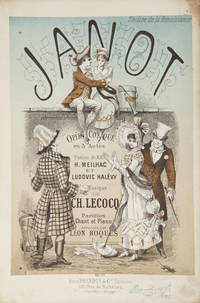
188128614Paris: Brandus & Cie PN B et Cie 12705 1881. Large octavo. Original publisher's dark pink illustrated wrappers. 1f. recto illustrated title printed in colour verso blank 1f. recto notes on first performance and named cast list verso contents xii 286 pp. Some leaves unopened.<br/><br/>With an autograph inscription signed by the composer "Ch. Lecocq" to Vauthier who played Latignasse in the premiere of the work.<br/><br/>Named cast includes J. Granier Jolly Vauthier Lary Jeannin Libert Deberg Perrenot Williams Crambade Schamyl Desclauzas Mily Meyer Belliard Rouvroy Lydie Borel Ducouret Panseron Doriani Davenay Roger and Boulard.<br/><br/>Wrappers worn and chipped at edges; upper detached; spine faded. Occasional minor foxing; first signature partially detached; publisher's facsimile handstamp to blank lower outer corner of title. First Edition.<br/><br/>Janot to a libretto by Meilhac and Halévy was first performed at the Renaissance on January 21 1881.<br/><br/>"After a lapse of more than a year caused by illness and domestic problems his career resumed with Janot 1881 Le jour et la nuit 1881 and Le coeur et la main 1882 but these were his last real successes."<br/><br/>"Much of Lecocq's music is characterized by a light touch but he could also adopt a more lyrical and elevated style than Offenbach and termed several of his operettas opéras comiques. His greatest popular triumph La fille de Madame Angot has remained a classic among operettas and demonstrates Lecocq's abundant flow of pleasing melodies his deft exploitation of rhythm for a lively theatrical effect impressive building up of extended numbers and typically French shaping of phrases." Andrew Lamb in Grove Music Online. Brandus & Cie [PN B et Cie 12705] unknown books
1892028183Mobile AL: The Gossip Printing Company 1892. Octavo. Author's autograph edition with portrait frontispiece signed. In addition he has written a long note: "It is not the deeds men do as much as their manner of doing that makes impression on an era." J.C. DeLeon Mobile January 1896. 1-23--12 1 pp. dedication 5-6 i-vii 11-376 pages. The author was from a prominent Jewish family his brother became the first Surgeon-General of the Confederacy. De Leon saw the sad failures of the Confederate government from the financial mismanagement to his description of the horrendous prices that led the women of Richmond to start the "bread riots" meat butter pork $35 a pound; common shoes $200-800 a pair; a barrel of flower $1400. He writes that the Richmond papers were often seen more editorials of emotion while the Northern papers were often considered more reliable. Ralph Jeffrey Newman lists this as one of the essential books for a serious Civil War Library. Bound in brown decorative cloth lettered and decorated in black and gilt spine lettering gilt floral endpapers p. 375 shows a bit of separation at the gutter a spot of rubbing to upper board mild bumping to corners. previous owner's name stamped on endpapers. A very good copy. Howes D-241: Nevins II 218. The Gossip Printing Company unknown books
1899025963Austin Texas: Von Boeckmann-Jones 1899. First Edition. Octavo. 264 pages 4pp. ads at rear printed on rectos only errata sheet tipped in owned by Dr. Henry C. Cooke Galveston Texas 1900. He was a member of the Texas Academy of Science. An unusually bright copy of an important first hand account with illustrations. Nevins I p.78. In George Worthington Adams article on Confederate Medicine he quotes this work on the use still of bleeding and the price of the various opiates which were becoming scarce. His descriptions of the poor diet of the doctors still better than for most of the men was horrifying though when it was available they did occasionally get milk and vegetables. The author edited the Texas Medical Journal from 1885 to 1910 and was listed in Types of Successful Men of Texas as well as Who's Who in America. Bound in red cloth lettered and decorated in black and gilt spine lettering gilt floral endpapers. Von Boeckmann-Jones unknown books
1885251281np 1885. 1 page. 1 vols. 8vo. Tipped to larger sheet. 1 page. 1 vols. 8vo. President Garfield's wife:<br/>"This I have first received from Mr. Browne as the result of his search. It is not very satisfactory If you still desire that I see the original of the Chase letter I do not object to it. I am now at the farm and shall be glad to see you here should it be your pleasure to come. unknown books
1870RW1089Paris:: Librairie de L. Hachette 1870. 1870. 4to. iv 612 pp. 117 engravings 6 chromolithographic plates. Original quarter crimson and gilt-stamped leather red blind-stamped cloth all edges gilt; extremities worn joints cracked. Very good. An interesting collection of writings by 4 very different men joined by their fascination with aeronautics. Flammarion was a French astronomer and prolific author of works on popular science Glasiher was an English meteorologist and aeronaut Fonvielle was a dedicated balloonist while Tissandier was a chemist meteorologist and aviator. This work describes many of their experience and experiments relating to air travel principally in balloons. Includes some very nice illustrations. Librairie de L. Hachette, 1870. hardcover books
188324708New York: Charles Scribner's Sons 1883. 1st edition Nevins I p. 229. Blue cloth binding with gilt lettering. Embossed ship design to front board. VG gilt bright/minor wear/pos to t.p. viii 2 267 pp including index. 4 pp of adverts at rear. Illustrated with 8 maps & plans 3 folding. 8vo. 7-1/2" x 5" <br/><br/>Author's first book. Per Nevins ". clear and thoughtful." Charles Scribner's Sons hardcover books
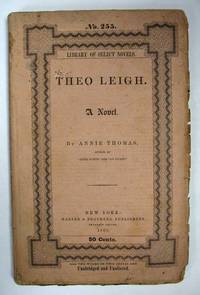
186538770New York: Harper & Brothers Publishers 1865. 1st US edition. Not in Wolff. Publisher's original printed buff paper wrappers. Slight roll to volume. General wear & soiling to wrappers. A respectable VG copy. 158 2 pp. Text double column. Last 2 pages publisher adverts. 8vo. 9-1/8" x 5-3/4" <br/><br/>Thomas wrote by necessity doing so to support herself after her father passed. She authored 60 novels which Margaret Oliphant & Charlotte Yonge were said to loathe with this title ". another very feeble story pomposly told" with just enough "spice to keep the pages turning." Feminist Companion to Lit in Eng p. 1073. However Tinsley one of her publishers described her thusly: "a bright merry light-hearted girl and a writer of bright easy-reading fiction of which she could write acres in a short time ." A publisher's dream author it seems though now somewhat faded in current reputation & scholarly attention. This one of her earlier efforts quite scarce in this edition & condition with OCLC showing just 7 institutional holdings none west of the Rockies. Harper & Brothers, Publishers unknown books
18831297849Boston: Geo. H. Ellis 1883. First Edition. Hardcover. Octavo 160 pages; VG-; bound in brown cloth gilt lettering to spine; mild wear and rubbing; webbing slightly showing on top of front gutter; age-toning to pages; binding slightly weak; shelved case 10. 1297849. Shelved Dupont Bookstore. Geo. H. Ellis hardcover books