437 résultats
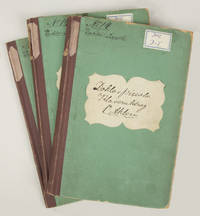
187528431Paris: Brandus & Cie B. & Cie. 12050 1875. 3 volumes. Large octavo. Dark brown textured cloth-backed green boards with decorative cut paper labels titled in manuscript to uppers; small manuscript title labels to head of spines. <br/><br/>Act I: 128 pp.<br/>Act II: 129-258 pp.<br/>Act III: 259-326 pp. With notes on cast in pencil to verso of front free endpaper.<br/><br/>Heavily annotated in black ink and lead red and blue pencil. With Swedish translation of French text overlaid in pencil and with corrections/alterations to notation and performance annotations in both pencil and ink in the same hand throughout. Manuscript music laid in to end of Act III being an alternative ending. Oval handstamp of the Swedish theatre publisher Arvid Enlind to several pages. <br/><br/>Binding slightly worn rubbed and bumped. Occasional small edge chips and tears; annotations tipped into p. 319 partially obscuring music; lacking title and preliminary leaf. Le pompon to a libretto by Chivot and Duru was first performed at the Folies-Dramatiques on November 10 1875.<br/><br/>"Much of Lecocq's music is characterized by a light touch but he could also adopt a more lyrical and elevated style than Offenbach and termed several of his operettas opéras comiques. His greatest popular triumph La fille de Madame Angot has remained a classic among operettas and demonstrates Lecocq's abundant flow of pleasing melodies his deft exploitation of rhythm for a lively theatrical effect impressive building up of extended numbers and typically French shaping of phrases." Andrew Lamb in Grove Music Online.<br/><br/>An interesting performance copy. [Brandus & Cie [B. & Cie. 12050] unknown books
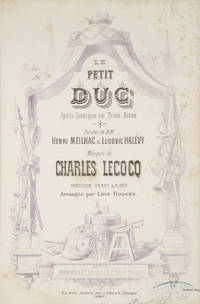
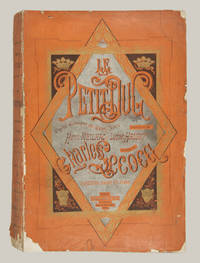
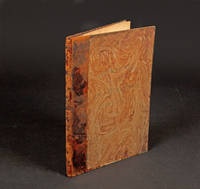
187828609Paris: Brandus et Cie. PN B. et Cie. 12367 1878. Large octavo. Quarter dark red calf with marbled boards spine with decorative gilt rules titling gilt. 1f. recto title within illustrated border by L. Denis printed in light purple verso blank 1f. recto dedication verso blank 1f. recto notes on first performance and named cast list verso contents x 297 i blank pp.<br/><br/>Named cast includes J. Granier Vauthier Berthelier Urbain Caliste Elim Bovet Hervier Deberg Desclos Duchosal Desclauzas Mily Meyer Léa d'Asco Piccolo Panseron Ribe Lasselin Dianie and Davenay. <br/><br/>Binding slightly worn rubbed and bumped; former owner's signature "Mde. G. G. Carandine" to front pastedown. Light to moderate foxing; some signatures split; handstamps to title. First Edition of the second version. <br/><br/>Le petit duc to a libretto by Meilhac and Halévy was first performed in Paris at the Renaissance on January 25 1878.<br/><br/>"Settling once again in Paris Lecocq confirmed his international reputation with La petite mariée 1875 and Le petit duc 1878 both of which have remained in the French operetta repertory."<br/><br/>"Much of Lecocq's music is characterized by a light touch but he could also adopt a more lyrical and elevated style than Offenbach and termed several of his operettas opéras comiques. His greatest popular triumph La fille de Madame Angot has remained a classic among operettas and demonstrates Lecocq's abundant flow of pleasing melodies his deft exploitation of rhythm for a lively theatrical effect impressive building up of extended numbers and typically French shaping of phrases." Andrew Lamb in Grove Music Online. Brandus et Cie. [PN B. et Cie. 12367] unknown books
187828616Paris: Brandus et Cie. PN B. et Cie. 12367 1878. Large octavo. Original publisher's decorative orange wrappers printed in silver and black. 1f. recto title within decorative border printed in light purple verso blank 1f. recto dedication to Jeanne Granier verso blank 1f. recto notes on first performance and named cast list verso contents x 301 i blank pp. Lithographed.<br/><br/>Named cast includes J. Granier Vauthier Berthelier Urbaoin Caliste Elim Bovet Hervier Deberg Desclos Duchosal Desclauzas Mily Meyer Léa d'Asco Piccolo Panseron Ribe Lasselin Dianie and Davenay.<br/><br/>Wrappers somewhat worn with chipping to edges; upper partially detached; shaken. Some minor foxing; handstamp to lower margin of title. First Edition second issue.<br/><br/>Le petit duc to a libretto by Meilhac and Halévy was first performed in Paris at the Renaissance on January 25 1878.<br/><br/>"Settling once again in Paris Lecocq confirmed his international reputation with La petite mariée 1875 and Le petit duc 1878 both of which have remained in the French operetta repertory."<br/><br/>"Much of Lecocq's music is characterized by a light touch but he could also adopt a more lyrical and elevated style than Offenbach and termed several of his operettas opéras comiques. His greatest popular triumph La fille de Madame Angot has remained a classic among operettas and demonstrates Lecocq's abundant flow of pleasing melodies his deft exploitation of rhythm for a lively theatrical effect impressive building up of extended numbers and typically French shaping of phrases." Andrew Lamb in Grove Music Online. Brandus et Cie. [PN B. et Cie. 12367] unknown books
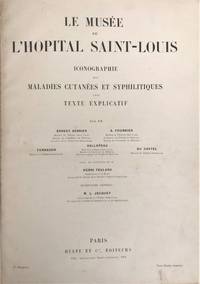
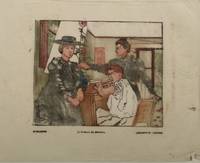
1895M13445Paris:: Rueff et Cie 1895-97. 1895. Folio. 2 iv 346 pp. 50 chromolithographic plates 23 engravings 18 photogravures. Contemporary half crimson gilt-stamped morocco marbled boards raised bands. Very good. RARE. First edition. A MASTERPIECE OF PHOTO-CHROMOLITHOGRAPHY. "The authors of this book were senior doctors at the Hôpital Saint-Louis. Besnier presided over the 4th International Congress of Dermatologists held in Paris in 1900. The museum had been founded by Devergie in 1865. During his 25 year long career Devergie commissioned water colour paintings of the major skin diseases for use in his lectures. It was not long before these were supplemented by photographs and moulages. Between 1867 and 1894 the Italian moulage artist M. Baretta 1834-1925 produced 1800 such models. He devised the internal colouring technique. This is a technique whereby the colours are applied in between the layers of wax. The effect is one of transparency and greater similarity to the colour of human skin Zanca and Tagliavini. The various separate lesions have been portrayed exceptionally well. Less attention was paid to facial expressions. The museum now has a collection of 4667 moulages at its disposal Dahm. The finest among them were reproduced in this book. The printing technique used was photochromy." – Franz Ehring Skin Diseases: 5 Centuries of Scientific Illustration. pp. 176-177. "Ernest Besnier was born in Honfleur in 1831. He studied in Paris and was a celebrated pupil of Hardy and Bazin. Having been graduated in 1857 he turned his attention exclusively to dermatology and by 1872 had become a chief at l'Hôpital Saint Louis." "Besnier was active in all phases of dermatology. Although essentially French in his diathetic thinking he was responsible for translating Kaposi's text into French with masterful annotations by himself. His monograph on psoriasis his work on atopic dermatitis. and his work on eczema entitle him to his place as the leading French dermatologist of his time." - Shelley & Crissey Classics in Clinical Dermatology p. 246. "Ernest Besnier was the unquestioned master of French dermatology towards the end of the 19th century. When he took over the leadership of the Parisian dermatology clinic in 1873 French dermatology had lost its premier position and fallen behind the Vienna school not only in regards to research and teaching but also in terms of space and equipment. Besnier reformed French dermatology incorporating many advances from Vienna such as establishing laboratories for bacteriology mycology and histopathology and encouraging basic research. As he retired just before the turn of the century French dermatology had closed the gap." "Ernest Henri Besnier was born on 21 April 1831 in Honfleur a small village in the Normandy. Since his father was a customs official the family moved frequently including stays in Marseille and Orleans. Besnier studied medicine in Paris and advanced to Interne des Hôpitaux in 1853. His teachers included Ernest Bazin Philippe Boyer and Henri-Louis Royer whose niece Besnier married a few years later. In 1857 his doctoral thesis on the diagnosis and therapy of ileus was accepted. He continued to address mainly internal medicine themes. Named Medecin des Hôpitaux in 1863 he published between 1864 and 1872 studies ranging from cholera to diseases of the spleen to rheumatic diseases to gall stones becoming one of the best known internists in France. As signs of recognition he was elected Vice-President of the Societe anatomique in 1861 and Secretary-General of the Societe Medicale des hôpitaux in 1864. He served as a military physician in the Franco-Prussian War of 1870/1871 and was awarded the highest military honor being named a Chevalier de la Legion d'Honneur." "When Bazin retired as head of dermatology clinic at Hôpital Saint-Louis at the end of 1872 Besnier was the highest ranking faculty member and entitled to the position. Although no one dreamed he would desert internal medicine for dermatology he accepted the challenge. With little experience but great energy he started his new job on 1 January 1873. Within a few months he had read the entire dermatologic literature concentrating on the works of Bazin and Erasmus Wilson; he profited greatly from the immense clinical experience of his colleague Charles Lailler who tactfully assumed the role of the old experienced tutor. Besnier also benefited from working together with Adrien Doyon the founder and editor of the Annales de Dermatologie et de Syphiligraphie; Doyen made him aware of the great advances in dermatology in Germany and Austria. With Besnier' encouragement Doyen translated into French Moriz Kaposi's textbook from 1880 Pathologie und Therapie der Hautkrankheiten. Besnier employed his by now encyclopedic knowledge of the dermatologic literature to provide commentaries which enhanced Doyen's translation. The French edition appeared just one year later 1881 and dominated the training of dermatologists in France for the next two decades and helped to reduce the differences between the French and German-speaking schools of dermatology. In 1881 Besnier also became editor of the Annales de Dermatologie et de Syphiligraphie and was named a member of the medical academy." "Kaposi's Clinic in Vienna was the model of a modern dermatology clinic for Besnier. In 1882 he asked Doyen for a detailed report over the Viennese clinic which was published in the Annales de Dermatologie et de Syphiligraphie and including information not only about the teaching program and costs of inpatient care but also covered such details as patient clothing the size of hospital rooms and how instruction signs were posted on the walls. When compared to Vienna the conditions in Hôpital Saint-Louis were primitive. Besnier described his outpatient clinic as a sleazy ramshackle hut completely unworthy of a great capital city. He demanded the construction of new inpatient wards and emphasized the importance of a histopathology laboratory. He also established the first laboratory for bacteriology and mycology at Hôpital Saint-Louis. Besnier demanded a change from purely descriptive dermatology turned against the nosologic speculations of his predecessor Bazin which he felt had lost validity through the groundbreaking work of Pasteur and demanded the incorporation of knowledge from bacteriology and histopathology into dermatology. In addition he tried to get dermatology incorporated into general medical education so that medical students could not graduate without some exposure to dermatology – that had not been the case previously." "Besnier's daily activities were highly regimented. He arrived every morning at 8:45; once a week he made inpatient rounds while the other days were devoted to specialty clinics. After each patient contact Besnier washed his hands and cleaned under his fingernails. He was always carefully dressed and reserved. his students including Louis Brocq Raymond Sabouraud Lucien Jacquet 1860-1914 George Thibierge Felix Balzer 1849-1929 and Emile Leredde 1866-1926 consider him the ideal academic teacher. He stimulated them to produce many papers. His lectures were clear and contained a great deal of clinical and histopathological information embedded in a broad theoretical background. They attracted a wide range of listeners ranging from pharmacists and medical students to guest physicians from abroad. in 1888 Besnier started weekly meetings on Thursday for all physicians working at Hôpital Saint-Louis during which all the interesting cases of the week were discussed. Out of this meeting evolved in 1889 the Societe francaise de Dermatologie et de Syphiligraphie with Besnier as a founding father. He served initially as Vice-President and then became President in 1892." "Besnier published very little. In 1879 he described the diagnostic possibilities made available by histologic examination and coined the term biopsy. In 1889 he described the diagnostic possibilities made available by histologic examination and coined the term biopsy. In 1889 he described lupus pernio which was recognized a few years later as a manifestation of sarcoidosis and in 1892 he provided the first precise description of atopicdermatitis. In order to properly describe this illness Besnier stated that one had to break away from the tyranny of Willan's and consider not only the primary lesions but all the findings. He stated that the central symptom is pruritus intensive pruritus waxing and waning often worse in the evening with seasonal remissions and exacerbations. The lesion morphology in contrast had little meaning; instead he pointed out that one absolute fundamental characteristic was that none of the lesions associated with or triggered by the illness were specific. Besnier did not use the terms lichen or eczema employing instead lichenification and eczematization to emphasize that the skin changes were not specific but instead banal lesions which resulted from itching and scratching. The disease often started in early childhood and took a variable but chronic course. Sometimes the disease left the skin and presented then primarily as emphysema bronchitis asthma hay fever or less often gastrointestinal problems. Since he felt a congenital tendency towards pruritus existed which then could appear in varying degrees of severity Besnier designated the disease as Prurigo diathesique." – Loser Plewig and Burgdorf Pantheon of Dermatology pp. 89-93. Franz Ehring Skin Diseases: 5 Centuries of Scientific Illustration. pp. 176-177; Loser Plewig and Burgdorf Pantheon of Dermatology pp. 89-93; Shelley & Crissey Classics in Clinical Dermatology p. 246. Rueff et Cie, 1895-97. hardcover books
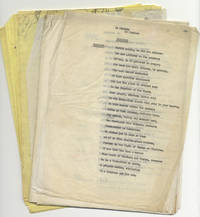
30632Folio. 24 pp. On onionskin. With typed note at conclusion "Translation by Leonard Bernstein August 29th 1962." <br/><br/>Contents: <br/>Prologue: 2 pp. <br/>Act I: First Window: the Court of Lilies 5 pp.<br/>Act II: Second Window: The Magic Chamber 3 pp.<br/>Act III: Third Window: The Council of False Gods 9 pp.<br/>Act IV: Fourth Window: The Wounded Laurel 4 pp. <br/>Act IV: 1 p. <br/><br/>With numerous annotations corrections etc. in ink and lead red and blue pencil throughout by Yuri Krasnapolsky 1934-2018. Somewhat worn and creased; several leaves stapled together at upper inner corners.<br/><br/>Together with: <br/>- An extensively corrected draft of an interesting autograph letter from Krasnapolsky to Leonard Bernstein. 5 pp. Folio. In pencil on 4ff. of yellow lined paper. No date. Addressed "Dear Lenny." Krasnapolsky writes regarding his travels in Europe after seeing Bernstein in Vienna possible conducting engagements having been blacklisted during the McCarthy era etc. The letter is particularly poignant regarding his relationship with and feelings of indebtedness to Bernstein: "The European experience. showed me that my association with you over the past eighteen years has been crucial & pervasive. Your working style in every respect became for me as for many others an object of tremendous admiration and imitation. My own style took longer. to evolve but now that it has I can see & feel more clearly what it owes to yours." Krasnapolsky very much regrets the fact that he has apparently offended Bernstein in some way and is struggling to understand "how & when." He goes on to say that "it is a simple fact of my life that I am deeply indebted to and in a sense derived from you and can no more separate myself from that fact than I can deny my love for music. I literally cannot survive professionally without your help." Krasnapolsky goes on to request various letters of endorsement. <br/><br/>- A corrected draft of an autograph letter from Krasnapolsky to Sir John Barbirolli. 3 pp. Folio. In pencil on 3ff. of yellow lined paper. No date. Addressed "Dear Sir John." Krasnapolsky apologizes for the delay in writing but says that he has been "unexpectedly but unavoidably busy with a series of youth concerts." He thanks Barbirolli for his kindness and hospitality. "It was a great pleasure and a privilege to see you at work again and to have assisted you however briefly." Krasnapolsky has regarded Barbirolli as a "heroic musical figure. for many years." He mentions going to a concert of Barbirolli's at Carnegie Hall "at age 8 and/or 9 quite alone" with Gieseking as soloist. "Furthermore now that I am at the age you were when you took on the N.Y. Phil. I realize more than ever what an enormous task and brilliant achievement that was. Who else could have done that I don't know. But you have remained undeniably a heroic figure of 20th century music. I can only wish that someone. will say the same of me someday. My wife and I are planning to be in London again just after the first of the year. I'll be looking for ways to become a part of the musical life of London and the Continent." <br/><br/>- A corrected draft of a letter to John S. Edwards General Manager of the Chicago Symphony. 1 page. Folio. In pencil on 1f. of yellow lined paper. Thanking him for his time whle in New York mentioning "the Florida affair" etc.<br/><br/>- A corrected draft of a letter to Walter Hendl at the Eastman School of Music. 2 pp. Folio. In pencil on 1f. of yellow lined paper. Recommending a colleague Francois Jarosely for a possible conducting appointment at the school. <br/><br/>- Biographical notes. 5 pp. Folio. In pencil on 5 ff. Le Martyre de Saint Sébastian a "mystère" in five acts to a libretto by Gabriele D'Annunzio composed for the dancer Ida Rubinstein was first performed in Paris at the Châtelet on May 22 1911. Debussy's last stage work it is "a synthesis of orchestra and vocal music dance mime and speech." <br/><br/>Bernstein translated D'Annunzio's text and conducted a recording of the work in 1962 with the Choral Art Society and the New York Philharmonic featuring his wife Felicia Montealegre as Sebastian one of the narrators: ".among its best moments the serenely celestial 'Magic Chamber' in which the NYPO strings bloom and 'The Wounded Laurel' which could have come from La mer. Mr and Mrs. Bernstein were having a good day judging by the passion which comes across." Christopher Fifield BBC Music Magazine. <br/><br/>"The following year 1963 he conducted The Martyrdom of Saint Sebastian to commemorate Debussy's centenary. The sung parts were in German the dialogue in English. Fritz Weaver the actor was the narrator and Felicia appeared as the male saint. Bernstein probably thought of her as at least a saint. If he tested orchestra managements and presidents to see how far he could push them he repeatedly tested Felicia too. She seemed to pass all his tests right up to the end of her life. As for the Debussy critics remarked on the clean articulation of the text." Peyser: Bernstein p. 359. <br/><br/>Krasnapolsky was an assistant conductor of the New York Philharmonic under Leonard Bernstein. unknown books
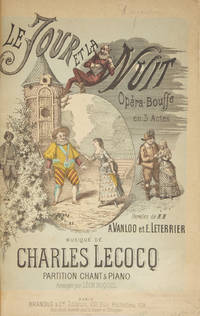
188228619Paris: Brandus et Cie. PN B. et Cie. 12765 1882. Large octavo. Full dark green pebbled flexible cloth boards titling gilt to spine. 1f. recto illustrated title printed in colour verso blank 1f. recto notes on first performance and named cast list verso contents viii 280 pp.<br/><br/>Named cast includes Brasseur Berthelier E. Montaubry Scipion Matrat Dacheux Prosper Marguerite Ugalde Juliette Darcourt Piccolo Maurianne Frédéa Lucy-Jane Panot d'Albe Varennes G. d'Oria Jeanne and Charbonnel.<br/><br/>Slightly worn; title browned and with handstamps and former owner's signature; second and third leaves detached. First Edition later issue.<br/><br/>Le jour et la nuit to a libretto by Vanloo and Leterrier was first performed in Paris at thew Nouveautés on November 5 1881.<br/><br/>"Much of Lecocq's music is characterized by a light touch but he could also adopt a more lyrical and elevated style than Offenbach and termed several of his operettas opéras comiques. His greatest popular triumph La fille de Madame Angot has remained a classic among operettas and demonstrates Lecocq's abundant flow of pleasing melodies his deft exploitation of rhythm for a lively theatrical effect impressive building up of extended numbers and typically French shaping of phrases." Andrew Lamb in Grove Music Online. Brandus et Cie. [PN B. et Cie. 12765] unknown books
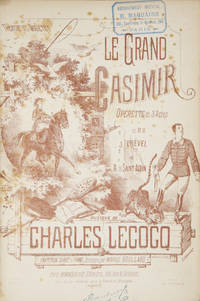
187928612Paris: Brandus et Cie. PN B. et Cie. 12465 1879. Large octavo. Quarter dark brown calf with green marbled marbled upper with Maquaire subscription information gilt pebbled dark brown papder lower titling gilt to spine. 1f. recto title illustrated by G. Fraipont printed in sepia verso blank 1f. recto blank verso notes on first performance named cast list and contents 139 i blank pp. Lithographed.<br/><br/>Named cast includes Dupuis Léonce Baron Alex. Guyon Deltombe Germain Angely Gaussins Ambroise Drouin Coste Videix Millaux Le petit Charles Céline Chaumont Baumaine Odette Farna Marguerite Léonie Frank Maria and Renouard. <br/><br/>Binding slightly worn rubbed and bumped. Slightly foxed; some signatures partially split; handstamps to title. First Edition.<br/><br/>Le grand Casimir to a libretto by Prével and Saint-Albin was first performed in Paris at the Variétés on January 11 1879.<br/><br/>"Much of Lecocq's music is characterized by a light touch but he could also adopt a more lyrical and elevated style than Offenbach and termed several of his operettas opéras comiques. His greatest popular triumph La fille de Madame Angot has remained a classic among operettas and demonstrates Lecocq's abundant flow of pleasing melodies his deft exploitation of rhythm for a lively theatrical effect impressive building up of extended numbers and typically French shaping of phrases." Andrew Lamb in Grove Music Online. Brandus et Cie. [PN B. et Cie. 12465] unknown books
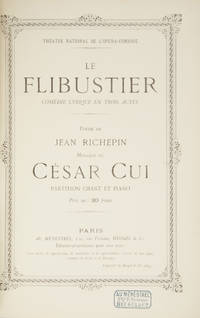
189328279Paris: Au Ménestrel Heugel PN H & Cie 7870 1893. Large octavo. Quarter dark red cloth with marbled boards black leather title label gilt to spine. 1f. dedication 1f. title i premiere information and named cast list ii contents i blank 321 i blank pp. Lithographed.<br/><br/>Named cast includes Fugère Taskin Clément Landouzy and Tarquini d'Or.<br/><br/>Small rectangular publisher's label to title; tear to outer margin of p. 53. First Edition. <br/><br/>Le flibustier to a libretto by Richepin after his play 1888-1889 was first performed in Paris at the Opéra Comique Favart on January 22 1894. Au Ménestrel, Heugel [PN H & Cie 7870] unknown books
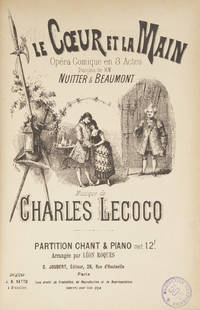
189028382Paris: C. Joubert PN B. & Cie. 12823 1890. Large octavo. Quarter red calf with red pebbled paper boards raised bands on spine in ruled compartments titling gilt. 1f. recto title illustrated by E. Buval verso notes on first performance and named cast list 1f. recto contents verso notes x 252 ii 252bis-252ter 253-278 pp.<br/><br/>Named cast includes Berthelier Vauthier Scipioin E. Montaubry Charvet Lauret Dubois Prosper Vaillant-Couturier Élise Clary Felcourt Morianne Lucy-Jane Ducouret Norette Varennes and Eymard; <br/><br/>Binding slightly worn bumped and scuffed. Slightly browned; some signatures split or partially split; occasional minor edge chips and tears not affecting music; small circular handstamp to lower margin of title. First Edition later issue.<br/><br/>Le coeur et la main to a libretto by Nuitter and Beaumont was first performed in Paris at the Nouveautés on October 19 1882.<br/><br/>"Much of Lecocq's music is characterized by a light touch but he could also adopt a more lyrical and elevated style than Offenbach and termed several of his operettas opéras comiques. His greatest popular triumph La fille de Madame Angot has remained a classic among operettas and demonstrates Lecocq's abundant flow of pleasing melodies his deft exploitation of rhythm for a lively theatrical effect impressive building up of extended numbers and typically French shaping of phrases." Andrew Lamb in Grove Music Online. C. Joubert [PN B. & Cie. 12823] unknown books
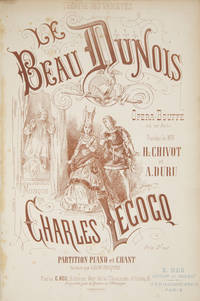
187028371Paris: E. Heu PN E.H. 1845 1870. Large octavo. Quarter dark brown calf with patterned maroon paper boards. 1f. recto title illustrated by A. Jannin and printed in brown verso blank 1f. recto notes on first performance named cast list and contents verso blank 99 i blank pp.<br/><br/>Named cast includes Dupuis Kopp Léonce Aimée and Lucy-Abel.<br/><br/>Boards slightly worn rubbed and bumped; publisher's advertisement laid down to front endpapers with rectangular handstamp to front free endpaper and first two leaves. Occasional minor foxing; facsimile signature handstamp to cast leaf and two additional leaves. First Edition. <br/><br/>Le beau Dunois to a libretto by Chivot and Duru was first performed in Paris at the Variétés on April 13 1870.<br/><br/>"Much of Lecocq's music is characterized by a light touch but he could also adopt a more lyrical and elevated style than Offenbach and termed several of his operettas opéras comiques. His greatest popular triumph La fille de Madame Angot has remained a classic among operettas and demonstrates Lecocq's abundant flow of pleasing melodies his deft exploitation of rhythm for a lively theatrical effect impressive building up of extended numbers and typically French shaping of phrases." Andrew Lamb in Grove Music Online. E. Heu [PN E.H. 1845] unknown books
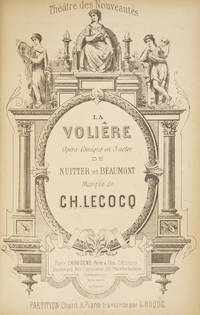
189028337Paris: Choudens Père & Fils PN A.C. 7823 1890. Large octavo. Quarter red calf with marbled boards raised bands on spine in decorative compartments gilt titling gilt marbled endpapers. 1f. recto title within architectural border verso notes decorative title i notes 1f. named cast list andn contents 225 i blank pp.<br/><br/>Binding slgihtly worn rubbed and bumped. Browned; small tear to blank outer edge of p. 61 with tape repair. First Edition later issue. <br/><br/>La volière to a libretto by Nuitter and Beaumont was first performed in Paris at the Nouveautés on February 11 or 12 1888.<br/><br/>"Much of Lecocq's music is characterized by a light touch but he could also adopt a more lyrical and elevated style than Offenbach and termed several of his operettas opéras comiques. His greatest popular triumph La fille de Madame Angot has remained a classic among operettas and demonstrates Lecocq's abundant flow of pleasing melodies his deft exploitation of rhythm for a lively theatrical effect impressive building up of extended numbers and typically French shaping of phrases." Andrew Lamb in Grove Music Online. Choudens Père & Fils [PN A.C. 7823] unknown books
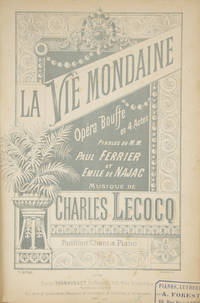
188828335Paris: Brandus & Cie. PN B. & Cie. 13016 1888. Large octavo. Quarter green calf with green textured paper boards titling gilt to spine. 1f. recto decoratibve title printed in gray-green verso blank 1f. recto named cast list and contents verso blank x 232 pp.<br/><br/>Named cast includes Berthelier Alb. Brasseur Jourdan Allart Schmiddt Charvet Dubois Lauret Simon Girard Mily-Meyer Darcourt Ducouret and Norette. <br/><br/>Binding somewhat worn and rubbed; edges bumped with minor damage to paper. Browned; some signatures split or partially split; two handstamps to lower margin of title slightly cropped; small tear to blank outer margin of p. 117. First Edition later issue.<br/><br/>La vie mondaine to a libretto by Ferrier and de Najac was first performed in Paris at the Nouveautés on February 13 1885.<br/><br/>"Much of Lecocq's music is characterized by a light touch but he could also adopt a more lyrical and elevated style than Offenbach and termed several of his operettas opéras comiques. His greatest popular triumph La fille de Madame Angot has remained a classic among operettas and demonstrates Lecocq's abundant flow of pleasing melodies his deft exploitation of rhythm for a lively theatrical effect impressive building up of extended numbers and typically French shaping of phrases." Andrew Lamb in Grove Music Online. Brandus & Cie. [PN B. & Cie. 13016] unknown books
1888SS11210Lyon:: Vitte & Perrussel 1888. 1888. 8vo. xiii 1 392 pp. Half title title printed in red & black; paper evenly toned. Quarter pebbled green morocco over marbled paper-backed boards 5 raised bands to gilt-stamped spine marbled free endleaves and pastedowns. Discrete ownership stamp of "FICHE". Fine. This is a detailed biography of Ozanam by one who admired his achievements detailing his scientific and scholarly interests work as a writer his works as a teacher professor 'a friend of youth' the Conferences of Notre-Dame and 'Les Cercles Catholiques' the Societe de Saint-Vincent de Paul as popularizer and as a Christian. Ozanam 1813-1853 was a French scholar who was "the leading historical and literary critic in the neo-Catholic movement in France during the first half of the 19th century." He was beatified by Pope John Paul II in 1997 and is consequently referred to as Blessed Frederick by Catholics Wikip. Ozanam died at just 40 years of age due to 'consumption'. Huit wrote on the life and history of Plato the history of metaphysics Pierre-Simon Ballanche 1776-1847 etc. Vitte & Perrussel, 1888. hardcover books
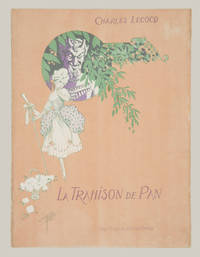
191228419Paris: Max Eschig PN M.E. 725 1912. Folio. Original publisher's peach wrappers illustrated by Clérice Frères and printed in white green and lavender. 1f. recto dedication verso blank 1f. recto title printed in red and black verso blank 1f. recto notes on first performance with named cast list 88 1f. blank pp.<br/><br/>Named cast includes Lowelly Tesorone and Ovido.<br/><br/>Wrappers slightly worn. First Edition.<br/><br/>Le trahison de Pan to a libretto by Bordèse was first performed in Aix-les-Bains at the Casino on September 13 1911. <br/><br/>"Much of Lecocq's music is characterized by a light touch but he could also adopt a more lyrical and elevated style than Offenbach and termed several of his operettas opéras comiques. His greatest popular triumph La fille de Madame Angot has remained a classic among operettas and demonstrates Lecocq's abundant flow of pleasing melodies his deft exploitation of rhythm for a lively theatrical effect impressive building up of extended numbers and typically French shaping of phrases." Andrew Lamb in Grove Music Online. Max Eschig [PN M.E. 725] unknown books
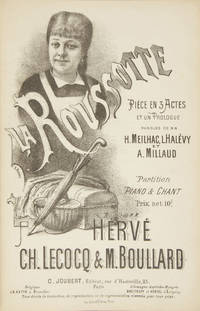
190028350Paris: C. Joubert PN L. B. 2828 1900. Large octavo. Quarter black cloth with marbled boards. 1f. recto title illustrated by E. Buval verso copyright statement 1f. recto named cast list and contents verso blank 92 pp.<br/><br/>Named cast includes Anna Judic Dupuis Léonce Baron Lassouche E. Didier Angély Le Petit Charles Maurel Chalont Marguerite M. Thérèse A. Farna Fillion and Lamarre. <br/><br/>Minor damage to upper margin of first page of music; some signatures partially split. La roussotte a "vaudeville-opérette" to a libretto by Meilhac Halévy and A. Millaud was first performed in Paris at the Variétés on January 26 or 28 1881 in collaboration with Hervé Florimond Ronger 1825-1892 and Marius Boullard 1842-1891. <br/><br/>"Much of Lecocq's music is characterized by a light touch but he could also adopt a more lyrical and elevated style than Offenbach and termed several of his operettas opéras comiques. His greatest popular triumph La fille de Madame Angot has remained a classic among operettas and demonstrates Lecocq's abundant flow of pleasing melodies his deft exploitation of rhythm for a lively theatrical effect impressive building up of extended numbers and typically French shaping of phrases." Andrew Lamb in Grove Music Online.<br/><br/>"For his theatrical career Ronger took the name Hervé gradually gaining recognition through his Don Quichotte et Sancho Pança 1848 and engagements at the Théâtre de l'Odéon and Théâtre du Palais-Royal where he appeared as author composer conductor actor tenor buffo singer and producer as required." Andrew Lamb in Grove Music Online. C. Joubert [PN L. B. 2828] unknown books
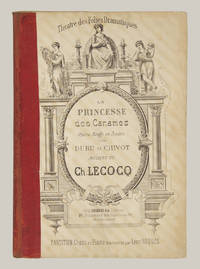
189028423Paris: Choudens Fils PN A.C. 5797 1890. Large octavo. Red cloth spine. 1f. recto title printed within architectural border verso blank 1f. recto notes on first performance named cast list and contents verso blank 218 223-224 pp. Some leaves unopened.<br/><br/>Named cast includes Simon-Girard Jeanne Andrée Dekernel Delannoy Lepers Simon-Max and Bartel. <br/><br/>Wrappers lacking; spine somewhat worn and rubbed. Slightly worn; blank corner of title lacking; title and final leaf stained; several upper outer corners slightly soiled. La princesse des Canaries to a libretto by Duru and Chivot was first performed in Paris at the Folies-Dramatiques on February 9 1883.<br/><br/>"Much of Lecocq's music is characterized by a light touch but he could also adopt a more lyrical and elevated style than Offenbach and termed several of his operettas opéras comiques. His greatest popular triumph La fille de Madame Angot has remained a classic among operettas and demonstrates Lecocq's abundant flow of pleasing melodies his deft exploitation of rhythm for a lively theatrical effect impressive building up of extended numbers and typically French shaping of phrases." Andrew Lamb in Grove Music Online. Choudens Fils [PN A.C. 5797] unknown books
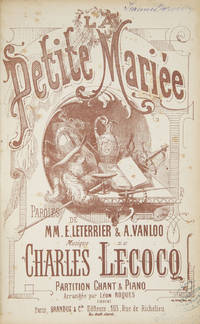
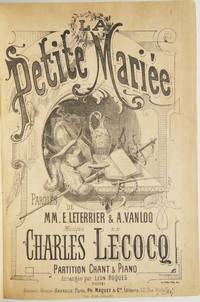
187628606Paris: Brandus & Cie. PN B. & Cie. 12078 1876. Large octavo. Quarter black cloth with black boards titling gilt to spine. 1f. recto illustrated title printed in brown verso blank 1f. recto notes on first performance named cast list and contents verso blank 172 189-196 173-188 197-269 i blank pp.<br/><br/>Named cast includes Vauthier F. Puget Dailly Caliste Paul Albert Derval Baudin Jeanne Granier Alphonsine Panseron Blanche Miroir and Duchesne.<br/><br/>Binding slightly worn rubbed and bumped; lower hinge split. Light to moderate foxing; occasional staining; some signatures split; former owner's signature and handstamps to title. First Edition.<br/><br/>La petite mariée to a libretto by Leterrier and Vanloo was first performed in Paris at the Renaissance on December 21 1875. <br/><br/>"Settling once again in Paris Lecocq confirmed his international reputation with La petite mariée 1875 and Le petit duc 1878 both of which have remained in the French operetta repertory."<br/><br/>"Much of Lecocq's music is characterized by a light touch but he could also adopt a more lyrical and elevated style than Offenbach and termed several of his operettas opéras comiques. His greatest popular triumph La fille de Madame Angot has remained a classic among operettas and demonstrates Lecocq's abundant flow of pleasing melodies his deft exploitation of rhythm for a lively theatrical effect impressive building up of extended numbers and typically French shaping of phrases." Andrew Lamb in Grove Music Online. Brandus & Cie. [PN B. & Cie. 12078] unknown books
188826629Paris: Ph. Maquet & Cie. PN B. & Cie. 12078 1888. Octavo. Dark red leather-backed textured paper boards spine in compartments gilt with titling gilt. 1f. decorative title with copyright notice to verso 1f. named cast list for the first performance and table of contents 269 i blank pp. Lithographed. <br/><br/>Binding slightly worn rubbed and bumped with som abrasion to upper; tail of spine slightly defective. Uniformly browned; minor offsetting; occasional light soiling and staining to margins not affecting music. Handstamped "3718" to final page of music. A reissue of the first edition originally published by Brandus in 1876. Scarce. Worldcat 5 copies only. OCLC nos. 864205582 19008410 81845610.<br/><br/>La Petite Mariée was first performed at the Théâtre de la Renaissance in Paris on December 21 1875. "Lecocq confirmed his international reputation with La petite mariée 1875 and Le petit duc 1878 both of which have remained in the French operetta repertory. Much of Lecocq's music is characterized by a light touch but he could also adopt a more lyrical and elevated style than Offenbach and termed several of his operettas opéras comiques." His greatest operettas "demonstrate his abundant flow of pleasing melodies his deft exploitation of rhythm for a lively theatrical effect impressive building up of extended numbers and typically French shaping of phrases." Andrew Lamb in Grove Music Online. Ph. Maquet & Cie. [PN B. & Cie. 12078] unknown books
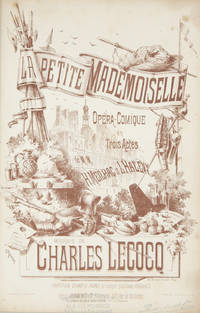
187928607Paris: Brandus et Cie. PN B. et Cie. 12515 1879. Large octavo. Half dark red leather with dark red pebbled paper boards raised bands on spine in decorative compartments gilt titling gilt marbled endpapers. 1f. recto title illustrated by G. Fraipont printed in brown verso blank 1f. recto notes on first performance and named cast list verso contents viii 278 pp.<br/><br/>Named cast includes Berthelier Vauthier Urbain Lary Pacra Libret Caliste Tony Deberg Duchosal Tauffenberger Auger Perrenot Desclos William J. Granier Desclauzas Mily Meyer Piccolo Ribe Dianie and Kolb. <br/><br/>First Edition.<br/><br/>La petite mademoiselle to a libretto by Meilhac and Halévy was first performed in Paris at the Renaissance on April 12 1879.<br/><br/>". Much of Lecocq's music is characterized by a light touch but he could also adopt a more lyrical and elevated style than Offenbach and termed several of his operettas opéras comiques. His greatest popular triumph La fille de Madame Angot has remained a classic among operettas and demonstrates Lecocq's abundant flow of pleasing melodies his deft exploitation of rhythm for a lively theatrical effect impressive building up of extended numbers and typically French shaping of phrases." Andrew Lamb in Grove Music Online.<br/><br/>Bound with:<br/>POISE Ferdinand 1828-1892<br/>La Surprise de l'Amour Opéra Comique en 2 Actes de Ch. Monselet d'après la Comédie de Marivaux. Prix net: 8f. Partition Chant et Piano réduite par Ate. Bazille. Piano-vocal score. Paris: Durand Schœnewerk & Cie. D. S. et Cie. 2364 1877. 1f. recto title illustrated by L. Denis in sepia verso blank 1f. recto named cast list and contents verso blank 122 pp.<br/><br/>Named cast includes Galli Marié Irma Marié Nicot and Moblet.<br/><br/>First Edition. <br/><br/>A French composer specializing in opéra comique Poise's La surprise de l'amour to a libretto by Monselet after Marivaux was first performed in Paris at the Opéra-Comique Favart on October 31 1877.<br/><br/>Binding somewhat worn; hinges split. Slightly worn browned and foxed throughout; handstamps to title of the Lecocq; minor damage to pp. 101-102 of the Poise. Brandus et Cie. [PN B. et Cie. 12515] unknown books
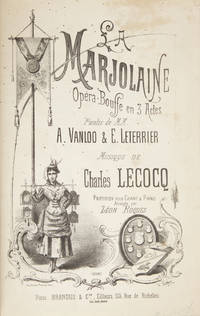
187728611Paris: Brandus & Cie. PN B. & Cie. 12281 1877. Large octavo. Quarter dark red pebbled cloth with marbled boards titling gilt to spine. 1f. recto title illustrated by L. Denis verso blank 1f. recto notes on first performance and named cast list verso contents 284 pp.<br/><br/>Named cast includes Berthelier Vauthier Puget Caliste Hervier Gaussins Valotte Cailloux Robillot Gisors Jeanne Granier Théol Carli Ribe Bied Careine Dianie Andrée Néline Davenay and Dhaucourt.<br/><br/>Binding slightly worn rubbed and bumped. Publisher's facsimile signature handstamp to title. First Edition.<br/><br/>La marjolaine to a libretto by Vanloo and Leterrier was first performed in Paris at the Renaissance on February 3 1877.<br/><br/>"Much of Lecocq's music is characterized by a light touch but he could also adopt a more lyrical and elevated style than Offenbach and termed several of his operettas opéras comiques. His greatest popular triumph La fille de Madame Angot has remained a classic among operettas and demonstrates Lecocq's abundant flow of pleasing melodies his deft exploitation of rhythm for a lively theatrical effect impressive building up of extended numbers and typically French shaping of phrases." Andrew Lamb in Grove Music Online. Brandus & Cie. [PN B. & Cie. 12281] unknown books
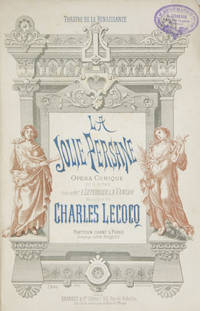
187928613Paris: Brandus & Cie PN B et Cie 12563 1879. Large octavo. Original publisher's blue illustrated wrappers. 1f. recto title illustrated by P. Borie in gray sepia and blue verso blank 1f. recto notes on first performance and named cast list verso contents viii 290 pp. Most leaves unopened.<br/><br/>With presentation stamp and signed inscription from the publisher to upper inner corner of first page of music.<br/><br/>Named cast includes Ismael Vauthier Paul Ginet Lary William Tauffenberger Desclos Perrenot Morand Legrain Veret Jane Hading Desclauzas Gélabert Lilia Herman Norette Lydie Borel Panseron Doriani Davenay Kolb and Ducouret.<br/><br/>Wrappers slightly worn and chipped; spine worn and split reinforced with tape. Light to moderate foxing; some signatures partially split; small decorative oval bookseller's handstamp to first three leaves. First Edition.<br/><br/>La jolie Persane to a libretto by Leterrier and Vanloo was first performed in Paris at theRenaissance on October 28 1879.<br/><br/>"Much of Lecocq's music is characterized by a light touch but he could also adopt a more lyrical and elevated style than Offenbach and termed several of his operettas opéras comiques. His greatest popular triumph La fille de Madame Angot has remained a classic among operettas and demonstrates Lecocq's abundant flow of pleasing melodies his deft exploitation of rhythm for a lively theatrical effect impressive building up of extended numbers and typically French shaping of phrases." Andrew Lamb in Grove Music Online. Brandus & Cie [PN B et Cie 12563] unknown books
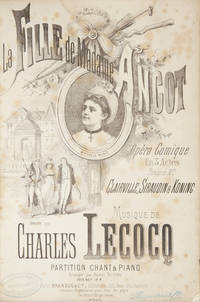
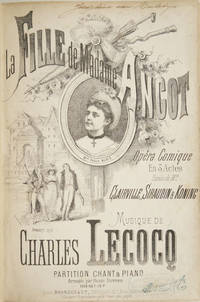
187328618Paris: Brandus & Cie. PN B. & Cie. 11801 1873. Large octavo. Half dark blue pebbled cloth with marbled boards titling gilt to spine. 1f. recto title illustrated by Barbizet. verso blank 1f. recto notes on first performance named cast list and contents verso blank 1f. dedication 269 i blank pp.<br/><br/>Named cast for the first performance in Brussels at the Théâtre des Fantaisie-Pareisiennes on December 4 1872 includes Mario Widmer Jolly Charlier et Chambéry Touzé Ernotte Noé Ometz Durieu Desclauzas Pauline Luigini Delorme Bourgeois Sporas Pauline Carben Malleville Savigny and Camille and for the Paris performance at the Théâtre des Folies-Dramatiques on February 24 1873 Mendasti Ph. Dupin Luco Haymé Legrain Vavasseur Jeault Heuzey Desclauzas Paola Marié Vauthier-Toudouze Julien Minne Alieri Marie Dordan d'Aubigny Fleury and Duvernay.<br/><br/>Title incorporates a small oval portrait of Paola Marié the singer who performed the role of Clairette Angot in Paris.<br/><br/>Binding slightly worn rubbed and bumped. Mostly minor foxing; dampstaining to upper margins; title slightly trimmed and with small chip to blank lower outer corner; handstamps to title and third leaf; 2" tear to first page of music. First Edition. <br/><br/>"Much of Lecocq's music is characterized by a light touch but he could also adopt a more lyrical and elevated style than Offenbach and termed several of his operettas opéras comiques. His greatest popular triumph La fille de Madame Angot has remained a classic among operettas and demonstrates Lecocq's abundant flow of pleasing melodies his deft exploitation of rhythm for a lively theatrical effect impressive building up of extended numbers and typically French shaping of phrases." Andrew Lamb in Grove Music Online. Brandus & Cie. [PN B. & Cie. 11801] unknown books
187326627Paris: Brandus & Cie. PN B. & Cie. 11801 1873. Octavo. Mid-tan leather-backed dark brown textured paper boards spine in gilt-ruled compartments with contemporary manuscript label. 1f. decorative title by Barbizet dated 1873 1f. named cast list for the Brussels and Paris premieres and table of contents 1f. dedication to Théodore Warnots 269 i blank pp. Lithographed.<br/><br/>Title slightly browned and foxed; trimmed at lower margin just affecting publisher's statement. Contemporary signature and publisher's and music seller's handstamps to title; later signature to free front endpaper. <br/><br/>Binding slightly worn rubbed and bumped with minor loss to upper. Slightly foxed; some signatures partially detached. First Edition. OCLC no. 4751112.<br/><br/>La Fille de Madame Angot was first performed at the Fantaisies-Parisienes in Brussels on December 4 1872.<br/><br/>"Much of Lecocq's music is characterized by a light touch but he could also adopt a more lyrical and elevated style than Offenbach and termed several of his operettas opéras comiques. His greatest popular triumph La fille de Madame Angot has remained a classic among operettas and demonstrates Lecocq's abundant flow of pleasing melodies his deft exploitation of rhythm for a lively theatrical effect impressive building up of extended numbers and typically French shaping of phrases." Andrew Lamb in Grove Music Online. Brandus & Cie. [PN B. & Cie. 11801] unknown books
1890184Lithograph. c. 1890. As published for L'Estampe et L'Affiche. Printed on very thin tissue. Image: 5 x 7. Margins: 9 x 11¼. L'Estampe et L'Affiche. books
190633663Paris: A. Durand & Cie. PN 6106 1906. Quarter leather with brown marbled boards titling gilt to upper and spine "Abonnement au Ménestrel 2bis Rue Vivienne Paris". 1f. recto title printed in green and black verso blank 1f. recto publisher's note verso blank 1f. recto printed dedication to Paul Dukas verso blank 25 pp. Text in French.<br/><br/>Binding worn soiled and bumped; large "Abonnement de Musique" label laid down to front endpapers; "721/1" in red ink and publisher's handstamp to flyleaf. Uniformly browned; slightly creased. Lesure 62.<br/><br/>La Damoiselle Élue premiered on in Paris by Julia Robert and Thérèse Roger under the direction of Gabriel Marie at a concert of the Société National de Musique at the Salle Érard on 8 April 1893.<br/><br/>"One of the most important musicians of his time Debussy's harmonic innovations had a profound influence on generations of composers. He made a decisive move away from Wagnerism in his only complete opera Pelléas et Mélisande and in his works for piano and for orchestra he created new genres and revealed a range of timbre and colour which indicated a highly original musical aesthetic." François Lesure and Roy Howat in Grove Music Online. A. Durand & Cie. [PN 6106] unknown books