6 569 résultats
stela2258Houston: Texas: Billy F. Price Publishing Co. 1984. 4to. pp. 260. Profusely illus. in b/w & colour. cloth. dw [Houston: Texas: Billy F. Price Publishing Co., [1984] hardcover
1983stela1423<p>Zug: Gallant Verlag 1983. 1983. 4to. pp. 252. German text. profusely illus. in colour & b/w. cloth. dw. Hardcover. Fine/Dust Jacket Included.</p> [Zug: Gallant Verlag, 1983]. hardcover
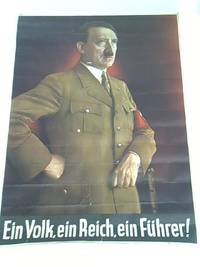
4aa1335Carl Werner Reichenbach i. V. um 1933. Maße: ca. 415 x 595 cm rückwärtig etwas fleckig/Papierknickspuren vom Einrollen/untere Kante mit 2 kleinen Randeinrissen/geringer Abrieb. - seltenes Original-Plakat der frühen NS-Zeit - unknown
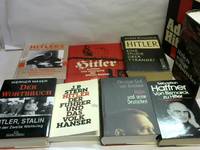
6f3730Stocker/Desch/Droste/Gondrom/Siedler/Olzog/Hanser/List/Kindler Stuttgart/München/Düsseldorf/Bergisch Gladbach/Wien 1956 - 2001 mit jeweils circa 398 bis 1200 Seiten mit zahlreichen Abb. sieben Pappbände davon fünf mit Schutzumschlag rest kartoniert. - Enthalten: Hitlers Briefe und Notizen. Sein Weltbild in handschriftlichen Dokumenten/ Hitler. Aufstieg und unergang des Dritten Reiches/ Hitler. Eine Studie über Tyranne/ Adolf Hitler/ Hitlers willige Vollstrecker. Ganz gewöhnliche Deutsche und der Holocaust/ Der Wortbruch. Hitler Stalin und der Zweite Weltkrieg/ Hitler der Führer und das Volk/ Hitler und seine Deutschen/ Von Bismarck zu Hitler - unknown
Original Wrappers. 8vo. 44 pages. 22 cm. Jewish Currents Reprint Number 10. "Appeared originally in the October, November, December 1975 and January 1976 issues of Jewish currents. " "An original critique, analysis and documented exposé of the ominous 'Hitlermania' that has been sweeping over the West in books, plays, art, newspapers, radio, film and TV... And its meaning today" (Front cover description) . The author, who passed away in 2004, was a prolific anti-fascist journalist, who devoted his life to exposing the nazi-war criminals living freely in the United States, many of whom were employed by the U. S. Intelligence forces. Subjects: Antisemitism. National socialism. Fascism - History. Light wear to covers. Good + condition. (HOLO2-97-30)
1st edition. Original Orange Paper Wrappers, 8vo, 34 pages + 8 pages of photo plates + maps. Very slight discoloration along top edge, otherwise Very Good Condition. (SPEC-35-16)
Softcover, 88 pages, 8vo, 25 cm. In Dutch. Series: De Vrije bladen; jrg. 18, schrift 6/7; De Vrije bladen; jrg. 18, schrift 6/7. "Diary from a Camp. " Survivor's diary of camp life. "Loden Vogel (Louis Tas) was the son of an Amsterdam doctor and psychiatrist; he was arrested in Amsterdam on September 29, 1943, along with his parents, and taken to the transit camp at Westerbork. He was born on December 25, 1920, so he was 23 years old at the time. Everyone in his family had South American passports, so they were sent to Bergen-Belsen as "'exchange Jews'" on April 15, 1944. Loden was one of the survivors; he had spent exactly one year in the Star Camp. His father worked as a doctor in the camp and because of this, Loden was given a job as a nurse. In 1946, he published the diary that he kept in Bergen Belsen under the title "'Dagboek uit een kamp'" (scrapbookpages-com, 2013).SUBJECT (S) : Concentratiekampen. Vogel, Loden. Genre/Form: Dagboeken (vorm) . OCLC lists 12 copies online. Writing on front cover. Chipping to edges. Yellowing of pages. Wear and chipping to cover binding. Otherwise, good condition. (Holo2-19-71)
Softbound. 8vo. XVI, 113 pages. 22 cm. Reprint of the 1955 edition; including 1969 introduction as well as the author's letters to Lessing J. Rosenwald and Clarence L. Coleman, Jr. , from April 7 to June 24, 1955. Elmer Berger (1908-1996) was an American Reform Rabbi, outspoken since the 1930s against Zionism, an ideology which he interpreted to be a surrender to anti-semitic myths concerning race. He was the executive director of the American Council for Judaism for over 13 years, and when forced to resign, be became the founder of the American Jewish Alternatives to Zionism. The publisher, the Institute for Palestine Studies, is the oldest independent non-profit research institute in the Arab World, and has consistently committed itself to putting together analysis and documentation so as to allow the possibility of a peaceful resolution of the Arab-Israeli conflict (their words) . Subjects: Jewish-Arab relations. Jewish institutional stamp, Light wear to covers. Very good condition. (HOLO2-88-2)
(FT) Original Paper Wrappers, 8vo, 118 pages. Includes illustrations 22 cm. In Yiddish. Mayse-bikhlekh -- Bay a raykhn korev -- In geroysh fun mashinen -- 1905 -- Zump. SUBJECT(S) : Yiddish fiction. Some edgewear to covers, paper browning as generally found but no tears. Good+ Condition. (HOLO2-87-7)
8vo. 112 pages. In Yiddish. First edition. Title translates as, "Refugees and Heroes: A Historical Overview of the Refugees in America 1492-1940" SUBJECT (S) : Jews United States; Refugees, Jewish. OCLC lists 21 copies worldwide. Covers and spine are faded. otherwise in good condition. (HOLO2-6-15)
8vo; 79 pages; 23 cm. Fifth Edition. An early call to action to push for US government support for German Jews. Contents include: Precendents for Popular Protests; American Governmental Intercession on Behalf of the Jews; The Bernheim Upper Silesian Petition before the Council of the League of Nations [description & analysis]; Petition of Franz Bernheim to the Council of the League of Nations [exact text of the petition]. Very good Condition. (HOLO2-87-4)
Original Publisher's Cloth. xi, 202 pages, incl. tables. 26 cm. Holocaust-era imprint. Pinson (1904-1961) was "a U. S. Historian. Born in Lithuania, Pinson was taken to the U. S. In 1907. He lectured at the New School for Social Research from 1934 to 1937, when he went to Queens College, N. Y. , becoming professor of history in 1950. He was also history editor of the Encyclopedia of the Social Sciences (1929-35) , and an editor of Jewish Social Studies (1938-61) . In 1945-46, he was director of education and culture, Jewish Displaced Persons in Germany and Austria, United Nations Relief and Rehabilitation Association. Pinson's principal scholarly interests embraced modern European history, with special emphasis on nationalism and modern Germany, and recent Jewish history. His contributions to general history were Pietism as a Factor in the Rise of German Nationalism (1934) ; A Bibliographical Introduction to Nationalism (1935) ; and Modern Germany, Its History and Civilization (1954) . In Jewish studies, he edited a number of important books: Essays on Anti-Semitism (19462) ; Yivo Annual of Jewish Social Science, vols. 59 (1950-54) ; and notably Nationalism and History (1958) , which made available in English Simon Dubnow's classic, Essays on Old and New Judaism. Pinson analyzed Dubnow's national theories and appraised his role as historian. Pinson was actively involved in the work of the Yivo Institute for Jewish Research. He was also chairman of the modern Jewish history committee of the Jewish Publication Society of America. " (Janowsky in EJ, 2007) . Series: Jewish social studies. Publications, ; no. 2. SUBJECT(S): Jewish question. Some wear to cloth. Very good condition. (Holo2-16-15B)
Hardcover, 593 pages, illustrated, maps, 8vo, 25 cm. SUBJECT (S) : Jews -- Poland -- Biography. Holocaust, Jewish (1939-1945) -- Poland -- Biography. Holocaust survivors -- Louisiana - New Orleans -- Biography. Levy, Anne. Skorecki family. Duke, David Ernest. Skorecki (Family) . Louisiana -- Politics and government - 1951. Includes bibliographical references on pages 555-576 and index. In dustjacket. Very Good Condition. (Holo2-18-23)
Original Publisher's Cloth. 8vo. xvii, 528 pages. In Yiddish with added English Table of Contents, Summaries and Conclusion. Fold out maps. First edition. SUBJECT (S) : Jews Poland Lódz; Holocaust, Jewish (1933-1945) Poland Lódz; Jewish ghettos Poland Lódz. SERIES: Yad va-shem-Yivo monograph seriesm [Yad Washem-YIVO Monograph Series] No. 1. OCLC lists 26 copies worldwide. Bumped corners, very good condition. (HOLO2-7-2)
Small 8vo; 134 pages; 8vo. 134 pages. 21 cm. In the original Dutch with beautifully illustrated cover. Memoir of life in Neuengamme Concentration Camp near Hamburg from 1941-43.van de Poel was prisoner #5919. Wiener Library (Wolff) #1: 1797. Pages browning. Overall Very Good Condition. (HOLO2-53-7).
Original Wraps. 8vo. 31 pages. 21 cm. First edition. In French. On cover: Temoignages de deportes politiques en Allemagne. 'Testimonies of political deportees in Germany'. 'Extermination Camps: Documents, Testimony, Photographs of the Camps of the deported in Germany. ' Contains 8 pages of photographs, depicting deportations, ovens, those murdered. Testimonies describe the deportations of Jews and resistance members to Drancy and on to Auschwitz. Subjects: Concentration camps - Germany. World War, 1939-1945 - Atrocities. Atrocities. Concentration camps. World War (1939-1945) . Wraps torn at edges and soiled; bumped edges, otherwise fresh and clean. Good condition. (HOLO2-124-9)
Original Publisher's Boards. 8vo. 48 pages. 24 cm. First edition. Early photographic expose of Nazism in Germany, in French, with parallel German and English translations. Mostly illustrated (pgs 6-47) , containing photographs and the printed speeches of Nazi leaders. Photographs of childhood, training of youth, propaganda, S. A. , S. S. , police in the Third Reich, which demonstrate that the everyday tutelage of the people, no matter of what age, constitute the terror of the third Reich (p. 5) . The world is threatened by the brown hate! ! (p. 5) . Dt. Exilarchiv 4106; Sternfeld/Tiedemann 350. Subjects: National socialism. Political science. 1933 - 1945 Germany - Politics and government - 1933-1945. OCLC lists 29 copies. Light wear to spine, otherwise Very good condition. (HOLO2-125-23) xx
in-8 (17,5x23), 16 pages. Photographie : les photos jointes au texte montrent un couple de Bruxelles qui mènent la belle vie en Allemagne.- Peu courant. Bon état. [ARCH] Publication de propagande pour le travail obligatoire (Description très méliorative de la vie en Allemagne : pas de guerre, bonne santé, beaucoup de travail, des rémunérations intéressantes, on mange à sa faim..)
1st edition. Original Orange Paper Wrappers, 8vo, 50 pages + 8 pages of photo plates of atrocities + maps. Very slight discoloration along top edge, otherwise Very Good Condition. (SPEC-35-13)
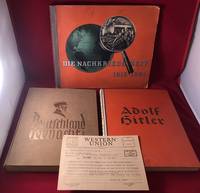
19333659Germany 1933. First Edition. Hardcover. Very Good. 3 Volumes Complete. Collection of three books and one Western Union telegram detailing that these three books were removed from Hitler's apartment in Munich. The telegram: "To Daniel Longwell Managing Editor - LIFE Magazine - Time and Life Building Rockefeller Center - New York 20 New York / Returned from Europe with three books taken from Hitler Munich apartment containing original repeat original photos and history of rise of Luftwaffe Nazi Party rise and life of Hitler stop Include background material apropos coming war criminal trials if interested combat intelligence officer contact Major S.P. Helms Squadron X La Junta Colorado Army Air Field - Major S.P. Helms."<br /> <br /> Volumes printed in German and published between 1933 and 1935. Two hardcovers and one oversized softcover. All contain dozens and dozens of tipped-in photographs that are actually copies as originally issued and not originals as noted in the telegram. <br /> <br /> Die Nachkriegszeit 1918-1934 Herausgegeben Von Den Zigarettenfabriken 1934 - Cigarette book with color photos mounted in large folio format covering the years 1918 to 1934. Orange stiff heavy wrapps with pictorial Nazi image. Pictorial history of the rise of Hitler in Germany. FIRST EDITION.<br /> <br /> Deutfchland Erwacht Werden Rampf Und Seig Der NSDAP Cigaretten-bilderdienst 1933 - Cigarette book with B/W and color photos mounted. As with previous volume the pictures were provided with cigarettes and you completed your album by pasting them in. Original brown cloth with wear to gilt illustration and title on front cover. A few photos loose but all present. FIRST EDITION.<br /> <br /> Adolf Hitler - Bilder Aus Dem Leben des Fuhrers Cigaretten-Bilderdienst 1936 - Cigarette album in original orange cloth boards. The most iconic of all cigarette albums produced as part of Hitler's Nazi propaganda during WWII. FIRST EDITION.<br /> <br /> ALL THREE VOLUMES EXHIBIT SOME WEAR AT EDGES AND SPINES. Bindings a bit shaken overall. Fold-out image in Deutfchland has some wear and a few closed tears. WE CANNOT VERIFY THE INFORMATION IN THE TELEGRAM AND THE BOOKS ARE NOT SIGNED AND/OR MARKED LENDING PROVENANCE TO THE STORY. THEREFORE WE CANNOT GUARANTEE THE BOOKS WERE ORIGINALLY OWNED BY ADOLF HITLER. WE HAVE DETAILED THE COLLECTION AS WE FOUND IT. hardcover
19402062Bayreuth Germany: Reichswaltung Teacher's Association of the Third Reich 1940. 1st Edition. Original wraps. Very Good. 6 X 8 3/4 Inches. 48 PP. "Das Deutfche Jugendburch 1940/41" - Original directory of the leaders of the Nazi Party as well as heads of all the departments in the Third Reich. <br /> <br /> The first page of the actual directory is a who's who of the Nazi Party. Names include Adolf Hitler Joseph Goebbels Frans Ritter von Epp Hermann Goring etc. Original stapled wraps. Light toning and wear to spine. A very rare books. Zero copies located at OCLC. Reichswaltung (Teacher's Association of the Third Reich) unknown
1st edition, original wrappers, 8vo. 64 pages, portraits throughout. In Yiddish with English title page. Book 3 part 1 of History of the Jews in Bialystok. SUBJECT (S) : Jews -- Poland -- Bialystok. OCLC: 970935047, OCLC lists 17 copies worldwide. Staples rusted, light wear on spine, Very Good Condition overall. (YIZ-18-12)
1st edition. Original cloth. 4to, x + 205 (English) + 396 (Yiddish) + v pages. Illustartions throughout. Bialystok's strength rests only in its extraordinary features but in its normal characteristics as well. The fifty thousand living there are doing reasonably well financially and also spiritually, like other Jews in Poland. Still, Bialystok was the first, at the end of the German occupation after World War I, to abolish its autocratic community leadership, replacing it with an exemplary democratic system that will do down in history. The Hebraist movement in Bialystok was only a part of the diffuse cultural advance in all of Poland. But when Bialystok established its Hebrew Gymnasium (high school) it was the rank and file Jews, not the radical Hebraists, who erected it. The tall, sturdy building evoked the admiration of the local community as well as of visitors from near and far, especially since it could accommodate seven hundred students. The Yiddish influence in Bialystok was also only a part of the Yiddish movement in all of Poland and in the entire world. But with the exception of Wilno, no other Jewish town besides Bialystok was able to fashion such an intricate Yiddish school network, let alone a high school, despite difficult circumstances. The orphan problem became one of the most critical social issues in Bialystok after World War I. Surely no other city had someone like Mrs. Rabinowicz, who, when the situation became next to hopeless, was the only leader in all of Poland who went to America to obtain the necessary assistance for these unfortunate children. It is possible to mention hundreds of other examples of community and private initiatives in Bialystok which clearly depict its special atmosphere of effervescing creativity a contagion transmitted from one to another compelling everyone to outdo his neighbour. Such is the breeding ground for important accomplishments. (Pejsach Kaplan, a prominent Bialystoker writer and social activist) SUBJECT(S) : Jews -- Poland -- Bialystok. World War, 1939-1945 -- Jews. Memorial books (Holocaust) . Jewish (1939-1945) Ethnic relations. OCLC: 19303249. Ex library with usual marks, inscription on front end page by Max Ranter, Honorary Chairman of the Book Committee. Very Good Condition Overall (YIZ-16-2A)xx
1st edition. Original cloth with dust jacket. 4to, x+ 205 (English) + 396 (Yiddish) + v pages. Illustrations throughout. Bialystok's strength rests only in its extraordinary features but in its normal characteristics as well. The fifty thousand living there are doing reasonably well financially and also spiritually, like other Jews in Poland. Still, Bialystok was the first, at the end of the German occupation after World War I, to abolish its autocratic community leadership, replacing it with an exemplary democratic system that will do down in history. The Hebraist movement in Bialystok was only a part of the diffuse cultural advance in all of Poland. But when Bialystok established its Hebrew Gymnasium (high school) it was the rank and file Jews, not the radical Hebraists, who erected it. The tall, sturdy building evoked the admiration of the local community as well as of visitors from near and far, especially since it could accommodate seven hundred students. The Yiddish influence in Bialystok was also only a part of the Yiddish movement in all of Poland and in the entire world. But with the exception of Wilno, no other Jewish town besides Bialystok was able to fashion such an intricate Yiddish school network, let alone a high school, despite difficult circumstances. The orphan problem became one of the most critical social issues in Bialystok after World War I. Surely no other city had someone like Mrs. Rabinowicz, who, when the situation became next to hopeless, was the only leader in all of Poland who went to America to obtain the necessary assistance for these unfortunate children. It is possible to mention hundreds of other examples of community and private initiatives in Bialystok which clearly depict its special atmosphere of effervescing creativity a contagion transmitted from one to another compelling everyone to outdo his neighbour. Such is the breeding ground for important accomplishments. (Pejsach Kaplan, a prominent Bialystoker writer and social activist) SUBJECT(S) : Jews -- Poland -- Bialystok. World War, 1939-1945 -- Jews. Memorial books (Holocaust) . Jewish (1939-1945) Ethnic relations. OCLC: 19303249. Dust jacket has light wear on edges and corners, else near perfect condition. Very Good Condition overall. (YIZ-16-2B)xx
1st edition, original cloth, 4to, xix+ 288+ (2) pages. Illustrations throughout. Yiddish, with English introduction. There once was a town of Jewish tailors Brzezin. From early dawn until late at night one could hear the music of the Singer sewing machines. It was the music of hard work, of intense anxiety, of a hard life, but also of noisy youth, semi-intellectuals, observant Jews, Hasidim who lived and had aspirations in the small Jewish town Brzezin. The Nazi savages extinguished this life forever, transformed it into ashes. Only a few Jews from the tailoring town Brzezin, by some miracle, remain, scattered over the entire world, individuals who were witnesses to the German cannibalism. May these words, frail in print, but inscribed not with ink but with blood, be a modest contribution to the matseve [gravestone] for my native town, Brzezin. Brzezin was one of the oldest and most popular Jewish communities in Poland. When this community was established, it carried the name Krakowek [Little Krakow]. At that time, the community extended from the Strykower highway to beyond the Jewish besoylem [cemetery] to the surrounding hills. The Polish noblewoman, Anna Lasocka, had brought the first weavers from afar into this community. Then the community developed even further and began to broaden its borders. At that time, the town already carried the name Brzezin. Jewish tailors came to Brzezin from many places, and after several generations, the town developed its own type of tailoring industry, by which it was known all over the world. A cottage industry was the main occupation here. As early as 1772, Brzezin was famous for its mass production in tailoring. Until 1914 the great Czarist Russia was flooded with the inexpensive products of Brzeziner tailors. In the years between the two world wars, the export of Brzezin industry was spread over many lands in Europe and into other parts of the world. In this, the great Jewish magaziners [owners of clothing enterprises] exporters such as Frankensztejn, Tuszynski, Sulkowicz, and others played a great role. The Jews in Brzezin did not only work, they also participated actively in the socio-political and cultural life of the town, had their representatives on the town council in town hall, and had their religious and secular educational, cultural, and social organizations. Materially, it was a life of Jewish poverty, but spiritually, socially, and culturally, it was rich. (translated from book) SUBJECT(S) : Holocaust, Jewish (1939-1945) -- Poland -- Brzeziny (Lo´dz´) ; Jews. OCLC: 19306453. Light wear on cover, Good Condition Overall. (YIZ-16-6)