6 569 résultats
1st edition, original cloth with dust jacket, 4to, 11 pages + 754, 170 columns. Illustrations throughout. In Hebrew, with an English section. This is the story of a vanished world, the shtetel of Antopol. The material for this presentation was gathered painstakingly over a long period of time by a relatively small group of dedicated people who wished to preserve its memory and heritage for the descendants of its martyred. More than a history, this story is very personal because our parents, grandparents and great-great grandparents going back many generations came from this community. This is also a place whose many sons and daughters in years past left to seek a new and free life. Many achieved success and prominence all over the world - the United States, South Africa, Argentina, and other areas of the globe. We are the fortunate descendants of these hardy forebears and pioneers. It is hard to imagine that only a few decades ago there existed a vibrant, living community called Antopol, with its men, women and children; its market place, stores, schools. Beth medroshim (Houses of Prayer) , orphanages, Gmilas Hasodim (free loan society for the needy) , newspaper stands - all so familiar and so dear to memory. This little town was typical of hundreds of similar smaller and larger communities. And, like Atlantis, or some past people recounted in a saga, it suddenly vanished in the most bloody massacre in all of history. But this presentation is for the living - to convey to us, the she'erit or last remnant of descendants, something of the heritage, spirit and, record of the life of this community which many of us know only in an abstract and detached way. The task is too great, and our resources too limited to write the whole story. This little volume, condensed and translated into English, is both a record and a personal memorial to a profoundly meaningful and warmly nostalgic past. (foreword from the English version of this book) SUBJECT(S) : Jews -- Belarus -- Antopal. Holocaust, Jewish (1939-1945) . Ethnic relations. OCLC: 19155706. Dust jacket has some tearing and damp stains, cover corners are dented, some wear on bottom of spine, page edges slightly yellowed, internally very good. Good Condition overall. (YIZ-17-7A) xx
1st edition, original wrappers, 8vo. 64 pages, portraits throughout. In Yiddish with English title page. Book 3 part 1 of History of the Jews in Bialystok. SUBJECT (S) : Jews -- Poland -- Bialystok. OCLC: 970935047, OCLC lists 17 copies worldwide. Ex library with usual marks, light wear on spine and cover, Good Condition overall. (YIZ-18-12A)
1st edition, original cloth, 4to, xix+ 288+ (2) pages. On title page: Brzezin memorial book. Illustrations throughout. Yiddish, with English introduction. There once was a town of Jewish tailors Brzezin. From early dawn until late at night one could hear the music of the Singer sewing machines. It was the music of hard work, of intense anxiety, of a hard life, but also of noisy youth, semi-intellectuals, observant Jews, Hasidim who lived and had aspirations in the small Jewish town Brzezin. The Nazi savages extinguished this life forever, transformed it into ashes. Only a few Jews from the tailoring town Brzezin, by some miracle, remain, scattered over the entire world, individuals who were witnesses to the German cannibalism. May these words, frail in print, but inscribed not with ink but with blood, be a modest contribution to the matseve [gravestone] for my native town, Brzezin. Brzezin was one of the oldest and most popular Jewish communities in Poland. When this community was established, it carried the name Krakowek [Little Krakow]. At that time, the community extended from the Strykower highway to beyond the Jewish besoylem [cemetery] to the surrounding hills. The Polish noblewoman, Anna Lasocka, had brought the first weavers from afar into this community. Then the community developed even further and began to broaden its borders. At that time, the town already carried the name Brzezin. Jewish tailors came to Brzezin from many places, and after several generations, the town developed its own type of tailoring industry, by which it was known all over the world. A cottage industry was the main occupation here. As early as 1772, Brzezin was famous for its mass production in tailoring. Until 1914 the great Czarist Russia was flooded with the inexpensive products of Brzeziner tailors. In the years between the two world wars, the export of Brzezin industry was spread over many lands in Europe and into other parts of the world. In this, the great Jewish magaziners [owners of clothing enterprises] exporters such as Frankensztejn, Tuszynski, Sulkowicz, and others played a great role. The Jews in Brzezin did not only work, they also participated actively in the socio-political and cultural life of the town, had their representatives on the town council in town hall, and had their religious and secular educational, cultural, and social organizations. Materially, it was a life of Jewish poverty, but spiritually, socially, and culturally, it was rich. (translated from book) SUBJECT(S) : Holocaust, Jewish (1939-1945) -- Poland -- Brzeziny (Lo´dz´) ; Jews. OCLC: 19306453. Light wear on cover, some wear on spine. Good Condition Overall. (YIZ-16-6A)
194545969Seattle Washington: Seattle Post-Intelligencer. 1945. First Edition. Newspaper. Very Good. Seattle Post-Intelligencer; Oblong folio; 16 pages; Seattle Post-Intelligencer. Vol. CXXVIII No. 61. Entire issue two sections 16 pages. One horizontal fold as issued. This is an- 81 year-old newspaper in its natural state not removed from a volume etc. The pages are toned but not brittle; a few leaves in the second section are separated but present. The Front page displays a large b/w image in half-tones depicting Adolf Hitler shaking hands with his eventual successor: Admiral Doenitz. A smaller banner headline at the top of the page reads: "Swedish Count Denies German Surrender Offer." . Seattle Post-Intelligencer unknown
1st English Language edition. 4to. Original wrappers, xxxix + 663 pages. Illustrations throughout. In English. The book by Serge Klarsfeld, contains vital statistics of some 76, 000 Jews deported from France. Together with his wife Beate, the Paris-based Serge Klarsfeld has published lists of Jews deported from France and Belgium over the last decades. He was the leading Nazi hunter in France . France was one of the more liberal nations in opening its doors to Jewish refugees from Poland, Romania, and Germany. Some 350, 000 Jews were living in France when the Germans invaded the country in June 1940. More than half of them were refugees from Germany who had arrived during the 1930s. Many were French citizens whose families had lived in France for centuries and who were fully assimilated. Others had come to France, often from Eastern Europe, to seek a better life and escape from antisemitism. Approximately 76, 000 Jews were deported from France between 1942 and 1944. Most went to Auschwitz-Birkenau, where the vast majority were exterminated on arrival. Klarsfeld's book is a most startling document. Nearly the size of the Manhattan (NYC) telephone directory, it lists nearly 76, 000 names of Jews deported to Eastern Europe or killed in France. Names are listed in alphabetical order, according to each of the 80 convoys. Family name, first name, birth date, place of birth, and nationality are recorded for every person. Klarsfeld also provides a detailed history of each convoy. (Jewishgen 2018) SUBJECT(S) : Jews -- Persecutions -- France. Holocaust, Jewish (1939-1945) -- Registers of dead -- France. World War, -- Deportations from France. Ethnic relations. Genealogy. Translation of: Le mémorial de la déportation des juifs de France. OCLC: 9685134. Small tear to margin of cover, otheriwse Very Good Condition Overall. (YIZ-16-20) xx
1st edition, later paper wrappers, 8vo. 808 + xx columns, illustrations throughout. In Hebrew, with an English title page and introduction. We consider it important and necessary to represent a review of our Memorial-Book to the children and friends of the Goniondz Society who do not read Yiddish or Hebrew. Let all of them get an idea about the Hometown of their parents and relatives and together with them hold dear the memory of the small Jewish community, that went to martyrdom during the black period of the bestial Nazi rule. 6, 000, 000 Jews perished during the 2nd World War in Eastern and Central Europe. Many bigger and smaller towns were immortalized in memorial books. They stand out like living symbols, spiritual monuments for the coming generations. Our beloved Goniondz has surely earned such a monument. The Jewish Goniondz was very lively and interesting. The small Jewish population was very active, established many parties and clubs and gave to the world outstanding intellectuals in many fields, both Jewish and general. Citizens of Goniondz are spread out all over the world. The majority of them live in the United States and in Israel, where they have established many societies and cooperatives in the socio-philanthropic field, giving financial and moral support to needy townspeople. The Memorial-Book portrays to a great extent the manysided life of Goniondz before its destruction. (from book) SUBJECT(S) : Jews -- Poland -- Gonia? Dz. Holocaust, Jewish (1939-1945) . Ethnic relations. OCLC: 18096280, OCLC lists 29 copies worldwide. Cover is missing, outside pages have some wear and discoloration, internally very good, Good Condition overall. (YIZ-20-2)
1938LFA-126728063Un journal de10 pages, format 430 x 610 mm, illustré, bon état, rare
46878P., Arthaud, 1967, in 8° broché, 322 pages, 37 héliogravures hors-texte.
1950785141950 Pari, Payot (Collection de Mémoires, Etudes et Documents pour servir à l'Histoire de la Guerre), 1950, in 8° broché, 143 pages.
46885P., Arthaud, 1965, in 8° broché, 250 pages ; 6 cartes dans le texte.
73212Paris, Tallandier, 1940, in 12 broché, 61 pages ; couverture imprimée (fanée).
2016LFA-126742188Revue bimestrielle de 106 pages, format 225 x 290 mm, illustrée, brochée couverture couleurs, bon état
2020LFA-126734276Revue de 98 pages, format 200 x 265 mm, illustrée, brochée couverture couleurs, bon état
2020LFA-126734815Revue de 98 pages, format 200 x 265 mm, illustrée, brochée couverture couleurs, bon état
2021LFA-126742291Revue de 98 pages, format 200 x 265 mm, illustrée, brochée couverture couleurs, bon état
2022LFA-126743432Revue de 98 pages, format 200 x 265 mm, illustrée, brochée couverture couleurs, bon état
1973255891973 Paris, Plon (Sélection du Livre d'HIstoire), 1973, grand in 8°, cartonnage de l'éditeur, jaquette illustrée, 511 pages ; index et importante bibliographie in-fine.
2012871592012 Paris, Michel Lafon, 2012, in 8° broché, 255 pages ; couvetrure illustrée ; des phrases soulignées au crayon avec des annotations.
L16660Fayard en collaboration avec l'Institut für Zeitgeschichte, 2021. Fort volume in-4 de 850 pages, reliure éditeur. Nouvelle traduction. Annotation critique. Analyse historique. Analyse critique de Mein Kamps sous la direction de F. Brayard & A. Wirsching et de nombreuses autres contributions scientifiques et historiques. E.O. collective.
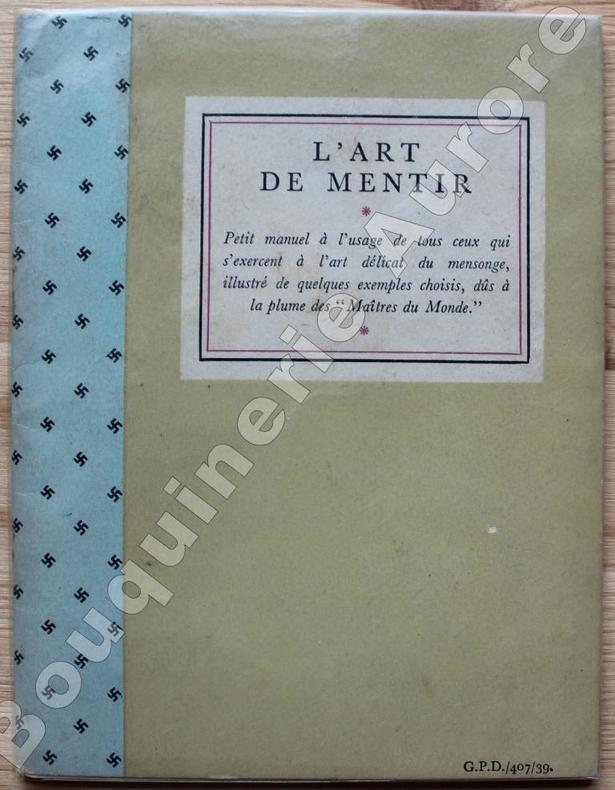
11926S.l., Publication du Bureau d'Information Anglo-Américain FP/109, s.d. (dernière date citée dans l'ouvrage : 1944), 1 plaquette in-12 (159 x 121) brochée, titre imprimé au plat supérieur, dos à l'imitation de papier vert collé avec semis de croix gammées, de 36 pp. Cahiers intérieurs dessolidarisés de la couverture sinon très bel exemplaire.
6511Ensemble constitué de 35 photographies, 14 diffusées par L'Eigentum der Reichsbahnzentrale für den Deutschen Reiseverkehr, 12 par l'Istituto Luce (L'Unione Cinematografica Educativa), 3 photo par Cor. [?] Ghergo, Macerata, et 6 sans aucune mention. 30 sont au format 18 x 24, 3 au format 13 x 18 et les six dernières de formats divers.
19354838Germany 1935 1935. A collection of 195 photographs and 5 reproductions of paintings and drawings by Adolf Hitler. The photographs are all from number 15 of the Sammelwerk "Cigarette cards" issued as Adolf Hitler propaganda in 1935. The larger photographs measure 170x120mm and the smaller one 120x80mm. They have been tipped into a notebook 208x150mm which was "borrowed" from the first owner's place of work as it has on the front cover the name of the company - Wehrle-Werk A.G. - which still exists. As the images are tipped in it means that the captions and information on the back can be read. A few of the photographs are torn at the edges but overall they are in very good condition. These photographs are not particularly uncommon but they are usually found loose and so it is rare to find then put together in this rather tidy organised way. On the inside cover is inscribed "J.L.Lindsell Schleswigland 1945". The name sounds English and perhaps it was seized by an invading soldier towards the end of the war. The original owner clearly lavished a lot of time on this album. There is a typed label on the front cover and then some of the early photographs have typed captions underneath them. An interesting collection. Germany 1935 unknown
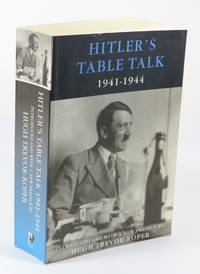
200027098London: Phoenix Press / Orion. Very Good- with No dust jacket as issued. 2000. Softcover. Light creasing to spine. Review Copy label on first page.; 2000 third edition of a title first published in 1953. This edition includes H. R. Trevor-Ropers essay from the1953 and a new 4 page Preface from 2000 by H. R. Trevor-Roper. xxxix 1 746 14 blank pages. Illustrated card covers. Page dimensions: 233 x 154mm. Text in English translated from German by Norman Cameron and R. H. Stevens. "In the relaxed atmosphere of his inner circle Hitler talked freely about his aims his early life and his plans for world conquest and a new German empire. The full text of Hitler's Table Talk as annotated and preserved by Bormann is presented here. This book is the most significant record of Hitler's mind and character in existence. Revealing for instance his thoughts on the English language which he though inferior to German as it 'lacks the ability to express thoughts that surpass the order of concrete things' to his hatred of idealism 'he found it quite normal that the bodies of his political prisoners should be burnt and their ashes used by his SS guards to manure their gardens'. A compelling and frequently repellent read. Hugh Trevor-Roper provides an Introduction on 'The Mind of Adolf Hitler' and a preface on developments since the book was first published in 1953." . Phoenix Press / Orion paperback
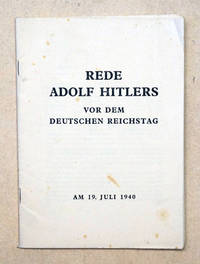
92847o. Angaben 1940. 8° 42 S. Geh. Umschlag u einige Bl. etwas stockfleckig fakzspurig- sonst gutes Exemplar. 010 o. Angaben, [1940] unknown
45201o. Angaben 1942. 8° 32 S. Geh. Tadellos. Mit beiliegender Karte «Überreicht von der Deutschen Gesandtschaft» in Bern. 010 o. Angaben, [1942] unknown