97 résultats
181523870paris 1815 une lettre (de 4 pages, une grande feuille pliée en deux) manuscrite à l'encre brune sur les 3 premières pages sur papier velin ligné filigrané, format : 20 centimètres de large x 25,5 centimètres de haut, adresse de la lettre au centre de la 4ème page à l'encre brune : à Mr Louis Admyraud à BEAULIEU par Mauzé (Charente-Inférieure), (lettre écrite par Mr Plessis), Paris LE 15 JUIN 1815,
1897135233Chicago: Way & Williams 1897. Hardcover. very good. 3rd Edition. ix 351pp. Octavo. Black cloth covered boards with yellow and red letter and decoration on front back and spine. Very slight bowing to boards with a small amount of professional restoration done to spine. B/W illustrated map frontis with many B/W illustrated plates through out. Clean pages. A few small spots in endpapers have been professionally repaired. Long outer and bottom edge of text block untrimmed. Top edge gilt. Inscribed by the author in black ink on the front free fly. A nice copy. very good Inscription reads "To W. B. Parker with the warmest regards of Stanley Waterloo Chicago July 14th 1898". This is Waterloo's most famous work. It was followed by a story by Jack London "Before Adam" which was so similar to Waterloo's novel that Waterloo accused London of plagiarism. London denied this explaining that his story was in the nature of a commentary on Waterloo's work. 1897 Way & Williams hardcover
1870128157Paris, Henri Plon 1870 In-8 23,5 x 15 cm. Reliure postérieure bradel toile rouge, dos lisse orné d’un petit fer doré, VII-442 pp., 5 cartes et plans repliés, table. Dos passé, rousseurs marginales. Exemplaire en bon état.
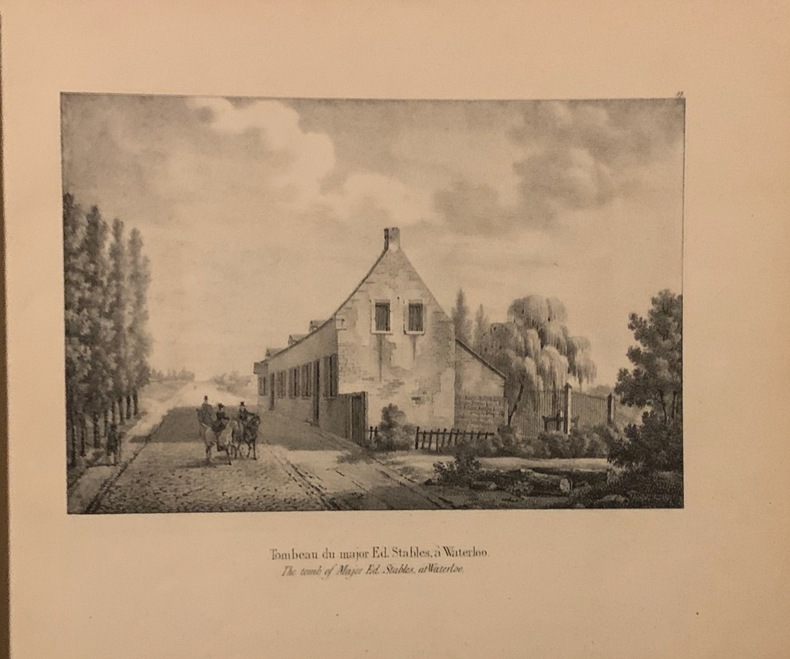
1840125251840 br. papier vert imprimé. (mouill. marginale à qq. planches) album in-8 oblong, 12 vues lithographiées et une grande carte, Bruxelles Gerard lithographe éditeur, (ca.1840)
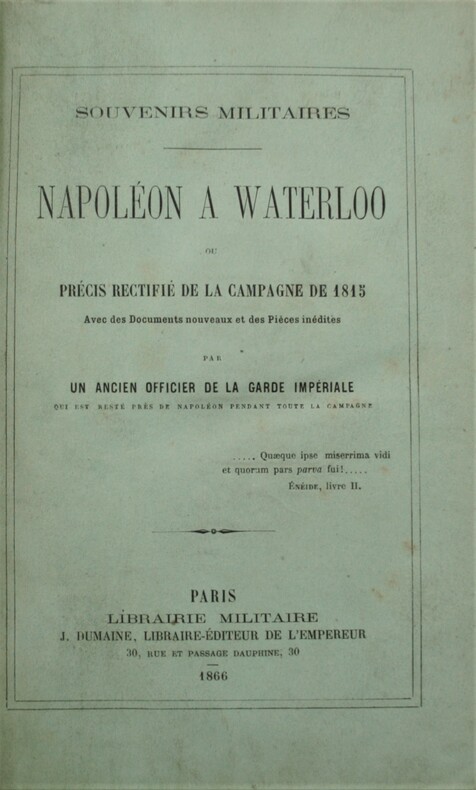
1866PHO-1032Paris,J. Dumaine, 1866, 8, [4]-LV-[1]-491-[1] p., demi-toile verte postérieur à coins, dos lisse avec pièce de titre et date en pied, tête dorée , couverture conservée , étiquette de la librairie Clavreuil et de la bibliothèque de Chambly. Bon exemplaire.
18151401021815. 17 x 22 cm.
1830119521830 A Bruxelles, à la Lithographie royale de Gobard, sans date, vers 1830; album in-4 oblong broché, couverture gris-vert imprimée en noir au 1er plat servant de titre, dos muet. 13 planches lithographiées en noir et une carte dépliante coloriée.
189578983Chicago: The Equitable Pub. Company. Good; Owner's Name Inside Spine Strip Slightly Torn. 1895. First Edition. Paperback. 204 pages . The Equitable Pub. Company paperback
181523872paris 1815 2 lettres (de 4 pages, une grande feuille pliée en deux) manuscrite à l'encre brune sur les 3 premières pages sur papier vergé ligné filigrané, format : 20 centimètres de large x 25,5 centimètres de haut, adresse de la lettre au centre de la 4ème page à l'encre brune : à Mr Louis Admyraud à BEAULIEU par Mauzé (Charente-Inférieure), (lettre écrite par Mr Plessis), Paris le 1er juillet 1815 pour la première lettre et le 4 Juillet 1815 pour la 2ème lettre,
1860140104Um 1860. In der Platte signiert und betitelt. Mit schmalem Rand um die volle Darstellung und der Schrift. 43,7 x 55,8 cm.
189709582THE STORY OF AB Way & Williams 1897 first edition a bright near fine copy of this one of the publisher's finest bindings this one executed by Will Bradley. A wonderful copy of this early man novel. Quite scarce in this condition. Way & Williams unknown
1840130746Bruxelles [Brüssel], chez Gerard, lithograph, éditeur, o.J. (um 1840). 1 w. Bl., 12 lithogr. Tafeln mit Ansichten von der Umgebung Waterloos und 1 gefalt. lithogr. Plan: Plan de la Bataille de Waterloo, 18 Juin 1815, dressé par le Général Baron de Jomini. Quer-4°, 22,5 x 30 cm, OBrosch. mit Deckeltitel.
1856G104307Paris/ Bruxelles, Charles Tanera/ Guyot et Stapleaux fils 1856-1857 Ouvrage complet en 3 tomes : xiii,486 + 492+ vii,437,[1] pp., illustré de 7 portraits hors-texte et 22 cartes/plans (dont 19 dépliantes) hors-texte (tout complet), Edition originale (1856-1857), 26cm., reliures uniformes cart. en bon état (plats marbrés, dos en cuir avec titre et nerfs dorés, deux petits trous de ver au bout du dos de t.3), feuilles de garde marbrées, peu de rousseurs occasionnelles, bon éat, peu commun, poids: 3.4kg., [Détails sur les illustrations: TOME I contenant 15 planches: portrait de Wellington, portrait de Napoleon Ier, portrait de Soult, 12 cartes/plans hors-texte (dont 9 dépliantes) numérotées de 1 à 12, TOME II contenant 11 planches: portrait de Masséna, potrait de Hill, et 9 cartes dépliantes (numérotées de 13 à 21), TOME III contenant 3 planches: portrait de Marmont, portrait de Blucher, grande carte dépliante d'Espagne et de Portugal (non numérotée)], G104307
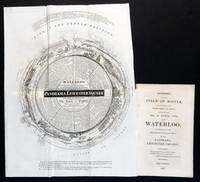
18163220567<p><em>8vo pp. 12 2; key consisting of a wood-engraved circular anamorphic-style image on folding plate measuring 40 × 31 cm; apart from a few light marks a clean fresh copy throughout; in recent marbled wraps.</em></p><p>At the foot of the key Barker 'respectfully informs the Public that in order to give a correct Representation of the Battle of Waterloo he went to Paris and from the Officers at Headquarters procured every possible Information on the Subject. A set of Eight Etchings from his original Sketches of the Field of Battle is published executed by Mr. J. Burnet; and may be had at the Panorama; price One guinea'.</p><p>At the end of the main text are proposals by Messrs Boydell & Co. for a 'national print' of the Battle of Waterloo by John Burnet after Atkinson and Devis.</p> [London, J. Adlard],
1819117441819 1 volume comprenant 4 tomes reliés ensemble (one volume composed of 4 books linked together), reliure plein veau havane brun marbré (binding full calfskin) in-octavo, dos long (spine without raised band) superbement décoré or (gilt decoration) - pièce de titre sur fond rouge avec filet or (red label of title with gilt line), coiffes légèrement défraîchies (head and tail of the spine lightly faded), coins émoussés (corners blunt), roulettes sur les coupes (fillets on the cuts) manque de dorure (blurred gilding), tranches peignées (painting edges) - petite tache d'encre sur la gouttière (small ink mark on the fore-edge), illustrations : planches repliées (folding plates), 107 - IV+87 - iv+112 - VIII+86 pages, 1815 à Paris J. G. Dentu Imprimeur-Libraire - 1815 à Paris Chez A. Tardieu Géographe-Graveur - Chez Madame Veuve Courcier Imprimeur-Libraire - Delaunay Libraire - Pillet Imprimeur-Libraire - Treuttel et Wurtz Libraires - Magimel Libraire - 1814 à Paris J. G. Dentu Imprimeur-Libraire - 1819 à Paris à la Librairie Constitutionnelle de Baudouin Frères,
1850TATLL(WA48Brussels: Gérard c1850. 1850. oblong 4to. folding partly hand-coloured lithographed plan & 12 lithographed plates. 19th century half vellum original printed front wr. bound in. some foxing throughout stain in lower margin of 5 plates. Brussels: Gérard, [c1850]. hardcover
185719030Paris, Jules Tardieu - Bruxelles, E. Guyot et Stapleaux Fils & Charles Tanera 1857 In-8 relié 27,5 cm. Bon état d’occasion.
182215861Paris, Béchet Ainé et chez le Capitaine Bacheville, 1822 ; in-8 ; demi-veau glacé grenat à petits coins, dos à quatre nerfs plats décorés encadrant le titre et deux caissons décorés "à la cathédrale", palette et roulettes décoratives dorées, fleurons et roulettes à froid, tranches marbrées (reliure de l'époque) ; XII, 432, (2) pp., frontispice lithographié par G. Engelmann montrant les frères Bacheville se séparant pour toujours en Turquie d'Europe.
188915949Paris, A. Le Vasseur, 1889 ; in-4 ; large demi-maroquin à coins bleu marine, dos à nerfs, titre doré, tête dorée sur témoins, couverture illustrée et dos conservés, non rogné (V. Champs) ; XVI, 518, (2) pp.
1816WATERLOO010935Printed by J. Russell Birmingham 1816. Second edition enlarged from the 1814 edition with the account of the Battle of Waterloo. Octavo. 476 pages. Five woodcut plates. Original boards with later leather spine retaining the endpapers.Covers rubbed. Discreet repairs to minor insect damage at bottom edges of first few leaves. Very good. Very scarce; no copies of this edition on Library Hub. Printed by J. Russell, Birmingham, hardcover
187023094Edinburgh and London: William Blackwood and Sons 1870. 2 volumes. RARE FIRST EDITION IN PRESENTATION BINDING. A UNIQUE COPY. A family presentation copy inscribed to George E. Mercer from I. Tod-Mercer and dated 1896. 8vo in a beautiful Zaehnsdorf signed binding dated 1896 thus no doubt custom made for the presentation to George E. Mercer. The binding is of full crushed scarlet morocco richly adorned in fine late-Victorian style. The boards feature a wide frame of gilt vines flowers and thistles which is further ruled in gilt then further surrounded by minutely detailed gilt rolling the upper boards also lettered “Mercer’s Waterloo†in fine gilt stamping the smooth rounded spines with gilt lettering with a gilt oval surrounded by more gilt vines and flowers which then grow both up and below to fully frame the spine panel board edges gilt ruled wide turn-ins gilt tooled in the same motif as the covers silk endpapers with powder blue moire pattern and further gilt tooling complete this beautiful presentation a.e.g. xii 369; viii 347 pp. An extraordinary set the condition remains outstanding. The text-block is essentially pristine the fine bindings show only the most minimal evidence of age. Truly and outstanding and unique copy. A SCARCE AND IMPORTANT FIRST EDITION SCARCE IN ANY STATE AND THIS AN EXTRAORDINARY COPY. Mercer's ‘Journal’ is an important source for historians of the Waterloo campaign as well as a detailed description of the landscape and people of Belgium and France in the early 19th century. It is one of the few accounts of the period written by an artillery officer. Mercer’s journals were kept throughout the campaign of 1815 but were not published until 1870 after his death. The work was compiled and written in its finished form some 30 years earlier from the original notes Mercer wrote contemporaneously with additions and verifications from correspondence and other sources. It covers the period from April 1815 to January 1816. Although he eventually rose to the rank of general his fame is as commander of the British G Troop Royal Horse Artillery in the thick of the fighting at the Battle of Waterloo. It is also notable for its lengthy descriptions of the countryside and its people.<br> In spite of his position with the British Army the work is usually found in 20th Century editions in French. Its historical value in the English-speaking nations was largely overlooked till its rediscovery with a Praeger edition in 1970. William Blackwood and Sons hardcover
18061547621806-45. They "succeeded to the utmost & overthrew every thing" - Uxbridge and the "heavies" at Waterloo In two vivid deeply detailed letters Lord Uxbridge - later Marquess of Anglesey and commander of allied cavalry at Waterloo - recounts the withdrawal from Quatre Bras and the battle of Waterloo. Written within six months of the engagement they are almost certainly among his earliest surviving narratives. Autograph correspondence from any senior Allied commander is exceptionally rare. Uxbridge 1768-1854 had been Wellington's brilliant and inspirational cavalry commander in the Peninsula. At Waterloo he reached his zenith at a critical juncture when Picton's infantry was under overwhelming pressure. He personally led the British heavy cavalry in a sweeping charge that routed vastly superior French numbers destroyed batteries and took prisoners and eagles though at severe cost in men and horses. Throughout the day he moved ceaselessly between units - losing eight or nine horses - until his right knee was shattered by grapeshot in the battle's final moments. His supposed exchange with Wellington - "By God sir I've lost my leg!" / "By God sir so you have!" - became the most famous anecdote of the field. John Morewood quoted both letters in Waterloo General 2016 and Edward Owen cited them in The Waterloo Papers 1997. Owen identifies the recipient as Colonel James Allan of the 57th Foot formerly Fitzroy Somerset's successor as Wellington's military secretary a veteran of the Cape 1795 Seringapatam 1799 and the Peninsular War. Written from Beaudesert Staffordshire in December 1815 and addressed to "My dear Sir" and earlier "My dear Colonel" the first letter 10 pages 9 December describes Uxbridge's management of the Allied withdrawal from Quatre Bras. After a quiet morning a substantial force of French cavalry and artillery appeared on the left of Quatre Bras advancing from the pursuit of the defeated Prussians. As the Anglo-allied light battalions withdrew Uxbridge organized the cavalry retreat over the Genappe. He gives a sharply observed account of the fighting there where French harassment became so severe that he ordered a spirited attack by the Hussars followed by a decisive charge of the Life Guards which checked the French advance. The second letter 9 pages 18 December covers the day of Waterloo. Uxbridge begins by admitting that to answer Allan fully "wd be writing a history of my own exploits" before setting out the celebrated charge of the heavy cavalry: their simultaneous assault under Sir William Ponsonby and Lord Edward Somerset the overthrow of infantry and cavalry the seizure of two eagles and some 2500 prisoners and the deep penetration into French squares. He notes their over-extension and heavy losses from French artillery then comments on the actions of Dörnberg Colquhoun Grant Arentsschildt Vandeleur who took over after Uxbridge fell and Hussey Vivian. He ends by directing Allan to his aide-de-camp Captain Thomas Wildman of the 7th Hussars at Stevens's Hotel Bond Street for further detail. The collection includes a note of 17 January 1816 from FitzRoy Somerset - Wellington's military secretary at Waterloo and later Lord Raglan - giving allied numbers engaged and remarking "I hope it will be as useful to you as you are welcome to it". Written shortly after Somerset himself lost an arm at Waterloo it is reproduced in Owen's Waterloo Papers. Three letters from Wellington to his former India colleague Sir Alexander Allan first baronet date from 1806 1814 and 1820 and address James Paull's actions against Richard Wellesley Allan's candidacy for an East India Company directorship which Wellington strongly endorsed and Wellington's request for Allan's influence at India House during the 1820 general election. Two revealing letters from Catherine Duchess of Wellington express her lifelong devotion to her husband ask to keep a portrait lent by Allan and describe her efforts to canvass support for Allan's directorship bid. A brief account of Allan notes his service in the Mysore Wars his published aquatints his parliamentary career and his later role as an East India Company director trusted by Richard Wellesley. The remaining correspondence includes Allan's three political letters of July 1813 advocating Lord Wellesley's alignment with Sidmouth Buckinghamshire and John Sullivan; an 1809 letter from the Marquis de Montalembert describing winter campaigning in the Peninsula; an 1816 note from Sir William Knighton apparently on Allan's mother's death; a friendly letter from "von Kuefstein" in Vienna referring to dispatches to Genoa and to Captain Cotton; a Stuttgart letter of February 1820 on affairs in Württemberg; and two mid-19th-century letters involving John Palfrey Burrell and William Boone seeking access to Waterloo documentation likely addressed to Major Edward Thomas Fitzgerald a wounded Waterloo veteran. Folio 300 x 245 mm contains an archive of 17 letters 55 pp. various sizes letters gummed direct to the leaf or with paper tape. Black half morocco-grain skiver album green pebble-grain cloth boards linen hinged mounting leaves;. Bookplate of Otto Orren Fisher 1881-1961 who after studying medicine at Johns Hopkins became an industrial surgeon for the Hudson Motor Company in Detroit establishing one of the first modern industrial first aid units there. Expected folds and minor toning to most letters generally very good the volume presenting handsomely. The Marquess of Anglesey One-Leg: The Life and Letters of Henry William Paget First Marquess of Anglesey 1768-1854 1991; David Howarth Waterloo: A Near Run Thing 1974. hardcover