Medlicott, W.N.MareMagnum

297 résultats
732 pages. Extensive index. "I was asked towards the end of 1941 to undertake the preparation of an official history based on the activities of the Ministrry of Economic Warfare." - from Preface. Hinges intact. Some library markings. Top corner of front free endpaper clipped. Above-average external wear. Binding intact. Book
72 pages. Features: "Canada is Strong", one-page ad shows Canadian farmer tilling land; One-page Singer sewing machine ad features Mrs. S. Armstrong of Montreal; News Digest discusses Yugolsavia's 'purge', Slav vs. Teuton again, Washington News, and an 'inside job' for Hitler; Frigidaire ad; We Blockade the Continent - article with fascinating map explains wartime trade complications; Slave Labour Under the Nazi Scourge - Fascinating photo-illustrated article written by Oskar Lutze, a former trade-union official of Berlin; The Slide on Short Mountain (short story); War and Canada's Golden Age - article explains how Canada will benefit from WWII; The Designing Wench (short story); The Running Man (short story); Inside the Gestapo - conclusion of fascinating article about a strange and fatal bunch of documents, with photos of Franz von Papen and Countess Vera Fugger; Bluff by Holloway Horn (short story); The Woes of Wives; Longines watch ad includes photo of Sir Hubert Wilkins; Gay Garden Gadgets; Half-page Canadian Pacific ad for the Banff Springs Hotel; Hollywood news and photos; Photo of Norma Shearer in Woodbury cold cream ad; Nostalgic 1941 Chevrolet centrefold ad encourages readers to be "Feature-Wise", with illustrations of dozens of features available in their cars; Men and Their Wardrobes; Treasure in Strange Places; With Love from the Luftwaffe - article on German bombing of Britain; Birth of a Lipstick; Maple Leaf Fund - article with photo of Victor T. Goggin, President of the Fund; Department of National War Services half-page ad says "Save Scrap Metals, Rags, Paper and Bones"; Norway Fights On - one year after the Germans invaded; Watch Your Step; The Small Room (short story); Swimming and Health; Serve Them, They Serve You - cooking article with recipes; Fashion illustrations; Classy War Savings Certificates ad inside back cover shows mother with kids on hilltop and her 'pledge to them - and to Canada'; and more. Unmarked with moderate wear. Binding sound. A quality copy of this extraordinary wartime issue. Book
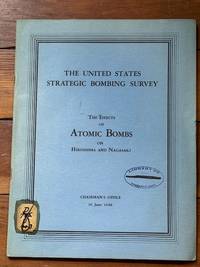
194677869Washington DC: U. S. Government Printing Office 1946. Presumed First Edition First printing thus. Hardcover. Good. Volume I xv 1 1-286 pages. Volume II 287-576 pages. 2 volumes. Illustrations including fold-outs. Maps. Tables. Index. Cover has wear and lettering has fading. Corners bumped. The United States Strategic Bombing Survey was a written report created by a board of experts assembled to produce an impartial assessment of the effects of Anglo-American strategic bombing of Nazi Germany during the European theater of World War II. After publishing its report the Survey members then turned their attention to the efforts against Imperial Japan during the Pacific War including a separate section on the recent use of the atomic bombs. In total the reports contained 208 volumes for Europe and another 108 for the Pacific comprising thousands of pages. The reports' called strategic bombing "decisive". This is designated OPNAV-P-03-100. It includes lists of Interrogations arranged numerically and by subject matter. It has an index of major battles operations and Japanese officials It includes in volume II Japanese notes of battles and brief biographies of Interrogated Japanese Officials. The interrogations were conducted in Tokyo during the final months of 1945. The purpose of the interrogations was to gain evidence for an assessment of the role of airpower in the war with Japan. Permission was obtained from General MacArthur to retain a nucleus of experienced officers at the Naval War College at Hiyoshi. In addition to being interrogated on their particular specialties and experiences these officers performed research at the direction of the Naval Analysis Division and together with the Japanese Naval Liaison Officer gave useful assistance in identifying and procuring other officers for interrogation. U. S. Government Printing Office hardcover
Pages 425-452. Features: Wonderful one-page colour Guinness ad entitled "Guinness for Strength" shows farmer pushing huge wheelbarrow loaded with veggies - presumably in the spirit of promoting wartime home food growing; Map of great R.A.F. bombing raid on Lubeck; Five graphic air photos of R.A.F.-inflicted bomb damage to Rostock; Five photos of bomb damage in Valetta, Malta; Three photos of terrible smoke and fire on Rangoon's waterfront as the great oil refineries of Syriam and the Burma Company's oil warehouse are destroyed before the Japanese arrive; Two photos of Nazi reprisal bomb damage in Bath; Photo of six R.A.F. men returning from the spectacular raid on the Diesel works at Augsburg, including Squadron-Leader J.D. Nettleton, V.C.; Photo of British-Italian prisoner exchange at Alexandria; Photo of smiling returing British POWs at Cairo Station; Five photos of the King and Queen visiting Canadian Armoured Division "Sansom's Rough Riders" (named after Major-General E. Sansom; Commandos and Their Raids - article with two photos of Major Lord Lovat and his landing force before their successful reconnaissance raid near Boulogne; Two photos of Scottish Command forces practicing marine landing excercises jumping off barges, some with scaling ladders; Two pages of illustrations of battle drill under the most rigorous and realistic conditions; Nine photos on two-page spread illustrated the H.M.S. "Illustrious" at sea again, carrying American fighter planes - Grumman Martlets; photo of 'Dodge'ems' used to move aircraft on aircraft carrier deck; Magnificent centerfold aerial photo of R.A.F. bomb damage inflicted upoin the city of Lubeck - a mile of roofless houses, great blasted areas and ruined war factories; Six photos illustrate novel U.S. method of rapidly fabricating a 173' submarine chaser at the Defoe Yards at Bay City, Michigan; Two great photos compare the instrument panels of an Me. 109 fighter and a Halifax bomger; Two-pages of illustrations wonderfully explain the mechanism behind aircraft dials - "Marvels of Lilliputian engineering for delicate modern aero instruments; Photos of eleven personalities of the week include General H. Giraud, Rifleman John Beeley, V.C., Sec.-Lieut. C. Ward Gunn, V.C.,Lieut.-Colonel C.G.W. Anderson, V.C., Lieut.-Colonel A.E. Cumming, V.C., and Princess Elizabeth in Girl Guide uniform; Drake's Globe-Cup sold at Christies (large photo); Classy half-page Rover car ad; Nice colour Johnnie Walker ad on back cover shows shipyard outside window; more nice vintage ads. This copy was never stapled. Clean and unmarked with moderate wear. A quality copy of this vintage issue. Book
Pages 625-644. Features: Cover Photo Portrait of 60-ton M-1 Tank Crushing Heavy Truck; Photo of FDR presenting Congressional Medal of Honour to Brig.-Gen. James Doolittle, while Mrs. Doolittle looks on; Six great photos from Chunking show how the resilient populace is coping with the war; The Campaign in Burma (article); "Japan's Successes in Burma - by Infiltration and Light Equipment" - six photos; The Kharkov Battlefield - six action pictures from the Russian Front; Two-page illustration of Red Air Force using "Stormoviks" and other fast-flying tank-busters attacking panzer divisions; Amazing four-page centerfold presents illustrations of ships of the British Navy from Alfred the Great to the Present Day; Eight photos of bomb damage in Bath, Norwich and York after German "Baedeker" raids; Photos of personalities of the week include Commander R.E.D. Ryder, V.C., Able Seaman W.A. Savage, V.C., Lieut.-Commander S.H. Beattie, V.C., Marshal and Madame Chiang Kai-Shek with General Joseph Stilwell, and scapegoated Nazi Food Minister Walther Darre; Two-pages with three maps illustrate "Tokyo - the most inflammable capital in the world, vulnerable war industries in a bamboo-built city"; Six-photos of high-speed reconstruction in Chungking in response to Japanese bombing; Ten photos present 'Novel points in warship design and camouflage'; Two pages with 18 illustrations present 'Defence and Attack as used in Army Training To-Day, Demonstrated in the seventeenth century (reproductions courtesy of Bernard Quaritch); Six photos of Paris under the Nazi heel after two years of occupation; The Soong Sisters - two photos of them in bombed Chungking; Nice photo ad for Ferodo with photo of five men dragging large mine onto beach; more vintage ads. Minor nibble from foot of spine. This copy was never stapled. Clean and unmarked with moderate wear. A quality copy of this vintage issue. Book
96 pages. Features: Nice color ad for Schenley Whiskey inside front cover features pot-bellied stove being carried into nice home; Large illustrated ad for J&L Steel with military theme; Nice one-page photo ad for Boeing with photo taken beneath wing of huge plane; Brief obituaries for Horace D. Taft, Christopher G. Sinsabaugh, Joseph J. Sinnott and Henry A. Shute; Nice illustrated Bell and Howell ad shows soldier using their movie camera; Nice military-themed one-page photo-ad for Beech Aircraft shows their AT-11 bombing trainers; Nice military-themed ad for Chevrolet Trucks; Photo of FDR and Churchill at Casablanca; Photo of FDR inspecting US troops near Cacablanca; Lots of war coverage; MacArthur's plan to drive back the Japs; U-boat menace still tops agenda; Nazis lament manpower pinch - photo of Goring and Goebbels in full dress; Ernst Franz Sedgwick Hanfstaengl - photo and brief write-up of this former friend of Hitler; Interesting one-page two-color ad for Milwaukee Machine Tools features boy studying behind stacks of enemy books such as Mein Kampf; Fantastic one-page color ad for Seagram's V.O. Whiskey features illustration of a very early version of Skype as men in Chicago and London do business face-to-face; Wholesale horsemeat market in Newark, NJ; The Significance of 'Unconditional Surrender'; Photo of Marine Generals Holcomb, Mitchell and Vandegrift on Guadalcanal; Fantastic one-page color-illustrated Continental Can ad shows downed fliers adrift pouring SOS colored fluid into ocean; Fantastic one-page color-illustrated ad for Aircraft Accessories Corporation; Nice two-page color ad for Old Grand-Dad, Old Taylor, Old Crow, Mount Vernon and Old Overhold whiskeys; Classy Dowmetal Magnesium ad shows planes flying from aircraft carrier; Great photo from the Pullman-Standard plant in Hammond IN shows Merry Leone and Robert Patterson Jr. demonstrating the "Bomb Boogie" dance; Classy one-page ad for Scott Fine Radio Receivers; Nice one-page photo ad for Bethlehem Steel displays their safety practices; Photo of Coach Shaughnessy of Pitt; Nice one-page ad for movie "Yankee Doodle Dandy"; Jack Benny entertains troops; Nice Gem razor blad ad features illustration of clean-cut sailor; Color-photo ad for Canadian Club whiskey inside back cover features Jungle Zoo, winter hq of Clyde Beatty's Circus at Fort Lauderdale; Fantastic back cover color ad for Chesterfield cigarettes features US Marine Raiders in jungle. Center two pages loose but present. Average wear and soiling. Unmarked. A worthy vintage copy. Book
Features: Title page photo of General Foch; Two pages of photos document a Moslem pilgrimage to Moses' tomb for the first time since the Allied occupation; The Fighting Poets of France (article); Germany's U-Boat "Cruisers"; Two half-page aerial photos of bombing in Palestine and Cologne; Photos of Sir Horace Darwin, Sir Cyril S. Cobb, Sir W.E. Hume-Williams, Sir William Orpen, The Earl of Plymouth, and Sir Howard Handley Spicer; Six photos of the Italian contingent in France; Twelve photos over two pages illustrate the training and work of canine despatch-carriers; Home-Grown Rations (article); Photo of the shelled houses of Villers-Bretonneux; Four photos illustrated the rescue work of the Sea-Patrol Service; The United States Militant - at the front and at Home - six photos, including two at Cantigny; Two half-page photos of Americans capturing Germans at Cantigny with flame-throwers; Graphic centrefold illustration depicts a bayonet charge by the French army on the Western Front; On Bombing in General - article by C.G. Grey; One-page of British officer on horseback being pursued by enemy plane; Roll of Honour - photos of 18 officers including Lt.-Col. C.K. James, D.S.O. and BAR; Several nice car ads; and more. 36 pages including several pages of marvelous vintage ads, most of which are illustrated. Unmarked with average wear. Binding intact. A sound copy of this excellent WWI-era issue. Magazine
Features: Two-page illustration describes the British share in "the magnificent Italian Victory" - artillery counter-preparation near Asiago; Article by G.K. Chesterton on Mr. Robert Dell who was expelled from France; Photos of Sir Gilbert F. Garnsey, K.B.E., General Guillaumat, Governor of France, and General Diaz of Italy; One-page illustration of British Aeroplane over the recaptured Montello - an air view of the Piave; Potsdam's Disappointment (article); The War Game of the Japanese (article); "The Beef Trip"; Two half-page photos show the raised Piave River; Article about air bombing and bombers; One-page illustration of the Montello, "Entirely retaken with elan from the Austrians by the Italians"; From Virgin Soil to Complete Shipyard in 165 Days - Three pages with fourteen photos marvelously document the rapid construction of the world's largest shipyard on Hog Island, in the Delaware River, just outside Philadelphia; Centrefold illustration of "The Beef Trip", the British Navy's way of securing the nation's food supply; The Conservation of Wild Life in War-Time (article); Detailed diagrams and text describe the Madsen Gun; Full-page illustration compares Britain's liberal rations compared to those of Germany; Roll of Honour - photos of 18 officers including Lieut.-Col. Bertrand D. Gibson; Photos of U.S. Army nurses under gas-mask instruction at Cape Kearney, California; Illustrated ad for the "Kooksjoie" Range warns of imminent coal restrictions; Nice car ads; Nice one-page illustrated ad for Beecham's Pills features reflection of lady in mirror; Back cover ad for Edwards' Harlene hair treatments; and more. 36 pages including several pages of marvelous vintage ads, most of which are illustrated. Unmarked with average wear. Binding intact. A sound copy of this excellent WWI-era issue. Magazine
50 pages. Great cover photo of Dusty Anderson; Features: My Toughest Fight - Boxer Joe Louis tells what it means to have a black skin and be champion of the world - major article with many great photos; No Wonder They Dropped Dead - modern marksmen say the old bad men of the saloon wars could only hit opponents at point-blank range; He Keeps Broadway On Its Feet - Dr. Horace Worrell takes care of the feet of dancers; We Almost Lost the Air War - photo-illustrated revelations of the handicaps our airmen had to overcome to make daylight bombing a success; New Yorkers are Nuts; Insurgent Senator - Republican Wayne Morse confounds his Oregon constituents by voting like a New Deal Democrat; How to Live with a Pregnant Woman; Colorado's "Atom-Proof" Canyon - great photo-illustrated article on Dr. M. Doreal and the Brotherhood of the White Temple, 35 miles southwest of Denver; If You Have To Get a Job - tips to help you get a job; Basketball's Babe Ruth - Super photo-illustrated article on Joe Fulks of Philadelphia; The Readjustment of Winnie - Vic Herman's cartoon cutie is now a civilian; Gertie (Gertrude Niesen) - Broadway's most fascinating fixture; London's Crime Wave - Eugene Messina is finally caught/London Police still refuse to carry gund; Sightless Swordsmen - photo-illustrated article on blind fencers; There's No Business Like Band Business - to become a singer with a name band you need a voice and a low-cut evening gown; Mr. Lewis' Miners; Movie of the Month - "Green Dolphin Street"; The Great Gibberisher - Tobacco Auctioneer Edgar A. Boone of Lexington, Kentucky; Frauleins as Cops - Germany trains female law-enforcement corps; Meet the Winner of Salute's Beauty Contest - 19-year-old Pat Geraghty of Houston, Texas; Coal miner cartoons by Tom Flannery; Speaking of Parties - photos from events organized by Atwater Kent and Earl Carroll; Gorgeous photo of Margaret Stohn, with zanies Vic Herman and Leisentritt in background; Handsome color back cover ad for Hammonton Park men's clothing; and more. Moderate wear. Unmarked. Light age-toning to contents. A nice vintage copy. Book
194635986San Francisco CA: U.S. Strategic Bombing Surv 1946. First Edition. First Printing. good. 71 & 251 2-vol. set spiralbound in binders binders somewhat worn and soiled. First binder contains the primary report 71 pages; second binder contains the appendix 251 pages. Essential resource for understanding bomb damage and recovery needs. U.S. Strategic Bombing Surv unknown
Sm. 8vo., First Edition; original yellow boards printed in black, blue cloth back with printed paper label, a very good, bright, clean copy in unclipped pictorial dustwrapper, the latter wanting about one sixth of rear panel. WALTER CRONKITE'S COPY WITH HIS HOLOGRAPH SIGNATURE ON FRONT FREE ENDPAPER. The signature reads 'Walter Cronkite, United Press' in blue ink. There is an additional signature in pencil on front paste-down. Cronkite joined United Press in 1937 after a year as sports announcer (only his second job in broadcasting) at KCMO in Kansas City, Missouri. This switch from national to international status was effectively the birth of an American legend, for Cronkite went on to become one of the best-known and most respected American reporters of WWII. After covering the North African theatre he turned his attention to Europe, where he was one of eight journalists selected by USAAF to accompany B-17 bombing raids over Germany. During MARKET GARDEN he landed by glider with 101st Airborne and subsequently covered the Battle of the Bulge in the Ardennes. His extended post-war career as anchorman with CBS created an American icon. A SPLENDID ASSOCIATION COPY FROM THE EARLIEST PERIOD OF HIS BROADCASTING CAREER. THE WORK ITSELF IS SCARCE; THIS COPY IS VERY POSSIBLY UNIQUE.
MA05F-00385U. S. Government Printing Office. Collectible - Good. Washington D.C.: U. S. Government Printing Office 1946. Sm 4to. v9pp. Illustrations maps. Good book. strategic bombing Japan aircraft engines Inquire if you need further information. U. S. Government Printing Office unknown
19465646Washington DC: Government Printing Office GPO 1946. First Edition. Paperback. Very good. Very Good in original blue paper wraps with neat cancelled library stamps. vi 46 pp ii 2 fold-outs. Government Printing Office [GPO] paperback
MA05F-00384U. S. Government Printing Office. Collectible - Good. Washington D.C.: U. S. Government Printing Office 1947. Sm 4to. v67pp. Photos folded illustrations maps. Good book. strategic bombing Japan aircraft Inquire if you need further information. U. S. Government Printing Office unknown
MA05F-00383U. S. Government Printing Office. Collectible - Good. Washington D.C.: U. S. Government Printing Office 1946. Sm 4to. viii158pp. Folded illustrations maps. Good book. strategic bombing Japan electric utilities Inquire if you need further information. U. S. Government Printing Office unknown
Contents: Nash car color ad inside front cover; Commercial Solvents Corp. ad with great Iwo Jima beach landing photo; Chrysler *Fluid Drive* color ad; Only Stalin of first trio is left but Attlee carries on where Churchill left off; Very graphic 6-photo sequence of a 'Jap' being burned to death by a flame-thrower; British Labor landslide stirs the world - the winning issue was not Churchill but new homes and jobs for Britons; Photo of a masked 'squeeler' identifying Gestapo agents hiding in the ranks of the Wehrmacht in Norway; Nice color ad for Martin aircraft; Photo of Dutch people tearing up trolly blocks for desperately needed fuel; Trial of Marshal Petain in France; Amazing coverage of B-25 Mitchell bomber striking the Empire State building - the diagram looks just like what the world witnessed September 11th, 2001; The Big Playhouse - Michigan's cushy prison at Jackson; Japan on the ropes - strikes at Kure naval base cover harbor with blazing ships - B-29s blast forewarned cities; Photo of American troops from Europe massing in Manila; *Super* color centerfold featuring a 1942 yellow Buick convertible; photo of leaflet dropped on Jap cities prior to bombing (with article); Photo of Canadian General Crerar who's army has been dissolved; Kaiser lines up Graham-Paige in march toward reconversion - with Frazer's selling genius added to Western Steel facilities, Combine's one need is capital; Photo of experimental helicopter, the PV-3, in flight; Nice color Imperial whiskey ad; Surplus problem - whether to scrap the Office of War Information's (OWI) profitable magazines abroad; Swiss family air force - survival training; Motorola radio ad; Great color Union Pacific Railroad ad with emphasis upon beautiful Washington state; Unmarked with average wear. Address label atop front cover. A sound copy. Book
Second edition. 215 pages. Glossary. Profusely illustrated with superb color photos. Printed upon glossy stock. "A riveting account of the authors' experiences flying in support of the F-111 bombing raid of Libya in April 1986, roaring across the African desert faster than a Magnum .357 bullet, outrunning enemy missiles, and returning to England after buring 30,000 gallons of fuel in six exhausting hours of mission-filled tension. Masterfully intertwines cockpit action with the fascinating revelations of that unique cadre of civilians who designed, built and maintained the jet. Includes over 120 color photos published for the first time from the author's collection." - dust jacket. Clean and unmarked with moderate wear. Binding sound. Dust jacket now preserved in glossy new archival-grade Brodart. A quality copy of this amazing work. Book
159 pages. Index. Author served as Principal Assistant Secretary of the British Air Ministry. Describes how it was the RAF which commenced bombing of German civilian targets before Germany reluctantly began similar attacks in Britain during the second world war. Unmarked. Moderate wear. Binding tight. A sound copy of this important work. Enser p.27, Select Bibliography of Revisionist Books p.21. Book
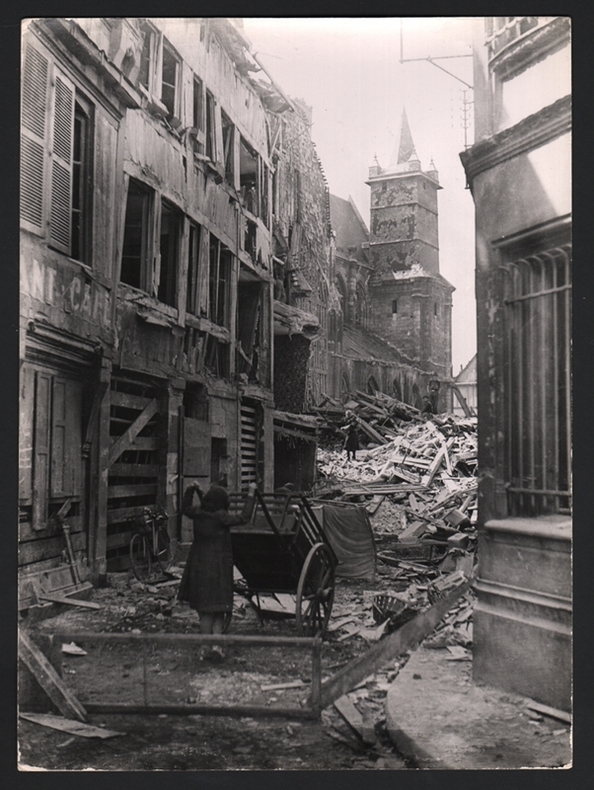
803Photos de Presse (le Petit Normand ) et de particuliers.
5332HIROSHIMA. An archive of 22 original aerial photographs of Japan at the end of World War II; seven of them are marked “Hiroshima†on the verso. The photos were likely taken by a bomber crewman who flew over Hiroshima and other parts of Japan. The near-total flattening of Hiroshima is obvious in some images and there are images of horrific destruction perhaps from firebombing. Each image measures 4 ½†x 4â€. Some has some minor scuffing and loss to the image and all have mounting remnants to the verso from where they were once attached to an album. unknown books
194587713Washington DC: United States Strategic Bombing Survey 1945. Presumed First Edition First printing There is a place for a Copy No. but no number is present. Wraps. Fair. 8 33 29 pages of Exhibits. Photographs Figures. Tables. Front cover torn at two of the three staples and restrengthened with tape. RARE Surviving Copy. This report was written primarily for the use of the U. s. Strategic Bombing Survey in the preparation of further reports of a more comprehensive nature. Any conclusions or opinions expressed in this report must be considered as limited to the specific target covered and as subject to further interpretation in the light of further studies conducted by the Survey. It can be said without exaggeration that no matter what terms are used to explain the extent of damage caused by this one bomb any statement regarding the havoc created at HIROSHIMA would be an understatement. Yet should one attempt to do it justice through a complete and documented description the reader could still not conceive of the magnitude of the destruction both in human lives and property because of the lack of a parallel with which to make a comparison. Many of the personnel concerned with civilian defense were killed and much of the equipment destroyed. Nearly all records were burned. Because of the historical importance of the incident a brief study was made to determine the potentiality of a full survey of civilian defense organizations and operations before and at the time of the atomic bombing. The absence of informative sources made this impracticable and this report is therefore not a thorough analytical study. It consists of impressions based upon inspection and of such information as could be gleaned from officials citizens and records which were still available. The United States Strategic Bombing Survey USSBS was a written report created by a board of experts assembled to produce an impartial assessment of the effects of the Anglo-American strategic bombing of Nazi Germany during the European theater of World War II. After publishing its report the Survey members then turned their attention to the war efforts against Imperial Japan during the Pacific War including a separate section on the recent use of the atomic bomb Little Boy. In total the reports contained 208 volumes for Europe and another 108 for the Pacific comprising thousands of pages. The reports' conclusions were generally favorable about the contributions of Allied strategic bombing towards victory calling it "decisive". A majority of the Survey's members were civilians in positions of influence on the various committees of the survey. Only one position of some influence was given to a prominent military officer USAAF General Orvil A. Anderson and that only in an advisory capacity. Anderson was the only one on the survey board who knew about procedures of strategic bombing as Jimmy Doolittle's former deputy commander of operations. While the Board was not associated with any branch of the military it was established by General Hap Arnold along with Carl A. Spaatz. This report addresses the story of the attack civilian defense activities air-raid warnings fire services emergency medical services shelters evacuation informing and training of the general public and financing. Comments were provided. Exhibits includes a map of Hiroshima showing ground zero a chart showing the Chain of Command of civilian defense organizations the Table of Organization and equipment of the auxiliary police and fire units and several sub-divisions transcripts of interviews with S. Nimura Hiroshima city engineer; Y. Yamano acting chief of the city fire department and S. Yabuki chief of the East Hiroshima fire department. The report ends with a Glossary of Japanese characters with English terms. United States Strategic Bombing Survey paperback
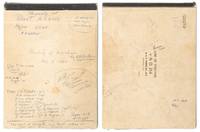
194578271945. United States War Department-issued "Line of Position" notebook 203 x 270 mm. 27 pp. of autograph text in ink and pencil including covers. The account of Captain Robert A. Lewis 1917 - 1983 occupies the first 8 pp. followed by his 14-pp. history of the 509th Composite Group written by him 1 p. additional notes and a 2-pp. song about the 509th. Lewis also filled out both covers of the record book with notes: on the front cover the title "Bombing of Hiroshima" a list of the crew aboard the Enola Gay and several other notes; and on the back cover a sketch of the Hiroshima mushroom cloud as observed by Lewis from the plane dated and initialed "09:30 8/6/45 R.A.L.". The pages were later numbered and the pencil emendations visible across all eight pages were made by New York Times editor William L. Laurence 1888 - 1977.<br /> <br /> Drab paper boards top bound in black cloth. Some light soiling to boards and a bit of wear to cloth binding. One leaf p. 7 of the account was torn from later in the notebook and taped in by Lewis at its current position see below for a timeline of Lewis' account. In Very Good condition overall.<br /> <br /> This in-flight record documents the bombing of Hiroshima from the perspective of Captain Robert A. Lewis co-pilot of the Enola Gay on the journey to drop the "Little Boy" bomb. Over the course of the twelve-hour flight from Tinian Northern Mariana Islands to Hiroshima and back again Lewis recorded both what he saw - including a sketch of the mushroom cloud over the city - and what he felt - apprehension confusion shock awe - as he and his crew entered history. Though Lewis' record is one of two firsthand accounts of the Hiroshima bombing written aboard the Enola Gay it is the only account that documents the personal observations and emotional response of one of the crewmembers. The other documentation of the flight the navigator's log of Theodore "Dutch" Van Kirk is a purely technical account recording data like timing and flight position but not including the historically valuable and emotionally impactful commentary present here. Lewis' record then provides an unequalled firsthand account of the flight of the Enola Gay.<br /> <br /> Lewis wrote this account at the request of New York Times science editor William "Atomic Bill" Laurence who had been given permission to document the mission aboard the Enola Gay. At the last minute however Laurence was barred from the flight he was ultimately allowed aboard the plane that bombed Nagasaki. Laurence asked Lewis to record the Enola Gay mission in his stead and Lewis took this notebook aboard to document his experiences: "A great deal of the notes were written in almost complete darkness. Half way through I ran out of ink" Lewis wrote.<br /> <br /> On August 6 1945 the Enola Gay left Tinian at 2:25am. The plane passed over Iwo Jima within three hours and by 7:30 Lewis wrote: "we are loaded the bomb is now alive and it's a funny feeling knowing its right in back of you. Knock wood. We started out climb to 30000ft.well folks its not long now." At 8:15 the Enola Gay dropped the bomb. The "Little Boy" fell for forty-four seconds before detonating over a Hiroshima hospital instantly killing tens of thousands of people and destroying nearly four square miles of the city. <br /> <br /> Of the moment the bomb struck Hiroshima Lewis wrote: "We then turned the ship so we could observe results and there in front of our eyes was with out a doubt the greatest explosion man has ever witnessed. The city was 9/10 covered with smoke.and a column which.reached 30000 ft." In his later reflections likely recorded within a few days he added: "I am certain the entire crew felt this experience was more than anyone human had ever thought possible. It just seems impossible to comprehend. Just how many did we kill I honestly have the feeling of groping for words to explain this.My God what have we done. If I live a hundred years I'll never quite get these few minutes out of my mind." <br /> <br /> We now know that by the end of 1945 the bomb had killed between 90000 and 160000 people mostly Japanese civilians; another 60000 to 80000 people were killed after the "Fat Man" bomb was dropped on Nagasaki. The bombings also marked the end of World War II and concluded a period of hostilities between the United States and Japan sparked by the Japanese strike on Pearl Harbor four years earlier. Lewis' record then not only documents the flight of the Enola Gay but the last gasp of World War II a years-long conflict that claimed millions of lives and culminated in the largest single moment of violence in human history with tens of thousands killed in an instant. It also marks the advent of the Atomic Age a period of unprecedented technological advancement and political upheaval; and the first moments of the Cold War. Lewis' record is a unique and invaluable document of a technological political and social turning point not just one of the defining moments of the twentieth century but one of the most consequential moments in human history.<br /> <br /> A note on the timeline of this account: Lewis' writing in this notebook spans several days dated from August 6 to August 10 but probably extending a few days beyond. His account of the Enola Gay flight dated August 6 comprises the pages later numbered 1-6 and 8. The sketch of the mushroom cloud over Hiroshima on the back cover is also dated August 6. Lewis' notes on the inside front cover are dated August 8. His "History of the 509th" is dated August 10 but appears in multiple colors of ink and may have been written over the course of multiple days. Lewis' reflection on the bombing taped-in and numbered as p. 7 is on a leaf torn from later in the notebook just after his "History of the 509th" but before the song that concludes his writing. It seems that Lewis reflected on his experience of the bombing some days later - possibly at Laurence's prompting - once news of the devastation in Hiroshima had reached the world and Lewis was beginning to grasp the historical significance of his own actions. It was in those reflections that Lewis arrived at one of the most affecting portions of his account: "My God what have we done. If I live a hundred years I'll never quite get these few minutes out of my mind." Laurence's autograph emendations appear throughout the eight pages of Lewis' account though not in the rest of the writing indicating that Laurence had prepared the account for publication in the weeks following the bombing. However it seems that Laurence's article on the Hiroshima bombing using Lewis' account was never published likely because Laurence had the opportunity to publish his personal account of the Nagasaki bombing in the Times on September 9 1945.<br /> <br /> Lewis' record has appeared at auction four times: it made $37000 at Sotheby's in 1971; $85000 at Sotheby's in 1978; $391000 at Christie's in 2002 as part of the Malcolm Forbes sale; and $543000 at Heritage in 2022. Theodore Van Kirk's navigator's log made $358500 at Heritage in 2007 and $372500 at Sotheby's in 2016.<br /> <br /> Transcript: Below is a full transcript of Lewis' in-flight account pp. 1-6 8 plus p. 7 which was likely written a few days after the flight added at the end. Single brackets indicate corrections seemingly made by Robert A. Lewis. Double brackets indicate emendations seemingly made by William Laurence. Text in curly brackets is added for the sake of description and is not present in the original record.<br /> <br /> <br /> FRONT COVER INTERIOR:<br /> <br /> Aug 8 - 1945<br /> <br /> This Log WAS A LAST MINUTE REQUEST OF WILLIAM LAURENCE - SCIENCE EDITOR N.Y. TIMES. HE HAD EXPECTED been ordered TO BE ABOARD BUT THIS REQUEST WAS NOT PERMITTED arrived in Tinian too late. HE ASKED me TO KEEP SOME NOTES OF THE MISSION. A GREAT DEAL OF THE NOTES WERE DONE WRITTEN IN ALMOST COMPLETE DARKNESS HALF WAY THROUGH I RAN OUT OF INK. - <br /> Capt Robert A. Lewis<br /> <br /> Pencil corrections were made by Mr. William Laurence <br /> Attested as true William Laurence<br /> <br /> <br /> IN-FLIGHT ACCOUNT BEGINS HERE. <br /> <br /> PAGE 1.<br /> <br /> Little Boy Mission #1 <br /> First Atomic Bomb.<br /> August 6th 1945<br /> Target Hit <br /> <br /> By Capt Robert Lewis<br /> Pilot aboard Ship.<br /> <br /> Briefing at 1200 2400<br /> Eating at 0030<br /> <br /> Dear Mom Dad -<br /> <br /> We started engines at 0227 and taxied out to take off at 0235 then we got off the ground at exactly 0245 Everything went well on take off nothing unusual was encountered at the last minute before takeoff over cruising altitude had been change from 9000 to 4000 pressure altitude which means possibly a crossed out rougher try. At 0313 we encountered a little trouble with our interphone system as we were receiving both interphone V.H.F. transmission on the interphone jack box position. At 0320 items 1-11 were completed satis. by Capt Parsons. At the same time we lost contact with Ed Dahl.<br /> <br /> 1<br /> <br /> PAGE 2:<br /> <br /> From time to time we are encountering small cumulus build ups which when you can't see make you wonder how big things are. Conversations between Capt Van Kirk Sgt Stiborik the nav. radio operator respectively are continuing for they are shooting bearings on the Northern Marianas and working radar wind runs. The fact is at 45 minutes out of our base everyone is at work. Col Tibbets has been hard at work with the usual tasks that are belong to the pilot of a B-29. At the end of one hr. 0345 everything is going along smoothly. The engineer Sgt Duzenbury and blaster gunner Sgt Shumard are busy panelling generators. And at the same time P.F.C. Nelson the R.O. is double checking the nav's Loran set which is a necessary part of the nav equipment.<br /> <br /> 2<br /> <br /> <br /> PAGE 3:<br /> <br /> At 0420 the Dutch Van Kirk sent me up an ETA. For Iwo Jima of 0552 so we'll just check on him. The colonel better known as the "Old Bull" shows signs of a tough day with all he had to do to help get this mission off he is deserving of a few winks. So I'll have a bite to eat and look after georgethe auto Pilot and crew. At 0430 we started to see signs of a late moon in the east. I think everyone will feel relieved when we have left our bomb with the Japs and get halfway home. Or better still all the way home. Well at first crossed out signs of dawn came to us at 0500 and that also is a nice sight after having spent the previous30 minutes dodging large cumulus clouds. It looks at this time 0515 that we will have clear sailing for a long spell. Our bombardier Maj Tom Ferebee has been very quiet and methinks he is mentally back in mid-west part of the U.S.<br /> <br /> 3<br /> <br /> <br /> PAGE 4:<br /> <br /> By 0552 it crossed out is real light outside and we crossed out are only a few miles from Iwo Jima. We are finishing a second climb which is to 9000 ft. Will stay here until we are about 1 hr away<br /> from the Empire. out of ink After leaving Iwo we crossed out began to pick up some low stratus and before very long we were flying on top of an undercast. At 0710 the undercast began to break up just a little bit. Outside of a high this cirrus and the low stuff its a very beautiful day. We are now about 2 hrs from Bombs away which reminds me that at 0715 the colonial had to go. You know where. At 0730 we are loaded the bomb is now alive and it's a funny feeling knowing its right in back of you. Knock wood. We started our climb to 30000 FT at 0740 Well folks its not long now. <br /> <br /> 4<br /> <br /> <br /> PAGE 5:<br /> <br /> At 18500 ft I set the C-1 Auto Pilot up for the last time until after Bombs away. I checked with crew at 2000 ft and all stations report in satisfactory. We reached our altitude and a 08:30 Nelson received a report that our primary is the best target so with everything going well so far we will make a bomb run a Hiroshima. Right now we are 15 miles from the Empire and everyone has a big hopeful look on his face. Landfall was 8:50 crossed out and it won't be long now. As we are approaching our IP crossed out Farebee Van Kirk Stiborik are coming into their run while the Col I are standing by and are giving the boys what they want. There will be a short intermission while we bomb our target.<br /> <br /> <br /> 5<br /> <br /> <br /> PAGE 6:<br /> <br /> A brief blow by blow description of the bomb run.<br /> <br /> We turned off our IP and had about a 4 minutes run on a perfectly open target Tom Ferebee synchronized on his briefed A.P. and let go from for the next minute no one knew what would happen to expect the bombardier and the right seat jockey or Pilot both forgot to put on their dark glasses and therefore witnessed the flash crossed out which was terrific. Then in about 15 seconds after the flash there were two very distinct bumps or slaps on the ship Then that was all the physical effects we felt. We then turned the ship so we could observe the results and there in front of our eyes was with out a doubt !!! the greatest explosion man has ever witnessed. The city was 9/10 covered with smoke crossed out of a boiling texture which seemed to indicate buildings blowing up and a huge column of white cloud which in less that 3 crossed out reached 30000 ft and then went to at least 50000 ft<br /> <br /> 6<br /> <br /> <br /> PAGE 8:<br /> <br /> We Bob Caron our tail gunner got excellent pictures and everyone on the shop is actually crossed out dumbstruck even though we had expected something fierce it was the actual sight that we saw that caused the crew to feel that they were a part of Buck Rogers 25 century warriors. This essay on the bombing results could go on indefinitely by telling how huge it grew even after an hour and half. 400 miles from the target then the billow of smoke reached 5500 ft and contained very weird colors. But perhaps the Japs that are left can save me the trouble and let us know. We then headed hope on 150° and our ship sure had a happy but puzzled crew Mission home was as briefed weather the same everyone got a few cat naps<br /> <br /> Love to all "Bud" R.A. Lewis<br /> STOP<br /> <br /> 8<br /> <br /> <br /> PAGE 7 LIKELY WRITTEN A FEW DAYS LATER:<br /> <br /> I am certain the entire crew felt this experience was crossed out more than anyone human had ever thought possible. It just seems impossible to comprehend. Just how many Japs did we kill I honestly have the feeling that of groping for words to explain this or I might say My God what have we done. If I live a hundred years I'll never quite get these few minutes out my mind. Looking at Capt Parsons why he is as confounded as the rest and he was suppose to have known everything and expected this much to happen. After a few last looks I honestly feel the Japs may give up before we land at Tinian. They certainly don't care to have us drop any more bombs like that of atomic energy like this.<br /> <br /> 7. unknown